Start with Mercury and travel outward. Each stop below shows the planet in a real spacecraft or crew photo, its known moons, and the Dark Cosmic Insights guides that go deeper. Every guide separates what is observed and measured from what is modelled and what is still open, the approach we explain in How We Know.
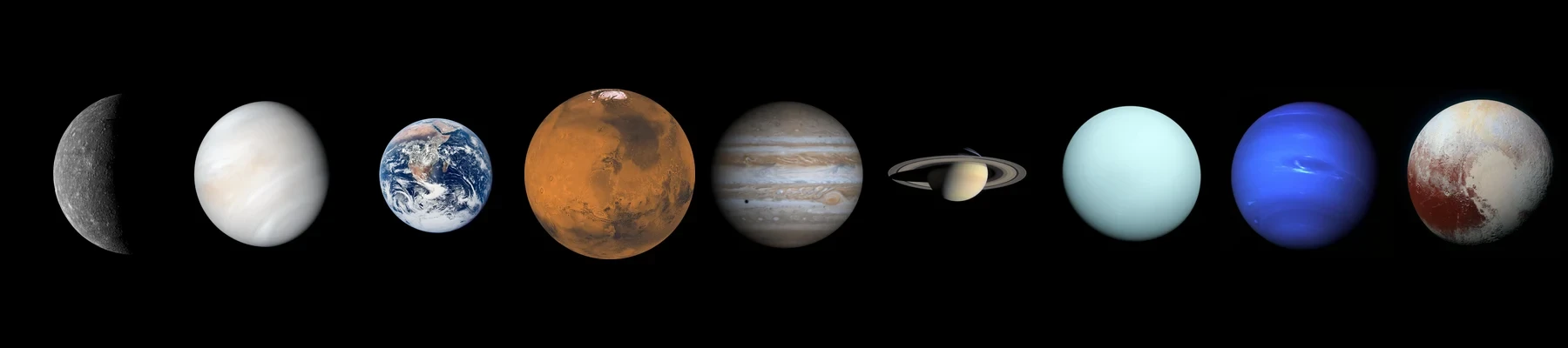
Jump to: At a glance · Compare the planets · Mercury · Venus · Earth · Mars · Jupiter · Saturn · Uranus · Neptune · Beyond Neptune
Moon counts are as of November 2026, from NASA JPL, and change as new moons are confirmed. See our dated moon table for the full dated comparison.
The Planets at a Glance
Tap a planet to jump to its section. Diameter is twice the mean radius; year length is the time for one orbit of the Sun (sidereal period). Moons are known moons.
| Planet | Diameter | Year length | Moons |
|---|---|---|---|
| Mercury | 4,879 km 3,032 mi | 88 days | 0 |
| Venus | 12,104 km 7,521 mi | 225 days | 0 |
| Earth | 12,742 km 7,918 mi | 1 year | 1 |
| Mars | 6,779 km 4,212 mi | 1.9 years | 2 |
| Jupiter | 139,822 km 86,881 mi | 11.9 years | 115 |
| Saturn | 116,464 km 72,367 mi | 29.4 years | 293 |
| Uranus | 50,724 km 31,518 mi | 84.0 years | 29 |
| Neptune | 49,244 km 30,599 mi | 164.8 years | 16 |
| Pluto* | 2,377 km 1,477 mi | 247.9 years | 5 |
*Pluto is a dwarf planet, included for comparison. Diameters and orbital periods: DCI arithmetic from NASA JPL planetary physical parameters (km to miles at 1.609344). Moon counts as of November 2026, from NASA JPL.
Compare the Planets
The table above covers size, year length and moons. These tables go further: mass, gravity, distance, day length, temperature and tilt, all from one source, the NASA Planetary Fact Sheet. Giant planets have no solid surface, so NASA gives their gravity at the 1-bar level, about Earth’s sea-level air pressure, and their temperatures at that same 1-bar level (NASA planetary fact sheet notes).
Jump to: Mass and Gravity · Distance · Day · Temperature · Tilt · Moons and Rings · Records
Mass, Density and Gravity
| Planet | Mass (Earth = 1) | Density |
|---|---|---|
| Mercury | 0.055 | 5,429 kg/m³ |
| Venus | 0.82 | 5,243 kg/m³ |
| Earth | 1.00 | 5,514 kg/m³ |
| Mars | 0.11 | 3,934 kg/m³ |
| Jupiter | 317.9 | 1,326 kg/m³ |
| Saturn | 95.1 | 687 kg/m³ |
| Uranus | 14.5 | 1,270 kg/m³ |
| Neptune | 17.1 | 1,638 kg/m³ |
| Planet | Equatorial gravity* | Times Earth |
|---|---|---|
| Mercury | 3.7 m/s² | 0.38 |
| Venus | 8.9 m/s² | 0.91 |
| Earth | 9.8 m/s² | 1.00 |
| Mars | 3.7 m/s² | 0.38 |
| Jupiter | 23.1 m/s² | 2.36 |
| Saturn | 9.0 m/s² | 0.92 |
| Uranus | 8.7 m/s² | 0.89 |
| Neptune | 11.0 m/s² | 1.12 |
Earth is the densest planet. Saturn is the least dense, at 687 kg/m³, less than water’s 1,000. *Gravity here is NASA’s effective equatorial gravity, at the surface or, for the giants, the 1-bar level, including the outward effect of the planet’s spin (NASA planetary fact sheet notes). Jupiter’s is about 2.4 times Earth’s. Saturn’s, Uranus’s and Neptune’s are close to Earth’s despite their huge masses, because gravity at the cloud tops depends on mass divided by the square of the radius. Those planets are so wide that their measuring point sits far from their centers, and their fast spin slightly reduces the pull at the equator.
Distance From the Sun
| Planet | Average distance | In AU |
|---|---|---|
| Mercury | 57.9 million km | 0.39 |
| Venus | 108.2 million km | 0.72 |
| Earth | 149.6 million km | 1.00 |
| Mars | 228.0 million km | 1.52 |
| Jupiter | 778.5 million km | 5.20 |
| Saturn | 1,432.0 million km | 9.57 |
| Uranus | 2,867.0 million km | 19.16 |
| Neptune | 4,515.0 million km | 30.18 |
Neptune is about 30 times farther from the Sun than Earth. For travel times and light-delay, see How Far Is Jupiter? and How Far Is Saturn?.
Length of a Day
| Planet | Solar day | Spin (vs. stars) |
|---|---|---|
| Mercury | 4,222.6 h | 1,407.6 h |
| Venus | 2,802.0 h | 5,832.5 h (backward) |
| Earth | 24.0 h | 23.9 h |
| Mars | 24.7 h | 24.6 h |
| Jupiter | 9.9 h | 9.9 h |
| Saturn | 10.7 h | 10.7 h |
| Uranus | 17.2 h | 17.2 h (backward) |
| Neptune | 16.1 h | 16.1 h |
There are two kinds of “day.” The solar day is the time from one noon to the next; the spin (sidereal rotation) is one turn measured against the stars (NASA fact sheet notes). On most planets they’re nearly equal. On slow spinners they aren’t: Mercury spins once every 1,407.6 hours, but its solar day lasts 4,222.6 hours, about 176 Earth days, the longest solar day of any planet (DCI calculation). Venus and Uranus spin backward compared with the other planets. Jupiter has the shortest day, about 9.9 hours.
Temperature
| Planet | Mean temperature | Note |
|---|---|---|
| Mercury | 167 °C | No air to hold heat |
| Venus | 464 °C | Hottest planet |
| Earth | 15 °C | |
| Mars | -65 °C | |
| Jupiter | -110 °C | At the 1-bar level |
| Saturn | -140 °C | At the 1-bar level |
| Uranus | -195 °C | At the 1-bar level |
| Neptune | -200 °C | 1-bar level; coldest mean |
Venus, not Mercury, is the hottest planet, because its thick carbon dioxide atmosphere traps heat. The full story is in What Is the Hottest Planet?. For the giant planets, the mean temperature describes the 1-bar level of the atmosphere; deep inside, they’re far hotter. See How Cold Is Saturn?.
Axial Tilt
| Planet | Tilt | What it means |
|---|---|---|
| Mercury | 0.034° | Almost upright |
| Venus | 177.4° | Retrograde rotation |
| Earth | 23.4° | Gives us seasons |
| Mars | 25.2° | Seasons like Earth’s |
| Jupiter | 3.1° | Almost upright |
| Saturn | 26.7° | Seasons, and ring tilt that changes |
| Uranus | 97.8° | Rolls on its side |
| Neptune | 28.3° | Seasons like Earth’s |
Moons and Rings
| Planet | Known moons | Rings? |
|---|---|---|
| Mercury | 0 | No |
| Venus | 0 | No |
| Earth | 1 | No |
| Mars | 2 | No |
| Jupiter | 115 | Yes |
| Saturn | 293 | Yes |
| Uranus | 29 | Yes |
| Neptune | 16 | Yes |
Moon counts change as new moons are confirmed, which is why we date them. NASA’s fact sheet, last updated in March 2025, still lists older totals. For the race between the two leaders, see Which Planet Has the Most Moons?. Every giant planet has rings; Saturn’s are just the easiest to see. Compare Saturn’s rings with Jupiter’s.
Planet Records
- Biggest: Jupiter, about 11 Earths wide.
- Smallest: Mercury, a little over a third of Earth’s width.
- Hottest: Venus, about 464 °C on average.
- Coldest (mean): Neptune, about −200 °C.
- Densest: Earth, 5,514 kg/m³.
- Least dense: Saturn, 687 kg/m³.
- Shortest day: Jupiter, about 9.9 hours.
- Longest solar day: Mercury, about 176 Earth days.
- Fastest orbit: Mercury, 47.4 km/s.
- Longest year: Neptune, about 165 Earth years.
- Most tilted: Venus at 177.4°, which means it rotates retrograde; Uranus at 97.8° rolls on its side.
- Most known moons: Saturn, 293 (JPL, November 2026).
What about Pluto? It was reclassified as a dwarf planet in 2006, so it isn’t in these tables. Here’s why: Why Is Pluto Not a Planet?.
Comparison tables: every physical value is from the NASA Planetary Fact Sheet (last updated March 18, 2025); ratios, AU and records are DCI calculations. NASA’s planetary table uses tropical orbital periods, so its Neptune year (59,800 days) runs slightly shorter than the familiar sidereal figure of about 165 Earth years. Moon counts: JPL discovery table, November 2026. The diameters in the At a Glance table above use NASA JPL mean radii, so they run slightly smaller than NASA’s equatorial diameters.
Mercury

The closest planet to the Sun and the smallest of the eight.
Known moons: 0
Venus

Wrapped in a thick carbon-dioxide atmosphere, Venus is the hottest planet, even though Mercury is closer to the Sun.
Known moons: 0
Earth

Our home planet, and the only world known to host life.
Known moons: 1, the Moon
Mars

A cold desert world explored by orbiters and rovers.
Known moons: 2, Phobos and Deimos
Jupiter
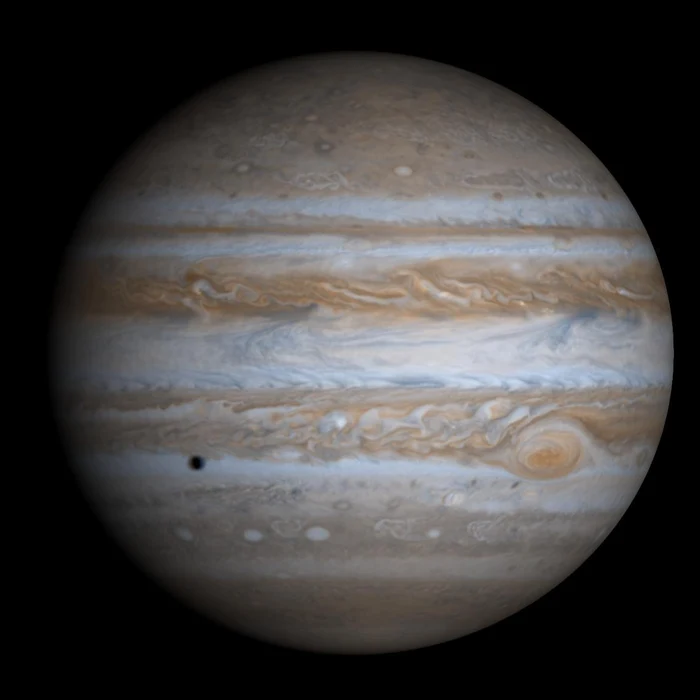
The largest planet, a gas giant with storms bigger than Earth.
Known moons: 115
Saturn

The ringed giant, with the largest known family of moons.
Known moons: 293
Uranus

An ice giant that spins tipped on its side.
Known moons: 29
Neptune

The farthest planet from the Sun, a blue-green ice giant only slightly bluer than Uranus.
Known moons: 16, led by Triton
Beyond Neptune: Pluto and the Dwarf Planets
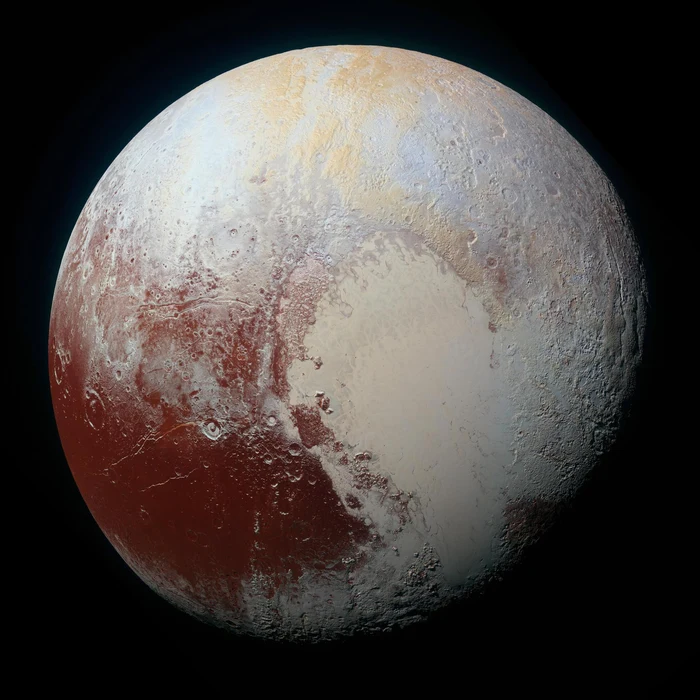
Past Neptune lies the Kuiper Belt, home to Pluto, which was reclassified as a dwarf planet in 2006.
Pluto’s known moons: 5
Questions That Span the Whole Solar System
- Which Planet Has the Most Moons?
- What Is the Hottest Planet?
- How Cold Is Space?
- Are Space Photos Real?
- How We Know: Follow the Evidence
- What Is a Nebula? (the kind of cloud our solar system formed from)
Want the stars and galaxies beyond? Visit Stars & Galaxies, or browse every Dark Cosmic Insights article.