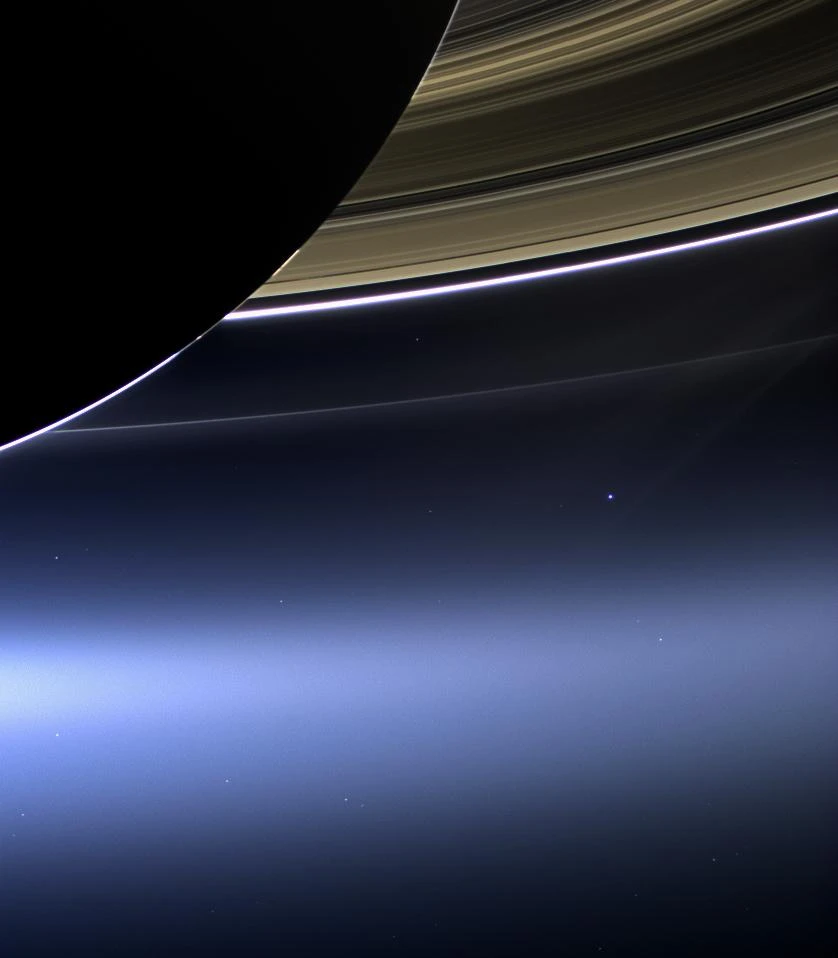
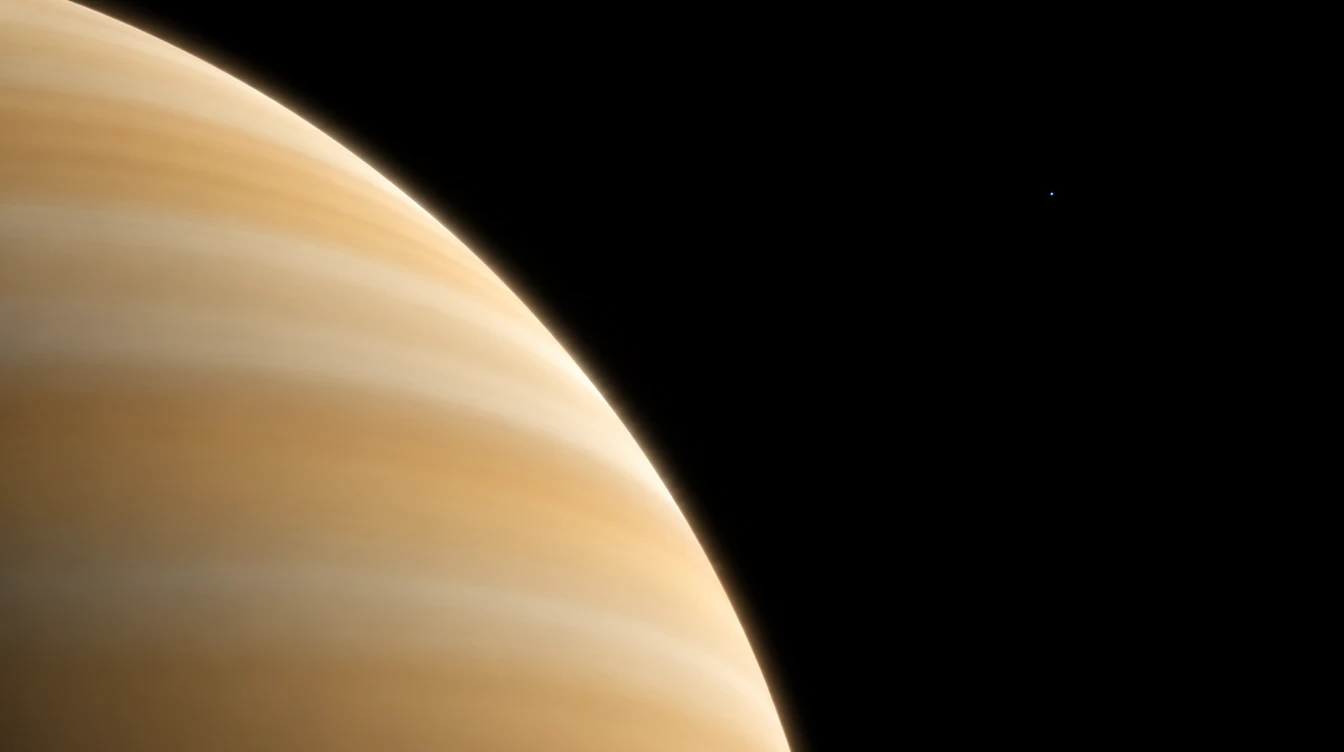
On July 19, 2013, NASA’s Cassini spacecraft turned around at Saturn and took a picture of home. Earth showed up as a tiny blue dot below Saturn’s rings. In that image, NASA says, Earth was “898 million miles (1.44 billion kilometers) away” (NASA, PIA17171).
That’s how far Saturn is. Far enough that our whole planet shrinks to a single point of light. Far enough that sunlight takes more than an hour to arrive. And far enough that the fastest spacecraft humans have sent there still needed more than three years to make the trip.
Observed, measured, modelled, open. Saturn’s distances and orbit are measured to high precision. Spacecraft travel times are observed facts of past missions. The light-travel times and comparisons in this article are DCI calculations from NASA’s measured distances, and they’re labelled that way.
Quick Answer: How Far Is Saturn?
Saturn is about 1.4 billion km (886 million miles) from the Sun on average, or 9.5 astronomical units (AU), meaning 9.5 times Earth’s distance from the Sun (NASA). From Earth, Saturn ranges from about 1.21 billion km at its closest to 1.66 billion km at its farthest (NASA NSSDC). Sunlight takes about 80 minutes to reach Saturn (NASA). Getting a spacecraft there has taken anywhere from about 3 years 2 months (Voyager 1’s flyby) to nearly 7 years (Cassini, which had to slow down to orbit). And because Saturn is so far out, one Saturn year lasts about 29.4 Earth years.
What this article can and cannot establish. It can give you Saturn’s measured distances from the Sun and Earth, the real travel times of past missions, and the length of a Saturn year. It cannot give one fixed Earth-to-Saturn distance, because both planets are always moving, and the gap between them changes every day.
Table of Contents
The DCI Evidence Map: Saturn’s Distance
| Question | What we know | Status | Key source |
|---|---|---|---|
| How far from the Sun, on average? | About 1.4 billion km (9.5 AU) | Measured | NASA |
| Closest and farthest from the Sun? | About 1.358 and 1.507 billion km | Measured | NASA NSSDC |
| How far from Earth? | About 1.21 to 1.66 billion km | Measured | NASA NSSDC |
| How long does sunlight take? | About 80 minutes | Measured | NASA |
| How long does light from Earth take? | About 67 to 92 minutes | DCI calculation | NASA NSSDC |
| How long to fly there? | About 3 to 7 years, depending on the mission | Observed | NASA, Voyager 1 |
| How long is a Saturn year? | About 29.4 Earth years | Measured | NASA |
Status key: Observed = seen directly. Measured = a number with a stated uncertainty or a direct measurement. Modelled = inferred from measurements through a physical model, dependent on assumptions. Open = unresolved; the evidence is incomplete or points different ways. Not supported = the evidence goes against the claim, or there is none for it. DCI calculation = our arithmetic from the linked measurement.
Cite this framework: “DCI Evidence Map: Saturn’s Distance,” Dark Cosmic Insights, November 2026, darkcosmicinsights.com/how-far-is-saturn/.
How Far Is Saturn From the Sun?
The average distance
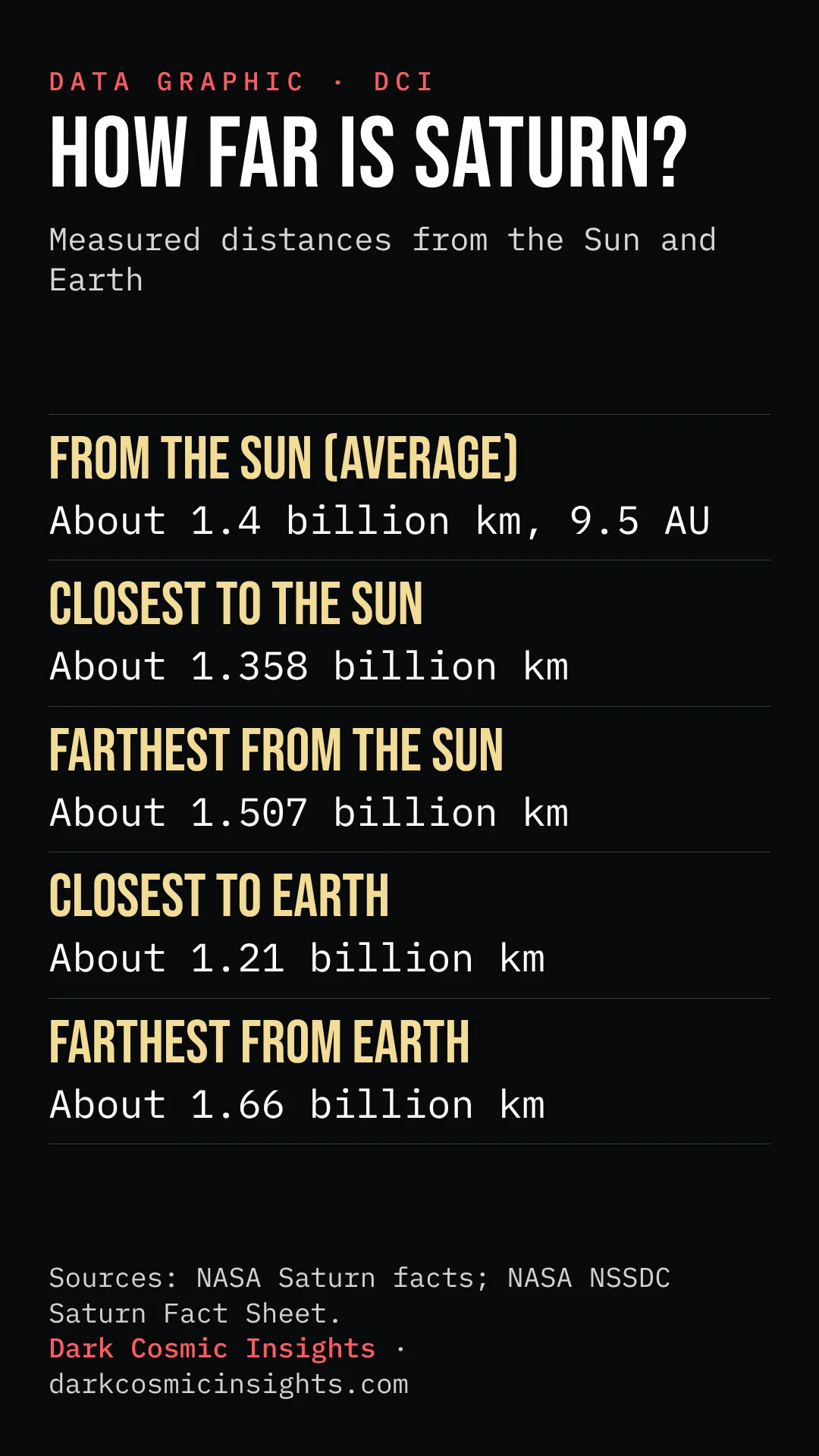
NASA says that “from an average distance of 886 million miles (1.4 billion kilometers), Saturn is 9.5 astronomical units away from the Sun” (NASA). One astronomical unit is the average distance from Earth to the Sun, about 150 million km. So Saturn sits roughly nine and a half times farther out than we do.
Closest and farthest
Saturn’s orbit is slightly stretched, with an eccentricity of 0.052 (NASA NSSDC). NASA’s fact sheet gives:
- Perihelion (closest to the Sun): about 1,357.6 million km, roughly 9.1 AU.
- Aphelion (farthest from the Sun): about 1,506.5 million km, roughly 10.1 AU.
- Semimajor axis (average): about 1,432.0 million km, about 9.57 times Earth’s.
That’s a swing of about 149 million km between Saturn’s nearest and farthest points from the Sun, almost exactly the distance between Earth and the Sun (DCI calculation from NASA NSSDC).
What that means for sunlight
NASA says “it takes sunlight 80 minutes to travel from the Sun to Saturn” (NASA). Light also spreads out as it travels. At about 9.57 times Earth’s distance, Saturn gets roughly 1 percent of the sunlight Earth does, per square meter (DCI calculation using the inverse-square law). That’s one reason Saturn is so cold: NASA’s fact sheet lists a temperature of about −139 °C at the 1-bar level (NASA NSSDC).
How Far Is Saturn From Earth?
It changes every day
Earth and Saturn both orbit the Sun, at very different speeds. Earth goes around in a year. Saturn takes nearly 30. So the distance between us keeps changing. NASA’s fact sheet gives Saturn’s distance from Earth as a minimum of 1,205.5 million km and a maximum of 1,658.6 million km (NASA NSSDC). In miles, that’s roughly 749 million to 1.03 billion miles (DCI conversion).
Closest at opposition
Saturn is nearest to us around opposition, when Earth passes between the Sun and Saturn. NASA’s fact sheet gives a mean distance at opposition of 1,277.13 million km. Oppositions come about every 378 days, which is Saturn’s synodic period (NASA NSSDC). In 2026, NASA said Saturn reached opposition on October 4 (NASA). The next one falls on October 18, 2027 (EarthSky), about two weeks later in the calendar, because Earth has to travel a little farther each year to catch up with Saturn.
Farthest when the Sun is in the way
Saturn is farthest from Earth around conjunction, when it’s on the far side of the Sun from us. Then it’s lost in the Sun’s glare and you can’t see it at all.
How long does a signal take?
At those distances, a radio signal or a beam of light from Earth takes about 67 minutes to reach Saturn at the closest and about 92 minutes at the farthest (DCI calculation from NASA’s distances and the speed of light). That’s why spacecraft at Saturn can’t be steered in real time. Every command is a message that arrives more than an hour later.
How Far Is That, Really?
Big numbers stop meaning much after a while. Here’s Saturn’s distance from Earth at its closest, about 1.2 billion km, in more familiar terms (DCI calculations from NASA NSSDC):
- Driving nonstop at 100 km/h: about 1,380 years.
- Flying nonstop at a jet’s 900 km/h: about 150 years.
- Earth–Moon trips: about 3,100 Earth-to-Moon distances lined up end to end (using an average Earth–Moon distance of about 384,400 km).
And from the other direction: when Cassini photographed Earth from Saturn in 2013, our planet was just a dot. NASA notes that in that image, “the illuminated areas of neither Earth nor the Moon are resolved” (NASA, PIA17171). It was only the third time Earth had ever been imaged from the outer solar system.
How Long Does It Take to Get to Saturn?
Four missions, four travel times
Only a handful of spacecraft have visited Saturn. Their travel times, from NASA’s mission pages:
- Pioneer 11: launched April 6, 1973, flew past Saturn on September 1, 1979. About 6 years 5 months. NASA calls it the “first spacecraft to fly by Saturn” (NASA, Pioneer 11).
- Voyager 1: launched September 5, 1977, closest approach November 12, 1980. About 3 years 2 months (NASA, Voyager 1).
- Voyager 2: launched August 20, 1977, closest approach August 26, 1981. About 4 years (NASA, Voyager 2).
- Cassini: launched October 15, 1997, entered orbit July 1, 2004. NASA calls it a “seven-year journey” (NASA, 2019).

Why was Cassini so much slower?
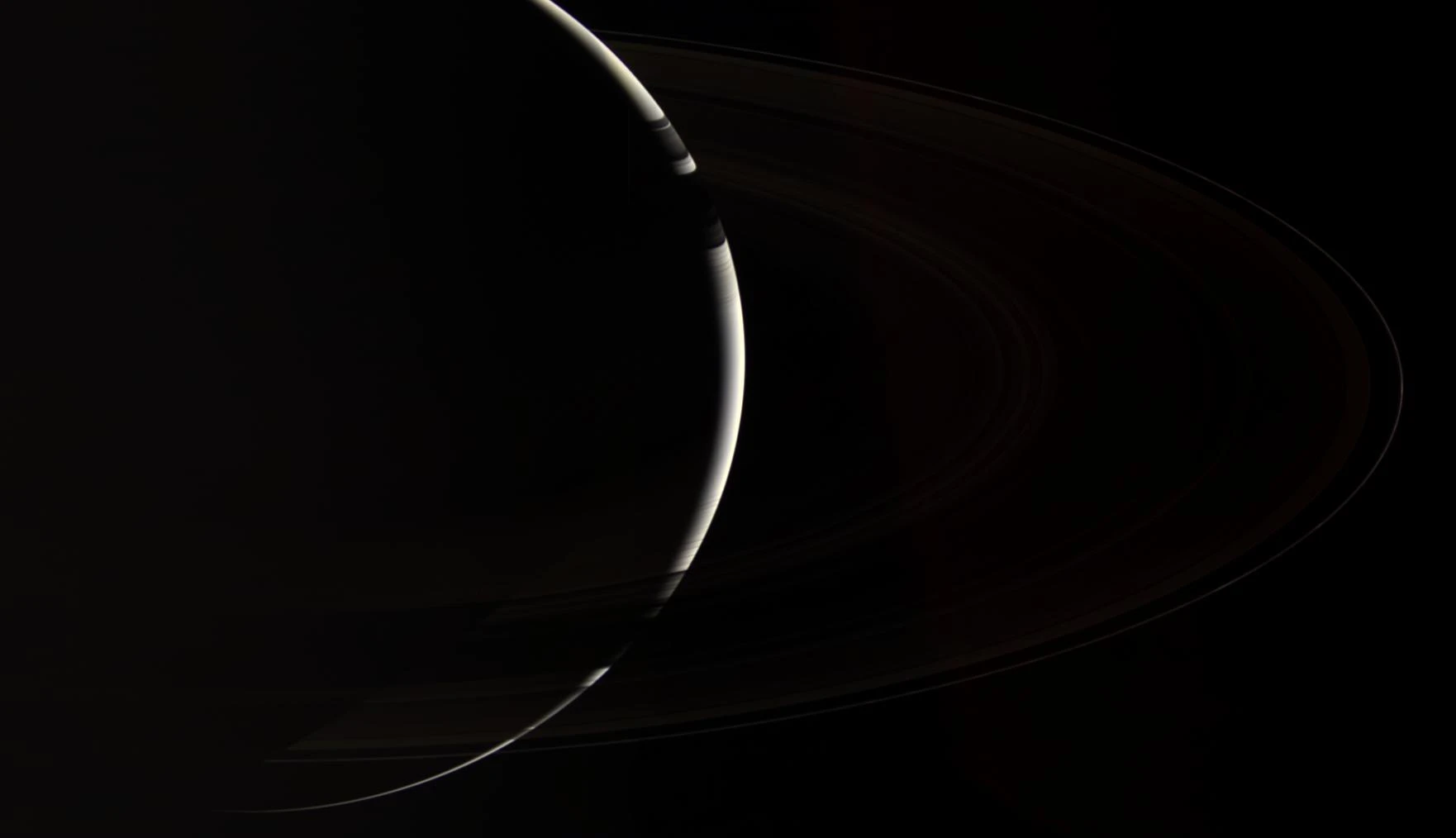
There are two big reasons. First, the Voyagers and Pioneer 11 were flybys. They raced past Saturn and kept going. Cassini had to stay, and to be captured into orbit it fired its main engine for 96 minutes to slow down (NASA, 2019). Arriving slowly enough to be caught takes a different, gentler path.
Second, Cassini was a big, heavy spacecraft, so it borrowed speed from planets along the way. NASA says it used “several gravity assist maneuvers,” including two flybys of Venus, one of Earth and one of Jupiter, before reaching Saturn.
The next mission
NASA’s Dragonfly rotorcraft is headed for Saturn’s largest moon, Titan. NASA has confirmed “a launch date of July 2028” and says the mission is “targeted to arrive at Titan in 2034” (NASA, 2024). We cover the mission in Titan and Dragonfly.
How Long Is a Year on Saturn?
About 29.4 Earth years
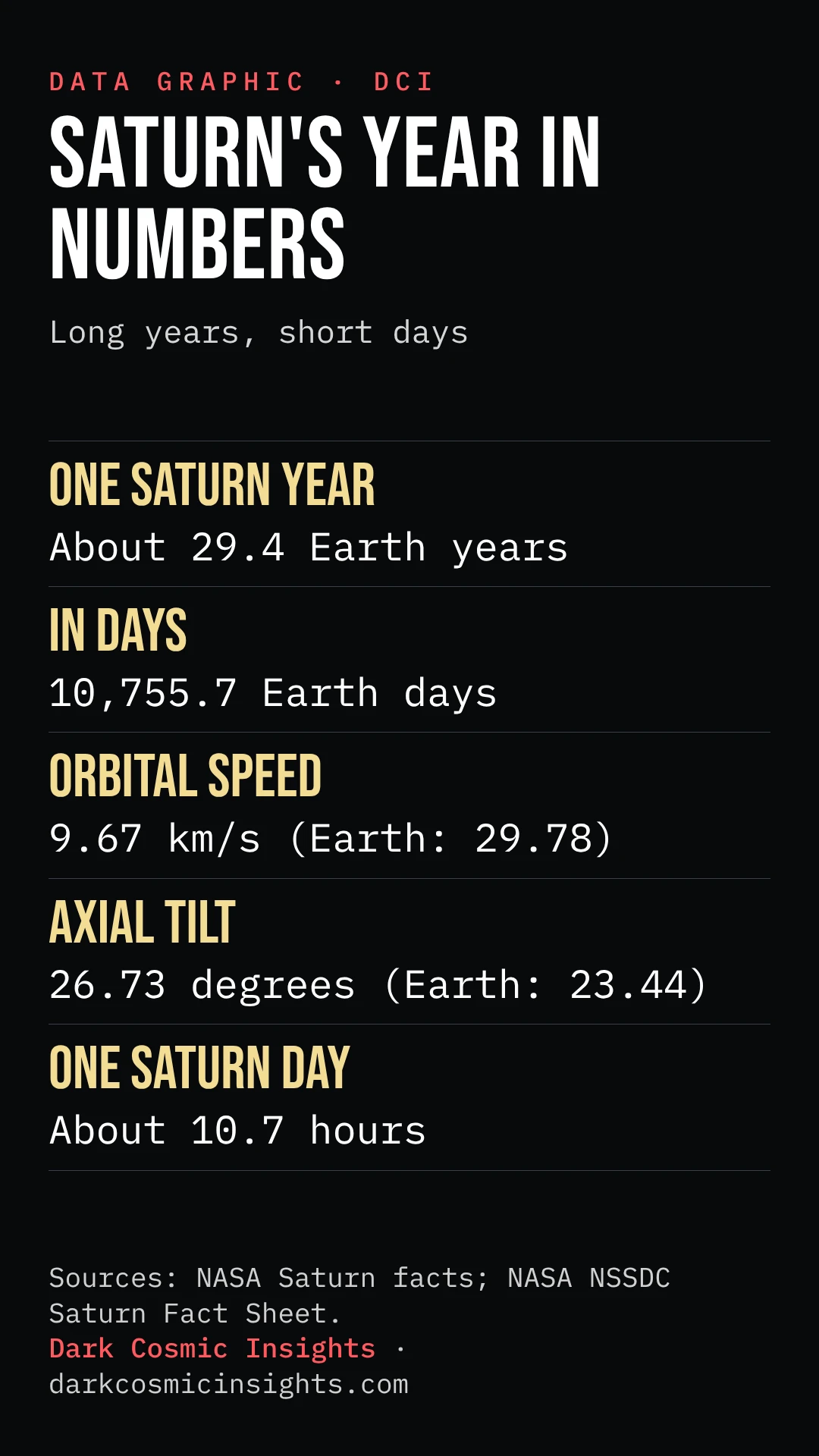
NASA says Saturn “makes a complete orbit around the Sun (a year in Saturnian time) in about 29.4 Earth years (10,756 Earth days)” (NASA). NASA’s fact sheet gives the precise figure as 10,755.699 days (NASA NSSDC).
Why it takes so long
Two things stretch out Saturn’s year. Its orbit is much bigger than Earth’s, and it moves more slowly. Saturn’s average orbital speed is about 9.67 km/s, compared with Earth’s 29.78 km/s (NASA NSSDC). A bigger loop at a slower pace adds up to almost 30 of our years.
Long seasons
Saturn’s axis is tilted about 26.7 degrees, a bit more than Earth’s 23.4 (NASA NSSDC). So Saturn has seasons, and each one lasts roughly seven Earth years (DCI estimate). Over a Saturn year, our view of the rings tilts too, which is why they turned edge-on to Earth in 2025, as we explain in Are Saturn’s Rings Disappearing?.
Your age in Saturn years
Because a Saturn year is about 29.4 Earth years, you’d celebrate your first Saturn birthday at about age 29 and a half. Most people live through only two or three Saturn years.
Short days, long years
Saturn’s days are the opposite of its years. A day on Saturn takes only about 10.7 hours (NASA). We cover how scientists measured it in What Is Saturn Made Of?.
Myth vs. Fact: Saturn’s Distance
| Myth | Fact | Status |
|---|---|---|
| “Saturn is always the same distance from Earth.” | It ranges from about 1.21 to 1.66 billion km. | Measured |
| “Saturn is closest when it’s highest in the sky.” | It’s closest around opposition, opposite the Sun. | Measured |
| “It takes a few months to fly to Saturn.” | Past missions took about 3 to 7 years. | Observed |
| “Faster is always better for reaching Saturn.” | An orbiter must slow down to be captured. | Observed |
| “A Saturn year is about 10 hours.” | That’s a Saturn day; a year is about 29.4 Earth years. | Measured |
| “We talk to Saturn spacecraft in real time.” | Signals take over an hour each way. | DCI calculation |
How Can You Find Saturn Yourself?
Look around opposition
Saturn is easiest to find near opposition, when it rises around sunset and stays up for much of the night. NASA put the 2026 opposition on October 4 (NASA), and Saturn stays in the evening sky for months after.
Know what you’re looking for
To the naked eye, Saturn is a steady, bright point, not twinkling like many stars. NASA notes it’s “the farthest planet from Earth discovered by the unaided human eye” (NASA). A small telescope shows its rings.
Think about the light
When you look at Saturn, you’re seeing sunlight that left the Sun about 80 minutes earlier, bounced off Saturn, and then crossed more than a billion kilometers to reach your eye. The Saturn you see is already more than an hour old.
Saturn’s Distance by the Numbers
| Measure | Value | Source |
|---|---|---|
| Average distance from the Sun | about 1.4 billion km (886 million mi), 9.5 AU | NASA |
| Perihelion / aphelion | 1,357.6 / 1,506.5 million km | NASA NSSDC |
| Closest / farthest from Earth | 1,205.5 / 1,658.6 million km | NASA NSSDC |
| Mean distance at opposition | 1,277.13 million km | NASA NSSDC |
| Sunlight travel time | about 80 minutes | NASA |
| Light from Earth | about 67 to 92 minutes (DCI calculation) | NASA NSSDC |
| Fastest trip so far | about 3 years 2 months (Voyager 1 flyby) | NASA |
| One Saturn year | about 29.4 Earth years | NASA |
| Time between oppositions | about 378 days | NASA NSSDC |
Values are as of November 2026.
Saturn Distance FAQ
How far is Saturn from the Sun in miles?
About 886 million miles, or 1.4 billion kilometers, on average, according to NASA. Because Saturn’s orbit is slightly stretched, it ranges from about 1.36 billion km at its closest to about 1.51 billion km at its farthest from the Sun.
How far is Saturn from Earth right now?
It depends on the date. Saturn’s distance from Earth ranges from about 1.21 billion km at its closest to about 1.66 billion km at its farthest. It’s closest around opposition, which came on October 4 in 2026 and will come on October 18 in 2027.
How long does it take to get to Saturn?
Past missions took about three to seven years. Voyager 1 flew past after about 3 years 2 months, Voyager 2 after about 4 years and Pioneer 11 after about 6 years 5 months. Cassini, which had to slow down to orbit Saturn, needed about seven years.
How long does light take to reach Saturn?
NASA says sunlight takes about 80 minutes to reach Saturn. Light or a radio signal from Earth takes roughly 67 to 92 minutes, depending on where the two planets are in their orbits, so commands to spacecraft at Saturn arrive more than an hour later.
How many AU is Saturn from the Sun?
About 9.5 AU on average, NASA says, meaning Saturn is about nine and a half times farther from the Sun than Earth is. At its closest it’s about 9.1 AU, and at its farthest about 10.1 AU.
How long is a year on Saturn?
About 29.4 Earth years, or 10,756 Earth days. Saturn’s orbit is far bigger than Earth’s and it moves about a third as fast, so one trip around the Sun takes nearly 30 of our years. Its seasons each last roughly seven Earth years.
Why did Cassini take longer than Voyager?
Voyager flew past Saturn without stopping. Cassini had to arrive slowly enough to be captured into orbit, so it took a gentler path, used gravity assists from Venus, Earth and Jupiter, and then fired its engine for 96 minutes to slow down.
Can you see Earth from Saturn?
Only as a tiny dot. In 2013, Cassini photographed Earth from Saturn when it was about 1.44 billion km away. Earth and the Moon appeared as small points of light, too small for the camera to resolve their disks.
Your next step: check when Saturn is up from where you live, then look for that steady, bright point. Remember that its light left the Sun more than an hour before it reached you.

Sources and Further Reading
- NASA Science, Saturn: Facts; Saturn.
- NASA Space Science Data Coordinated Archive, Saturn Fact Sheet.
- NASA, PIA17171: The Day the Earth Smiled: Sneak Preview (2013).
- NASA Science, Pioneer 11; Voyager 1; Voyager 2; Cassini.
- NASA (2019), 15 Years Ago: Cassini-Huygens Begins to Reveal Saturn’s Secrets.
- NASA Science (April 16, 2024), NASA’s Dragonfly Rotorcraft Mission to Saturn’s Moon Titan Confirmed.
- NASA Science (October 2026), What’s Up: October 2026 Skywatching Tips from NASA.
- EarthSky (October 4, 2026), Saturn at opposition.
Explore Next
- The full Saturn guide: Saturn: Facts, Rings, Moons and Your Questions
- Seven, eight or thousands: How Many Rings Does Saturn Have?
- Why Saturn looks pale gold, and why its poles turn blue: What Color Is Saturn?
- Size, mass and the bathtub question: How Big Is Saturn?
- What Saturn is made of, and how long its day is: What Is Saturn Made Of?
- Saturn’s rings, and whether they’re vanishing: Are Saturn’s Rings Disappearing?
- NASA’s helicopter for Titan: Titan and Dragonfly
- How cold it gets that far out: How Cold Is Space?
- Every planet in one place: Solar System Explorer
- What that distance does to its temperature: How Cold Is Saturn?
- Jupiter’s distance, for comparison: How Far Is Jupiter?
- How a claim earns its label: How We Know
How This Explainer Was Checked
Every number in this article was checked in November 2026 against the source linked beside it: NASA’s Saturn facts and Saturn pages, NASA’s Saturn fact sheet, NASA’s mission pages for Pioneer 11, Voyager 1, Voyager 2 and Cassini, NASA’s 2019 Cassini anniversary feature, NASA’s 2024 Dragonfly confirmation, NASA’s October 2026 skywatching guide and EarthSky for the 2027 opposition date. Light-travel times from Earth, mile conversions, the sunlight fraction, the driving and flying comparisons and the length of a season are DCI calculations from NASA’s numbers, labelled as such. Mission travel times are rounded from NASA’s launch and arrival dates. Images are labelled: real spacecraft images as OBSERVATION, illustrations as ILLUSTRATION, and our charts as DATA GRAPHIC. Nothing AI-generated is presented as a real image.

Final Thought: An Hour and a Half Away, at the Speed of Light
Saturn is close enough to see with your own eyes and far enough that light needs over an hour to cross the gap. Our fastest flyby took more than three years. Our longest visit took seven years just to arrive, then stayed for thirteen. From out there, our whole world is a blue dot under the rings. Saturn’s distance isn’t just a number. It’s the reason every picture we have of it is a small miracle of patience.
About the Author
Author: King | Founder of Dark Cosmic Insights
King is the founder of Dark Cosmic Insights, a science storytelling platform exploring the strangest true stories hiding in space, science and AI. He digs into NASA, ESA and peer-reviewed research, separates what has been measured from what is still a mystery, and turns it into articles, data graphics and Shorts.
Follow the anomaly. Trace the source.