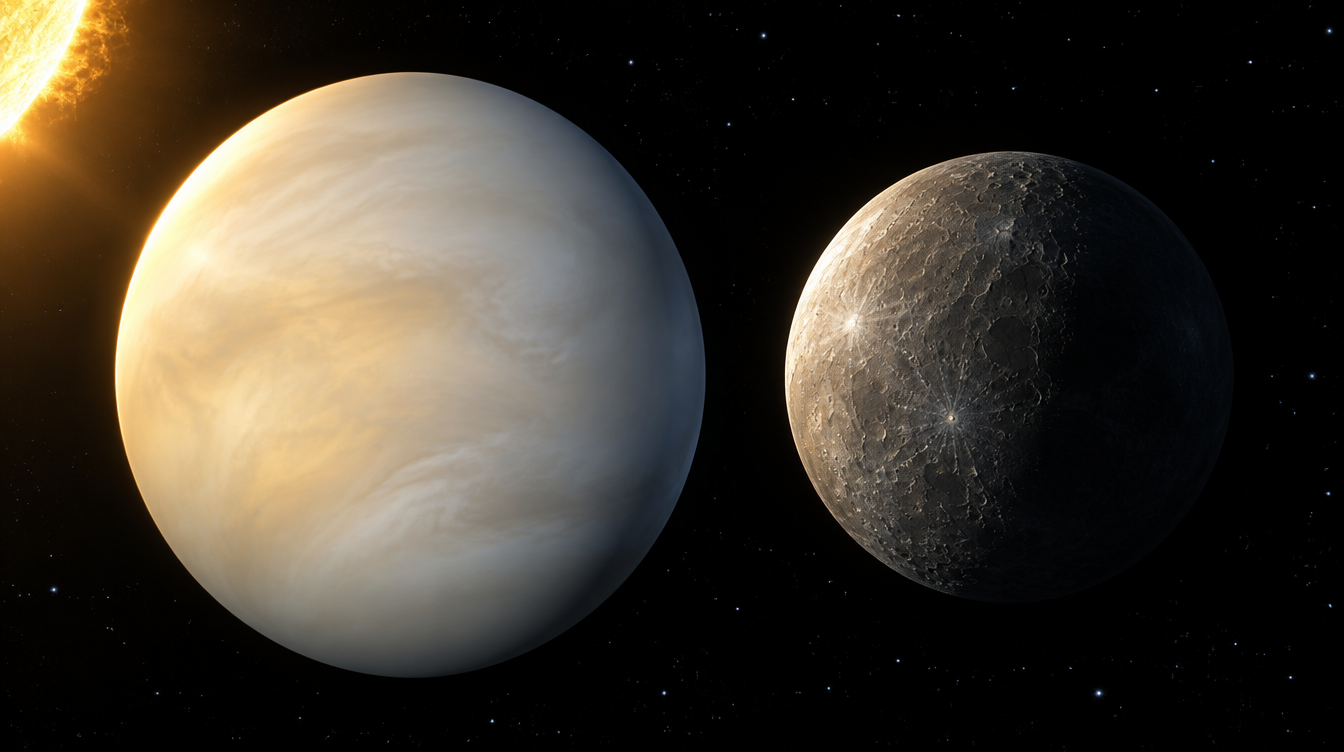
Ask almost anyone what is the hottest planet and they’ll say Mercury. It’s the closest planet to the Sun, after all. But the answer is Venus, nearly twice as far out, with a surface that averages about 464°C (867°F). Hotter than Mercury’s dayside. On average, hotter at midnight than Mercury is at noon.
That raises a better question than “which one?” How does a planet that’s farther from the Sun, and covered in bright clouds that bounce most sunlight away, end up as the solar system’s oven? The answer is its air: an atmosphere so thick that standing on the surface would feel like being nearly a kilometre underwater.
Here’s the runaway greenhouse step by step, every planet compared, and how Soviet landers and NASA radar proved it.
What’s observed, modelled and open. Venus’s surface temperature and pressure have been measured directly by landers and from orbit. The greenhouse physics that explains them is modelled, and well tested. Whether Venus once had oceans, and why it spins backwards, are still open questions.
Quick Answer: What Is the Hottest Planet?
Venus is the hottest planet in our solar system. NASA’s planetary fact sheet gives Venus a mean surface temperature of 464°C (867°F, 737 K), against 167°C (333°F) for Mercury (NASA NSSDCA, Planetary Fact Sheet). Mercury is closer to the Sun but has almost no atmosphere, so its heat escapes to space. Venus is wrapped in a carbon dioxide atmosphere with a surface pressure about 92 times Earth’s, which traps heat in a runaway greenhouse effect. The result: Venus stays hot day and night, with relatively little day–night variation, though its higher terrain is somewhat cooler than its lowland plains.
What this article can and cannot establish. It can give you sourced temperatures for every planet, explain Venus’s heat and show how we know. It cannot settle Venus’s deep history: whether it had oceans, when its greenhouse ran away and why it spins backwards are still open. Giant-planet temperatures are a special case, since those worlds have no solid surface.
Table of Contents
The DCI Evidence Map: The Hottest Planet
As always at Dark Cosmic Insights, we separate what has been measured from what is modelled and what is still open.
| Question | What we know | Status | Key source |
|---|---|---|---|
| Is Venus the hottest planet? | Mean surface temperature 464°C (737 K), the highest of the eight planets | Measured | NASA NSSDCA Fact Sheet |
| Is Venus hotter than Mercury’s dayside? | Mercury’s dayside reaches about 430°C; Venus averages 464°C with relatively little day–night variation | Measured | NASA Mercury Facts · NSSDCA Venus |
| Has anything measured it on the surface? | Venera 7 (1970) reported 475°C; Venera 13 (1982) operated for 127 minutes | Measured | Space.com · Wikipedia, Venera 7 |
| What keeps Venus so hot? | A thick CO₂ atmosphere traps outgoing heat (the greenhouse effect) | Modelled | NASA Venus Facts |
| Is Venus losing water to space? | Hydrogen escapes at roughly twice the rate of oxygen, the signature of split water | Observed | ESA, Venus Express |
| Did Venus once have oceans? | A climate model allows a habitable ocean for up to 2 billion years | Modelled / Open | NASA, Way and Del Genio |
| Why does Venus spin backwards? | Several mechanisms can produce it; none is confirmed | Open | Correia and Laskar, Nature 2001 |
| Could human emissions turn Earth into Venus? | Emissions are “probably insufficient” to trigger a runaway greenhouse | Not supported | Goldblatt et al., Nature Geoscience 2013 |
| What is the hottest planet known anywhere? | Exoplanet KELT-9b’s dayside is about 4,600 K | Measured | Gaudi et al., Nature 2017 |
Status key: Observed = seen directly. Measured = an instrument reading with known uncertainty. Modelled = the best physics-based explanation, consistent with data. Open = unresolved. Not supported = the evidence does not back it.
Cite this framework: Dark Cosmic Insights, “DCI Evidence Map: The Hottest Planet,” darkcosmicinsights.com/what-is-the-hottest-planet/, checked November 2026.
Which Planet Is the Hottest? Every Planet’s Temperature Compared
Here are all eight planets from one consistent source, the fact sheet kept by NASA’s Space Science Data Coordinated Archive (NSSDCA).
| Planet | Mean °C | °F | K | Distance from Sun (million km / mi) |
|---|---|---|---|---|
| Mercury | 167 | 333 | 440 | 57.9 / 36.0 |
| Venus | 464 | 867 | 737 | 108.2 / 67.2 |
| Earth | 15 | 59 | 288 | 149.6 / 93.0 |
| Mars | −65 | −85 | 208 | 228.0 / 141.7 |
| Jupiter* | −110 | −166 | 163 | 778.5 / 483.7 |
| Saturn* | −140 | −220 | 133 | 1,432 / 890 |
| Uranus* | −195 | −319 | 78 | 2,867 / 1,781 |
| Neptune* | −200 | −328 | 73 | 4,515 / 2,806 |
Source: NASA NSSDCA Planetary Fact Sheet, last updated March 18, 2025. °F, kelvin and mile conversions are ours, rounded.
\*The giant-planet asterisk matters. Jupiter, Saturn, Uranus and Neptune have no solid surface. NASA’s notes explain that the mean temperature is the average over the planet’s surface “or for the gas giants at the one bar level,” the height where air pressure roughly matches Earth’s at sea level (NSSDCA, Notes on the Fact Sheets). Some sources quote cloud-top temperatures instead, which is why numbers online differ.
The order isn’t simply by distance: Venus breaks the pattern, hotter than Mercury at almost twice the distance from the Sun.

Venus vs. Mercury Temperature: Why Is Venus Hotter?
The short version: Mercury gets more sunlight, but Venus keeps more heat.
Start with the sunlight. At Mercury’s average distance, sunlight delivers 9,082.7 watts per square metre, about 6.7 times what reaches Earth (NSSDCA, Mercury Fact Sheet). At Venus it’s 2,601.3 W/m², about 1.9 times Earth’s (NSSDCA, Venus Fact Sheet). On sunlight alone, Mercury should win easily.
Now add reflectivity. A planet’s Bond albedo is the fraction of incoming sunlight it bounces back to space. Venus’s bright clouds give it 0.77, about three-quarters reflected. Earth’s is 0.294, and dark Mercury’s is just 0.068 (NSSDCA fact sheets for Venus and Mercury).
Here’s the counter-intuitive bit. Average those numbers over the whole globe and Venus absorbs less sunlight per square metre than Earth does: roughly 150 W/m² against Earth’s 240 W/m² (our calculation from the NSSDCA values: sunlight × (1 − albedo) ÷ 4). If Venus had no greenhouse effect, NASA’s fact sheet puts its black-body temperature, the temperature a planet would settle at just by absorbing and re-radiating sunlight, at 226.6 K (−46.6°C, −51.9°F). That’s colder than Earth’s 254.0 K.
Yet Venus’s real surface is 737 K. The difference, about 510 kelvin of extra warming, is the greenhouse effect at work. For comparison, Earth’s greenhouse adds about 34 K (288 K actual vs. 254.0 K black-body, from NSSDCA’s Earth fact sheet). Venus’s adds roughly fifteen times as much.
Mercury has no such blanket. Instead of an atmosphere it has “a thin exosphere made up of atoms blasted off the surface” (NASA, Mercury Facts), with a surface pressure below about 5 × 10⁻¹⁵ bar, which NSSDCA calls “essentially a vacuum” (NSSDCA, Mercury). Heat that reaches Mercury’s ground radiates straight back to space.
How Hot Is Venus, Exactly?
About 464 to 467°C (867 to 872°F), depending on which NASA page you read, and the small gap is a useful lesson in sources.
- NASA’s planetary fact sheet gives a mean of 737 K (464°C) (NSSDCA Venus).
- NASA Science’s Venus page says “about 872 degrees Fahrenheit (467 Celsius)” (NASA, Venus Facts).
- Space.com, describing Venera 13’s mission, gives “as high as 870 degrees Fahrenheit (465 degrees Celsius)” (Space.com).
These are rounding and averaging differences.
What Venus barely has is a day-night swing. NSSDCA lists Venus’s diurnal (day-to-night) temperature range as about zero (NSSDCA Venus). The dense atmosphere carries heat around the whole planet, so the night side, dark for nearly two Earth months at a time, stays about as hot as the day side.
That doesn’t mean 464°C holds everywhere. It’s a mean. As on Earth’s mountains, Venus’s higher terrain is cooler than its lowland plains, so the temperature you’d measure depends more on altitude than on time of day.
How hot is that in everyday terms? NASA describes the surface as “hot enough to melt lead” (NASA, Venus Facts).

Why Is Venus So Hot? The Runaway Greenhouse, Step by Step
A greenhouse effect happens when a planet’s atmosphere lets sunlight in but blocks some of the infrared heat the surface radiates back out. A runaway greenhouse is when that warming feeds itself until a planet’s water is gone.
NASA describes Venus’s thick atmosphere as trapping heat “in a runaway greenhouse effect” (NASA, Venus Facts). Here is the proposed sequence: modelled overall, with some pieces observed.

Step 1: Sunlight warms a wet young planet
Venus may once have had water at the surface. NASA reports that measurements by the Pioneer Venus mission in the 1980s “first suggested Venus originally may have had an ocean” (NASA, 2016). Closer to the Sun than Earth, that water would have evaporated more readily.
Step 2: Water vapour traps heat
Water vapour is itself a greenhouse gas, so more evaporation means more trapped heat.
Step 3: The feedback loop takes off
Warmer air holds more vapour, which traps more heat, which evaporates more water. Past a threshold, the loop doesn’t settle; the oceans end up in the atmosphere.
Step 4: Sunlight splits the water, and hydrogen escapes
High in the atmosphere, ultraviolet sunlight breaks water molecules apart. Hydrogen, the lightest element, escapes to space. This part is observed today: ESA’s Venus Express orbiter measured that “roughly twice as much hydrogen is escaping as oxygen,” the 2-to-1 ratio you’d expect from water (H₂O) being broken up (ESA, 2010). ESA also notes that deuterium, a heavier form of hydrogen that escapes less easily, is progressively enriched high in Venus’s atmosphere, another fingerprint of long-term water loss.
Step 5: Carbon dioxide builds up with nowhere to go
On Earth, oceans and rain pull carbon dioxide out of the air and lock it into rocks over millions of years. Without liquid water, that recycling stops. NASA’s summary of a 2016 study describes carbon dioxide building up, “leading to a so-called runaway greenhouse effect” (NASA, 2016).
When did it happen?
That’s open. NASA Goddard Institute for Space Studies scientists Michael Way and Anthony Del Genio modelled an early Venus and found it “may have had a shallow liquid-water ocean and habitable surface temperatures for up to 2 billion years of its early history” (NASA, August 10, 2016). That is a model result, not a measurement: whether Venus really had oceans is unproven. Answering this is one of the main goals of the next wave of missions.
What Is Venus’s Atmosphere Made Of?
Venus’s atmosphere near the surface is 96.5% carbon dioxide and 3.5% nitrogen by volume (NSSDCA Venus).
The crushing pressure
NASA’s fact sheet gives Venus’s surface pressure as 92 bars, where 1 bar is roughly sea-level pressure on Earth (NSSDCA Venus). NASA Science rounds it slightly differently, as “93 times what it is at sea level on Earth,” and compares it to being more than 3,000 feet (930 metres) underwater (NASA, Venus Facts).
At the surface, that air has a density of about 65 kg per cubic metre (NSSDCA Venus), more than fifty times the 1.217 kg/m³ of air at Earth’s surface (NSSDCA Earth).
Sulfuric acid clouds
Above it all sit dense clouds composed of sulfuric acid (NASA, Venus Facts). They make Venus bright and hide its surface from ordinary telescopes, which is why mapping it took radar.
Curiously, about 50 km (30 miles) up, NASA notes that temperatures fall to a range of 30 to 70°C (86 to 158°F) (NASA, Venus Facts).
Winds that outrun the planet
At the cloud tops, winds have been “measured as high as 224 mph (360 kph)” (NASA, Venus Facts). This is super-rotation: an atmosphere circling far faster than the planet spins. Japan’s Akatsuki orbiter is credited with clarifying “the mechanism that maintained” it (JAXA, September 18, 2025). Down at the surface, by contrast, winds are gentle, just 0.3 to 1.0 metres per second (NSSDCA Venus).
How Hot and Cold Does Mercury Get?
NASA says its “day temperatures can reach highs of 800°F (430°C),” while at night “temperatures can dip as low as -290°F (-180°C)” (NASA, Mercury Facts). That’s a swing of about 610°C (1,100°F) between day and night.
Sources differ on the exact dayside peak. NSSDCA lists a sunward-side range of 590 to 725 K (about 317 to 452°C, 602 to 845°F) (NSSDCA Mercury). Even taking the highest figure, Mercury’s hottest ground (725 K) is still a little cooler than Venus’s average (737 K), and only for part of a Mercury day.
Why the night is so cold
With no atmosphere to hold heat, the ground cools fast after sunset, and nights are long: Mercury spins once every 59 Earth days, but because it’s also racing around the Sun, one full day-night cycle takes 176 Earth days (NASA, Mercury Facts). That’s about three months of darkness for the night side to radiate its heat away.
Ice on the planet closest to the Sun
Strangest of all, some craters near Mercury’s poles never see sunlight at all. In 2012, NASA’s MESSENGER team reported three independent lines of evidence for water ice in these permanently shadowed craters. Neutron data showed a buried layer whose hydrogen content, team scientist David Lawrence said, is “consistent with nearly pure water ice” (Phys.org, reporting the MESSENGER papers in Science).

How Long Is a Day on Venus?
A day on Venus is longer than its year, depending on which “day” you mean.
- One rotation, measured against the distant stars, takes 243 Earth days. Its year, one trip around the Sun, takes about 225 Earth days (NASA, Venus Facts).
- One solar day, from noon to noon as you’d experience it standing on the surface, is 2,802 hours, or about 117 Earth days (NSSDCA Venus). It’s shorter than one rotation because the backward spin and the orbit work together.
NASA’s fact sheet lists the rotation period as a negative number, −5,832.6 hours, and explains that “Negative numbers indicate retrograde” rotation, meaning backwards relative to Earth (NSSDCA Notes). Venus spins the opposite way to most planets, so on Venus the Sun would rise in the west and set in the east (NASA, Venus Facts).
Why does Venus spin backwards?
Open. The common explanation is that Venus’s spin axis was gradually flipped over, driven by friction between its core and mantle together with atmospheric tides, the Sun’s heating pushing on the massive atmosphere. In a 2001 Nature paper, Alexandre Correia and Jacques Laskar showed that planets with dense atmospheres like Venus can end up in only four final rotation states, and that Venus could reach its present one by two different routes: flipping its axis, or slowing and reversing its spin without flipping (PubMed abstract, Nature 2001). Neither route is confirmed.
The slow spin may once have helped: Way and Del Genio’s model found a slowly rotating early Venus could build thick daytime clouds that shaded the surface (NASA, 2016).
How Do We Know How Hot Venus Is?
Venus’s clouds hide its surface, so nearly everything we know about it was earned by spacecraft.
Mariner 2 (1962): the first look
NASA’s Mariner 2 flew past Venus on December 14, 1962, at a closest distance of 34,854 km (21,660 miles). NASA calls it “humanity’s first successful planetary science mission” (NASA Science, Mariner 2). Its microwave radiometer found “no significant difference in temperature across Venus,” an early hint that the planet’s heat was spread fairly evenly.
Venera 7 (1970): first data from another planet’s surface
The Soviet Union’s Venera 7 landed on December 15, 1970. Space.com, citing NASA, notes it was “the first spacecraft to return data after landing on another planet” (Space.com). It reported a surface temperature of 475 ± 20°C (887 ± 36°F). Its surface pressure, about 9.0 megapascals or roughly 90 times Earth’s, was not directly transmitted: scientists inferred it from the lander’s other data (Wikipedia, Venera 7). Its weak signal from the surface lasted about 23 minutes, recovered later from recorded tapes (Space.com).
Venera 13 (1982): two hours on the surface
Venera 13 touched down on March 1, 1982 (Space.com). Designed to last about 32 minutes, it kept working for at least 127 minutes, recording a surface temperature of 457°C (855°F) (Wikipedia, Venera 13). It was the first lander to send back colour images from Venus’s surface: “14 color photographs” and “eight in black and white” (Space.com).
Magellan (1990–1994): mapping through the clouds
NASA’s Magellan orbiter reached Venus on August 10, 1990 and used radar, which passes through clouds, to map the surface. By its third mapping cycle it had covered 98% of the planet, at resolutions of 120 to 300 metres (390 to 985 feet), and found that “at least 85% of the Venusian surface is covered with volcanic flows” (NASA Science, Magellan). Decades later, scientists re-examining its images found a volcanic vent on Maat Mons that roughly doubled in size between February and October 1991, which NASA’s JPL called “direct geological evidence of recent volcanic activity” (NASA JPL, March 15, 2023).
Venus Express (2006–2014): the atmosphere up close
ESA’s Venus Express orbited from April 11, 2006 to December 2014, studying the atmosphere and clouds, mapping surface temperatures, and finding evidence of lightning (ESA, Venus Express). It also made the hydrogen-escape measurement described above.
Akatsuki (2015–2024): Venus’s weather satellite
Japan’s Akatsuki became the first Japanese probe to orbit another planet on December 7, 2015 (JAXA, Akatsuki mission). It studied Venus’s weather, discovering “the largest mountain wave (stationary gravity waves) in the Solar System” and helping explain super-rotation. Contact was lost in April 2024, and JAXA formally ended operations on September 18, 2025 (JAXA). Space.com reported that Akatsuki’s end meant “Humanity’s last active mission at Venus is no more” (Space.com).
For how a number like this is earned in general, see how astronomers measure stars; for how to read planetary images, see Are Space Photos Real?
What Is the Hottest Planet in the Universe?
Note: this section is about exoplanets, planets orbiting other stars, outside our solar system. Out there, Venus is nowhere near the top.
The best-known record holder is KELT-9b, a giant planet announced in 2017. Its dayside temperature is about 4,600 K (roughly 4,300°C, or 7,800°F), according to the discovery paper led by B. Scott Gaudi in Nature (Gaudi et al. 2017, arXiv version). NASA called it the “hottest gas giant planet that has ever been discovered” and noted it is “being vaporized by its own star” (NASA, June 5, 2017).
Why so hot? KELT-9b has about 2.88 times Jupiter’s mass and orbits its star in about 1.5 days, at just 0.034 AU, roughly 5 million km (3.1 million miles) (NASA Exoplanet Catalog). Its star, KELT-9, is itself about 10,170 K (Gaudi et al. 2017), far hotter than our Sun.
A caution on the word “hottest.” KELT-9b is the record that NASA and the discovery team highlight, but its figure is for the star-facing dayside, and exoplanet surveys continue. If a hotter world is confirmed, the title moves. Within our solar system, the answer stays Venus.
Could Earth Become Like Venus?
From human emissions: not supported. A 2013 study in Nature Geoscience by Colin Goldblatt and colleagues found that a runaway greenhouse could in principle be triggered by greenhouse forcing, but that “anthropogenic emissions are probably insufficient” to do it (Goldblatt et al. 2013). Human-caused climate change is a serious problem on its own terms, but not this one.
From the Sun, over geological time: modelled. The Sun slowly brightens “over geological timescales,” and a 2013 Nature study led by Jérémy Leconte estimated that Earth-like planets tip into a runaway greenhouse at about 375 watts per square metre of average incoming sunlight, higher than earlier estimates (Leconte et al. 2013, arXiv). For comparison, Earth’s global average today works out to about 340 W/m² (the 1,361 W/m² solar constant from NSSDCA, divided by four to spread it over the whole globe; our calculation). The gap closes only as the Sun ages, over a timescale far longer than human history.
Venus is better seen as a natural laboratory: a world “nearly as big around as Earth” (NASA, Venus Facts) that took a different path.
Myth vs. Fact: The Hottest Planet
| Myth | Fact |
|---|---|
| “Mercury is the hottest planet because it’s closest to the Sun.” | Venus is hotter: about 464°C mean vs. Mercury’s 167°C (NSSDCA). |
| “Venus is hot because it gets so much sunlight.” | Its bright clouds reflect about 77% of sunlight. Its atmosphere, not its distance, does the work. |
| “Venus’s night side must be cooler.” | Day-night variation is small; NSSDCA lists the range as about zero (NSSDCA). Altitude matters more: higher terrain is cooler. |
| “Venus has water clouds like Earth’s.” | Its clouds are made of sulfuric acid (NASA). |
| “Nothing has ever survived on Venus’s surface.” | Venera 13 operated for at least 127 minutes in 1982. |
| “Mercury is hot all over.” | Its night side drops to about −180°C, and its polar craters hold water ice. |
| “We’re on track to turn Earth into Venus.” | Research finds human emissions “probably insufficient” to trigger a runaway greenhouse. |
How Can You See Venus Yourself?
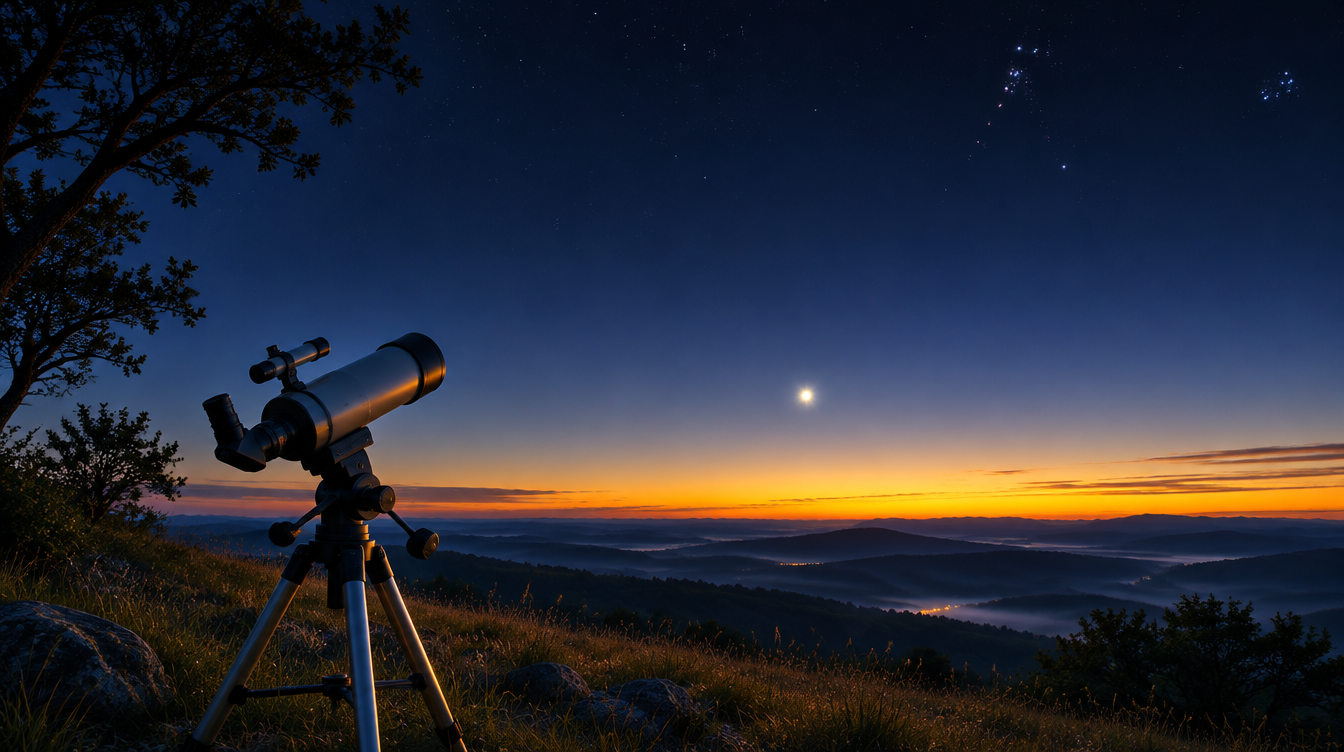
You can’t feel Venus’s heat from here, but you can see the clouds that trap it: the brilliant “star” low in the sky near sunrise or sunset.
As of November 2026, Venus is a morning object. Space.com’s 2026 planet guide lists its morning window as November 3 to December 31 (Space.com). Sources differ on the exact date of peak brightness, but Venus is near its brightest in late November. Look east before sunrise.
- With your eyes: look for the brightest point of light in the pre-dawn east.
- With binoculars or a small telescope: the same guide notes Venus shows a crescent phase in telescopes and steady binoculars through most of November.
- Catch Mercury too: Mercury’s best morning window in 2026 runs November 13 to December 4 (Space.com). The closest planet and the hottest planet, in one dawn sky.
Safety: never point binoculars or a telescope near the Sun. Observe Venus only when the Sun is fully below the horizon.
Go further: to see how scientists turn raw data into the pictures you see, read our comparison of Hubble vs. Webb.
What Comes Next for Venus?
Three missions are planned to return to Venus in the 2030s. The NASA dates below come from attributed news reporting as of November 2026. NASA’s own mission pages (last updated July 14, 2026) don’t list them, and Venus missions have slipped before, so treat them as current targets, not guarantees.
NASA DAVINCI: a probe through the clouds
DAVINCI will drop a probe through Venus’s atmosphere, sampling its “chemical makeup, as well as the temperature, pressure, and winds” on the way down, and imaging Alpha Regio, a highland region that “may be among the oldest surfaces on Venus” (NASA Science, DAVINCI). In March 2026, Space.com reported a December 2030 launch target with the probe released in January 2033, and that the 2026 appropriations bill provided $99 million to keep it going (Space.com, March 27, 2026). More recent reporting moves the descent earlier. Ars Technica reported in October 2026 that a Venus flyby in early 2032 will set DAVINCI up to release its probe for descent on October 3, 2032 (Ars Technica, October 14, 2026), and DigitalToday quoted principal investigator Jim Garvin that the date “was moved up by 54 weeks from the existing plan” (DigitalToday, October 15, 2026). NASA’s DAVINCI page gives no dates, saying only that the probe will be released “two years into the mission.”
NASA VERITAS: mapping the surface again
VERITAS is an orbiter designed to produce the first global, high-resolution topographic maps of Venus and a near-global map of surface rock types, and to test whether Venus has active volcanism and plate tectonics (NASA Science, VERITAS, page updated July 14, 2026). NASA’s page doesn’t list a launch date. SpaceNews earlier reported that principal investigator Sue Smrekar said the team was working toward June 2031, while warning NASA could slip the launch to November 2032 (SpaceNews). Current reporting says November 2032 is now the target: Ars Technica reported that VERITAS “will follow with a launch in November 2032” (Ars Technica, October 14, 2026). Earlier, in March 2026, NASA’s planetary science head Louise Prockter said “It’s going to be a challenge getting all three Venus missions to continue” (Space.com).
ESA EnVision: core to clouds
ESA adopted EnVision on January 25, 2024 and, at approval, foresaw a launch “on an Ariane 6 rocket in 2031” (ESA, 2024). It will study Venus from its core to its upper atmosphere, including how geologically active it is today. More recent reporting changes that picture: Ars Technica reported in September 2026 that NASA pulled out of supplying its VenSAR radar, that ESA is moving ahead with a European-built radar instead, and that ESA has delayed the launch by one year to 2032 (Ars Technica, September 10, 2026; Ars Technica, October 14, 2026). ESA’s own mission pages still show the earlier plan, so treat 2032 as the reported current target rather than an ESA-confirmed date.
Together, these missions target the open rows in our Evidence Map: whether Venus had oceans, whether it’s volcanically active now, and how its greenhouse ran away.
The Hottest Planet by the Numbers
- 464°C (867°F, 737 K): Venus’s mean surface temperature (NSSDCA)
- 430°C (800°F) / −180°C (−290°F): Mercury’s daytime high and night-time low (NASA)
- 92 bars: Venus’s surface pressure, about the same as 930 m (3,050 ft) underwater (NSSDCA; NASA)
- 96.5%: carbon dioxide in Venus’s atmosphere (NSSDCA)
- 0.77: Venus’s Bond albedo; it reflects about three-quarters of incoming sunlight
- 108.2 million km (67.2 million miles): Venus’s average distance from the Sun, vs. 57.9 million km (36.0 million miles) for Mercury (NSSDCA)
- 243 vs. 225 Earth days: Venus’s rotation vs. its year (NASA)
- 127 minutes: how long Venera 13 operated on the surface in 1982 (Space.com)
- 98%: share of Venus’s surface mapped by Magellan’s radar (NASA)
- About 4,600 K (about 7,800°F): dayside temperature of exoplanet KELT-9b (Gaudi et al. 2017)
The Hottest Planet: FAQ
What is the hottest planet in our solar system?
Venus is the hottest planet in the solar system. NASA’s planetary fact sheet gives it a mean surface temperature of 464°C (867°F). That is hotter than Mercury, even though Mercury is closer to the Sun.
Why is Venus hotter than Mercury?
Venus has a thick carbon dioxide atmosphere, with a surface pressure about 92 times Earth’s, that traps heat in a runaway greenhouse effect. Mercury has almost no atmosphere, so its heat radiates straight back to space. Venus actually absorbs less sunlight than Mercury; it just keeps far more of it.
How hot is Venus at night?
About as hot as during the day. NASA’s fact sheet lists Venus’s day-night temperature range as about zero, because its dense atmosphere carries heat all around the planet. The surface averages about 464°C, with relatively little day-night variation, though higher terrain is somewhat cooler.
How hot does Mercury get?
NASA says Mercury’s dayside can reach about 430°C (800°F), and its night side can drop to about −180°C (−290°F). Some NASA data put the dayside peak a little higher, up to 725 K (about 452°C). That’s still below Venus’s average.
How long does a day on Venus last?
One rotation of Venus takes 243 Earth days, longer than its 225-day year. Because Venus spins backwards, a full sunrise-to-sunrise solar day is shorter, about 117 Earth days. On Venus, the Sun rises in the west.
What are Venus’s clouds made of?
Venus’s clouds are made of sulfuric acid. They are bright enough to reflect about three-quarters of the sunlight that reaches Venus, and they hide the surface from ordinary telescopes, which is why it had to be mapped by radar.
Has any spacecraft landed on Venus?
Yes. The Soviet Venera 7 returned the first data from another planet’s surface in December 1970. Venera 13 landed in March 1982, operated for at least 127 minutes and sent back the first colour images from Venus’s surface.
What is the hottest known planet in the universe?
Among known planets, the exoplanet KELT-9b is the record most often cited, with a dayside of about 4,600 K (about 7,800°F). It orbits a hot star outside our solar system every 1.5 days. Exoplanet surveys continue, so the record could change.
Your next step: set an alarm for a clear morning in late November 2026, look east before sunrise, and find Venus near its brightest. Then remember what’s under that dazzling cloud: a surface hot enough to melt lead.
Sources and Further Reading
- NASA Space Science Data Coordinated Archive (NSSDCA), D. R. Williams, Planetary Fact Sheet (Metric), last updated March 18, 2025; Notes on the Fact Sheets; Venus Fact Sheet; Mercury Fact Sheet.
- NASA Science, Venus Facts and Venus overview.
- NASA Science, Mercury Facts.
- NASA Science, Mariner 2 and Magellan mission pages.
- NASA JPL (March 15, 2023), NASA’s Magellan Data Reveals Volcanic Activity on Venus.
- ESA, Venus Express mission page; ESA (June 24, 2010), Was Venus once a habitable planet?
- JAXA, Akatsuki mission overview; JAXA (September 18, 2025), Venus Climate Orbiter “Akatsuki” Operation Completed.
- NASA Science (August 10, 2016), NASA Climate Modeling Suggests Venus May Have Been Habitable, on Way, M. J., et al. (2016), Geophysical Research Letters, DOI: 10.1002/2016GL069790.
- Correia, A. C. M., and Laskar, J. (2001), “The four final rotation states of Venus,” Nature 411, 767–770, DOI: 10.1038/35081000.
- Goldblatt, C., Robinson, T., Zahnle, K., et al. (2013), “Low simulated radiation limit for runaway greenhouse climates,” Nature Geoscience 6, 661–667, DOI: 10.1038/ngeo1892.
- Leconte, J., Forget, F., Charnay, B., Wordsworth, R., and Pottier, A. (2013), “Increased insolation threshold for runaway greenhouse processes on Earth-like planets,” Nature 504, 268–271, DOI: 10.1038/nature12827.
- Gaudi, B. S., Stassun, K. G., Collins, K. A., et al. (2017), “A giant planet undergoing extreme-ultraviolet irradiation by its hot massive-star host,” Nature 546, 514–518, DOI: 10.1038/nature22392 (arXiv:1706.06723).
- NASA Science (June 5, 2017), Astronomers Find Planet Hotter Than Most Stars; NASA, Exoplanet Catalog: KELT-9 b; Ohio State News, A planet hotter than most stars.
- Phys.org (November 2012), MESSENGER finds new evidence for water ice, organic material at Mercury’s poles, reporting Lawrence, D. J., et al., Neumann, G. A., et al., and Paige, D. A., et al. in Science.
- NASA Science, VERITAS and DAVINCI mission pages (updated July 14, 2026); SpaceNews, VERITAS stands up after stand-down; Space.com (March 27, 2026), NASA’s ambitious “decade of Venus” exploration may bank on 1 probe.
- Ars Technica (October 14, 2026), Things are finally looking up for NASA’s first missions to Venus in a generation; DigitalToday (October 15, 2026), NASA to resume Venus exploration in 2030s, moves up DAVINCI, restarts VERITAS.
- Ars Technica (September 10, 2026), Europe will go it alone on Venus mission after NASA yanks radar instrument.
- ESA (January 2024), We’re heading for Venus: ESA approves EnVision.
- Space.com, Venera 7, 1st to Send Data from Venus Surface and Venera 13 and the Mission to Reach Venus; Space.com, What to expect from the planets in 2026.
- Wikipedia, Venera 7 and Venera 13. Used for lander measurements not stated on agency pages, alongside Space.com.
Explore Next
- Another planet-ranking question, dated and sourced: Which Planet Has the Most Moons?
- Weather on the giant planets: Jupiter’s Polar Cyclones vs. Saturn’s Hexagon
- How a number like 464°C is earned: How Astronomers Measure Stars
- How to read the planet images you see online: Are Space Photos Real?
- The 2006 vote and the debate: Why Is Pluto Not a Planet?
- The three temperatures of space: How Cold Is Space?
- How birth mass shapes a star’s ending: Life Cycle of a Star
- More from the planets: Planets & Moons
How This Explainer Was Checked
Every planetary temperature, pressure and rotation figure in this article comes from NASA’s NSSDCA planetary fact sheets or NASA Science pages, checked in November 2026. Where NASA pages give slightly different numbers (Venus at 464 or 467°C, 92 or 93 bars; Mercury’s dayside at 430°C or up to 725 K), we show both and explain why. Venera lander measurements come from Space.com and Wikipedia, cross-checked against each other, because the NASA NSSDCA catalogue pages were unavailable when we checked. Venera 7’s pressure was inferred rather than directly transmitted, and we leave out a Venera 13 pressure figure because archives disagree on the exact value. Past mission dates come from NASA, ESA and JAXA. Future NASA Venus dates come from attributed news reporting as of November 2026, because NASA’s mission pages don’t list them, and they may change. Kelvin and Fahrenheit conversions, the absorbed-sunlight comparison and Earth’s average insolation are DCI calculations from the sourced values, and are labelled as ours. Images are labelled: our charts as DATA GRAPHIC, generated art as ILLUSTRATION. Nothing AI-generated is presented as a real image.

Final Thought: It’s the Air, Not the Distance
The hottest planet isn’t the one closest to the fire. It’s the one that can’t let the heat go. Venus reflects most of the sunlight that reaches it, and it’s still the solar system’s oven, because a thick, dry, carbon dioxide atmosphere holds on to every bit of warmth it gets. That’s the lesson Venus keeps teaching: a planet’s temperature is written as much in its air as in its orbit. The next missions to Venus aim to read the rest of that story, including how a world so like Earth in size took such a different road.
About the Author
Author: King | Founder of Dark Cosmic Insights
King is the founder of Dark Cosmic Insights, a science storytelling platform exploring the strangest true stories hiding in space, science and AI. He digs into NASA, ESA and peer-reviewed research, separates what has been measured from what is still a mystery, and turns it into articles, data graphics and Shorts.
Follow the anomaly. Trace the source.