Saturn is one of the coldest places you could visit in the solar system and one of the hottest at the same time. At its cloud tops, NASA’s fact sheet lists a temperature of −139 °C (NASA NSSDC). Deep inside, models put the core at about 11,700 °C (ESA), about twice as hot as the visible surface of the Sun, which NASA puts at about 5,500 °C (NASA).
And here’s the strangest part. NASA says Saturn “actually emits more than twice the energy it absorbs from the sun,” a puzzle that has lasted for decades (NASA/JPL, 2010). Saturn is cold because it’s far from the Sun. But it’s also quietly glowing with heat of its own.

Observed, measured, modelled, open. Cloud-top and upper-atmosphere temperatures are measured by spacecraft and telescopes. Saturn’s extra heat output is measured. The core temperature is modelled, because nothing has gone there. Exactly where Saturn’s extra heat comes from is still partly open.
Quick Answer: How Cold Is Saturn?
At the 1-bar level, about the air pressure at sea level on Earth, Saturn’s temperature is 134 K (−139 °C, about −218 °F) (NASA NSSDC). Higher up, at the 0.1-bar level, it’s colder still: 84 K (−189 °C). Saturn gets only about 1 percent of the sunlight Earth gets per square meter, which is a big reason it’s so cold. But it’s much hotter inside: ESA lists the core at about 12,000 K (11,700 °C), a model-based estimate (ESA). And Saturn gives off more than twice the energy it absorbs from the Sun (NASA/JPL).
What this article can and cannot establish. It can give you Saturn’s measured temperatures at its cloud tops and in its upper atmosphere, its measured heat output, and the hot spots astronomers have found. It cannot give you a measured core temperature, because no probe has reached Saturn’s interior. Those numbers come from models. And there’s no single “temperature of Saturn,” because it changes enormously with depth.
Table of Contents
The DCI Evidence Map: Saturn’s Temperature
| Question | What we know | Status | Key source |
|---|---|---|---|
| How cold are the cloud tops? | 134 K (−139 °C) at the 1-bar level | Measured | NASA NSSDC |
| How cold higher up? | 84 K (−189 °C) at the 0.1-bar level | Measured | NASA NSSDC |
| How much sunlight does it get? | About 1% of Earth’s, per square meter | Measured | NASA NSSDC |
| Does Saturn make its own heat? | It emits more than twice what it absorbs | Measured | NASA/JPL, 2010 |
| How hot is the core? | About 12,000 K (11,700 °C) | Modelled | ESA |
| Where was the warm polar cap? | A compact warm stratosphere cap at the south pole (seen in 2004) | Observed | NASA/JPL, 2005 |
| Why is the upper atmosphere so hot? | Auroral heating, spread by winds | Modelled | University of Arizona, 2020 |
| Where does the extra heat come from? | Leftover heat and possibly helium rain | Open | NASA/JPL, 2010 |
Status key: Observed = seen directly. Measured = a number with a stated uncertainty or a direct measurement. Modelled = inferred from measurements through a physical model, dependent on assumptions. Open = unresolved; the evidence is incomplete or points different ways. Not supported = the evidence goes against the claim, or there is none for it.
Cite this framework: “DCI Evidence Map: Saturn’s Temperature,” Dark Cosmic Insights, November 2026, darkcosmicinsights.com/how-cold-is-saturn/.
How Cold Are Saturn’s Cloud Tops?
Measured at “1 bar”
Saturn has no solid ground, so scientists quote temperatures at set pressure levels. The standard one is 1 bar, close to the air pressure at sea level on Earth. There, NASA’s fact sheet lists 134 K, or −139 °C (NASA NSSDC). That’s about −218 °F (DCI conversion).
Colder higher up
Climb higher, to the 0.1-bar level, where the pressure is one-tenth as high, and the fact sheet lists 84 K, or −189 °C (NASA NSSDC). That’s about −308 °F.
A note on different numbers
You’ll see slightly different cloud-top temperatures in different places. ESA’s Saturn fact page lists cloud tops at “150K (-139 °C)” (ESA). Those two figures don’t match each other: 150 K is about −123 °C. The −139 °C value matches NASA’s 134 K at the 1-bar level, so that’s the one we use here. Cloud-top temperatures also vary with latitude, season and altitude.

Why Is Saturn So Cold?
Far from the Sun
Saturn orbits about 9.5 times farther from the Sun than Earth does (NASA). Sunlight spreads out as it travels, so by the time it reaches Saturn it’s very weak. NASA’s fact sheet gives Saturn’s solar irradiance as 14.82 watts per square meter, compared with 1,361 at Earth (NASA NSSDC). That’s about 1.1 percent of what Earth gets (DCI calculation). We cover Saturn’s distance in How Far Is Saturn?.
Reflecting much of what it gets
Saturn also bounces a lot of that weak sunlight straight back into space. Its Bond albedo, the share of incoming light it reflects, is 0.342, a bit higher than Earth’s 0.294 (NASA NSSDC).
The “black-body” temperature
Put those together and NASA’s fact sheet gives Saturn a black-body temperature, of 81 K (about −192 °C), compared with 254 K for Earth (NASA NSSDC). NASA defines this as the theoretical temperature a planet would have from sunlight alone, as a black body with no atmosphere (NASA NSSDC notes). It’s a reference number, not a layer of Saturn’s air, so it can’t prove anything about Saturn’s insides on its own. The proof of internal heat comes from measuring the energy Saturn gives off against the energy it absorbs, which is next.
Saturn Makes Its Own Heat
More energy out than in
In 2010, NASA reported that Saturn “actually emits more than twice the energy it absorbs from the sun,” calling it “a puzzle for many decades” (NASA/JPL, 2010). In other words, Saturn is glowing with internal heat, mostly in infrared light our eyes can’t see.
You can see the glow
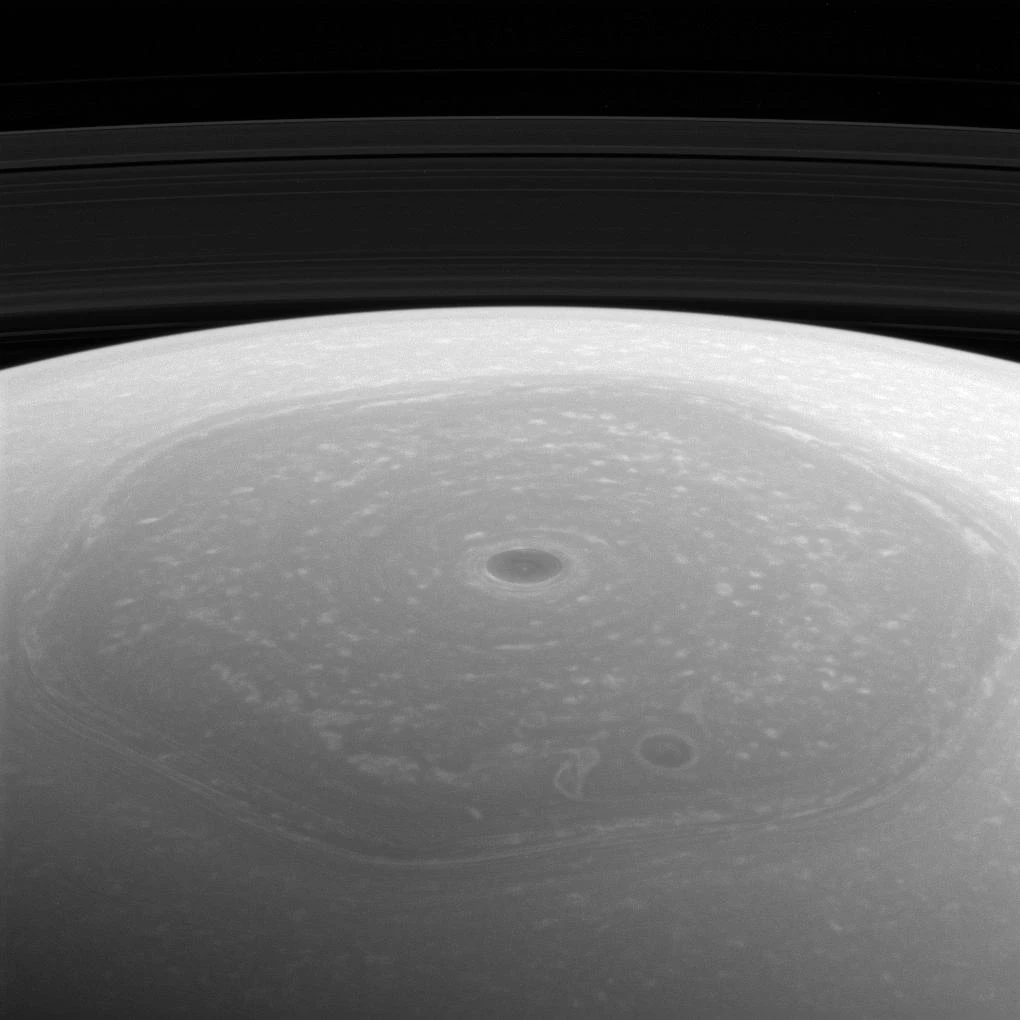
Cassini’s visual and infrared mapping spectrometer could see it. At a wavelength of 5 microns, NASA says the instrument “is sensing heat coming from Saturn’s interior,” with clouds silhouetted against that inner glow (NASA, PIA21896). That’s the image at the top of this article.
The heat changes with the seasons
The same 2010 study, led by Liming Li and published in the Journal of Geophysical Research–Planets, found Saturn’s southern hemisphere “giving off about one-sixth more energy than the northern one” during the years studied, matching summer in the south and winter in the north (NASA/JPL, 2010). In the north, the effective temperature “gradually dropped from 2005 to 2008 and started to warm up again by 2009.”
Where does the extra heat come from?
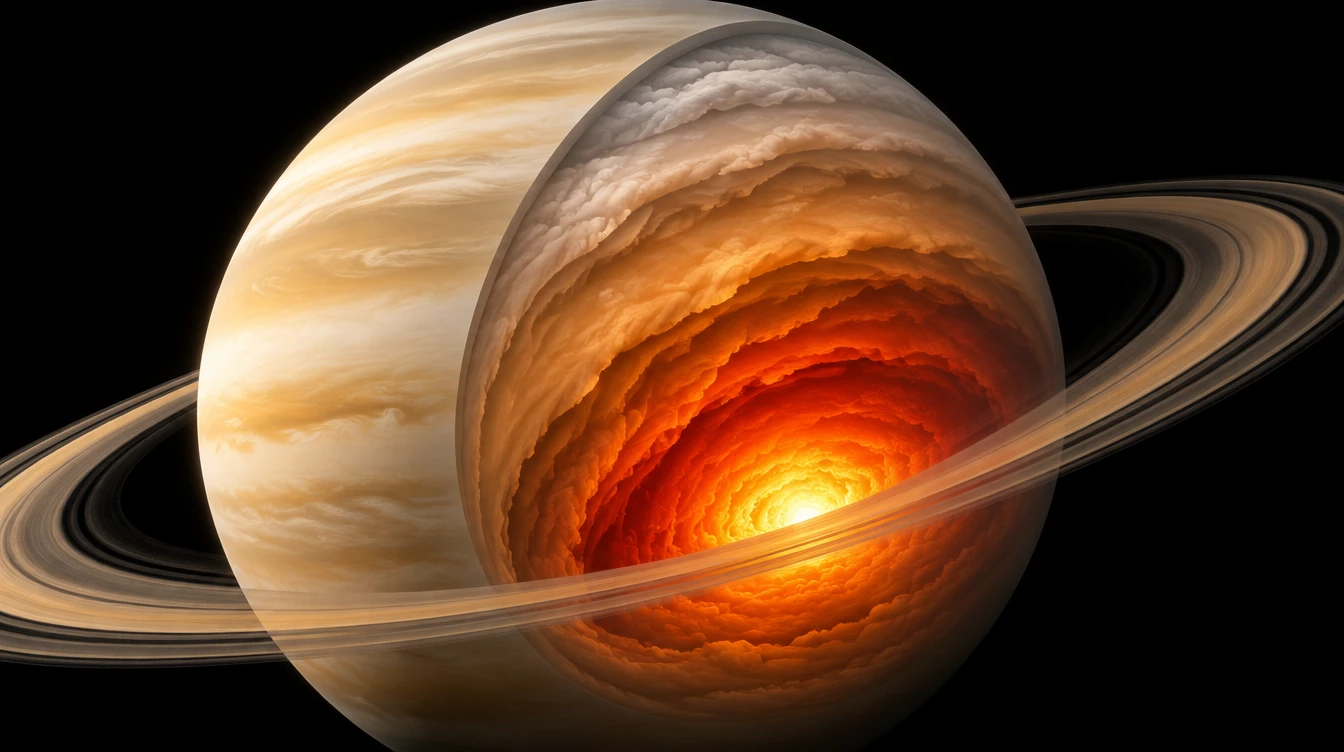
This part is still open. Some of it is heat left over from when Saturn formed. Another leading idea is helium rain: deep inside, helium may separate from hydrogen and sink, releasing energy as it falls. We look at the evidence for helium rain in What Is Saturn Made Of?.

How Hot Is Saturn’s Core?
Thousands of degrees
ESA lists Saturn’s core temperature at “Approx. 12 000K (11 700°C)” (ESA). That’s about twice the temperature of the Sun’s visible surface. But no instrument has measured it. It comes from models of Saturn’s interior that have to match its gravity, size, spin and heat output.
Pressure, not just heat
Deep inside Saturn, enormous pressure squeezes hydrogen so tightly that it conducts electricity like a metal. Those same conditions keep the interior extremely hot. We walk through Saturn’s layers, from cloud tops to its “fuzzy” core, in What Is Saturn Made Of?.
Hot inside, frozen outside
So Saturn is a strange mix: a searing interior, wrapped in a deep atmosphere that gets colder and colder toward the top, until the cloud tops sit about 150 degrees Celsius below freezing.
Saturn’s Hot Spots
A warm cap at the south pole
In 2005, NASA reported that observations with the Keck I telescope in Hawaiʻi had found “the first warm polar cap ever to be discovered in the solar system” at Saturn’s south pole (NASA/JPL, 2005). The observations were taken on February 4, 2004, and the results appeared in Science.
The stratosphere right at the pole measured 151 K (−188 °F), about −122 °C. It was southern summer on Saturn. But lead author Glenn Orton of JPL noted something odd: sunlight alone should warm the pole gradually, yet the temperature jumped abruptly at the pole. “There is nothing like this compact warm ‘cap’ in the Earth’s atmosphere,” he said.
A hot upper atmosphere
High above the clouds, in the thin upper atmosphere called the thermosphere, Saturn is surprisingly hot. For decades, this was called an “energy crisis,” because, as the University of Arizona put it, “the sun is too far from these outer planets to account for the high temperatures” (University of Arizona, 2020).
Solved with Cassini’s last orbits
During Cassini’s 2017 Grand Finale, the spacecraft tracked starlight shining through Saturn’s upper atmosphere. In a 2020 study in Nature Astronomy, Zarah Brown, Tommi Koskinen and colleagues mapped the temperatures and found that electric currents that “spark the auroras and heat the upper atmosphere” deposit energy near the poles, and winds carry it toward the equator, where it roughly doubles the temperatures sunlight alone would produce (University of Arizona, 2020). This explanation is modelled from the Cassini data.

How Does Saturn Compare to Jupiter and Earth?
Saturn vs. Jupiter
Jupiter is closer to the Sun and warmer at the same pressure level. NASA’s fact sheet lists Jupiter at 165 K (−108 °C) at 1 bar, compared with Saturn’s 134 K (NASA NSSDC, Jupiter). Jupiter’s black-body temperature is 109.9 K, versus Saturn’s 81 K.
Saturn vs. Earth
Earth’s black-body temperature is 254 K, and Earth receives about 92 times more sunlight per square meter than Saturn (DCI calculation from NASA NSSDC). Earth’s greenhouse effect warms its surface well above that black-body figure, which is why we’re not frozen.
Saturn vs. its moon Titan
Saturn’s largest moon has a thick atmosphere and a surface you could stand on, but it’s bitterly cold too. We cover NASA’s helicopter mission there in Titan and Dragonfly.
Myth vs. Fact: Saturn’s Temperature
| Myth | Fact | Status |
|---|---|---|
| “Saturn is frozen all the way through.” | Models put its core near 11,700 °C. | Modelled |
| “Saturn only reflects sunlight.” | It emits more than twice the energy it absorbs. | Measured |
| “Saturn has one temperature.” | It ranges from about −189 °C up high to thousands of degrees inside (models). | Measured / Modelled |
| “The poles must be the coldest place.” | A compact warm cap sat at the south pole in 2004. | Observed |
| “Scientists measured the core temperature.” | Core values come from models, not probes. | Modelled |
| “We know exactly why Saturn is so warm inside.” | Leftover heat and helium rain are still debated. | Open |
How Can You Explore Saturn’s Temperature Yourself?
Look for infrared images
Browse Cassini’s infrared images, like PIA21896, in NASA’s Photojournal. Infrared views show heat, not visible color, so read the caption to see what each color stands for.
Compare the fact sheets
NASA’s Saturn fact sheet and Jupiter fact sheet list temperatures at the same pressure levels, so you can compare the two giants side by side.
Find Saturn in the sky
NASA said Saturn reached opposition on October 4, 2026, when it “rises around sunset and stays visible for much of the night” (NASA). It stays in the evening sky for months afterward.
Saturn’s Temperature by the Numbers
| Measure | Value | Source |
|---|---|---|
| Temperature at 1 bar | 134 K (−139 °C) | NASA NSSDC |
| Temperature at 0.1 bar | 84 K (−189 °C) | NASA NSSDC |
| Black-body temperature (sunlight-only reference, not a layer) | 81 K (Earth: 254 K) | NASA NSSDC |
| Sunlight received | 14.82 W/m² (Earth: 1,361) | NASA NSSDC |
| Bond albedo | 0.342 | NASA NSSDC |
| Energy out vs. in | more than twice | NASA/JPL, 2010 |
| South pole stratosphere (2004) | 151 K (−188 °F) | NASA/JPL, 2005 |
| Core temperature (model) | about 12,000 K (11,700 °C) | ESA |
Values are as of November 2026.
Saturn Temperature FAQ
What is the temperature on Saturn?
There isn’t one temperature. At the 1-bar level, about Earth’s sea-level pressure, NASA lists 134 K, or −139 °C. Higher up it drops to about −189 °C, while deep inside models put the core near 11,700 °C. The number depends on how deep you go.
Is Saturn hot or cold?
Both. Its cloud tops are far colder than anywhere on Earth, around −139 °C, because it gets only about 1 percent of Earth’s sunlight. But its interior is extremely hot, and Saturn gives off more than twice the energy it absorbs from the Sun.
How hot is Saturn’s core?
ESA lists it at about 12,000 K, or 11,700 °C, about twice as hot as the Sun’s visible surface. That figure comes from models of Saturn’s interior, not from a measurement, because no spacecraft has reached anywhere near the core.
Why is Saturn so cold?
Mainly distance. Saturn orbits about 9.5 times farther from the Sun than Earth, so each square meter gets only about 1 percent as much sunlight. It also reflects about a third of what arrives. Its own internal heat keeps it warmer than sunlight alone would.
Does Saturn give off its own heat?
Yes. NASA reported in 2010 that Saturn emits more than twice the energy it absorbs from the Sun. Some is leftover heat from its formation, and helium raining deep inside may add more, though scientists are still working out the details.
What is the warm spot at Saturn’s south pole?
In 2004, the Keck telescope found a compact warm cap at Saturn’s south pole, the first of its kind found in the solar system. The stratosphere there measured 151 K, about −122 °C, during Saturn’s southern summer.
Is Saturn colder than Jupiter?
Yes. At the same 1-bar pressure level, NASA lists Jupiter at 165 K, or −108 °C, and Saturn at 134 K, or −139 °C. Jupiter is closer to the Sun and gets more than three times as much sunlight per square meter.
Could a human survive on Saturn?
No. There’s no surface to stand on, the air is mostly hydrogen and helium, the cloud tops are around −139 °C, and the pressure and heat rise to crushing levels as you sink. Even spacecraft only study Saturn from orbit or burn up entering it.
Your next step: pull up Cassini’s infrared image of Saturn’s glowing interior next to a natural-color view of the same planet. You’ll be looking at the cold outside and the hot inside of the same world.

Sources and Further Reading
- NASA Space Science Data Coordinated Archive, Saturn Fact Sheet; Jupiter Fact Sheet.
- ESA, Facts about Saturn.
- NASA/JPL (November 10, 2010), Cassini Sees Saturn on a Cosmic Dimmer Switch, on Li et al. in Journal of Geophysical Research–Planets.
- NASA/JPL (February 3, 2005), Saturn’s Bull’s-Eye Marks Its Hot Spot, on Orton et al., Science (2005).
- University of Arizona (April 6, 2020), What Makes Saturn’s Upper Atmosphere So Hot, on Brown et al. 2020, Nature Astronomy.
- NASA, PIA21896: Impact Site: Infrared Image; PIA21351: The North.
- NASA Science, Sun: Facts; Saturn: Facts; What’s Up: October 2026.
Explore Next
- The full Saturn guide: Saturn: Facts, Rings, Moons and Your Questions
- What’s inside, from clouds to fuzzy core: What Is Saturn Made Of?
- Why Saturn gets so little sunlight: How Far Is Saturn?
- Why its poles change color with the seasons: What Color Is Saturn?
- Size, mass and gravity: How Big Is Saturn?
- Temperatures across the cosmos: How Cold Is Space?
- The warmer giant next door: What Is Jupiter Made Of?
- How a claim earns its label: How We Know
How This Explainer Was Checked
Every number in this article was checked in November 2026 against the source linked beside it: NASA’s Saturn and Jupiter fact sheets, ESA’s Saturn facts, NASA/JPL’s 2010 and 2005 releases, the University of Arizona’s 2020 release on the Cassini Grand Finale study, and NASA’s image pages. Cloud-top and upper-atmosphere temperatures and heat output are labelled Measured. The core temperature and the explanation for the hot upper atmosphere are labelled Modelled. The source of Saturn’s extra heat is labelled Open. Fahrenheit conversions, the sunlight percentage and the Earth comparison are DCI calculations. Where ESA and NASA list different cloud-top values, we explain the difference and use NASA’s 1-bar value. Images are labelled: real spacecraft images as OBSERVATION, illustrations as ILLUSTRATION, and our charts as DATA GRAPHIC. Nothing AI-generated is presented as a real image.

Final Thought: A Furnace Wrapped in Ice
From far away, Saturn looks calm and cold, and at its cloud tops it is. But underneath, it’s a furnace, still pouring out more heat than the Sun gives it, billions of years after it formed. Every bright photo of Saturn’s rings and bands is the cold surface of a world that’s still burning inside.
About the Author
Author: King | Founder of Dark Cosmic Insights
King is the founder of Dark Cosmic Insights, a science storytelling platform exploring the strangest true stories hiding in space, science and AI. He digs into NASA, ESA and peer-reviewed research, separates what has been measured from what is still a mystery, and turns it into articles, data graphics and Shorts.
Follow the anomaly. Trace the source.