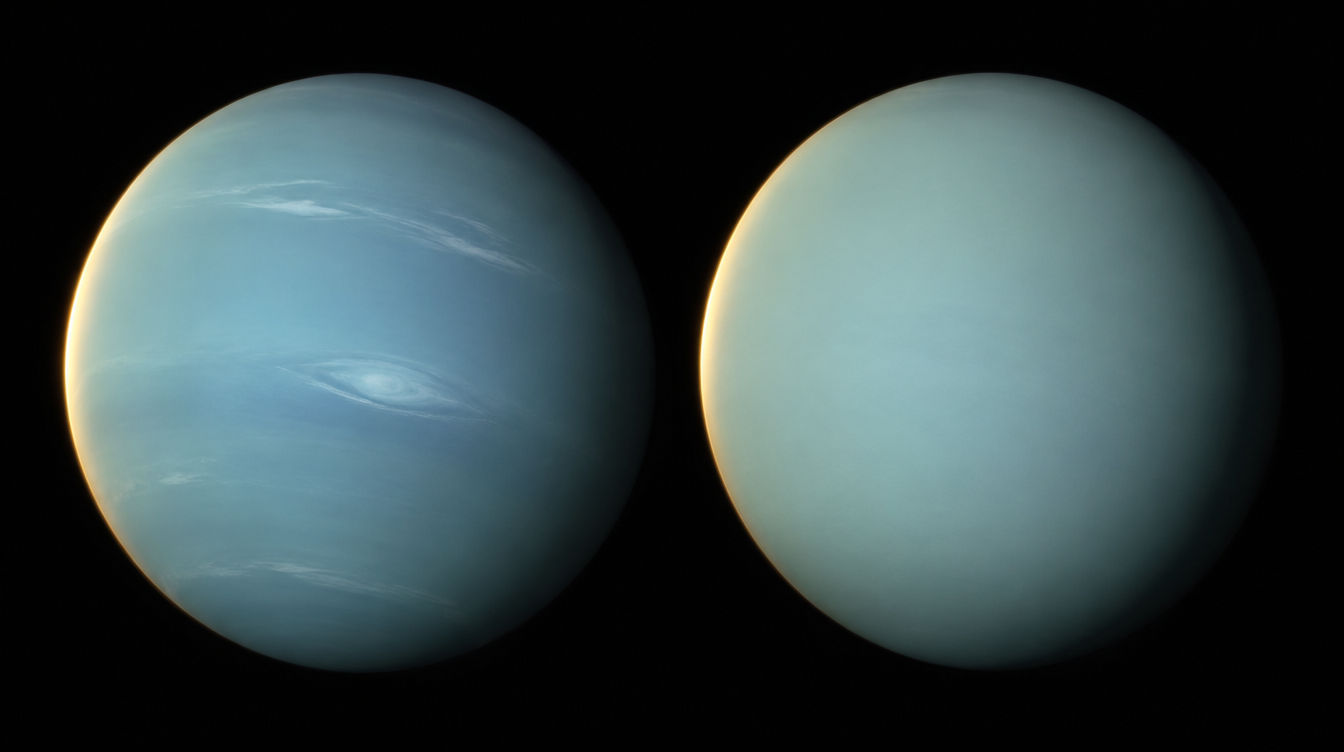
Ask “why is Neptune blue?” and most people picture one image. In August 1989, NASA’s Voyager 2 flew past Neptune, the only spacecraft ever to do so, and its pictures defined the planet for a generation: a rich, deep blue world streaked with white clouds. Uranus, imaged by the same spacecraft in 1986, looked paler and greener beside it.
Here’s the twist. In January 2024, a team led by Patrick Irwin of the University of Oxford reported that the two planets are “far closer in colour than typically thought” (Royal Astronomical Society, January 2024). Neptune’s deep blue in those early images had been contrast-enhanced to bring out its clouds. So how blue is Neptune really, and what makes it blue at all? This guide covers the measured color, the physics of methane and haze, and the parts scientists are still arguing about.
Observed, modelled, open. Neptune’s color in visible light is measured, from Hubble and ground-based spectra, and the processing of the early Voyager images is documented. That methane absorbs red light is measured. Why Neptune looks slightly bluer than Uranus, a thinner haze layer, is modelled. Why Neptune’s haze is thinner, and what makes its dark storms dark, are still open.
Quick Answer: Why Is Neptune Blue?
Neptune is blue because methane gas in its atmosphere absorbs red light, so the sunlight that bounces back toward us is shifted toward blue and green (NASA Science, Webb and Neptune). But it isn’t the deep royal blue of the famous Voyager 2 pictures. A 2024 study in Monthly Notices of the Royal Astronomical Society found Neptune is a pale greenish blue, close to Uranus, with a slightly bluer tinge that the authors’ model attributes to a thinner haze layer (Irwin et al. 2024).
What this article can and cannot establish. It can show you how Neptune’s true color was measured, why the old images looked darker and bluer, and which explanations rest on spectra and which rest on models. It cannot tell you exactly how Neptune would look to your own eyes from orbit, because “true color” images are reconstructions that depend on processing choices, and no person has seen Neptune up close. It also cannot settle why Neptune’s haze is thinner, because that is still a proposed mechanism.
Table of Contents
The DCI Evidence Map: Neptune’s Color
| Question | What we know | Status | Key source |
|---|---|---|---|
| What color is Neptune in visible light? | A pale greenish blue, slightly bluer than Uranus, from Hubble STIS and VLT MUSE spectra | Measured | Irwin et al. 2024 |
| Is Voyager 2’s deep blue Neptune’s true color? | No: the early images were contrast-enhanced and not true color | Not supported | Irwin et al. 2024 · NASA, PIA02210 |
| What does methane do to sunlight? | It absorbs red and infrared light | Measured | NASA Science, Webb · NASA, Uranus Facts |
| Why is Neptune slightly bluer than Uranus? | A thinner haze layer near 1–2 bar; in the 2022 model, about half Uranus’s opacity near 2 bar | Modelled | Irwin et al. 2022 · Irwin et al. 2024 |
| Why is Neptune’s haze thinner? | One proposed mechanism: more “methane snow” in a more turbulent atmosphere | Open | Gemini/NOIRLab, May 2022 |
| Does Uranus’s color change with its seasons? | Yes: greener at solstices, bluer at equinoxes, in brightness data from 1950–2016 | Measured | Irwin et al. 2024 |
| What drives Uranus’s seasonal color change? | Less methane near the poles plus a brightening polar haze, possibly methane ice | Modelled | Irwin et al. 2024 |
| Did Voyager 2 see a Great Dark Spot? | Yes, in 1989; it has since disappeared | Observed | NASA, Neptune Facts |
| What makes Neptune’s dark spots dark? | For one spot studied with VLT MUSE, a clearing in the clouds was ruled out; dark particles below the main haze are favored. The exact mechanism is unresolved | Open | ESO, August 24, 2023 · Irwin et al. 2022 |
Status key: Observed = seen directly in images or data. Measured = a number, spectrum or detection with stated uncertainty. Modelled = inferred from measurements through a physical model, dependent on assumptions. Open = unresolved; the evidence is incomplete or points different ways. Not supported = the evidence goes against the claim, or there is none for it.
Cite this framework: “DCI Evidence Map: Neptune’s Color,” Dark Cosmic Insights, November 2026, darkcosmicinsights.com/why-is-neptune-blue/.
What Color Is Neptune Really?
The short version: Neptune is a pale greenish blue, a close cousin of Uranus. The Royal Astronomical Society’s summary of the 2024 study says both planets are a similar greenish blue, with Neptune carrying a slightly bluer tinge (RAS, January 2024).
The paper itself is careful with its words. It says Neptune “appears slightly more blue” than Uranus when both are scaled to the same maximum brightness, and that “the difference in colour is not very great” (Irwin et al. 2024). In its introduction, the paper notes that both planets have long looked blue-green to astronomers observing them by eye.
The difference between Neptune and Uranus is real, but it is small, much smaller than the side-by-side Voyager images suggested.
What “true color” means here
A true-color image tries to show a planet the way a human eye would see it under the same light. A spacecraft camera doesn’t do this on its own. It takes separate black-and-white frames through different color filters, and people combine them afterward. How those frames are weighted and stretched decides the final look.
So “Neptune’s true color” is a careful reconstruction, not a snapshot. The 2024 team rebuilt it from spectra.
For more on how space images are assembled, and when “enhanced” or “false color” is the honest label, see our guide Are Space Photos Real?
Why Did Voyager 2’s Neptune Image Look So Blue?
Voyager 2 reached Neptune in the summer of 1989, with closest approach on August 25, 1989, about 4,800 km (2,980 miles) above the cloud tops (NASA Science, Voyager 2). It remains the only spacecraft to visit Uranus and Neptune.
The camera took images through separate filters. NASA’s classic full-disk portrait, catalogued as PIA01492, was “produced from the last whole planet images taken through the green and orange filters” of Voyager 2’s narrow-angle camera, about 4.4 million miles (7.1 million km) from the planet (NASA Photojournal, PIA01492).
Here’s the key detail. Many early Neptune images were processed to make faint cloud features easier to see. NASA’s own caption for PIA02210, taken on August 14, 1989, calls it a “contrast enhanced color picture of Neptune” (NASA Photojournal, PIA02210). That suited the science: researchers wanted to track storms and winds.
The 2024 paper spells out the consequence. The color images released right after the flybys of Uranus in 1986 and Neptune in 1989 were, for Neptune, “contrast-enhanced to accentuate faint, dark features” and are not true color (Irwin et al. 2024). The RAS summary adds that this contrast enhancement made Neptune look too blue, while Voyager’s Uranus images were closer to true color (RAS).
Why the myth stuck
The paper says the idea that these were true-color images has persisted even though several earlier authors had pointed out otherwise (Irwin et al. 2024). Once a picture becomes iconic, its caption often gets dropped and the enhanced version becomes “the” Neptune.
Nobody faked anything. The images did what they were made to do; the problem was treating a science-processed image as a portrait.

How Did Scientists Work Out Neptune’s True Color?
The 2024 study, “Modelling the seasonal cycle of Uranus’s colour and magnitude, and comparison with Neptune,” was published online on January 5, 2024 in Monthly Notices of the Royal Astronomical Society, volume 527 (Irwin et al. 2024). Its twelve authors include Leigh Fletcher of the University of Leicester and Amy Simon of NASA Goddard.
Instead of guessing how to weight filter images, the team started with spectra: measurements of how much light each planet reflects at each wavelength.
The instruments
- Hubble’s Space Telescope Imaging Spectrograph (STIS), covering 300 to 1,000 nanometers (nm) at a 1 nm step. A nanometer is a billionth of a meter; the range spans the visible colors, with a little ultraviolet and near-infrared on either side. The STIS observations date from 2002 for Uranus and 2003 for Neptune (Irwin et al. 2024).
- MUSE, the Multi Unit Spectroscopic Explorer on the European Southern Observatory’s Very Large Telescope, covering 473 to 933 nm (Irwin et al. 2024).
Because a spectrograph records the full spread of colors at each point, the team could calculate what a human eye would register, using a standard color system for screens (sRGB), and then use that answer to rebalance the old filter images. The RAS release says they re-balanced both Voyager 2 composites and Hubble’s Wide Field Camera 3 (WFC3) images this way (RAS).
One fair comparison
Neptune is much farther from the Sun, so it gets less light. The paper puts Uranus at 19.2 astronomical units (au) and Neptune at 30.1 au, where 1 au is Earth’s average distance from the Sun, and scales Neptune’s brightness to compensate (Irwin et al. 2024).
According to the RAS release, Irwin described it as the first study to fit a quantitative model to imaging data to explain Uranus’s color changes (RAS). The result for Neptune: once both planets get the same careful processing, their colors look far more alike than the 1986 and 1989 releases implied.
One caveat belongs right here. A reconstructed color still involves choices, such as the brightness curve used for screens (the paper used a standard value, γ = 2.4). Two careful teams could produce slightly different shades. What the spectra pin down firmly is the relationship: Neptune and Uranus are similar, and Neptune is only slightly bluer.
How Does Methane Make Neptune Blue?
Now to the physics underneath the color. Neptune’s atmosphere is mostly hydrogen and helium. NASA’s fact sheet lists it, by volume, as about 80.0% hydrogen (±3.2%), 19.0% helium (±3.2%) and 1.5% methane (±0.5%) (NASA NSSDC, Neptune Fact Sheet).
Hydrogen and helium don’t add much color. Methane (CH₄, the same gas as natural gas on Earth) does. NASA’s Webb team explains that methane in Neptune’s atmosphere strongly absorbs red and infrared light (NASA Science, Webb). NASA’s Uranus page puts the same idea simply: methane “absorbs the red portion of the light, resulting in a blue-green color” (NASA Science, Uranus Facts).
Step by step
- Sunlight arrives. White light holds every color.
- Light sinks in. It travels down through gas and haze layers.
- Methane takes red. Red and infrared are absorbed; the deeper light goes, the more red is lost.
- Haze reflects. Particles scatter light back up.
- Blue-green escapes. Light short on red reaches us, so the planet looks blue-green.

Why “blue” isn’t the whole story
NASA’s Neptune facts page says methane “absorbs other colors but reflects blue” (NASA Science, Neptune Facts). The research papers add haze: it decides how deep light goes before bouncing back, which changes the final shade.
How much methane each planet holds depends on the source, the depth and the method, so we attribute each figure rather than compare them. NASA’s fact sheets list methane at 2.3% by volume for Uranus and 1.5% (±0.5%) for Neptune (NASA NSSDC, Uranus Fact Sheet; Neptune Fact Sheet). For Uranus alone, the 2024 paper cites Karkoschka and Tomasko (2009) for methane falling from 4–5% at equatorial latitudes to 2–3% at the poles, and its introduction gives 2–5% for the observable atmospheres of both planets, citing Atreya et al. (2020) (Irwin et al. 2024). These figures don’t settle which planet has more methane. What the 2022 model shows is that the color difference can be explained by haze, without needing a methane difference (Gemini/NOIRLab).
Neptune vs. Uranus Color: Why Is Neptune Slightly Bluer?
The two planets are close in size: NASA gives equatorial diameters of 49,528 km (30,775 miles) for Neptune and 51,118 km (31,763 miles) for Uranus (NASA, Neptune Facts; NASA, Uranus Facts). The Gemini Observatory release on the 2022 study describes them as similar in mass, size and atmospheric composition (Gemini/NOIRLab, May 31, 2022). So why the slight color gap?
The three-layer haze model (2022)
In 2022, Irwin and colleagues published “Hazy Blue Worlds: A Holistic Aerosol Model for Uranus and Neptune, Including Dark Spots” in the Journal of Geophysical Research: Planets (Irwin et al. 2022). An aerosol is a suspension of tiny particles in a gas; on these planets, that means haze and ice particles. The team reanalysed observations from 0.3 to 2.5 micrometers, from ultraviolet to near-infrared, from Gemini North’s NIFS spectrometer, NASA’s Infrared Telescope Facility and Hubble (Gemini/NOIRLab).
Their model fits both planets with three main layers (Irwin et al. 2022):
- A deep layer with its base below about 5–7 bar, likely hydrogen sulfide ice mixed with photochemical haze. (One bar is roughly Earth’s air pressure at sea level.)
- A haze and ice layer near 1–2 bar, at the level where methane condenses. The Gemini release calls this middle layer Aerosol-2.
- An extended photochemical haze reaching from that level up into the stratosphere.
For Neptune only, the model also needs a thin layer of micron-sized methane ice near 0.2 bar to explain its extra reflection at the wavelengths methane absorbs.
Thinner haze, bluer planet
The key layer is Aerosol-2. According to the Gemini release, it is thicker on Uranus than on Neptune. A thicker haze reflects more light before methane can absorb much red, which “whitens” Uranus’s appearance. On Neptune, a thinner layer lets light go deeper, so more red is absorbed and the blue shows more strongly (Gemini/NOIRLab). The release adds that without this haze, the two planets would look almost equally blue.
The 2022 model also put a number on it. As the 2024 paper summarizes that earlier work, “the opacity of Neptune’s Aerosol-2 layer at ∼2 bar” was found to be roughly half that of Uranus (Irwin et al. 2022; Irwin et al. 2024). Opacity is a measure of how much a layer blocks or scatters light.
Status check: the colors are measured; the haze layers are modelled. Nobody has sampled these layers directly. The model is a structure that reproduces the spectra well across both planets, which is strong evidence, but it is still a model.
Why might Neptune’s haze be thinner?
This is the part that is still open. The Gemini release describes one proposed mechanism. The team suspects methane ice condenses onto haze particles in Aerosol-2 and falls deeper as a “shower of methane snow.” Neptune’s atmosphere is more active and turbulent than Uranus’s, and the team believes this churns methane up into the haze layer more efficiently, making more snow and clearing more haze (Gemini/NOIRLab).
It fits the data, but it is one proposed mechanism, not a measured process, so we label it Open.
Why Is Uranus Blue, and Why Does Its Color Change?
Uranus gets its blue-green color the same way Neptune does: methane absorbing red light (NASA Science, Uranus Facts). What makes Uranus special is that its color changes with its seasons, and that was the main subject of the 2024 paper.
Uranus is tipped on its side, with an axial tilt NASA gives as 97.77 degrees, so over its 84-year orbit each pole spends years facing the Sun (NASA, Uranus Facts; RAS). For the explorer’s tour of that sideways world and its moons, see how many moons Uranus has.
What was measured
Lowell Observatory measured Uranus’s brightness at blue and green wavelengths from 1950 to 2016, and Hubble’s WFC3 added observations from 2016 to 2022 (Irwin et al. 2024). The record shows Uranus looking greener at its solstices and bluer at its equinoxes (RAS).
The paper puts numbers on it: Uranus’s “disc-averaged green reflectivity” changes from about 0.47 to about 0.51 from equinox to solstice, a rise of about 0.04, or roughly 8.5% (DCI’s arithmetic from the paper’s approximate values), and its brightness in the green filter varies by about 0.1 magnitude (Irwin et al. 2024). Disc-averaged means averaged over the planet’s whole visible disk.
What the model says causes it
The team’s model points to two effects (Irwin et al. 2024; RAS):
- Less methane near the poles. With methane at 2–3% near the poles versus 4–5% near the equator (Karkoschka and Tomasko 2009, as cited in the 2024 paper), less red light is absorbed there, so the polar regions reflect more green and red.
- A brightening polar “hood.” A haze over the summer pole grows more reflective, consistent with added particles that are possibly methane ice. When a pole faces us near solstice, that brighter, greener region dominates the disk.
The paper also found that methane depletion alone was not enough to match the spectra; the extra haze reflectivity was needed. That is a model result, so we label the cause Modelled, while the brightness changes themselves are Measured.
The Voyager-era Uranus image
Voyager 2 visited Uranus in 1986, shortly after its southern solstice in September 1985 (Irwin et al. 2024). The paper says Voyager’s Uranus image was approximately true color, though slightly less blue because of its polar hood. With Uranus near its greenest season and Neptune’s images enhanced, the side-by-side pictures exaggerated the gap from both directions.
What Was the Great Dark Spot?
The most famous feature in Voyager 2’s Neptune images is the Great Dark Spot, a large oval storm in the southern hemisphere seen in 1989. NASA says it was “large enough to contain the entire Earth” and has since disappeared (NASA Science, Neptune Facts). A 2024 Hubble release describes it as “the size of the Atlantic Ocean” (NASA Hubble, December 9, 2024). Those are two NASA descriptions of the same storm’s scale, not competing measurements.
Voyager 2 actually found two dark storms in 1989, and both had disappeared before Hubble could observe them, according to NASA (NASA Hubble, December 15, 2020).

Dark spots come and go
Hubble has since watched new dark storms form and fade:
- September 2018: Hubble discovered a new dark storm in Neptune’s northern hemisphere, later measured at 4,600 miles (about 7,400 km) across (NASA Hubble, 2020).
- 2020: The storm, which had been drifting south toward the equator, stopped and began moving north again, which Hubble saw by August 2020. A smaller dark spot, about 3,900 miles (about 6,300 km) across, appeared nearby (NASA Hubble, 2020).
- Lifetimes: NASA’s 2020 release said each dark spot had appeared and faded over roughly two years. Its 2024 OPAL release says these storms last two to six years each (NASA Hubble, 2024).

Why are the spots dark?
This is genuinely open, and the sources describe it differently, so we show both:
- The 2022 haze model found that the spectra of dark spots, including Voyager’s Great Dark Spot and Hubble’s 2018 spot, are best matched by darkening or clearing of the deep aerosol layer alone (Irwin et al. 2022).
- NASA’s 2020 Hubble release said the 2018 storm’s darkness may be due to an elevated dark cloud layer (NASA Hubble, 2020). That work was a conference presentation, not a journal paper.
- In 2023, a team using MUSE on ESO’s Very Large Telescope made what Irwin called “the first detection of a dark spot from the ground.” For the spot they studied, they ruled out a clearing in the clouds and found it is more likely caused by dark particles in a layer below the main visible haze, where ices and hazes mix. The same data also revealed a rare, deep bright cloud type, never identified before, at the same level as the dark spot (ESO, August 24, 2023; Irwin et al. 2023, Nature Astronomy, doi:10.1038/s41550-023-02047-0).
The 2023 result narrows the options for that one spot: darkened particles below the haze, not a gap. But what darkens those particles, and whether every dark spot works the same way, remain open.
Why Does Neptune Look So Different in Webb and Hubble Images?
Webb’s NIRCam camera works in near-infrared light, beyond what our eyes see. Because methane strongly absorbs red and infrared light, Neptune looks dark at those wavelengths, except where high-altitude clouds reflect sunlight before it can be absorbed; those clouds appear as bright streaks and spots (NASA Science, Webb, September 21, 2022).
Hubble’s visible-light images, by contrast, show the familiar blue-green tone. Hubble’s long-running Outer Planet Atmospheres Legacy (OPAL) program, led by Amy Simon of NASA Goddard, photographs each giant planet once a year (STScI MAST, OPAL). NASA’s December 2024 release said OPAL “now spans 10 years and counting” (NASA Hubble, 2024).
Enhanced, true and false color
The honest labels matter:
- True color tries to match what an eye would see. The 2024 rebalanced images aim for this.
- Enhanced color keeps real colors but stretches contrast to show detail. Many early Voyager Neptune images, such as PIA02210, are enhanced.
- False color maps wavelengths to colors that don’t match what we’d see. NASA’s PIA00051 is labelled false color: in it, features deep in the atmosphere appear blue and higher ones white, built from an orange filter and two methane filters (NASA Image Library, PIA00051).
Infrared images like Webb’s show light our eyes can’t see at all. For a side-by-side example of why Hubble and Webb views of the same target look so different, see our explainer on Hubble vs. Webb.
Myth vs. Fact: Is Neptune Really Deep Blue?
| Myth | Fact |
|---|---|
| “Neptune is a deep royal blue.” | It’s a pale greenish blue, close to Uranus, in the 2024 spectra-based study. |
| “Voyager 2’s Neptune picture is a true-color photo.” | Many early Neptune images were contrast-enhanced to show clouds. |
| “NASA faked Neptune’s color.” | The processing served science and was documented, as in PIA02210’s “contrast enhanced” caption. |
| “Neptune is bluer because it has more methane.” | The 2022 model explains the difference with thinner haze on Neptune, not more methane. |
| “Neptune and Uranus are very different colors.” | The paper says “the difference in colour is not very great.” |
| “Uranus is always the same shade.” | It looks greener at solstices and bluer at equinoxes. |
| “The Great Dark Spot is still there.” | It has since disappeared; dark spots on Neptune come and go. |
| “Webb shows Neptune’s real color.” | Webb sees infrared light, where methane makes Neptune look dark. |
The lesson isn’t “don’t trust space photos.” It’s read the caption: NASA’s archives often say exactly how a picture was made.
How Can You See Neptune’s Color Yourself?
You can’t see Neptune with the naked eye, but it’s within reach of binoculars and small telescopes.
Find it
- Opposition 2026: Neptune reached opposition, when it’s opposite the Sun and visible all night, on September 26, 2026 at 2 UTC, in the constellation Pisces, at magnitude +7.8, about 28.9 au from Earth (EarthSky, September 25, 2026). EarthSky’s timings are written for North American readers; elsewhere, use a local sky chart or planetarium app.
- What you’ll see: In binoculars, Neptune looks like a faint star if you know where to look. EarthSky says that to see it as a small disk you need a telescope at about 200x magnification and steady air (EarthSky).
- Next opposition: September 28, 2027 (EarthSky).
Whatever tint you notice in that tiny disk is an impression, filtered by your eyes, your sky and your telescope. That’s exactly why the 2024 team measured spectra instead of trusting eyes or filter images.
Explore the real data
- NASA Photojournal and the NASA Image Library: Search PIA01492 and PIA02210 and read the full captions. Look for words like “contrast enhanced” and “false color.”
- Hubble OPAL data: The program’s processed maps are archived at STScI under DOI 10.17909/T9G593 (STScI MAST, OPAL).
For where Neptune sits among the other planets, and links to every DCI planet guide, open our Solar System Explorer. It already describes Neptune as blue-green, with the Voyager deep blue coming from processing.
What Comes Next for Neptune Color Research?
With Voyager 2 still the only spacecraft to have visited, the next chapters will come from telescopes, and from Uranus.
- Hubble OPAL keeps going. The program images Uranus and Neptune yearly (STScI MAST, OPAL). NASA’s 2024 release reported that Hubble data revealed a link between Neptune’s shifting cloud cover and the 11-year solar cycle, surprising for a world that NASA says gets about 1/1000th of Earth’s sunlight (NASA Hubble, 2024). That link is an observed correlation; the full explanation is still being worked out.
- Uranus’s 2030 solstice. NASA’s 2025 Hubble update says Uranus is approaching its northern summer solstice in 2030, when the Sun will shine almost directly over its north pole (NASA Hubble, March 31, 2025); an older 2024 NASA release gave 2028. Based on the seasonal pattern in the 2024 study, Uranus is expected, not yet observed, to look greener around then. It’s a direct test of the model.
- A Uranus mission, not yet approved. The AAS describes the Uranus Orbiter and Probe as a priority of the most recent Planetary Science Decadal Survey, and the American Astronomical Society reported in April 2026 that the President’s FY2027 budget request provided no funding for it (AAS, April 2026). The AAS piece does not mention any Neptune mission. In the RAS release, Fletcher said work like this will help put a future Uranus mission’s discoveries in a wider context (RAS).
As of November 2026, then, Voyager 2’s 1989 flyby remains the only close-up look anyone has had at Neptune.
Neptune’s Color by the Numbers
- 1.5% (±0.5%): methane share of Neptune’s atmosphere by volume, in NASA’s fact sheet (NASA NSSDC)
- Roughly half: Neptune’s Aerosol-2 haze opacity near 2 bar compared with Uranus’s, in the 2022 model (Irwin et al. 2022)
- August 25, 1989: Voyager 2’s closest approach to Neptune, about 4,800 km (2,980 miles) above the cloud tops (NASA)
- 49,528 km (30,775 miles): Neptune’s equatorial diameter (NASA)
- About 4.5 billion km (2.8 billion miles), or 30 au: Neptune’s average distance from the Sun; sunlight takes about four hours to arrive (NASA)
- 72 K (−201 °C, about −330 °F): temperature at Neptune’s 1-bar level, from NASA’s fact sheet (NASA NSSDC)
- More than 1,200 mph (2,000 km/h): Neptune’s wind speeds, by NASA’s figure (NASA)
- 1950–2016: the span of Lowell Observatory brightness records used to track Uranus’s color changes (Irwin et al. 2024)
- 300–1,000 nm: wavelength range of the Hubble STIS spectra behind the new true-color images (Irwin et al. 2024)
- +7.8: Neptune’s magnitude at its September 2026 opposition, too faint for the naked eye (EarthSky)
Neptune’s Color: FAQ
Is Neptune the same color as Uranus?
Almost. A 2024 study using Hubble and Very Large Telescope spectra found both planets are a similar greenish blue. Neptune has a slightly bluer tinge, which the authors’ model attributes to a thinner haze layer.
Was the famous Voyager 2 picture of Neptune fake?
No. The images were real, but many early ones were contrast-enhanced to make faint clouds and storms easier to study. That processing made Neptune look deeper blue than it is, and the enhanced versions were later mistaken for true color.
What gas gives Neptune its blue tint?
Methane. It makes up about 1.5% of Neptune’s atmosphere by volume in NASA’s fact sheet, and it absorbs red and infrared light. The sunlight reflected back to us is short on red, so the planet looks blue-green.
Does Uranus change color over time?
Yes. Brightness records from 1950 to 2016 show Uranus looking greener at its solstices and bluer at its equinoxes. A 2024 model links this to less methane near the poles and a brightening polar haze.
Is Neptune’s Great Dark Spot still there?
No. Voyager 2 saw it in 1989, and NASA says it has since disappeared. Hubble has watched newer dark storms form and fade, each lasting about two to six years by NASA’s 2024 account.
Why does Neptune look white or grey in Webb’s pictures?
Webb photographs Neptune in near-infrared light. Methane absorbs infrared strongly, so the planet looks dark there, while high methane-ice clouds and the rings stand out brightly.
Can you see Neptune’s color through a backyard telescope?
You can find Neptune with binoculars if you know where to look, but it looks like a faint star. EarthSky says a telescope at about 200x magnification and steady air shows it as a small disk, and any tint you see is filtered by your eyes and sky.
How many spacecraft have visited Neptune?
One. NASA’s Voyager 2 made its closest approach on August 25, 1989, and NASA says it is the only spacecraft to visit Uranus and Neptune. Everything since has come from telescopes such as Hubble and Webb.
Your next step: open NASA’s PIA02210 page and read the first line of its caption, the words “contrast enhanced” are right there. Then compare it with PIA01492, and with the rebalanced images in the RAS release. Seeing the same planet three ways is the fastest way to understand what “true color” really means.
Sources and Further Reading
- Irwin, P. G. J., Dobinson, J., James, A., Teanby, N. A., Simon, A. A., Fletcher, L. N., Roman, M. T., Orton, G. S., Wong, M. H., Toledo, D., Pérez-Hoyos, S., & Beck, J. (2024). Modelling the seasonal cycle of Uranus’s colour and magnitude, and comparison with Neptune. Monthly Notices of the Royal Astronomical Society, 527(4), 11521–11538. doi:10.1093/mnras/stad3761
- Irwin, P. G. J., Teanby, N. A., Fletcher, L. N., Toledo, D., Orton, G. S., Wong, M. H., Roman, M. T., Pérez-Hoyos, S., James, A., & Dobinson, J. (2022). Hazy Blue Worlds: A Holistic Aerosol Model for Uranus and Neptune, Including Dark Spots. Journal of Geophysical Research: Planets, 127(6), e2022JE007189. doi:10.1029/2022JE007189 (record confirmed via the University of Bristol research portal)
- Royal Astronomical Society (January 2024), New images reveal what Neptune and Uranus really look like.
- Irwin, P. G. J., Dobinson, J., James, A., Wong, M. H., Fletcher, L. N., Roman, M. T., Teanby, N. A., Toledo, D., Orton, G. S., Pérez-Hoyos, S., Sánchez-Lavega, A., Sromovsky, L., Simon, A. A., Morales-Juberías, R., de Pater, I., & Cook, S. L. (2023). Spectral determination of the colour and vertical structure of dark spots in Neptune’s atmosphere. Nature Astronomy. doi:10.1038/s41550-023-02047-0
- ESO (August 24, 2023), Neptune dark spot observed from Earth for the first time (eso2314).
- Gemini Observatory / NSF NOIRLab (May 31, 2022), Gemini North Telescope Helps Explain Why Uranus and Neptune Are Different Colors.
- NASA Science, Neptune Facts and Neptune (updated October 26, 2026); Uranus Facts (updated October 15, 2026).
- NASA Space Science Data Coordinated Archive, Neptune Fact Sheet (updated October 3, 2024) and Uranus Fact Sheet (updated October 2, 2024).
- NASA Science, Voyager 2 (updated September 28, 2026).
- NASA Photojournal, PIA01492: Neptune Full Disk View; PIA02210: Neptune; NASA Image Library, PIA00051: Neptune in False Color.
- NASA Science (September 21, 2022), New Webb Image Captures Clearest View of Neptune’s Rings in Decades.
- NASA Science (December 15, 2020), Dark Storm on Neptune Reverses Direction, Possibly Shedding a Fragment. Based on M. H. Wong et al., AGU Fall Meeting presentation, 2020.
- NASA Science (December 9, 2024), NASA’s Hubble Celebrates Decade of Tracking Outer Planets.
- NASA Science (March 31, 2025), 20-Year Hubble Study of Uranus Yields New Atmospheric Insights.
- STScI MAST, Outer Planet Atmospheres Legacy (OPAL) High Level Science Product, doi:10.17909/T9G593.
- EarthSky (September 25, 2026), Neptune at opposition: closest, brightest, best.
- American Astronomical Society (April 2026), FY27 President’s Budget Request: NASA, NSF and DOE Details.
Explore Next
- Triton and the rest of Neptune’s family: How Many Moons Does Neptune Have?
- Neptune’s ice-giant twin, tipped on its side: How Many Moons Does Uranus Have?
- Enhanced, false and true color, explained: Are Space Photos Real?
- Why the same target looks different in visible and infrared light: Hubble vs. Webb
- Every planet, its moons and our guides: Solar System Explorer
- How a claim earns its label: How We Know
- Read next: How Old Is the Universe?
- Read next: What Is a Black Hole?
- Read next: What Is Dark Matter?
- Read next: What Is Tidal Locking?
How This Explainer Was Checked
Every number in this article was checked in November 2026 against the source linked beside it: three peer-reviewed Irwin et al. papers (2022 in JGR Planets, 2023 in Nature Astronomy, 2024 in MNRAS), the RAS, ESO and Gemini/NOIRLab releases that summarise them, NASA Science, NSSDC fact sheets and Photojournal captions, NASA Hubble and Webb releases, STScI’s OPAL archive, EarthSky and the AAS. Neptune’s visible color, the Uranus brightness record and methane’s absorption of red light are labelled Measured; the haze layers and the causes of Uranus’s seasonal color change are labelled Modelled; why Neptune’s haze is thinner (“one proposed mechanism”) and what darkens Neptune’s dark spots are labelled Open; the claim that Voyager’s deep blue is Neptune’s true color is labelled Not supported. Where sources differ, as for methane abundance, the dark spots’ cause and their lifetimes, we show each with its original source; methane figures from different methods and depths are attributed, not compared. The haze-opacity ratio is dated to the 2022 model. Mile, kilometer and temperature conversions not given by a source are DCI’s arithmetic. The rebalanced 2024 images are licensed CC BY 4.0 and are linked rather than reproduced. Images are labelled: real spacecraft images as OBSERVATION, with “enhanced color” where NASA says so, illustrations as ILLUSTRATION, and our charts as DATA GRAPHIC. Nothing AI-generated is presented as a real image.
Final Thought: The Color Was in the Caption All Along
Neptune didn’t change color in 2024. Our picture of it did. The deep blue world on posters and textbook covers was a science image doing its job, sharpened to reveal storms, and then asked to do a different job it was never built for. Underneath, the real story is just as beautiful: a pale greenish-blue giant, tinted by methane, with a slightly thinner veil of haze than its twin. The next time you see a space photo you love, read the caption. That’s where the truth usually is.
About the Author
Author: King | Founder of Dark Cosmic Insights
King is the founder of Dark Cosmic Insights, a science storytelling platform exploring the strangest true stories hiding in space, science and AI. He digs into NASA, ESA and peer-reviewed research, separates what has been measured from what is still a mystery, and turns it into articles, data graphics and Shorts.
Follow the anomaly. Trace the source.