One of Mars’s moons is falling. Every century, Phobos sinks about 3.8 m (12.5 feet) closer to the planet, roughly the height of two tall people stacked up, and the tides it raises on Mars are what drag it down. Run that forward far enough and the moon either smashes into the surface or is torn into a ring.
Mars’s other moon, Deimos, is predicted to be doing the opposite: drifting outward, too slowly for the data to pin down yet. So how many moons does Mars have? Two, as of November 2026. But the better question is why two tiny, potato-shaped rocks around the same planet are heading in opposite directions, and where they came from in the first place. This guide covers what they look like, how they move, what will happen to them, and how we know.
Observed, modelled, open. The moons’ sizes, shapes and orbits are measured by spacecraft. Phobos’s inward drift is measured from its changing position. Its final breakup or impact is modelled, not observed. And whether the moons are captured asteroids or debris from a giant impact on Mars is still open.
Quick Answer: How Many Moons Does Mars Have?
Mars has two moons, Phobos and Deimos, both discovered by the American astronomer Asaph Hall in August 1877 (NASA Science, Mars Moons). As of November 2026, NASA JPL’s satellite list still counts two for Mars (JPL Solar System Dynamics). Both are small and irregular: Phobos measures about 27 × 22 × 18 km (17 × 14 × 11 miles), and Deimos about 15 × 12 × 11 km (9 × 7 × 6.8 miles) (NASA, Phobos; NASA, Deimos). Phobos is measured spiralling inward; Deimos is expected to be drifting slowly outward.
What this article can and cannot establish. It can give you the measured sizes and orbits, explain why Phobos is sinking, and lay out the competing origin ideas with the evidence behind each. It cannot tell you exactly when Phobos will break up, because that depends on how strong its interior is, which nobody has measured directly. And it cannot settle where the moons came from: that is what samples from Phobos are meant to test. For how Mars’s count compares with every other planet, see our dated table in Which Planet Has the Most Moons?
Table of Contents
The DCI Evidence Map: Mars’s Two Moons
| Question | What we know | Status | Key source |
|---|---|---|---|
| How many moons does Mars have? | Two, Phobos and Deimos (as of November 2026) | Observed | JPL SSD |
| How big are they? | Mean radius 11.08 km (Phobos) and 6.2 km (Deimos) | Measured | JPL SSD, physical parameters |
| How fast do they orbit? | Phobos every 0.3187 days, Deimos every 1.2625 days | Measured | JPL SSD, mean elements |
| Are they tidally locked? | Yes, both keep the same face toward Mars | Observed | National Academies, 2019 |
| Is Phobos moving closer to Mars? | Yes, by about 3.8 m per century in the 2025 JPL orbit fit; older NASA summaries say 1.8 to 2 m | Measured | Brozović et al. 2025, AJ; NASA, Phobos |
| When will Phobos break up or hit Mars? | In roughly 20 to 50 million years, depending on the model | Modelled | Black & Mittal 2015; NASA, 2015 |
| Are Phobos’s grooves “stretch marks” from tides? | One leading model says so; other causes have been proposed | Modelled | NASA, 2015 |
| Is Deimos moving away from Mars? | Expected to be, very slowly; the data can’t yet resolve the exact rate | Modelled | Bagheri et al. 2021; Madeira et al. 2023 |
| Where did the moons come from? | Capture, giant impact or a torn-apart asteroid are all proposed | Open | Kegerreis et al.; Eos, 2023 |
| Is Phobos a solid chunk of rock? | Its low density suggests a porous body | Measured (density), Modelled (interior) | ESA Mars Express |
Status key: Observed = seen directly. Measured = a number with stated uncertainty. Modelled = calculated, dependent on assumptions. Open = unresolved. Not supported = contradicted by evidence.
Cite this framework: “DCI Evidence Map: Mars’s Two Moons,” Dark Cosmic Insights, November 2026, darkcosmicinsights.com/how-many-moons-does-mars-have/.
Who Discovered Phobos and Deimos, and When?
Mars’s moons were found in Washington, D.C. The U.S. Naval Observatory’s 26-inch (66 cm) “Great Equatorial” refractor, built by Alvan Clark & Sons, saw first light in November 1873, and less than four years later Asaph Hall used it to find “the two moons of Mars, Phobos and Deimos” over a run of August nights in 1877 (U.S. Naval Observatory, November 13, 2023).
The exact dates depend on which event you count and which clock you use:
- Deimos. NASA gives August 11, 1877 (NASA, Deimos). Astronomy magazine says Hall first spotted it on August 11, lost it to bad weather, and “conclusively discovered Deimos” the next evening, August 12 (Astronomy).
- Phobos. NASA gives August 17, 1877 (NASA, Phobos). The Linda Hall Library describes Hall relocating the outer moon that night, along with a second moon that was closer and larger (Linda Hall Library).
Part of the mismatch is a clock convention: until 1925, astronomers began the day at noon, so in Universal Time the discoveries fall on August 12 (Deimos) and August 18 (Phobos) (Wikipedia, Moons of Mars). What everyone agrees on: Hall found both moons in mid-August 1877, Deimos first.
Where the names come from
Hall named them after the mythological sons of Ares, the Greek counterpart of Mars. Phobos means fear and Deimos means dread (NASA, Phobos; NASA, Deimos). The names were suggested by Henry Madan, science master at Eton, drawing on Book XV of the Iliad (Wikipedia, Moons of Mars). Phobos’s biggest crater, Stickney, is named for Chloe Angeline Stickney Hall, a mathematician and Asaph Hall’s wife (NASA, Phobos).
What Do Phobos and Deimos Look Like?
Forget the round, bright moon you see from Earth. ESA describes both as looking like “battered potatoes” and “blacker than coal” (ESA Kids, Phobos and Deimos).

Phobos: grooves and a giant crater
Phobos is the larger moon, about 27 by 22 by 18 km (17 by 14 by 11 miles) (NASA, Phobos). JPL gives its mean radius as 11.08 ± 0.04 km, which works out to a mean diameter of about 22.2 km (13.8 miles) (JPL SSD).
Its signature feature is Stickney crater. NASA’s Phobos page gives two figures for its width, 9 km (5.6 miles) in one passage and about 9.7 km (6 miles) in another, so call it roughly 9 to 10 km across (NASA, Phobos). On a moon this small, that is enormous: NASA describes Phobos as “nearly shattered by a giant impact.”
Phobos is also striped with long grooves and crater chains, which NASA’s HiRISE camera photographed from about 6,800 km (4,200 miles) away in March 2008 (NASA Photojournal, PIA10368). What made the grooves is debated; more below.
Surface temperatures swing hard. NASA gives a daytime high of about −4 °C (25 °F, 269 K) and a nighttime low of about −112 °C (−170 °F, 161 K) (NASA, Phobos).
Deimos: smooth and dusty
Deimos is smaller, about 15 by 12 by 11 km (9 by 7 by 6.8 miles) (NASA, Deimos), with a mean radius of 6.2 ± 0.24 km, or a mean diameter of about 12.4 km (7.7 miles) (JPL SSD).
It looks softer than Phobos. Its largest crater is only about 2.3 km (1.4 miles) wide, and it lacks Phobos’s grooves and ridges. NASA says it is blanketed by a thick layer of regolith, the loose, broken rock and dust that covers airless worlds, “perhaps as deep as 328 feet (100 meters)” (NASA, Deimos). A 1977 Viking caption put the regolith covering many craters at about 50 m thick (NASA NSSDCA, Viking 2 image), so treat the depth as an estimate that varies by place and method.
HiRISE images from February 21, 2009 show the surface as smooth and reddish, with fresh craters and ridges looking less red (NASA Photojournal, PIA11826).
Why are they potato-shaped?
Because they are too small to be round. A body only pulls itself into a sphere when its gravity is strong enough to overcome the stiffness of its own rock. The Open University puts the threshold for icy bodies at roughly 400 km in diameter, and higher for rocky ones, and says Phobos is “far too small to have enough gravity to pull itself into a sphere” (OpenLearn, Moons of our Solar System).
Low density adds to the picture. JPL gives Phobos a mean density of 1.872 g/cm³ and Deimos 1.471 g/cm³, against 3.344 g/cm³ for Earth’s Moon (JPL SSD). ESA, using its own Mars Express measurement of 1.86 g/cm³ for Phobos, called that “unexpectedly low,” pointing to a porous body rather than solid rock (ESA Mars Express). A loosely packed rubble pile, a heap of fragments held together mostly by gravity, is one way to get there.
How Do Phobos and Deimos Orbit Mars?
The two moons circle Mars at very different distances.
- Phobos orbits 9,375 km (5,825 miles) from Mars’s centre, once every 0.3187 days, or about 7 hours 39 minutes (JPL SSD, mean elements). That’s about 6,000 km (3,700 miles) above the surface, which NASA says is closer to its planet than any other moon in the solar system (NASA, 2015).
- Deimos orbits 23,457 km (14,576 miles) from Mars’s centre, once every 1.2625 days, or about 30 hours 18 minutes (JPL SSD, mean elements).
For comparison, Mars spins once every 1.02595676 days, about 24 hours 37 minutes (JPL SSD, planetary parameters). So Phobos laps the planet roughly three times a day, while Deimos takes a little longer than a day per orbit. That one difference, faster or slower than Mars’s spin, decides each moon’s fate.
What is tidal locking?
Tidal locking, also called synchronous rotation, is when a moon spins on its axis in exactly the time it takes to orbit its planet, so it always shows the planet the same face. NASA’s example is our own Moon, which turns once per trip around Earth (NASA Science, Tidal Locking).
Both Martian moons do this: they “are tidally locked, always presenting the same face toward Mars” (National Academies, 2019). A tidally locked moon still spins. It just spins in step with its orbit.
What would they look like from Mars’s surface?
Strange. Because Phobos orbits faster than Mars turns, it runs backwards across the sky. Answering a reader question for Astronomy, planetary scientist Mark Lemmon of Texas A&M University explained that Phobos crosses the Martian sky from west to east in about four hours, looking “obviously non-round,” while Deimos rises in the east and sets in the west like a normal moon (Astronomy, 2015). Phobos hugs the planet so tightly that from some places on Mars it cannot always be seen (NASA Science, Mars Moons).
Will Phobos Crash Into Mars?
Probably, or it breaks up first, but not for tens of millions of years. The ending is modelled, not observed.
Why Phobos is sinking
Phobos raises a small tidal bulge on Mars. Because Phobos orbits faster than Mars spins, that bulge lags behind the moon, and its gravity tugs Phobos backward, so the moon loses orbital energy and spirals inward. JPL’s orbit modellers measure this as a steady tidal acceleration of Phobos along its orbit, first spotted in telescope data back in 1945 (Brozović et al. 2025, AJ).
The drift is measured. The newest orbit solution, by JPL’s Marina Brozović, Robert Jacobson and Ryan Park, fits more than a century of telescope and spacecraft positions and finds Phobos’s orbit shrinking by about 3.8 cm a year. That is about 3.8 m (12.5 feet) closer every 100 years (Brozović et al. 2025, AJ).
You’ll see a smaller number in older NASA summaries. NASA’s Phobos page says the moon is “nearing Mars at a rate of six feet (1.8 meters) every hundred years” (NASA, Phobos), and a 2015 NASA Goddard release gives about 2 m (6.6 feet) per century (NASA, 2015). This isn’t a sudden change in Phobos: the 2025 paper’s tidal acceleration matches the most recent earlier published value (Lainey and colleagues, 2021), as that paper itself notes (Brozović et al. 2025, AJ). The gap is between the research figure and NASA’s rounded public summaries. We use the research figure and note the older summaries so you can compare.
How do we know? One line of evidence came from shadows. A laser altimeter on NASA’s Mars Global Surveyor caught Phobos’s shadow sweeping across the Martian surface in 15 chance events, and all of them put Phobos slightly ahead of its predicted position, with the lead growing over time: the signature of an orbit that is shrinking and speeding up (Bills et al., NASA Goddard, AGU 2004 abstract).
Ring or impact?
As Phobos sinks, Mars’s tides stretch it harder. Eventually it crosses the Roche limit, the distance inside which a planet’s tides can pull a moon apart.
A 2015 study by Benjamin Black and Tushar Mittal of UC Berkeley modelled what happens next. They found much of Phobos is likely “weak, heavily damaged materials,” which would be torn away in about 20 to 40 million years and spread into a ring around Mars. That ring could last roughly 1 million to 100 million years. Any big, strong pieces would instead hit Mars at a shallow angle and low speed (Black & Mittal 2015, Nature Geoscience).
Other sources give different numbers for the end:
- NASA’s Phobos page says the moon will “either crash into Mars in 50 million years or break up into a ring” (NASA, Phobos).
- NASA Goddard’s 2015 release says scientists expect Phobos to be pulled apart in 30 to 50 million years (NASA, 2015).
- A 2021 tidal-evolution study puts impact or breakup at the Roche limit within about 39 million years (Bagheri et al. 2021).
These aren’t rival measurements of the same event. They come from different models of how stiff Mars’s interior is and how strong Phobos is. Taken together, the honest range is roughly 20 to 50 million years, and every figure in it is a model.
Are the grooves stretch marks?
Some researchers think the breakup has already begun. In 2015, a team led by Terry Hurford of NASA Goddard presented modelling suggesting Phobos’s long grooves are “stretch marks” from tidal stress, rather than scars from the Stickney impact or many smaller impacts. “We think that Phobos has already started to fail,” Hurford said, with the grooves as the first sign. The same work pictures Phobos’s interior as a loosely held rubble pile under about 100 m (330 feet) of powdery regolith (NASA, 2015).
That is a model, presented at a scientific meeting, and other groove explanations remain on the table. MMX’s close-up mapping should help test it.

Why Is Deimos Expected to Drift Away?
Deimos sits on the other side of an invisible line. At one particular distance, a moon’s orbit takes exactly as long as the planet’s spin; this is the synchronous orbit. For Mars it lies at about 6.03 Mars radii from the centre, with Phobos inside it and Deimos beyond it (Madeira et al. 2023). Using JPL’s mean Mars radius of 3,389.5 km, that’s about 20,400 km (12,700 miles) from Mars’s centre (DCI arithmetic).
Outside that line, the tidal tug works the other way. The bulge Deimos raises runs slightly ahead of it, so it gently pulls the moon forward and outward. But Deimos is small and far away, so its tides on Mars are weak, and the effect is tiny. Madeira and colleagues write that the satellite “moves very slowly away from Mars” (Madeira et al. 2023), and Bagheri and colleagues describe Deimos as “very slowly receding” (Bagheri et al. 2021). It is the same kind of tidal push that is moving Earth’s Moon outward (Wikipedia, Moons of Mars).
The direction is well understood, but the rate isn’t measured. JPL’s 2025 orbit paper says Deimos’s orbit is expected to be evolving outward, but the data “are not yet sensitive enough to reveal the exact rate” (Brozović et al. 2025, AJ). So unlike Phobos’s measured drift, the Evidence Map labels this one Modelled.
Where Did Mars’s Moons Come From?
This is the biggest open question about Phobos and Deimos, and it has three main contenders.
Idea 1: captured asteroids
The moons are dark and carbon-rich-looking, much like some asteroids. NASA notes that both “appear to be C-type rock,” similar to blackish carbonaceous chondrite asteroids, and that Phobos “may be a captured asteroid, but some scientists show evidence that contradicts this theory” (NASA, Phobos). NASA’s main Mars moons page still leads with that idea: “Both are thought to be captured asteroids, or debris from early in the formation of our solar system” (NASA Science, Mars Moons).
The problem is the orbits. A captured asteroid would normally end up on a tilted, stretched orbit. Phobos and Deimos have almost circular orbits close to Mars’s equator, with inclinations of just 1.1° and 1.8° to their local reference plane (JPL SSD, mean elements). Turning a captured rock’s orbit that neat is hard to explain.
Idea 2: debris from a giant impact
In this picture, a large body slammed into Mars early in its history and threw debris into orbit, which then clumped into moons, a little like the leading theory for Earth’s Moon.
A 2016 Nature Geoscience study by Rosenblatt and colleagues simulated this. It found the moons could form in the outer part of a giant-impact debris disc, while larger moons formed closer in and later fell back to Mars after about 5 million years. The model predicts Phobos and Deimos are a mix of Martian and impactor material (Rosenblatt et al. 2016, Nature Geoscience, via NASA ADS).
ESA’s Mars Express team also favoured an origin in Mars orbit, reading Phobos’s low density as a “loose agglomeration” of debris rather than a captured asteroid (ESA Mars Express).
Idea 3: something in between
Two newer ideas blend the first two.
- One parent moon, broken in two. Amirhossein Bagheri and colleagues modelled the moons’ tidal histories backward and argued that Phobos and Deimos are remnants of a single parent body that was disrupted between about 1 and 2.7 billion years ago (Bagheri et al. 2021, Nature Astronomy).
- An asteroid torn apart, not captured whole. Jacob Kegerreis and colleagues simulated an asteroid passing close to Mars and being shredded by its tides. In their models, tens of percent of the asteroid’s mass can be captured, forming a debris disc that could build moons on orbits like today’s. This route needs a smaller parent body than a giant impact (Kegerreis et al., Icarus, arXiv:2407.15936).
What the newest data say
The UAE’s Hope orbiter, of the Emirates Mars Mission, flew about 103 km (64 miles) from Deimos on March 10, 2023. Its infrared spectrum looked more like basalt, the volcanic rock covering much of Mars, than a carbon-rich meteorite, and its ultraviolet instrument found no sign of the organic or carbon-rich minerals expected on D-type asteroids, the closest asteroid match to Deimos (Eos, June 2, 2023).
That tilts the evidence toward an impact origin, but not all the way. Scientists don’t fully know what a D-type asteroid looks like up close, so the data don’t rule out capture. Andrew Rivkin of Johns Hopkins APL, who was not on the mission, put it simply: “MMX will absolutely clinch it” (Eos). Status: open.
How Do We Know? From a Washington Telescope to a Rover’s Eclipse Video
Almost everything here comes from spacecraft data, earned one mission at a time (our general approach is in How We Know).
- 1877, the telescope. Hall found both moons with the Naval Observatory’s 26-inch refractor, which the observatory describes as the world’s largest refractor when it first saw use (U.S. Naval Observatory).
- 1971, Mariner 9. NASA’s Mariner 9 became “the first spacecraft to orbit another planet” and returned the first close-up pictures of Mars’s “two small, irregular moons” (NASA JPL, November 3, 2021).
- 1977, Viking. On October 15, 1977, the Viking 2 orbiter photographed Deimos from 30 km (19 miles), showing features as small as 3 m and blocks 10 to 30 m across (NASA NSSDCA).
- 2004, Mars Global Surveyor. Results reported that year used its laser altimeter’s 15 chance sightings of Phobos’s shadow to pin down the inward drift (Bills et al., 2004).
- 2008–2009, MRO HiRISE. The HiRISE camera on NASA’s Mars Reconnaissance Orbiter imaged Phobos at 6.8 m per pixel and Deimos at about 20 m per pixel (PIA10368; PIA11826). Both are colour composites made from near-infrared, red and blue-green channels; our guide Are Space Photos Real? explains what that means.
- 2010, Mars Express. ESA’s orbiter passed just 67 km (42 miles) above Phobos on March 3, 2010. Phobos’s gravity nudged the spacecraft’s speed by a few millimetres per second, which let controllers measure the moon’s mass “100 times more accurately than before” (ESA).
- 2023, Hope. The Emirati orbiter mapped nearly all of Deimos, including the first view of its far side (Eos).
- 2025, Hera. ESA’s asteroid probe swung past Mars on March 12, 2025, passing within about 1,000 km (620 miles) of Deimos and imaging the side that is rarely seen because Deimos is tidally locked (DLR, March 13, 2025).
Watching Phobos from the ground
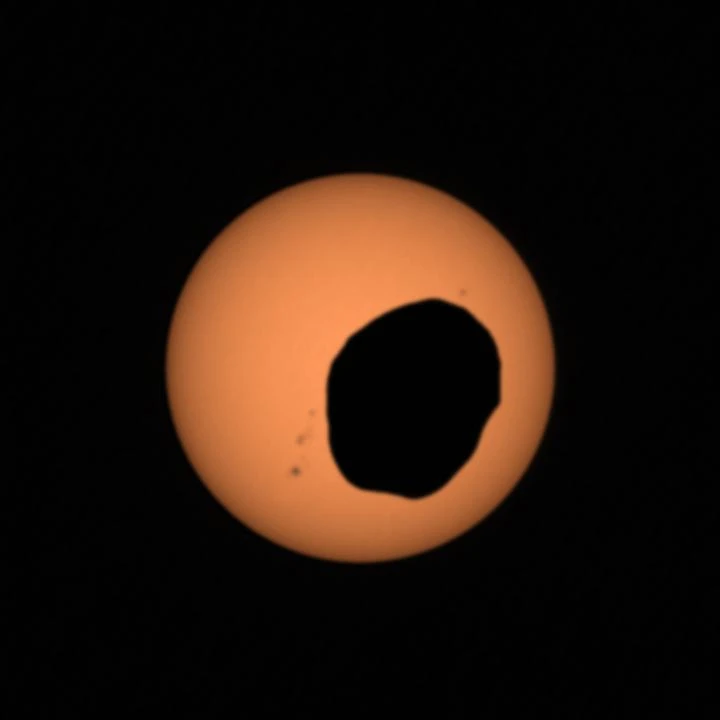
Rovers measure the moons from below. In 2004, Spirit and Opportunity took the first time-lapse photos of Phobos crossing the Sun, and Curiosity later recorded eclipse videos. On April 2, 2022, NASA’s Perseverance rover filmed Phobos passing in front of the Sun with its Mastcam-Z camera. The eclipse lasted “a little over 40 seconds” (NASA, April 20, 2022).
These aren’t just pretty videos. Each eclipse fixes Phobos’s position at a precise time, and because Phobos’s tides slightly flex Mars’s crust and mantle while slowly changing its orbit, those timings help scientists learn how pliable Mars’s interior is (NASA, 2022). If you want to know how Perseverance finds its way between those observations, see How Mars Rovers Navigate.
How Big Are Mars’s Moons Compared With Our Moon?
Tiny. Earth’s Moon has a mean radius of 1,737.4 km (JPL SSD), a diameter of about 3,475 km (2,159 miles). Phobos, at about 22.2 km across, is roughly 157 times narrower, and NASA makes the same comparison in its eclipse release (NASA, 2022). Deimos, at about 12.4 km, is smaller still.

At that scale, the bars for Phobos and Deimos barely show, which is the point. It also explains the look of Perseverance’s eclipse video: Phobos crosses the Sun as a dark, lumpy shape rather than blotting it out.
Myth vs. Fact: Mars Moons Edition
| Myth | Fact |
|---|---|
| “Mars has no moons,” or “just one.” | Mars has two, Phobos and Deimos (JPL, as of November 2026). |
| “Phobos is about to hit Mars.” | Breakup or impact is modelled for roughly 20 to 50 million years from now. |
| “Both moons are falling toward Mars.” | Only Phobos is measured falling. Deimos is expected to be moving very slowly away. |
| “Tidally locked moons don’t spin.” | They do spin, exactly once per orbit, so the same side faces the planet. |
| “Phobos is a solid block of rock.” | Its low density points to a porous body, possibly a rubble pile. |
| “We know they’re captured asteroids.” | That’s one of three main ideas. The origin is still open. |
Can You See Mars’s Moons From Earth?
Yes, in principle, but it’s hard. BBC Sky at Night Magazine gives Phobos as about magnitude +10.7 and Deimos +11.8, far too faint for the naked eye. The real problem is glare: Phobos never appears more than about 30 arcseconds from Mars’s centre, and Deimos about 77 arcseconds (BBC Sky at Night Magazine).
What helps:
- Observe near opposition, when Mars is opposite the Sun in our sky and visible all night. The next is on February 19, 2027 (BBC Sky at Night Magazine); Japan’s National Astronomical Observatory lists it at 00:51 on February 20, Japan time, which is the same moment (NAOJ).
- Hide Mars. Fix a thin strip of foil or paper at the eyepiece’s field stop as an “occulting bar” and park the planet behind it (BBC Sky at Night Magazine).
- Time it. Look when a moon is near its greatest distance from the planet. Free software such as WinJUPOS shows where they are.
What Comes Next: Is MMX on Its Way to Phobos?
Yes. As of November 2026, Japan’s MMX (Martian Moons eXploration) spacecraft is in flight. JAXA reports that it launched on October 20, 2026, at 4:41:03 a.m. Japan time, on the H3 rocket’s tenth flight from Tanegashima Space Center, and its first signal after launch was announced on October 26 (JAXA MMX; JAXA press release, August 20, 2026). The mission had originally aimed for the 2024 Mars launch window before H3 rocket problems pushed it back (Space.com, April 23, 2026).
Here’s the plan as JAXA states it now (JAXA MMX):
- 2026–2027: cruise. About one year to reach the Martian system.
- 2027–2030: at Mars. Enter a “quasi-satellite” orbit around Phobos, study it in detail and make two soft landings. Deimos is observed in the final phase.
- 2030–2031: home. Leave Mars in 2030 and return to Earth over about a year. A capsule is to be recovered in Australia in 2031, carrying more than 10 g (0.35 oz) of Phobos material.
MMX also carries IDEFIX, a four-wheeled rover of about 25 kg (55 lb) built by Germany’s DLR and France’s CNES, to be dropped onto Phobos (Space.com). Space.com reported the sampling for 2029; JAXA’s own timeline gives the 2027–2030 window without a landing date, so the exact date should be treated as a plan.
Why it matters: samples analysed in Earth labs could show whether Phobos is Martian rock, asteroid material or a mix, testing the origin ideas above. JAXA calls the moons’ formation “a heavily debated topic in solar system science” (Space.com, August 21, 2026).
Mars’s Moons by the Numbers
- 2: known moons of Mars, as of November 2026 (JPL SSD)
- 1877: the year Asaph Hall discovered both, in mid-August (NASA)
- 27 × 22 × 18 km (17 × 14 × 11 miles): the size of Phobos (NASA)
- 15 × 12 × 11 km (9 × 7 × 6.8 miles): the size of Deimos (NASA)
- About 6,000 km (3,700 miles): Phobos’s height above the Martian surface (NASA, 2015)
- 9,375 km (5,825 miles) and 23,457 km (14,576 miles): Phobos’s and Deimos’s distances from Mars’s centre (JPL SSD)
- 7 h 39 min and 30 h 18 min: their orbital periods (from JPL SSD)
- About 3.8 m (12.5 feet) per century: Phobos’s inward drift in the 2025 JPL orbit fit; older NASA summaries give 1.8 to 2 m (Brozović et al. 2025, AJ; NASA)
- About 20 to 50 million years: the modelled range for Phobos’s breakup or impact
- More than 10 g (0.35 oz): the Phobos sample MMX aims to return in 2031 (JAXA)

Mars’s Moons: FAQ
Does Mars have two moons or more?
Mars has exactly two known moons, Phobos and Deimos, as of November 2026. NASA JPL’s satellite list counts two for Mars. No other Martian moons have been confirmed.
What are the names of Mars’s moons?
They are Phobos, meaning fear, and Deimos, meaning dread, named after the mythological sons of Ares, the Greek counterpart of Mars. Asaph Hall discovered both in August 1877 at the U.S. Naval Observatory in Washington, D.C.
Which Martian moon is bigger?
Phobos is bigger, at about 27 by 22 by 18 km (17 by 14 by 11 miles). Deimos is about 15 by 12 by 11 km (9 by 7 by 6.8 miles). Phobos also orbits much closer to Mars.
When will Phobos hit Mars?
Not for a very long time. Models put Phobos’s breakup or impact roughly 20 to 50 million years from now, depending on assumptions about Mars’s interior and Phobos’s strength. One leading model predicts most of Phobos becomes a ring, with only strong fragments hitting the planet.
Are Phobos and Deimos captured asteroids?
Possibly, but it’s unproven. Their dark colour resembles some asteroids, but their circular, equatorial orbits are hard to explain by capture, and the Hope orbiter found Deimos’s infrared spectrum looks more like Martian basalt. A giant-impact origin and a torn-apart asteroid are the main alternatives.
Could Mars end up with a ring?
According to one model, yes. Black and Mittal (2015) calculated that Phobos’s weakest material could be pulled apart in about 20 to 40 million years and spread into a ring lasting roughly 1 million to 100 million years. That is a prediction, not an observation.
Do Mars’s moons always show the same face?
Yes. Both Phobos and Deimos are tidally locked, which means each spins once per orbit and always keeps the same side turned toward Mars. Earth’s Moon behaves the same way toward Earth.
What will the MMX mission bring back?
JAXA’s MMX aims to return more than 10 g (0.35 oz) of material from Phobos to Earth in 2031. It launched on October 20, 2026, and plans two soft landings on Phobos during its 2027 to 2030 stay at Mars, as of November 2026.
Your next step: pull up NASA’s Perseverance eclipse video and watch Phobos cross the Sun in real time, then check the JAXA MMX page for the spacecraft’s progress toward Mars. If you have a telescope of your own, mark February 19, 2027, Mars’s next opposition.
Sources and Further Reading
- NASA JPL Solar System Dynamics (checked November 8, 2026), Planetary Satellite Discovery Circumstances; Planetary Satellite Physical Parameters; Planetary Satellite Mean Elements; Planetary Physical Parameters.
- NASA Science (updated November 2024), Mars Moons, Phobos, Deimos.
- NASA Science (updated July 23, 2026), Tidal Locking.
- Hille, K. B. (2015, November 10). Mars’ Moon Phobos is Slowly Falling Apart. NASA Goddard Space Flight Center.
- Black, B. A., & Mittal, T. (2015). The demise of Phobos and development of a Martian ring system. Nature Geoscience, 8, 913–917. doi:10.1038/ngeo2583; summary via ScienceDaily.
- Bills, B., Neumann, G., Smith, D., & Zuber, M. (2004). Improved Estimate of Phobos Secular Acceleration from MOLA Observations. AGU Fall Meeting abstract, NASA Technical Reports Server.
- Rosenblatt, P., et al. (2016). Accretion of Phobos and Deimos in an extended debris disc stirred by transient moons. Nature Geoscience, 9, 581. doi:10.1038/ngeo2742. NASA ADS abstract.
- Bagheri, A., Khan, A., Efroimsky, M., Kruglyakov, M., & Giardini, D. (2021). Dynamical evidence for Phobos and Deimos as remnants of a disrupted common progenitor. Nature Astronomy, 5, 539–543. doi:10.1038/s41550-021-01306-2; EPSC 2021 abstract.
- Kegerreis, J. A., Lissauer, J. J., Eke, V. R., Sandnes, T. D., & Elphic, R. C. Origin of Mars’s moons by disruptive partial capture of an asteroid. Icarus, doi:10.1016/j.icarus.2024.116337. arXiv:2407.15936 (revised November 19, 2024).
- Madeira, G., Charnoz, S., Zhang, Y., Hyodo, R., Michel, P., Genda, H., & Giuliatti Winter, S. (2023). Exploring the recycling model of Phobos formation: rubble-pile satellites. arXiv:2302.12556.
- National Academies of Sciences, Engineering, and Medicine (2019). Planetary Protection Classification of Sample Return Missions from the Martian Moons.
- ESA, Mars Express science highlights #10: Mapping and measuring Phobos in unprecedented detail (last updated September 1, 2019); ESA Kids, Phobos and Deimos.
- DLR (2025, March 13). Asteroid mission Hera: close flyby of Mars and Martian moon Deimos.
- Eos (2023, June 2). Tiny Martian Moon May Be a Chip off the Old Block. On the Emirates Mars Mission’s Deimos observations.
- NASA JPL (2022, April 20). NASA’s Perseverance Rover Captures Video of Solar Eclipse on Mars.
- NASA Photojournal: PIA10368, Phobos from 6,800 Kilometers (Color); PIA11826, Martian Moon Deimos in High Resolution; PIA25179, Perseverance’s Mastcam-Z Captures a Phobos Solar Eclipse.
- NASA NSSDCA, Deimos, Viking 2 Orbiter image (October 15, 1977).
- NASA JPL (2021, November 3). Slice of History: 50 Years of Mariner 9 in Orbit.
- U.S. Naval Observatory (2023, November 13). 26-inch telescope 150th anniversary release (PDF).
- Astronomy, Aug. 11, 1877: Asaph Hall discovers Deimos; Linda Hall Library, Scientist of the Day: Asaph Hall.
- Astronomy (2015, September issue). Could you see Mars’ moons from the surface with just your eyes? Answer by Mark Lemmon.
- JAXA, MMX Martian Moons eXploration (checked November 8, 2026); JAXA press release (2026, August 20), Launch of MMX on H3 Launch Vehicle No. 10.
- Space.com (2026, April 23), Japan’s audacious sample-return mission to the Mars moon Phobos has made it to the launch pad; Space.com (2026, August 21), Japan unveils Mars moon sample-return spacecraft.
- OpenLearn, The Open University, Moons of our Solar System: Shapes of moons.
- Brozović, M., Jacobson, R. A., & Park, R. S. (2025). Revised ephemerides of the Martian satellites, Phobos and Deimos. The Astronomical Journal, 170(1), 42. doi:10.3847/1538-3881/addab4
- BBC Sky at Night Magazine, How to see the moons of Mars (2020) and Mars opposition 2027 (2025); NAOJ, Celestial Phenomena 2027.
- Wikipedia, Moons of Mars. Used only for UTC discovery times, the naming history and the Earth’s Moon comparison.
Explore Next
- Mars’s two moons in context: Which Planet Has the Most Moons?
- The rover that filmed Phobos’s eclipse: How Mars Rovers Navigate
- What “colour composite” means: Are Space Photos Real?
- Our own Moon is changing too: Why Is the Moon Shrinking?
- How every claim here is labelled: How We Know
- More from the planets: Planets & Moons
- Start anywhere: Explore Dark Cosmic Insights
- Four strange worlds around Jupiter: How Many Moons Does Jupiter Have?
- Spirals, ellipticals and the tuning fork: Types of Galaxies
How This Explainer Was Checked
Every number in this article was checked on November 8, 2026 against the source linked beside it: NASA JPL’s satellite tables, NASA Science and Photojournal pages, ESA and DLR releases, JAXA’s MMX site and press release, and peer-reviewed papers (read via publisher abstracts, NASA ADS, arXiv or conference abstracts, with DOIs given). The Mars moon count is JPL’s, dated as of November 2026. Mean diameters, orbital periods in hours and minutes, heights above the surface, the synchronous-orbit distance in kilometres, the 157-times ratio and all mile, kelvin and Fahrenheit conversions are DCI’s own arithmetic from the cited values. Where sources disagree, we show both: Phobos’s inward drift (about 3.8 m per century in the 2025 JPL orbit fit vs 1.8 to 2 m in older NASA summaries; the breakup timescales below come from models built on the earlier rates), its timescale (20 to 40, 30 to 50, about 39 and 50 million years, from different models), Stickney’s width (9 vs 9.7 km), Deimos’s regolith depth (about 50 m vs up to 100 m) and the discovery dates (Washington time vs UTC). MMX dates are given only as JAXA states them on its own pages; one news report’s 2029 sampling date is attributed to that report. Origin theories are labelled Open, and models are labelled as models. Images are labelled: real spacecraft or telescope images as OBSERVATION, illustrations as ILLUSTRATION, and our charts as DATA GRAPHIC. Nothing AI-generated is presented as a real image.

Final Thought: Two Moons, Two Directions, One Open Question
Phobos and Deimos look like leftovers, and maybe they are. But they are also clocks. One is ticking down toward a ring or a crash; the other is creeping away almost too slowly to notice. Phobos’s fall is measured; Deimos’s slow escape is what the same tides predict, though no one has yet pinned down its rate. What they can’t yet tell us is where they came from. That answer may be sitting in a capsule’s worth of Phobos dust, due on Earth in 2031.
About the Author
Author: King | Founder of Dark Cosmic Insights
King is the founder of Dark Cosmic Insights, a science storytelling platform exploring the strangest true stories hiding in space, science and AI. He digs into NASA, ESA and peer-reviewed research, separates what has been measured from what is still a mystery, and turns it into articles, data graphics and Shorts.
Follow the anomaly. Trace the source.