Yes, the Moon really is shrinking. A new study has mapped more than 10,000 young cracks across its surface, and they tell a story of a world that is still cooling, still squeezing and still shaking. Here’s what that means, how much it has shrunk, and why it matters for the first Moon bases.
Here’s the strangest true thing about our nearest neighbour: the Moon is getting smaller. Not by much. Over the past few hundred million years it has lost about 45 metres (roughly 150 feet) of radius, on a world more than 1,700 km across. But the evidence is written all over its face, in thousands of fresh-looking cliffs that only make sense if the whole Moon has been slowly contracting.
That raises an obvious question: why is the Moon shrinking, and should anyone planning to live there be worried? This guide covers what is causing it, how scientists measured it without ever watching it happen, how shrinking produces moonquakes, why shrinking is completely different from the Moon drifting away from Earth, and what it could mean for astronauts and future bases.
As always at Dark Cosmic Insights, we keep three things apart. What is observed: the faults are real and visible in spacecraft images, and Apollo instruments really recorded moonquakes. What is modelled: the 45-metre figure is an estimate calculated from those faults, not a direct measurement. And what is still open: exactly which faults are active today, and how often they slip.
In this guide
- Quick Answer: Why Is the Moon Shrinking?
- The DCI Shrinking Moon Evidence Map
- Is the Moon Really Shrinking?
- Why Is the Moon Shrinking?
- How Much Has the Moon Shrunk?
- How Do Scientists Know the Moon Is Shrinking?
- What Are Lobate Scarps?
- What Causes Moonquakes?
- Are Moonquakes Caused by the Moon Shrinking?
- Is the Moon Still Geologically Active?
- Is Shrinking the Same as the Moon Moving Away From Earth?
- Can We See the Moon Shrinking?
- Myth vs. Fact: The Shrinking Moon
- What Do Moonquakes Mean for Future Moon Bases?
- How Can You Explore the Shrinking Moon Yourself?
- What Comes Next for Moonquake Science?
- The Shrinking Moon by the Numbers
- Frequently Asked Questions
- Sources and Further Reading
- Keep Exploring
- How This Explainer Was Checked
Quick Answer: Why Is the Moon Shrinking?
Quick Answer: The Moon is shrinking because its interior is slowly cooling. As hot rock and the iron core lose heat, they contract, and the rigid crust has to crack to fit a slightly smaller ball. One slab of crust is pushed up over another along thrust faults, leaving cliffs called lobate scarps. An October 2026 study mapped more than 10,000 of these young faults and estimates the Moon’s radius has shrunk by about 45 metres over the last 400 to 800 million years. That is far too small to see, but the faults can still slip and cause shallow moonquakes.
What this article can and cannot establish: We can explain the cause of lunar shrinking and report the published estimates and the moonquake records from Apollo, using NASA, Smithsonian and peer-reviewed sources. We cannot say exactly how fast the Moon is shrinking today, because nobody has measured it year by year. The shrinkage figure is worked out from the size and number of faults. We also cannot predict when or where the next strong moonquake will strike.
The DCI Shrinking Moon Evidence Map
Some claims about the shrinking Moon are things you can see in a photograph. Others are calculations, and a few are still unknown. Here’s where each big question stands.
| Question | What we know | Status | Key source |
|---|---|---|---|
| Is the Moon shrinking? | Yes. Thousands of young thrust faults show the crust has been squeezed | Observed | Watters et al. 2026; NASA |
| How much has it shrunk? | About 45 m of radius over 400 to 800 million years | Modelled (from fault mapping) | Smithsonian NASM, 2026 |
| How fast is it shrinking? | About 6 to 11 cm per million years, if the rate was steady | Modelled | Smithsonian NASM, 2026 |
| What causes it? | The interior is cooling and contracting | Modelled (strong consensus) | NASA; Smithsonian NASM |
| How many young faults are there? | More than 10,000: over 8,900 lobate scarps and over 2,000 small mare ridges | Observed (LRO images) | Watters et al. 2026 |
| Does the Moon have moonquakes? | Yes. Apollo seismometers recorded them from 1969 to 1977 | Measured | NASA |
| Are shrinking faults causing quakes today? | Likely. Eight of 28 shallow quakes struck near young faults | Supported, not proven | Watters et al. 2019 |
| Can we see the Moon getting smaller? | No. The change is about 0.0026% of its radius | Not supported | DCI calculation from NASM figures |
| Is shrinking why the Moon moves away? | No. Drifting away is caused by Earth’s tides | Not supported | NASA/JPL |
| How risky are moonquakes for bases? | Real enough to plan for; not yet quantified site by site | Open | Watters et al. 2024 |
Status key: Observed means visible in images. Measured means recorded by an instrument. Modelled means calculated from evidence. Supported, not proven means the evidence points one way but is not conclusive. Open means scientists don’t yet know. Not supported means the evidence says no.
Cite this framework: Dark Cosmic Insights, “Shrinking Moon Evidence Map,” darkcosmicinsights.com, 2026.
Is the Moon Really Shrinking?
Yes. This is not a fringe idea or a misreading of a headline. NASA’s own guide to moonquakes states plainly that the Moon has shrunk globally and is likely still shrinking (NASA Science). The newest and most detailed estimate comes from a study published on October 14, 2026, in The Planetary Science Journal, titled “Thrust Faulting and the Late-Stage Contraction of the Moon” (Smithsonian National Air and Space Museum).
The lead author is Thomas R. Watters, a scientist emeritus at the Smithsonian’s Center for Earth and Planetary Studies, working with Maria Banks, Cole Nypaver and Mark Robinson. “The number of these young faults revealed in LROC images is much greater than I ever imagined,” he said in the museum’s announcement.
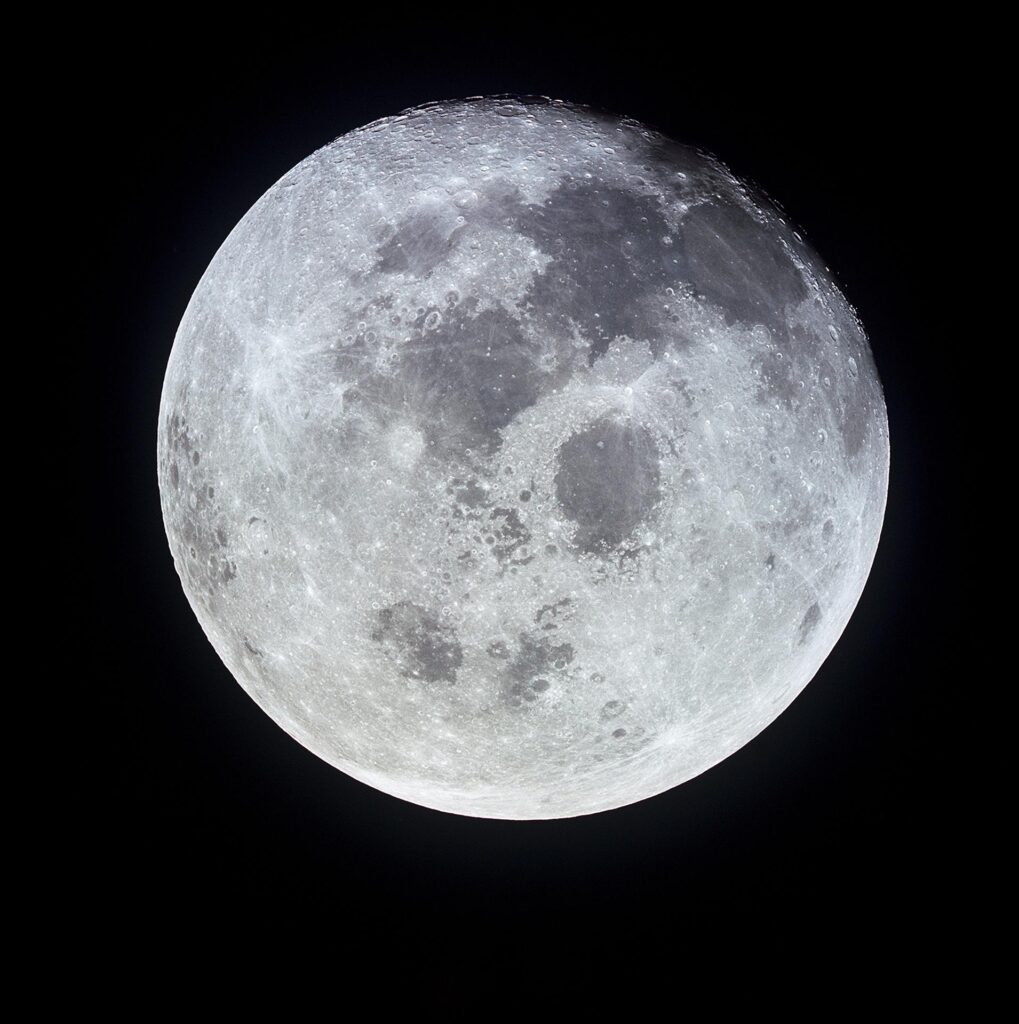
The important word is slowly. Nothing about this is sudden or dramatic on a human timescale. The Moon is not caving in. It is a 4.5-billion-year-old world finishing the long process of losing the heat it was born with, and the cracks are the scars that process leaves.
Why Is the Moon Shrinking?
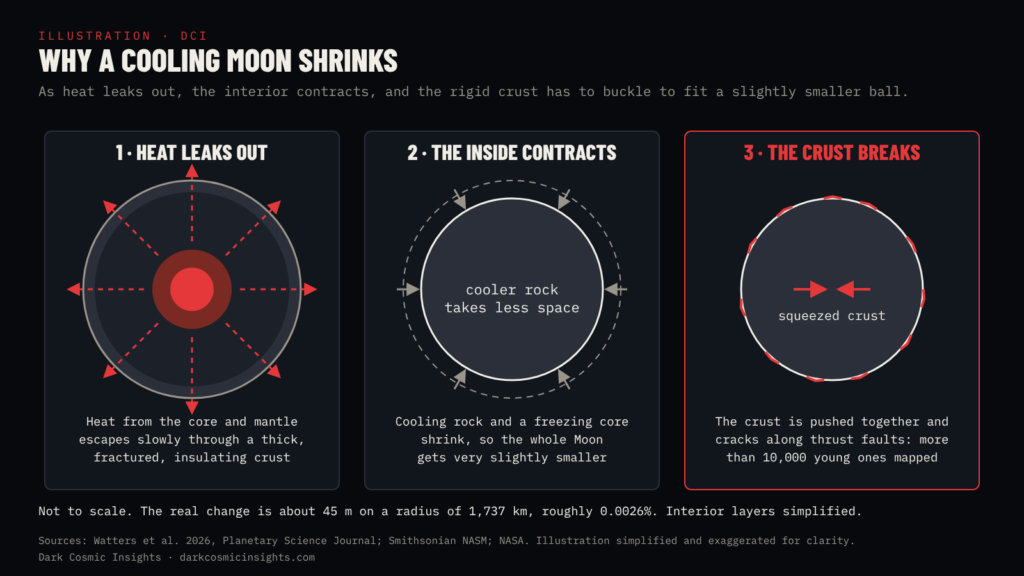
The short answer is heat loss. The Moon formed hot, and it has been cooling ever since. Hot rock takes up more space than cool rock, so as the interior loses heat, it contracts. Scientists also think part of the Moon’s iron core is liquid and slowly freezing, which adds to the squeeze (NASA Science; Smithsonian NASM).
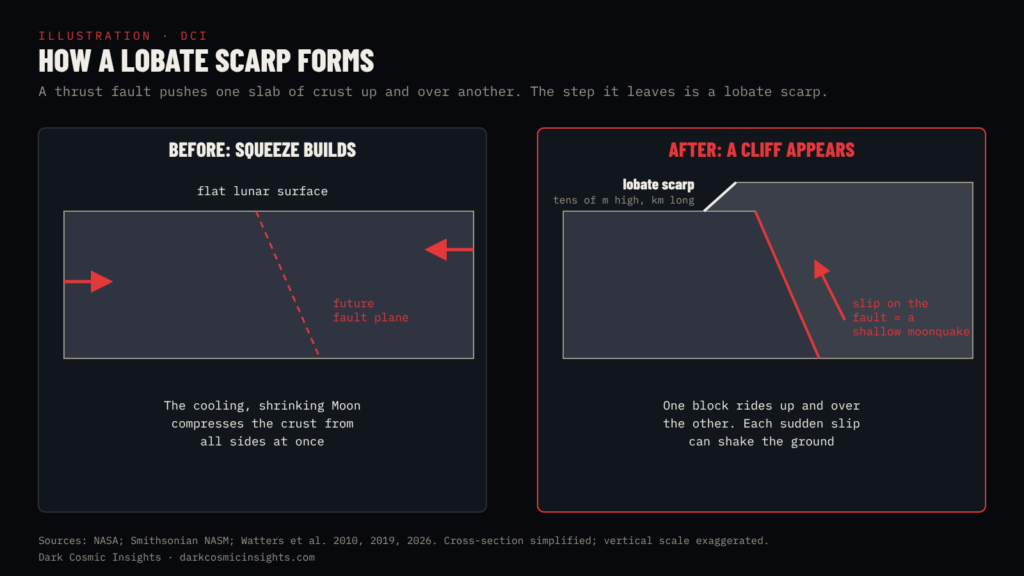
The surface can’t simply shrink with it. The Moon’s outer layer, the crust, is cold, brittle rock. When the ball underneath gets smaller, the crust is pushed together from every direction at once. Brittle rock under that kind of squeeze doesn’t fold smoothly. It breaks.
A useful picture: think of a grape drying into a raisin. As the inside loses volume, the skin wrinkles. The Moon is the rocky version, except its “skin” is so stiff that instead of wrinkling, it snaps into faults. NASA uses the same grape-and-raisin comparison in its explanation of lunar contraction.
Why did the shrinking start so late?
Here’s the surprising twist in the 2026 study. You might expect a cooling world to shrink fastest when it is young and hot. But the faults Watters and his team mapped are young, and they suggest widespread faulting did not start early in lunar history. The team’s explanation is that a thick, heavily fractured, porous crust acted like insulation, trapping heat and slowing the cooling. Only relatively recently, in geologic terms, did enough contraction build up to crack the surface on a global scale (Smithsonian NASM). That part is a model, a best explanation for the pattern, not something anyone has watched happen.
How Much Has the Moon Shrunk?
According to the 2026 study, the Moon’s radius has decreased by about 45 metres (about 150 feet) over the past 400 to 800 million years (Smithsonian NASM). Older NASA summaries gave a similar headline figure of “about 150 feet (50 meters)” without describing it as a change in radius (NASA Science), so be careful when comparing numbers from different articles. The new study is the most complete count so far.
To get a feel for how small that is, compare it with the size of the Moon itself. Its average radius is about 1,737 km (1,079 miles). Losing 45 metres is a change of about 0.0026%. If the Moon were a basketball, it would have shrunk by roughly three thousandths of a millimetre, about one-twentieth of the width of a human hair.
Spread over time, the number becomes even harder to picture. If the rate was constant, the Moon has shrunk about 6 to 11 centimetres per million years, or about 0.1 micrometres (0.0001 mm) per year (Smithsonian NASM). For comparison, the museum points out that Earth’s tectonic plates move about 1.5 cm a year, which is many thousands of times faster.
So the honest headline is: the Moon is definitely shrinking, but only by a tiny amount and extremely slowly. The reason it matters isn’t the size change. It’s the faults and quakes the size change creates.
How Do Scientists Know the Moon Is Shrinking?
Nobody has put a tape measure around the Moon twice. The evidence is the crust itself. When a surface is squeezed, it develops a very particular kind of crack, and those cracks can be counted and measured from orbit.
1. The faults are visible from orbit
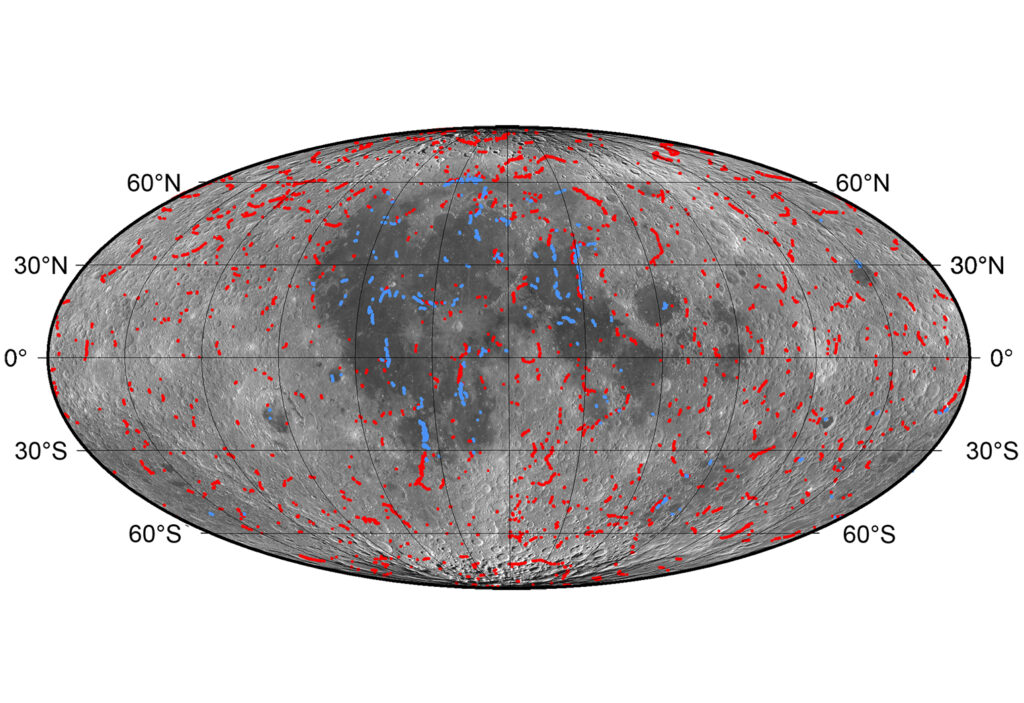
The key instrument is the Lunar Reconnaissance Orbiter Camera (LROC) on NASA’s Lunar Reconnaissance Orbiter (LRO), which launched on June 18, 2009, and has been returning images for about 17 years. Its sharp, low-angle photographs reveal small cliffs that older cameras couldn’t resolve. By 2019, LROC had imaged more than 3,500 of these fault scarps (NASA). The 2026 study raised the count to more than 10,000 young faults (Smithsonian NASM).
2. The faults are the “squeezing” kind
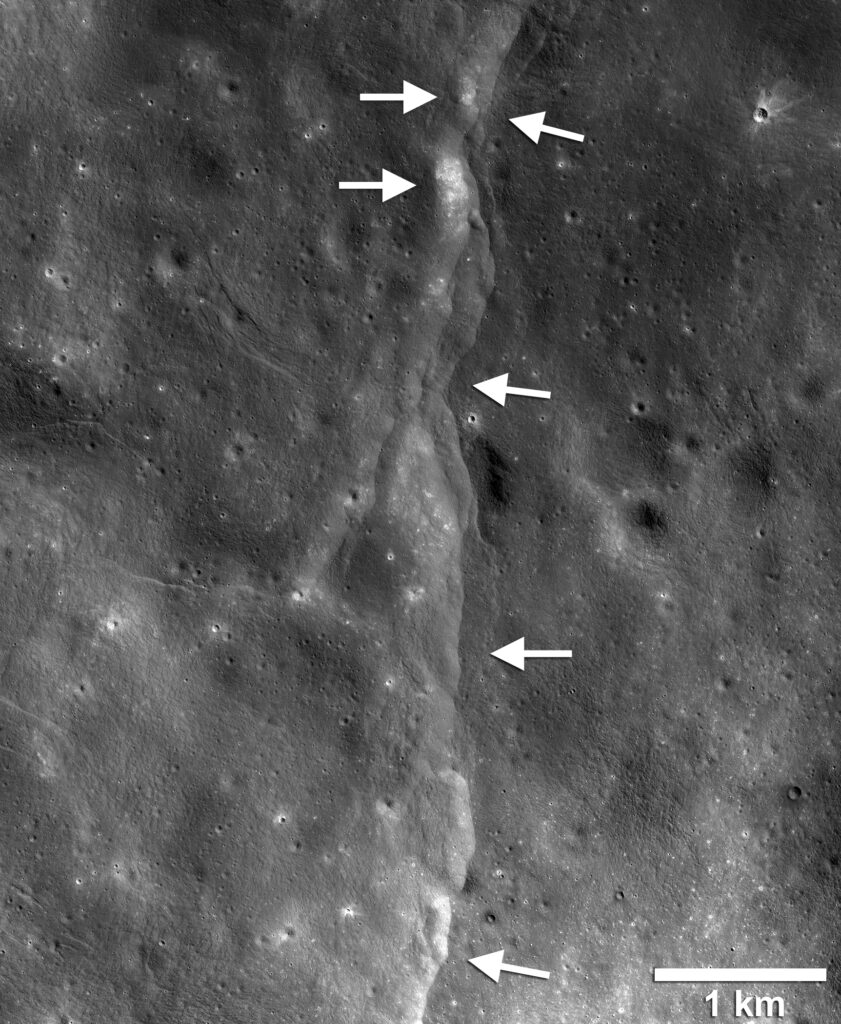
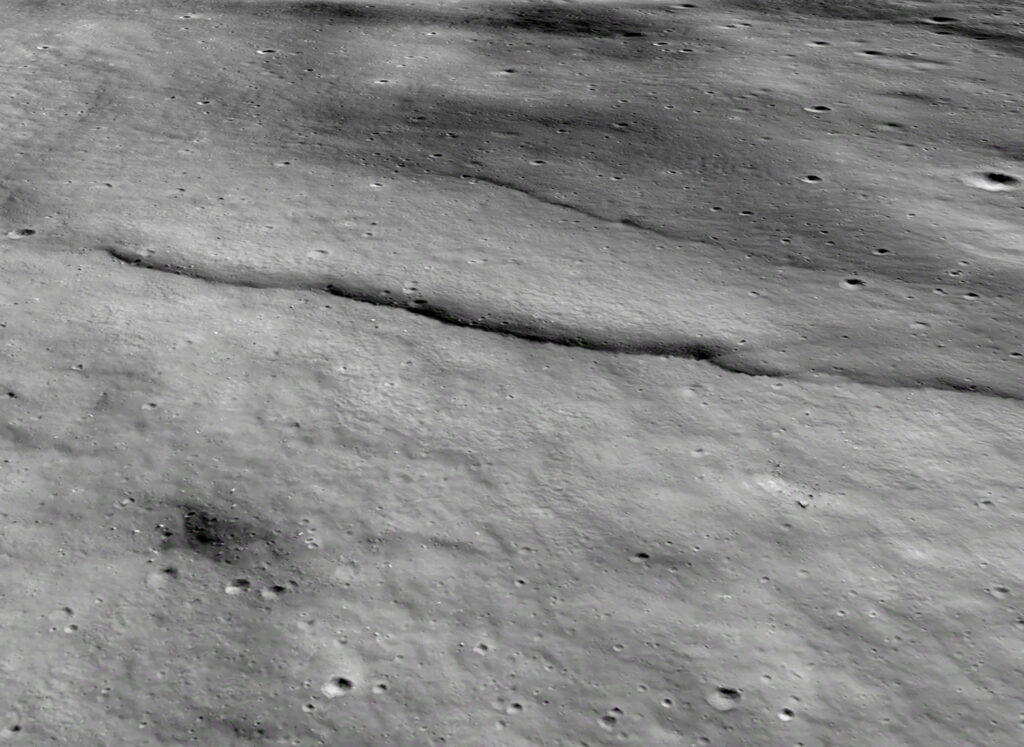
There are two main types of contraction feature. In the bright, rugged highlands, the squeeze makes lobate scarps: step-like cliffs, often tens of metres high and kilometres long, with a curved, lobe-shaped front. In the dark lava plains called maria, it makes small mare ridges: low, wrinkle-like ridges. The 2026 team counted over 8,900 lobate scarps and over 2,000 small mare ridges (Smithsonian NASM). Both form when crust is shortened, which is exactly what a shrinking world should produce.
3. The faults are young
Most lunar landscapes are ancient and battered by billions of years of impacts. These faults look crisp. They cut across small, fresh craters, which means the faults formed after those craters did. Some show boulder fields and landslides on their slopes, and boulder tracks that would fade quickly under the steady rain of micrometeorites (NASA). Young faults mean recent contraction.
4. Adding them up gives the shrinkage
Each fault absorbs a small amount of shortening. By measuring how much the crust has been pushed together across thousands of faults, scientists can calculate how much the Moon’s radius must have decreased. That is where the 45-metre estimate comes from. It is a calculation based on careful mapping, which is why we label it modelled rather than measured.
What Are Lobate Scarps?
A lobate scarp is the surface trace of a thrust fault, the type of fault where rock is pushed together until one block slides up and over its neighbour. On Earth, thrust faults build mountain ranges. On the Moon, they leave modest but very sharp steps in the landscape.
Most lunar scarps are tens of metres high, but some are much bigger. A thrust fault on the wall of Slipher crater near the north pole forms a cliff about 20 metres (65 feet) high (NASA Science), while the largest scarp in Mouchez L crater reaches more than 100 metres of relief (Smithsonian NASM).

One fault is famous for a different reason. In December 1972, the Apollo 17 astronauts drove their lunar rover over the Lee-Lincoln scarp in the Taurus-Littrow valley, without anyone realising it was a young thrust fault. Decades later, LRO images showed landslides and boulder tracks on that scarp that point to strong shaking in the geologically recent past (NASA).
What Causes Moonquakes?
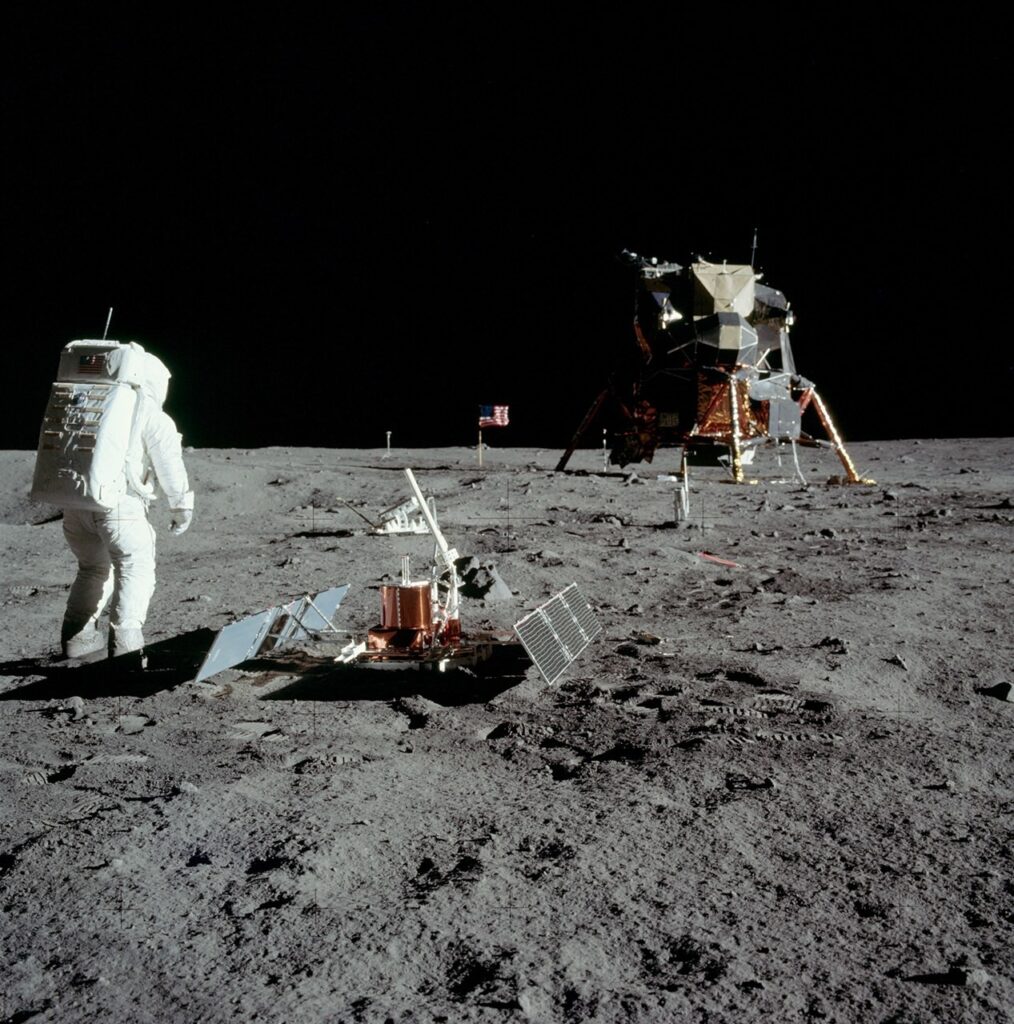
A moonquake is the lunar version of an earthquake: the ground vibrating as energy is released. We know they happen because the Apollo astronauts left seismometers behind. Apollo 11 placed the first one in July 1969. It ran for only three weeks, but the instruments left by Apollo 12, 14, 15 and 16 kept listening until 1977 (NASA).
Those records show that moonquakes come from four different sources (NASA Science):
- Deep moonquakes happen hundreds of kilometres down. They are triggered by tides: Earth’s gravity stretches and flexes the Moon’s interior as it moves around its orbit. They are the most common type but are weak.
- Shallow moonquakes originate in the crust, about 20 to 30 km below the surface. These are the ones linked to shrinking. NASA says they can reach magnitude 5.5 and last more than 10 minutes.
- Impact moonquakes are caused by meteoroids slamming into the surface.
- Thermal moonquakes are tiny and extremely shallow, caused by rock expanding and contracting as the surface swings between the heat of lunar day and the cold of lunar night.

Why do moonquakes last so long?
On Earth, most earthquakes stop shaking within seconds to a minute or two. The Moon is different. Its crust is dry, cold and broken up by billions of years of impacts, and it has no water to damp vibrations. Seismic energy bounces around inside that fractured rock instead of fading quickly, which is why shallow moonquakes can keep the ground moving for many minutes (NASA Science).
Are Moonquakes Caused by the Moon Shrinking?
At least some of them, very likely. The connection came from a 2019 study in Nature Geoscience, also led by Watters, that re-analysed the Apollo records (NASA). It found:
- Apollo seismometers recorded 28 shallow moonquakes between 1969 and 1977, ranging from about magnitude 2 to 5.
- Eight of those quakes struck within 30 km (18.6 miles) of young faults seen in LRO images, close enough to tentatively link them.
- Six of those eight happened when the Moon was at or near apogee, its farthest point from Earth, when tidal stress on the crust is at its peak. That suggests Earth’s tides add the final nudge that makes a stressed fault slip.
- After 10,000 simulations, the team found less than a 4% chance that the pattern was a coincidence.
“Our analysis gives the first evidence that these faults are still active and likely producing moonquakes today.” Thomas Watters, Smithsonian National Air and Space Museum (NASA, 2019)
We call this supported, not proven. Apollo’s seismometers were all on the near side, and they could only roughly locate where shallow quakes started. A link between eight quakes and nearby faults is strong evidence, but it isn’t the same as catching a fault in the act.
Is the Moon Still Geologically Active?
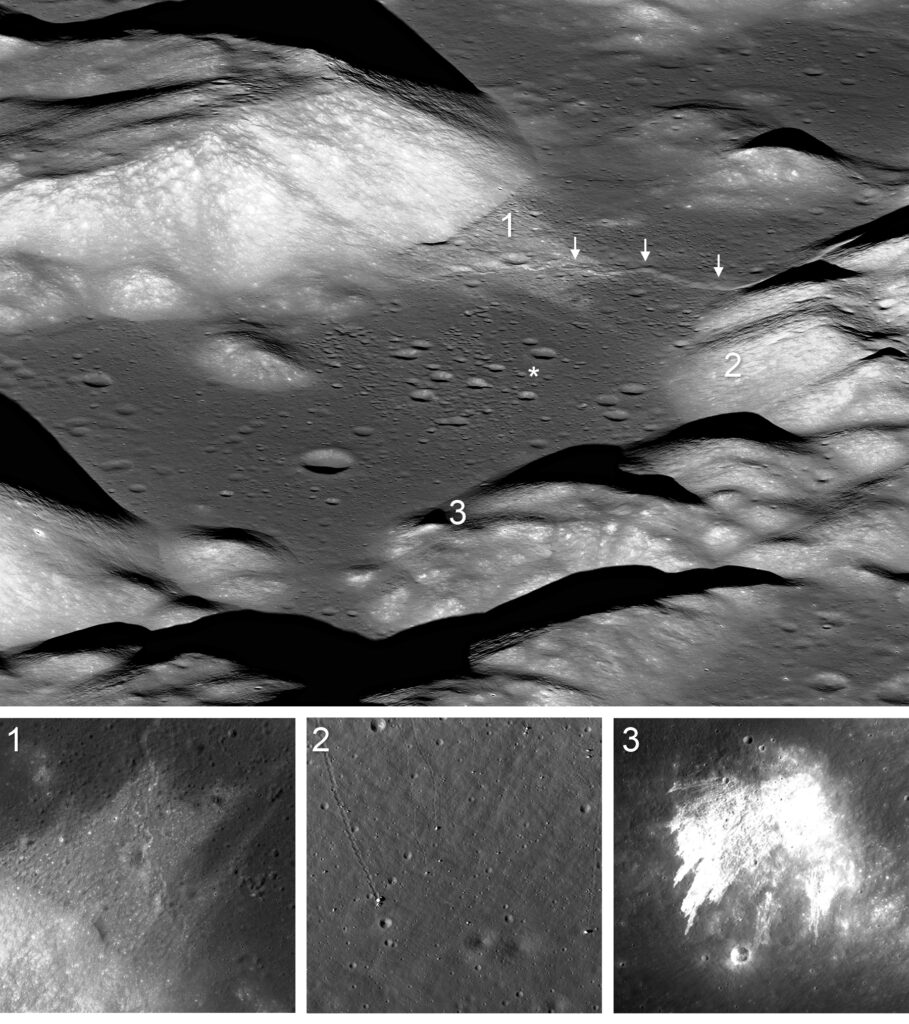
In one important sense, yes. The Moon has no volcanoes erupting today and no moving plates like Earth’s. But “geologically active” also means a world whose surface is still changing because of forces inside it, and the Moon fits that description.
The 2026 study expects fault growth and the formation of new faults to continue today as the interior keeps cooling (Smithsonian NASM). The young age of the faults, the Apollo moonquake records and the fresh boulder tracks all point the same way: the Moon is quiet, but it is not dead.
There is one big difference from Earth. Earth’s crust is broken into separate tectonic plates, so most earthquakes happen along plate boundaries. The Moon is a single-plate body. Its faults are not lined up at boundaries. They are scattered across the whole surface, which means a moonquake from a slipping fault could, in principle, happen almost anywhere (Smithsonian NASM).
Is Shrinking the Same as the Moon Moving Away From Earth?
No, and this is one of the most common mix-ups. The Moon is doing two unrelated things at once.
It is shrinking in size because its interior is cooling. And it is moving away from Earth, slowly spiralling outward by about 3.8 cm (1.5 inches) a year. That second change is caused by tides. The Moon’s gravity raises bulges in Earth’s oceans and rock, and because Earth spins faster than the Moon orbits, those bulges run slightly ahead of the Moon and tug it forward. That transfers energy to the Moon, nudging it into a wider orbit, and very slowly lengthens Earth’s day (NASA/JPL).
We know the drift precisely because Apollo 11, 14 and 15 astronauts left laser reflectors on the surface. Observatories on Earth fire lasers at them and time the return trip, measuring the distance to within a few millimetres (NASA/JPL).
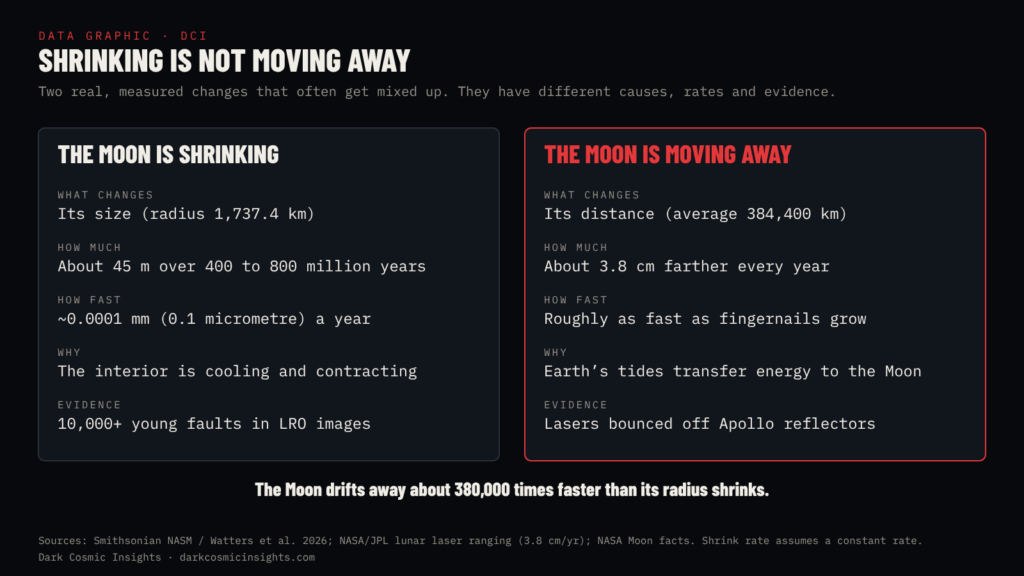
Put the two rates side by side and the difference is huge. The Moon’s distance grows by about 38 mm a year, while its radius shrinks by about 0.0001 mm a year. The Moon drifts away roughly 380,000 times faster than it shrinks. Neither change affects the other.
How far away is the Moon, really?
The Moon’s average distance from Earth is about 384,400 km (238,855 miles) (NASA Science). Its orbit is slightly oval, so the distance swings from roughly 363,000 km at its closest (perigee) to roughly 405,000 km at its farthest (apogee). Light covers the average gap in about 1.3 seconds, and the gap grows by about 3.8 cm every year.
Can We See the Moon Shrinking?
No. Not with your eyes, a backyard telescope or any instrument in existence. A 45-metre change spread over hundreds of millions of years is invisible from Earth, where the Moon’s apparent size is set by its distance, not its radius.
What does change, every month, is how big the Moon looks. At perigee it appears about 14% wider than at apogee, which is why “supermoons” look a little larger. That has nothing to do with shrinking. It’s just the oval shape of the orbit.
What you can see are the results of contraction, if you look at the right images. LRO’s photographs of lobate scarps are public, and the 2026 global map shows just how widespread the faults are.
Myth vs. Fact: The Shrinking Moon
Myth: The Moon is collapsing.
Fact: It has lost about 45 m of radius over hundreds of millions of years, about 0.0026%. Its shape, gravity and orbit are effectively unchanged.
Myth: The Moon will shrink until it disappears.
Fact: Contraction slows as a world cools. Nothing in the research suggests the Moon will shrink by more than a tiny fraction of its size.
Myth: Shrinking is why the Moon is moving away.
Fact: The drift of about 3.8 cm a year is caused by Earth’s tides. The two processes are unrelated.
Myth: The Moon is geologically dead.
Fact: It has no active volcanoes, but young faults and Apollo’s moonquake records show its crust is still adjusting.
Myth: Moonquakes only happen in a few places.
Fact: Because the Moon is a single plate, its faults are spread across the whole surface, so quakes are not limited to boundaries.
What Do Moonquakes Mean for Future Moon Bases?
This is where the science stops being abstract. NASA’s Artemis programme aims to return astronauts to the lunar surface, with a crewed landing now targeted for 2028 on Artemis IV, and increasingly ambitious missions at the lunar south pole after that (NASA).
In January 2024, Watters and University of Maryland geologist Nicholas Schmerr published a study focused on that region. They linked a magnitude 5 shallow moonquake recorded by Apollo in the 1970s to a group of faults near the south pole, and their models showed that some slopes there are vulnerable to landslides if the ground shakes (University of Maryland). Simulated shaking from a shallow quake in the area produced moderate to strong ground motion at least about 40 km from the source.
“Loose sediments make it very possible for shaking and landslides to occur.” Nicholas Schmerr, University of Maryland (UMD, 2024)
None of this means the Moon is too dangerous to visit. Strong shallow moonquakes appear to be rare, and Apollo crews worked safely on the surface. It does mean that engineers need to treat quakes as a design factor, the same way builders on Earth plan for earthquakes. The studies point to practical precautions:
- Pick sites carefully. Avoid building directly on or beside young scarps, and avoid steep slopes and loose material that could slide.
- Favour stable ground. The 2026 study found the thickest crust appears to have the fewest faults, suggesting those areas may be the most stable (Smithsonian NASM).
- Design for long shaking. Structures must tolerate vibrations that can last many minutes, not just seconds.
- Listen first. Put new seismometers on the surface. NASA planetary seismologist Renee Weber has called a new seismic network “a priority for human exploration of the Moon” (NASA).
The risk is real but not yet measured site by site. That’s why we mark it open in the Evidence Map.
How Can You Explore the Shrinking Moon Yourself?
You don’t need a spacecraft to follow this story:
- Browse the faults. The Lunar Reconnaissance Orbiter Camera team at Arizona State University publishes its images online, and you can zoom into scarps like Lee-Lincoln near the Apollo 17 site.
- Read the study summary. The Smithsonian announcement includes the global fault map and the Mouchez L images.
- Look up at the terminator. Through binoculars or a small telescope, the line between lunar day and night shows the most relief. You won’t see individual scarps, which are too small, but you’ll see how low sunlight reveals shape on the surface, the same trick LRO uses.
- Watch the Moon’s distance change. Note when the next perigee and apogee occur and compare how big the full Moon looks. That monthly change is real, and it’s caused by the orbit, not by shrinking.
What Comes Next for Moonquake Science?
The biggest gap is data. Apollo’s network went silent in 1977, and no long-running seismic network has operated on the Moon since. That is starting to change. India’s Chandrayaan-3 lander carried a seismometer to the south polar region in 2023, and NASA selected a seismometer suite called the Lunar Environment Monitoring Station (LEMS) to be set up by Artemis astronauts (UCLA). LEMS was originally planned for the first Artemis landing. After NASA’s 2026 schedule changes, which turned Artemis III into an Earth-orbit test flight in 2027, we couldn’t confirm which mission will now carry it.
The research timeline so far looks like this:
- 1969–1977: Apollo seismometers record thousands of moonquakes, including 28 shallow ones.
- 2009: NASA launches the Lunar Reconnaissance Orbiter.
- 2019: Watters and colleagues link eight shallow moonquakes to young faults.
- 2024: A study warns of quake and landslide risk in the south polar region.
- 2026: The 10,000-fault study estimates about 45 m of radius loss.
- 2028: NASA’s target for the next crewed Moon landing, on Artemis IV.
Future missions with new seismometers should finally answer the open questions: how often faults slip today, where the active ones are, and how strong the shaking gets.
The Shrinking Moon by the Numbers
- About 45 m (about 150 ft): decrease in the Moon’s radius over 400 to 800 million years.
- 0.0026%: that change as a share of the Moon’s radius.
- 6 to 11 cm per million years: the shrinking rate, if it was constant.
- 0.1 micrometres (0.0001 mm) a year: the same rate per year.
- More than 10,000: young faults mapped in the 2026 study.
- Over 8,900 / over 2,000: lobate scarps and small mare ridges counted.
- 1,737 km (1,079 miles): the Moon’s average radius.
- 28: shallow moonquakes recorded by Apollo, 1969–1977.
- Up to magnitude 5.5 and 10+ minutes: strength and length of the strongest shallow moonquakes.
- 384,400 km (238,855 miles) and +3.8 cm a year: the Moon’s average distance and how fast it is drifting away.
Frequently Asked Questions
Why is the Moon shrinking?
Because its interior is slowly cooling. Cooling rock and a partly liquid iron core contract, and the brittle crust breaks along thrust faults to fit a slightly smaller Moon.
Is the Moon still shrinking?
Very likely. The faults are young, and the 2026 study expects fault growth and new faults to continue today as the interior keeps cooling.
How much has the Moon shrunk?
About 45 metres (150 feet) of radius over the past 400 to 800 million years, according to a 2026 study of more than 10,000 faults. That is about 0.0026% of its radius.
What causes moonquakes?
There are four kinds: deep quakes triggered by Earth’s tides, shallow quakes from faults slipping as the Moon shrinks, quakes from meteoroid impacts, and tiny thermal quakes as the surface heats and cools.
How strong can moonquakes get?
Apollo recorded shallow moonquakes up to about magnitude 5, and NASA says they can reach magnitude 5.5 and shake for more than 10 minutes, much longer than most earthquakes.
Can we see the Moon shrinking?
No. The change is far too small and too slow to see. The changing size of the Moon in the sky each month is caused by its oval orbit, not by shrinking.
Is the Moon shrinking the same as it moving away from Earth?
No. Shrinking is caused by internal cooling. Moving away, about 3.8 cm a year, is caused by Earth’s tides. The two are unrelated.
Are moonquakes dangerous for Moon bases?
They are a real hazard to plan for, especially near young faults and on steep slopes near the south pole, but they are not a reason to avoid the Moon. Careful site choice, sturdy design and new seismometers can manage the risk.
Sources and Further Reading
- Smithsonian National Air and Space Museum (October 14, 2026). New Study Reveals How Much the Moon Is Shrinking. Press release on Watters, T. R., Banks, M., Nypaver, C., and Robinson, M., “Thrust Faulting and the Late-Stage Contraction of the Moon,” The Planetary Science Journal (2026).
- NASA Science. Moonquakes.
- NASA Goddard Space Flight Center (May 13, 2019). Shrinking Moon May Be Generating Moonquakes. On Watters, T. R., et al., “Shallow seismic activity and young thrust faults on the Moon,” Nature Geoscience (2019).
- University of Maryland (January 2024). The Moon Is Shrinking, Causing Landslides and Instability in Lunar South Pole. On Watters, T. R., Schmerr, N. C., et al., “Tectonics and Seismicity of the Lunar South Polar Region,” The Planetary Science Journal (January 25, 2024).
- NASA/JPL (July 24, 2019). The Apollo Experiment That Keeps On Giving. Lunar laser ranging and the Moon’s 3.8 cm-a-year drift.
- NASA Science. Earth’s Moon: Facts. Radius and distance figures.
- NASA (November 2026). NASA Shares Plans to Accelerate Artemis, Return to Moon.
- UCLA Earth, Planetary, and Space Sciences. The Lunar Environment Monitoring Station (LEMS).
Keep Exploring
For another world whose hidden interior scientists are still working out, read NASA’s Dragonfly Mission to Titan. To learn how to read orbiter images like the LRO pictures in this article, see Are Space Photos Real?. And for how robots explore a surface we can’t reach in person, try How Do Mars Rovers Navigate?.
Earth has one moon. Saturn has hundreds. For the dated count across the solar system, read Which Planet Has the Most Moons?
How This Explainer Was Checked
Every number in this article comes from NASA, the Smithsonian National Air and Space Museum, the University of Maryland or NASA/JPL, linked above, and was checked against those sources in November 2026. The 45-metre shrinkage figure is quoted as published and labelled as an estimate. The percentage, the basketball comparison and the 380,000-times ratio are our own simple calculations from the published figures. Images labelled OBSERVATION are real photographs from NASA and partner spacecraft; DATA marks a published map or topographic product; ILLUSTRATION and DATA GRAPHIC mark original Dark Cosmic Insights diagrams. Nothing here was generated by AI and presented as a real image.
About The Author
Author: King | Founder of Dark Cosmic Insights
King is the founder of Dark Cosmic Insights, a science storytelling platform exploring the strangest true stories hiding in space, science and AI. Through Dark Cosmic Insights, King digs into NASA, ESA and peer-reviewed research, separates what has been measured from what is still a mystery, and turns real discoveries into clear articles, original data graphics and Shorts that help curious people see the universe more clearly.
Follow the anomaly. Trace the source. 🔭
November 6, 2026