Every planet in the solar system spins like a top as it goes around the Sun. Most of them spin fairly upright, tipped a little to one side. Earth leans about 23 degrees, which is why we have seasons. Uranus doesn’t lean. It lies down. Its spin axis is tilted almost 98 degrees, so it rolls around the Sun on its side like a ball rolling along a track (NASA NSSDC).
NASA calls Uranus “the only planet whose equator is nearly at a right angle to its orbit” (NASA). That tilt is one of the best-measured facts about the planet. How it got that way is one of the best open questions about it.
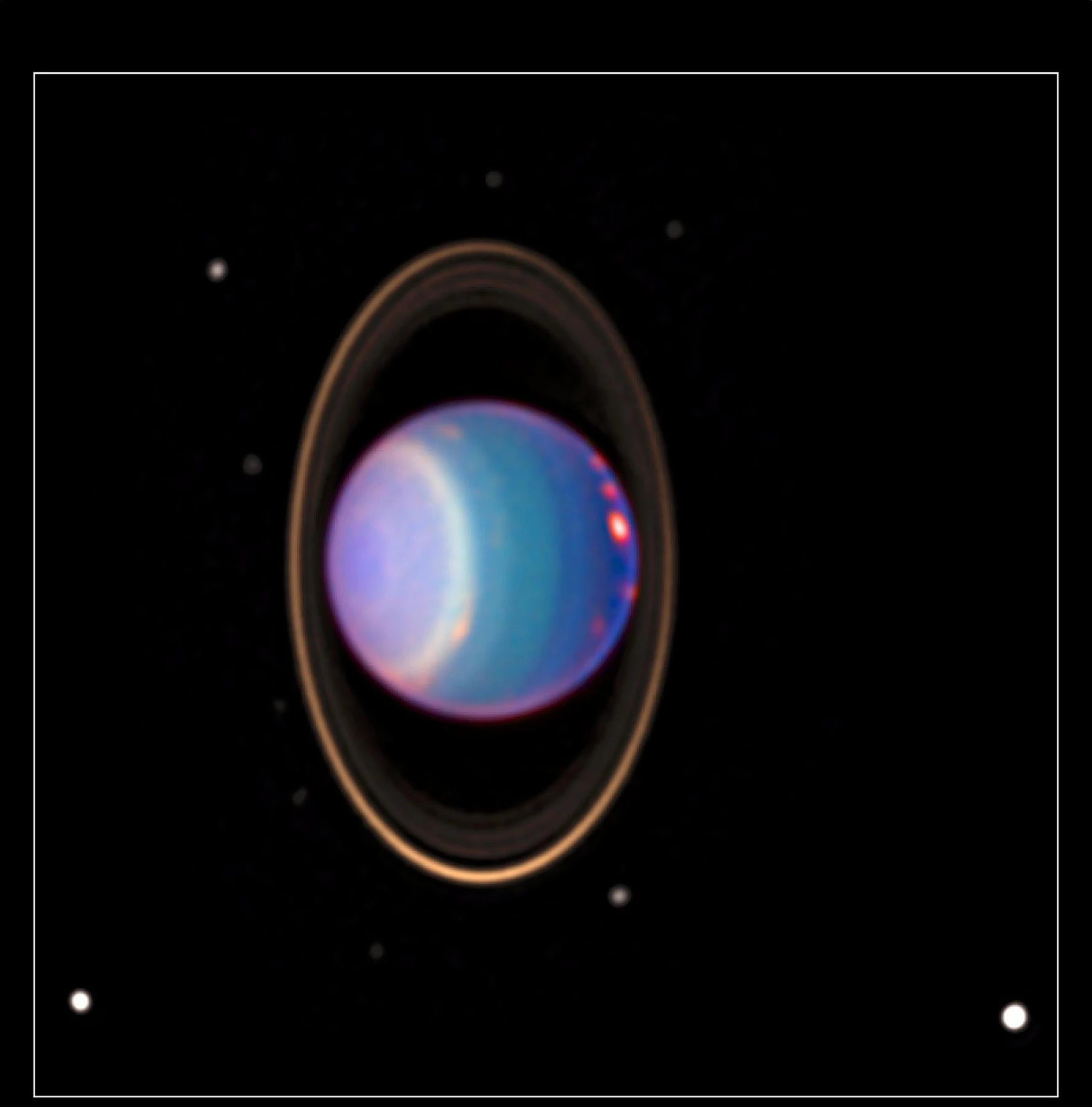
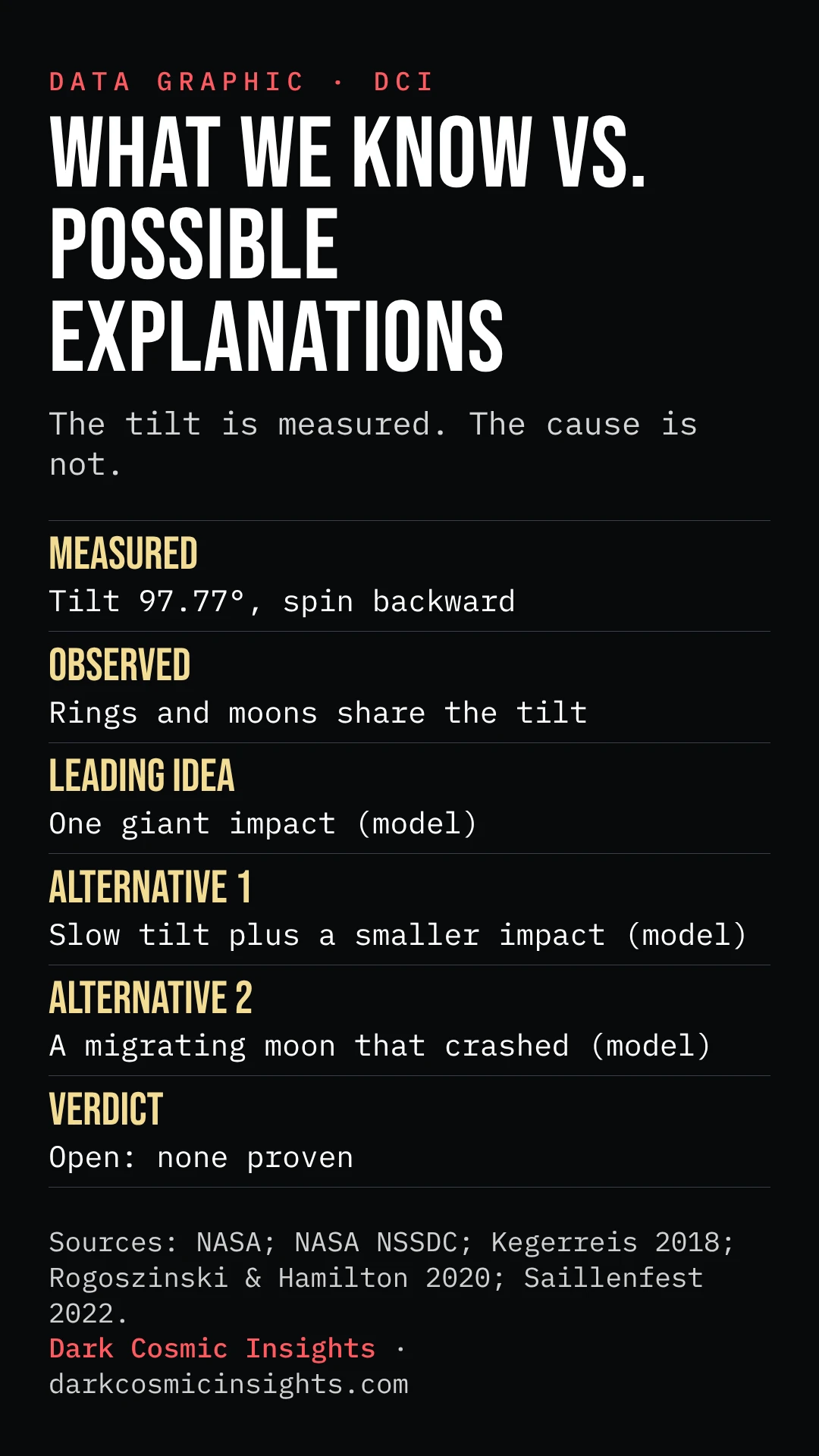
Observed, measured, modelled, open. Uranus’s tilt, spin and orbit are measured. That its rings and major moons share the tilt is observed. Every explanation for the tilt, including the popular giant impact, is modelled from computer simulations. Which explanation is right is still open.
Quick Answer: Why Is Uranus Tilted?
Uranus is tilted 97.77 degrees, so it spins on its side (NASA NSSDC). Nobody knows for certain why. NASA’s short answer is that “this may be the result of a collision with an Earth-sized object long ago” (NASA). Computer simulations show a giant impact can do it, and that’s the leading idea. But two other modelled explanations, a slow tilt from a spin-orbit resonance and a tilt driven by an ancient moon that later crashed into Uranus, are also in the running. The tilt gives Uranus the most extreme seasons in the solar system: each pole gets roughly 42 years of daylight, followed by roughly 42 years of darkness, and each of the four seasons lasts about 21 years.
What this article can and cannot establish. It can give you Uranus’s measured tilt and spin, the seasons that follow from them, and what each leading explanation proposes and predicts. It cannot tell you which explanation is true. No one watched it happen, the evidence is billions of years old, and only one spacecraft, Voyager 2 in 1986, has ever flown past Uranus.
Table of Contents
The DCI Evidence Map: Uranus’s Tilt
| Question | What we know | Status | Key source |
|---|---|---|---|
| How tilted is Uranus? | 97.77 degrees | Measured | NASA NSSDC |
| Does it spin backward? | Yes, its rotation is listed as −17.24 hours | Measured | NASA NSSDC |
| Do its rings and moons share the tilt? | Yes, they circle its tilted equator | Observed | NASA, PIA02963 |
| How long do its seasons last? | About 21 years each; about 42 years of polar daylight, then 42 of darkness | Measured | NASA |
| Did a giant impact tilt it? | Simulations show one could; not proven | Modelled | Astronomy Now, on Kegerreis et al. 2018 |
| Could it have tilted slowly instead? | Resonance and ancient-moon models say partly or fully | Modelled | AAS Nova; Saillenfest et al. 2022 |
| Which explanation is right? | Unknown | Open | NASA |
Status key: Observed = seen directly. Measured = a number with a stated uncertainty or a direct measurement. Modelled = inferred from measurements through a physical model, dependent on assumptions. Open = unresolved; the evidence is incomplete or points different ways. Not supported = the evidence goes against the claim, or there is none for it.
Cite this framework: “DCI Evidence Map: Uranus’s Tilt,” Dark Cosmic Insights, November 2026, darkcosmicinsights.com/why-is-uranus-tilted/.
How Tilted Is Uranus?
Almost 98 degrees
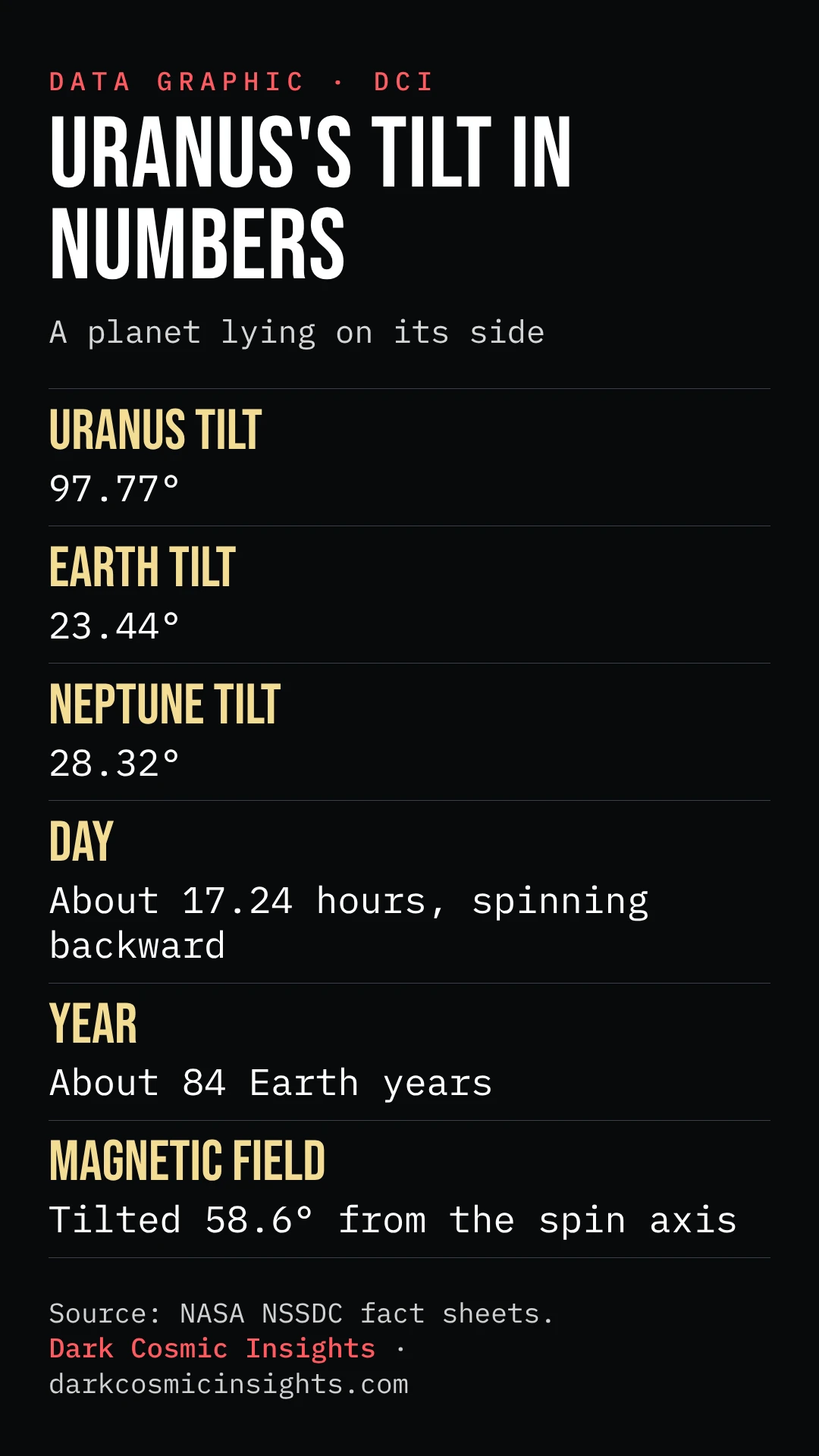
NASA’s fact sheet gives Uranus an obliquity, or axial tilt, of 97.77 degrees (NASA NSSDC). Obliquity is the angle between a planet’s equator and the plane of its orbit. Zero degrees would mean the planet spins perfectly upright. Ninety degrees would mean it lies exactly on its side. Uranus has tipped just past that, which is why NASA calls it the only planet whose equator sits “nearly at a right angle to its orbit” (NASA).
For comparison, the same fact sheets list Earth at 23.44 degrees and Neptune, Uranus’s near twin in size, at 28.32 degrees (NASA NSSDC, Neptune). Jupiter is almost upright at about 3 degrees.
Why “past 90” means it spins backward
Because Uranus is tipped beyond 90 degrees, its spin runs backward compared with most planets. That’s why NASA lists its rotation period as a negative number, −17.24 hours (NASA NSSDC). The only other planet with a backward spin is Venus, which is tilted 177 degrees, essentially flipped upside down.
The whole system is sideways
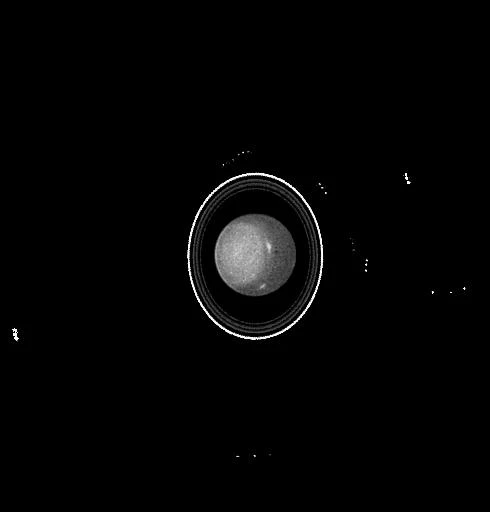
Uranus isn’t the only thing that’s tipped. Its rings and its major moons circle its tilted equator, so the whole system is turned on its side. Hubble images from the late 1990s show the rings surrounding the planet almost like a bullseye, because at that time one of Uranus’s poles was pointed nearly toward the Sun and Earth (NASA, PIA02963).
That detail matters. Any explanation for the tilt also has to explain why the rings and moons ended up lined up with the new, sideways equator.
Even the magnetic field is odd
Uranus’s magnetic field is tilted too, but not the same way. NASA’s fact sheet lists the magnetic dipole as tilted 58.6 degrees from the rotation axis and offset from the planet’s center by about a third of Uranus’s radius (NASA NSSDC). NASA calls it “an unusual, irregularly shaped magnetosphere” (NASA). Neptune’s field is lopsided as well, which suggests the cause lies in how both ice giants generate their fields deep inside, not in Uranus’s tilt. We explore that in How Many Moons Does Uranus Have? and in our guide to why Neptune is blue.
What Does a Sideways Tilt Do to Uranus’s Seasons?
The most extreme seasons in the solar system
NASA says Uranus’s tilt “causes Uranus to have the most extreme seasons in the solar system” (NASA). Here’s why.
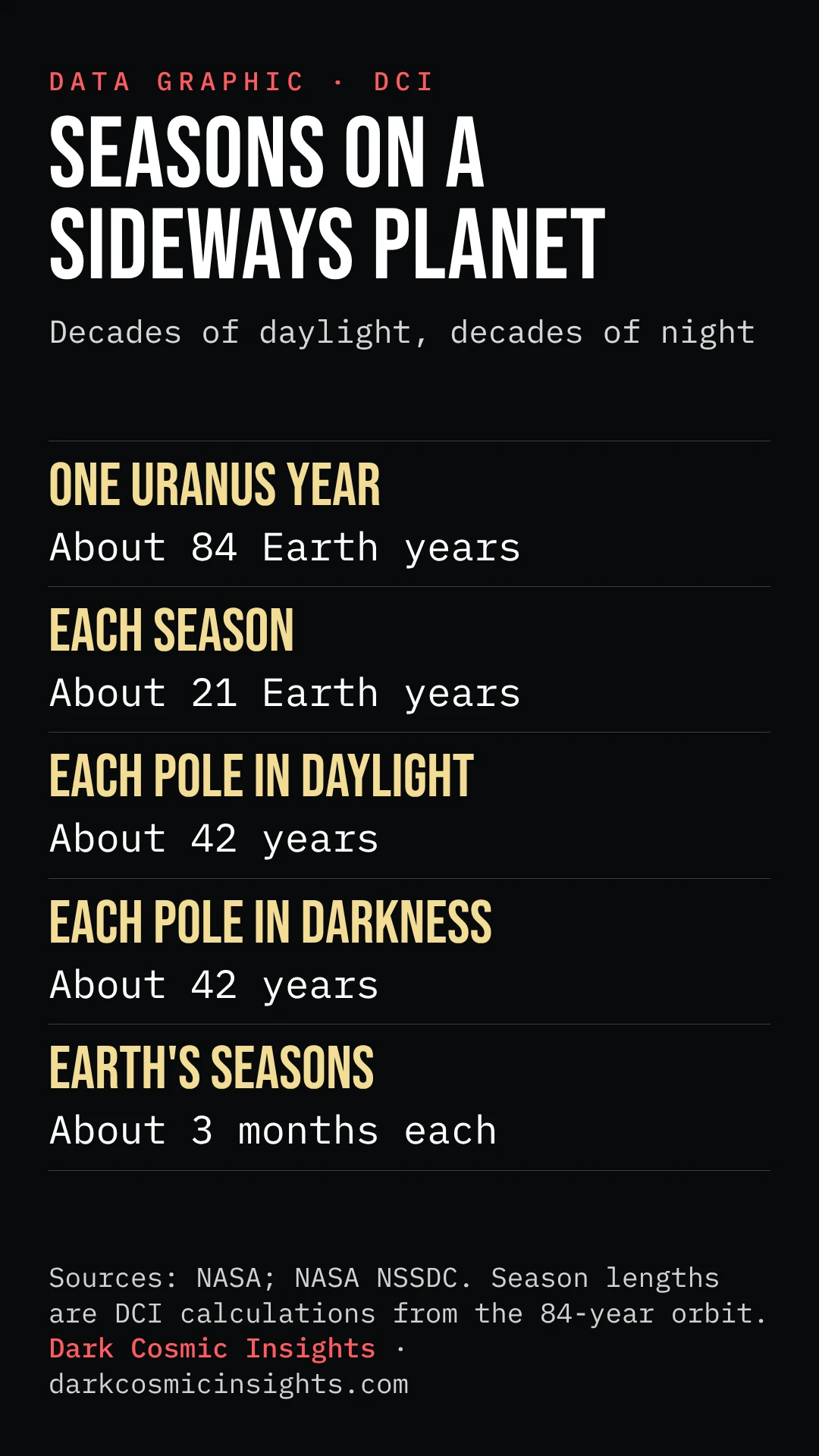
Uranus takes about 84 Earth years to orbit the Sun (30,685 days on NASA’s fact sheet). Because it’s tipped on its side, around one solstice a pole points almost straight at the Sun. About a quarter of an orbit later, at equinox, the Sun is over the equator. About a quarter after that, at the next solstice, the other pole faces the Sun.
42 years of daylight, 42 years of night
Over one 84-year orbit, each pole gets roughly 42 years of daylight, then roughly 42 years of darkness, while the other pole takes its turn (NASA, 2025; DCI calculation from the orbit). Around the middle of that stretch the pole points almost straight at the Sun. Each of the four seasons lasts about 21 years, a quarter of the 84-year orbit (DCI calculation). NASA describes the dark season as “a 21-year-long, dark winter” for half the planet (NASA).
What it would be like
If you could stand at one of Uranus’s poles, the Sun would circle in the sky for decades without setting, slowly spiraling higher and then lower, before finally sinking below the horizon for decades of night. On Earth, even the polar night lasts at most about six months.
Weather that changes over decades
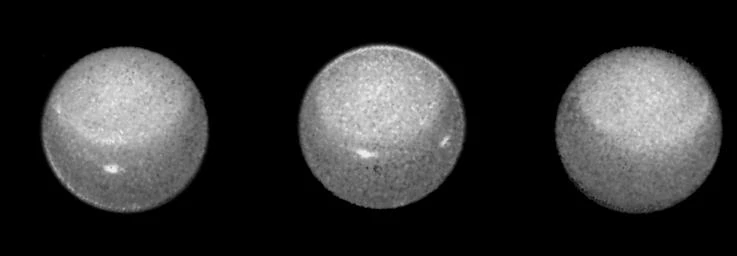
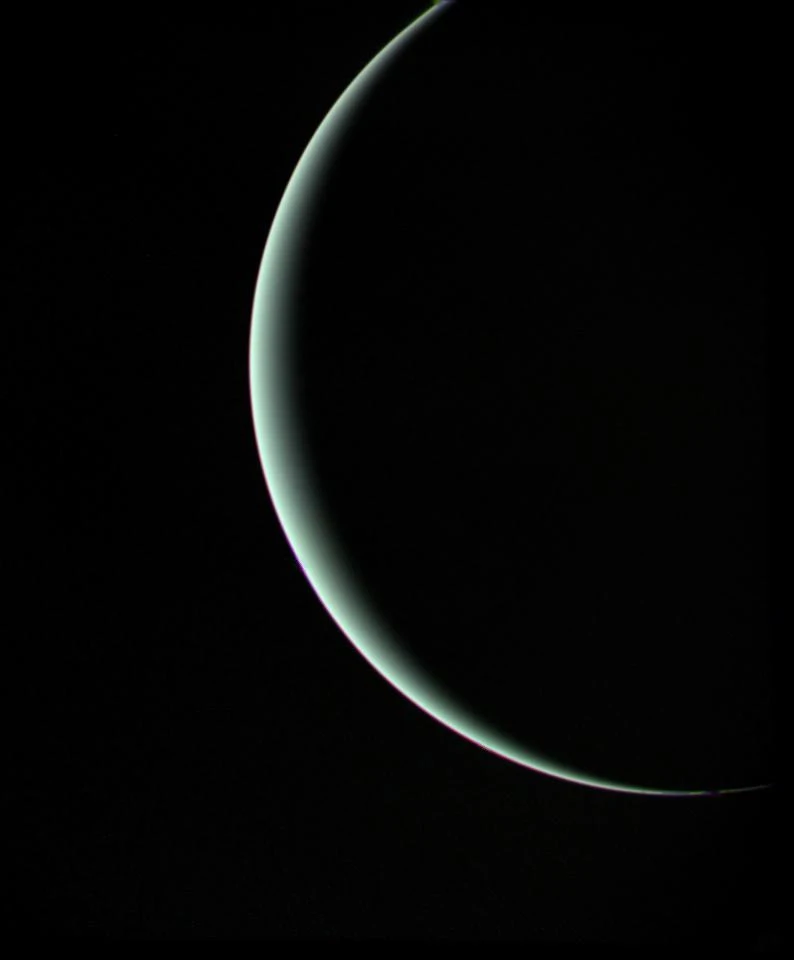
Because the seasons are so long, Uranus’s weather changes slowly. When Voyager 2 flew past in 1986, its cameras saw an almost featureless blue-green globe. NASA notes that Voyager 2 “saw only a few discrete clouds” (NASA). Later Hubble images, taken as the seasons shifted, showed bright clouds and a high haze cap over the south pole (NASA, PIA01283). Watching Uranus’s weather is a project measured in decades.
What Tilted Uranus? What We Know vs. the Possible Explanations
Here’s where the evidence runs out. The tilt is measured. What caused it is not. Scientists test explanations by building computer models of the early solar system and checking whether they can reproduce what we see today: a 98-degree tilt, a spin of about 17 hours, rings and moons lined up with the equator, and a planet that still has its atmosphere. Three main ideas are in play.
Explanation 1: one giant impact (the leading idea)
The most popular explanation is that something huge hit young Uranus and knocked it over. NASA’s facts page says the tilt “may be the result of a collision with an Earth-sized object long ago” (NASA).
In 2018, a team led by Jacob Kegerreis, then at Durham University, ran more than 50 computer simulations of impacts on young Uranus and published the results in The Astrophysical Journal. They found that “an object twice the mass of Earth, if not larger” could produce the tilt (Astronomy Now, 2018). The simulations also tackled a puzzle: how Uranus kept its atmosphere. A grazing blow, rather than a head-on hit, would not have blasted it all away.
The idea has problems, though. A summary of the debate in AAS Nova lists several, including that it’s hard to find a single body large enough, and that giant impacts would have heated Uranus enough to boil away much of its interior ice (AAS Nova, 2020). The giant impact is modelled: it can work, but no evidence shows it did.
Explanation 2: a slow tilt from resonance, plus a smaller impact
In 2020, Zeeve Rogoszinski and Douglas Hamilton of the University of Maryland proposed that Uranus might have been tipped gradually. In their model, published in The Astrophysical Journal, a massive disk around young Uranus made the wobble of its spin axis fall into step, or resonance, with its orbit, slowly tipping it over (AAS Nova, 2020).
It couldn’t do the whole job. Their best model reached “a maximum of 70º” before settling near 60 degrees, and the authors concluded “it would still take a massive impact, most likely, to push Uranus from 70º up to 98º” (AAS Nova, 2020). The advantage is that the impact needed is smaller and easier to find. This idea is modelled.
Explanation 3: a lost moon that tipped it over
In 2022, a team led by Melaine Saillenfest proposed an explanation that doesn’t need a giant impact at all. In their model, published in Astronomy & Astrophysics, Uranus once had a large moon that slowly drifted outward. As it did, its pull set up resonances that tipped Uranus toward 90 degrees. Past about 80 degrees the moon’s orbit became unstable, and it eventually crashed into Uranus, freezing the tilt in place (Saillenfest et al., 2022).
The authors found Uranus-like results in up to 80 percent of their simulations under the right conditions. But the scenario needs the moon to have been fairly big, and it requires Uranus to lose tidal energy much more efficiently than scientists traditionally assume (Saillenfest et al., 2022). This idea is modelled.
So which is it?
Nobody knows yet. All three can produce a sideways Uranus in a computer. Each depends on assumptions about the early solar system that can’t be checked directly. Telling them apart will take better measurements of Uranus’s interior, its moons and its heat, the kind only a dedicated mission could gather. Until then, the honest label is open.
Uranus vs. Neptune: Twins With Different Tilts
Uranus and Neptune are close in size, both about four times wider than Earth, and both are ice giants (NASA; NASA). Yet Neptune is tilted a modest 28.32 degrees and has more Earth-like seasons, each lasting “over 40 years” because its orbit takes about 165 Earth years (NASA).
The two planets differ in another way that may be connected. A 2025 model-based study estimated that Uranus gives off about 15% more thermal energy in total than it absorbs from sunlight, while Neptune “emits more than twice the energy it receives” (NASA, 2025; Irwin et al. 2025, MNRAS). Some researchers have wondered whether whatever tipped Uranus also changed how it holds its internal heat. That connection is open. We dig into the numbers in Why Is Neptune Blue?, and Uranus’s moons, which share its tilt, in How Many Moons Does Uranus Have?.
Myth vs. Fact: Uranus’s Tilt
| Myth | Fact | Status |
|---|---|---|
| “Uranus is tilted exactly 90 degrees.” | It’s 97.77 degrees, a little past sideways. | Measured |
| “A giant impact definitely knocked Uranus over.” | It’s the leading idea, but it’s modelled, not proven. | Modelled |
| “Only the planet is tilted.” | Its rings and major moons share the tilt. | Observed |
| “Uranus is the only planet that spins backward.” | Venus spins backward too. | Measured |
| “Uranus’s magnetic field lines up with its tilt.” | It’s tilted 58.6 degrees from the spin axis. | Measured |
| “Each season on Uranus lasts 84 years.” | That’s a full year; each season lasts about 21 years. | Measured |
How Can You See Uranus Yourself?
It’s just barely visible
Uranus is at the edge of naked-eye visibility from a very dark site, which is part of why it wasn’t recognized as a planet until 1781. NASA notes it was discovered that year by William Herschel, who “originally thought it was either a comet or a star” (NASA).
Use binoculars
Binoculars and a star chart or planetarium app make it much easier. Look for a tiny, pale blue-green point that doesn’t twinkle.
A telescope shows a disk
A small telescope at high magnification shows Uranus as a tiny blue-green disk. You won’t see the tilt, but you’ll be looking at a world rolling around the Sun on its side.
Uranus’s Tilt by the Numbers
| Measure | Value | Source |
|---|---|---|
| Axial tilt (obliquity) | 97.77° | NASA NSSDC |
| Rotation (sidereal) | −17.24 hours (backward) | NASA NSSDC |
| Orbit | 30,685 days, about 84 Earth years | NASA NSSDC |
| Each season | about 21 years (DCI calculation) | NASA |
| Polar daylight, then darkness | about 42 years each | NASA, 2025 |
| Magnetic field tilt | 58.6° from the spin axis | NASA NSSDC |
| Neptune’s tilt, for comparison | 28.32° | NASA NSSDC |
| Earth’s tilt, for comparison | 23.44° | NASA NSSDC |
| Spacecraft visits | 1 (Voyager 2, 1986) | NASA |
Sources checked November 2026.

Uranus Tilt FAQ
Why is Uranus tilted on its side?
No one knows for sure. The leading idea is that a giant impact, from something at least about twice Earth’s mass, knocked it over early in the solar system’s history. Other models suggest a slow tilt from a resonance plus a smaller impact, or a large ancient moon that tipped Uranus over before crashing into it.
How many degrees is Uranus tilted?
97.77 degrees, according to NASA’s fact sheet. That’s a little more than sideways, compared with Earth’s 23.44 degrees.
Does Uranus spin backward?
Yes. Because it’s tipped past 90 degrees, its spin runs backward relative to most planets, so NASA lists its rotation period as −17.24 hours. Venus is the only other planet that spins backward.
How long are the seasons on Uranus?
Each season lasts about 21 Earth years, a quarter of Uranus’s 84-year orbit. Each pole gets roughly 42 years of daylight, then roughly 42 years of darkness.
Are Uranus’s rings and moons tilted too?
Yes. Its rings and major moons orbit around its tilted equator, so the whole system is on its side. Any explanation for the tilt has to account for that.
Did a planet crash into Uranus?
Possibly. Simulations show a collision with a body at least about twice Earth’s mass could tilt Uranus and still leave it with an atmosphere. But it’s a model, not an observation, and other explanations can also produce the tilt.
Is Neptune tilted like Uranus?
No. Neptune is tilted about 28 degrees, much like Earth’s 23, so its seasons follow a pattern more like ours. Each one just lasts more than 40 years.
Has a spacecraft visited Uranus?
Only one. NASA’s Voyager 2 flew past in January 1986. Everything else we know comes from telescopes on and around Earth, including Hubble and Webb.
Your next step: next time Uranus is well placed, find it with binoculars and a sky app, and picture a world rolling around the Sun on its side, with decades-long days at its poles.
Sources and Further Reading
- NASA Science, Uranus: Facts.
- NASA Space Science Data Coordinated Archive, Uranus Fact Sheet; Neptune Fact Sheet.
- NASA Science, Neptune: Facts.
- NASA (July 17, 2025), NASA, Oxford Discover Warmer Uranus Than Once Thought.
- Astronomy Now (July 6, 2018), Computer simulations confirm massive impact knocked Uranus off kilter, on Kegerreis et al., The Astrophysical Journal.
- AAS Nova (March 10, 2020), A New Approach to Tilting Uranus, on Rogoszinski & Hamilton, The Astrophysical Journal.
- Saillenfest et al. (2022), Tilting Uranus via the migration of an ancient satellite, Astronomy & Astrophysics 668, A108.
- NASA images: PIA02963, PIA01283, PIA01984, PIA00143, PIA01281.
Explore Next
- Uranus’s family of moons, tilted with it: How Many Moons Does Uranus Have?
- Its near twin: Why Is Neptune Blue?
- The other planet that spins backward: What Is the Hottest Planet?
- Why moons end up facing their planets: What Is Tidal Locking?
- Every planet in one place: Solar System Explorer
- How a claim earns its label: How We Know
How This Explainer Was Checked
Every number and quote in this article was checked in November 2026 against the source linked beside it: NASA’s Uranus and Neptune facts pages, NASA’s Uranus and Neptune fact sheets, NASA’s 2025 release on Uranus’s heat, Astronomy Now’s 2018 report on the Kegerreis et al. impact simulations, AAS Nova’s 2020 summary of Rogoszinski and Hamilton’s resonance model, the 2022 Saillenfest et al. paper in Astronomy & Astrophysics, and NASA’s image pages. The tilt, spin, orbit and magnetic-field values are labelled Measured. Every explanation for the tilt is labelled Modelled, and which one is right is labelled Open. Season lengths are DCI calculations from the 84-year orbit. Images are labelled: real spacecraft and telescope images as OBSERVATION, our charts as DATA GRAPHIC. Nothing AI-generated is presented as a real image.
Final Thought: A Planet That Fell Over
Uranus is a reminder that the solar system wasn’t built neatly. Something, maybe a collision, maybe a lost moon, maybe both, tipped a giant planet onto its side billions of years ago, and it has been rolling around the Sun that way ever since. We can measure the tilt to a hundredth of a degree. We still can’t say for sure how it got there. That’s what makes it one of the best open questions in planetary science.
About the Author
Author: King | Founder of Dark Cosmic Insights