Ask what is the biggest planet in our solar system and the answer is easy: Jupiter. It’s so large that its volume is about 1.5 times that of all seven other planets added together (Jupiter to the other seven, DCI’s arithmetic from NASA JPL mean radii). Yet in February 2026, NASA’s Juno spacecraft showed that the biggest planet is slightly smaller than the reference numbers used since the 1970s: about 8 km (5 miles) narrower at the equator and about 24 km (15 miles) flatter at the poles (NASA Science, February 4, 2026).
That raises a better question: how do we know how big a planet is, and what does “big” even mean for a world with no solid surface? The answer leads down to Mercury, the smallest planet, which is narrower than two moons.
Observed, modelled, open. The sizes and masses of all eight planets are measured by spacecraft and telescopes, with stated uncertainties. Why Jupiter grew so large, and why gas giants stop growing wider as they gain mass, are modelled from physics and meteorite evidence. Why some giant exoplanets are puffed up far beyond Jupiter’s size, and where exactly a planet ends and a brown dwarf begins, are still open.
Quick Answer: What Is the Biggest Planet?
Jupiter is the biggest planet in our solar system by every common measure. Its equatorial radius is 71,492 km (44,423 miles) and its mean radius is 69,911 km (43,441 miles), about 11 times Earth’s; its mass is 1,898 × 10²⁴ kg, about 318 Earths (NASA JPL Solar System Dynamics). The smallest planet is Mercury, with a mean radius of 2,439.4 km (1,516 miles). Juno’s 2026 radio measurements trimmed Jupiter’s equatorial radius to about 71,488 km (NASA Science).
What this article can and cannot establish. It can rank the eight planets by diameter, mass and volume from NASA’s reference tables, say which radius each number means, show how they’re measured, and explain the models behind the gas-giant size ceiling. It cannot name the “largest planet in the universe”: some exoplanet sizes carry large uncertainties, and the planet/brown-dwarf boundary is still a convention.
Table of Contents
The DCI Evidence Map: Planet Sizes
| Question | What we know | Status | Key source |
|---|---|---|---|
| What is the biggest planet? | Jupiter, by radius, mass and volume | Measured | JPL SSD |
| Is the ranking the same by every measure? | No: Neptune is smaller than Uranus but more massive | Measured | JPL SSD |
| How big is Jupiter? | Reference equatorial radius 71,492 km; Juno’s 2026 value about 71,488 km | Measured | NASA Science, 2026 · Galanti et al. 2026 |
| Why did Jupiter grow so large? | An early core of about 20 Earth masses within about 1 million years, then slower growth | Modelled | LLNL, on Kruijer et al. 2017 |
| Why don’t gas giants get much wider? | In models, old radii stay within about 30% from about 0.3 to 70 Jupiter masses | Modelled | Burrows et al. 2001 |
| How big are giant exoplanets? | One well-measured example, HAT-P-67 b: 2.140 ± 0.025 Jupiter radii | Measured | NASA Exoplanet Archive |
| Why are some hot Jupiters puffed up? | Extra internal heating is needed; one proposed mechanism is Ohmic dissipation | Open | Thorngren & Fortney 2018 |
| Where does a planet end and a brown dwarf begin? | IAU working line near 13 Jupiter masses; no clear break in the mass-density data | Open | Lecavelier des Etangs & Lissauer 2022 · Hatzes & Rauer 2015 |
| What is the smallest planet? | Mercury, mean radius 2,439.4 km | Measured | JPL SSD |
| Are any moons bigger than Mercury? | Ganymede and Titan are wider; Mercury is more than twice as massive as either | Measured | JPL SSD, satellites |
Status key: Observed = seen directly in images or data. Measured = a number or detection with stated uncertainty. Modelled = inferred from measurements through a physical model, dependent on assumptions. Open = unresolved; the evidence is incomplete or points different ways. Not supported = no evidence for the claim.
Cite this framework: “DCI Evidence Map: Planet Sizes,” Dark Cosmic Insights, November 2026, darkcosmicinsights.com/what-is-the-biggest-planet/.
What Is the Biggest Planet in Our Solar System, Ranked?
Here are all eight planets, from biggest to smallest, using NASA JPL’s planetary physical parameters table, which takes its radii from the IAU working group report by Archinal et al. (2018) (JPL SSD).
How to read it: the equatorial radius runs from the centre to the equator, where spinning planets bulge; the mean radius is that of a perfect sphere with the planet’s volume.
Planet sizes and masses (radii and masses from JPL SSD; diameters, miles and Earth multiples are DCI’s arithmetic)
| Rank by size | Planet | Equatorial radius | Mean radius | Equatorial diameter | Mass (Earth = 1) |
|---|---|---|---|---|---|
| 1 | Jupiter | 71,492 km (44,423 mi) | 69,911 km | 142,984 km (88,846 mi) | 317.8 |
| 2 | Saturn | 60,268 km (37,449 mi) | 58,232 km | 120,536 km (74,898 mi) | 95.2 |
| 3 | Uranus | 25,559 km (15,882 mi) | 25,362 km | 51,118 km (31,763 mi) | 14.5 |
| 4 | Neptune | 24,764 km (15,388 mi) | 24,622 km | 49,528 km (30,775 mi) | 17.1 |
| 5 | Earth | 6,378.1 km (3,963 mi) | 6,371.0 km | 12,756 km (7,926 mi) | 1.0 |
| 6 | Venus | 6,051.8 km (3,760 mi) | 6,051.8 km | 12,104 km (7,521 mi) | 0.815 |
| 7 | Mars | 3,396.2 km (2,110 mi) | 3,389.5 km | 6,792 km (4,221 mi) | 0.107 |
| 8 | Mercury | 2,440.5 km (1,516 mi) | 2,439.4 km | 4,881 km (3,033 mi) | 0.055 |
NASA’s Planetary Fact Sheet, last updated March 18, 2025, gives equatorial diameters of 142,984 km for Jupiter and 4,879 km for Mercury (JPL’s equatorial radius gives 4,881 km). Its notes define diameter as the planet’s width “at the equator” (NSSDCA, Fact Sheet Notes).
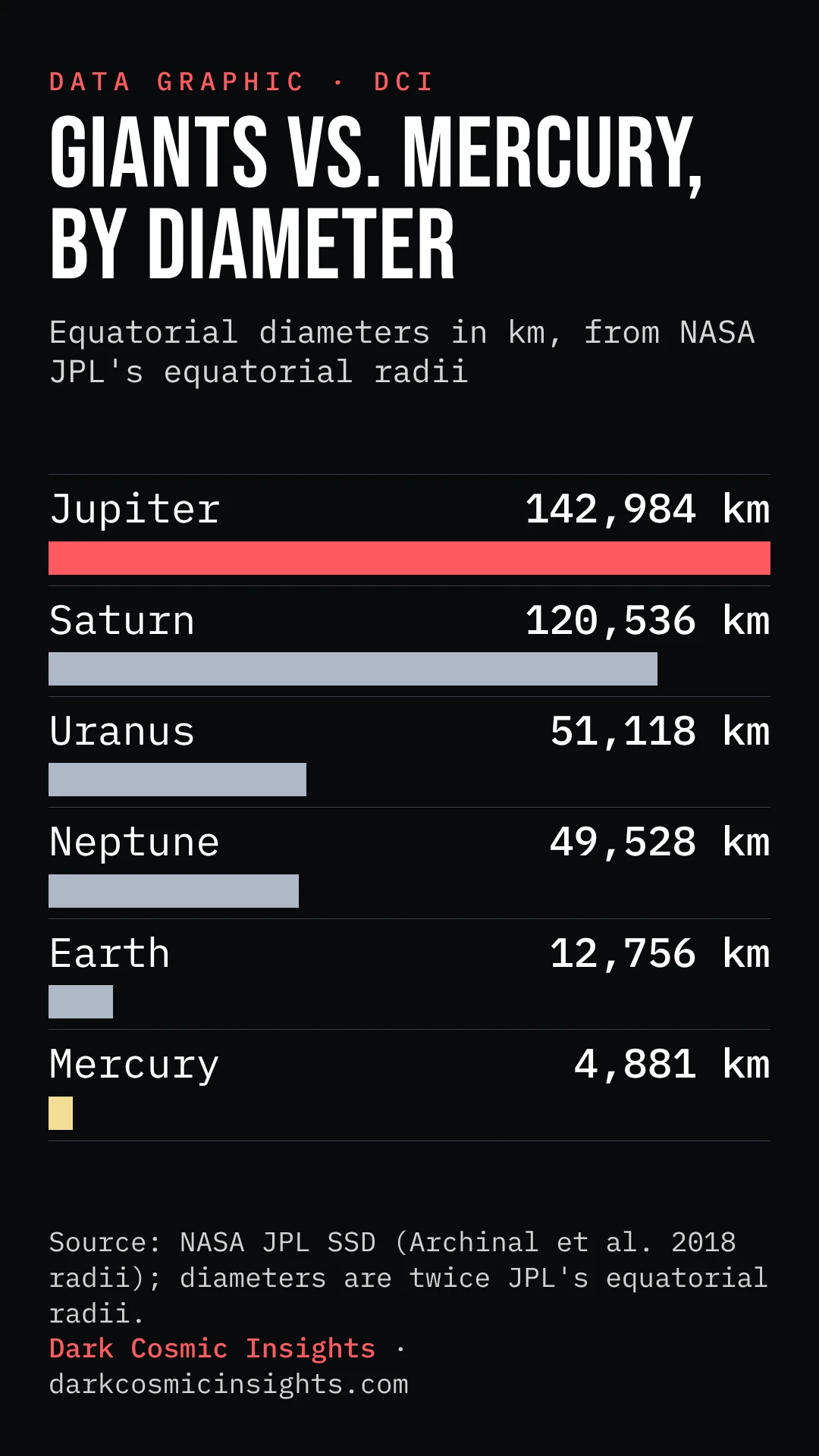
The gap is enormous: Jupiter’s mean radius is about 29 times Mercury’s (Jupiter to Mercury, DCI’s arithmetic).
Largest Planet in the Solar System: Does It Depend on How You Measure?
For Jupiter, no: it wins on radius, volume and mass. Further down the table, “biggest” depends on the measure.
Radius and volume
Volume grows with the cube of the radius, so ranking by volume gives the same order as mean radius, just more spread out. NASA’s Jupiter Fact Sheet gives Jupiter’s volume as 143,128 × 10¹⁰ km³, which is 1,321.33 times Earth’s. NASA’s popular summary puts it more simply: if Jupiter were a hollow shell, “1,000 Earths could fit inside” (NASA Science, Jupiter Facts).
Mass
Neptune is the fourth-largest planet by radius but the third-most massive: about 17.1 Earth masses, against 14.5 for the slightly wider Uranus (DCI’s arithmetic from JPL SSD masses). Its bulk density, 1.638 g/cm³, beats Uranus’s 1.270 g/cm³.
NASA says Jupiter holds “more than twice” the combined material of the solar system’s other bodies (NASA Science, Jupiter Facts). Adding up JPL’s masses for the other seven planets gives about 769 × 10²⁴ kg, so Jupiter (1,898 × 10²⁴ kg) is about 2.5 times all of them together (Jupiter to the other seven combined, DCI’s arithmetic).
Equatorial or mean radius: which should you quote?
It matters most for spinning giants. Jupiter’s equatorial radius is 71,492 km, its polar radius 66,854 km, a difference of more than 4,600 km (NSSDCA, Jupiter Fact Sheet). Mercury barely bulges: equatorial 2,440.5 km, polar 2,438.3 km (NSSDCA, Mercury Fact Sheet).

How Big Is Jupiter?
How big is Jupiter? NASA’s reference answer is an equatorial radius of 71,492 km at the 1-bar pressure level, the height in the atmosphere where the pressure equals about Earth’s sea-level air pressure (NSSDCA, Jupiter Fact Sheet). A gas giant has no solid ground to measure to, so the radius is quoted at a chosen pressure level. NASA describes Jupiter as “11 times wider than Earth,” with 317.83 times Earth’s mass and an ellipticity of 0.06487, meaning it is flattened by about 6.5% (NASA Science, Jupiter Facts; NSSDCA).
Jupiter got a little smaller in 2026
Until 2026, Jupiter’s shape rested on six radio occultation experiments by Pioneer and Voyager in the 1970s. A spacecraft’s radio signal to Earth passes through the planet’s atmosphere, which bends and delays it; measuring that change reveals temperature, pressure and density at different depths (NASA Science, February 4, 2026).
Juno repeated the experiment on 13 flybys, this time including the effect of Jupiter’s zonal winds. The results, published in Nature Astronomy on February 2, 2026, revised Jupiter’s equatorial radius from 71,492 km to 71,488 km, and its polar radius down by about 12 km (NASA Science; University of Arizona LPL, February 9, 2026; Galanti et al. 2026). A Weizmann Institute summary says the earlier shape carried “uncertainties of several kilometres” (Galanti & Kaspi, 2026).
As of November 2026, NASA’s fact sheet and JPL’s table still list 71,492 km. Neither number is “wrong”: one is the long-standing reference value, the other a newer research value. A measured number is the best current answer, with error bars, open to revision. Our How We Know hub explains how DCI labels claims like this.
Why Is Jupiter So Big?
Current models say Jupiter got a head start. NASA says it formed about 4.6 billion years ago as gravity pulled in gas and dust, and that it took most of the mass left over after the Sun formed. Its composition is “similar to that of the Sun,” mostly hydrogen and helium (NASA Science, Jupiter Facts).
A head start, read from meteorites
A team led by Thomas Kruijer read Jupiter’s history from tungsten and molybdenum isotopes in iron meteorites. Their result, published in PNAS in June 2017, suggests Jupiter’s solid core reached about 20 Earth masses within about 1 million years of the solar system’s start, then grew more slowly to about 50 Earth masses until at least 3 to 4 million years (Lawrence Livermore National Laboratory). That would make Jupiter the oldest planet. This is modelled: an inference from isotopes, not a measurement of Jupiter itself.
What’s inside: a “fuzzy” core
NASA says Juno’s data suggest a core that is partially dissolved, with no clear boundary: “dilute” or “fuzzy” (NASA Science, Jupiter Facts). Models matching Juno’s gravity data spread it over a significant fraction of the planet’s radius, holding roughly 7 to 25 Earth masses of heavy elements, with results that depend strongly on the equation of state chosen (Wahl et al. 2017). How Jupiter ended up with a dilute core is still debated.
Why Can’t Gas Giants Get Much Bigger?
Adding mass to Jupiter would barely make it wider. In models, it could even make it smaller.
The physics, in plain terms
Pressure inside a gas giant pushes out against gravity. A review of giant-planet theory by Burrows et al. (2001) in Reviews of Modern Physics describes two effects competing (Burrows et al. 2001, arXiv):
- Electrostatic (Coulomb) interactions between the charged particles inside the planet behave like ordinary solids and liquids: they tend to set a roughly fixed spacing between particles, about an ångström, and so a roughly fixed density. On their own, they would make radius grow with mass, roughly as mass to the one-third power.
- Electron degeneracy pressure (a quantum effect: electrons resist being squeezed into the same states) behaves the other way: on its own, it would make a more massive object smaller, as happens in white dwarfs.
In a gas giant, the two roughly cancel, which keeps the radius “constant over roughly two orders of magnitude in mass.” For old, cooled objects, their models give radii that stay within about 30% from about 0.3 to 70 Jupiter masses, with a peak radius at about 4 Jupiter masses (Burrows et al. 2001).
The data agree
Measurements point the same way. Chen & Kipping (2017) fitted a mass-radius relation to 316 well-constrained objects, from dwarf planets to small stars (Chen & Kipping 2017). For their “Jovian” class, which begins at about 0.41 Jupiter masses, they found radius changes with mass to the power −0.044, essentially flat. They describe radius there as “nearly degenerate with respect to mass” (Chen & Kipping 2017, arXiv).
Could Jupiter have become a star?
NASA notes that Jupiter has “the same ingredients as a star” but never grew massive enough to ignite (NASA Science, Jupiter Facts). In Chen & Kipping’s fit, the “stellar” class begins at about 0.080 solar masses, about 84 Jupiter masses (DCI’s conversion).
How Big Do Planets Get Beyond the Solar System?
One well-measured example: HAT-P-67 b
HAT-P-67 b is a giant planet that passes in front of its star, a transit, every 4.81 days. In NASA’s Exoplanet Archive, Wang et al. (2025) give a radius of 2.140 ± 0.025 Jupiter radii with a mass of only 0.45 ± 0.15 Jupiter masses, while the 2017 discovery paper gave 2.085 (+0.096/−0.071) Jupiter radii (NASA Exoplanet Archive, HAT-P-67 b). The discovery team titled their paper “an extremely low density Saturn” (Zhou et al. 2017).
That’s about twice Jupiter’s radius with under half its mass. We call it one well-measured example, not “the largest.”
Why some hot Jupiters are puffed up
Hot Jupiters, giant planets with equilibrium temperatures above 1,000 K (727 °C, 1,340 °F), are often “significantly larger than expected,” and the cause is still debated (Thorngren & Fortney 2018, arXiv). Analysing about 300 giant planets, Thorngren and Fortney found that the extra heating needed to explain their sizes peaks at about 2.5% of the incoming starlight near 1,500 K (1,227 °C, 2,240 °F) and falls to about 0.2% at 2,500 K (2,227 °C, 4,040 °F) (Thorngren & Fortney 2018). They argue this favours Ohmic dissipation, heating by electric currents in the atmosphere: one proposed mechanism, not a settled answer. The anomaly is open.
The biggest numbers in the archive, with caveats
When we queried NASA’s Exoplanet Archive on November 8, 2026, the largest listed radii belonged to objects found by direct imaging, such as V2376 Ori b, listed at 7.78 ± 0.97 Jupiter radii and 20 ± 10 Jupiter masses (archive record), and HD 100546 b, at 6.9 (+2.7/−2.9) Jupiter radii and 8.5 ± 4.0 Jupiter masses, which the archive marks as a controversial planet (archive record). (Full list: NASA Exoplanet Archive, TAP query of the composite parameters table).
The uncertainties are large. NASA notes that direct images have mostly been of giant planets that are still hot from formation (NASA Science, How We Find Exoplanets), and Burrows et al. note that a giant’s radius always shrinks with age, with early radii of “two to six times Jupiter’s radius” during deuterium burning (Burrows et al. 2001). And V2376 Ori b’s mass range, 10 to 30 Jupiter masses, straddles the planet/brown-dwarf line discussed next.
Where a planet ends and a brown dwarf begins
The IAU’s current working definition, published by Lecavelier des Etangs & Lissauer (2022), treats objects below the deuterium-fusion limit, about 13 Jupiter masses for objects of solar composition, as planets if they orbit stars, brown dwarfs or stellar remnants and meet a mass-ratio condition; objects above it are brown dwarfs (arXiv preprint; New Astronomy Reviews). NASA’s Exoplanet Archive uses a wider net: it includes objects with a mass (or minimum mass) of 30 Jupiter masses or less (NASA Exoplanet Archive, inclusion criteria).
Nature doesn’t draw that line sharply. Hatzes & Rauer (2015) found that objects from about 0.3 to 60 Jupiter masses follow one tight mass-density trend, with “no distinguishing feature” between giant planets and brown dwarfs (Hatzes & Rauer 2015, arXiv). The boundary is a working definition, so we label it Open.

What Is the Smallest Planet?
What is the smallest planet? Mercury. NASA calls it “the smallest planet in our solar system,” only slightly larger than Earth’s Moon, with a radius of 2,440 km (1,516 miles) (NASA Science, Mercury Facts). JPL’s table gives a mean radius of 2,439.4 ± 0.1 km and an equatorial radius of 2,440.53 ± 0.04 km (JPL SSD).
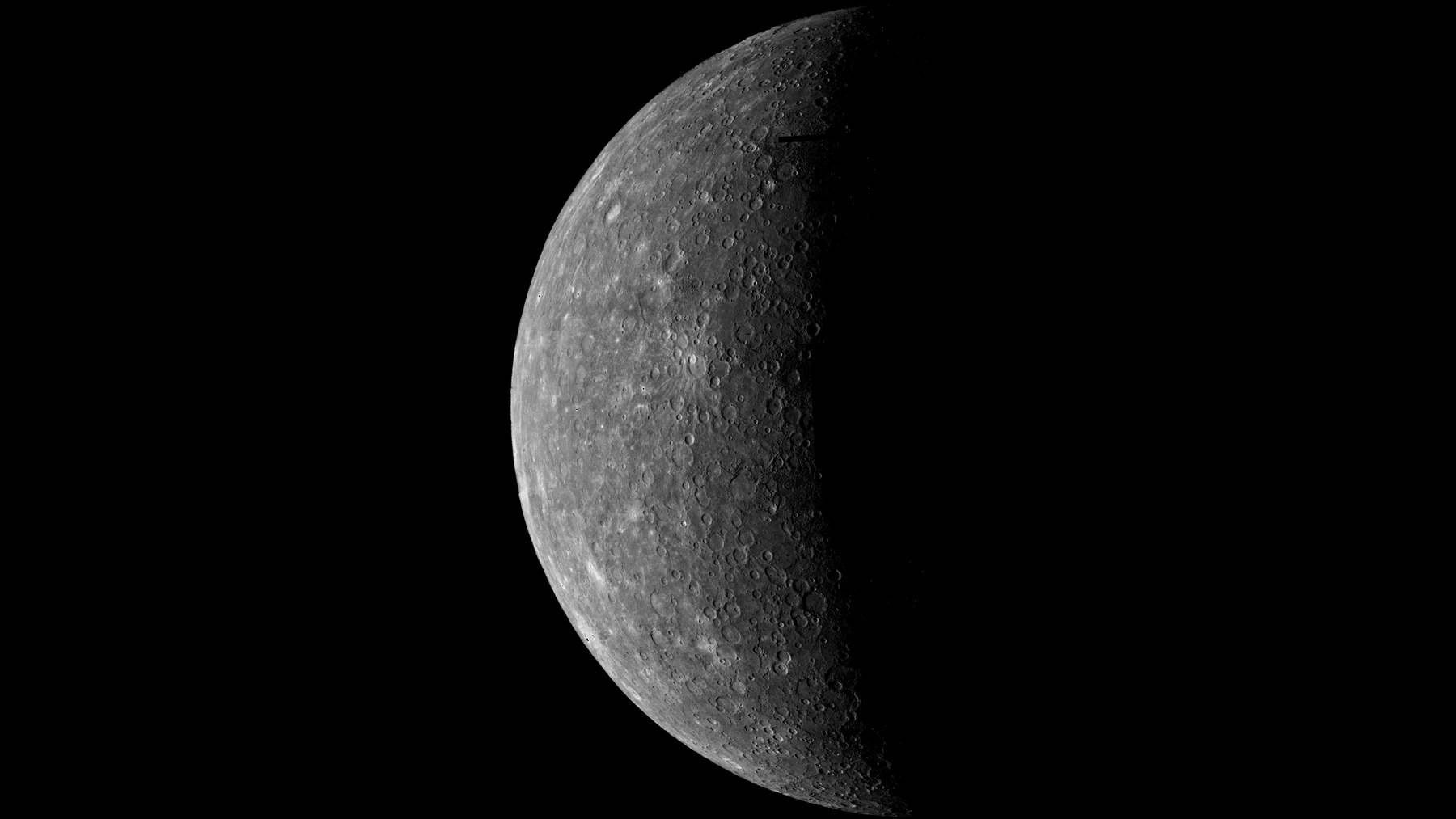
It has 0.0553 of Earth’s mass and 0.0562 of its volume (NSSDCA, Mercury Fact Sheet), but its density, 5,429 kg/m³, is second only to Earth’s among the planets (NSSDCA Planetary Fact Sheet). NASA says it has a large metallic core with a radius of about 2,074 km (1,289 miles), about 85% of the planet’s radius (NASA Science, Mercury Facts).
Mercury has shrunk as it cooled
As Mercury’s interior cooled, the planet contracted and its crust buckled into long cliffs (NASA Science). By mapping ridges and fault scarps in MESSENGER images, Byrne et al. (2014) estimated that Mercury’s radius has contracted by as much as 7 km (4.3 miles), far more than the 0.8 to 3 km earlier estimates (Byrne et al. 2014). That figure is an estimate from mapped structures, not a before-and-after measurement. Our own Moon shows a smaller version of the same effect: see why the Moon is shrinking.
Mercury is the closest planet to the Sun but not the hottest; see what is the hottest planet.
Is Mercury the Smallest World? Ganymede, Titan and Pluto
Mercury is the smallest planet, but not the smallest round world, and not even bigger than every moon.
Mean diameters (DCI’s doubling of JPL’s mean radii; JPL SSD, satellites and planets)
| World | Type | Mean diameter | Bigger than Mercury? |
|---|---|---|---|
| Ganymede (Jupiter) | Moon | 5,262 km (3,270 mi) | Yes |
| Titan (Saturn) | Moon | 5,150 km (3,200 mi) | Yes |
| Mercury | Planet | 4,879 km (3,032 mi) | n/a |
| Callisto (Jupiter) | Moon | 4,821 km (2,995 mi) | No, about 99% of Mercury’s width |
| Earth’s Moon | Moon | 3,475 km (2,159 mi) | No |
| Pluto | Dwarf planet | 2,377 km (1,477 mi) | No |
NASA says Ganymede is “the largest moon in our solar system,” even bigger than Mercury and Pluto (NASA Science, Ganymede). For Titan, NASA says it is “larger than even the planet Mercury,” and that only Ganymede is larger, “by just 2 percent” (NASA Science, Titan Facts). Titan is also the destination of NASA’s Dragonfly rotorcraft.
Wider, but lighter
By mass, Mercury wins easily. Using JPL’s measured GM values (the product of the gravitational constant and mass), Ganymede’s mass is about 1.48 × 10²³ kg and Titan’s about 1.35 × 10²³ kg, against Mercury’s 3.30 × 10²³ kg (JPL SSD, satellites; JPL SSD, planets). So Mercury is about 2.2 times as massive as Ganymede and about 2.5 times as massive as Titan (Mercury to each moon, DCI’s arithmetic). The moons are wider because they’re made largely of lower-density ice and rock: Ganymede’s mean density is 1.94 g/cm³, Mercury’s 5.43 g/cm³.
They orbit planets, so they’re moons, whatever their size. For more on Jupiter’s family, see how many moons Jupiter has.
What about Pluto?
Pluto has an equatorial diameter of about 2,377 km (1,477 miles), about two-thirds the diameter of Earth’s Moon (NASA Science, Pluto Facts). It’s classified as a dwarf planet, so it isn’t in the eight-planet ranking. We cover why in why is Pluto not a planet?
How Do Scientists Measure a Planet’s Size?
Radio occultations
As described above, a radio signal grazing a planet’s atmosphere reveals each pressure level. Pioneer and Voyager made six at Jupiter; Juno’s 13 refined its shape in 2026 (NASA Science, 2026).
Laser altimetry plus occultations
For Mercury, MESSENGER‘s Mercury Laser Altimeter bounced laser pulses off the northern hemisphere, and 378 radio occultations filled in the south. Combining them, Perry et al. (2015) reported a mean radius of 2,439.36 ± 0.02 km and found Mercury’s polar radius is 1.65 km less than its mean equatorial radius (NASA ADS record, Geophysical Research Letters).
Radar through clouds
Venus’s surface is hidden under thick clouds, so NASA’s Magellan orbiter mapped it by radar, eventually imaging about 98% of the surface between 1990 and 1994 (NASA Science, Magellan).
Transits for exoplanets
For most planets around other stars, NASA explains, a planet’s size “can be calculated based on how much the star’s brightness lowered” during a transit (NASA Science). Our guide to how astronomers measure stars covers that side.
Mass from gravity
Mass is a separate measurement, made through gravity. Juno, for example, measured Jupiter’s gravity field in enough detail to test models of its core (Wahl et al. 2017). JPL cites a separate published source for each planet’s mass (JPL SSD).
Myth vs. Fact: Planet Sizes
| Myth | Fact |
|---|---|
| “Jupiter’s size is known exactly.” | It’s measured with error bars. Juno trimmed its equatorial radius by about 4 km in 2026. |
| “Bigger planets are always heavier.” | Neptune is smaller than Uranus but more massive. |
| “Add enough gas and Jupiter would swell enormously.” | In models, adding mass to a Jupiter-like planet barely changes its radius; past about 4 Jupiter masses it shrinks. |
| “Jupiter is a failed star.” | It never grew massive enough to ignite; the stellar class begins at about 84 Jupiter masses in Chen & Kipping’s fit. |
| “Mercury is the smallest world in the solar system.” | It’s the smallest planet. Pluto and many moons are smaller, while Ganymede and Titan are wider. |
| “There’s a known largest planet in the universe.” | Archive values for the largest objects carry big uncertainties, and the planet/brown-dwarf line is a working definition. |
How Can You See the Biggest and Smallest Planets Yourself?
Jupiter
Jupiter is best around opposition, when Earth passes between it and the Sun. The next opposition is on February 11, 2027 (UTC), which is the evening of February 10 in the Americas. Japan’s National Astronomical Observatory lists it at 09:29 Japan time (NAOJ, Celestial Phenomena 2027), about 00:29 UTC; EarthSky gives 0:21 UTC (EarthSky).
Even ordinary binoculars show several of Jupiter’s four big moons as pinpoints of light lined up beside the planet (EarthSky). Those are the moons Galileo first saw in 1610 (NASA Science, Jupiter Moons), and two of them, Ganymede and Callisto, are close to Mercury’s size.
Mercury
Mercury never strays far from the Sun in our sky; look near a greatest elongation, when it appears farthest from the Sun. Selected 2027 dates from NAOJ: February 3, 2027 (east, evening sky, about 18.3° from the Sun), March 17, 2027 (west, morning sky, about 27.6°) and May 28, 2027 (east, evening sky, about 22.9°), all in Japan time (NAOJ, Celestial Phenomena 2027). Never point binoculars or a telescope near the Sun.
What Comes Next for Jupiter and Mercury?
Dated plans, as of November 2026:
- BepiColombo (ESA and JAXA), Mercury. BepiColombo completed the separation of its transfer module on 3 September 2026. The remaining milestones are plans: ESA’s arrival page gives Mercury orbit entry on 21 November 2026, separation of its two orbiters on 9–10 December 2026 and the start of science in April 2027 (ESA, BepiColombo arrival updates), while ESA’s main mission page says arrival in December 2026 (ESA, BepiColombo). ESA’s pages have shown more than one version of this schedule, so check ESA for the current dates.
- Europa Clipper (NASA), Jupiter. Launched October 14, 2024, it is due to reach Jupiter in April 2030 (NASA Science, Europa Clipper).
- Juice (ESA), Jupiter. Launched April 14, 2023, it is planned to arrive in July 2031, with Ganymede as its primary target; its latest Earth flyby, reported by ESA on September 28, 2026, adjusted its course (ESA, Juice).
- Juno (NASA), Jupiter. At a 2025 conference, principal investigator Scott Bolton described a proposed three-year second extended mission starting in October 2025; his abstract notes the proposal was still under review (Bolton, EPSC-DPS 2025). A 2026 abstract from the Juno team reports that extended operations were continuing (Levin & Juno Science Team, EGU 2026). We haven’t verified the spacecraft’s status on the day you read this.
If the reference tables adopt Juno’s revised Jupiter shape, we’ll update the numbers in this article, with dates.
The Biggest Planet by the Numbers
- 71,492 km (44,423 miles): Jupiter’s reference equatorial radius at the 1-bar level (JPL SSD)
- 71,488 km (44,421 miles): Jupiter’s equatorial radius from Juno’s 2026 radio occultations (NASA Science)
- 317.83: Jupiter’s mass in Earth masses (NSSDCA)
- 1,321: how many times Earth’s volume fits in Jupiter’s (NSSDCA)
- About 2.5: Jupiter’s mass compared with the other seven planets combined (DCI’s arithmetic from JPL masses)
- 2,439.4 km (1,516 miles): Mercury’s mean radius (JPL SSD)
- 5,262 km (3,270 miles): Ganymede’s mean diameter, wider than Mercury’s 4,879 km (3,032 miles) (DCI’s doubling of JPL radii)
- Up to 7 km (4.3 miles): estimated shrinkage of Mercury’s radius as it cooled (Byrne et al. 2014)
- About 4 Jupiter masses: where cold giant planets reach their largest radius in models (Burrows et al. 2001)
- 2.140 ± 0.025 Jupiter radii: the size of HAT-P-67 b, one well-measured puffed-up giant (NASA Exoplanet Archive)

Biggest and Smallest Planets: FAQ
Which planet is the largest, and by how much?
Jupiter. Its equatorial radius is 71,492 km in NASA’s reference tables, about 11 times Earth’s, and it has about 318 times Earth’s mass. Saturn is second, with an equatorial radius of 60,268 km and about 95 Earth masses.
Which planet is the tiniest?
Mercury. Its mean radius is 2,439.4 km (1,516 miles), only slightly larger than Earth’s Moon, according to NASA JPL. It has about 5.5% of Earth’s mass.
How many Earths would fit inside Jupiter?
Jupiter’s volume is about 1,321 times Earth’s, according to NASA’s Jupiter Fact Sheet. NASA’s popular summary rounds this to about 1,000 Earths fitting inside a hollow Jupiter.
Did Jupiter really get smaller in 2026?
Not physically. Juno’s radio measurements, published in February 2026, refined Jupiter’s equatorial radius from 71,492 km to about 71,488 km and found its poles flatter than thought. It’s a better measurement, not a change in the planet.
Is Ganymede bigger than Mercury?
Yes, in diameter. Ganymede’s mean diameter is about 5,262 km and Mercury’s about 4,879 km, from JPL’s mean radii. But Mercury is about 2.2 times as massive, because it’s mostly rock and metal while Ganymede holds a lot of ice.
Why is Uranus bigger than Neptune but lighter?
Uranus has a slightly larger equatorial radius, 25,559 km against Neptune’s 24,764 km. But Neptune holds about 17.1 Earth masses to Uranus’s 14.5, so it’s denser.
What is the largest known exoplanet?
There’s no simple answer. NASA’s Exoplanet Archive lists directly imaged objects up to about 7.8 Jupiter radii, with large uncertainties; the largest, V2376 Ori b, has a mass of 20 ± 10 Jupiter masses, a range that crosses the IAU’s 13-Jupiter-mass planet line, and another, HD 100546 b, is flagged as controversial. HAT-P-67 b is one well-measured transiting example at about 2.1 Jupiter radii.
Could Jupiter turn into a star if it gained mass?
Not unless it gained an enormous amount. In Chen and Kipping’s mass-radius fit, the stellar class begins at about 0.08 solar masses, roughly 80 times Jupiter’s mass. Below that, extra mass mostly compresses a gas giant rather than making it shine.
Your next step: when you see a planet’s size quoted, ask: radius or diameter, equatorial or mean? Then compare it with NASA JPL’s planetary physical parameters table, the reference the numbers in this article come from.

Sources and Further Reading
- NASA JPL Solar System Dynamics (masses last updated 2018-Mar-28; checked November 2026), Planetary Physical Parameters. Equatorial and mean radii, masses and densities for all eight planets; Pluto’s mean radius.
- NASA JPL Solar System Dynamics (checked November 2026), Planetary Satellite Physical Parameters. GM, mean radius and density for Ganymede, Titan, Callisto and the Moon.
- Archinal, B. A., et al. (2018). Report of the IAU Working Group on Cartographic Coordinates and Rotational Elements: 2015. Celestial Mechanics and Dynamical Astronomy, 130. doi:10.1007/s10569-017-9805-5. The source of JPL’s radii.
- NASA NSSDCA (updated March 18, 2025), Planetary Fact Sheet, with Fact Sheet Notes, Jupiter Fact Sheet (updated October 2, 2024) and Mercury Fact Sheet (updated January 11, 2024).
- NASA Science (February 4, 2026), NASA’s Juno Mission Redefines Size, Shape of Jupiter.
- Galanti, E., Smirnova, M., Ziv, M., et al. (2026). The size and shape of Jupiter. Nature Astronomy, 10, 493–501. doi:10.1038/s41550-026-02777-x. With the University of Arizona LPL news item (February 9, 2026) and the Weizmann Institute summary.
- NASA Science (updated October 15, 2026), Jupiter Facts; (updated September 21, 2026) Jupiter Moons; (updated April 25, 2025) Ganymede.
- NASA Science (updated April 25, 2025), Mercury Facts; (updated October 19, 2026) Titan Facts; (updated April 22, 2025) Pluto Facts.
- Lawrence Livermore National Laboratory (June 2017), Lab scientist finds Jupiter is one old-timer. On Kruijer et al., PNAS (2017).
- Wahl, S. M., Hubbard, W. B., Militzer, B., et al. (2017). Comparing Jupiter interior structure models to Juno gravity measurements and the role of a dilute core. Geophysical Research Letters, 44. doi:10.1002/2017GL073160.
- Burrows, A., Hubbard, W. B., Lunine, J. I., & Liebert, J. (2001). The theory of brown dwarfs and extrasolar giant planets. Reviews of Modern Physics, 73, 719. doi:10.1103/RevModPhys.73.719 (arXiv).
- Chen, J., & Kipping, D. M. (2017). Probabilistic forecasting of the masses and radii of other worlds. The Astrophysical Journal, 834, 17. doi:10.3847/1538-4357/834/1/17 (arXiv).
- Hatzes, A. P., & Rauer, H. (2015). A definition for giant planets based on the mass-density relationship. The Astrophysical Journal Letters, 810, L25. doi:10.1088/2041-8205/810/2/L25 (arXiv).
- Lecavelier des Etangs, A., & Lissauer, J. J. (2022). The IAU working definition of an exoplanet. New Astronomy Reviews, 94. doi:10.1016/j.newar.2022.101641 (arXiv).
- Thorngren, D. P., & Fortney, J. J. (2018). Bayesian analysis of hot-Jupiter radius anomalies: evidence for Ohmic dissipation? The Astronomical Journal. doi:10.3847/1538-3881/aaba13 (arXiv).
- Zhou, G., Bakos, G. Á., Hartman, J. D., et al. (2017). HAT-P-67b: An extremely low density Saturn transiting an F-subgiant confirmed via Doppler tomography. The Astronomical Journal, 153. doi:10.3847/1538-3881/aa674a.
- NASA Exoplanet Archive (queried November 8, 2026), HAT-P-67 b overview, composite parameters query and inclusion criteria (updated December 6, 2024). Individual records: V2376 Ori b and HD 100546 b (flagged controversial).
- NASA Science, What’s a Transit? and How We Find and Characterize Exoplanets.
- Byrne, P. K., Klimczak, C., Şengör, A. M. C., Solomon, S. C., Watters, T. R., & Hauck, S. A. (2014). Mercury’s global contraction much greater than earlier estimates. Nature Geoscience, 7, 301–307. doi:10.1038/ngeo2097.
- Perry, M. E., et al. (2015). The low-degree shape of Mercury. Geophysical Research Letters, 42. doi:10.1002/2015GL065101 (ADS record).
- NASA Science, Magellan, Juno and Europa Clipper mission pages (Juno and Europa Clipper updated November 3, 2026).
- Bolton, S. (2025). The Juno 2nd Extended Mission. EPSC-DPS Joint Meeting 2025, EPSC-DPS2025-158. doi:10.5194/epsc-dps2025-158; Levin, S., & the Juno Science Team (2026). Science from Juno’s Continuing Extended Mission. EGU General Assembly 2026, EGU26-22848. doi:10.5194/egusphere-egu26-22848.
- ESA, BepiColombo, Latest updates: BepiColombo’s arrival at Mercury and Juice.
- National Astronomical Observatory of Japan, Celestial Phenomena 2027; EarthSky (July 10, 2026), Jupiter at opposition.
- NASA Photojournal: PIA04866, Cassini Jupiter Portrait; PIA00437, Planet Mercury (Mariner 10).
Explore Next
- The moons that rival Mercury: How Many Moons Does Jupiter Have?
- Why the closest planet isn’t the hottest: What Is the Hottest Planet?
- The world that lost its planet status: Why Is Pluto Not a Planet?
- Mercury isn’t the only shrinking world: Why Is the Moon Shrinking?
- Titan, the moon wider than Mercury: NASA’s Dragonfly Mission to Titan
- How a claim earns its label: How We Know
- More from the planets: Planets & Moons
- Read next: How Many Moons Does Uranus Have? Shakespeare’s Moons on a Sideways Planet
- Read next: What Is a Nebula? Star Nurseries, Stellar Ghosts and the Clouds Between the Stars
How This Explainer Was Checked
Every number in this article was checked in November 2026 against the source linked beside it: NASA JPL tables, NSSDCA fact sheets, NASA Science, ESA and Photojournal pages, the NASA Exoplanet Archive, university news and peer-reviewed papers, with DOIs confirmed through Crossref, arXiv or ADS. Radii are labelled equatorial or mean each time. Diameters, miles, Celsius and Fahrenheit, Earth-mass multiples, the moons’ masses (from JPL’s GM values), and all ratios are DCI’s arithmetic, with the order of each ratio stated. Jupiter’s 2026 Juno radius is given beside the older reference value, not in place of it, because the reference tables had not changed when we checked. Why Jupiter grew so large and why gas giants have a size ceiling are labelled Modelled; the hot-Jupiter radius anomaly and the planet/brown-dwarf boundary are labelled Open. Exoplanet values come from a dated archive query, with uncertainties. Images are labelled: real spacecraft images as OBSERVATION, illustrations as ILLUSTRATION, and our charts as DATA GRAPHIC. Nothing AI-generated is presented as a real image.

Final Thought: Big Is a Measurement, Not a Feeling
Jupiter is the biggest planet in our solar system by every measure we have. What changes is how sure we can be, and what “big” means. Its radius is a chosen pressure level, refined in 2026 by a spacecraft’s radio signal. Its size has a ceiling written in quantum physics. And the smallest planet is narrower than two moons. Every one of those facts is a number with a method behind it.
About the Author
Author: King | Founder of Dark Cosmic Insights
King is the founder of Dark Cosmic Insights, a science storytelling platform exploring the strangest true stories hiding in space, science and AI. He digs into NASA, ESA and peer-reviewed research, separates what has been measured from what is still a mystery, and turns it into articles, data graphics and Shorts.
Follow the anomaly. Trace the source.