In February 2026, scientists reported something strange about two huge, tea-dark lakes in the Congo Basin. The carbon dioxide bubbling out of them is partly thousands of years old. The rain that fills the lakes fell recently. The plants around them are alive. Yet the carbon leaving the water carries a radiocarbon age of more than 2,000 years in one lake and more than 3,500 in the other.
The explanation leads straight into one of the planet’s biggest carbon vaults: the peatlands of the central Congo Basin, the largest tropical peatland complex on Earth. It also leads into a tool most people have heard of but few could explain: radiocarbon dating.
This guide covers radiocarbon dating peatlands from the ground up. You’ll learn how carbon-14 works as a clock, how scientists date carbon dissolved in lake water, what the Congo results actually mean, and why “old carbon” doesn’t mean “old water.” As always at Dark Cosmic Insights, we keep three things apart: what was measured, what is modelled, and what is still open.
In this guide
- Quick Answer: What Did Radiocarbon Reveal About the Congo Lakes?
- The DCI Peatland Radiocarbon Evidence Map
- What Is a Peatland, and Why Does It Store So Much Carbon?
- How Big Are the Congo Basin Peatlands?
- How Does Radiocarbon Dating Work?
- Are Radiocarbon Years the Same as Calendar Years?
- How Do Scientists Radiocarbon-Date Carbon in Lake Water?
- What Did the Congo Lake Study Find?
- Does Old Carbon Mean Old Water?
- Has the Congo Peat Released Carbon Before?
- Is Old Carbon Leaking From Other Peatlands?
- Myth vs. Fact: Old Carbon Edition
- How Can You Read a Carbon-Dating Headline?
- What Comes Next for Congo Peatland Research?
- Peatland Radiocarbon by the Numbers
- Frequently Asked Questions
- Sources and Further Reading
- Keep Exploring
- How This Explainer Was Checked
Quick Answer: What Did Radiocarbon Reveal About the Congo Lakes?
Quick Answer: Living things absorb a tiny, steady amount of radioactive carbon-14. After death it decays, about half every 5,730 years, so the amount left works as a clock. When scientists measured the carbon dissolved as CO₂ in Congo’s Lake Mai Ndombe and Lake Tumba, it averaged about 2,170 and 3,515 radiocarbon years old. Mixing models suggest roughly 40% of it comes from ancient peat that microbes are breaking down. The water is young; part of the carbon in it is not.
What this article can and cannot establish: We can explain the physics and chemistry behind radiocarbon dating and report what the Congo study measured, with a source for every number. We can’t tell you whether this leak is new or has been going on for thousands of years, because the study doesn’t settle that. Where scientists are still working things out, we say so.
The DCI Peatland Radiocarbon Evidence Map
Some claims about old carbon in the Congo are firmly measured. Others are interpretations or open questions. This map sorts them.
| Question | What we know | Status | Key source |
|---|---|---|---|
| Is the CO₂-related carbon in the lakes old? | Dissolved inorganic carbon averaged ~2,170 (Mai Ndombe) and ~3,515 (Tumba) radiocarbon years | Measured | Drake et al. 2026 |
| Is the dissolved organic matter old too? | No. Dissolved and particulate organic carbon were modern | Measured | Drake et al. 2026 |
| How much comes from peat? | About 39% (Mai Ndombe) and 40% (Tumba) of the dissolved inorganic carbon | Modelled | Drake et al. 2026 |
| How much peat carbon does Mai Ndombe vent? | Upwards of 150,000 tonnes of carbon a year, a conservative estimate | Modelled | Drake et al. 2026 |
| How big is the Congo peat store? | About 167,600 km² holding about 29 billion tonnes of carbon | Measured (field and map based) | Crezee et al. 2022 |
| Has this peat lost carbon before? | Yes. A drying spell ~5,000–2,000 years ago triggered decomposition | Measured (peat cores) | Garcin et al. 2022 |
| Exactly how does old carbon reach the lakes? | Microbes respire old peat carbon, then CO₂ travels to the lakes; details unclear | Open | Drake et al. 2026; Mongabay 2026 |
| Is the peatland collapsing? | No evidence of that; the leak may be long-standing and natural | Not supported | Mongabay 2026 |
Status key: Measured = quantified from samples or field data; Modelled = estimated with statistical or physical models; Open = still under investigation; Not supported = the evidence doesn’t back the claim.
Cite this framework: Dark Cosmic Insights, “Peatland Radiocarbon Evidence Map,” darkcosmicinsights.com, 2026.
What Is a Peatland, and Why Does It Store So Much Carbon?
A peatland is a wetland where dead plants pile up faster than they rot. The ground is so waterlogged that oxygen can’t get in, and without oxygen most decomposers slow to a crawl. Leaves, roots and wood that would vanish in a dry forest within a few years instead collect, layer on layer, as peat: a dark, spongy soil made mostly of partly decayed plant matter.
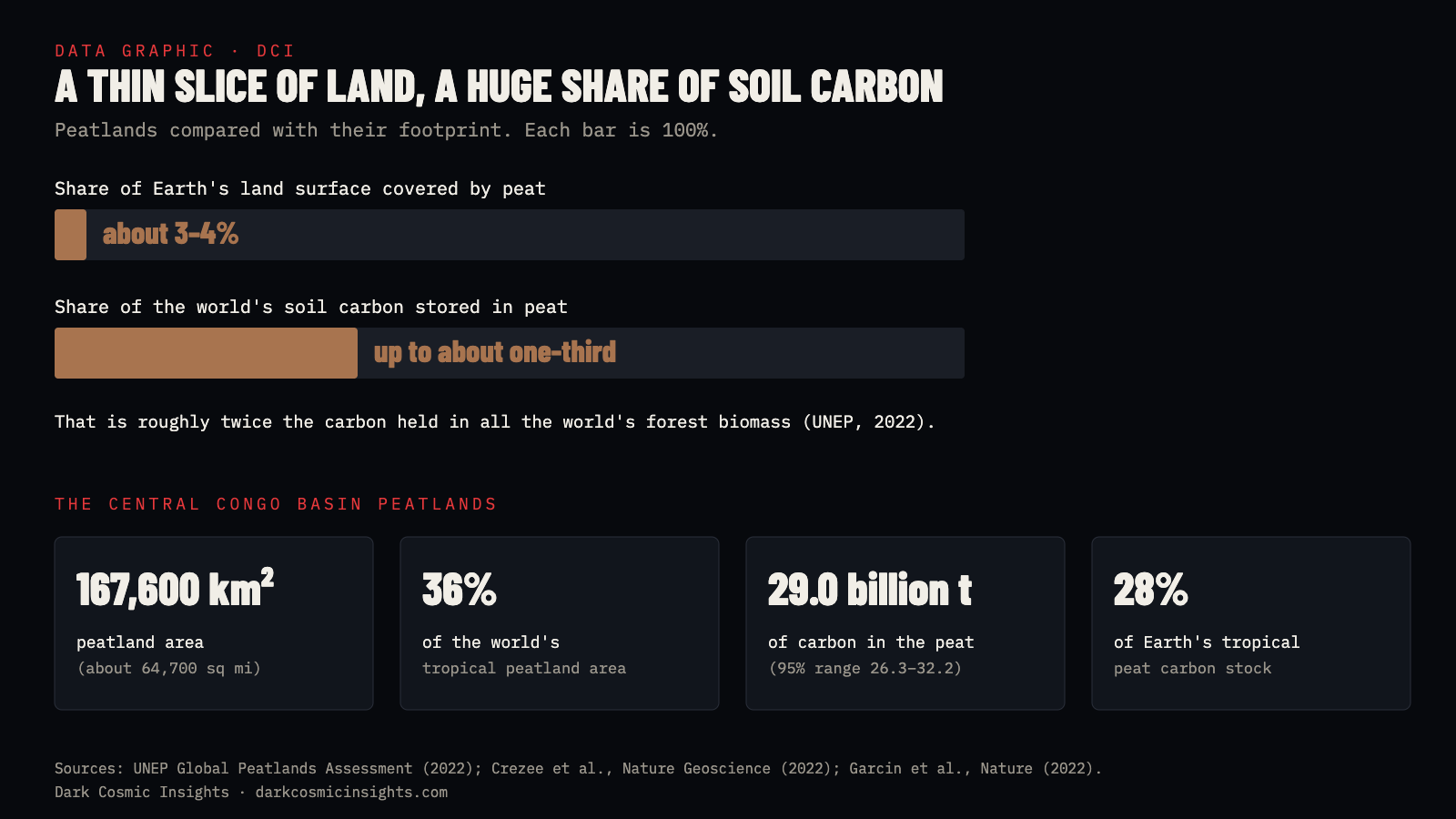
Because peat is mostly carbon-rich plant material, a peatland is a carbon vault. The UN Environment Programme’s 2022 Global Peatlands Assessment says peatlands cover only about 3–4% of the world’s land, yet hold nearly one-third of its soil carbon, twice as much carbon as all the world’s forest biomass combined ({a(UNEP,’UNEP, 2022′)}).
That vault only stays locked while the peat stays wet. About 12% of the world’s peatlands have already been drained or degraded, and UNEP says they release around 4% of all human-caused greenhouse gas emissions each year (UNEP). Drain a peatland and oxygen floods in, microbes wake up, and carbon that was stored for millennia starts heading back into the air.
How Big Are the Congo Basin Peatlands?
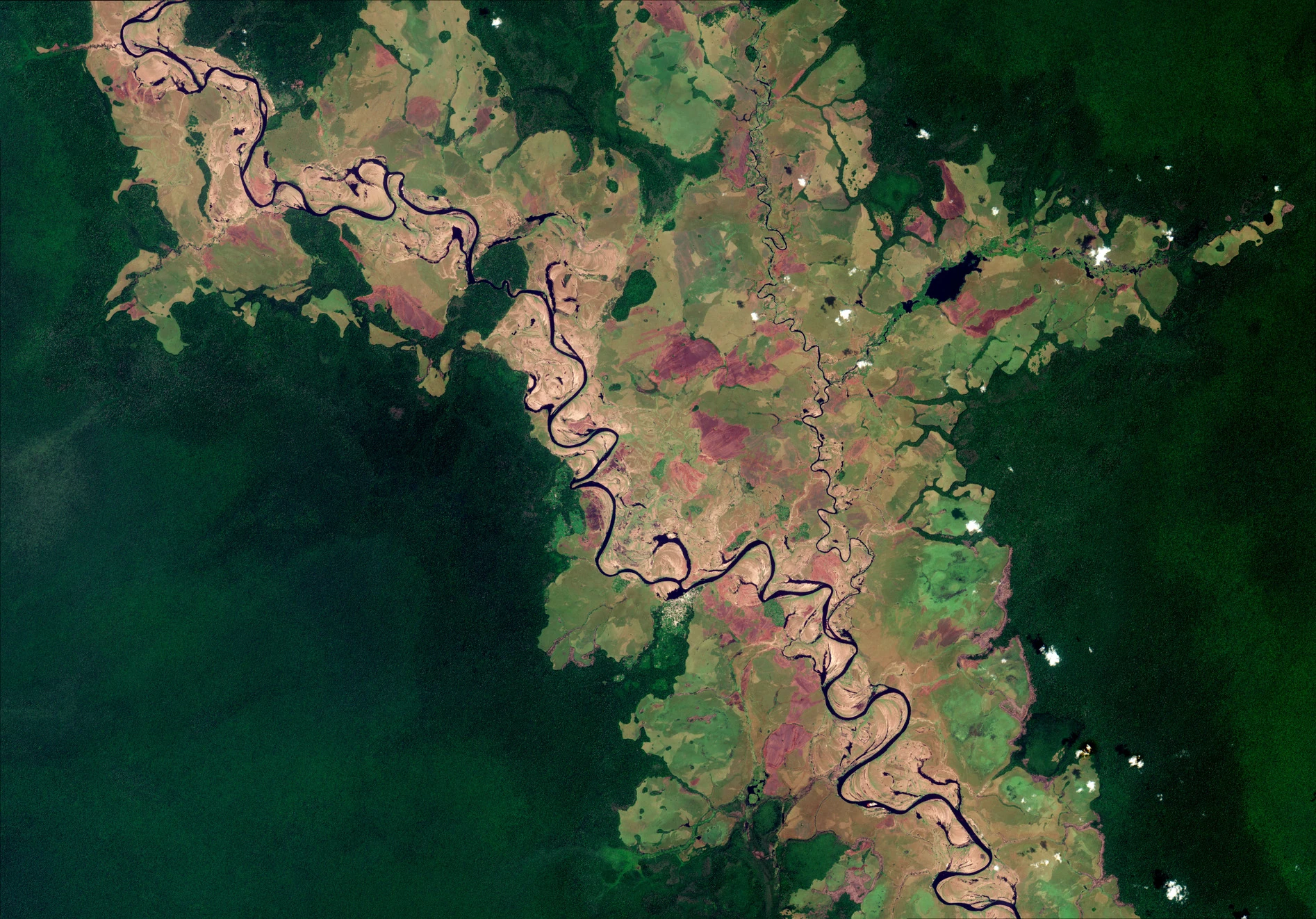
For a long time, nobody knew. Then in 2017 a team led by Greta Dargie published field measurements from the Cuvette Centrale, the vast, nearly flat central depression of the Congo Basin. They found peat under the swamp forests almost everywhere they looked, estimated its area at about 145,500 km², and called it the most extensive peatland complex in the tropics (Dargie et al., Nature, 2017). Radiocarbon dates showed the peat began building up about 10,600 years ago.
In 2022, a bigger mapping effort led by Bart Crezee raised the area to 167,600 km², about 64,700 square miles, larger than England and Wales combined. It estimated the peat holds 29.0 billion tonnes of carbon below ground, with a 95% range of 26.3 to 32.2 billion tonnes, and covers 36% of the world’s tropical peatland area (Crezee et al., Nature Geoscience, 2022). Another 2022 study puts that at about 28% of Earth’s tropical peat carbon (Garcin et al., Nature, 2022).
The peat isn’t especially deep. Dargie’s team measured a maximum of 5.9 metres (19 feet) and a median of about 2 metres. Its power comes from scale: thousands of square kilometres of wet forest, quietly storing carbon for over ten thousand years.
How Does Radiocarbon Dating Work?
Carbon comes in three natural forms, or isotopes. Carbon-12 makes up about 99% of it, carbon-13 about 1%, and radioactive carbon-14 only about one atom in every trillion (Oxford Radiocarbon Accelerator Unit). Carbon-14 is made high in the atmosphere, where cosmic rays knock neutrons into nitrogen atoms and turn them into carbon-14.
That new carbon-14 quickly joins oxygen to form carbon dioxide, mixes through the air and gets pulled into plants during photosynthesis. Animals eat the plants. So every living thing carries roughly the same tiny ratio of carbon-14 to carbon-12 as the air around it, as long as it keeps taking in fresh carbon.
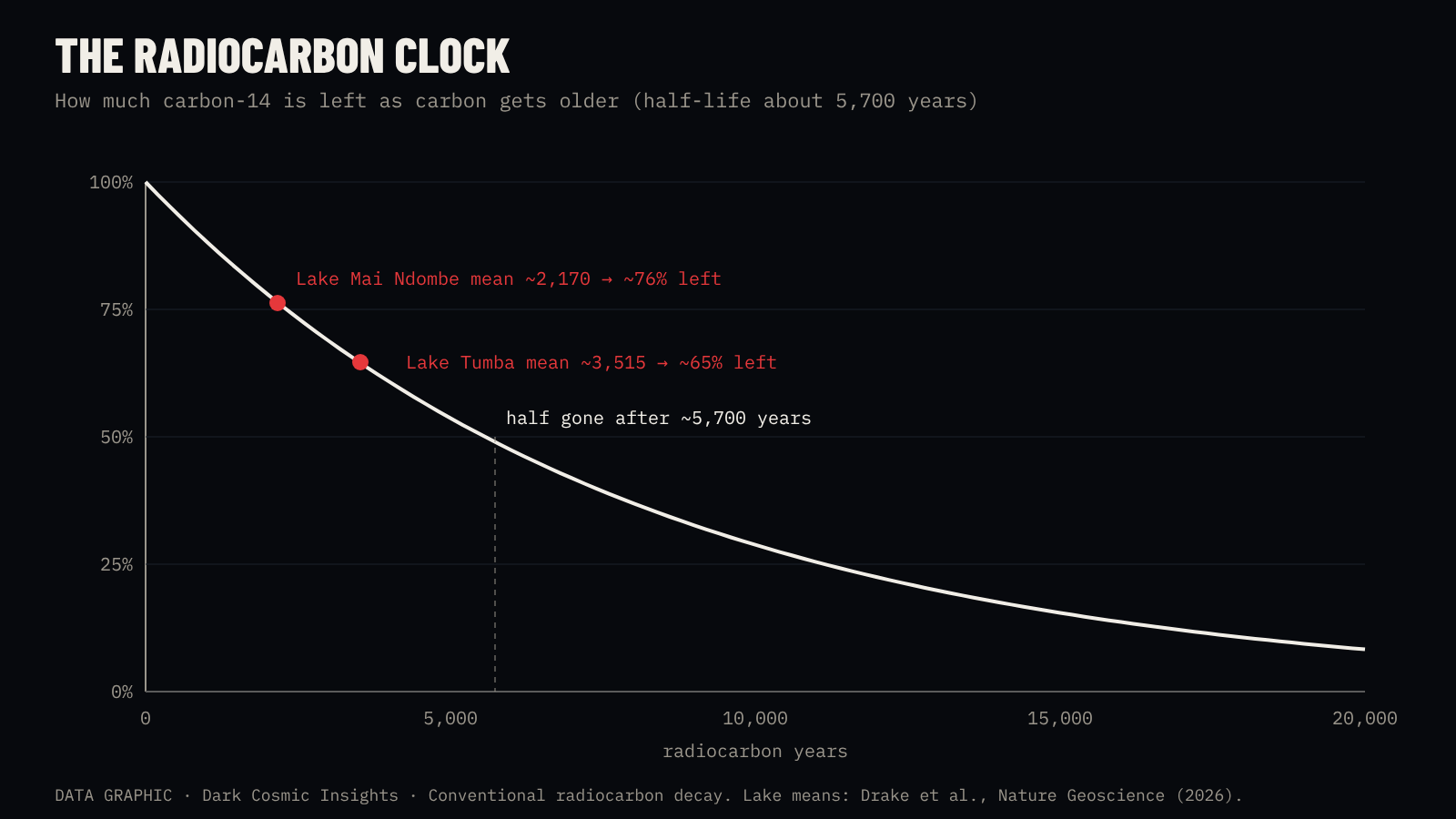
When an organism dies, the intake stops. The carbon-14 it already has keeps decaying back into nitrogen at a steady rate. The modern measured half-life is about 5,730 years: after that long, half the carbon-14 is gone; after another 5,730, half of the rest (ANU Radiocarbon Laboratory). Measure how much is left compared with the stable carbon and you can work out how long ago the carbon stopped being topped up.
The method was developed in the late 1940s at the University of Chicago by Willard Libby and his students, and it earned Libby the 1960 Nobel Prize in Chemistry (Oxford). Today most labs use accelerator mass spectrometry (AMS), which counts individual carbon-14 atoms instead of waiting for them to decay. It needs only about half a milligram to a milligram of carbon (NIST, J. Res.).
There’s a limit. After about ten half-lives, so little carbon-14 remains that it can’t be measured reliably. Oxford’s radiocarbon lab puts the practical limit at around 50,000 to 55,000 years (Oxford). Anything older looks “radiocarbon dead.” That will matter in a moment, because peat and rocks can feed carbon of very different ages into the same lake.
Are Radiocarbon Years the Same as Calendar Years?
No, and this trips up a lot of headlines. A raw radiocarbon age is calculated with two built-in conventions:
- The “Libby half-life” of 5,568 years, Libby’s original measurement. It’s about 3% too short, but labs keep using it so every date ever published stays comparable (Oxford).
- “Present” means 1950. Ages are given in years BP, before present, counted back from AD 1950.
- A constant atmosphere. The calculation assumes air always had the same carbon-14 level. It didn’t, because the Sun’s activity, Earth’s magnetic field and the carbon cycle have all shifted over time.
To turn a radiocarbon age into a calendar age, scientists calibrate it against materials of known age, mostly tree rings counted year by year. The current Northern Hemisphere curve, IntCal20, is built from tree rings back to about 13,900 years ago and from lake sediments, cave formations and corals beyond that, reaching 55,000 calendar years before present (Reimer et al., Radiocarbon, 2020).
Humans have also scrambled the clock. Nuclear weapons tests in the 1950s and early 1960s nearly doubled the carbon-14 in the atmosphere before the 1963 test ban treaty (ANU). Burning fossil fuels, which are millions of years old and contain no carbon-14 at all, works the other way and dilutes it. That’s why scientists often report a raw number called F¹⁴C, the “fraction modern”: the sample’s carbon-14 level compared with a 1950 standard. An F¹⁴C of 1 means modern; 0.5 means about one Libby half-life old.
The Congo lake results are reported in radiocarbon years and F¹⁴C, not calendar years. That’s the honest way to report a mixture, because there’s no single event to put on a calendar.
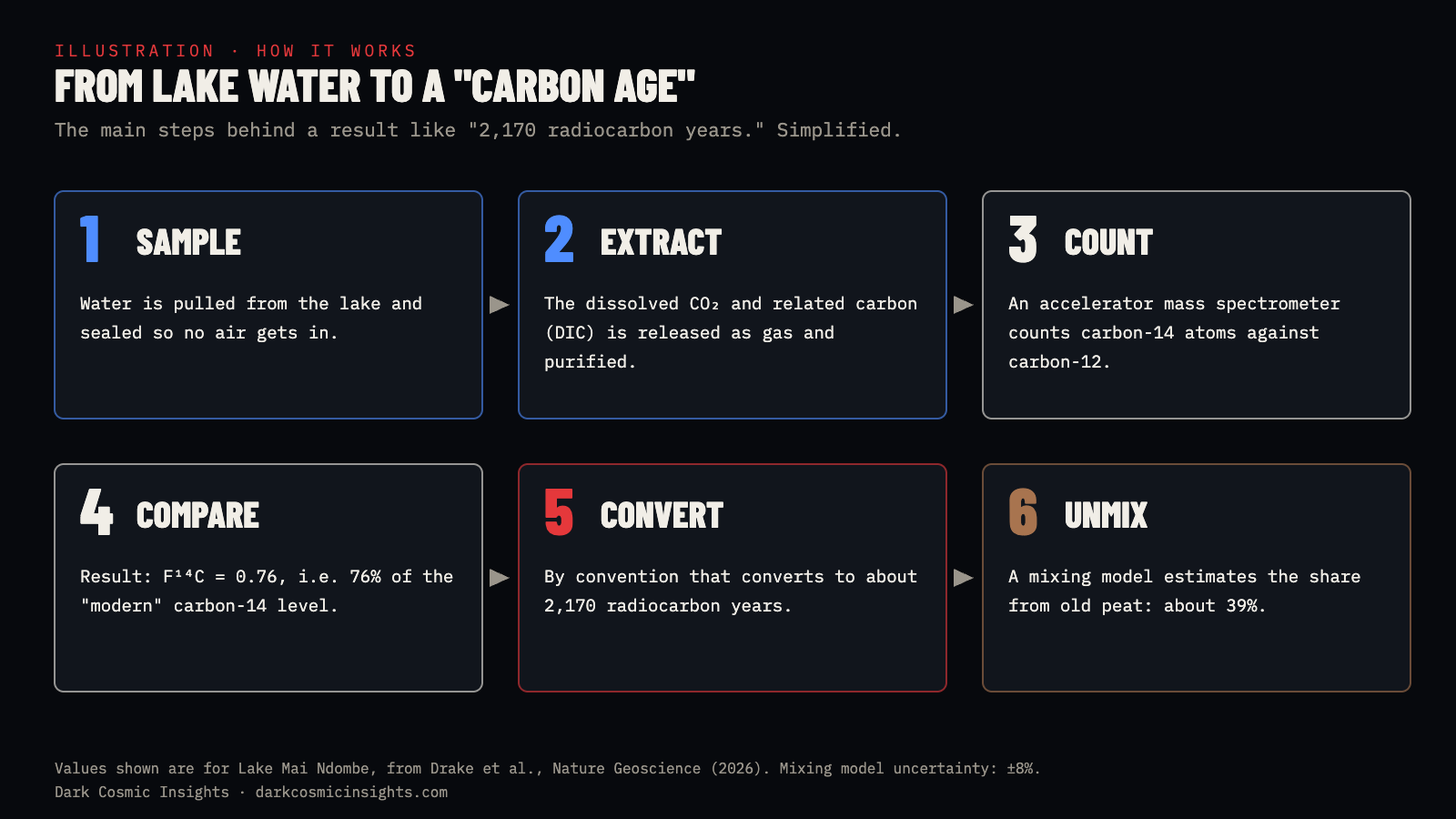
How Do Scientists Radiocarbon-Date Carbon in Lake Water?
Dating a bone or a piece of charcoal is straightforward: one object, one age. Dating a lake is different, because lake water carries several kinds of carbon at once:
- Dissolved inorganic carbon (DIC): dissolved CO₂ plus related forms like bicarbonate. This is the pool that escapes to the air as CO₂.
- Dissolved organic carbon (DOC): the tea-colored remains of leaves, roots and soil that stain blackwater lakes.
- Particulate organic carbon (POC): tiny floating bits of plant and microbial matter.
Each pool can have a different age, so scientists separate them. For DIC, the dissolved carbon is converted to CO₂ gas, purified, and measured by AMS. The Congo team also measured carbon-13, a stable isotope whose ratio helps identify sources such as plants, peat and rocks, and then fed both isotopes into statistical mixing models to estimate how much of the carbon came from each source (Drake et al., 2026).

What Did the Congo Lake Study Find?
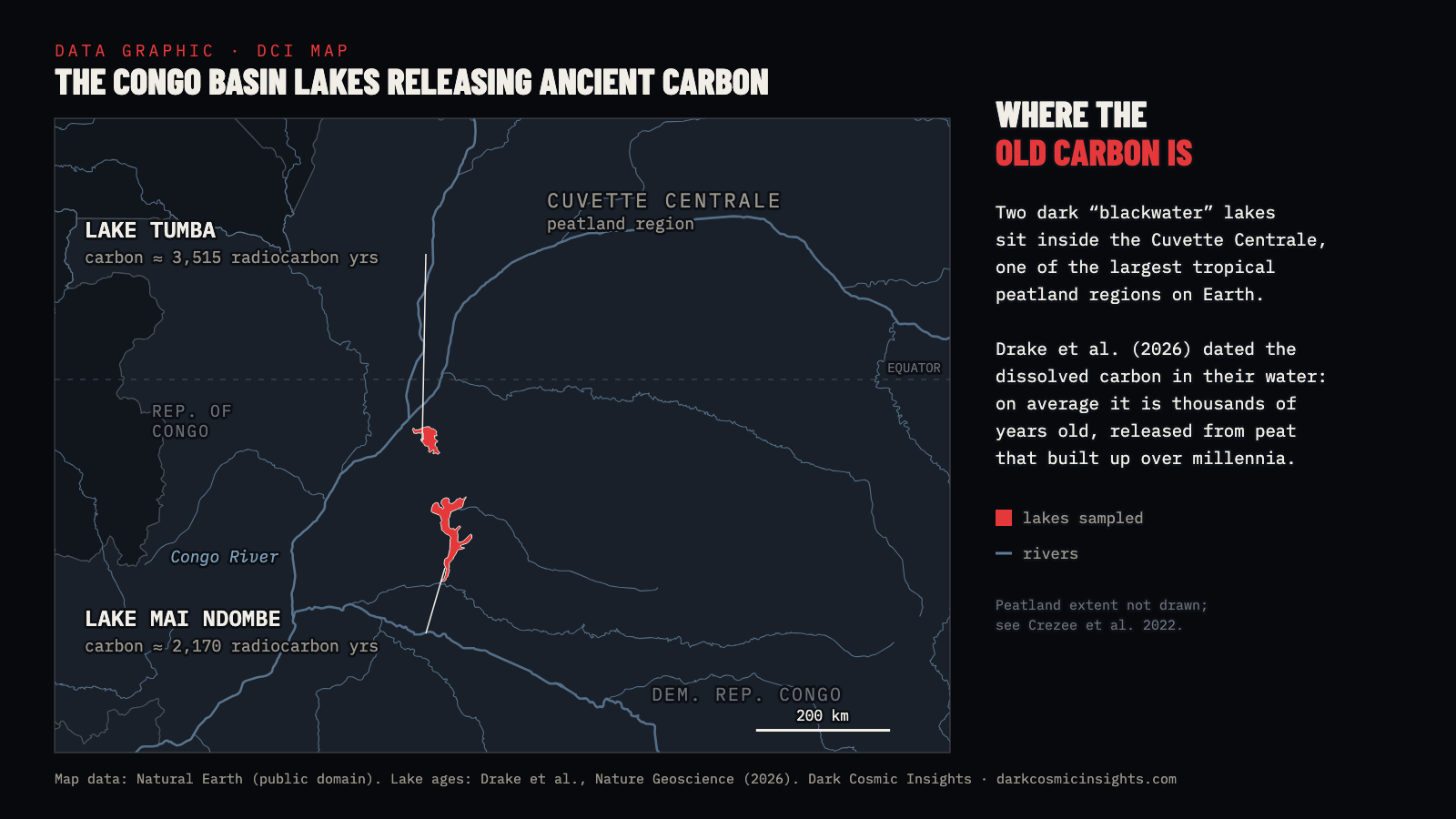
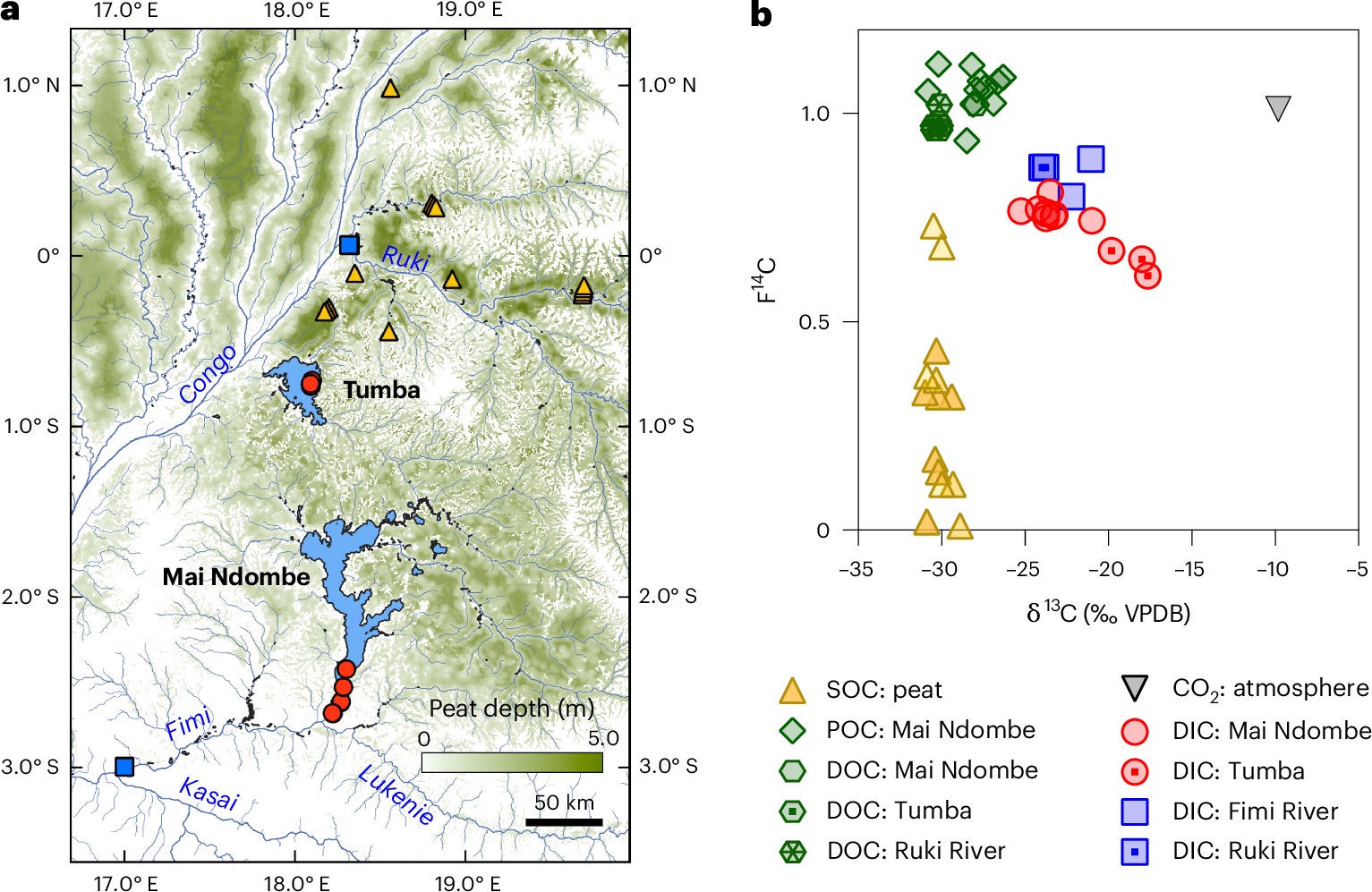
Lake Mai Ndombe, about 2,250 km² (870 sq mi), is the largest blackwater lake in Africa. Lake Tumba, about 700 km² (270 sq mi), lies to its north. Both are surrounded by swamp forests underlain by thick peat, inside the Tumba-Ngiri-Maindombe wetland complex (Drake et al., 2026). Their dark, acidic water is supersaturated with CO₂, at roughly 1,700 to 3,100 parts per million compared with about 420 in today’s air, so they constantly breathe carbon dioxide out.
Travis Drake of ETH Zurich and colleagues radiocarbon-dated the carbon pools in both lakes. Their results, published in Nature Geoscience on February 23, 2026, were:
- Mai Ndombe DIC: about 2,170 radiocarbon years (+208 / −203), F¹⁴C = 0.76 ± 0.02.
- Tumba DIC: about 3,515 radiocarbon years (+387 / −369), F¹⁴C = 0.65 ± 0.03.
- DOC in both lakes, and POC in Mai Ndombe: modern.
- Peat share: ancient peat carbon makes up 39 ± 8% of DIC in Mai Ndombe and 40 ± 6% in Tumba.
- Scale: combined with measured CO₂ fluxes, that implies upwards of 150 gigagrams (150,000 tonnes) of peat carbon outgassed from Mai Ndombe alone each year, a conservative figure.
The Fimi River, which drains Mai Ndombe, also carried aged DIC. The authors conclude that “the degradation of old, stored carbon is a major source of CO₂ evasion” from these lakes (Drake et al., 2026). “We were surprised to find that ancient carbon is being released via the lake,” Drake said in the ETH Zurich release (ETH Zurich via EurekAlert!).
For the full story of the Congo peatlands, the lakes and what protecting them involves, our sister site has a deeper guide: the Congo peatlands and their ancient-carbon lakes. Here we focus on how to read the evidence.
Does Old Carbon Mean Old Water?
No. This is the single most common misreading. “3,500-year-old carbon” does not mean the lake holds 3,500-year-old water, or that every molecule of CO₂ leaving it is ancient. Rain and rivers refresh the water constantly. What’s old is some of the carbon dissolved in it.
A measured radiocarbon age is an average of everything in the sample. Picture mixing a cup of modern carbon with a cup of carbon that’s many thousands of years old: the result lands somewhere in between. Tumba’s 3,515-year average could come from a fairly small share of very old carbon mixed with a lot of young carbon. The averaged number doesn’t describe any single atom.
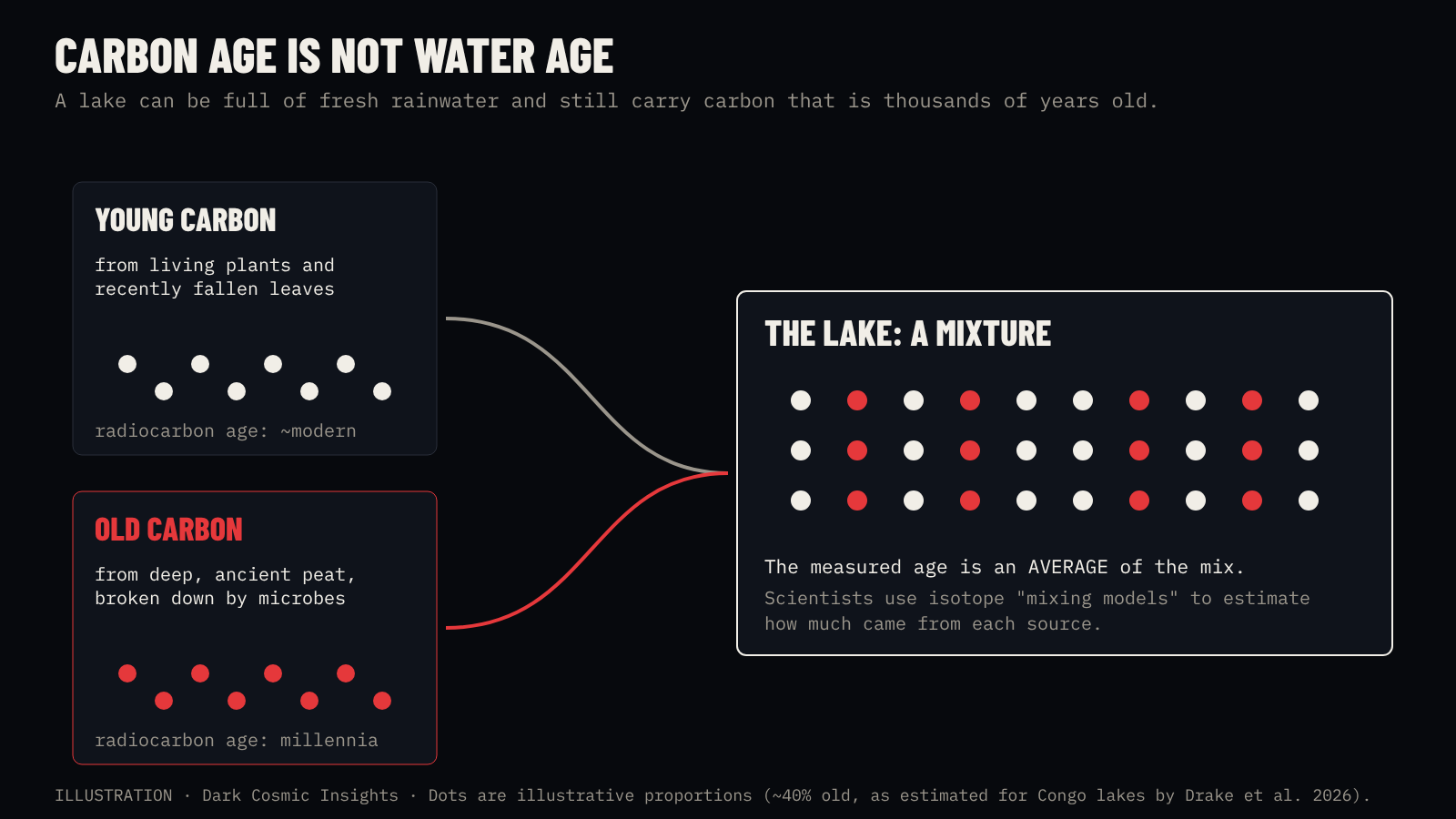
That’s why the study relies on mixing models rather than the raw average, and why the DOC result matters so much. The dissolved organic matter that makes the water dark was modern. So the old signal isn’t peat simply washing into the lake. The authors propose that microbes deep in the peat respire old carbon into CO₂, which then travels through the waterlogged ground to the lakes (Drake et al., 2026).
Drake told Mongabay that part of that pathway, where microbes may first produce methane that is later oxidized to CO₂, is still a “hypothetical scenario” needing more research (Mongabay, 2026). The age is measured. The route is still being worked out.
Has the Congo Peat Released Carbon Before?
Yes, and the evidence comes from radiocarbon too. In 2022, Yannick Garcin and colleagues dated peat cores from a large basin in the Republic of the Congo. Peat there began forming at least 17,500 years ago. But peat laid down between about 7,500 and 2,000 years ago was far more decomposed than the layers above and below it (Garcin et al., Nature, 2022).
Chemical clues in plant waxes revealed why. The climate dried from about 5,000 to 2,000 years ago, the water table probably fell, and microbes broke down peat, including carbon stored long before the dry spell. Researchers have nicknamed this decomposed layer the “Ghost Interval.” After about 2,000 years ago, the drying stopped and peat began building up again.
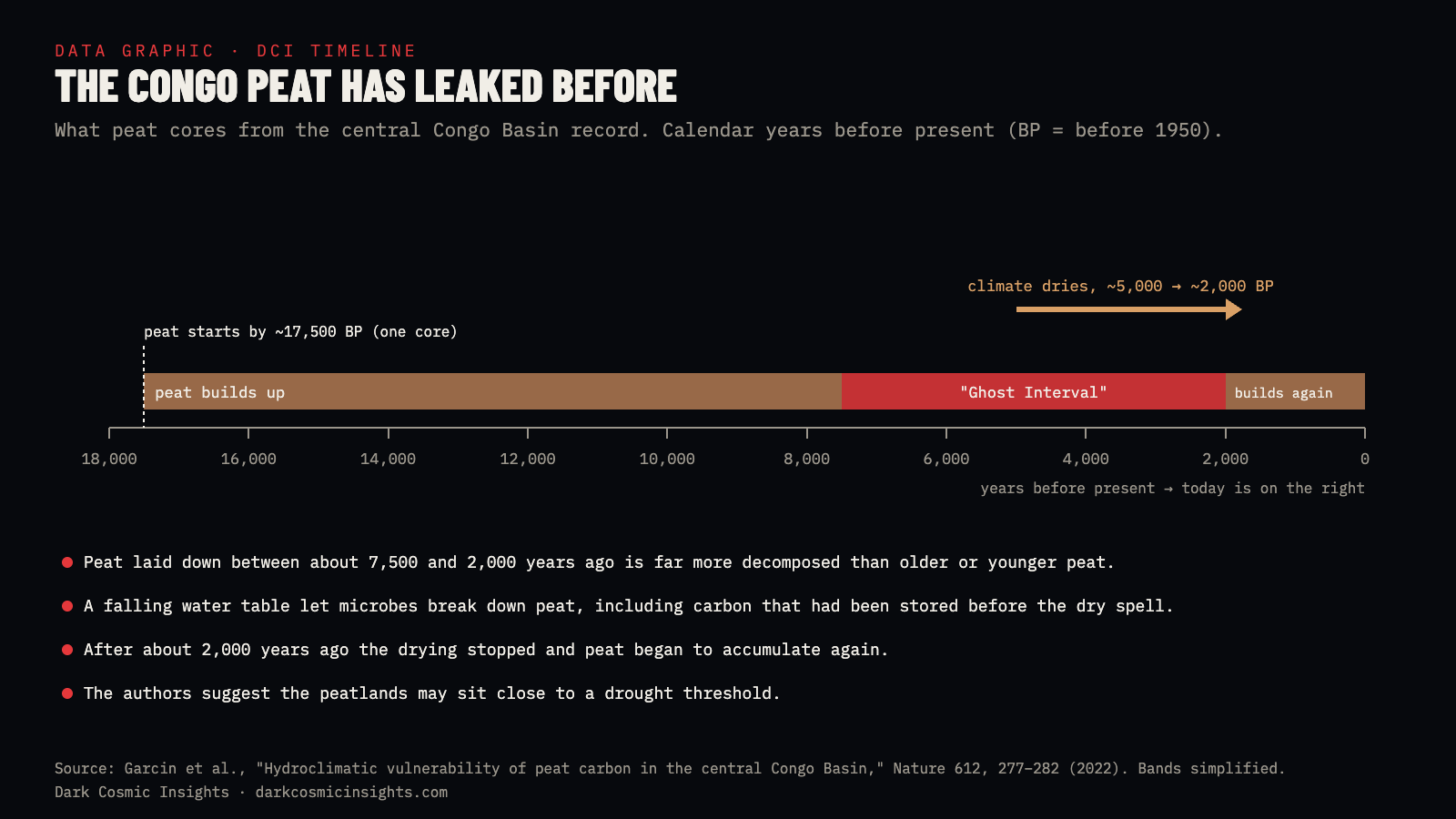
The authors warn that this accumulation-loss-accumulation pattern suggests the peatlands “may lie close to a climatically driven drought threshold.” In other words, the Congo peat has leaked carbon on a large scale before, without any human help, when the climate dried out.
Is Old Carbon Leaking From Other Peatlands?
The Congo lakes are the newest piece of a pattern scientists have been tracing for years. In Borneo, Indonesia, a 2013 study radiocarbon-dated dissolved organic carbon in streams draining peat swamp forest. Water from intact forest carried mostly young carbon from recent plant growth. Water from drained, deforested peat carried mostly carbon “centuries to millennia” old from deep in the peat, and total carbon loss to streams was about 50% higher (Moore et al., Nature, 2013).
A 2024 study in Indonesian canals went further, showing that old dissolved carbon from drained and burned peat can be turned into CO₂ by microbes and sunlight as it travels, with ages up to about 1,300 years (Bowen et al., Global Change Biology, 2024).
Not every dark river carries old carbon, though. A year of sampling on the Congo’s pristine Ruki River, one of the darkest blackwater rivers known, found it carries four times as much organic carbon as the Congo River itself, yet radiocarbon showed very little of it comes from old peat. Most came from younger forest vegetation and soils (NASA Earth Observatory; Drake et al., Limnology and Oceanography, 2023).

Put together, the lesson is consistent: in healthy peatlands, most carbon moving through water is young. Old carbon shows up where peat is drained or burned, where the climate dries, or, as in Mai Ndombe and Tumba, through pathways that seem to carry CO₂ from deep peat. Radiocarbon is what lets scientists tell these situations apart.
Myth vs. Fact: Old Carbon Edition
| Myth | Fact |
|---|---|
| “The lakes are full of 3,500-year-old water.” | The water is young. About 40% of the dissolved inorganic carbon comes from old peat, and the measured age is an average of young and old carbon. |
| “Carbon dating gives an exact calendar year.” | It gives a radiocarbon age with an error range. Calendar dates need calibration, and mixtures like lake carbon have no single date at all. |
| “The Congo peatland is collapsing.” | The study found a pathway for old carbon to escape, not a collapse. Drake suspects the lakes “have long outgassed peat carbon to one degree or another.” |
| “Dark water means old carbon.” | Not necessarily. The Congo lakes’ dark organic matter was modern, and the blackwater Ruki River carries mostly young carbon. |
| “Carbon dating works on anything.” | It only works on carbon-bearing material up to about 50,000–55,000 years old. Rocks and fossil fuels are far older and carry no carbon-14. |
| “Peatlands are too wet to lose carbon.” | Congo peat cores show major peat loss during a natural dry spell 5,000–2,000 years ago, and drained peatlands worldwide release about 4% of human-caused emissions. |
The same habit of asking “what exactly was measured?” runs through every DCI explainer. It’s how astronomers get a star’s temperature from its light, as in How Astronomers Measure a Star They Can Never Visit, and how conservators spot an ancient pigment by its invisible glow, as in Egyptian Blue.
How Can You Read a Carbon-Dating Headline?
Next time a headline says something is “X years old,” run through these questions:
- What exactly was dated? A bone, a seed, dissolved CO₂, the sediment around an object? The age belongs to that material only.
- One object or a mixture? Mixtures give averages, and an average can hide a small amount of very old carbon.
- Radiocarbon years or calendar years? Look for “BP,” “¹⁴C years” or “cal BP.” Only calibrated dates are calendar ages.
- What’s the error range? Real results come with one, like Tumba’s +387 / −369 years.
- Could anything contaminate it? Old carbonate rock or fossil carbon makes things look older; modern roots or bomb carbon make them look younger.
- Is the conclusion measured or modelled? The ages here are measured. The 40% peat share and the 150,000-tonne flux are model estimates.
You can also explore real data yourself. The Congo study is open access, and its data are archived publicly on Zenodo (Drake et al., 2026). The CongoPeat project’s maps of peat extent and depth are free to view and download (Global Peatlands Initiative).
What Comes Next for Congo Peatland Research?
- Is the leak old or new? The study can’t yet tell whether outgassing of peat carbon is a long-standing natural feature or a recent change. ETH Zurich frames the open question as whether it’s a turning point or a natural balance offset by new peat (ETH Zurich).
- Water levels and methane. A companion study of Mai Ndombe in the Journal of Geophysical Research found water levels strongly affect how much methane escapes (ETH Zurich).
- More lakes and rivers. The authors note aged CO₂ in the Fimi River and earlier hints elsewhere suggest outgassing of old carbon “may be a broader feature of humic waters” in the Cuvette Centrale (Drake et al., 2026).
- Drought risk. Garcin’s team calls for monitoring and models to find out whether human-driven droughts could push the peatlands past a threshold again (Garcin et al., 2022).
- Protection. Drake’s prescription is simple: keep peat wet. “We can protect, preserve, and restore peatlands by rewetting them, revegetating them,” he told Mongabay (Mongabay).
Think of it like a leaky freezer: some cold air escaping is fine, but if you unplug the freezer, all the food will spoil. Travis Drake, ETH Zurich, to Mongabay (2026)
Peatland Radiocarbon by the Numbers
- About 5,730 years: half-life of carbon-14 (labs still calculate ages with Libby’s 5,568).
- About 1 in a trillion: carbon atoms in living things that are carbon-14.
- 50,000–55,000 years: practical limit of radiocarbon dating; IntCal20 calibrates to 55,000 cal BP.
- 2,170 and 3,515 radiocarbon years: mean ages of dissolved inorganic carbon in Lakes Mai Ndombe and Tumba.
- 39% and 40%: estimated share of that carbon from ancient peat.
- 150,000+ tonnes a year: peat carbon outgassed by Lake Mai Ndombe alone (conservative).
- 2,250 km² (870 sq mi): area of Lake Mai Ndombe, Africa’s largest blackwater lake.
- 167,600 km² (64,700 sq mi): area of the central Congo Basin peatlands.
- 29.0 billion tonnes: carbon stored in that peat.
- 3–4% of land, ~1/3 of soil carbon: the world’s peatlands.
Frequently Asked Questions
How does radiocarbon dating work?
Living things take in carbon-14 from the air along with ordinary carbon. When they die, the carbon-14 decays at a steady rate, about half every 5,730 years. Measuring how much is left compared with stable carbon shows roughly how long ago the carbon stopped being replaced.
What is a radiocarbon year?
It’s an age calculated from carbon-14 using fixed conventions: Libby’s 5,568-year half-life, 1950 as “present,” and a constant atmosphere. Because the atmosphere’s carbon-14 has varied, radiocarbon years must be calibrated, for example with IntCal20, to get calendar years.
Is the water in the Congo lakes thousands of years old?
No. The water is constantly refreshed by rain and rivers. Part of the carbon dissolved in it comes from ancient peat, and the measured age is an average of young and old carbon.
Why is old carbon leaking from the Congo peatlands?
The study’s authors propose that microbes deep in the peat break down old organic matter and the resulting CO₂ moves through the waterlogged ground to the lakes. Some steps in that pathway are still hypothetical.
Does this mean the Congo peatlands are being destroyed?
Not on current evidence. The leak may be a long-standing natural process. The bigger risk scientists flag is drying or drainage, which could greatly speed up carbon loss.
How much carbon do the Congo peatlands store?
About 29 billion tonnes of carbon across roughly 167,600 km², according to a 2022 mapping study. That’s about 28% of Earth’s tropical peat carbon.
How far back can radiocarbon dating go?
About 50,000 to 55,000 years. Beyond that, too little carbon-14 remains to measure reliably, and other dating methods are needed.
What is a peatland?
A wetland where dead plants build up faster than they decay, because waterlogged soil keeps oxygen out. Over thousands of years the plant matter forms peat, which can store enormous amounts of carbon.
Sources and Further Reading
- Drake, T.W., Hemingway, J.D., Barthel, M. et al. (2026). Millennial-aged peat carbon outgassed by large humic lakes in the Congo Basin. Nature Geoscience 19, 415–418. doi:10.1038/s41561-026-01924-3. Research briefing: Congo’s largest humic lakes emit ancient peat carbon.
- Dargie, G.C., Lewis, S.L., Lawson, I.T. et al. (2017). Age, extent and carbon storage of the central Congo Basin peatland complex. Nature 542, 86–90. doi:10.1038/nature21048.
- Crezee, B., Dargie, G.C., Ewango, C.E.N. et al. (2022). Mapping peat thickness and carbon stocks of the central Congo Basin using field data. Nature Geoscience 15, 639–644.
- Garcin, Y., Schefuß, E., Dargie, G.C. et al. (2022). Hydroclimatic vulnerability of peat carbon in the central Congo Basin. Nature 612, 277–282. doi:10.1038/s41586-022-05389-3.
- Moore, S., Evans, C.D., Page, S.E. et al. (2013). Deep instability of deforested tropical peatlands revealed by fluvial organic carbon fluxes. Nature 493, 660–663.
- Bowen, J.C. et al. (2024). Aquatic processing enhances the loss of aged carbon from drained and burned peatlands. Global Change Biology 30, e17394.
- Drake, T.W. et al. (2023). Hydrology drives export and composition of carbon in a pristine tropical river. Limnology and Oceanography 68, 2476–2491; NASA Earth Observatory, Shedding Light on a Very Dark River (2024).
- Reimer, P.J. et al. (2020). The IntCal20 Northern Hemisphere radiocarbon age calibration curve (0–55 cal kBP). Radiocarbon 62, 725–757. doi:10.1017/RDC.2020.41.
- Oxford Radiocarbon Accelerator Unit, Radiocarbon Dating: Methods; ANU, Radiocarbon dating: background; Currie, L.A. (2004), The Remarkable Metrological History of Radiocarbon Dating [II], J. Res. NIST 109.
- UNEP (2022). Global Peatlands Assessment: The State of the World’s Peatlands; press release.
- ETH Zurich (2026). Peatland lakes in the Congo Basin release carbon that is thousands of years old. EurekAlert!
- Mongabay (2026). ‘Ancient’ carbon venting from lakes in the Congo Basin peatlands: Study.
Keep Exploring
Radiocarbon is one of science’s great “how do we know?” tools. For more of them, see How Astronomers Measure a Star They Can Never Visit, how scientists detect Egyptian blue in ancient art, and why invisible light changes what we see in Hubble vs. Webb. For the deeper story of the Congo peatlands themselves, visit our sister site’s guide to the Congo peatlands and their ancient-carbon lakes.
How This Explainer Was Checked
Every number in this article comes from a peer-reviewed paper, a UN report or a university radiocarbon laboratory, linked above. Ages are quoted exactly as published, in radiocarbon years with their stated uncertainty. Images labeled OBSERVATION are real photographs or satellite data; DATA marks a published scientific figure; DATA GRAPHIC and ILLUSTRATION mark original Dark Cosmic Insights diagrams based on the cited sources. Where a mechanism is still hypothetical, we say so.
About The Author
Author: King | Founder of Dark Cosmic Insights
King is the founder of Dark Cosmic Insights, a science storytelling platform exploring the strangest true stories hiding in space, science and AI. Through Dark Cosmic Insights, King digs into NASA, ESA and peer-reviewed research, separates what has been measured from what is still a mystery, and turns real discoveries into clear articles, original data graphics and Shorts that help curious people see the universe more clearly.
Follow the anomaly. Trace the source. 🔭
November 5, 2026