On August 27, 2003, Mars came closer to Earth than it had in almost 60,000 years. NASA said the two planets were about 55.76 million km (34.65 million miles) apart that day (NASA/JPL, 2003). It won’t be that close again until 2287.
At other times, Mars is on the far side of the Sun, more than seven times farther away. That huge swing is the key to everything about traveling to Mars: when we launch, how long the trip takes, and how long it takes to send a message.
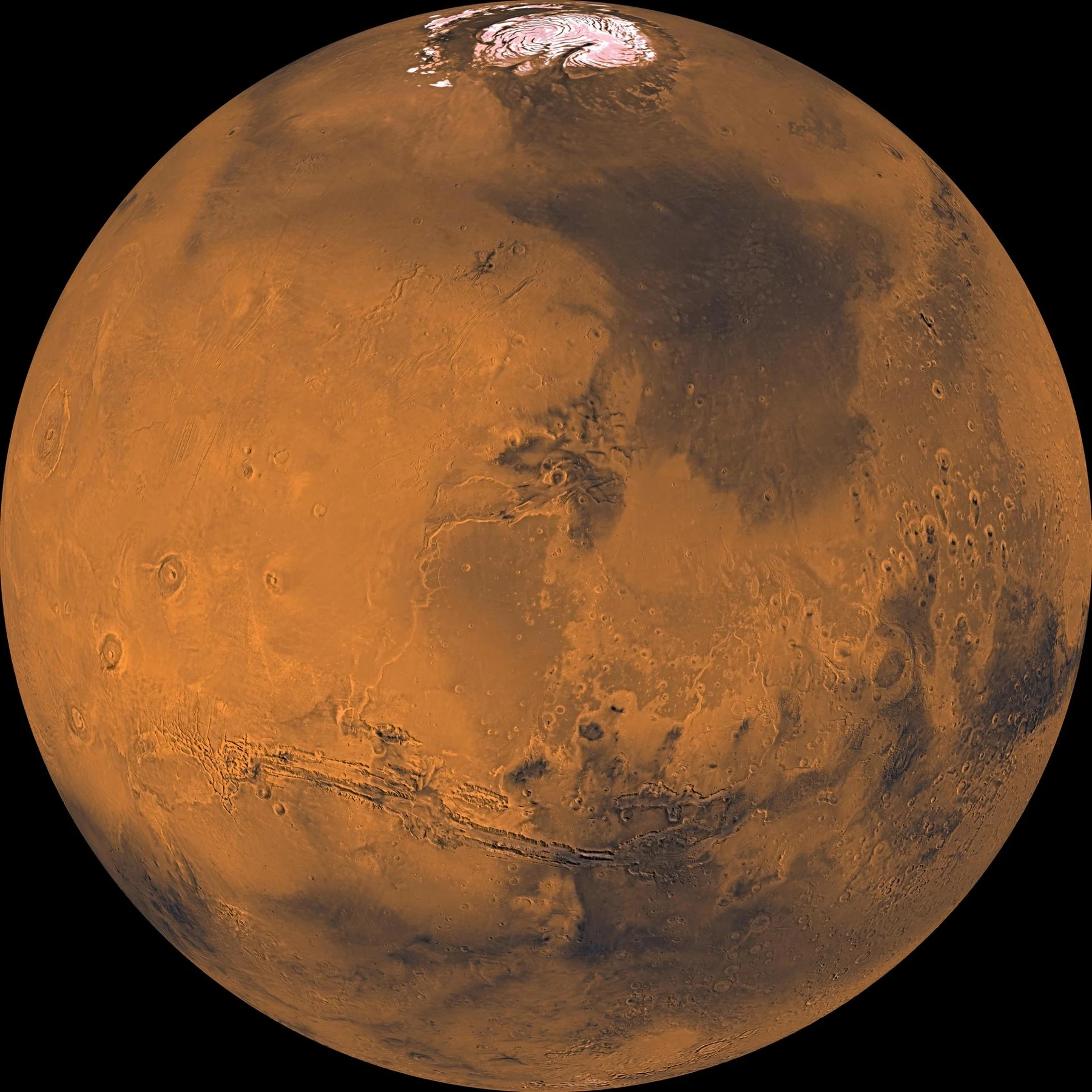
Observed, measured, modelled, open. Mars’s orbit and its distance from the Sun are measured to high precision. Its closest and farthest distances from Earth are calculated from the two planets’ orbits. The 2003 close approach and Perseverance’s trip are observed facts. Light-travel times, travel comparisons and AU values here are DCI calculations from NASA’s measured distances, labelled as such.
Quick Answer: How Far Is Mars?
Mars orbits about 228 million km (142 million miles) from the Sun on average, or 1.5 astronomical units (AU), NASA says (NASA). Its distance from Earth changes a lot: NASA’s fact sheet gives a range from about 54.6 million km at the very closest to about 401.4 million km at the farthest (NASA NSSDC). Sunlight takes about 13 minutes to reach Mars (NASA); a radio signal from Earth takes about 3 to 22 minutes. NASA’s Perseverance rover took about seven months to get there.
What this article can and cannot establish. It can give you Mars’s measured distance from the Sun, its calculated range of distances from Earth, why they vary, how long light and spacecraft take, and when Mars comes closest. It can’t give one fixed Earth–Mars distance, because both planets are always moving, and it can’t tell you how long a future crewed trip will take, because no crewed mission has a fixed plan yet.
Table of Contents
The DCI Evidence Map: Mars’s Distance
| Question | What we know | Status | Key source |
|---|---|---|---|
| How far from the Sun, on average? | About 228 million km (1.5 AU) | Measured | NASA |
| Closest and farthest from the Sun? | About 206.7 and 249.3 million km | Measured | NASA NSSDC |
| How far from Earth? | About 54.6 to 401.4 million km | Calculated | NASA NSSDC |
| How long does sunlight take? | About 13 minutes | Measured | NASA |
| How long did Perseverance take? | July 30, 2020 to February 18, 2021 | Observed | NASA, Perseverance |
| When was Mars closest recently? | August 27, 2003, about 55.76 million km | Observed | NASA/JPL |
| When is it best placed next? | Opposition on February 19, 2027 | Measured | Royal Observatory Greenwich |
Status key: Observed = seen directly. Measured = a number with a stated uncertainty or a direct measurement. Modelled = inferred from measurements through a physical model, dependent on assumptions. Open = unresolved; the evidence is incomplete or points different ways. Calculated = worked out from measured orbits rather than measured directly. Not supported = the evidence goes against the claim, or there is none for it.
Cite this framework: “DCI Evidence Map: Mars’s Distance,” Dark Cosmic Insights, November 2026, darkcosmicinsights.com/how-far-is-mars/.
How Far Is Mars From the Sun?
The average distance
NASA says that “from an average distance of 142 million miles (228 million kilometers), Mars is 1.5 astronomical units away from the Sun” (NASA). One astronomical unit is the average Sun–Earth distance, 149,597,870.7 km (NASA NSSDC notes).
A stretched orbit
Mars’s orbit is noticeably oval. NASA’s fact sheet gives an eccentricity of 0.0935, more than five times Earth’s (NASA NSSDC). Its distance from the Sun swings between:
- Perihelion (closest to the Sun): about 206.7 million km, roughly 1.38 AU.
- Aphelion (farthest from the Sun): about 249.3 million km, roughly 1.67 AU.
- Semimajor axis (average): about 228.0 million km, roughly 1.52 AU.
(AU values are DCI calculations from NASA’s kilometer figures.) That’s a difference of more than 40 million km between Mars’s closest and farthest points from the Sun.
How much sunlight reaches it
Farther from the Sun means weaker sunlight. NASA’s fact sheet lists the solar irradiance at Mars as 586.2 watts per square meter, about 43 percent of what reaches Earth (NASA NSSDC). That’s one reason Mars is so cold, which we explore in How Cold Is Mars?

How Far Is Mars From Earth?
Between 54.6 and 401.4 million km
Earth and Mars both orbit the Sun, at different speeds. Earth goes around in a year; Mars takes about 687 Earth days (NASA). So the distance between them keeps changing. NASA’s fact sheet gives a minimum of about 54.6 million km and a maximum of about 401.4 million km, approximate limits calculated from the two orbits, not measured records (NASA NSSDC). In miles, that’s roughly 34 to 249 million miles (DCI conversion).
The minimum is a theoretical best case, when Earth and Mars line up on the same side of the Sun with Mars near its closest point to the Sun. The maximum is when they’re on opposite sides of the Sun.
Close approaches come every 26 months
Earth catches up with Mars and passes it about every 780 days, NASA’s fact sheet says (its synodic period is 779.94 days) (NASA NSSDC). That’s about every 26 months (DCI calculation). Around each pass, Mars reaches opposition, opposite the Sun in our sky, and is near its closest to Earth for that cycle.
Why some close approaches are closer
Because Mars’s orbit is stretched, not every close approach is equally close. When opposition happens while Mars is near perihelion, its closest point to the Sun, the planets get especially close. When it happens near aphelion, they stay farther apart. NASA’s 2003 explanation compared the two orbits to race tracks: “neither track is perfectly circular,” and their shapes slowly shift (NASA/JPL, 2003).
The 2003 record
On August 27, 2003, Mars came within about 55.76 million km of Earth, its closest in nearly 60,000 years. Hubble photographed it within minutes of the closest approach (NASA, Hubble 2003). NASA said Mars won’t come that close again until 2287 (NASA/JPL, 2003).
The next one
Mars’s next opposition is on February 19, 2027 (Royal Observatory Greenwich). Around that date, Mars will be bright, rising at sunset and up all night.

How Long Does Light Take to Reach Mars?
From the Sun: about 13 minutes
NASA says “it takes sunlight 13 minutes to travel from the Sun to Mars” (NASA).
From Earth: 3 to 22 minutes
Radio signals travel at the speed of light, about 299,792 km per second. At Mars’s closest, a signal from Earth arrives in about 3 minutes. At its farthest, it takes about 22 minutes (DCI calculations from NASA’s distances).
Why that matters for rovers
That delay means nobody can drive a Mars rover with a joystick. By the time a command arrived, and the rover’s camera image came back, up to 44 minutes could pass. Instead, rovers get instructions in batches and do a lot of driving on their own. We cover how in How Do Mars Rovers Navigate?
How Far Is That, Really?
All DCI calculations from NASA’s numbers:
- By car, at 100 km/h nonstop: about 62 years to cover Mars’s closest possible distance from Earth, and about 458 years at its farthest.
- From the Sun by car: about 260 years to drive Mars’s average distance from the Sun.
- In Moon distances: at its closest, Mars is about 142 Earth–Moon distances away; at its farthest, about 1,044.
How Long Does It Take to Get to Mars?
About seven months for Perseverance
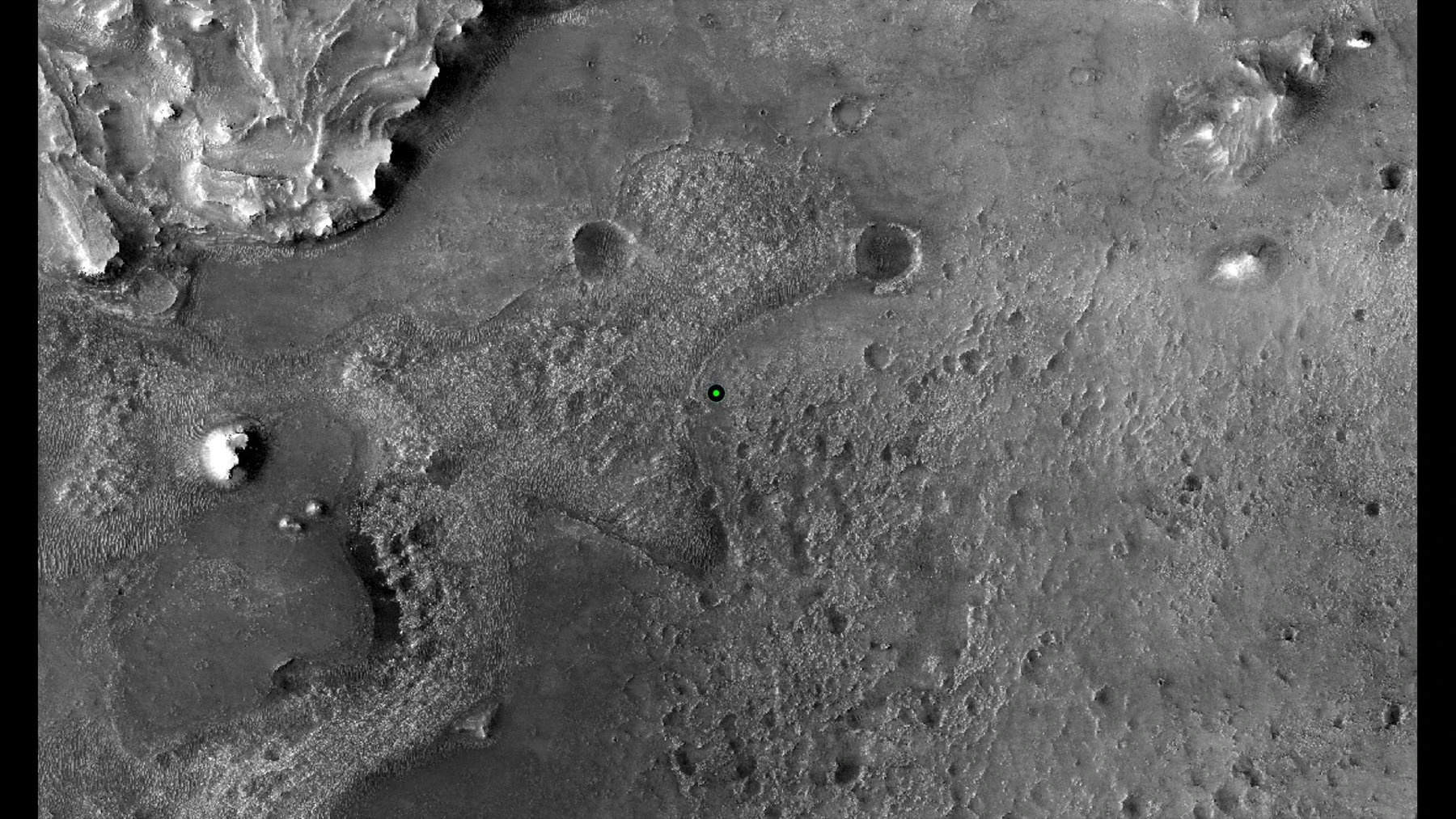
NASA’s Perseverance rover launched on July 30, 2020, and landed in Jezero Crater on February 18, 2021 (NASA, Perseverance). That’s 203 days, or about seven months (DCI calculation).
Spacecraft don’t fly in a straight line
A spacecraft can’t simply point at Mars and go. It launches from a moving Earth into its own orbit around the Sun, then curves outward to meet Mars where Mars will be months later. The path is much longer than the straight-line distance on launch day.
Efficient launch windows every 26 months
That’s why most Mars missions launch in short windows, roughly every 26 months, timed to the same Earth–Mars cycle as the oppositions (DCI calculation from the 780-day synodic period). Perseverance launched in the July–August 2020 window. Those windows give the most fuel-efficient direct trips, but they aren’t the only option. Other trajectories exist: NASA’s twin ESCAPADE spacecraft, for example, are taking a longer, loitering route to Mars (NASA, ESCAPADE).

How Long Is a Year on Mars?
687 Earth days
NASA says “a year on Mars lasts 669.6 sols, which is the same as 687 Earth days” (NASA). That’s about 1.88 Earth years (DCI calculation from NASA’s 686.98-day sidereal period).
A day is a little longer than ours
A Martian day, called a sol, is only a bit longer than an Earth day. NASA says Mars “completes one rotation every 24.6 hours” (NASA), and its fact sheet lists the solar day as 24.66 hours, about 24 hours and 40 minutes (NASA NSSDC).
Seasons like Earth’s, but longer
Mars is tilted 25.19 degrees, close to Earth’s 23.44 (NASA NSSDC), so it has seasons like ours. Because its year is nearly twice as long, its seasons last about twice as long too, and its stretched orbit makes some seasons longer than others.
Myth vs. Fact: Mars’s Distance
| Myth | Fact | Status |
|---|---|---|
| “Mars is always the same distance from Earth.” | It ranges from about 54.6 to 401.4 million km. | Calculated |
| “Mars is the closest planet to Earth.” | Venus comes closer; Mars is closest only at certain times. | Measured |
| “Spacecraft fly straight to Mars.” | They curve out on an orbit around the Sun to meet it. | Observed |
| “You can launch to Mars anytime.” | The most efficient direct windows open roughly every 26 months; other routes take longer. | Calculated |
| “Mars will look as big as the Moon.” | A recurring hoax; Mars always looks like a bright point to the naked eye. | Observed |
| “Messages to Mars arrive instantly.” | They take about 3 to 22 minutes each way. | DCI calculation |
How Can You Find Mars Yourself?
Watch for opposition
Mars is easiest to see around opposition, when it rises at sunset and stays up all night. The next is February 19, 2027 (Royal Observatory Greenwich).
Look for a steady orange point
Mars is bright and clearly orange-red. At its best, NASA’s fact sheet lists it at about magnitude −2.94 (NASA NSSDC), brighter than any star at night. It shines with a steady light.
A telescope shows a tiny disk
Even near opposition, Mars looks small in a telescope. With steady air and patience, you can pick out a polar cap and darker markings. We explain where its color comes from in Why Is Mars Red?
Mars’s Distance by the Numbers
| Measure | Value | Source |
|---|---|---|
| Average distance from the Sun | about 228 million km (142 million mi), 1.5 AU | NASA |
| Perihelion / aphelion | about 206.7 / 249.3 million km | NASA NSSDC |
| Closest / farthest from Earth | about 54.6 / 401.4 million km | NASA NSSDC |
| Sunlight travel time | about 13 minutes | NASA |
| Signal from Earth | about 3 to 22 minutes (DCI calculation) | NASA NSSDC |
| Time between oppositions | about 780 days | NASA NSSDC |
| 2003 close approach | about 55.76 million km | NASA/JPL |
| Perseverance trip | July 30, 2020 to February 18, 2021 | NASA |
| One Mars year | 687 Earth days (669.6 sols) | NASA |
| Next opposition | February 19, 2027 | Royal Observatory Greenwich |
Sources checked November 2026.

Mars Distance FAQ
How far is Mars from Earth right now?
It depends on the date. The distance ranges from about 54.6 million km to about 401.4 million km. It’s smallest around opposition; the next is February 19, 2027.
How far is Mars from the Sun?
About 228 million km, or 142 million miles, on average, NASA says, which is 1.5 AU. Its stretched orbit takes it from about 206.7 to 249.3 million km from the Sun.
How long does it take to get to Mars?
About seven months on a direct transfer like Perseverance’s. Perseverance launched on July 30, 2020, and landed on February 18, 2021, a trip of 203 days.
How long does a message take to reach Mars?
About 3 to 22 minutes each way, depending on the distance. A round trip, sending a command and getting a reply, can take up to about 44 minutes.
When was Mars closest to Earth?
On August 27, 2003, at about 55.76 million km, the closest in nearly 60,000 years. NASA says it won’t be that close again until 2287.
Why do Mars launches happen about every two years?
Because Earth and Mars line up for the most fuel-efficient direct trips only about every 26 months. Other trajectories are possible, but they usually take longer.
Is Mars the closest planet to Earth?
Not usually. Venus comes closer to Earth than Mars ever does. Mars is our neighbor on the outside, and it’s closest to us only around its oppositions.
How long is a year on Mars?
About 687 Earth days, or 669.6 Martian days, NASA says. That’s nearly two Earth years.
Your next step: mark February 19, 2027, on your calendar. That’s Mars’s next opposition, when it rises at sunset, stays up all night and shines as a bright orange point. Its light will reach your eyes after a trip of only a few minutes from Mars.

Sources and Further Reading
- NASA Science, Mars: Facts.
- NASA Space Science Data Coordinated Archive, Mars Fact Sheet; Fact Sheet Notes.
- NASA/JPL (July 28, 2003), Mars Moves in for Some Quality Visual Time.
- NASA, Hubble Mars Close Approach 2003.
- NASA Science, Mars 2020: Perseverance Rover.
- Royal Observatory Greenwich, What is a planet in opposition?
- NASA images: PIA00407, PIA24331, PIA24427, PIA22960, PIA00003.
Explore Next
- Our nearest neighbor, measured: How Far Is the Moon?
- Mars’s two small moons: How Many Moons Does Mars Have?
- Why delay means rovers drive themselves: How Do Mars Rovers Navigate?
- The giant planets, for comparison: How Far Is Jupiter?
- All eight planets side by side: Solar System Explorer
- What AU and opposition mean: Space Glossary
- How a claim earns its label: How We Know
How This Explainer Was Checked
Every number and quote in this article was checked in November 2026 against the source linked beside it: NASA’s Mars facts, NASA’s Mars fact sheet and its notes, NASA/JPL’s 2003 close-approach release, NASA’s Hubble 2003 image page, NASA’s Perseverance mission page, and the Royal Observatory Greenwich opposition table. Distances from the Sun and orbit values are labelled Measured; the closest and farthest Earth–Mars distances are labelled Calculated. The 2003 approach and Perseverance’s trip are labelled Observed. Light-travel times, mile conversions, AU values, the sunlight percentage, travel comparisons, the 203-day trip length and the 26-month window spacing are DCI calculations. Images are labelled: real spacecraft images as OBSERVATION, our charts as DATA GRAPHIC. Nothing AI-generated is presented as a real image.
Final Thought: A Neighbor That Keeps Moving
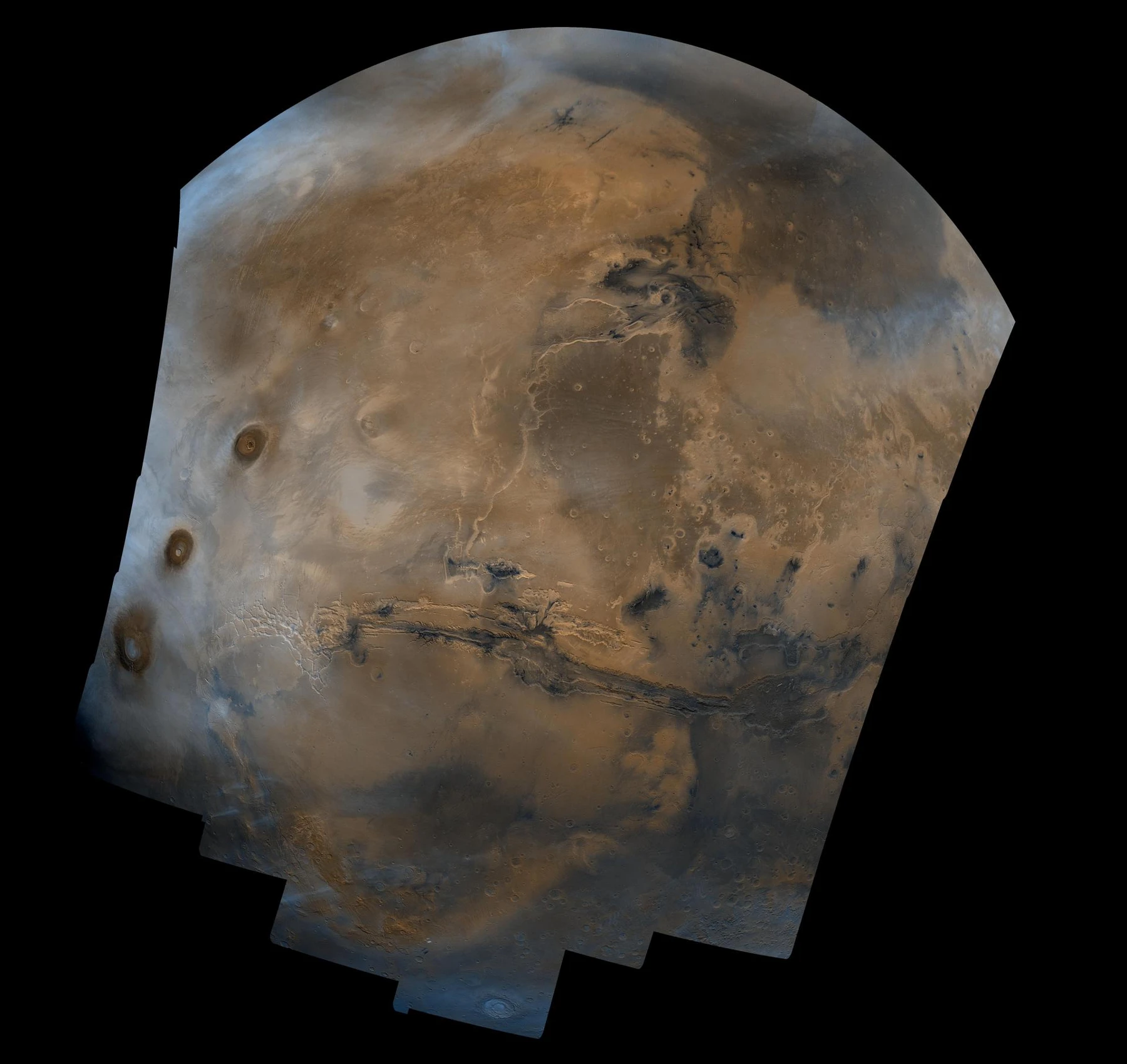
Mars is our next-door neighbor, but it’s a neighbor that never stays put. Some years it’s a few light-minutes away; others it’s hiding on the far side of the Sun, more than 22 light-minutes off. The most fuel-efficient direct journeys follow that roughly two-year rhythm, though other routes are possible. It’s a beat set by two planets circling the Sun at different speeds.
About the Author
Author: King | Founder of Dark Cosmic Insights