On the night of August 29, 1864, William Huggins pointed a spectroscope at a small, fuzzy patch of light. He expected the rainbow smear of starlight. Instead he saw a single bright line, and concluded that the object was “not an aggregation of stars, but a luminous gas” (Becker, Sky & Telescope, 2014).
That patch was the Cat’s Eye Nebula, and Huggins had just answered half of a very old question: what is a nebula? The other half took about 60 more years and one flickering star in Andromeda. This guide covers the five main types of nebulae, what makes each glow or go dark, how nebulae build stars and dying stars build nebulae, why nebula photo colours are chosen, and how to see one with binoculars.
Observed, modelled, open. The gas, the dust, the specific colours of light nebulae give off, their distances, the young stars forming inside them and the debris of dying stars are observed or measured. That our own Sun will one day make a faint planetary nebula is modelled. Whether the Pillars of Creation have already been toppled by a stellar explosion is still open.
Quick Answer: What Is a Nebula?
A nebula is a cloud of gas and dust in space, mostly hydrogen and helium, sitting in the space between the stars (NASA Space Place). Some nebulae glow because hot young stars energise their gas (emission nebulae). Some shine by scattered starlight (reflection nebulae). Some block the light behind them (dark nebulae). Others are the cast-off layers of dying stars (planetary nebulae) or the debris of exploded ones (supernova remnants). Stars are born in nebulae, and dying stars make new nebulae.
What this article can and cannot establish. It can explain each type of nebula, separate observation from model, and give sourced distances and sizes for famous examples. It cannot give a single “true” distance where good sources disagree, so we show the range. Nor can it tell you what a nebula would look like to your eye up close, because most published images map infrared or narrow-band light to chosen colours.
Table of Contents
The DCI Evidence Map: Nebulae
| Question | What we know | Status | Key source |
|---|---|---|---|
| What is a nebula made of? | Gas, mostly hydrogen and helium, mixed with dust | Measured | NASA Space Place |
| Why do emission nebulae glow? | Ultraviolet light from hot O and B stars ionises hydrogen; the gas then gives off light at set wavelengths, such as hydrogen-alpha at 656.3 nm | Observed | Swinburne COSMOS, Emission Nebula |
| Were some “nebulae” really other galaxies? | Yes: Hubble’s 1923 Cepheid star V1 placed Andromeda far outside the Milky Way | Measured | NASA Science, 2011 |
| Do stars form inside nebulae? | Webb sees newly formed stars and their jets inside the Pillars of Creation | Observed | NASA Webb, Oct 19, 2022 |
| Do dying stars make nebulae? | Planetary nebulae surround dying Sun-like stars; the Crab Nebula is debris from a supernova recorded in 1054 | Observed | ESA/Webb, Ring Nebula · NASA, Messier 1 |
| How far away is the Orion Nebula? | About 1,350 to 1,500 light-years, depending on the source | Measured | Menten et al. 2007 · NASA, Messier 42 |
| Will the Sun make a planetary nebula? | Stellar models say yes, a faint one, in roughly 5 billion years | Modelled | Gesicki et al. 2018 |
| Have the Pillars of Creation already been destroyed? | A 2007 idea said a supernova blast may have toppled them; a 2011 study also offers an explanation with no supernova | Open | NASA JPL, 2007 · Flagey et al. 2011 |
| Do nebula photos show the colours your eye would see? | Usually not: each filter is assigned a colour, and infrared light is translated into visible hues | Not supported | NASA Webb explainer |
Status key: Observed = seen directly in images or spectra. Measured = a number or detection with stated uncertainty. Modelled = inferred from measurements through a physical model, dependent on assumptions. Open = unresolved; the evidence is incomplete or points different ways. Not supported = no evidence for the claim.
Cite this framework: “DCI Evidence Map: Nebulae,” Dark Cosmic Insights, November 2026, darkcosmicinsights.com/what-is-a-nebula/.
Where Does the Word “Nebula” Come From?
The word is older than the telescope. Latin nebula meant mist, vapour, fog or smoke, and English borrowed it as “a cloud, mist” in the mid-1400s. The astronomical sense, a luminous cloud-like patch in the sky, dates to about 1730 (Etymonline).
For the next two centuries, “nebula” meant almost anything that looked fuzzy in a telescope.
Messier’s list of things that are not comets
Charles Messier (1730–1817), a French comet hunter, catalogued fuzzy objects so that other comet hunters wouldn’t waste time on them. The catalogue, as NASA presents it, holds 110 objects, a mix of nebulae, star clusters and galaxies (NASA Science, Hubble’s Messier Catalog).
The first entry, M1, is the Crab Nebula, discovered by John Bevis in 1731. Messier mistook it for Halley’s Comet, which NASA says inspired his catalogue (NASA, Messier 1).
Herschel’s “planetary” nebulae
William Herschel coined the term “planetary nebula” on March 17, 1785, in a letter to Jérôme Lalande. These objects looked like small, round planetary disks (University of St Andrews, MacTutor). The name stuck, even though, as ESA/Hubble puts it, planetary nebulae have “nothing to do with planets” (ESA/Hubble, Planetary nebula).
Huggins splits the gas from the stars
Huggins’s spectroscope showed that at least some nebulae were not distant star clusters at all: the Cat’s Eye gave off light at a few set wavelengths, the signature of a glowing gas, not the continuous spectrum of stars (Sky & Telescope). His report appeared that year in the Philosophical Transactions of the Royal Society (Huggins 1864).
Hubble moves the “spiral nebulae” out of the galaxy
In 1920, Harlow Shapley and Heber Curtis publicly debated whether the “spiral nebulae” were part of the Milky Way. On the night of October 5, 1923, Edwin Hubble, using the 100-inch Hooker telescope on Mount Wilson, photographed the Andromeda “nebula” and found a Cepheid variable, a star whose regular pulsing reveals its true brightness. That star, V1, put Andromeda at about a million light-years by his calculation, far outside our galaxy. NASA now gives its distance as about 2.5 million light-years (NASA Science, Messier 31; NASA Science, May 23, 2011).
Hubble’s 1926 classification paper was still titled “Extragalactic Nebulae” (Hubble 1926, ApJ 64, 321). Today we call them galaxies (see our guide to the types of galaxies), and “nebula” means what Huggins found: real clouds of gas and dust.
What Are Nebulae Made Of?
NASA Space Place defines a nebula as “a giant cloud of dust and gas in space,” made mostly of hydrogen and helium with dust mixed in (NASA Space Place, updated July 31, 2026). The dust can scatter starlight or block it completely, as the sections below show.
Nebulae are also very thin. A typical glowing nebula has a density of around a thousand atoms per cubic centimetre (Swinburne COSMOS, Emission Nebula).
How do we know the recipe? The same way Huggins did: each element gives off light at its own set of wavelengths, so a spectrum works like a barcode. Our How We Know hub explains how DCI labels evidence like this, and how astronomers measure stars shows the same toolkit applied to starlight.
What Are the Types of Nebulae?
NASA groups nebulae into two broad families: star-forming regions, sometimes called stellar nurseries, and the remains of dying stars (NASA Space Place). Within those, five types matter most.

Emission nebulae and H II regions
An emission nebula is a cloud of ionised gas that glows with its own light. The most common kind is an H II region (“H two”), named for ionised hydrogen, which forms around hot, luminous young stars of types O and B (Swinburne COSMOS). The Orion Nebula (M42), below Orion’s belt, is the classic example.
Reflection nebulae
A reflection nebula shines by starlight scattered off a nearby dust cloud. The dust grains are about the size of the wavelength of blue light, so they scatter blue light more efficiently than red, which is why reflection nebulae usually look blue. The best-known example is the haze around the stars of the Pleiades (Swinburne COSMOS, Reflection Nebula).
Dark nebulae
A dark nebula is a cloud with so much dust that it scatters and absorbs visible light completely, so it shows up as a black shape against a brighter background. Inside, temperatures are roughly 10 to 100 kelvin (about −263 to −173 °C, or −442 to −280 °F), cold enough for hydrogen molecules to form and for stars to begin forming (Swinburne COSMOS, Dark Nebula). Swinburne calls the Horsehead Nebula in Orion the most famous example; it stands out against a glowing emission nebula behind it.
Planetary nebulae
A planetary nebula is, in ESA/Hubble’s definition, a region of gas and dust formed from the cast-off outer layers of a dying star (ESA/Hubble). The Ring Nebula (M57) in Lyra is the textbook case, roughly 2,000 to 2,500 light-years away depending on the source (NASA, Messier 57; ESA, Aug 21, 2023).
Supernova remnants
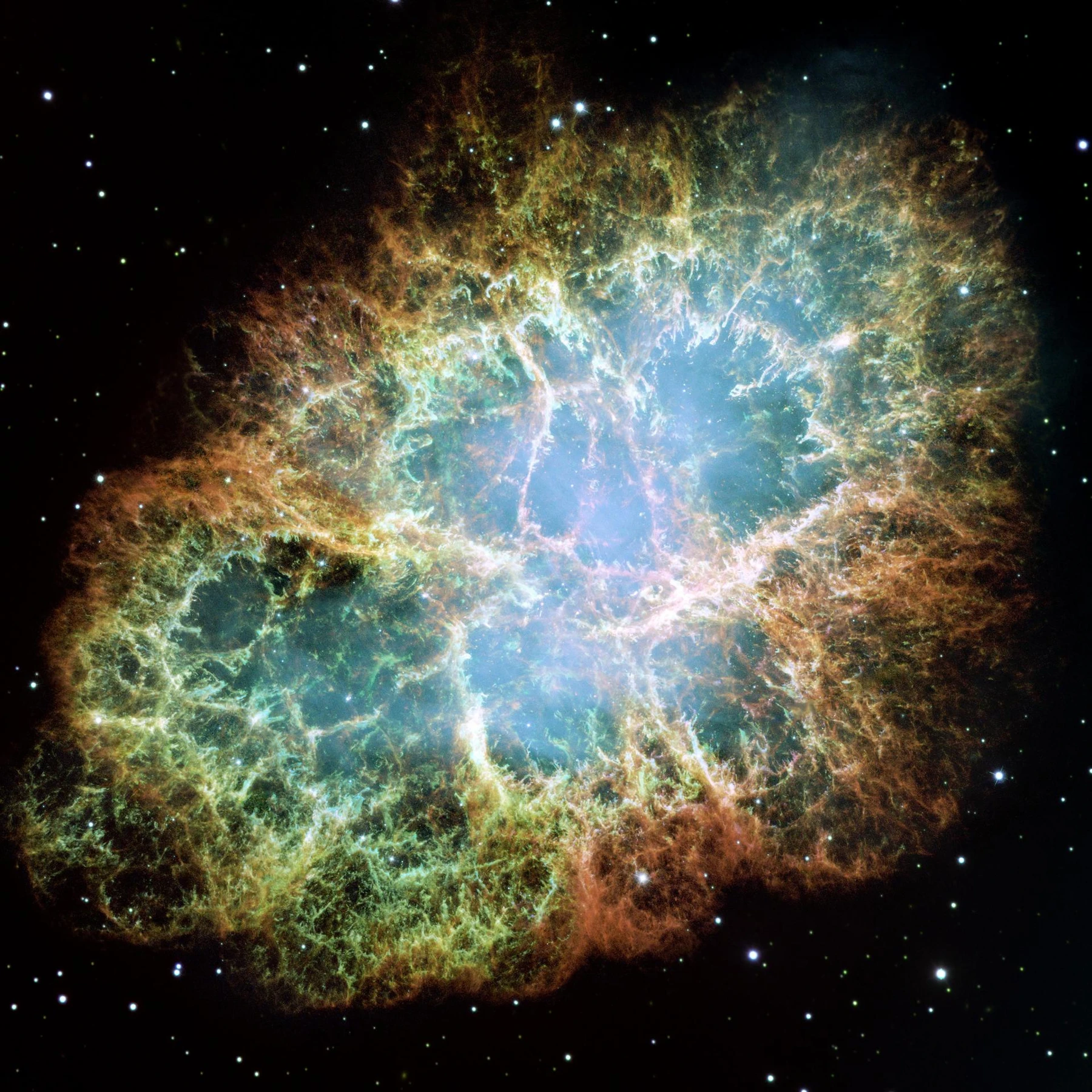
A supernova remnant is the expanding debris of a star that exploded. The Crab Nebula (M1) in Taurus is about 6,500 light-years away and about six light-years wide. Chinese astronomers recorded the explosion in 1054 as a “guest star” visible in daylight for nearly a month (NASA, Messier 1).
What Makes an Emission Nebula Glow?
An emission nebula is lit from inside by ultraviolet light, in the sequence Swinburne University’s encyclopedia describes (Swinburne COSMOS, Emission Nebula):
- Hot O and B stars pour out high-energy ultraviolet photons.
- Those photons knock electrons off hydrogen atoms, leaving free protons and electrons. The gas is now ionised.
- Electrons recombine with protons, landing in excited energy levels.
- As each atom drops back down, it gives off light at specific wavelengths.
The most important of those wavelengths in visible light is hydrogen-alpha (H-alpha), at 656.3 nanometres, in the red part of the spectrum. That red line gives many emission nebulae their red colour. Oxygen, nitrogen and sulfur add their own lines, which is why astronomers can map them separately.
The gas in these regions averages near 10,000 K (about 9,700 °C, or 17,500 °F) (Swinburne COSMOS).
Planetary nebulae glow the same way, lit by the dying star’s hot core: Swinburne notes that the Ring Nebula shows ionised nitrogen, oxygen and helium around its central white dwarf.
How Do Nebulae Form?
There are two main routes.
From the gas between the stars. Cold gas and dust gather into molecular clouds, which NASA says range from 1,000 to 10 million times the mass of the Sun and span hundreds of light-years (NASA Science, Stars, updated August 12, 2026). The largest dark nebulae, giant molecular clouds, can hold over a million solar masses and stretch more than 200 parsecs (about 650 light-years). The smallest, Bok globules, are under 3 light-years across (Swinburne COSMOS, Dark Nebula).
When hot, massive O and B stars are born inside such a cloud, their ultraviolet light ionises the surrounding hydrogen, and that gas becomes a glowing emission nebula (Swinburne COSMOS, Emission Nebula).
From dying stars. A Sun-like star sheds its outer layers to make a planetary nebula; a massive star explodes and leaves a supernova remnant. Both are covered below.
How Do Nebulae Make New Stars?
NASA describes star birth in a few steps (NASA Science, Stars; NASA Space Place):
- Cold gas clumps. Molecular clouds are cold, which lets gas gather into high-density pockets.
- Gravity takes over. As a clump gathers mass, its gravity strengthens until it collapses.
- A protostar forms. The collapse heats the material at the centre, forming a protostar.
- Fusion switches on. At first, a protostar shines mainly from the energy of collapse. Fusion in its core begins only “after millions of years,” in NASA’s words.

What Webb sees inside the Pillars of Creation
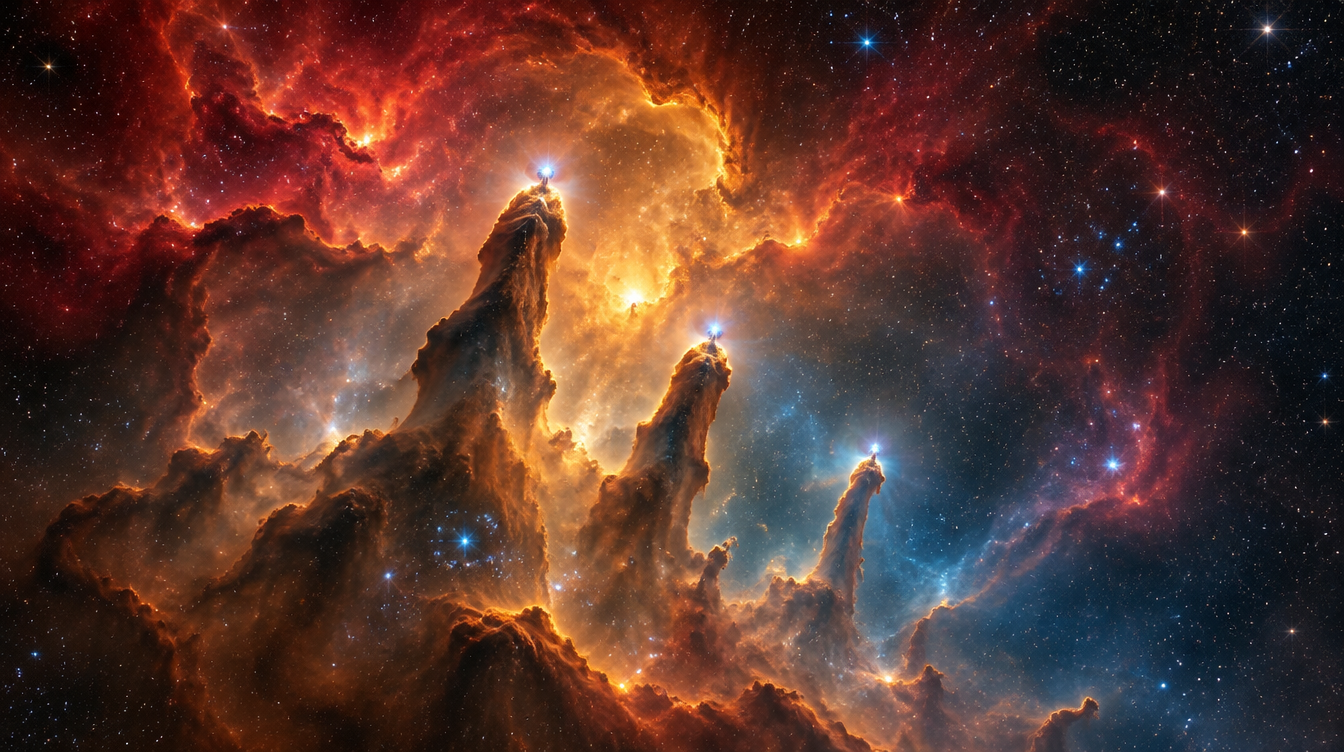
The Pillars of Creation are towers of gas and dust inside the Eagle Nebula (M16), roughly 4 to 5 light-years tall (NASA, Messier 16). Hubble first imaged them in 1995 and returned in 2014 for a sharper, wider view in visible light (NASA Webb, October 19, 2022).
Webb’s near-infrared view, released October 19, 2022, sees through much of the dust. NASA describes the bright red orbs at the pillar edges as newly formed stars, estimated to be only a few hundred thousand years old. Wavy red lines at the tips are supersonic jets from stars still forming, glowing from energetic hydrogen molecules (NASA Webb, October 19, 2022).
The same kind of scene appears in Webb’s “Cosmic Cliffs”, the edge of the young star-forming region NGC 3324 in the Carina Nebula, about 7,600 light-years away. Its cavity was carved by ultraviolet radiation and winds from massive young stars, and NASA notes this earliest phase of star formation lasts only about 50,000 to 100,000 years per star (NASA Image Library, Cosmic Cliffs).
That’s the first chapter of the life cycle of a star: a cold cloud, a collapse, a new star, and its light reshaping the nebula that made it.
How Do Dying Stars Make Nebulae?
Which kind of nebula a dying star makes depends mostly on its mass.
Planetary nebulae: the gentle exit
When a low-mass star like the Sun runs low on fuel, its atmosphere swells and its outer layers eventually blow away, forming an expanding cloud of dust and gas around a hot exposed core. That core becomes a white dwarf that cools over billions of years (NASA Science, Stars).
Webb’s 2023 images of the Ring Nebula show a central star on its way to becoming a white dwarf and roughly ten concentric arcs beyond the main ring (ESA, August 21, 2023).
Planetary nebulae don’t last long. ESA/Hubble says they last about 20,000 years (ESA/Hubble), while a 2018 University of Manchester release says the ejected envelope glows for about 10,000 years (University of Manchester, May 7, 2018). The same Manchester release says planetary nebulae mark the end of the active lives of about 90% of all stars.
Will the Sun make one?
Probably, according to models. A 2018 study in Nature Astronomy by K. Gesicki, A. A. Zijlstra and M. M. Miller Bertolami used new stellar models to predict that the Sun will produce a faint but visible planetary nebula after it dies in roughly five billion years. In their models, stars below about 1.1 solar masses produce fainter planetary nebulae, and the Sun sits near the lower mass limit for making a visible one; stars only a few percent less massive would not. Earlier models had suggested stars below about twice the Sun’s mass would make nebulae too faint to see (Gesicki et al. 2018; University of Manchester). This is modelled.
Supernova remnants: the violent exit
In massive stars, NASA explains, the core fuses elements up to iron, collapses, rebounds and explodes as a supernova, leaving a neutron star or black hole (NASA Science, Stars).
In the Crab Nebula, at the centre spins a pulsar, a rapidly rotating neutron star whose twin beams make it appear to pulse about 30 times per second. NASA says electrons whirling at nearly the speed of light around the pulsar’s magnetic field lines produce the blue light inside the nebula (NASA, Messier 1).
Recycling: from stellar ash to new stars
NASA says material cast into space by supernovae and other stellar events enriches future molecular clouds and ends up in the next generation of stars (NASA Science, Stars). Nebulae make stars; stars make nebulae.
Are the Colours in Nebula Photos Real?
The light is real. The colours are usually chosen, and the source tells you how.
Hubble and Webb take a separate grayscale image through each filter, and image specialists assign a colour to each. For Webb, NASA explains that infrared light is invisible to human eyes, so processors “translate these wavelengths of light, in order, to visible colors,” with the shortest wavelengths shown as blue and the longest as red. Those assignments are a baseline, and a filter is sometimes given a different colour to bring out the science (NASA Science, How Are Webb’s Full-Color Images Made?, September 3, 2025).
Hubble’s narrow-band filters each isolate one element’s light, and the colour given to each element varies by image:
| Image | Colour mapping, as NASA describes it |
|---|---|
| Orion Nebula (Hubble mosaic) | Orange = hydrogen; green = oxygen; red = sulfur and some infrared (NASA, M42) |
| Eagle Nebula, Pillars (Hubble) | Blue = oxygen; red = sulfur; green = nitrogen and hydrogen (NASA, M16) |
| Crab Nebula (Hubble mosaic) | Orange = mostly hydrogen; blue (outer filaments) = neutral oxygen; green = singly ionised sulfur; red = doubly ionised oxygen (NASA, M1) |
| Ring Nebula (Hubble) | Deep blue = helium; light blue = hydrogen and oxygen; reddish outer ring = nitrogen and sulfur (NASA, M57) |
Notice that hydrogen is shown as orange in two of these pictures and folded into green in another. NASA says plainly of the Crab mosaic that its colours don’t exactly match what the eye would see. That doesn’t make the images fake: every colour maps to real light. It means you should read the caption before reading the colours. Our explainer Are Space Photos Real? covers the whole processing chain, and Hubble vs. Webb: Same Nebula, Different View shows how one nebula changes between visible and infrared light.
How Big and How Far Away Are Nebulae?
The famous nebulae are hundreds to thousands of light-years away. A light-year, the distance light travels in a year, is about 9.46 trillion km (5.88 trillion miles); NASA Space Place rounds this to 9 trillion km, or 6 trillion miles (NASA Space Place, light-year).
Good sources sometimes give different distances, so we show the range.
| Nebula | Type | Distance (light-years) | Size | Sources |
|---|---|---|---|---|
| Helix | Planetary | About 700 | n/a | NASA Space Place |
| Horsehead | Dark | About 1,300 | n/a | ESA/Hubble, 2013 |
| Orion (M42) | Emission (H II) | About 1,350 to 1,500 | n/a | Menten et al. 2007; NASA, M42 |
| Ring (M57) | Planetary | About 2,000 to 2,500 | n/a | NASA, M57; ESA, 2023 |
| Crab (M1) | Supernova remnant | About 6,500 | About 6 light-years wide | NASA, M1 |
| Eagle (M16) | Star-forming | About 6,500 to 7,000 | 70 by 55 light-years; Pillars 4 to 5 light-years tall | NASA Webb, 2022; NASA, M16 |
| Carina, NGC 3324 | Star-forming | About 7,600 | n/a | NASA Image Library |

- Orion: a 2007 radio study measured the parallax (the tiny yearly shift in position as Earth orbits the Sun) of stars in the Orion Nebula Cluster, giving 414 ± 7 parsecs, about 1,350 ± 23 light-years (Menten et al. 2007). NASA’s Hubble Messier page gives 1,500, and ESA/Hubble’s 2006 Orion release gives both 1,500 and 1,400 (ESA/Hubble, heic0601). The chart uses the parallax value.
- Eagle: about 6,500 in NASA’s 2022 Webb release, 7,000 on NASA’s Hubble Messier page. Ring: about 2,000 on NASA’s Messier page, roughly 2,500 in ESA’s 2023 Webb release. The chart uses the Webb values.
- Helix: NASA’s Hubble team calls it one of the nearest planetary nebulae to Earth, at about 650 light-years (NASA Science, Caldwell 63); NASA Space Place gives about 700. It is possibly the remnant of a star like the Sun.
The light you see from Orion tonight left it roughly 1,350 to 1,500 years ago.
Myth vs. Fact: Nebulae
| Myth | Fact |
|---|---|
| “A nebula is a type of galaxy.” | Not any more. Before the 1920s, many galaxies were called “spiral nebulae.” Hubble’s 1923 Cepheid put Andromeda far outside the Milky Way. |
| “Nebula photos show what you’d see with your eyes.” | Usually not. Colours are assigned to filters, and infrared is translated into visible hues. |
| “Planetary nebulae have something to do with planets.” | They don’t. Herschel named them in 1785 because they looked like small planetary disks. |
| “All nebulae glow.” | Dark nebulae are seen only because they block light from behind. |
| “The Pillars of Creation have been destroyed.” | Open. A 2007 idea said a supernova blast may have toppled them; a 2011 study also offers an explanation with no supernova. |
About that last row: in January 2007, a team led by Nicolas Flagey suggested that hot dust seen by Spitzer around the Eagle Nebula was heated by a supernova. NASA JPL’s release said the pillars “might have met their demise” about 6,000 years ago, which we wouldn’t see for another 1,000 years or so (NASA JPL, January 9, 2007). The team’s 2011 paper offers two interpretations: a shell fed by evaporating cloud material pushed by stellar winds, or a supernova remnant (Flagey et al. 2011). Neither is established, so we label it Open.
How Can You See a Nebula Yourself?
Your first nebula needs only a dark sky and, ideally, binoculars.
Start with the Orion Nebula
The Orion Nebula (M42) sits just below the three stars of Orion’s belt, in the line of stars called Orion’s Sword. Its apparent magnitude (a measure of how bright it looks from Earth; lower numbers are brighter) is 4.0, so NASA says it can be spotted with the naked eye from dark sites. NASA’s Hubble Messier page says it is best observed during January (NASA, M42).
NASA’s Night Sky Network describes what each tool shows (NASA Night Sky Notes, January 2022):
- Your eyes: parts of the Sword may look fuzzy.
- Binoculars: show that the fuzzy patch is the nebula, next to the star Hatysa.
- A telescope: reveals more cloud detail and, at higher magnification, the young stars of the Trapezium, four massive stars at the nebula’s bright heart.
Next targets
- The Ring Nebula (M57), magnitude 8.8, lies about halfway between the stars Sheliak and Sulafat in Lyra. NASA says it’s easy to find, but you’ll need a moderately sized telescope to see the ring shape (NASA, M57).
- The Crab Nebula (M1), magnitude 8.4, can be seen with a small telescope (NASA, M1).
- The Eagle Nebula (M16), magnitude 6.0 (NASA, M16).
Tip: compare your view with the NASA image of the same object, and read its colour key.
What Comes Next for Nebula Science?
These are real missions, with dates as their agencies report them, as of November 2026.
- SPHEREx (NASA). Launched March 11, 2025, on a two-year planned mission (NASA Science, SPHEREx). On April 15, 2026, NASA JPL reported SPHEREx maps of water, carbon dioxide and carbon monoxide ices on dust grains in giant molecular clouds in Cygnus X and the North America Nebula, across more than 600 light-years, and said the first of four planned all-sky maps was completed by late 2025 (NASA JPL, April 15, 2026).
- Nancy Grace Roman Space Telescope (NASA). NASA’s Roman page, updated November 7, 2026, lists a launch date of August 30, 2026 and reports the observatory entering its final commissioning phase (NASA Science, Roman). Its first announced general astrophysics survey, selected in March 2024, is a planned Galactic Plane Survey meant to peer through dust and resolve stars even in stellar nurseries on the galaxy’s far side (NASA, March 12, 2024).
Nebulae by the Numbers
- 1,000 to 10 million: the mass range of molecular clouds, in Suns (NASA Science)
- More than 200 parsecs (about 650 light-years, 6.2 quadrillion km or 3.8 quadrillion miles): the span of the largest giant molecular clouds (Swinburne COSMOS)
- About 10,000 K (about 9,700 °C, 17,500 °F): average temperature of the gas in emission nebulae (Swinburne COSMOS)
- About 10 to 100 K (about −263 to −173 °C, −442 to −280 °F): temperatures inside dark nebulae (Swinburne COSMOS)
- 656.3 nm: the wavelength of hydrogen-alpha, the red light behind many emission nebulae
- About 1,350 to 1,500 light-years (12.8 to 14.2 quadrillion km, 7.9 to 8.8 quadrillion miles): distance to the Orion Nebula, depending on source
- About 6 light-years (57 trillion km, 35 trillion miles): width of the Crab Nebula (NASA)
- 4 to 5 light-years (38 to 47 trillion km, 24 to 29 trillion miles): height of the Pillars of Creation (NASA)
- 1054: the year Chinese astronomers recorded the supernova that made the Crab Nebula
- 110: objects in Charles Messier’s catalogue of fuzzy things that are not comets
Nebulae: FAQ
Is a nebula the same thing as a galaxy?
No. A nebula is a cloud of gas and dust inside a galaxy, while a galaxy is a vast system of stars, gas and dust. Before the 1920s, galaxies such as Andromeda were called “spiral nebulae,” until Edwin Hubble’s 1923 observation of a Cepheid star showed Andromeda lies far beyond the Milky Way.
Which nebulae are closest to Earth?
Among well-known nebulae, the Helix Nebula in Aquarius is one of the closest planetary nebulae, at about 650 light-years according to NASA’s Hubble team (NASA Space Place gives about 700). The Horsehead and Orion nebulae lie roughly 1,300 to 1,500 light-years away.
Can you see a nebula without a telescope?
Yes. The Orion Nebula, at magnitude 4.0, can be spotted with the naked eye from a dark site as a fuzzy patch in Orion’s Sword, below the belt. Binoculars show that the fuzzy patch is the nebula, and NASA says it’s best observed in January.
Will the Sun turn into a nebula?
Stellar models published in 2018 predict that the Sun will make a faint but visible planetary nebula after it dies, in roughly five billion years. Its outer layers will drift away and its core will become a white dwarf. This is a model prediction, not an observation.
How long do planetary nebulae last?
Only briefly, in cosmic terms. ESA/Hubble says planetary nebulae last about 20,000 years, and a 2018 University of Manchester release says the ejected envelope glows for about 10,000 years. Either figure is tiny next to a star’s lifetime of billions of years.
Why do some nebulae look blue?
Many blue nebulae are reflection nebulae: their dust grains are about the size of the wavelength of blue light, so they scatter blue starlight more efficiently than red. In processed telescope images, blue can also simply be the colour assigned to a particular filter or element, so check the caption.
What are the Pillars of Creation?
They are towers of gas and dust in the Eagle Nebula, roughly 4 to 5 light-years tall, where new stars are forming. Hubble imaged them in 1995 and 2014, and Webb’s 2022 infrared view revealed young stars and jets inside them.
How hot is the gas in a nebula?
It depends on the type. The glowing gas in emission nebulae averages near 10,000 K (about 9,700 °C, 17,500 °F), while the inside of a dark nebula is roughly 10 to 100 K (about −263 to −173 °C, −442 to −280 °F). The glowing gas is also extremely thin, around a thousand atoms per cubic centimetre.
Your next step: on the next clear winter evening, find Orion’s belt, look just below it, and point a pair of binoculars at the faint smudge in the Sword. That glow left the Orion Nebula roughly 1,350 to 1,500 years ago. Then compare what you saw with NASA’s Hubble mosaic on its Messier 42 page, and read its colour key.

Sources and Further Reading
- NASA Space Place (updated July 31, 2026), What Is a Nebula?; What Is a Light-Year?.
- NASA Science, Hubble’s Messier Catalog (updated 2025–2026): Catalog overview; Messier 1, Crab Nebula; Messier 16, Eagle Nebula; Messier 42, Orion Nebula; Messier 57, Ring Nebula.
- NASA Science (updated August 12, 2026), Stars.
- NASA Science (October 19, 2022), NASA’s Webb Takes Star-Filled Portrait of Pillars of Creation.
- NASA Science (September 3, 2025), How Are Webb’s Full-Color Images Made?
- NASA Science (May 23, 2011), Hubble Views the Star That Changed the Universe.
- NASA Science, Hubble’s Messier Catalog, Messier 31; Hubble’s Caldwell Catalog, Caldwell 63 (Helix Nebula).
- ESA (August 21, 2023), Webb captures detailed beauty of Ring Nebula.
- ESA/Hubble, Planetary nebula (word bank); Horsehead Nebula in infrared, heic1307a (April 19, 2013); Orion Nebula mosaic, heic0601a (January 11, 2006); Crab Nebula mosaic, heic0515a (December 1, 2005).
- Swinburne University of Technology, COSMOS encyclopedia: Emission Nebula; Reflection Nebula; Dark Nebula.
- Menten, K. M., Reid, M. J., Forbrich, J., and Brunthaler, A. (2007). “The distance to the Orion Nebula.” Astronomy & Astrophysics 474(2), 515–520. doi:10.1051/0004-6361:20078247 (arXiv:0709.0485).
- Gesicki, K., Zijlstra, A. A., and Miller Bertolami, M. M. (2018). “The mysterious age invariance of the planetary nebula luminosity function bright cut-off.” Nature Astronomy 2(7), 580–584. doi:10.1038/s41550-018-0453-9. Plain-language summary: University of Manchester (May 7, 2018), What will happen when our Sun dies?
- Flagey, N., Boulanger, F., Noriega-Crespo, A., et al. (2011). “Tracing the energetics and evolution of dust with Spitzer: a chapter in the history of the Eagle Nebula.” Astronomy & Astrophysics. doi:10.1051/0004-6361/201116437 (arXiv:1103.2495).
- NASA JPL (January 9, 2007), Famous Space Pillars Feel the Heat of Star’s Explosion.
- Huggins, W. (1864). “On the spectra of some of the nebulae.” Philosophical Transactions of the Royal Society of London 154, 437–444. doi:10.1098/rstl.1864.0013
- Becker, B. (2014), article on the 150th anniversary of Huggins’s first planetary nebula spectrum, Sky & Telescope.
- Hubble, E. P. (1926). “Extragalactic nebulae.” The Astrophysical Journal 64, 321. doi:10.1086/143018
- University of St Andrews, MacTutor, William Herschel’s astronomical discoveries.
- Etymonline, nebula.
- NASA Night Sky Network, David Prosper (January 2022), Hunting the Hunter: Observing Orion (copy hosted by a member astronomy club).
- NASA Science, SPHEREx; NASA JPL (April 15, 2026), Interstellar Glaciers: NASA’s SPHEREx Maps Vast Galactic Ice Regions.
- NASA Science (updated November 7, 2026), Nancy Grace Roman Space Telescope; NASA (March 12, 2024), NASA’s Roman Team Selects Survey to Map Our Galaxy’s Far Side.
- NASA Image and Video Library: Cosmic Cliffs in the Carina Nebula (carina_nebula); Southern Ring Nebula (southern_ring_nebula); NASA Photojournal, Most Detailed Image of the Crab Nebula (PIA03606); NASA Science, Cosmic Cliffs NIRCam image asset.
Explore Next
- What happens before and after a nebula: The Life Cycle of a Star
- The “nebulae” that turned out to be galaxies: Types of Galaxies
- One nebula, two telescopes: Hubble vs. Webb: Same Nebula, Different View
- How to read the colours in space images: Are Space Photos Real?
- The spectral toolkit behind this article: How Astronomers Measure Stars
- How a claim earns its label: How We Know
- More from deep space: Stars & Galaxies
- Read next: How Many Moons Does Uranus Have? Shakespeare’s Moons on a Sideways Planet
- Read next: What Is the Biggest Planet? Jupiter, Tiny Mercury and the Limits of Size
How This Explainer Was Checked
Every number in this article was checked in November 2026 against the source linked beside it: NASA Science, NASA Space Place, NASA JPL, the NASA Image and Video Library and Photojournal, ESA and ESA/Hubble pages, Swinburne University’s COSMOS encyclopedia, the University of St Andrews’ MacTutor archive, and peer-reviewed papers, with DOIs given where they exist (paper details confirmed through Crossref and arXiv records). Where sources give different distances, as for the Orion, Eagle and Ring nebulae, and different lifetimes for planetary nebulae, we show both values and say which one a chart uses. Light-year, kilometre, mile, Celsius and Fahrenheit conversions, and the parsec-to-light-year conversion of the Orion parallax, are DCI’s arithmetic. The Sun’s future planetary nebula is labelled Modelled; the fate of the Pillars of Creation is labelled Open; the claim that nebula photos show natural eye colours is labelled Not supported. Image captions say how colour was assigned, as the source describes it. Images are labelled: real spacecraft or telescope images as OBSERVATION, illustrations as ILLUSTRATION, and our charts as DATA GRAPHIC. Nothing AI-generated is presented as a real image.

Final Thought: The Clouds That Remember Every Star
For two centuries, “nebula” was a word for what we couldn’t yet see clearly. Spectroscopes split the true gas clouds from the star-filled ones, and Hubble’s Cepheid sent the spiral nebulae out into the universe as galaxies. What’s left is the most interesting part: clouds that build stars, and stars that, at the end, build clouds again. The atoms in a new star in the Pillars may once have drifted in a nebula like the Crab. Some of the details, like the Sun’s own future nebula and the fate of the Pillars, are still models and open questions. The cycle itself is written in the light.
About the Author
Author: King | Founder of Dark Cosmic Insights
King is the founder of Dark Cosmic Insights, a science storytelling platform exploring the strangest true stories hiding in space, science and AI. He digs into NASA, ESA and peer-reviewed research, separates what has been measured from what is still a mystery, and turns it into articles, data graphics and Shorts.
Follow the anomaly. Trace the source.