On February 1, 1979, NASA’s Voyager 1 was still a month away from its closest pass of Jupiter when it took a picture of the giant planet with its moon Io hanging beside it (NASA, PIA00235). Voyager had already been flying for almost a year and a half. It would still need a month more to reach Jupiter.
That’s what “far” means for Jupiter. It’s the closest of the giant planets, yet it sits more than five times farther from the Sun than we do. Sunlight needs 43 minutes to reach it (NASA). And the fastest spacecraft ever to pass it still needed more than a year to make the trip.

Observed, measured, modelled, open. Jupiter’s distances and orbit are measured to high precision. Past spacecraft travel times are observed facts. Future arrival dates are planned. The light-travel times and comparisons here are DCI calculations from NASA’s measured distances, labelled as such.
Quick Answer: How Far Is Jupiter?
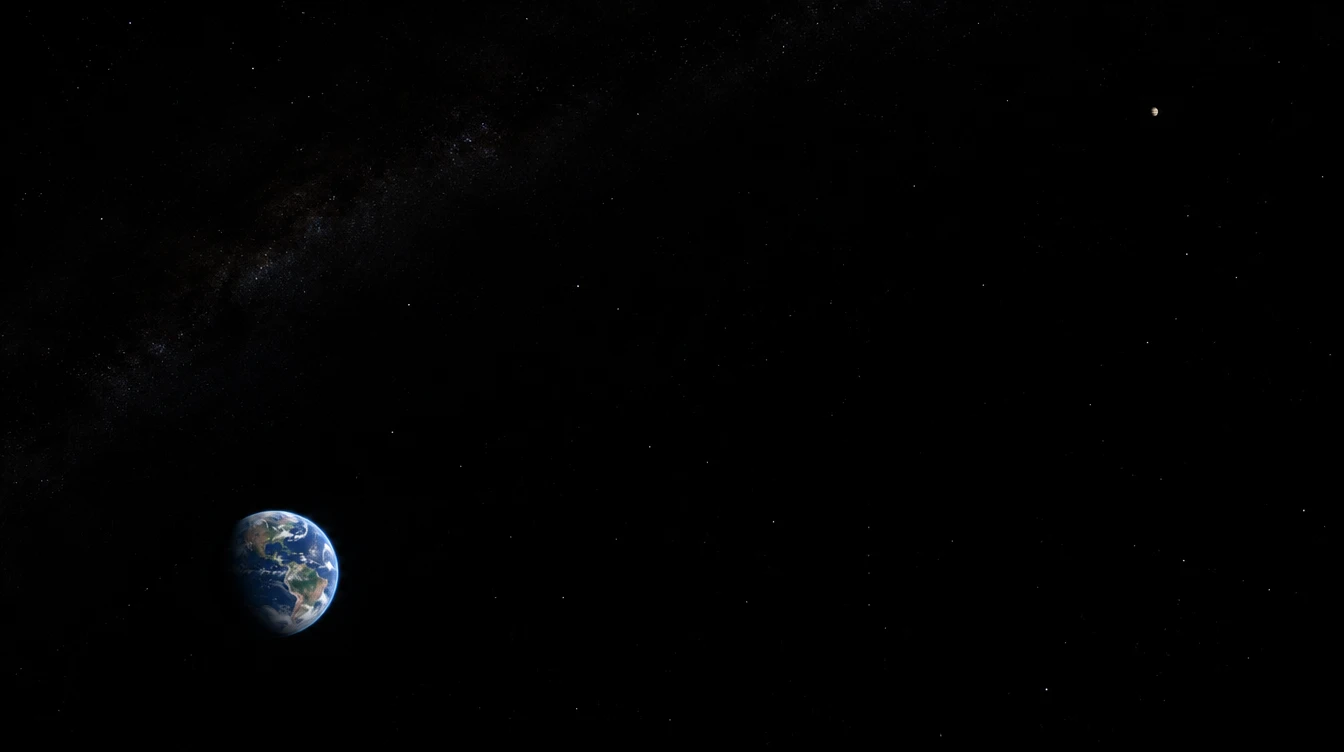
Jupiter is about 778 million km (484 million miles) from the Sun on average, or 5.2 astronomical units (AU), meaning 5.2 times Earth’s distance from the Sun (NASA). From Earth, Jupiter ranges from about 588.5 million km at its closest to about 968.5 million km at its farthest (NASA NSSDC). Sunlight takes about 43 minutes to reach it. Getting there has taken spacecraft from about 13 months (New Horizons, flying past) to about 6 years (Galileo, which went into orbit). And one Jupiter year lasts about 12 Earth years (4,333 Earth days).
What this article can and cannot establish. It can give you Jupiter’s measured distances from the Sun and Earth, the real travel times of past missions, and the length of a Jupiter year. It cannot give one fixed Earth-to-Jupiter distance, because both planets move constantly and the gap between them changes every day.
Table of Contents
The DCI Evidence Map: Jupiter’s Distance
| Question | What we know | Status | Key source |
|---|---|---|---|
| How far from the Sun, on average? | About 778 million km (5.2 AU) | Measured | NASA |
| Closest and farthest from the Sun? | About 740.6 and 816.4 million km | Measured | NASA NSSDC |
| How far from Earth? | About 588.5 to 968.5 million km | Measured | NASA NSSDC |
| How long does sunlight take? | About 43 minutes | Measured | NASA |
| How long does light from Earth take? | About 33 to 54 minutes | DCI calculation | NASA NSSDC |
| How long to fly there? | About 13 months to 6 years, depending on the mission | Observed | NASA, New Horizons |
| How long is a Jupiter year? | About 12 Earth years (4,333 days) | Measured | NASA |
Status key: Observed = seen directly. Measured = a number with a stated uncertainty or a direct measurement. Modelled = inferred from measurements through a physical model, dependent on assumptions. Open = unresolved; the evidence is incomplete or points different ways. Not supported = the evidence goes against the claim, or there is none for it. DCI calculation = our arithmetic from the linked measurement.
Cite this framework: “DCI Evidence Map: Jupiter’s Distance,” Dark Cosmic Insights, November 2026, darkcosmicinsights.com/how-far-is-jupiter/.
How Far Is Jupiter From the Sun?
The average distance
NASA says Jupiter orbits at an average distance of “484 million miles (778 million kilometers),” and that “Jupiter is 5.2 astronomical units away from the Sun” (NASA). One astronomical unit is the average Earth–Sun distance, about 150 million km.
Closest and farthest
Jupiter’s orbit is slightly stretched, with an eccentricity of 0.0487 (NASA NSSDC). NASA’s fact sheet gives:
- Perihelion (closest to the Sun): about 740.6 million km, roughly 4.95 AU.
- Aphelion (farthest from the Sun): about 816.4 million km, roughly 5.46 AU.
- Semimajor axis (average): about 778.5 million km.
(AU values are DCI calculations from NASA’s kilometer figures.)
What that means for sunlight
NASA says “it takes sunlight 43 minutes to travel from the Sun to Jupiter” (NASA). By the time it arrives, it’s much weaker. NASA’s fact sheet lists Jupiter’s solar irradiance as 50.26 watts per square meter, versus 1,361 at Earth (NASA NSSDC). That’s about 3.7 percent of Earth’s sunlight (DCI calculation). It’s one reason Jupiter’s cloud tops sit at about −108 °C.

How Far Is Jupiter From Earth?
It changes every day
Earth goes around the Sun in a year. Jupiter takes almost 12. So the distance between the two planets is always changing. NASA’s fact sheet gives a minimum of 588.5 million km and a maximum of 968.5 million km (NASA NSSDC). In miles, that’s roughly 366 million to 602 million (DCI conversion).
Closest at opposition
Jupiter is nearest to us around opposition, when Earth passes between the Sun and Jupiter. Oppositions come about every 398.9 days, Jupiter’s synodic period (NASA NSSDC). The next one is February 11, 2027 (Royal Observatory Greenwich). Around then, Jupiter rises at sunset and stays up all night.
Farthest behind the Sun
Jupiter is farthest from Earth around conjunction, when it’s on the far side of the Sun from us. Then it’s lost in the Sun’s glare.
How long does a signal take?
At those distances, light or a radio signal from Earth takes about 33 minutes to reach Jupiter at the closest and about 54 minutes at the farthest (DCI calculation from NASA’s distances and the speed of light). Commands to spacecraft at Jupiter arrive more than half an hour after they’re sent.
How Far Is That, Really?
Here’s Jupiter’s distance from Earth at its closest, about 588.5 million km, in more familiar terms (DCI calculations from NASA NSSDC):
- Driving nonstop at 100 km/h: about 670 years.
- Flying nonstop at a jet’s 900 km/h: about 75 years.
- Earth–Moon distances: about 1,500 lined up end to end (using about 384,400 km for the Moon).
And Jupiter is the closest giant planet. Saturn, at its nearest, is about twice as far away, as we explain in How Far Is Saturn?.
How Long Does It Take to Get to Jupiter?
Every mission’s travel time
Here’s how long each spacecraft took to reach Jupiter, from NASA’s and ESA’s mission pages:
- Pioneer 10: launched March 2, 1972, closest approach December 4, 1973. About 21 months. NASA calls it the “First spacecraft to fly past Jupiter” (NASA, Pioneer 10).
- Voyager 1: launched September 5, 1977, closest approach March 5, 1979. About 18 months (NASA, Voyager 1).
- Voyager 2: launched August 20, 1977, closest approach July 9, 1979. About 23 months (NASA, Voyager 2).
- Galileo: launched October 18, 1989, entered orbit December 7, 1995. About 6 years 2 months (NASA, Galileo).
- New Horizons: launched January 19, 2006, closest approach February 28, 2007. About 13 months (NASA, New Horizons).
- Juno: launched August 5, 2011, entered orbit July 4, 2016. About 5 years (NASA, Juno).

Why such different times?
Flybys vs. orbiters. Pioneer, Voyager and New Horizons flew past Jupiter and kept going, so they never had to brake. Galileo and Juno had to fire their engines on arrival to be captured into orbit. Juno’s capture burn lasted 35 minutes and cut its speed by about 542 meters per second (NASA/JPL, Juno press kit). Braking at the end doesn’t by itself make the trip longer. What stretched Galileo’s and Juno’s journeys was the route they flew to get there.
Launch speed. New Horizons was headed for Pluto and was launched extremely fast. NASA says it reached “the highest launch velocity attained by a human-made object relative to Earth,” about 58,536 km/h (NASA, New Horizons). It used Jupiter for a gravity boost on the way.
Detours for speed. Galileo couldn’t head straight to Jupiter. NASA says it used three planetary gravity assists, a Venus flyby in 1990 and Earth flybys in 1990 and 1992, to gain speed (NASA, Galileo). Juno did something similar. It looped out past Mars and came back for an Earth flyby on October 9, 2013, which boosted its speed by about 7.3 km/s; NASA says “Juno required a gravity assist from Earth in order to reach Jupiter” (NASA/JPL, Juno press kit). Those detours added years.
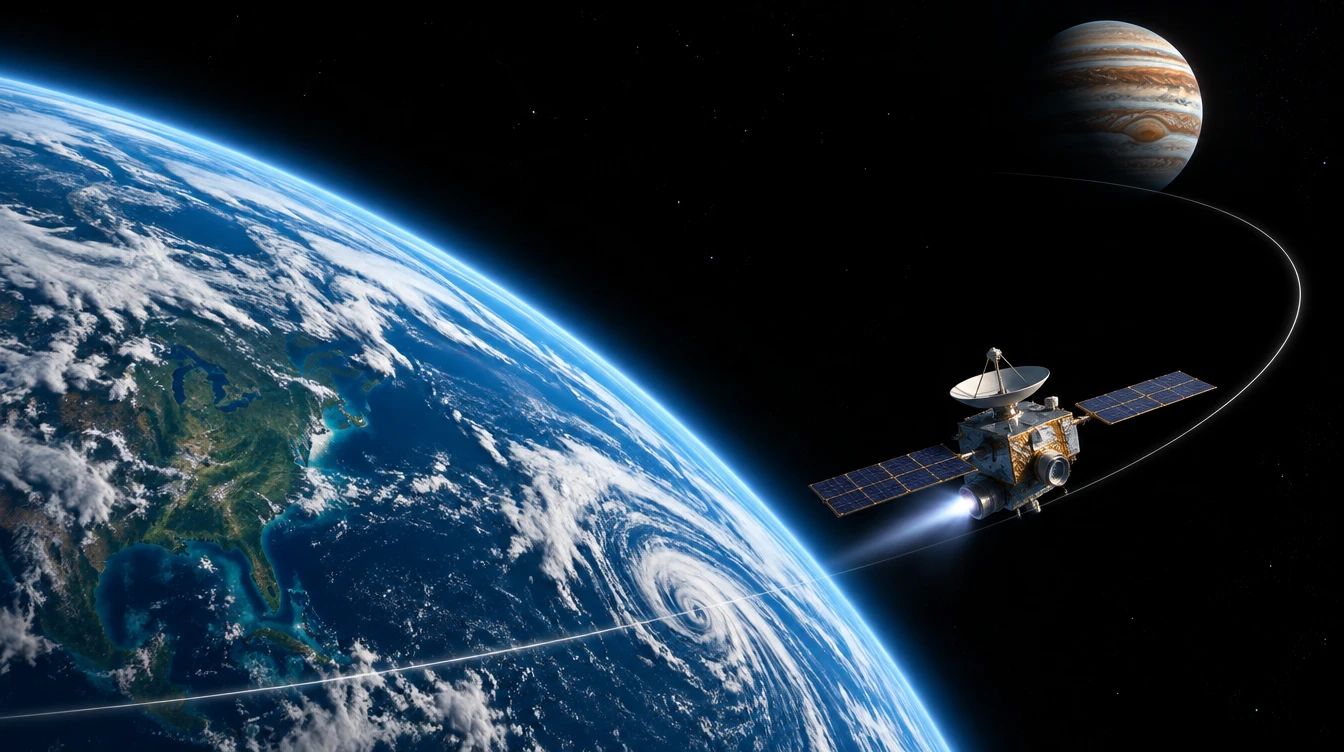
Missions on the way now
Two spacecraft are heading to Jupiter’s icy moons right now:
- Europa Clipper (NASA): launched October 14, 2024, scheduled to “reach Jupiter in April 2030” (NASA, Europa Clipper).
- Juice (ESA): launched April 14, 2023, planned arrival at Jupiter in July 2031 (ESA, Juice).
Both will take roughly five and a half to eight years (DCI calculation from the dates above), because both follow gravity-assist routes rather than a direct path.
How Long Is a Year on Jupiter?
About 12 Earth years
NASA says Jupiter makes a complete orbit “in about 12 Earth years (4,333 Earth days)” (NASA). NASA’s fact sheet gives the sidereal orbit period as about 4,332.6 days, or about 11.86 Earth years (DCI conversion from NASA NSSDC).
Why it takes so long
Jupiter’s orbit is much bigger than Earth’s, and it moves more slowly. Its average orbital speed is about 13.06 km/s, compared with Earth’s 29.78 km/s (NASA NSSDC). A longer path at a slower speed means nearly 12 of our years per lap.
Hardly any seasons
Jupiter’s axis is tilted only about 3.13 degrees (NASA NSSDC), compared with Earth’s 23.44. With so little tilt, sunlight hits each hemisphere in nearly the same way all year, so Jupiter has only very weak seasons compared with Earth or Saturn.
Short days, long years
Jupiter’s year is long, but its day is the shortest of any planet: about 9.9 hours (NASA). That means one Jupiter year holds more than 10,000 Jupiter days (DCI calculation). We explain why in What Is Jupiter Made Of?.

Myth vs. Fact: Jupiter’s Distance
| Myth | Fact | Status |
|---|---|---|
| “Jupiter is always the same distance from Earth.” | It ranges from about 588.5 to 968.5 million km. | Measured |
| “It takes decades to reach Jupiter.” | Past missions took about 13 months to 6 years. | Observed |
| “Every mission takes the same time.” | Trips ranged from about 13 months (New Horizons) to about 6 years (Galileo), depending on launch speed and route. | Observed |
| “Jupiter is the farthest planet you can see.” | Saturn is farther and also visible to the naked eye. | Observed |
| “A Jupiter year is about 10 hours.” | That’s a day; a year is about 12 Earth years. | Measured |
| “Jupiter has seasons like Earth.” | Its tilt is only about 3 degrees, so seasons are weak. | Measured |
How Can You Find Jupiter Yourself?
Look around opposition
Jupiter is easiest to see around opposition, when it rises at sunset and stays up all night. The next opposition is February 11, 2027 (Royal Observatory Greenwich), and Jupiter stays well placed for months around it.
It’s hard to miss
Jupiter is one of the brightest objects in the night sky. NASA’s fact sheet lists it at about magnitude −2.7 at mean opposition (NASA NSSDC), brighter than any star. It shines with a steady light rather than twinkling.
Bring binoculars
Steady binoculars show Jupiter’s four biggest moons as tiny points lined up beside it. We cover the full family in How Many Moons Does Jupiter Have?.
Jupiter’s Distance by the Numbers
| Measure | Value | Source |
|---|---|---|
| Average distance from the Sun | about 778 million km (484 million mi), 5.2 AU | NASA |
| Perihelion / aphelion | about 740.6 / 816.4 million km | NASA NSSDC |
| Closest / farthest from Earth | 588.5 / 968.5 million km | NASA NSSDC |
| Sunlight travel time | about 43 minutes | NASA |
| Light from Earth | about 33 to 54 minutes (DCI calculation) | NASA NSSDC |
| Fastest trip | about 13 months (New Horizons flyby) | NASA |
| One Jupiter year | about 11.86 Earth years | NASA NSSDC |
| Time between oppositions | about 398.9 days | NASA NSSDC |
| Next opposition | February 11, 2027 | Royal Observatory Greenwich |
Values are as of November 2026.
Jupiter Distance FAQ
How far is Jupiter from the Sun in miles?
About 484 million miles, or 778 million kilometers, on average, according to NASA. Because its orbit is slightly stretched, Jupiter ranges from about 740.6 million km at its closest to about 816.4 million km at its farthest from the Sun.
How far is Jupiter from Earth right now?
It depends on the date. Jupiter’s distance from Earth ranges from about 588.5 million km to about 968.5 million km. It’s closest around opposition; the next one is February 11, 2027, when Jupiter will be up all night.
How long does it take to get to Jupiter?
Past missions took from about 13 months to about 6 years. New Horizons flew past after about 13 months, Voyager 1 after about 18 months, and Pioneer 10 after about 21 months. Galileo and Juno, which flew long gravity-assist routes and then braked into orbit, took about 6 and 5 years.
How long does light take to reach Jupiter?
NASA says sunlight takes about 43 minutes to reach Jupiter. Light or a radio signal from Earth takes roughly 33 to 54 minutes, depending on where the two planets are in their orbits.
How many AU is Jupiter from the Sun?
About 5.2 AU on average, NASA says, meaning Jupiter is a little more than five times farther from the Sun than Earth. At its closest it’s about 4.95 AU, and at its farthest about 5.46 AU.
How long is a year on Jupiter?
About 12 Earth years, or 4,333 Earth days, according to NASA. Jupiter’s orbit is far bigger than Earth’s and it moves less than half as fast, so one trip around the Sun takes nearly 12 of our years.
Does Jupiter have seasons?
Only very weak ones. Jupiter’s axis is tilted just over 3 degrees, compared with Earth’s 23.4, so sunlight reaches both hemispheres in almost the same way all year long.
Which spacecraft are going to Jupiter now?
NASA’s Europa Clipper, launched in October 2024, is scheduled to reach Jupiter in April 2030. ESA’s Juice, launched in April 2023, is planned to arrive in July 2031. Both will study Jupiter’s icy moons.
Your next step: find Jupiter in the night sky, the brightest steady point you can see, and remember that its light left the Sun about 43 minutes before bouncing off those clouds and heading your way.

Sources and Further Reading
- NASA Science, Jupiter: Facts.
- NASA Space Science Data Coordinated Archive, Jupiter Fact Sheet.
- NASA Science, Pioneer 10; Voyager 1; Voyager 2; Galileo; New Horizons; Juno; Europa Clipper.
- ESA, Juice.
- Royal Observatory Greenwich, What is a planet in opposition?
- NASA, PIA00235: Jupiter with Satellite Io.
Explore Next
- The full Jupiter guide: Jupiter: Facts, Moons and the Great Red Spot
- Saturn’s distance, for comparison: How Far Is Saturn?
- What’s under those clouds: What Is Jupiter Made Of?
- Jupiter’s moons, from Io to the tiniest: How Many Moons Does Jupiter Have?
- Jupiter ranked against every planet: What Is the Biggest Planet?
- Every planet in one place: Solar System Explorer
- Its stripes and the Great Red Spot: What Color Is Jupiter?
- Its faint, dusty rings: Does Jupiter Have Rings?
- How a claim earns its label: How We Know
How This Explainer Was Checked
Every number in this article was checked in November 2026 against the source linked beside it: NASA’s Jupiter facts, NASA’s Jupiter fact sheet, NASA’s mission pages for Pioneer 10, Voyager 1 and 2, Galileo, New Horizons, Juno and Europa Clipper, ESA’s Juice page and the Royal Observatory Greenwich opposition table. Light-travel times, mile conversions, AU values, the sunlight percentage, the driving and flying comparisons, the year in Earth years and the number of Jupiter days per year are DCI calculations from NASA’s numbers. Mission travel times are rounded from launch and arrival dates. Images are labelled: real spacecraft images as OBSERVATION, illustrations as ILLUSTRATION, and our charts as DATA GRAPHIC. Nothing AI-generated is presented as a real image.
Final Thought: The Nearest Giant
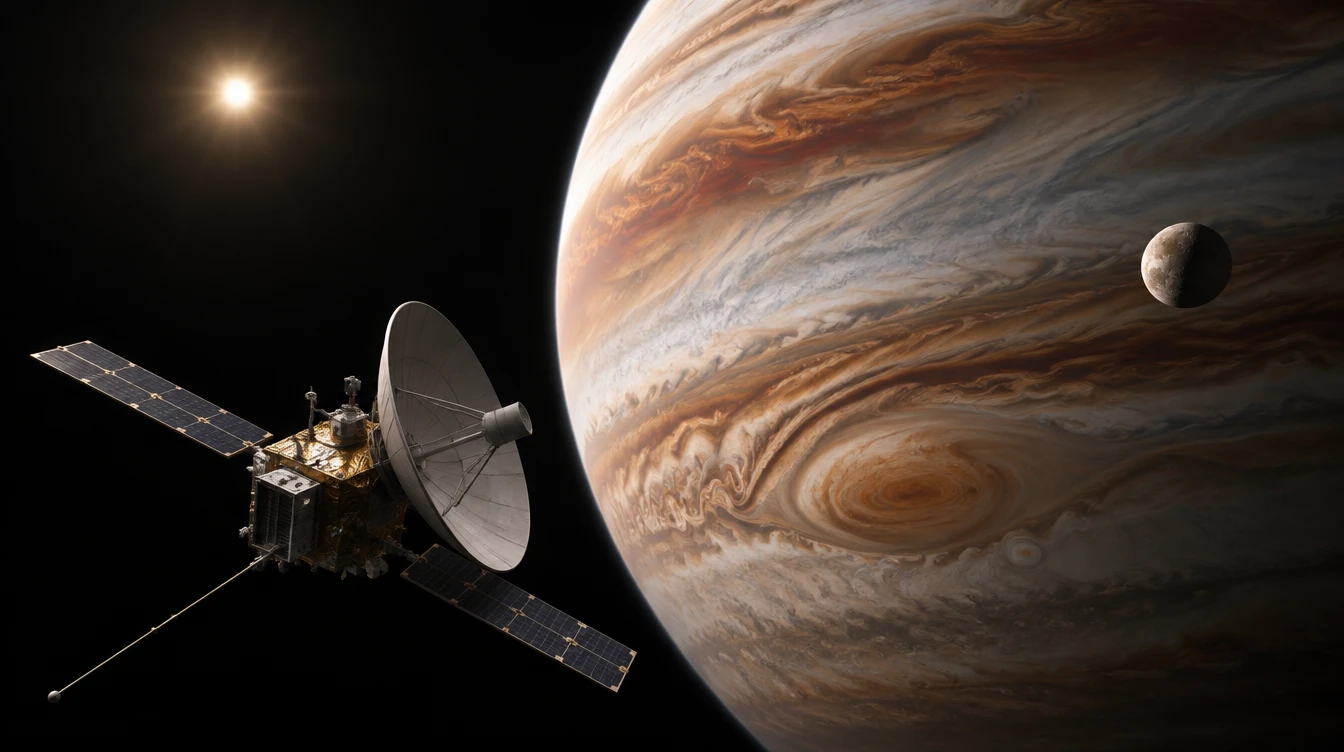
Jupiter is the closest of the giant planets, close enough that Galileo spotted its four biggest moons with one of the first telescopes. But “close” in the outer solar system still means hundreds of millions of kilometers, half an hour or more at the speed of light, and years of spaceflight. Every spacecraft that has reached it, from Pioneer 10 to Juno, has been a lesson in patience.
About the Author
Author: King | Founder of Dark Cosmic Insights
King is the founder of Dark Cosmic Insights, a science storytelling platform exploring the strangest true stories hiding in space, science and AI. He digs into NASA, ESA and peer-reviewed research, separates what has been measured from what is still a mystery, and turns it into articles, data graphics and Shorts.
Follow the anomaly. Trace the source.