Pluto never changed. On August 24, 2006, a few hundred astronomers in Prague raised yellow cards, and a world counted as a planet for 76 years became something else. Nothing about its ice, moons or orbit was different the next morning. Only the rulebook was.
So why is Pluto not a planet? Because the International Astronomical Union (IAU), the body that names and classifies objects in space, voted that week on its first formal definition of “planet”, and Pluto passes two of its three tests but not the third. The interesting questions are what that third test means, how you measure it, and why some planetary scientists still think the definition is wrong.
Observed, modelled, open. Pluto’s size, mass and orbit are measured. The IAU vote and its wording are documented. How well a body “clears” its orbit is modelled from orbital dynamics. Whether the IAU definition is the right one is open: it’s a debate about definitions, not a measurement.
Quick Answer: Why Is Pluto Not a Planet?
Pluto is not a planet because it fails the third of the IAU’s three criteria. Under Resolution 5A, adopted in Prague on August 24, 2006, a planet must orbit the Sun, be massive enough to pull itself into a nearly round shape, and have “cleared the neighbourhood around its orbit” (IAU, 2006). Pluto passes the first two, but it does not gravitationally dominate its orbital zone, which it shares with many Kuiper Belt objects. Resolution 6A made it a dwarf planet instead (IAU press release iau0603).
What this article can and cannot establish. It can show exactly what the IAU voted on, give the numbers that measure orbit-clearing, and lay out the evidence each side uses. It cannot tell you whether Pluto “really” is a planet, because that depends on which definition you find more useful. A definition is a human choice; we show the choices and the data behind them.
Table of Contents
The DCI Evidence Map: Pluto’s Planet Status
| Question | What we know | Status | Key source |
|---|---|---|---|
| How big is Pluto? | Mean radius 1,188.3 km (diameter ~2,377 km / 1,477 mi) | Measured | JPL SSD |
| How massive is Pluto? | 1.30 × 10²² kg, ~0.22% of Earth, ~1/6 of the Moon | Measured | JPL SSD, NASA |
| Eris vs. Pluto? | Eris slightly smaller (radius 1,163 ± 6 km) but ~27% more massive | Measured | Sicardy et al. 2011, JPL SSD |
| What are the IAU criteria? | Orbits the Sun; nearly round; has cleared its neighbourhood | Documented | IAU, 2006 |
| Has Pluto cleared its orbit? | No: discriminant μ = 0.07, vs. 1.7 × 10⁶ for Earth | Modelled | Soter 2006 |
| Is there a clear planet/non-planet gap? | Yes, four to five orders of magnitude | Modelled | Soter 2006, Margot 2015 |
| How many official dwarf planets? | Five (as of November 2026) | Documented | IAU |
| Is Pluto geologically active? | Young surfaces, glacial flow, global haze | Observed | Stern et al. 2015, Moore et al. 2016 |
| Does Pluto have a subsurface ocean? | Inferred from its ice basin’s position | Modelled | Nimmo et al. 2016 |
| Is the IAU definition the “right” one? | A geophysical definition is proposed instead | Open | Runyon et al. 2017 |
Status key: Observed = seen directly. Measured = a number with stated uncertainty. Documented = an official text. Modelled = calculated, dependent on assumptions. Open = unresolved. Not supported = contradicted by evidence.
Cite this framework: “DCI Evidence Map: Pluto’s Planet Status,” Dark Cosmic Insights, November 2026, darkcosmicinsights.com/why-is-pluto-not-a-planet/.
What Did the IAU Actually Vote On in 2006?
Before 2006, the IAU had never formally defined “planet”. The vote came at the end of its 26th General Assembly in Prague, which the IAU says drew more than 2,500 astronomers (IAU press release iau0603). Members voted on four resolutions in four steps by raising yellow ballot cards (IAU: the final resolution, ready for voting), at 14:00 on Thursday, August 24, 2006 (IAU, 2006).
- Resolution 5A (Definition of Planet): passed by a large majority; no count was taken.
- Resolution 5B (calling the eight “classical planets”): only 91 votes in favour. Failed.
- Resolution 6A (Pluto as a dwarf planet): 237 for, 157 against, 17 abstentions. Passed.
- Resolution 6B (naming the class “plutonian objects”): 183 for, 186 against. Failed.
The 6A tally adds up to 411 recorded votes, a small share of the assembly’s attendance. Critics noted the decision was made by those still in the room on the final day: legitimate under IAU rules, but not a poll of the profession.
What Is the IAU Definition of a Planet?
Resolution 5A sets three tests. A planet:
- Orbits the Sun.
- Is massive enough for its gravity to overcome its material’s rigid strength, pulling it into hydrostatic equilibrium: the nearly round shape a fluid body would take.
- Has “cleared the neighbourhood around its orbit.”
Footnotes name the eight that pass (Mercury, Venus, Earth, Mars, Jupiter, Saturn, Uranus and Neptune), promise an IAU process for borderline objects, and sweep most asteroids, comets and trans-Neptunian objects into a third bin, Small Solar System Bodies (IAU, 2006).
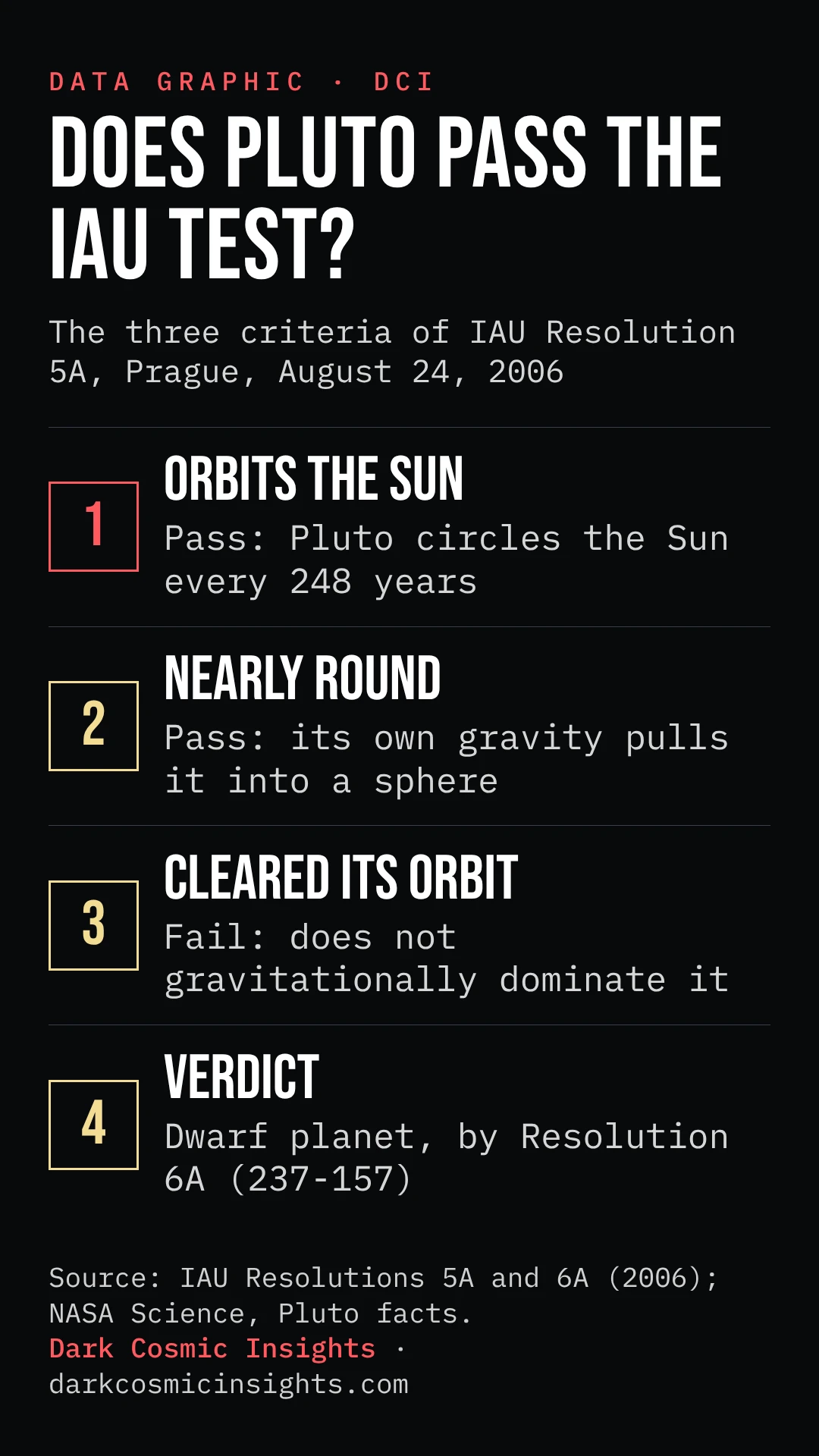
Notice what’s missing: no size limit, and nothing about composition or geology. The definition is mostly about a body’s orbital environment, not the body itself.
What Is a Dwarf Planet?
A dwarf planet orbits the Sun and is massive enough to be nearly round, but has not cleared the neighbourhood around its orbit and is not a satellite (IAU, 2006). It passes criteria one and two and fails three. The “not a satellite” clause keeps big round moons, such as Titan or our Moon, out.
Resolution 6A put Pluto in this class as the “prototype of a new category of trans-Neptunian objects” (IAU press release iau0603). A trans-Neptunian object is anything orbiting the Sun beyond Neptune.
The detail people miss: under the IAU scheme, a dwarf planet is not a kind of planet. A dwarf star is still a star, but a dwarf planet is a separate category.
Why Did Eris Force the Decision?
For decades Pluto was odd but alone. Then it stopped being alone.
In 1992, David Jewitt and Jane Luu found 1992 QB1 with the 2.2-metre telescope on Mauna Kea, the first Kuiper Belt object after Pluto (NASA Science). Others followed, and Pluto began to look like the biggest member of a crowd.
The tipping point was Eris. Mike Brown (Caltech), Chad Trujillo (Gemini Observatory) and David Rabinowitz (Yale) found it on January 5, 2005, in Palomar Observatory images from October 21, 2003 (NASA Science, Eris). First designated 2003 UB313, it looked in early Hubble data to be about as large as Pluto, possibly larger (IAU). If Pluto was a planet, Eris had to be one too. NASA notes that Eris helped prompt the 2006 debate (NASA Science, Eris).
Eris vs. Pluto: who’s bigger?
It depends on whether you mean size or mass.
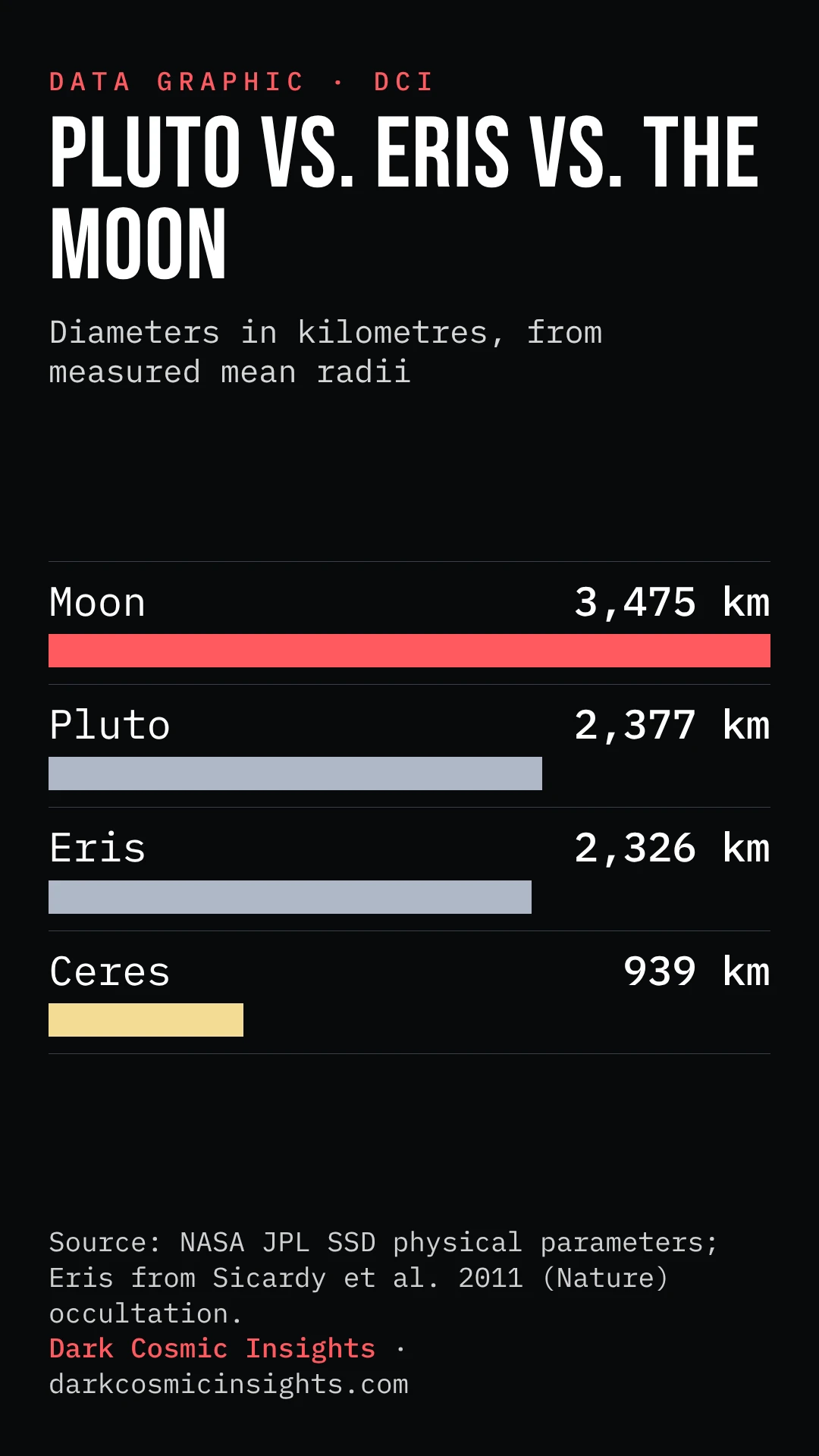
- Size. A stellar occultation (Eris passing in front of a star, timed from several sites) on November 6, 2010 gave a radius of 1,163 ± 6 km, a diameter of about 2,326 km (1,445 mi) (Sicardy et al. 2011, Nature). JPL’s table still shows an older 1,200 ± 50 km from Brown & Schaller (2007) (JPL SSD). Pluto’s radius is 1,188.3 ± 1.6 km (diameter ~2,377 km / 1,477 mi), so on the occultation figure Pluto is slightly larger.
- Mass. JPL lists Eris at 16,600 ± 200 × 10¹⁸ kg and Pluto at 13,024.6 ± 6.0 × 10¹⁸ kg (JPL SSD): Eris is about 1.27 times as massive.
Both are well under Earth’s Moon, mean radius 1,737.4 km (JPL SSD, satellites).
Eris’s mass comes from its moon Dysnomia, which circles it about every 16 days (NASA Science, Eris). The same trick first weighed Pluto.
What Does “Clearing the Neighbourhood” Mean, and How Is It Measured?
The resolution doesn’t attach a number to this criterion, but scientists had already built the tools.
Clearing doesn’t mean an empty orbit. Earth still shares space with near-Earth asteroids, as critics point out (Runyon et al. 2017). It means dominating your zone: everything else nearby is tiny by comparison or controlled by your gravity. Three published measures put a number on it.
1. Soter’s planetary discriminant (μ). Steven Soter posted “What is a planet?” on August 16, 2006, days before the vote; it was published in The Astronomical Journal that year (arXiv; DOI 10.1086/508861). Divide a body’s mass M by m, the combined mass of everything else sharing its orbital zone: μ = M/m (Soter 2006, PDF). Below 1, the body is outweighed by its neighbours.
2. The Stern–Levison parameter (Λ). Proposed in 2002 by Alan Stern and Harold Levison (Highlights of Astronomy 12, 205–213), it measures how effectively a body can scatter smaller objects out of its zone over the age of the solar system. Soter tabulates it beside μ.
3. Margot’s discriminant (Π). In 2015, Jean-Luc Margot of UCLA proposed a test needing only the star’s mass, the body’s mass and its orbital period. It asks whether a body could clear its zone within a set time, such as its star’s main-sequence lifetime; it passes if Π ≥ 1 (Margot 2015).
| Body | μ (Soter) | Λ (Stern–Levison) | Π (Margot) |
|---|---|---|---|
| Earth | 1.7 × 10⁶ | 1.5 × 10⁵ | 8.1 × 10² |
| Mars | 5.1 × 10³ | 9.3 × 10² | 5.4 × 10¹ |
| Neptune | 2.4 × 10⁴ | 2.7 × 10⁵ | n/a here |
| Ceres | 0.33 | 0.0013 | 4.0 × 10⁻² |
| Eris | 0.10 | 0.002 | 2.0 × 10⁻² |
| Pluto | 0.07 | 0.003 | 2.8 × 10⁻² |
Sources: μ and Λ from Soter 2006, Table 1; Π from Margot 2015, Table 1.
Earth outweighs everything else in its zone about 1.7 million to one; Pluto is outweighed. Soter reports a gap of four to five orders of magnitude (a factor of 10,000 to 100,000) between the eight planets and everything else (Soter 2006). Margot says all eight planets pass his test (Margot 2015); Pluto misses by a factor of about 35. It isn’t a slope. It’s a cliff.
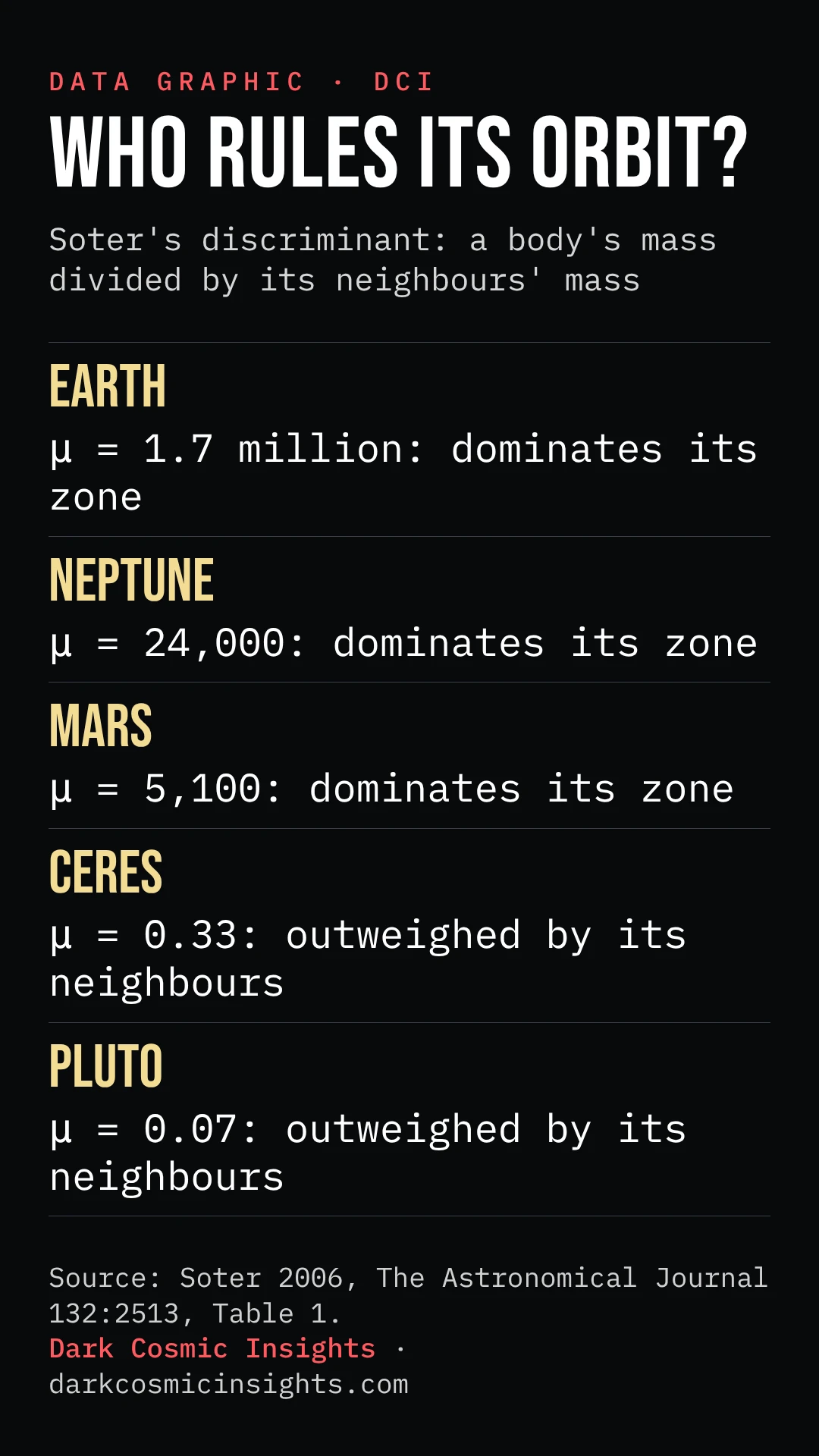
The caveat: these numbers are modelled, relying on estimates of each zone’s mass and width. But three methods built on different assumptions draw the line in the same place, the strongest argument that the split is physically real.
One irony: Alan Stern, co-author of Λ, leads New Horizons and is one of the IAU definition’s best-known critics. He doesn’t dispute that Pluto does not gravitationally dominate its orbital zone; he disputes making that the test.
What Is the Kuiper Belt?
The Kuiper Belt is a doughnut-shaped region of icy bodies beyond Neptune (NASA Science). It starts about 30 AU from the Sun and its main region ends near 50 AU (NASA, Kuiper Belt facts). An astronomical unit (AU) is the average Earth–Sun distance, so that’s roughly 4.5 to 7.5 billion km (2.8 to 4.6 billion miles).
NASA estimates hundreds of thousands of objects there at least 100 km wide, with a combined mass of no more than about 10% of Earth’s. It’s named for Gerard Kuiper, who speculated about it in 1951, and NASA counts Pluto as the first Kuiper Belt object discovered (NASA, Kuiper Belt facts).
Pluto’s orbit runs from 30 to 49.3 AU and takes about 248 years (NASA Science, Pluto facts), travelling through the belt with a crowd.
How Do We Know Pluto’s Size and Mass?
1930: a dot that moved
Clyde Tombaugh at Lowell Observatory in Flagstaff, Arizona, photographed the sky near the star Delta Geminorum on January 23 and 29, 1930, then compared the plates on a blink comparator, a device that flips between two images so anything that moved appears to jump (The Planetary Society). On February 18, 1930, he spotted a point that had shifted about 3 mm over six days, and reportedly told director V. M. Slipher, “I have found your Planet X” (The Planetary Society). Lowell Observatory announced the discovery on March 13, 1930 (Lowell Observatory archives); the name came from Venetia Burney, 11, of Oxford (NASA Science, Pluto facts).
“Planet X” was meant to explain irregularities in the orbits of Uranus and Neptune, so Pluto was assumed to be massive, even a “fifth terrestrial planet” (OpenStax Astronomy, via LibreTexts).
1978: Charon gives Pluto a weight
At the U.S. Naval Observatory, James Christy noticed that some images of Pluto on plates from the 1.55-metre (61-inch) reflector at USNO’s Flagstaff Station were elongated while the stars were round, and the bulge moved. It was a moon, announced in IAU Circular 3241 on July 7, 1978 (NASA Science, Charon discovery image). NASA dates the discovery to June 22, 1978 (NASA Science, Pluto moons).
A moon is a scale: its orbital period and distance give the pair’s mass through Newton’s gravity. Charon let astronomers measure Pluto’s mass directly for the first time, and it proved “far too small to account for discrepancies” in Uranus and Neptune’s orbits (NASA, Pluto lithograph). Planet X, as Pluto, evaporated.
Today JPL lists Pluto at 1.30 × 10²² kg (JPL SSD): about 0.22% of Earth’s mass (our arithmetic from JPL’s Earth value) and about one-sixth of the Moon’s (NASA). Charon, mean radius 606.0 km (JPL SSD, satellites), is the largest known moon relative to its parent body (NASA Science, Pluto moons). Our guide to which planet has the most moons puts Pluto’s five moons in context, and the orbit-then-weigh logic runs through how astronomers measure stars.
Is Pluto a Planet? The Scientific Debate That Never Ended
Under the IAU, no. Among planetary geologists, it’s an argument. Both positions are held by working scientists, so this section is labelled Open.
The geophysical definition
In 2017, Kirby Runyon, Alan Stern and colleagues proposed a geophysical planet definition at the Lunar and Planetary Science Conference: any sub-stellar body that has never undergone fusion and is massive enough to be round, “regardless of its orbital parameters” (Runyon et al. 2017). It judges what a body is, not where it is. By their count it gives about 110 known planets in our solar system, including Pluto, Ceres, Charon and the Moon.
Their objections to the IAU version:
- It covers only bodies orbiting the Sun, leaving out exoplanets and rogue planets.
- No planet fully clears its zone; near-Earth objects keep arriving.
- Clearing gets harder with distance, so an Earth-sized body in the Kuiper Belt could fail.
The history argument
A 2022 Icarus paper by Philip Metzger and colleagues argues that Copernican-era scientists counted moons as planets, and that classifying by what a body orbits is a “folk concept” adopted around 1910 to 1955 (Metzger et al.; DOI 10.1016/j.icarus.2021.114768).
The case for the IAU line
Supporters point to the μ, Λ and Π cliff. A definition, they argue, should mark the biggest physical divide in the system. Soter frames planets as end products of disk accretion, the build-up of bodies in the disk around a young star, and dominance as their signature (Soter 2006).
Where that leaves us
Nobody disputes Pluto’s mass, size or orbit. The disagreement is over which property earns the word: dynamical dominance or geophysical roundness. Evidence can inform that choice but can’t settle it.
What Did New Horizons Reveal About Pluto?
NASA’s New Horizons, launched January 19, 2006, seven months before the Prague vote, made its closest approach on July 14, 2015, passing about 12,500 km (7,750 miles) from Pluto (JHUAPL, New Horizons mission timeline; NASA, 2015) (NASA Science, New Horizons). It left for a planet and arrived at a dwarf planet, which turned out to be anything but a dead ice ball.
- Young, active ground. The team’s first results describe a water-ice crust, geologically young surfaces, convection in surface ice, wind streaks and glacial flow (Stern et al. 2015, Science; DOI 10.1126/science.aad1815).
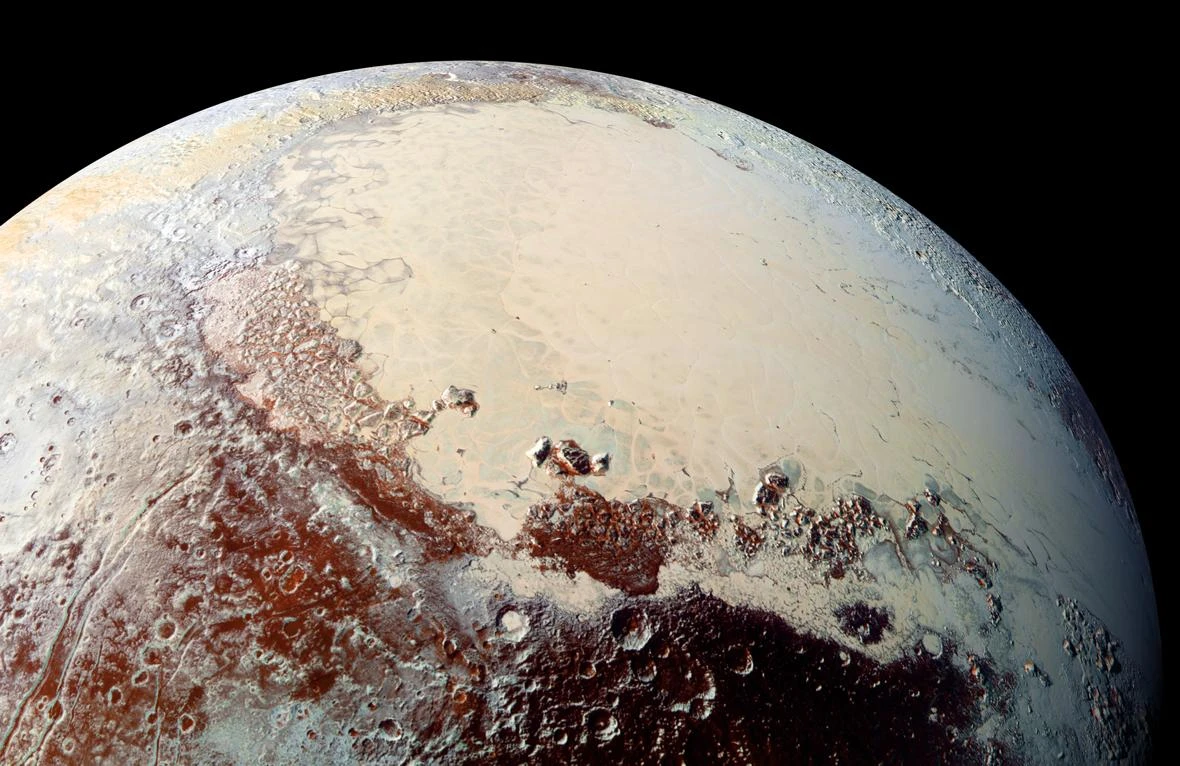
- A fresh ice basin. Activity centres on a vast basin of volatile ices, Sputnik Planitia, the heart-shaped glacier (NASA Science, August 5, 2026). Its crater retention age is no more than about 10 million years. Around it, water-ice blocks drift, and tall mounds may be cryovolcanic (built by icy eruptions). Elsewhere, cratered terrain is up to about 4 billion years old (Moore et al. 2016, Science; DOI 10.1126/science.aad7055).
- Mountains. Peaks 2 to 3 km (6,500 to 9,800 ft) tall and troughs up to 600 km (370 mi) long (NASA Science, Pluto facts).
- A hazy sky. An extended atmosphere with trace hydrocarbons, a global haze layer and surface pressure near 10 microbars, roughly one hundred-thousandth of Earth’s (Stern et al. 2015).
- A possible ocean (Modelled). Sputnik Planitia’s position is best explained if it formed by impact and Pluto has a subsurface ocean (Nimmo et al. 2016, Nature; DOI 10.1038/nature20148). Nobody has seen it.
- Possible recent liquid (Open). A Stern-led study in the Planetary Science Journal (July 31, 2026) reports dark features on the glacier’s northern edge, “most likely liquid nitrogen” from melting at its base (NASA Science). The authors say the features may only be wetted from time to time; it awaits independent testing.
For the geophysical camp, this is Exhibit A. For the IAU camp, it’s irrelevant: the definition was never about geology. (The images are real spacecraft data, though colour views are processed; see Are Space Photos Real?.)
How Many Dwarf Planets Are There?
Officially, five. As of November 2026, the IAU recognises Ceres, Pluto, Haumea, Makemake and Eris, and notes more may be added as bodies are discovered (IAU).
| Dwarf planet | Mean radius | Source |
|---|---|---|
| Ceres | 469.7 km | JPL SSD |
| Pluto | 1,188.3 km | JPL SSD |
| Haumea | 715 km | JPL SSD |
| Makemake | 714 ± 7 km | JPL SSD |
| Eris | 1,163 ± 6 km | Sicardy et al. 2011 |
Ceres, found by Giuseppe Piazzi in 1801 and long treated as an asteroid, is the only one in the asteroid belt; NASA’s Dawn became the first spacecraft to orbit a dwarf planet there on March 6, 2015 (NASA Science, Ceres).
Why only five? Confirming that a faint, distant dot is round is hard, so the official list moves slowly. Unofficial candidate lists exist, but they aren’t an official count.
Myth vs. Fact: Pluto Edition
| Myth | Fact |
|---|---|
| “Pluto was demoted for being too small.” | There’s no size rule. It failed the orbit-clearing test. |
| “All astronomers voted.” | 411 votes were recorded on Resolution 6A. |
| “A dwarf planet is a small planet.” | Not in IAU wording. It’s a separate category. |
| “Eris is bigger than Pluto.” | Eris is more massive; Pluto is slightly wider. |
| “Earth’s orbit is completely clear.” | No planet’s is. Earth dominates its zone; it doesn’t empty it. |
Is “Dwarf Planet” a Demotion?
The 2006 headlines said so. But before 2006, Pluto was a misfit ninth planet; after it, Pluto became the prototype of a class of worlds. Nine years later, New Horizons showed it had glaciers, young terrain and haze.
Interest followed the data, not the label. Titan is no planet under IAU rules, yet NASA is sending a rotorcraft there (NASA’s Dragonfly mission to Titan). “Dwarf planet” changed Pluto’s box, not what it is.
Will Pluto Be a Planet Again?
Not under the current definition, and as of November 2026 we found no announced IAU plan to revisit it.
The definition was adopted by a General Assembly vote, so a formal change would most plausibly come the same way. The next assembly is August 10–19, 2027, in Rome; its page doesn’t mention the planet definition (IAU). The 2030 assembly is planned for Santiago de Chile (IAU).
The IAU governs official classification, not everyday speech. So “Is Pluto a planet?” has two honest answers: no, by the IAU’s dynamical definition; yes, by the geophysical one.
How Can You See Pluto Yourself?
Finding Pluto is a re-run of Tombaugh’s method.
- Know its brightness. Pluto peaked at magnitude 13.8 in 1989 and has faded since, to about 14.4 at its July 25, 2025 opposition (Astronomy magazine). Bigger magnitudes are fainter; 14 is far beyond naked-eye range.
- Bring aperture. “A standard 8-inch telescope just won’t do the trick,” says Astronomy magazine; an 11-inch can work, larger is better, and a dark, steady, moonless night helps.
- Be your own blink comparator. Sketch the field at Pluto’s predicted position, then again three or four nights later. Pluto moves about 4 arcseconds a day; the dot that moved is Pluto.
- Time it. Aim for within a month of opposition, when Pluto sits opposite the Sun in our sky.
- No telescope? Explore more worlds in our Planets & Moons section.
What Comes Next for Pluto?
- New Horizons is still working. On June 23, 2026, it woke from a record 321-day hibernation in good health, about 9.5 billion km (5.9 billion miles) from Earth; its signals took 8 hours 52 minutes to arrive (NASA Science, July 7, 2026). It now studies the outer heliosphere, the solar wind’s bubble around the solar system.
- New survey alerts. The Vera C. Rubin Observatory, online since June 2025, issues alerts on changes in the sky, including small objects on the move (EarthSky), the kind of data that finds new dwarf planet candidates.
- The next IAU General Assembly: August 10–19, 2027, Rome.
We found no approved mission to return to Pluto as of November 2026, so the 2015 flyby remains our only close-up look.
Pluto by the Numbers
- 2,377 km (1,477 mi): Pluto’s diameter, from JPL’s mean radius of 1,188.3 km (JPL SSD)
- 1.30 × 10²² kg: Pluto’s mass, about 0.22% of Earth’s (JPL SSD)
- ~1.27×: how much more massive Eris is than Pluto (JPL SSD)
- 5.9 billion km (3.7 billion mi), 39 AU: Pluto’s average distance from the Sun (NASA)
- 248 years: one Pluto orbit (NASA)
- −232°C (about 41 K, −387°F): Pluto’s average temperature; NASA’s surface range is −226 to −240°C (about 47 to 33 K, −375 to −400°F) (NASA)
- 0.07: Pluto’s discriminant μ, against Earth’s 1.7 million (Soter 2006)
- 237–157–17: the Resolution 6A vote (IAU)
- 12,500 km (7,750 mi): New Horizons’ closest approach, July 14, 2015 (JHUAPL; NASA)
- 5: official dwarf planets, as of November 2026 (IAU)

Pluto: FAQ
Why is Pluto not a planet anymore?
Pluto fails the third of the IAU’s three planet criteria: it hasn’t cleared the neighbourhood around its orbit. It orbits the Sun and is round, but it does not gravitationally dominate its orbital zone, which it shares with many Kuiper Belt objects. In 2006, the IAU classed it as a dwarf planet instead.
Is Pluto a planet?
Under the IAU’s official 2006 definition, no: Pluto is a dwarf planet. Under the geophysical definition favoured by some planetary scientists, which counts any round body that has never undergone fusion, yes. Both are in use, and the debate is ongoing.
What exactly is a dwarf planet?
A dwarf planet orbits the Sun and is massive enough to be nearly round, but has not cleared its orbital neighbourhood and is not a moon. In IAU wording it’s a separate category, not a kind of planet. Pluto is its prototype.
When was Pluto reclassified?
The IAU voted on August 24, 2006, at its General Assembly in Prague. Resolution 6A, which made Pluto a dwarf planet, passed with 237 votes for, 157 against and 17 abstentions.
How many dwarf planets are there today?
The IAU officially recognises five as of November 2026: Ceres, Pluto, Haumea, Makemake and Eris. More may qualify, but confirming a distant body’s shape is difficult, so the list grows slowly.
What exactly is the Kuiper Belt?
The Kuiper Belt is a doughnut-shaped region of icy bodies beyond Neptune, about 30 to 50 AU from the Sun. NASA estimates it holds hundreds of thousands of objects at least 100 km wide. Pluto was the first one found, in 1930.
Is Eris bigger than Pluto?
Not in diameter: a 2010 occultation measured Eris’s radius at 1,163 km, slightly smaller than Pluto’s 1,188 km. But Eris is about 27% more massive. Its 2005 discovery was the main trigger for the IAU’s 2006 decision.
Will Pluto ever be a planet again?
Not unless the IAU changes its definition, and as of November 2026 no such proposal has been announced. A change would most likely need a General Assembly vote; the next is in Rome, August 10–19, 2027.
Your next step: next time someone says Pluto “got kicked out for being too small”, ask which criterion it failed, then show them the μ numbers: Earth at 1.7 million, Pluto at 0.07.
Sources and Further Reading
- International Astronomical Union (August 24, 2006), The Final IAU Resolution on the definition of “planet” ready for voting. Text of Resolutions 5A and 6A and footnotes.
- International Astronomical Union (August 24, 2006), Press release iau0603: Result of the IAU Resolution votes (archived copy of iau.org). Vote counts for 5A, 5B, 6A, 6B.
- International Astronomical Union (August 24, 2006), Press release iau0602. Voting procedure.
- International Astronomical Union, Pluto and the Developing Landscape of Our Solar System. The five recognised dwarf planets; Eris’s mass.
- International Astronomical Union, XXXIII General Assembly 2027 and General Assemblies.
- Soter, S. (2006). “What is a planet?” The Astronomical Journal, 132, 2513–2519. DOI: 10.1086/508861. arXiv:astro-ph/0608359. Source of μ and tabulated Λ values.
- Stern, S. A. & Levison, H. F. (2002). “Regarding the criteria for planethood and proposed planetary classification schemes.” Highlights of Astronomy, 12, 205–213. DOI: 10.1017/S1539299600013289. Λ values cited here as tabulated in Soter (2006).
- Margot, J.-L. (2015). “A Quantitative Criterion for Defining Planets.” arXiv:1507.06300. Π values.
- Runyon, K. D., Stern, S. A., Lauer, T. R., Grundy, W., Summers, M. E. & Singer, K. N. (2017). “A Geophysical Planet Definition.” 48th Lunar and Planetary Science Conference, abstract 1448. PDF.
- Metzger, P. T., Grundy, W. M., Sykes, M. V., Stern, S. A., Bell, J. F., Detelich, C. E., Runyon, K. D. & Summers, M. (2022). “Moons Are Planets: Scientific Usefulness Versus Cultural Teleology in the Taxonomy of Planetary Science.” Icarus. DOI: 10.1016/j.icarus.2021.114768. arXiv:2110.15285.
- Sicardy, B., Ortiz, J. L., Assafin, M., et al. (2011). “A Pluto-like radius and a high albedo for the dwarf planet Eris from an occultation.” Nature, 478, 493–496. DOI: 10.1038/nature10550. Abstract via IAC.
- Stern, S. A., Bagenal, F., Ennico, K., Gladstone, G. R., Grundy, W. M., et al. (2015). “The Pluto system: Initial results from its exploration by New Horizons.” Science. DOI: 10.1126/science.aad1815. arXiv:1510.07704.
- Moore, J. M., McKinnon, W. B., Spencer, J. R., et al. (2016). “The geology of Pluto and Charon through the eyes of New Horizons.” Science. DOI: 10.1126/science.aad7055. arXiv:1604.05702.
- Nimmo, F., Hamilton, D. P., McKinnon, W. B., et al. (2016). “Reorientation of Sputnik Planitia implies a subsurface ocean on Pluto.” Nature, 540, 94–96. DOI: 10.1038/nature20148.
- NASA JPL Solar System Dynamics, Planetary Physical Parameters (dwarf planet table) and Planetary Satellite Physical Parameters. Checked November 7, 2026.
- NASA Science, Pluto (updated October 15, 2026), Pluto Facts, Pluto Moons, Eris (updated October 26, 2026), Ceres.
- NASA Science, Kuiper Belt, Kuiper Belt Facts, 1992 QB1.
- NASA Science, New Horizons (updated May 11, 2026); New Horizons wakes from hibernation (July 7, 2026); Evidence of recent liquid on Pluto’s surface (August 5, 2026).
- JHU Applied Physics Laboratory, New Horizons Mission Timeline. Closest approach about 12,500 km (7,750 miles); NASA (2015), NASA’s Three-Billion-Mile Journey to Pluto Reaches Historic Encounter (“about 7,750 miles above the surface”).
- NASA Science, Charon discovery image; NASA, Pluto lithograph.
- Alexander, A. (2005). The Discovery of Pluto. The Planetary Society.
- OpenStax Astronomy, Pluto and Charon, via LibreTexts.
- Astronomy magazine (December 2024), Can you view Pluto in a backyard telescope?
- EarthSky, More moons for Jupiter and Saturn. On Vera C. Rubin Observatory alerts.
Explore Next
- Pluto’s five moons in context: Which Planet Has the Most Moons?
- A “non-planet” that acts like one: NASA’s Dragonfly Mission to Titan
- How to read the New Horizons images: Are Space Photos Real?
- How a measurement is earned: How Astronomers Measure Stars
- More from the planets: Planets & Moons
- Start anywhere: Explore Dark Cosmic Insights
- Why Venus beats Mercury: What Is the Hottest Planet?
- The three temperatures of space: How Cold Is Space?
- How birth mass shapes a star’s ending: Life Cycle of a Star
How This Explainer Was Checked
Every number in this article was checked on November 7, 2026 against the source linked beside it: the IAU’s 2006 resolution text and press releases, NASA JPL’s physical-parameter tables, NASA Science pages, and peer-reviewed papers (read via arXiv versions or publisher abstracts, with DOIs given). Vote counts are the IAU’s own. Discriminant values (μ, Λ, Π) are quoted exactly from Soter (2006) and Margot (2015); the Stern–Levison Λ values are as tabulated by Soter. Where sources disagree, such as Eris’s radius, we show both and explain the difference. On the vote date, NASA’s Eris page gives August 26, 2006; we use the IAU’s own date, August 24. For New Horizons’ closest approach, NASA’s mission page gives 7,800 km (4,800 miles); we use the 12,500 km (7,750 miles) given by JHUAPL’s mission timeline and NASA’s 2015 encounter release. Conversions to miles, kelvin and Fahrenheit, and the 0.22% and 411-vote figures, are DCI’s own arithmetic from the cited numbers. The debate over Pluto’s status is labelled Open, and both sides’ arguments are presented in their own terms. Images are labelled: real spacecraft or telescope images as OBSERVATION, illustrations as ILLUSTRATION, and our charts as DATA GRAPHIC. Nothing AI-generated is presented as a real image.
Final Thought: Pluto Didn’t Change. We Did.
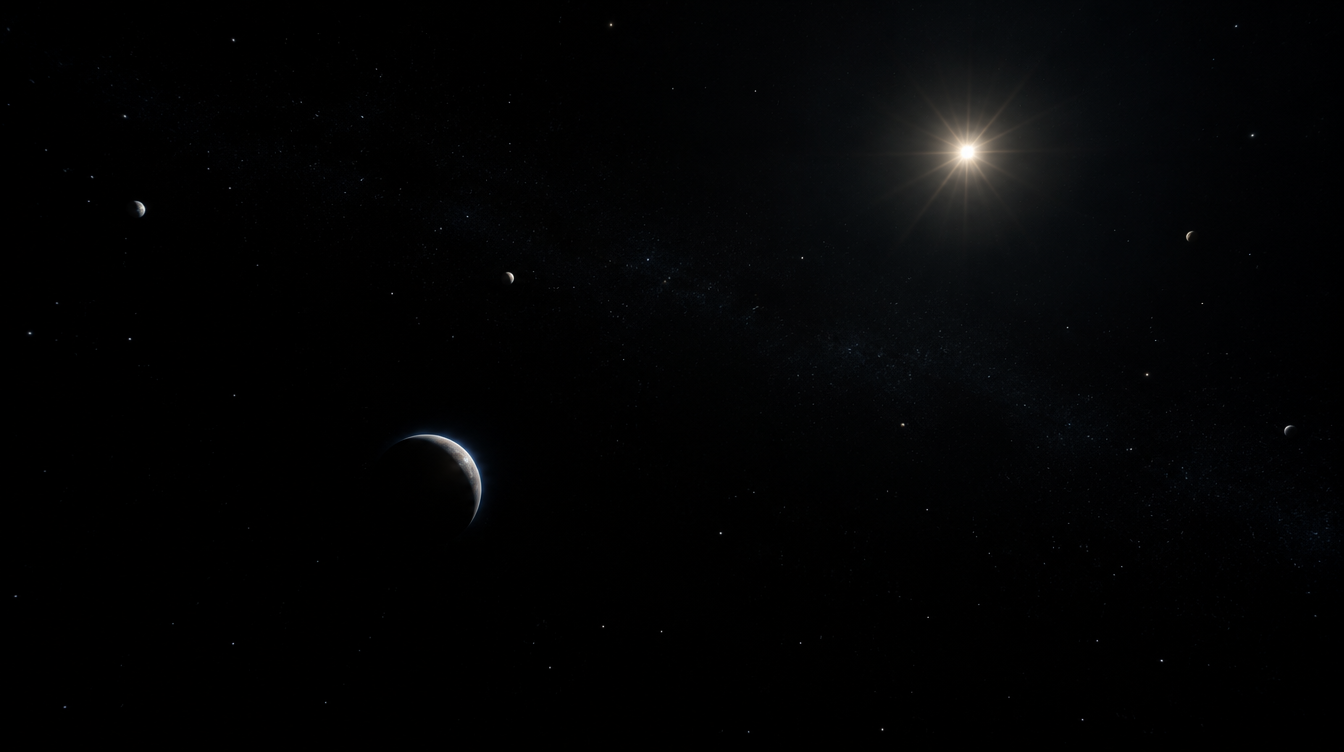
Pluto is the same world Clyde Tombaugh caught jumping between two photographic plates in 1930. What changed is how much we know: that it’s light, not heavy; that it has neighbours, not empty space; that it has glaciers and haze, not just ice. The 2006 vote was an attempt to sort a solar system more crowded than anyone expected. Call Pluto a dwarf planet or a planet, but don’t call it a demotion. It’s the first chapter of a new census, and we’ve barely started counting.
About the Author
Author: King | Founder of Dark Cosmic Insights
King is the founder of Dark Cosmic Insights, a science storytelling platform exploring the strangest true stories hiding in space, science and AI. He digs into NASA, ESA and peer-reviewed research, separates what has been measured from what is still a mystery, and turns it into articles, data graphics and Shorts.
Follow the anomaly. Trace the source.