Here’s a strange true fact: some of the emptiest places in the universe are also among the hottest. The thin gas of the Sun’s outer atmosphere reaches up to 2 million °C. Yet a spacecraft can fly through it, while spacewalk conditions in Earth orbit can be as cold as −250 °F.
So how cold is space, really? The honest answer is that “the temperature of space” means three different things, and most of the confusion online comes from mixing them up. This guide separates them, gives the numbers with their sources, and shows how scientists measured each one.
What’s observed, modelled and open. The temperature of the cosmic microwave background, the Boomerang Nebula’s 1 K gas and the swings on the Moon’s surface are measured. The temperatures of spacecraft parts are partly modelled by engineers and then checked in flight. Why the Sun’s corona is so hot is still open.
Quick Answer: How Cold Is Space?
How cold is space? The faint glow that fills the universe, the cosmic microwave background (CMB), the afterglow of the Big Bang, has a temperature of about 2.7 kelvin (−270.4 °C, −454.8 °F). An object only approaches that temperature under specific equilibrium conditions: no starlight or other heating reaching it, no internal heat source, and enough time to settle into radiative balance with that glow. Being far from a star isn’t enough on its own. The best measurement is 2.72548 ± 0.00057 K (Fixsen 2009, arXiv). But space isn’t one temperature. The thin gas in it can be millions of degrees, and an object’s own temperature depends on sunlight: in Earth orbit, spacewalk conditions run from about −250 °F to 250 °F (NASA).
What this article can and cannot establish. It can explain the three meanings of “the temperature of space,” give sourced numbers for each, and show how they were measured. It cannot give one number for “the temperature of space,” because there isn’t one. It also can’t tell you how long an unprotected person would take to cool, because there are no controlled measurements of it, and the danger of a vacuum comes from lack of air and pressure long before cold matters.
Table of Contents
The DCI Evidence Map: The Temperature of Space
As always at DCI, measured, modelled and open are kept apart.
| Question | What we know | Status | Key source |
|---|---|---|---|
| What is the temperature of the Big Bang’s afterglow? | 2.72548 ± 0.00057 K, from combined measurements | Measured | Fixsen 2009 |
| Is the CMB a near-perfect blackbody? | Yes; this won the 2006 Nobel Prize in Physics | Measured | NASA Goddard, COBE |
| Is anything natural colder than the CMB? | The Boomerang Nebula’s outflow, at about 1 K | Measured | ALMA Observatory |
| Can near-empty space be millions of degrees? | Yes: the solar corona and hot intergalactic gas | Measured | NASA Sun facts |
| Why is the corona hotter than the Sun’s surface? | Not fully understood | Open | NASA SVS, Parker Solar Probe |
| How much does sunlight change a surface’s temperature? | Moon: about 400 K by day, 140 K at night | Measured | NASA LRO Diviner |
| How cold are Webb’s sunshield layers and instruments? | Telescope below 50 K; coldest layer modelled at 36 K | Modelled and Measured | NASA Webb |
| Would a person freeze instantly in space? | No; a vacuum carries heat away slowly | Not supported | NASA SmallSat Institute |
| Is space colder than the coldest lab? | No; Cold Atom Lab reached 100 nanokelvin | Measured | NASA |
Status key: Observed = seen directly. Measured = a number with an uncertainty, from instruments. Modelled = calculated from physics and engineering, then checked where possible. Open = not yet explained. Not supported = a popular claim the evidence doesn’t back.
Cite this framework: Dark Cosmic Insights, “How Cold Is Space? The Three Temperatures of Space, Explained,” DCI Evidence Map, November 2026.
What Is a Kelvin, and What Is Absolute Zero?
Astronomers measure temperature in the kelvin (K), the SI unit of thermodynamic temperature. The US National Institute of Standards and Technology defines it by fixing a constant of nature, the Boltzmann constant, which links the energy in a substance to its temperature (NIST).
The kelvin scale starts at absolute zero, the lowest temperature possible. On the Celsius scale that is 0 K = −273.15 °C, which is −459.67 °F (our conversion) (NIST). One kelvin step is the same size as one Celsius degree, so converting is easy: add 273.15 to a Celsius number to get kelvin.
What does temperature actually measure? NIST describes it as how much average energy of motion (kinetic energy) an object’s atoms and molecules have. Hotter means the particles are jiggling and flying faster. Even at absolute zero, quantum theory says a little “zero-point motion” remains (NIST).
Keep that in mind: temperature is about how fast particles move, not how many there are.
What Is the Temperature of Space? Three Different Answers
When someone asks for the temperature of space, they could mean any of these:
- The temperature of the near-vacuum itself. Space isn’t perfectly empty. It holds a thin scatter of atoms, ions and electrons. Their temperature is about how fast they move, and it can be extremely hot.
- The temperature of the background radiation. The whole sky glows faintly with microwaves left over from the Big Bang. That glow has a temperature of about 2.7 K. It acts as a floor only for an object in equilibrium with it: no starlight or other heating, no internal heat, and enough time to settle.
- The temperature of an object in space. A rock, a spacecraft or an astronaut has its own temperature, set by how much sunlight hits it, how far it is from a star, how reflective it is, and how well it radiates heat away.

They can differ wildly in one place. Near the Sun, the thin gas of the corona is millions of degrees, the background glow is still 2.7 K, and Parker Solar Probe’s heat shield sits near 1,400 °C while the spacecraft body behind it stays near 30 °C.
How Can Empty Space Be Millions of Degrees?
Start with the Sun. Its visible surface, the photosphere, is about 5,500 °C (10,000 °F). Its outer atmosphere, the corona, reaches up to 2 million °C (3.5 million °F) (NASA Science, Sun facts). NASA’s Scientific Visualization Studio puts it as “several million degrees F” and says the reason for that heating isn’t fully understood (NASA SVS).
Hot gas, little heat transfer: temperature vs. heat
NASA’s Parker Solar Probe flies through that corona. NASA says it travels through material hotter than a million degrees Fahrenheit, yet doesn’t melt (NASA, July 19, 2018). The reason is the difference between temperature and heat. Temperature tells you how fast particles move. Heat, in NASA’s words, measures “the total amount of energy that they transfer.”
In the corona, the particles are fast but very sparse, so few of them hit the spacecraft. They hand over little energy. What actually heats Parker is sunlight: the sun-facing side of its shield reaches about 2,500 °F (about 1,400 °C), while the spacecraft body behind it stays near 85 °F (30 °C) (NASA).
Think of a hot oven versus boiling water: you can wave a hand through the hotter oven air, because thin air delivers far less heat than dense water.
Between the galaxies
The same thing happens on cosmic scales. Much of the ordinary matter between galaxies is thought to sit in the warm-hot intergalactic medium (WHIM), a very thin gas. Predictions put it at “a few hundred thousand to a million degrees Celsius,” and NASA’s Chandra X-ray Observatory found clouds at about 1 million °C, with extremely low density (Chandra X-ray Center, February 2, 2005).
Measured by its particles, a lot of “empty” space is hot. You’d never feel it: there’s too little of it.
What Is the Cosmic Microwave Background Temperature?
The cosmic microwave background is light released about 380,000 years after the Big Bang, when the universe cooled enough for light to travel freely (ESA, Planck and the CMB). As the universe expanded, that light was stretched into microwaves that now fill the sky.
D. J. Fixsen’s 2009 review of the measurements gives 2.72548 ± 0.00057 K; the COBE FIRAS data alone, recalibrated using WMAP, give 2.7260 ± 0.0013 K (Fixsen 2009, arXiv:0911.1955; DOI 10.1088/0004-637X/707/2/916).
You’ll see it written differently: 2.726, 2.73 or 2.7 K on ESA’s Planck page, about 3 K in a NASA Cold Atom Lab article and about 2.8 K in the ALMA Boomerang release (each sourced in this article). The same background, described at different levels of approximation.
When does the CMB set the floor?
Picture a rock drifting between galaxies. Distance from a star alone doesn’t make it 2.7 K. It gets there only if no starlight or other radiation is heating it, it has no internal heat source, and it has had enough time to radiate its stored heat away. Then only the faint glow warms it, and it radiates until what it emits balances what it absorbs. That balance point is about 2.7 K.
So “space is about 2.7 K” is a fair short answer only in that narrow sense: it’s where an isolated object in equilibrium with the background glow settles, not the temperature of the gas around it or of most objects in space.
Is the CMB the same everywhere?
Almost. COBE found that the glow varies by only about 1 part in 100,000 across the sky (ESA). In the standard cosmological model (a model, not a direct observation), those ripples grew into today’s galaxies.
How Do We Know Space Is 2.7 K? COBE, WMAP and Planck
This is the “how we know” part: each generation of instruments got colder and more sensitive.

COBE (launched 1989): the blackbody
NASA’s Cosmic Background Explorer (COBE) launched on November 18, 1989, from Vandenberg Air Force Base, California (NASA Goddard). Its FIRAS instrument was built to compare the CMB’s spectrum with a precise blackbody, the idealised glow of an object at one temperature. The match was so close that John Mather and George Smoot shared the 2006 Nobel Prize in Physics for the discovery of the CMB’s “blackbody form and anisotropy” (NASA Goddard).
That blackbody shape is the key evidence: the whole sky’s microwave glow has one temperature, as a hot, dense early universe that later expanded predicts.
WMAP (2001 to 2010): the full-sky map
NASA’s Wilkinson Microwave Anisotropy Probe (WMAP) launched on June 30, 2001, and ceased operations on August 19, 2010 (NASA Science, WMAP). It measured temperature differences across the whole sky in the CMB, turning COBE’s blurry ripples into a detailed map.
Planck (2009 to 2013): the coldest detectors in space
ESA’s Planck launched on 14 May 2009 and orbited the Sun-Earth L2 point, about 1.5 million km (930,000 miles) from Earth (ESA Denmark). To see ripples of “a few millionths of a degree” (ESA), its High Frequency Instrument detectors were cooled to 0.1 K (−273.05 °C), making them, at the time, the coldest known objects in space (ESA Denmark). Planck was switched off on 23 October 2013 (ESA, Planck).
Notice the pattern. Cooling a detector reduces its own noise, so a faint signal isn’t drowned out by the instrument’s warmth. That doesn’t mean a detector must be colder than what it measures: instruments use different methods. COBE’s FIRAS compared the sky’s spectrum with a precise blackbody, while Planck chilled its detectors to 0.1 K to pick out tiny ripples. The same logic underpins our explainer on how astronomers measure stars: a temperature is only as good as the instrument that earns it.
How Hot Is Space in Sunlight?
Now the third meaning, the temperature of an object. Here sunlight is everything.
Spacewalks and the space station
NASA says that during spacewalks in Earth orbit, conditions “can be as cold as minus 250 degrees Fahrenheit,” and in sunlight as hot as 250 degrees (NASA Knows, What Is a Spacesuit?). In other units that’s about −157 °C (116 K) to 121 °C (394 K), our conversion. A second NASA page gives the same range and notes that the suit’s white outer layer reflects sunlight (NASA, Spacewalk Spacesuit Basics).
The space station handles this with a giant plumbing system. Ammonia loops carry waste heat outside to radiator wings, each panel 23.3 m by 3.4 m (76.4 ft by 11.2 ft). In sunlight the radiators are turned “edge to the sun”; in Earth’s shadow they face Earth, so the ammonia doesn’t freeze at −77 °C (−107 °F) (NASA, ISS Active Thermal Control System overview).
The Moon: one world, two extremes
With no air to spread heat around, the Moon shows sunlight’s effect starkly. NASA’s Diviner instrument on the Lunar Reconnaissance Orbiter measured near-equator temperatures of about 120 °C (250 °F, 400 K) by day and −130 °C (−208 °F, 140 K) at night (NASA LRO).
In permanently shadowed craters it gets far colder. Diviner measured about −250 °C (−410 °F, 25 K) on the floor of Hermite Crater, which NASA’s 2014 summary called the coldest temperature measured anywhere in the solar system (NASA LRO). Our Moon is changing in other ways too: see why the Moon is shrinking.
Distance from the Sun
Move farther out and sunlight weakens. NASA’s planetary fact sheet lists Earth’s mean temperature as 15 °C (59 °F, 288 K) at 149.6 million km (93.0 million miles) from the Sun, and Pluto’s as −225 °C (48 K) at 5,906.4 million km (3,670 million miles) (NASA NSSDC). New Horizons’ mission team gives Pluto’s surface as about −233 °C (−387 °F, 40 K) (New Horizons, JHUAPL). We show Pluto as 40 to 48 K, because the two sources differ.
How Does Heat Move in Space?
On Earth, heat moves three ways. In space, one disappears.

Conduction: heat through touch
Conduction is heat flowing through direct contact, like a pan handle warming up. In space it still works inside a spacecraft. NASA’s Small Spacecraft Technology guide says heat inside a sealed small satellite moves mostly by conduction, and engineers use thermal straps to move heat between parts (NASA SmallSat Institute). But there’s nothing outside to touch.
Convection: heat carried by air or water
Convection is heat carried by moving fluid, like a breeze cooling your skin. It needs air or liquid. NASA states it plainly: “In a vacuum, heat is transferred only by radiation and conduction with no convection” (NASA SmallSat Institute).
Radiation: the only exit
Radiation is heat carried away as light, mostly infrared. Everything warmer than absolute zero glows this way. In space it’s the only way to get rid of heat, so spacecraft radiators dump their heat to deep space, as NASA’s guide explains (NASA SmallSat Institute). How fast a surface loses heat depends on its emissivity (how well it radiates) and how much sunlight its surface absorbs.

Would You Freeze in Space?
Not instantly, and cold isn’t what would harm you first.
Because there’s no air, your body couldn’t lose heat by convection, the way it does on a cold, windy day. It could only radiate heat away, which is relatively slow. NASA’s Imagine the Universe answer puts it plainly: “You do not freeze,” because heat “does not transfer away from a body quickly” (NASA Imagine the Universe, Ask an Astrophysicist).
The real danger is the lack of oxygen and pressure. The same NASA page describes one real case: in 1965, at NASA’s Manned Spacecraft Center (now Johnson Space Center), a test subject’s suit leaked in a vacuum chamber, exposing him to a near vacuum (less than 1 psi). He stayed conscious for about 14 seconds, and his last memory was of the water on his tongue beginning to boil. The suit probably didn’t reach a hard vacuum and the chamber was repressurized within 15 seconds, so treat 14 seconds as one documented case, not a universal timer (NASA Imagine the Universe).
Spacewalkers also have to shed the heat their own bodies make, so NASA suits carry a cooling garment with chilled water flowing through tubes near the skin (NASA, Spacewalk Spacesuit Basics).
Status: Not supported. The idea that you’d freeze solid in seconds isn’t backed by the physics of heat transfer in a vacuum.
What Is the Coldest Place in the Universe?
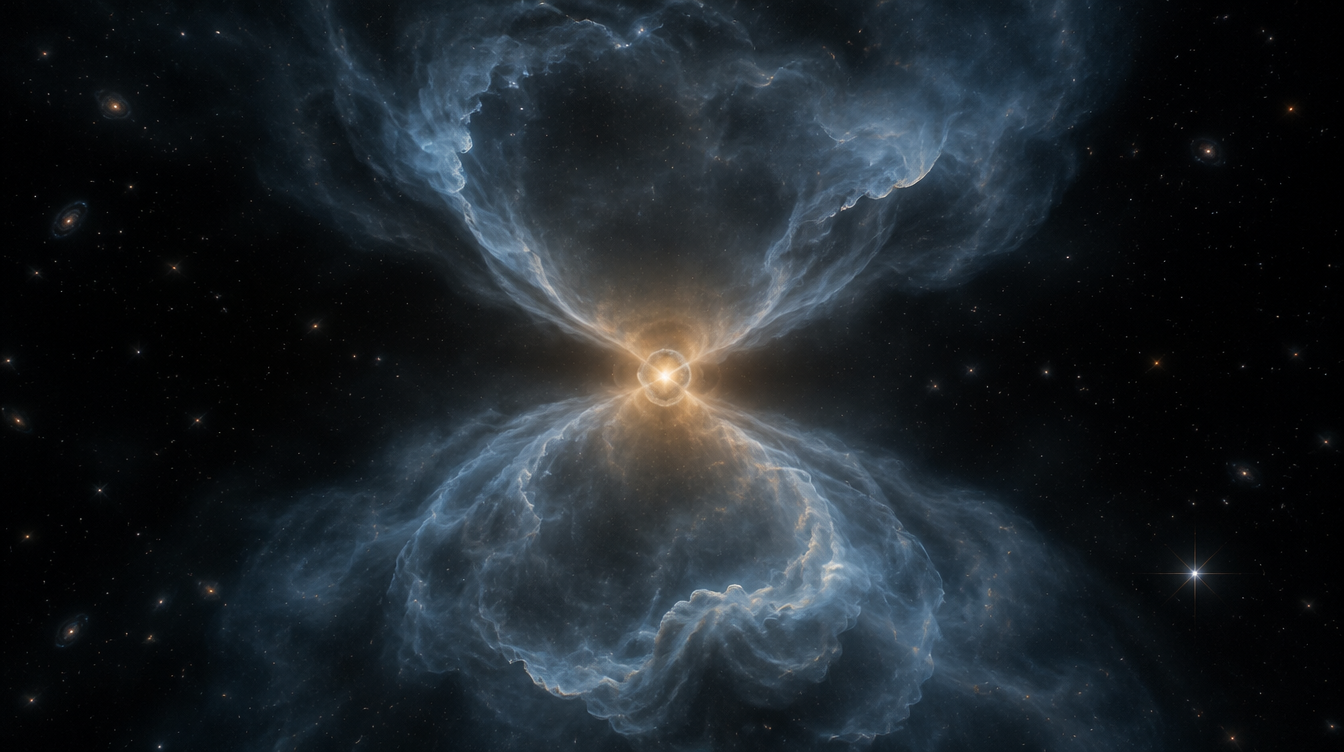
The coldest known natural place is the Boomerang Nebula, about 5,000 light-years away in the constellation Centaurus (ALMA Observatory, October 30, 2013). Its gas sits at about 1 K (−272 °C, −458 °F), which ALMA describes as “colder, in fact, than the faint afterglow of the Big Bang.” That distance is about 47 million billion km (29 million billion miles), our conversion.
How can anything be colder than the background it sits in? The Boomerang is a dying, sun-like star blowing off gas very fast. That gas expands rapidly and cools itself, the same principle a refrigerator uses with expanding gas (ALMA). In plain terms, the expansion cools the gas faster than the faint background glow can warm it.
The ALMA study, led by Raghvendra Sahai of NASA’s Jet Propulsion Laboratory, was published in The Astrophysical Journal (NASA JPL, October 25, 2013). The paper’s abstract notes that, beyond the ultracold region, the gas has re-warmed, most likely by light heating its dust grains (Sahai et al. 2013, arXiv:1308.4360). So the 1 K zone is a temporary state, not a permanent deep freeze.
ALMA’s view also changed the nebula’s look: the bow tie seen in visible light sits inside a broader, rapidly expanding structure (NASA JPL). Why one object looks different in different telescopes is the subject of Are Space Photos Real?.
Is Space Colder Than the Coldest Lab?
No. Laboratories have made temperatures far colder than any known natural place, and one such experiment runs in orbit.
NASA’s Cold Atom Lab
NASA’s Cold Atom Lab (CAL) launched to the space station on May 21, 2018 (NASA Science, Cold Atom Lab). It uses lasers to cool atoms into a Bose-Einstein condensate, a state of matter where atoms behave like one quantum object. NASA reported condensates “as low as 100 nanoKelvin,” or one ten-millionth of a kelvin above absolute zero (NASA, July 27, 2018).
By our calculation, that’s about 27 million times colder than the CMB (2.7 K ÷ 0.0000001 K), and about 10 million times colder than the Boomerang Nebula. In microgravity, each condensate could be watched for 5 to 10 seconds, longer than on Earth.
Cold instruments, by design
Space telescopes are cold on purpose too. Planck’s detectors ran at 0.1 K, as above. Webb’s Mid-Infrared Instrument (MIRI) runs at 7 K (−266 °C, −447 °F), cooled by a helium refrigerator called a cryocooler (NASA Webb).
The coldest temperatures we know of are inside our own machines.
How Does the Webb Telescope Stay So Cold?
The James Webb Space Telescope sees in infrared, the light warm objects give off, so it must be very cold or its own glow would blind it.
Webb’s answer is a five-layer sunshield about the size of a tennis court: 21.197 m by 14.162 m (69.5 ft by 46.5 ft) (NASA Webb). It doesn’t make cold. It blocks sunlight and lets the dark side radiate heat away to space.
The numbers show how much difference a shadow makes:
- Hot side: NASA’s infographic lists the sun-facing side at 85 °C (185 °F), and the outermost layer’s modelled maximum is 383 K (about 230 °F).
- Cold side: the infographic gives −233 °C (−388 °F); the coldest layer’s modelled minimum is 36 K (about −394 °F).
- Telescope: below 50 K (−223 °C, −370 °F).
- Near-infrared instruments: about 39 K (−234 °C, −389 °F).
All from NASA Webb. The infographic figures and the modelled extremes differ slightly, so we give both.
That’s a swing of more than 300 kelvin across a few metres, in the same patch of space. Same “space temperature,” completely different object temperatures. For what Webb’s cold infrared eyes reveal, see Hubble vs. Webb: The Same Nebula, Two Different Views.
Myth vs. Fact: Space Temperature Edition
| Myth | Fact |
|---|---|
| “Space is absolute zero.” | Deep space’s background is about 2.725 K, not 0 K. Nothing natural is known to reach absolute zero. |
| “Space has one temperature.” | The gas, the background glow and objects all have different temperatures. |
| “Empty space is always cold.” | The corona reaches up to 2 million °C; intergalactic gas about 1 million °C. |
| “You’d freeze solid instantly.” | A vacuum carries heat away slowly; lack of air is the immediate danger. |
| “Space is the coldest thing there is.” | Lab condensates reach 100 nanokelvin, far colder than the CMB. |
| “The CMB is exactly 3 K.” | That’s a rounding. The measured value is 2.72548 ± 0.00057 K. |
How Can You Explore the Temperature of Space Yourself?
You can’t put a thermometer in deep space, but you can still explore it.
- Look at the sky the CMB comes from. The background glow arrives from every direction equally, to about 1 part in 100,000 (ESA). Any patch of dark sky you look at tonight is sending you Big Bang light, too faint and too long in wavelength for eyes to see.
- Watch the Moon’s terminator. Through binoculars or a small telescope, look at the line between lunar day and night. That line is where the Sun is rising or setting, so the ground right at it is far from either extreme. The near-equator high of about 120 °C comes with the Sun high overhead, well onto the day side, and the low of about −130 °C is a night-side value (NASA LRO).
- Explore real CMB data. ESA’s Planck pages and NASA’s WMAP mission page show the full-sky maps behind the numbers.
- Browse more. Our Explore page collects DCI explainers by topic.
What Comes Next?
Real projects and dates, as of November 2026:
- Simons Observatory. Its Large Aperture Telescope, with mirrors about 6 m across, captured first light on February 22, 2025, near the summit of Cerro Toco in Chile’s Atacama Desert. It’s built to make precise measurements of the CMB to probe what happened just after the universe’s birth (Simons Foundation, March 17, 2025).
- LiteBIRD. Japan’s JAXA plans a mission to map the polarization of the CMB across the whole sky from the Sun-Earth L2 point for three years, searching for evidence of cosmic inflation. JAXA is “aiming for a launch in JFY2036” (Japanese fiscal year), a target rather than a fixed date (JAXA ISAS).
- Parker Solar Probe. It keeps flying through the corona, gathering data on why the Sun’s outer atmosphere is so much hotter than its surface, a question NASA still describes as not fully understood (NASA SVS).
Space Temperatures by the Numbers
- 2.72548 ± 0.00057 K (−270.4 °C, −454.8 °F): the cosmic microwave background (Fixsen 2009)
- About 1 K (−272 °C, −458 °F): the Boomerang Nebula, coldest known natural place (ALMA)
- 5,000 light-years (about 47 million billion km / 29 million billion miles): distance to the Boomerang Nebula (our conversion)
- Up to 2 million °C (3.5 million °F): the Sun’s corona (NASA)
- 400 K / 140 K (120 °C / −130 °C; 250 °F / −208 °F): lunar day and night near the equator (NASA LRO)
- −250 °F to 250 °F (about −157 °C to 121 °C): spacewalk conditions in Earth orbit (NASA)
- Below 50 K (−223 °C, −370 °F): Webb’s telescope; sunshield 21.197 m × 14.162 m (69.5 ft × 46.5 ft) (NASA Webb)
- 1.5 million km (930,000 miles): Planck’s distance from Earth at L2; its detectors ran at 0.1 K (ESA)
- 100 nanokelvin: Cold Atom Lab’s condensates on the space station (NASA)

How Cold Is Space? FAQ
How cold is space in Fahrenheit and Celsius?
The background temperature of deep space is about 2.7 K, which is about −270.4 °C or −454.8 °F. An object only settles near that temperature under specific equilibrium conditions: no starlight or other heating, no internal heat, and enough time to reach balance with the glow. Objects near a star can be far warmer or colder depending on sunlight and shade.
What is the temperature of space near Earth?
It depends on what you measure. The background glow is still 2.7 K, but in Earth orbit NASA says spacewalk conditions range from as cold as −250 °F to as hot as 250 °F in sunlight. An object’s temperature there depends mostly on whether it’s in sunlight or shadow.
What is the CMB’s temperature, exactly?
The best combined measurement is 2.72548 ± 0.00057 K, from a 2009 review by D. J. Fixsen. It’s the afterglow of light released about 380,000 years after the Big Bang. You’ll often see it rounded to 2.7 K or 2.73 K.
Is space absolute zero?
No. Absolute zero is 0 K (−273.15 °C), and deep space’s background is about 2.7 K above that. No natural place is known to reach absolute zero; the coldest known natural spot, the Boomerang Nebula, is about 1 K.
What is the coldest known place in the universe?
The coldest known natural place is the Boomerang Nebula, about 5,000 light-years away in Centaurus, at about 1 K. Its gas cools itself by expanding rapidly. Laboratory experiments, such as NASA’s Cold Atom Lab, have reached far colder temperatures.
Would a person freeze in space?
Not instantly. A vacuum has no air to carry heat away, so the body loses heat mainly by radiating it, which is slow. The immediate danger is lack of oxygen and pressure. In one 1965 NASA vacuum-chamber accident, a test subject stayed conscious for about 14 seconds; that’s one documented case, not a universal timer.
How hot can space get in sunlight?
An object’s temperature in sunlight depends on its distance from the Sun, colour and how it sheds heat. Near Earth, NASA gives spacewalk conditions up to 250 °F (about 121 °C), and the Moon’s day side reaches about 120 °C. Close to the Sun, Parker Solar Probe’s shield reaches about 1,400 °C.
Why is the Sun’s corona hotter than its surface?
Scientists don’t fully know yet. The corona reaches up to 2 million °C while the surface is about 5,500 °C. NASA’s Parker Solar Probe is flying through the corona to help answer the question.
Your next step: next time you see “space is −270 °C,” ask which temperature it means: the gas, the background glow or an object. Then check the source. For the background glow, Fixsen’s 2009 paper is the reference number; for spacecraft, look for NASA’s mission pages.
Sources and Further Reading
- Fixsen, D. J. (2009). “The Temperature of the Cosmic Microwave Background.” The Astrophysical Journal, 707(2), 916. DOI 10.1088/0004-637X/707/2/916; preprint arXiv:0911.1955.
- Sahai, R., Vlemmings, W. H. T., Huggins, P. J., Nyman, L.-Å. & Gonidakis, I. (2013). “ALMA Observations of the Coldest Place in the Universe: The Boomerang Nebula.” The Astrophysical Journal, 777(2), 92. DOI 10.1088/0004-637X/777/2/92; preprint arXiv:1308.4360.
- ALMA Observatory (October 30, 2013), ALMA Reveals Ghostly Shape of “Coldest Place in the Universe”.
- NASA Jet Propulsion Laboratory (October 25, 2013), Ghostly Specter Haunts the Coldest Place in the Universe.
- NASA Goddard, John Mather archive, COBE FAQ.
- NASA Science, WMAP mission page.
- ESA, Planck and the cosmic microwave background and Planck mission page; ESA Denmark (July 14, 2009), Rumfartøj sætter ny kulderekord (Planck’s 0.1 K record, in Danish).
- NIST, SI Redefinition: Kelvin, Introduction.
- NASA Science, Sun: Facts; NASA Scientific Visualization Studio, Parker Solar Probe.
- NASA (July 19, 2018, updated July 26, 2023), Traveling to the Sun: Why Won’t Parker Solar Probe Melt?.
- Chandra X-ray Center (February 2, 2005), Lost and Found: X-ray Telescope Locates Missing Matter.
- NASA Science, Webb’s Sunshield.
- NASA, ISS Active Thermal Control System overview (PDF).
- NASA Knows, What Is a Spacesuit?; NASA, Spacewalk Spacesuit Basics.
- NASA Small Spacecraft Technology State of the Art, Thermal Control.
- NASA LRO (2014), Lunar temperature variation lithograph (PDF).
- NASA NSSDC, Planetary Fact Sheet; New Horizons (JHUAPL), Questions and Answers.
- NASA (July 27, 2018), Space Station Experiment Reaches Ultracold Milestone; NASA Science, Cold Atom Laboratory.
- Simons Foundation (March 17, 2025), Simons Observatory Large Aperture Telescope Achieves First Light Milestone.
- JAXA ISAS, LiteBIRD.
- NASA Goddard, Imagine the Universe, Ask an Astrophysicist, How would the unprotected human body react to the vacuum of outer space? (includes the 1965 Manned Spacecraft Center vacuum-chamber accident).
Explore Next
- How a temperature is earned: How Astronomers Measure Stars
- Webb’s cold infrared eyes in action: Hubble vs. Webb: The Same Nebula, Two Different Views
- The Moon’s extremes, and its slow change: Why Is the Moon Shrinking?
- How images like the Boomerang Nebula are made: Are Space Photos Real?
- More from deep space: Stars & Galaxies
- How birth mass shapes a star’s ending: Life Cycle of a Star
- Why Venus beats Mercury: What Is the Hottest Planet?
- The 2006 vote and the debate: Why Is Pluto Not a Planet?
How This Explainer Was Checked
Every number in this article comes from NASA, ESA, JAXA, NIST, the ALMA Observatory, the Chandra X-ray Center or peer-reviewed papers, and was checked against those pages on November 7, 2026. Unit conversions marked “our conversion” or “our calculation” were done by DCI. Where sources round differently (the CMB at 2.7, 2.73 or “about 3” K) or disagree (Pluto at 40 K or 48 K; Webb’s infographic vs. modelled extremes), we show both and explain why. The human-exposure section relies on NASA’s Imagine the Universe account of a 1965 vacuum-chamber accident, presented as one documented case, alongside NASA’s heat-transfer guidance. Images are labelled: real spacecraft or telescope images as OBSERVATION, illustrations as ILLUSTRATION, and our charts as DATA GRAPHIC. Nothing AI-generated is presented as a real image.
Final Thought: Space Isn’t Cold, Things in Space Are
Space itself barely has a temperature you could feel. What it has is a 2.7 K glow from the Big Bang, a thin gas that can be fiercely hot, and sunlight that can bake one side of a spacecraft while the other side freezes. “How cold is space?” turns out to be a question about which thing you’re measuring. Ask that first, and the universe’s strangest temperatures start to make sense.
About the Author
Author: King | Founder of Dark Cosmic Insights
King is the founder of Dark Cosmic Insights, a science storytelling platform exploring the strangest true stories hiding in space, science and AI. He digs into NASA, ESA and peer-reviewed research, separates what has been measured from what is still a mystery, and turns it into articles, data graphics and Shorts.
Follow the anomaly. Trace the source.