Jupiter has rings. Most people are surprised to hear it. NASA’s Voyager 1 confirmed their existence when it flew past in 1979 (NASA). Even now, you won’t spot them in an ordinary backyard telescope.
Jupiter’s rings aren’t made of bright ice like Saturn’s. NASA says they’re “composed of small, dark particles” that are “difficult to see except when backlit by the Sun.” And the source of that dust is wonderfully violent: tiny meteoroids slamming into Jupiter’s small inner moons and blasting dust into orbit (NASA/JPL, 1998).

Observed, measured, modelled, open. Jupiter’s rings are observed by Voyager, Galileo, Juno and telescopes. Their positions and thickness are measured. The idea that their dust comes from impacts on small moons is modelled from Galileo’s images and fits the evidence well.
Quick Answer: Does Jupiter Have Rings?
Yes. Jupiter has a faint ring system, discovered in 1979 by NASA’s Voyager 1 (NASA). It has four main parts: an inner halo, a thin main ring, and two wide, faint gossamer rings (NASA/JPL, 1998). They’re made of small, dark dust particles, not ice. That dust is “kicked up as interplanetary meteoroids smash into the giant planet’s four small inner moons”: Metis, Adrastea, Amalthea and Thebe. Because the dust is dark and sparse, the rings are “difficult to see except when backlit by the Sun” (NASA).
What this article can and cannot establish. It can show you Jupiter’s ring parts, where they sit and what they’re made of, using NASA’s ring measurements and spacecraft images. It cannot show you the rings through a small telescope, because they’re far too faint. And their long-term history, such as how old the current rings are, is less certain.
Table of Contents
The DCI Evidence Map: Jupiter’s Rings
| Question | What we know | Status | Key source |
|---|---|---|---|
| Does Jupiter have rings? | Yes, found by Voyager 1 in 1979 | Observed | NASA |
| How many parts? | Halo, main ring and two gossamer rings | Observed | NASA/JPL, 1998 |
| What are they made of? | Small, dark dust particles | Observed | NASA |
| Where does the dust come from? | Meteoroid impacts on four small moons | Modelled | NASA/JPL, 1998 |
| How far out do they reach? | About 89,400 to 280,000 km from Jupiter’s center | Measured | NASA NSSDC |
| How dark is the main ring? | Albedo about 0.015 | Measured | NASA NSSDC |
| Can you see them from your backyard? | No; they’re best seen backlit by the Sun | Observed | NASA |
Status key: Observed = seen directly. Measured = a number with a stated uncertainty or a direct measurement. Modelled = inferred from measurements through a physical model, dependent on assumptions. Open = unresolved; the evidence is incomplete or points different ways. Not supported = the evidence goes against the claim, or there is none for it.
Cite this framework: “DCI Evidence Map: Jupiter’s Rings,” Dark Cosmic Insights, November 2026, darkcosmicinsights.com/does-jupiter-have-rings/.
How Many Rings Does Jupiter Have?
Four main parts
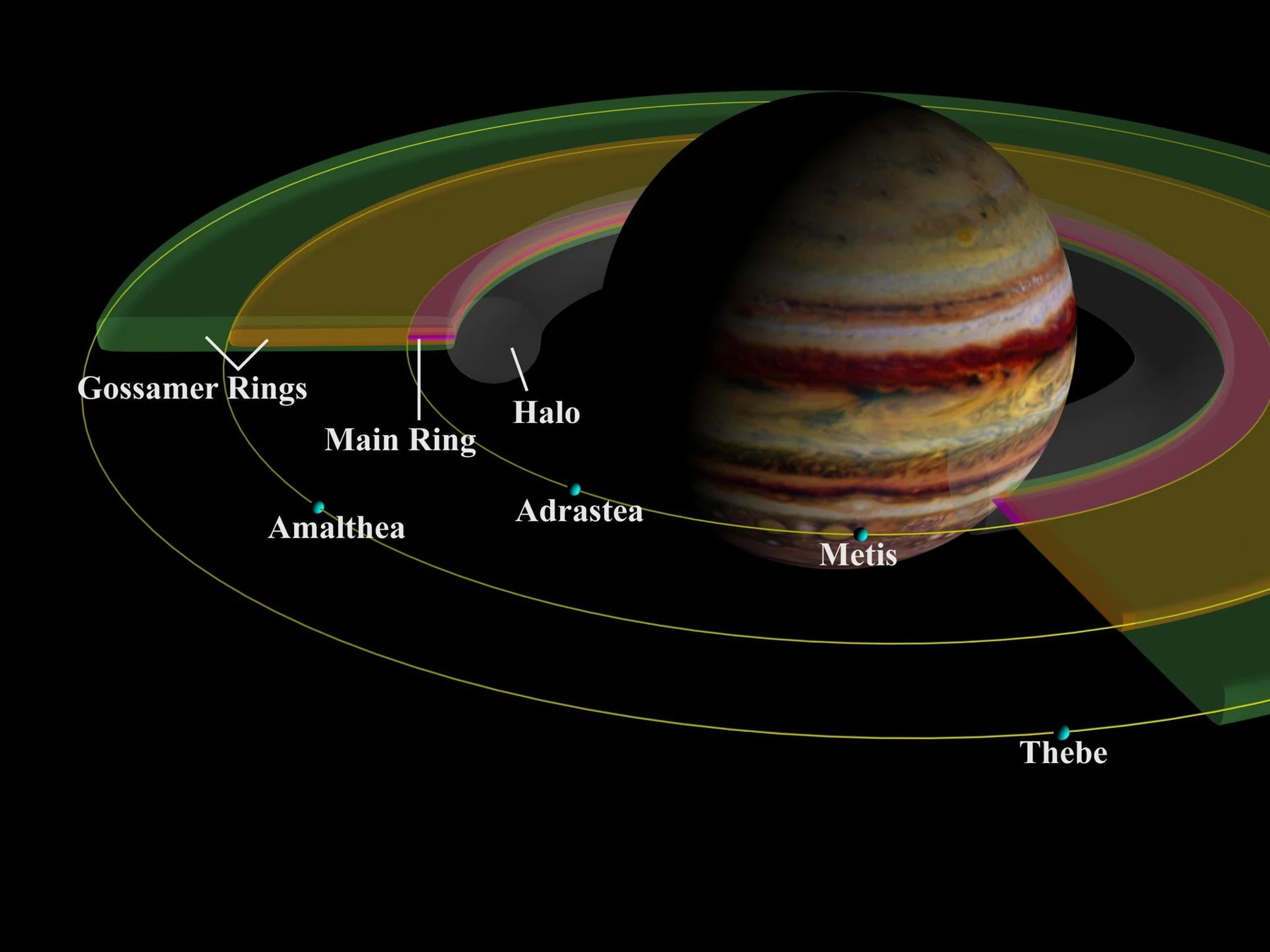
NASA’s Galileo mission mapped Jupiter’s ring system in detail in the 1990s. In 1998, Cornell astronomer Joseph Burns and colleagues described its structure: an inner “cloud-like ring, called the halo,” a thin main ring, and an outermost ring that is “actually two rings, one embedded in the other,” the gossamer rings (NASA/JPL, 1998).
Where each one sits
NASA’s Jovian Rings Fact Sheet gives their positions, measured from Jupiter’s center (NASA NSSDC):
- Halo: about 89,400 to 123,000 km. Thick and puffy, about 10,000 km from top to bottom.
- Main ring: about 123,000 to 128,940 km. Thin, under about 100 km thick, and the brightest part.
- Amalthea gossamer ring: about 128,940 to 181,350 km, about 2,600 km thick.
- Thebe gossamer ring: about 181,350 to 221,900 km, about 8,800 km thick, with a faint extension out to about 280,000 km.
Jupiter’s equatorial radius is about 71,492 km (NASA NSSDC, Jupiter), so the main ring sits roughly 1.7 to 1.8 times Jupiter’s radius from its center (DCI calculation). An older source, NASA’s 1998 Galileo release, gives a different range, describing the system as beginning about 92,000 km from Jupiter’s center and extending to about 250,000 km. We use the fact sheet’s figures.

What Are Jupiter’s Rings Made Of?
Dark dust, not ice
Saturn’s rings are mostly water ice, which is why they shine. Jupiter’s are not. NASA says Jupiter’s rings “are composed of small, dark particles” (NASA). The 1998 Galileo results described them as “very tiny particles resembling dark, reddish soot” (NASA/JPL, 1998).
How dark?
Very. NASA’s fact sheet lists the main ring’s albedo, the share of light it reflects, at about 0.015 (NASA NSSDC). That means it reflects only about 1.5 percent of the light that hits it (DCI conversion).
Thin as smoke
The rings are also extremely sparse. The fact sheet lists optical depths, a measure of how much light the ring blocks, of about 5 × 10⁻⁶ for the main ring and about 1 × 10⁻⁷ for the gossamer rings (NASA NSSDC). In plain terms: almost all light passes straight through them.
Where Do Jupiter’s Rings Come From?
Moons under bombardment
In 1998, NASA’s Galileo team announced that the rings form from dust “kicked up as interplanetary meteoroids smash into the giant planet’s four small inner moons” (NASA/JPL, 1998). When a meteoroid hits, it buries itself in the moon, then vaporizes and explodes, throwing debris fast enough to escape the moon’s weak gravity.
Which moon feeds which ring
Burns said, “the main ring comes from Adrastea and Metis.” The two gossamer rings are “composed of microscopic debris from two small moons, Amalthea and Thebe” (NASA/JPL, 1998). These moons are tiny. JPL lists Adrastea’s mean radius at about 8.2 km, which makes it roughly 16 km across (DCI calculation from JPL Solar System Dynamics). The 1998 release called it “just eight kilometers (five miles)” across, but JPL’s current data put its width at about twice that. Either way, it’s so small that its gravity can’t hold on to the dust that impacts knock loose.
A ring that keeps being refilled
This means Jupiter’s rings are constantly being resupplied as long as meteoroids keep hitting those moons. It’s a recycling system rather than a permanent structure. That interpretation is modelled from Galileo’s images, which linked each ring to the moons that feed it.

Why Can’t We See Jupiter’s Rings?
Too dark and too thin
Jupiter’s rings are made of dark, sparse dust. With an albedo of about 0.015 and an optical depth measured in millionths (NASA NSSDC), they reflect almost nothing. Next to Jupiter, one of the brightest objects in the night sky, they’re completely swamped.
They light up from behind
Fine dust tends to scatter light forward, much like dust glowing in a sunbeam when you look toward the window. That’s why NASA says the rings are “difficult to see except when backlit by the Sun” (NASA). Galileo’s best ring images were taken from inside Jupiter’s shadow, looking back toward the Sun (NASA, PIA00701).
Found by a spacecraft
Because they’re so faint, no telescope on Earth found them first. Voyager 1 confirmed them in 1979 during its flyby (NASA). Since then, Galileo and Juno have studied them up close, and specialist observatories have imaged them from the ground. Japan’s 8.2-meter Subaru Telescope photographed the main ring in infrared in 2005, even though, as NAOJ put it, the ring is “virtually impossible for even the best Earth based telescopes to see” (NAOJ Subaru Telescope).
How Did Juno See the Rings?
From inside
NASA’s Juno spacecraft orbits Jupiter on paths that pass very close to the planet. On July 16, 2018, during its 13th science orbit, Juno’s star camera captured the rings from a high-latitude vantage point “just as Juno flew inside the ring.” In that image, “the bright inner band is Jupiter’s main ring, the halo ring is to its left, and the gossamer rings are to its right” (NASA, PIA22963).
A star camera, not a regular camera
That image came from Juno’s Stellar Reference Unit, a navigation camera that normally tracks stars. Its view of the rings is grainy and black-and-white, but it shows the rings from an angle no spacecraft had used before.
Jupiter’s Rings vs. Saturn’s Rings
Night and day
The two ring systems could hardly be more different. Saturn’s main rings are made of chunks of water ice, from tiny grains to large pieces, and they’re bright enough to see in a small telescope. Jupiter’s are fine, dark dust that you won’t see in an ordinary backyard telescope; it takes a specialist observatory. We count Saturn’s rings in How Many Rings Does Saturn Have?
Both fed by moons
They do share one thing: moons supply material to both. At Saturn, NASA says water jets from the moon Enceladus provide much of the material in the E ring. At Jupiter, meteoroid impacts on four tiny moons supply the rings.
Not the only ringed giants
Uranus and Neptune have rings too. All four giant planets have ring systems, but only Saturn’s are bright and wide enough to be famous.

Myth vs. Fact: Jupiter’s Rings
| Myth | Fact | Status |
|---|---|---|
| “Only Saturn has rings.” | Jupiter, Uranus and Neptune have rings too. | Observed |
| “Jupiter’s rings are icy like Saturn’s.” | They’re small, dark dust particles. | Observed |
| “You can see them in a backyard telescope.” | Not in an ordinary backyard telescope; specialist observatories like Subaru have imaged them, and spacecraft see them best backlit by the Sun. | Observed |
| “Jupiter has one ring.” | It has a halo, a main ring and two gossamer rings. | Observed |
| “The rings are left over from Jupiter’s birth.” | Their dust is constantly blasted off small moons. | Modelled |
| “Astronomers found them with a telescope.” | Voyager 1 discovered them in 1979. | Observed |
How Can You Explore Jupiter’s Rings Yourself?
Through spacecraft images
You won’t see Jupiter’s rings from your backyard, but you can browse the real images. Look up Galileo’s PIA00701 and Juno’s PIA22963 in NASA’s Photojournal.
See Jupiter itself
Jupiter is easy to see. NASA’s fact sheet lists it at about magnitude −2.7 at mean opposition (NASA NSSDC), brighter than any star at night. Binoculars show its four biggest moons; a small telescope shows its cloud belts.
Think about the dust
Next time you see a sunbeam full of glowing dust in a dark room, you’re seeing the same effect that makes Jupiter’s rings visible to spacecraft: tiny particles lit up from behind.
Jupiter’s Rings by the Numbers
| Measure | Value | Source |
|---|---|---|
| Discovered | 1979, Voyager 1 | NASA |
| Main parts | 4 (halo, main, two gossamer) | NASA/JPL, 1998 |
| Halo | 89,400–123,000 km, ~10,000 km thick | NASA NSSDC |
| Main ring | 123,000–128,940 km, under ~100 km thick | NASA NSSDC |
| Outer edge (Thebe extension) | about 280,000 km | NASA NSSDC |
| Main ring albedo | about 0.015 | NASA NSSDC |
| Source moons | Metis, Adrastea, Amalthea, Thebe | NASA/JPL, 1998 |
| Adrastea’s size | about 8.2 km mean radius (about 16 km across) | JPL Solar System Dynamics |
Values are as of November 2026.

Jupiter Rings FAQ
Does Jupiter have rings?
Yes. Jupiter has a faint ring system that NASA’s Voyager 1 discovered in 1979. It’s made of a halo, a main ring and two gossamer rings. They’re too dark and thin to see from Earth with a normal telescope.
How many rings does Jupiter have?
Four main parts: an inner halo, a thin main ring, and two faint gossamer rings named after the moons Amalthea and Thebe. NASA’s fact sheet also lists a faint extension beyond the Thebe ring, out to about 280,000 km from Jupiter’s center.
What are Jupiter’s rings made of?
Small, dark dust particles, which Galileo scientists described as resembling dark, reddish soot. They’re very different from Saturn’s rings, which are mostly bright water ice. Jupiter’s main ring reflects only about 1.5 percent of the light that hits it.
Why can’t we see Jupiter’s rings?
They’re dark, sparse and right next to a very bright planet. NASA says they’re difficult to see except when backlit by the Sun, because tiny dust scatters light forward. That’s why spacecraft took their best ring images from behind Jupiter.
Who discovered Jupiter’s rings?
NASA’s Voyager 1 spacecraft discovered them in 1979 during its flyby of Jupiter. NASA’s Galileo orbiter later mapped them in detail in the 1990s, and Juno has photographed them from inside the ring.
Where do Jupiter’s rings come from?
From four small inner moons: Metis, Adrastea, Amalthea and Thebe. Meteoroids crash into them and blast dust into orbit. The main ring comes from Metis and Adrastea, and the two gossamer rings from Amalthea and Thebe.
Are Jupiter’s rings bigger than Saturn’s?
It depends which parts you compare. Jupiter’s faint outer gossamer ring reaches about 280,000 km from its center, about twice as far as the outer edge of Saturn’s bright main rings, about 136,780 km (DCI comparison). But Saturn’s own faint E ring reaches much farther than either, and Saturn’s rings are far brighter and more massive. By anything you could see, Saturn’s win easily.
Can you see Jupiter’s rings with a telescope?
Not with a backyard telescope. They’re far too faint next to bright Jupiter. What you can see easily is Jupiter’s cloud belts and its four largest moons, which show up even in steady binoculars.
Your next step: look up Galileo’s backlit ring mosaic and Juno’s view from inside the ring, then find Jupiter in the night sky. You’ll know its rings are out there, invisible, circling the brightest planet you can see.
Sources and Further Reading
- NASA Science, Jupiter: Facts.
- NASA Space Science Data Coordinated Archive, Jovian Rings Fact Sheet; Jupiter Fact Sheet.
- NASA/JPL (September 15, 1998), Galileo Finds Jupiter’s Rings Formed by Dust Blasted Off Small Moons.
- NASA, PIA00701: Jupiter Main Ring/Ring Halo; PIA01627: Jupiter Inner Satellites and Ring Components; PIA22963: Jupiter’s Ring.
- NASA Science, Cassini: Saturn Rings.
Explore Next
- The full Jupiter guide: Jupiter: Facts, Moons and the Great Red Spot
- Saturn’s very different rings: How Many Rings Does Saturn Have?
- Are Saturn’s rings going away? Are Saturn’s Rings Disappearing?
- The moons that feed Jupiter’s rings, and the rest: How Many Moons Does Jupiter Have?
- Jupiter ranked against every planet: What Is the Biggest Planet?
- Every planet in one place: Solar System Explorer
- What the planet itself is made of: What Is Jupiter Made Of?
- How far away Jupiter is: How Far Is Jupiter?
- How a claim earns its label: How We Know
How This Explainer Was Checked
Every number in this article was checked in November 2026 against the source linked beside it: NASA’s Jupiter facts, NASA’s Jovian Rings and Jupiter fact sheets, NASA/JPL’s 1998 Galileo ring release, NASA’s image pages for PIA00701, PIA01627 and PIA22963, and NASA’s Cassini ring page for the Saturn comparison. Ring positions, thickness, albedo and optical depth are labelled Measured. The impact origin of the dust is labelled Modelled. The ring distance in Jupiter radii and the albedo percentage are DCI calculations. Where NASA’s 1998 release and the fact sheet give slightly different ring distances, we show both. Images are labelled: real spacecraft images as OBSERVATION, diagrams as DIAGRAM, illustrations as ILLUSTRATION, and our charts as DATA GRAPHIC. Nothing AI-generated is presented as a real image.

Final Thought: Rings Made of Impacts
Saturn’s rings are a jewel. Jupiter’s are a dust cloud, made one meteoroid strike at a time on moons too small to hold onto their own debris. You’ll never see them from your backyard. But every time a speck of space rock hits Metis or Thebe, Jupiter’s rings get a little refill, glowing faintly whenever the Sun shines through them.
About the Author
Author: King | Founder of Dark Cosmic Insights
King is the founder of Dark Cosmic Insights, a science storytelling platform exploring the strangest true stories hiding in space, science and AI. He digs into NASA, ESA and peer-reviewed research, separates what has been measured from what is still a mystery, and turns it into articles, data graphics and Shorts.
Follow the anomaly. Trace the source.