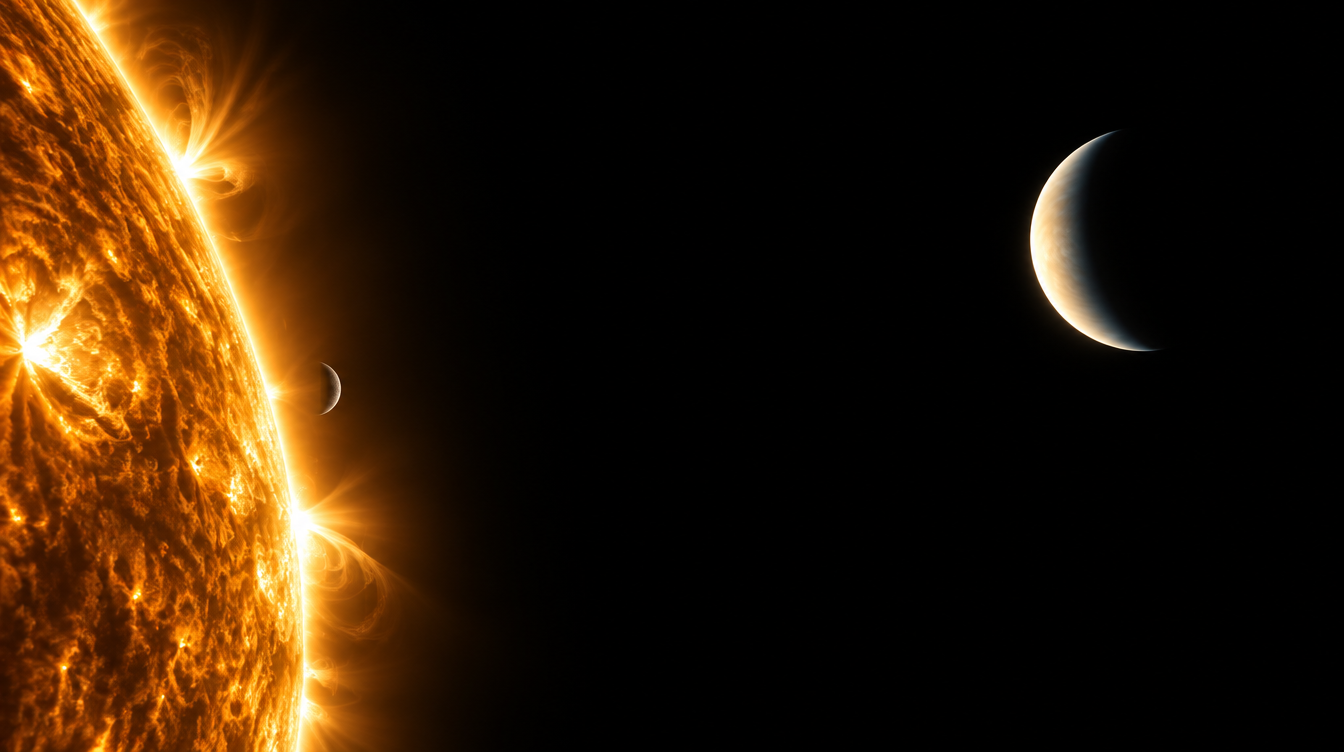
Eight planets circle the Sun, and six of them have moons. The two closest to the Sun have none at all, not even a small captured rock. So why don’t Mercury and Venus have moons, when even little Mars has two?
The odd part is that astronomers have “found” moons around both planets before. A moon of Venus was reported for more than a century, and it even got a name. A spacecraft once picked up what looked like a moon leaving Mercury. Neither held up. This guide covers the physics that makes moons hard to keep near the Sun, the ideas about moons that might have been lost, Venus’s not-quite-moon Zoozve, and how we know the count is zero.
Observed, modelled, open. That neither planet has a known moon is observed, from telescope surveys and spacecraft searches. How far each planet’s gravity can hold a moon, and how tides would drag one down, are calculated from measured masses, orbits and spins. Whether Venus ever had a moon and lost it is open: it rests on models, not evidence of a lost moon.
Quick Answer: Why Don’t Mercury and Venus Have Moons?
Mercury and Venus have no known moons. The main explanations are that, this close to the Sun, moons are very hard to keep, though each planet’s exact history is still uncertain. As of November 2026, NASA counts zero for both (NASA Space Place, updated July 31, 2026). A planet can only hold satellites within a limited region, its Hill sphere, before the Sun’s tidal pull wins out. Both planets also spin slowly, so tides would tend to drag a close moon inward until it crashed (Ward & Reid 1973). For Venus, NASA still calls the absence “a mystery for scientists to solve.”
What this article can and cannot establish. It can show you the measured facts (no moons found at Venus down to about 0.3 km in radius), the sums behind the Sun’s grip, and the published ideas about lost moons, each labelled. It cannot prove that either planet never had a moon, and it cannot pick a winner among the lost-moon ideas, because no one has found physical evidence for any of them. For how zero compares with every other planet’s count, see our dated table in Which Planet Has the Most Moons?
Table of Contents
The DCI Evidence Map: Mercury, Venus and Their Missing Moons
| Question | What we know | Status | Key source |
|---|---|---|---|
| Does Mercury or Venus have a known moon? | No. Zero for each, as of November 2026 | Observed | NASA Space Place; JPL SSD |
| How small a Venus moon would have been seen? | A 2005 survey had a 50% chance of catching a moon about 0.3 km in radius in its outer fields, and could see only moons of about 1 km in radius or larger close to the planet; it found none | Measured (survey limits) | Sheppard & Trujillo 2009 |
| Has Mercury been searched? | Yes: Mariner 10 in 1974 and MESSENGER in 2013; any moon “must be small” | Observed | NASA PIA17388 |
| How far does each planet’s gravity rule? | Hill radius about 221,000 km (Mercury) and about 1.0 million km (Venus) | Modelled (simple calculation from measured masses and orbits) | Sheppard & Trujillo 2009; DCI arithmetic from NASA NSSDCA |
| How slowly do they spin? | Venus 243.018 days, backward; Mercury 58.6462 days | Measured | JPL SSD |
| Would solar tides have removed moons? | Many kinds of moon would not have survived the planets’ tidal slowdown | Modelled | Ward & Reid 1973; Kumar 1977 |
| Did Venus once have a moon? | One model has a second giant impact making an early moon spiral in | Open (hypothesis) | Alemi & Stevenson 2006 |
| Is Zoozve a moon of Venus? | No. It orbits the Sun and only appears to loop around Venus | Observed (orbit) | Mikkola et al. 2004 |
| Was “Neith” a real moon of Venus? | No. The reports never established a moon; historians attribute them to telescope ghost images and nearby stars | Not supported | Pedersen & Kragh 2008 |
Status key: Observed = seen directly, or searched for directly and not found. Measured = a number with stated uncertainty or a stated survey limit. Modelled = computed, and dependent on assumptions. Open = unresolved. Not supported = contradicted by evidence.
Cite this framework: “DCI Evidence Map: Mercury, Venus and Their Missing Moons,” Dark Cosmic Insights, November 2026, darkcosmicinsights.com/why-mercury-and-venus-have-no-moons/.
Does Mercury Have a Moon?
No. NASA’s Mercury fact page says simply that Mercury doesn’t have moons (NASA Science, Mercury Facts), and NASA’s planetary fact sheet lists 0 natural satellites (NASA NSSDCA, Mercury Fact Sheet). JPL’s master list of planetary satellites has no entry for Mercury at all (JPL SSD).
And it has been searched, twice, from close range.
Mariner 10, 1974–75. NASA’s Mariner 10 flew past Mercury three times: on March 29, 1974, September 21, 1974 and March 16, 1975 (NASA Science, Mariner 10). According to the MESSENGER team’s 2013 release, Mariner 10’s search ruled out moons larger than 5 km (3.1 miles) across (Newswise, MESSENGER release, July 2013).
MESSENGER, 2013. NASA’s MESSENGER entered orbit around Mercury on March 18, 2011, and crashed into the surface as planned on April 30, 2015 (NASA Science, MESSENGER). In 2013 it ran moon searches in February and on July 19–20, taking repeated long exposures at 2.5 to 25 times Mercury’s radius from the planet, seconds to nearly an hour apart, so a moon would show up as a shifting dot (NASA Photojournal, PIA17388). The release said its camera could potentially pick out objects as small as 100 m (330 feet) (Newswise).
NASA’s summary is careful: any moon of Mercury “must be small (less than a few kilometers), or we would have seen them by now” (PIA17388). No moon has been reported since.
Does Venus Have a Moon?
No. NASA’s Venus page says it is “one of only two planets in our solar system” without a moon (NASA Science, Venus Facts, updated October 15, 2026). It does have a quasi-satellite, officially named Zoozve, which we’ll come to below.
The deepest published hunt used the 6.5 m Baade-Magellan telescope at Las Campanas Observatory, Chile, on October 7, 2005 (UT). Scott Sheppard and Chad Trujillo covered about 90% of Venus’s Hill sphere and about 99% of the inner part where moons should be stable. They found several main-belt asteroids in the field, and no moons (Sheppard & Trujillo 2009, arXiv:0906.2781).
How small would a moon have to be to slip past? The survey reached a red magnitude of about 20.4. Assuming a dark surface (albedo 0.1), the survey had a 50% detection efficiency for moons about 0.3 km in radius (about 980 feet) in its outer, more favourable fields. In other words, a moon that size had about even odds of being caught there. Close to Venus, the planet’s glare washes out the images, so the limit there is about 1 km radius or larger (Sheppard & Trujillo 2009). The authors say their survey was about 50 times deeper in brightness than an earlier search published by Kuiper in 1961.
So the honest answer: the deepest search found no Venus moons. It makes a sizeable moon in most of the stable zone unlikely, but its limits are probabilities, not a guarantee, and near the planet’s glare it could see only larger objects. Nothing found so far suggests a moon is there.

How Far Does a Planet’s Gravity Reach?
To keep a moon, a planet needs room where the Sun can’t pull it away. That room is the Hill sphere: the region around a planet where it can retain satellites despite the Sun’s tidal influence. Well inside it, a small body can orbit the planet. Toward and beyond its edge, the Sun’s tides increasingly win, and a body there tends to end up orbiting the Sun instead.
The size of the Hill sphere depends on two things: how massive the planet is compared with the Sun, and how far it is from the Sun. Sheppard and Trujillo give the standard formula, the planet’s distance from the Sun multiplied by the cube root of its mass divided by three times the Sun’s mass (Sheppard & Trujillo 2009). A small planet close to the Sun loses on both counts.
Plugging in NASA’s masses and orbits gives these Hill radii (DCI arithmetic):
- Mercury: about 221,000 km (137,000 miles), using its average distance of 57.909 million km and a mass of 0.330103 × 10²⁴ kg. Because Mercury’s orbit is quite stretched, the zone shrinks to about 175,000 km (109,000 miles) at its closest approach to the Sun (NASA NSSDCA, Mercury; JPL SSD).
- Venus: about 1,011,000 km (628,000 miles). Sheppard and Trujillo round this to 1.0 million km (Sheppard & Trujillo 2009).
- Earth, for comparison: about 1,497,000 km (930,000 miles) (NASA NSSDCA, Earth).
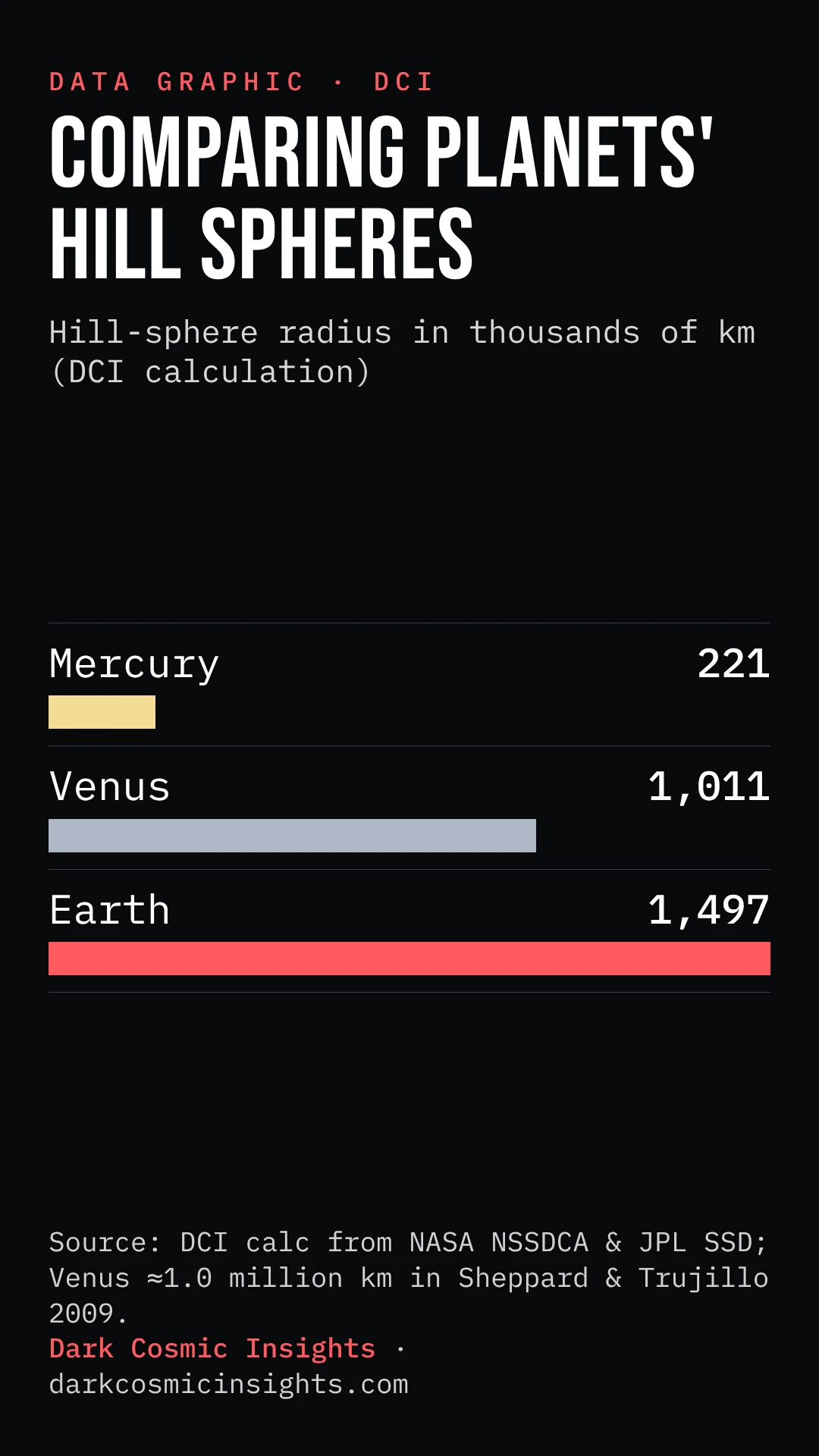
Notice that Venus’s Hill sphere is about two-thirds the size of Earth’s, so the size of the zone alone can’t explain why Venus is moonless.
The Hill radius isn’t a hard wall, and gravity doesn’t stop there. How far out a moon can survive long term depends on its orbit. Sheppard and Trujillo cite Hamilton and Krivov (1997) for a stable region out to around 0.7 times the Hill radius (Sheppard & Trujillo 2009); a later study of moons around giant exoplanets found that, for circular orbits in the same plane, the limit is about 0.49 Hill radii for moons orbiting in the same direction as the planet travels around the Sun, and about 0.93 Hill radii for moons orbiting in the opposite direction. Eccentric orbits reduce these limits (Domingos, Winter & Yokoyama 2006). Our Moon, at about 384,400 km (NASA NSSDCA, Moon), sits roughly a quarter of the way out (DCI arithmetic), comfortably safe.
For Mercury, the squeeze is real. A University of Illinois physics Q&A says a small Hill sphere likely leaves “a relatively small set of stable orbits (if any!)” (Illinois Physics, Ask the Van, January 19, 2012). NASA Space Place agrees: Mercury is too close to the Sun to hold on to a moon (NASA Space Place).
Why Would Solar Tides Steal a Moon?
The Hill sphere says where a moon could orbit. Tides decide whether it stays. A moon raises a small tidal bulge on its planet. If the planet spins faster than the moon orbits, the bulge runs ahead and tugs the moon forward, so it drifts outward. That’s happening to our Moon: NASA says it moves away from Earth by about 4 cm (1.5 inches) per year (NASA Science, Tidal Locking). If the moon orbits faster than the planet spins, or against the spin, the bulge lags and drags the moon inward. That’s how Mars’s moon Phobos is sinking, as we explain in How Many Moons Does Mars Have?
The dividing line is the synchronous orbit, the distance where one trip around the planet takes exactly as long as one spin. Mercury and Venus both spin very slowly. JPL lists Venus’s rotation as −243.018 days (the minus sign marks its backward spin) and Mercury’s as 58.6462 days, about 58.6 days (JPL SSD, Planetary Physical Parameters). So the synchronous orbit is very far out: DCI’s two-body arithmetic puts it at about 243,000 km for Mercury and about 1.54 million km for Venus. Both lie well beyond the zones where a moon could stay stable for long, and even beyond the Hill radii themselves.
So within each planet’s long-term stable satellite region, today’s tides would not push a moon outward: a moon there would be drawn slowly inward. Our sum ignores the Sun’s pull on the moon, so treat it as a rough guide to the logic.

What the published models say
This isn’t a new idea. In 1973, Joseph Burns asked in Nature Physical Science “Where are the satellites of the inner planets?” (Burns 1973). The same year, William Ward and Mark Reid modelled how a moon’s orbit changes while the Sun’s tides are braking its planet’s spin. They concluded that “a wide variety of satellites would not have survived” that braking on Mercury and Venus, lost either by orbital decay or by hitting the planet (Ward & Reid 1973, MNRAS).
A different route was proposed in 1977. S. S. Kumar suggested that a moon present early on would drift outward through tidal interaction with its planet, until it reached a distance where the Sun’s gravity made its orbit unstable, and escaped (Kumar 1977, Astrophysics and Space Science). And according to Sheppard and Trujillo’s review, a 1986 study by J. Rawal found that if Venus’s slow spin is primordial, it struggles to keep anything except the smallest, most distant original moons (Sheppard & Trujillo 2009).
The models disagree on the route (falling in versus flying off) but agree on the result: no surviving large moon. All of them are modelled, and none has been confirmed by debris or an impact scar.
Mercury’s three-to-two spin
Mercury’s spin is thought to have been shaped by solar tides too. It turns three times on its axis for every two trips around the Sun (Correia & Laskar 2004, Nature). Two 87.969-day orbits (NASA NSSDCA) match three 58.6462-day spins, giving a solar day, sunrise to sunrise, of 176 Earth days (NASA Science, Mercury Facts).
This spin-orbit lock was discovered in 1965 by Gordon Pettengill and Rolf Dyce, using radar from the Arecibo radio telescope (Paris Observatory, 2004). How Mercury got trapped is modelled: in Alexandre Correia and Jacques Laskar’s 1,000 simulations, Mercury’s chaotically changing orbit made the three-to-two state the most likely outcome, in 55.4% of runs (Correia & Laskar 2004).
Venus’s slow, backward spin
Venus spins backward compared with Earth, so there the Sun would rise in the west (NASA Science, Venus Facts). One spin takes about 243 Earth days, longer than its 224.701-day year; because spin and orbit run in opposite directions, NASA’s fact sheet gives a noon-to-noon day of 2,802.0 hours, about 116.75 Earth days (NASA NSSDCA, Venus).
The backward spin was first revealed by JPL radar in 1962 (Jacques Laskar, IMCCE). Why it spins that way is modelled. Correia and Laskar showed that the Sun’s tides on Venus’s rock, combined with atmospheric tides in its thick, sun-heated air, can drive the planet into a slow retrograde state, either by flipping its axis or by slowing it to a stop and reversing it (Correia & Laskar 2001, Nature). That thick atmosphere is also why Venus is the hottest planet, as we explain in What Is the Hottest Planet?
How Did Earth Get Its Moon, and Why Not Venus?
The leading picture for Earth’s Moon is a giant collision. NASA describes a Mars-sized body, named Theia, striking the young Earth about 4.5 billion years ago, with the debris gathering into the Moon (NASA Science, Moon Formation). NASA adds that several theories compete, but almost all share the idea of a collision.
That’s exactly what makes Venus puzzling. Venus is close to Earth in size and mass: 4.86731 × 10²⁴ kg against Earth’s 5.97217 × 10²⁴ kg (JPL SSD). Alemi and Stevenson’s 2006 abstract argues that Venus would likely have suffered a similar giant collision (DPS abstract). So if Earth’s made a moon, why didn’t Venus’s?
Spin is the key difference. Earth turns in about a day, putting its synchronous orbit at about 42,000 km (DCI arithmetic), far inside the Moon’s orbit, so tides push our Moon outward, toward safety. Venus, turning once every 243 days, offers no such outward push. Our Moon is also big for a moon, with a radius of 1,737.4 km against Earth’s 6,371 km, about 27% as wide (DCI arithmetic from NASA NSSDCA).
Did Venus Once Have a Moon?
Maybe. Everything in this section is a hypothesis.
The two-impact idea
The best-known version came from Caltech in 2006. Undergraduate Alex Alemi and planetary scientist David Stevenson presented models at the American Astronomical Society’s Division for Planetary Sciences meeting in Pasadena (Alemi & Stevenson 2006, DPS abstract). Their argument, as Scientific American summarised it: “Venus underwent not one but two large impacts” (Scientific American).
In their scenario, the first impact set Venus spinning and threw up debris that formed a moon, which drifted outward under tides, as Earth’s Moon does. Then, about 10 million years later in the models, a second giant impact hit Venus the other way and reversed its spin (Sky & Telescope, October 10, 2006). With the spin reversed, the tides flipped from pushing the moon out to dragging it in. The moon spiralled down and merged with Venus. Alemi said the reversal could also help explain Venus’s slow backward rotation today.
Their abstract suggests the merger might leave isotopic or chemical fingerprints in Venus rock, but identifies no clear observational test (Alemi & Stevenson 2006). As of November 2026, we found no published test of it. Status: open.
Was Mercury once a moon of Venus?
An older, stranger idea flips the question. In 1976, Thomas Van Flandern and Robert Harrington published a dynamical investigation in Icarus of “the conjecture that Mercury is an escaped satellite of Venus” (Van Flandern & Harrington 1976). It isn’t the mainstream view, and we found no modern evidence supporting it. Status: not supported by current evidence; treat it as historical speculation.
For Mercury, Ward and Reid suggested a fallen moon might leave a mark on the surface, but no crater has been tied to one. Until evidence turns up, a lost moon is a reasonable model, not a finding.
What Is Zoozve, Venus’s Quasi-Moon?
On November 11, 2002, the LONEOS survey at Anderson Mesa, Arizona, discovered a small asteroid catalogued as 2002 VE68 (JPL SBDB). In 2004, Seppo Mikkola and colleagues showed it was doing something unusual: travelling around the Sun in step with Venus, so that, seen from Venus, it seems to loop around the planet. They called it “the first known companion body to the planet Venus” (Mikkola et al. 2004, MNRAS).
Why it isn’t a moon
A quasi-satellite isn’t bound to the planet. Zoozve orbits the Sun, on an ellipse with the same average period as Venus. JPL lists its orbit with an average distance from the Sun of 0.724 au (an au is Earth’s average distance from the Sun), a period of 225 days, an eccentricity of 0.41 and a tilt of 9.04° (JPL SBDB). Venus itself takes 224.701 days.
Sharing a year but on a more stretched orbit, Zoozve alternately runs ahead of Venus and falls behind, which, seen from Venus, traces a long loop around the planet. Its real path swings from about 0.43 au from the Sun, inside the farthest point of Mercury’s orbit, out to about 1.02 au, just beyond Earth’s orbit (DCI arithmetic from JPL’s elements). Venus’s gravity keeps it in this dance, but never captures it.
It’s also temporary. Mikkola’s team calculated that Zoozve has been in this state for about 7,000 years and will stay for about five more centuries before becoming a Venus trojan, sharing Venus’s orbit near the trailing L5 point (Mikkola et al. 2004).
How big is it? JPL lists its absolute magnitude (a standard brightness measure) as H = 20.54 but no measured size. JPL’s size formula (CNEOS) with typical asteroid reflectivities of 0.1 to 0.25 gives roughly 210 to 330 m across (690 to 1,080 feet), a DCI estimate, not a measurement.
A name from a poster
Illustrator Alex Foster misread the “2002 VE” of its catalogue label as letters on a solar system poster, writing “Zoozve.” Radiolab host Latif Nasser spotted it on his child’s poster, tracked it down, and suggested the name. The IAU’s small-bodies naming group made it official in February 2024, and its citation calls the object “the first-identified quasi-satellite of a major planet (Venus)” (JPL SBDB, IAU name citation; IFLScience, February 6, 2024).
So Venus has a famous companion. It just doesn’t have a moon.
What Were the Moons That Weren’t?
Neith, the phantom moon of Venus
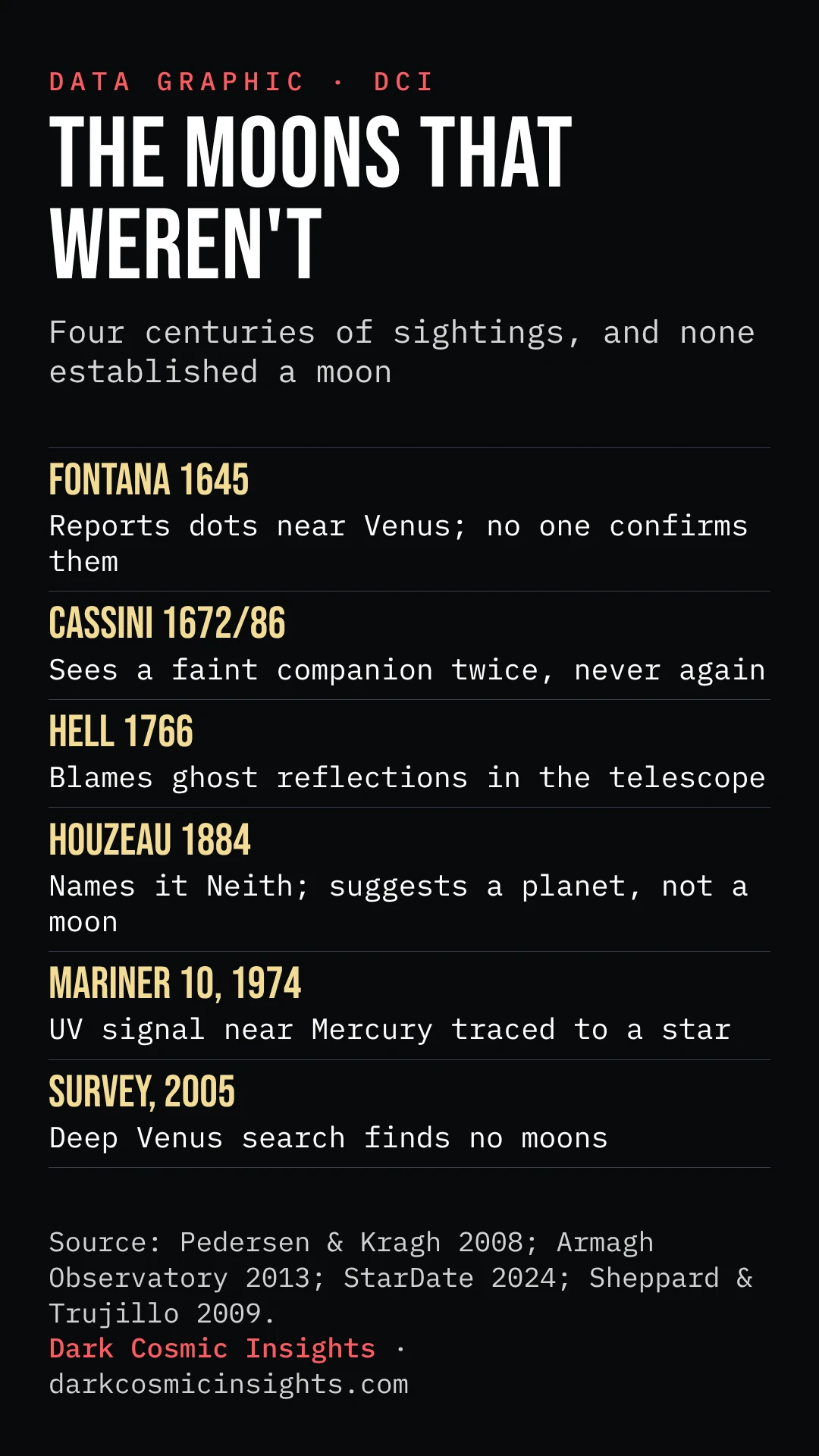
In November and December 1645 and January 1646, Francesco Fontana reported small dots following Venus. Few believed him, and others could not confirm the dots. In 1672 and again in 1686, Giovanni Domenico Cassini in Paris saw a faint object near Venus showing the same phase as the planet, but admitted he had seen it only those two times (Pedersen & Kragh 2008, Journal of Astronomical History and Heritage).
More reports followed: James Short in 1740, Andreas Mayer in 1759, several observers around the 1761 transit of Venus, and Peter Roedkiær and Christian Horrebow in Copenhagen up to January 1768. Short later said he no longer believed he’d seen a moon (Pedersen & Kragh 2008).
The explanation came from inside the telescope. In 1766, the astronomer Maximilian Hell argued that light from brilliant Venus was bouncing between the lenses and the observer’s eye, creating a faint copy of the planet beside it. Pedersen and Kragh conclude the moon was “a ghost image in the telescope” (Pedersen & Kragh 2008).
The name came late. In 1884, the astronomer Jean-Charles Houzeau suggested the object might be a small planet orbiting the Sun rather than a moon, and called it Neith, after an Egyptian goddess. In 1887, a paper from the Belgian Academy of Sciences went through the sightings and matched many of them to real stars near Venus at the time (Armagh Observatory and Planetarium, 2013; Paul Schlyter, Hypothetical Planets). Historian Helge Kragh tells the whole saga in The Moon that Wasn’t (Birkhäuser, 2008).
Mariner 10’s “moon” of Mercury
Mercury got its false alarm in the space age. On March 27, 1974, two days before Mariner 10’s closest approach, one of its instruments picked up a jump in ultraviolet light near Mercury. A few days later, as the spacecraft flew away, the source seemed to separate from the planet, the way a moon would (StarDate, McDonald Observatory, March 22, 2024).
The cameras showed no moon, and scientists concluded the source was a distant, very hot star. Later accounts identify it as the star 31 Crateris (Paul Schlyter, Hypothetical Planets).
The lesson of both stories: a moon claim needs a body that moves with the planet, again and again, on an orbit. One bright dot isn’t enough.
How Do Astronomers Search for Moons So Close to the Sun?
It’s harder than around Jupiter. Seen from Earth, both planets stay close to the Sun in the sky, so searches fight glare and often work in twilight, low in the sky. A later Venus survey by Petr Pokorný, Marc Kuchner and Scott Sheppard, hunting asteroids that share Venus’s orbit, was a “5 day twilight survey” on the 4 m telescope at Cerro Tololo, and it set upper limits rather than finding a population (Pokorný, Kuchner & Sheppard 2020). And the planets are dazzling: Venus’s glare is why the 2005 survey’s limit near the planet was about 1 km rather than 0.3 km.
The method is the one used around the giant planets: image the whole Hill sphere, take repeated exposures, look for dots that move with the planet while stars stay fixed, and then follow up to show the object really orbits the planet, not the Sun. That last step unmasked both Neith (an optical effect) and Zoozve (a body orbiting the Sun). Spacecraft avoid the glare by going there, which is why MESSENGER’s 2013 search from Mercury orbit is the closest look anyone has had. For how a “zero” like this is earned rather than assumed, see our How We Know hub.
Myth vs. Fact: Moonless Planets Edition
| Myth | Fact |
|---|---|
| “Venus has a moon called Zoozve.” | Zoozve is a quasi-satellite. It orbits the Sun, not Venus. |
| “Mercury is too small to have a moon.” | Small bodies can have moons (Pluto has five). The Sun’s nearby pull and solar tides matter more. |
| “Venus’s Hill sphere is too small for a moon.” | It’s about 1.0 million km, roughly two-thirds of Earth’s. Tides are the stronger argument. |
| “Astronomers once found Venus’s moon, Neith.” | Neith was a telescope ghost image and misread stars, never a real moon. |
| “Mariner 10 discovered a moon of Mercury.” | The ultraviolet source was a distant hot star. |
| “We know Venus lost its moon.” | That’s a hypothesis from models. No evidence of a lost moon has been found. |
Can You Look for These Moons Yourself?
You won’t find a moon, but you can see every piece of this story with a small telescope and a browser.
- Make your own “Neith.” After sunset, point a small telescope at Venus and look around the bright planet for a faint companion. If you see one, nudge the telescope or refocus: a ghost reflection shifts or changes with your optics, while a real object stays put against the stars. That’s the effect Hell described (Pedersen & Kragh 2008). Never point a telescope near the Sun.
- Trace Zoozve’s orbit. Look up “524522 Zoozve” in JPL’s Small-Body Database and open its orbit diagram to see it keep pace with Venus. Its H value is an absolute magnitude, a standard measure of intrinsic brightness, not how bright it looks from Earth; check an observing prediction before trying to spot it.
- See the search image. Open NASA’s PIA17388, “Looking Back at Us”, a frame from MESSENGER’s moon search that caught Earth and the Moon instead.
- Read the colours. NASA’s Mariner 10 view of Venus above is a false-colour composite. For what that means, see Are Space Photos Real?
What Comes Next for Mercury and Venus?
No mission is flying to look for moons, but new spacecraft will study both planets closely, as of November 2026.
BepiColombo at Mercury. ESA and JAXA’s BepiColombo completed the separation of its transfer module on 3 September 2026. The remaining milestones are plans: ESA’s timeline gives Mercury orbit entry on 21 November 2026, separation of its two orbiters (ESA’s MPO and JAXA’s Mio) on 9–10 December 2026, and the start of science in April 2027 (ESA, Latest updates: BepiColombo’s arrival at Mercury). ESA’s page has shown more than one version of this schedule, so check ESA for the current dates.
EnVision at Venus. ESA adopted EnVision in January 2024, committing to build it, with launch planned for 2031 on an Ariane 6 (ESA, January 25, 2024). An ESA team abstract from March 2026 says the launch “is scheduled for 2031” and science operations are expected to begin in mid-2034 (Straume-Lindner, Pacros et al., EGU26-4511).
VERITAS and DAVINCI. NASA’s VERITAS and DAVINCI Venus missions are listed as “Future Mission” on their NASA pages, last updated July 14, 2026, with no launch date stated there (NASA, VERITAS; NASA, DAVINCI).
None is designed as a moon search, but detailed Venus surface and chemistry data are the kind that could one day test ideas like the two-impact lost moon.
Mercury and Venus by the Numbers
- 0 and 0: known moons of Mercury and Venus, as of November 2026 (NASA Space Place)
- About 221,000 km (137,000 miles): Mercury’s Hill radius at its average distance; about 175,000 km (109,000 miles) at its closest to the Sun (DCI arithmetic)
- About 1.0 million km (621,000 miles): Venus’s Hill radius (Sheppard & Trujillo 2009)
- 243.018 days: one backward spin of Venus, longer than its 224.701-day year (JPL SSD; NASA NSSDCA)
- 3 spins per 2 orbits: Mercury’s lock, giving a 176-Earth-day solar day (NASA)
- About 0.3 km (980 feet): moon radius at which the 2005 survey had 50% detection efficiency in its outer fields (Sheppard & Trujillo 2009)
- 5 km (3.1 miles): the size above which Mariner 10 ruled out Mercury moons (Newswise)
- About 7,000 years: how long Zoozve has been Venus’s quasi-satellite, per Mikkola’s team (Mikkola et al. 2004)
- 1645: the first reported “moon” of Venus, by Francesco Fontana (Pedersen & Kragh 2008)
- 464 to 467 °C (737 to 740 K; 867 to 872 °F): Venus’s average surface temperature, by NASA’s fact sheet and NASA Science respectively (NSSDCA; NASA)
Mercury and Venus Moons: FAQ
Are Mercury and Venus the only planets without moons?
Yes. Of the eight planets, only Mercury and Venus have no known moons, as of November 2026. Earth has one, Mars has two, and the four giant planets have dozens or hundreds each.
Is Zoozve a real moon of Venus?
No. Zoozve (2002 VE68) is a quasi-satellite: a small asteroid that orbits the Sun with the same period as Venus, so from Venus it appears to loop around the planet. It isn’t gravitationally bound to Venus, and its discoverers’ model says it will move on in about 500 years.
Could Mercury or Venus gain a moon in the future?
A passing asteroid can become a temporary companion, as Zoozve shows. But tidal models suggest that slowly spinning planets this close to the Sun would struggle to keep a moon for long, so a lasting capture looks unlikely.
Why can Earth keep a moon when Venus can’t?
Earth spins once a day, so tides push our Moon gently outward, about 4 cm a year, into a safe zone. Venus spins once every 243 days, backward, so tides would pull a close moon inward instead. Earth’s larger distance from the Sun also gives it a bigger Hill sphere.
What is a Hill sphere, in simple terms?
It’s the region around a planet where it can hold on to satellites despite the Sun’s tidal pull. Its size grows with the planet’s mass and distance from the Sun. It isn’t a hard boundary: how far out a moon can stay stable over long times depends on its orbit, with estimates from about half to nearly the full Hill radius.
Was Mercury ever a moon of Venus?
That was proposed and examined in a 1976 study by Van Flandern and Harrington, but it isn’t the mainstream view. No modern evidence supports it. Treat it as a historical conjecture.
Has any spacecraft looked for moons around Mercury?
Yes. Mariner 10 ruled out moons larger than about 5 km in 1974, and NASA’s MESSENGER ran dedicated moon searches from orbit in 2013. NASA concluded that any moon of Mercury must be smaller than a few kilometres.
How small could an undiscovered Venus moon be?
The deepest survey, in 2005, found none. In its outer fields it had about a 50% chance of catching a moon roughly 0.3 km in radius, and near the planet’s glare it could only see objects of about 1 km in radius or more. So small moons, and less likely larger ones, can’t be fully ruled out, but there’s no sign of any.
Your next step: open NASA’s PIA17388 to see a real frame from MESSENGER’s moon search, then look up Zoozve’s orbit in JPL’s Small-Body Database. Then check our dated count in Which Planet Has the Most Moons? to see where zero sits among the eight planets.
Sources and Further Reading
- NASA Space Place (updated July 31, 2026), How Many Moons Are in Our Solar System?
- NASA JPL Solar System Dynamics (checked November 8, 2026), Planetary Satellite Discovery Circumstances; Planetary Physical Parameters.
- NASA JPL Small-Body Database, 524522 Zoozve (2002 VE68) (API record, checked November 8, 2026); NASA CNEOS, Asteroid Size Estimator.
- NASA NSSDCA planetary fact sheets: Mercury (updated January 11, 2024), Venus (January 11, 2024), Earth (November 15, 2024), Moon (January 11, 2024), Sun (May 9, 2024).
- NASA Science, Mercury Facts (updated April 25, 2025); Venus Facts (October 15, 2026); Venus (October 26, 2026); Moon Formation (July 23, 2026); Tidal Locking (July 23, 2026).
- NASA Science mission pages: Mariner 10, MESSENGER, VERITAS and DAVINCI (both updated July 14, 2026).
- NASA Photojournal: PIA17388, Looking Back at Us (July 22, 2013); PIA03103, Photomosaic of Mercury, Inbound View (Mariner 10; header image); PIA23791, Venus from Mariner 10 (June 8, 2020).
- Newswise / Johns Hopkins APL (July 2013), MESSENGER to Capture Images of Earth and Moon During Search for Satellites of Mercury.
- Sheppard, S. S., & Trujillo, C. A. (2009). A survey for satellites of Venus. Icarus. doi:10.1016/j.icarus.2009.02.008. arXiv:0906.2781.
- Domingos, R. C., Winter, O. C., & Yokoyama, T. (2006). Stable satellites around extrasolar giant planets. Monthly Notices of the Royal Astronomical Society, 373(3), 1227–1234. doi:10.1111/j.1365-2966.2006.11104.x
- Pokorný, P., Kuchner, M. J., & Sheppard, S. S. (2020). A Deep Search for Stable Venus Co-Orbital Asteroids: Limits on The Population. arXiv:2008.01149.
- Burns, J. A. (1973). Where are the satellites of the inner planets? Nature Physical Science, 242, 23–25. doi:10.1038/physci242023a0.
- Ward, W. R., & Reid, M. J. (1973). Solar tidal friction and satellite loss. Monthly Notices of the Royal Astronomical Society, 164(1), 21–32. doi:10.1093/mnras/164.1.21.
- Kumar, S. S. (1977). The escape of natural satellites from Mercury and Venus. Astrophysics and Space Science, 51(1), 235–238. doi:10.1007/BF00642476.
- Van Flandern, T. C., & Harrington, R. S. (1976). A dynamical investigation of the conjecture that Mercury is an escaped satellite of Venus. Icarus, 28(4), 435–440. doi:10.1016/0019-1035(76)90116-0.
- Alemi, A., & Stevenson, D. (2006). Why Venus has No Moon. AAS Division for Planetary Sciences Meeting Abstracts #38; coverage in Scientific American and Sky & Telescope (Tytell, D., October 10, 2006).
- Correia, A. C. M., & Laskar, J. (2001). The four final rotation states of Venus. Nature, 411, 767–770. doi:10.1038/35081000; PubMed record.
- Correia, A. C. M., & Laskar, J. (2004). Mercury’s capture into the 3/2 spin-orbit resonance as a result of its chaotic dynamics. Nature, 429, 848–850. doi:10.1038/nature02609.
- Paris Observatory (2004, July 1), La capture de Mercure en résonance spin-orbite 3/2; Laskar, J., IMCCE, The retrograde rotation of Venus.
- Mikkola, S., Brasser, R., Wiegert, P., & Innanen, K. (2004). Asteroid 2002 VE68, a quasi-satellite of Venus. MNRAS, 351(3), L63–L65. doi:10.1111/j.1365-2966.2004.07994.x; author PDF; Tuorla Observatory summary.
- IFLScience (Felton, J., February 6, 2024), Solar System’s first quasi-moon officially named Zoozve after error on child’s poster.
- Pedersen, K. M., & Kragh, H. (2008). The Phantom Moon of Venus, 1645–1768. Journal of Astronomical History and Heritage, 11(3), 227–234. PDF.
- Kragh, H. (2008). The Moon that Wasn’t: The Saga of Venus’ Spurious Satellite. Birkhäuser.
- Armagh Observatory and Planetarium (Redpath, M., February 8, 2013), 8 Phantom Moons and Planets; Schlyter, P., Hypothetical Planets.
- StarDate, McDonald Observatory (March 22, 2024), Evening Mercury.
- University of Illinois Physics, Ask the Van (January 19, 2012), Why doesn’t Mercury have any moons?
- ESA, Latest updates: BepiColombo’s arrival at Mercury (checked November 8, 2026); ESA (2024, January 25), We’re heading for Venus: ESA approves EnVision; Straume-Lindner, A. G., Pacros, A., et al. (2026), Objectives and status of the Envision Venus mission, EGU26-4511.
Explore Next
- Zero in context, with every planet’s dated count: Which Planet Has the Most Moons?
- Why Venus, not Mercury, is the hottest: What Is the Hottest Planet?
- A moon that tides are pulling down: How Many Moons Does Mars Have?
- Our own Moon is changing too: Why Is the Moon Shrinking?
- What “false colour” means in space images: Are Space Photos Real?
- How every claim here is labelled: How We Know
- More from the planets: Planets & Moons
- Titan, Enceladus and Saturn’s crowd of moons: How Many Moons Does Saturn Have?
- Triton’s backwards orbit and Neptune’s moons: How Many Moons Does Neptune Have?
How This Explainer Was Checked
Every number in this article was checked on November 8, 2026 against the source linked beside it: NASA Space Place, NASA Science and Photojournal pages, NASA’s NSSDCA fact sheets, JPL’s satellite, planetary and small-body tables, ESA pages, and peer-reviewed papers (read via arXiv, author PDFs, publisher abstracts and records, with DOIs given). The zero count for both planets is NASA’s, dated as of November 2026. Hill-sphere radii, synchronous-orbit distances, Zoozve’s closest and farthest distances from the Sun and its size range, the Earth–Moon ratios and all mile, foot, kelvin and Fahrenheit conversions are DCI’s own arithmetic from the cited values; the Venus Hill radius matches Sheppard and Trujillo’s published 1.0 million km. Where sources differ we say so: Venus’s surface temperature (464 °C on NASA’s fact sheet, 467 °C on NASA Science), Venus’s solar day (116.75 days from the fact sheet’s 2,802.0 hours), and Maximilian Hell’s explanation (1766 in Pedersen and Kragh’s text, 1765 in their reference list). Mariner 10’s 5 km limit comes from the MESSENGER team’s 2013 release, not a Mariner 10 paper. The identification of the 1974 ultraviolet source as 31 Crateris and the 1884 naming of Neith come from secondary historical sources, linked in place. Lost-moon ideas are labelled as hypotheses and tidal explanations as models. Mission dates are given as ESA and NASA state them, dated, and planned events are called planned. Images are labelled: real spacecraft or telescope images as OBSERVATION, illustrations as ILLUSTRATION, and our charts as DATA GRAPHIC. Nothing AI-generated is presented as a real image.
Final Thought: An Empty Orbit Is Still Evidence
Zero sounds like nothing to write about. But Mercury’s and Venus’s empty skies are a measurement, earned by a 1974 flyby, a 2013 orbital search and a night of deep imaging in Chile. The Sun’s reach and the slow spins of both planets explain a lot of that emptiness. Whether Venus once had a moon and swallowed it is still a good question with no answer. The next clues may come from rocks that no spacecraft has yet brought home.
About the Author
Author: King | Founder of Dark Cosmic Insights
King is the founder of Dark Cosmic Insights, a science storytelling platform exploring the strangest true stories hiding in space, science and AI. He digs into NASA, ESA and peer-reviewed research, separates what has been measured from what is still a mystery, and turns it into articles, data graphics and Shorts.
Follow the anomaly. Trace the source.