In 2013, astronomers using the Hubble Space Telescope put an age on a nearby star called HD 140283. They got 14.5 billion years, give or take 0.8 billion (NASA, March 7, 2013). The universe, by the best estimates, is only about 13.8 billion years old. NASA called it “an obvious dilemma.”
It isn’t a paradox once you read the error bars, and that’s the point of this guide. How old is the universe, and how can anyone know? The answer comes from three complementary clocks that cross-check one another: the oldest light in the sky, the rate at which space is expanding, and the oldest stars we can date. This guide shows how each clock works, where they agree, and where one of them, the expansion rate, refuses to line up.
Observed, modelled, open. The leftover glow of the early universe, its temperature, and the expansion of space are observed or measured. The age itself, about 13.8 billion years, is modelled: it comes from fitting measured light to the standard model of cosmology, called ΛCDM (lambda cold dark matter). Star ages are modelled too. Why two kinds of expansion-rate measurement disagree, the Hubble tension, is still open.
Quick Answer: How Old Is the Universe?
The universe is about 13.8 billion years old. A widely quoted figure, 13.787 ± 0.020 billion years, comes from fitting the standard cosmological model to the European Space Agency’s Planck maps of the cosmic microwave background, the oldest light we can see, combined with galaxy-clustering (BAO) data (Planck Collaboration 2020, Table 2). The Atacama Cosmology Telescope, in an analysis calibrated to Planck, got 13.8 billion years in 2025. The oldest star clusters, dated separately, come out at roughly 13.3 to 13.8 billion years, consistent with that age.
What this article can and cannot establish. It can show how each age estimate is made, what it assumes, and how well the different methods cross-check one another, with every number dated and sourced. It cannot tell you the age without a model: the 13.8-billion-year figure is an inference from data, not a stopwatch reading. And it cannot resolve the Hubble tension, which, as of November 2026, nobody has.
Table of Contents
The DCI Evidence Map: The Age of the Universe
| Question | What we know | Status | Key source |
|---|---|---|---|
| What age does the CMB give? | 13.787 ± 0.020 billion years, from Planck CMB data plus BAO, fitted with ΛCDM | Modelled | Planck Collaboration 2020 |
| Is there a leftover glow from the early universe? | Yes: the cosmic microwave background, at 2.72548 ± 0.00057 K | Measured | Fixsen 2009 |
| Does a second CMB telescope agree? | ACT’s 2025 analysis, calibrated to Planck, gives 13.8 billion years, with a 0.1% uncertainty | Modelled | Princeton/ACT, Mar 18, 2025 |
| How old are the oldest star clusters? | Metal-poor globular clusters average 13.61 ± 0.25 (stat) ± 0.23 (sys) billion years (2026 study) | Modelled | Valcin et al. 2026 |
| How fast is space expanding nearby? | 73.50 ± 0.81 km/s/Mpc from a 2026 combination of local distance methods | Measured | H0DN Collaboration 2026 |
| Do local and early-universe expansion rates agree? | No: the local value sits 7.1σ from the early-universe ΛCDM value of 67.24 ± 0.35 | Measured | H0DN Collaboration 2026 |
| What causes the Hubble tension? | Unknown; new Webb data argue against a simple measurement error | Open | NASA, Mar 11, 2024 |
| Is dark energy changing over time? | DESI prefers evolving dark energy at 2.8σ to 4.2σ, depending on the data combined | Open | DESI Collaboration 2025 |
| Is any star older than the universe? | HD 140283’s 14.5 ± 0.8 billion years overlaps the 13.8-billion-year age | Not supported | NASA, Mar 7, 2013 |
| Do Webb’s early galaxies contradict the age? | Galaxies seen about 280 to 290 million years after the Big Bang fit inside a 13.8-billion-year history | Not supported | Carniani et al. 2024 · Naidu et al., arXiv:2505.11263 |
Status key: Observed = seen directly in images or spectra. Measured = a number or detection with stated uncertainty. Modelled = inferred from measurements through a physical model, dependent on assumptions. Open = unresolved; the evidence is incomplete or points different ways. Not supported = no evidence for the claim.
Cite this framework: “DCI Evidence Map: The Age of the Universe,” Dark Cosmic Insights, November 2026, darkcosmicinsights.com/how-old-is-the-universe/.
What Does “the Age of the Universe” Mean?
When cosmologists give the age of the universe, they mean the time since the hot, dense early phase we call the Big Bang, as calculated within a model of how the universe has expanded. It isn’t the age of any single object. Nobody can carbon-date the cosmos.
So the honest answer has two parts: a number, about 13.8 billion years, and the model that produced it, ΛCDM. “Λ” (lambda) stands for dark energy, the unknown something that NASA says scientists suspect is speeding up cosmic expansion, which was discovered in 1998 when distant supernovae looked fainter than expected (NASA Science, Universe Overview). “CDM” stands for cold dark matter, unseen matter that shapes how structure grows.
Planck’s final analysis found the six-parameter version of this model fits its data well, with “no compelling evidence for extensions to the base-ΛCDM model” (Planck Collaboration 2020). That good fit gives the age its authority, and it’s why a crack in the model, such as the Hubble tension, matters.
How Old Is the Big Bang?
The Big Bang is the starting line for the cosmic clock, so it’s about 13.8 billion years old.
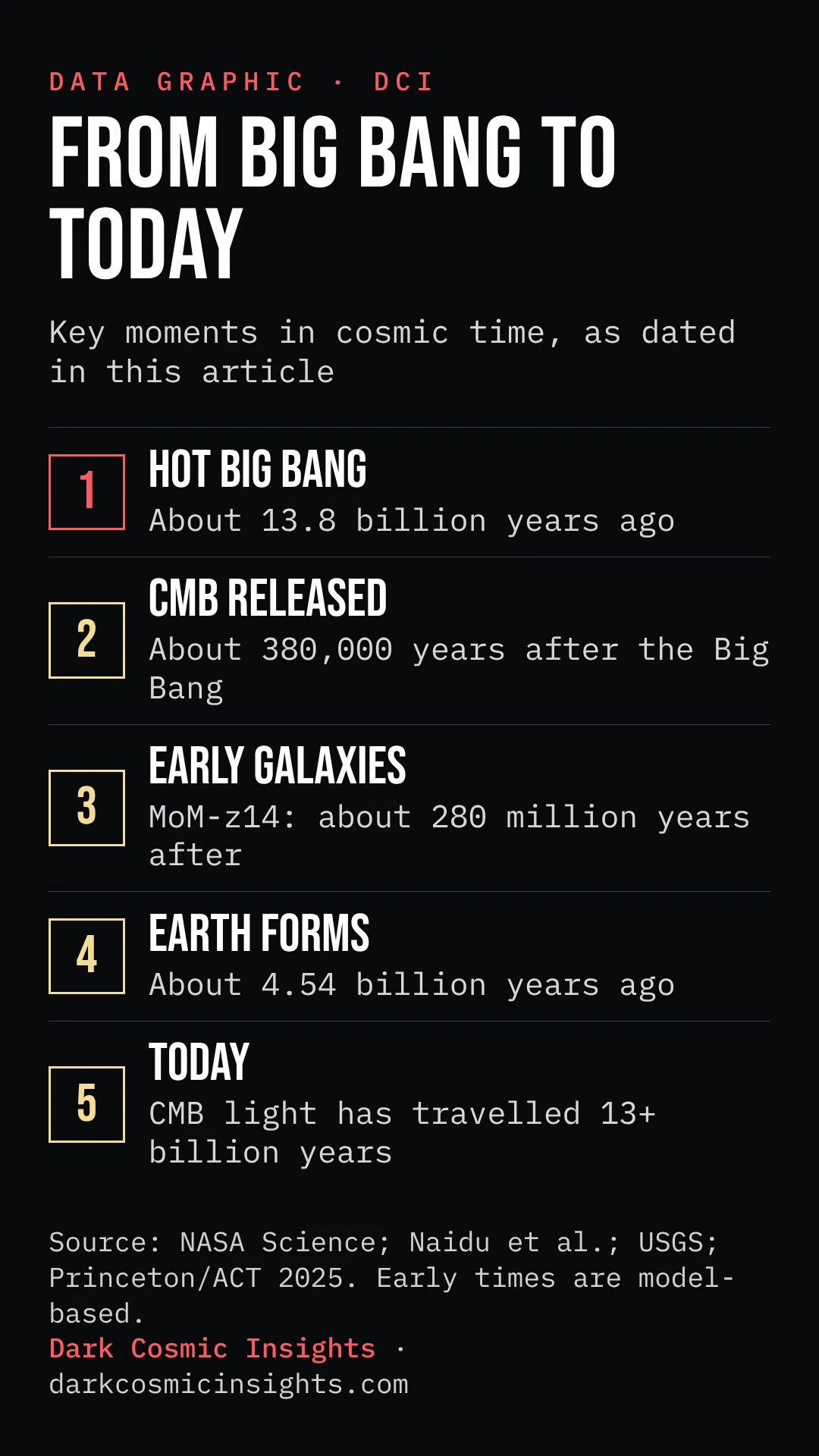
NASA says that around 13.8 billion years ago the universe went through a brief burst of faster-than-light expansion, called inflation, and that when inflation ended its energy went into matter and light, the moment NASA calls the big bang (NASA Science, Universe Overview). Inflation itself is a theory: a model of the very first instant, not something we’ve seen directly.
What we can see comes later. NASA dates the release of the cosmic microwave background to around 380,000 years after the big bang, when atoms formed and space became transparent to light (NASA Science, Universe Overview). Everything before that moment is reconstructed, not observed.
How Do Scientists Know the Age of the Universe?
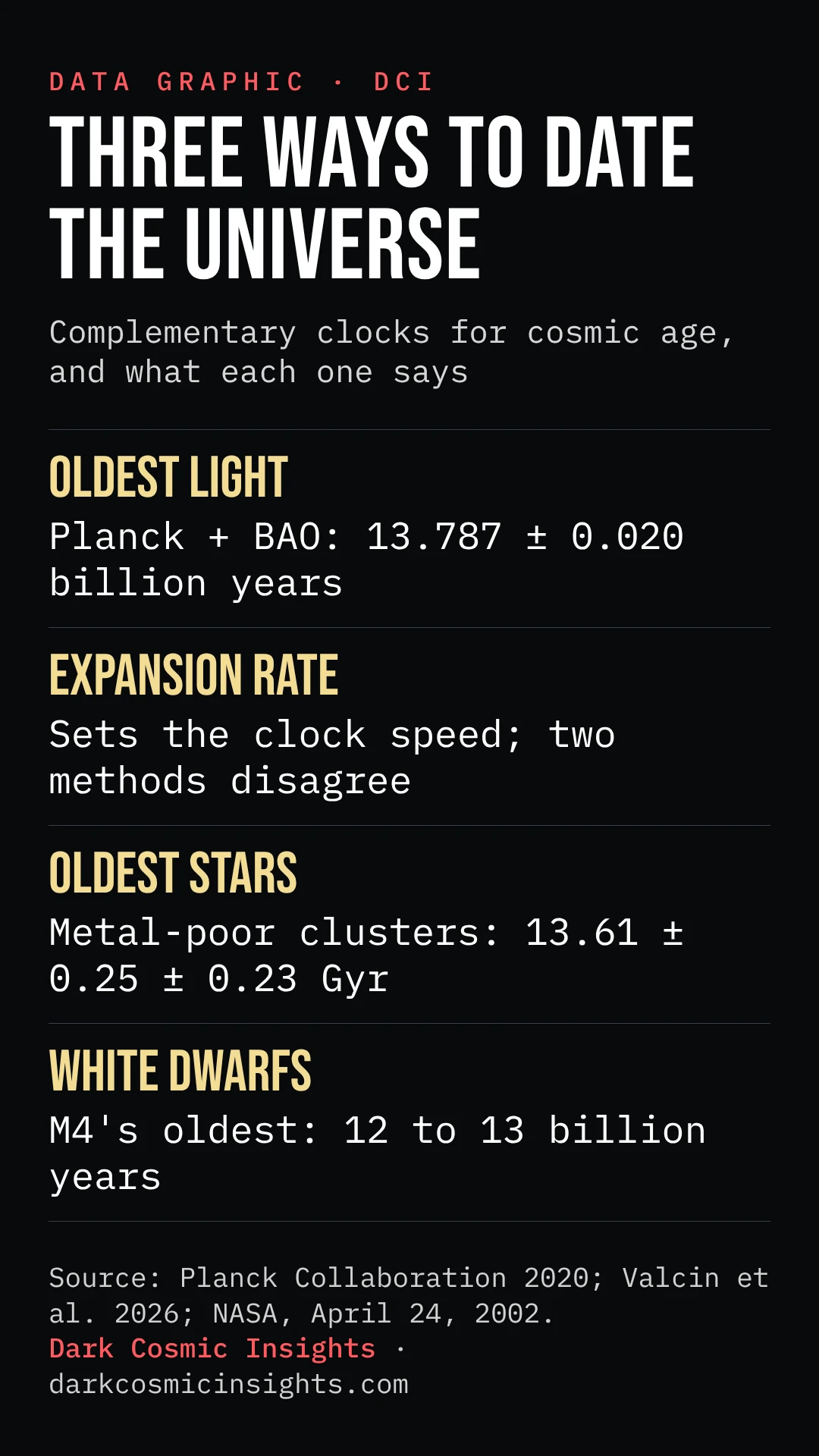
There’s no single measurement. Astronomers read three clocks that tick for different reasons, then check whether they agree. They’re complementary cross-checks rather than fully independent: CMB analyses share calibration and data, and star ages depend on stellar models. Our How We Know hub explains how DCI labels evidence like this.
Clock 1: the oldest light
The cosmic microwave background (CMB) is a snapshot of the universe at about 380,000 years old. Its pattern of hot and cold spots encodes the universe’s ingredients. Feed those ingredients into ΛCDM, run the expansion forward, and you get an age. It’s the most precise of the three, and it depends on the model.
Clock 2: the expansion rate
Galaxies are moving apart as space expands. The rate today is the Hubble constant, written H0. If you know how fast things are spreading out, and how that rate has changed, you can work out how long ago everything was together. This clock is where the trouble is.
Clock 3: the oldest stars
Stars can be dated using models of how they burn their fuel, and dead stars by how far they’ve cooled. The universe can’t be younger than the oldest things in it. This clock gives a minimum age, and it works almost independently of cosmology. A 2020 study described its estimate as made “largely independently of the cosmological parameters” (Valcin et al. 2020).
What Is the Cosmic Microwave Background?
The cosmic microwave background is, in NASA’s words, “the oldest light we can observe in the universe” (NASA Science, Universe Overview). Today it arrives as microwaves, which is where the name comes from.
Its temperature is known precisely: 2.72548 ± 0.00057 K in a 2009 analysis of the literature (Fixsen 2009). That’s about −270.42 °C (−454.76 °F), less than 3 degrees above absolute zero. (Our guide to how cold space is covers what that means for the rest of the cosmos.) The discovery earned Arno Penzias and Robert Wilson a share of the 1978 Nobel Prize in Physics, “for their discovery of cosmic microwave background radiation” (Nobel Prize).

How a glow becomes an age
The CMB isn’t perfectly smooth. It has tiny temperature differences from spot to spot, and their typical size on the sky is set by the sound horizon, the distance sound waves could travel through the early universe before the light was released. ACT’s 2025 paper defines the key parameter, θ\* (theta-star), as the “angular size of sound horizon at last scattering” (Louis et al. 2025).
Planck measured that angle to about 0.03% precision, along with the densities of ordinary matter and dark matter (Planck Collaboration 2020). Once you know what the universe is made of, ΛCDM tells you how fast it expanded at every stage, and adding up that history gives the age.
What Planck actually reported
Planck’s 2018 results, published in Astronomy & Astrophysics in 2020, give several ages depending on which data are combined (Planck Collaboration 2020, Table 2):
| Planck data combination | Age (billion years) | H0 (km/s/Mpc) |
|---|---|---|
| TT+lowE | 13.830 ± 0.037 | 66.88 ± 0.92 |
| TT,TE,EE+lowE+lensing | 13.797 ± 0.023 | 67.36 ± 0.54 |
| TT,TE,EE+lowE+lensing+BAO | 13.787 ± 0.020 | 67.66 ± 0.42 |
The often-quoted 13.787 ± 0.020 is the last row, which adds baryon acoustic oscillations (BAO), a pattern in how galaxies cluster. The headline Hubble constant in the paper’s abstract, 67.4 ± 0.5 km/s/Mpc, comes from the CMB-only combination (Planck Collaboration 2020). Different rows, slightly different answers, all inside about 0.05 billion years of each other.
Newer CMB telescopes, dated
Two ground-based telescopes have since published their own maps, though their headline analyses also draw on Planck.
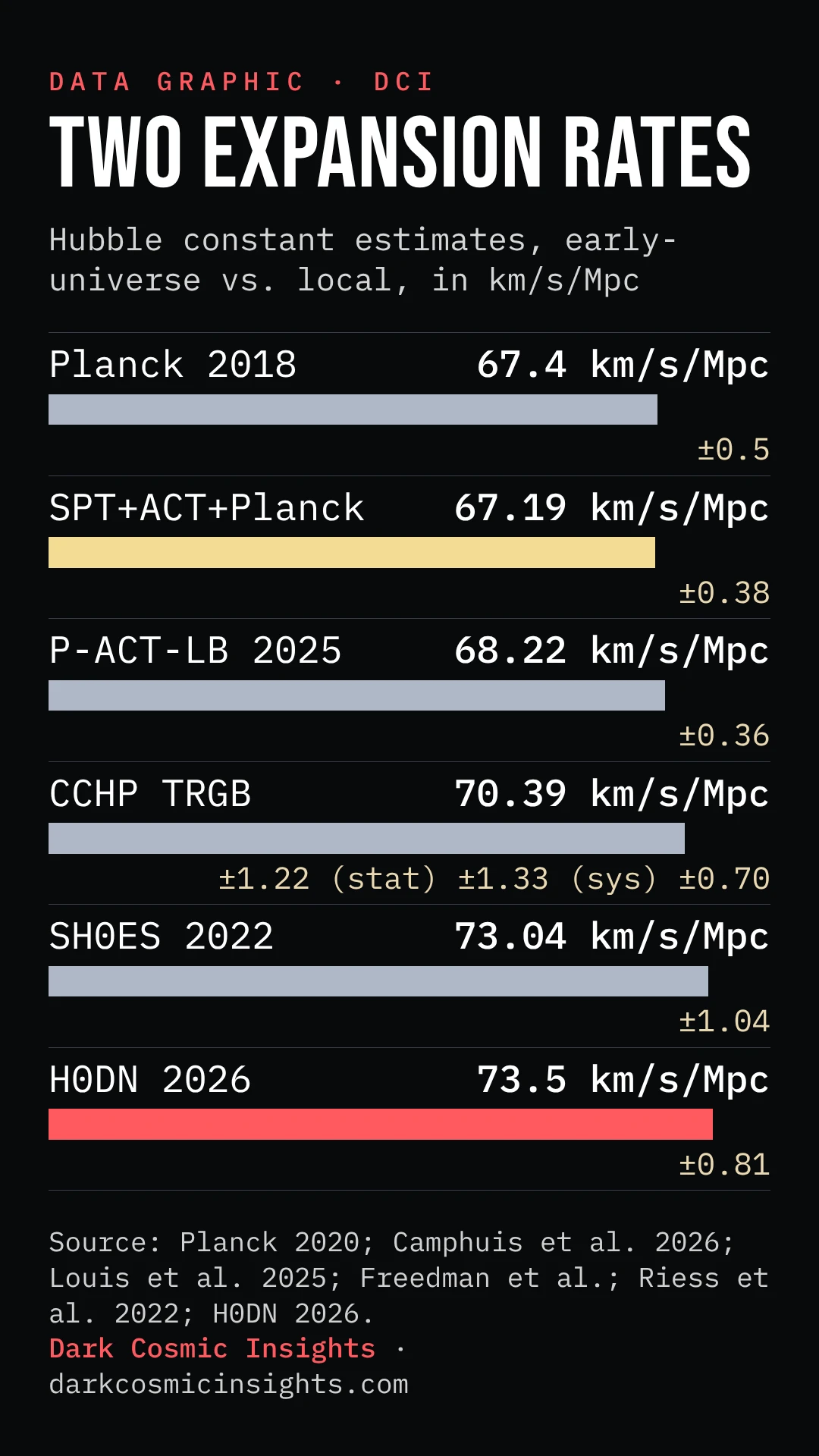
- Atacama Cosmology Telescope (ACT), March 2025. ACT’s Data Release 6 covered 19,000 square degrees with polarization noise three times lower than Planck’s (Louis et al. 2025). Princeton’s release put the age at 13.8 billion years, with an uncertainty of 0.1% (Princeton/EurekAlert, March 18, 2025). ACT’s analysis is not fully separate from Planck: the team refines its map calibration against Planck’s temperature maps, takes the optical depth from Planck’s large-scale polarization data, and builds its headline P-ACT dataset by adding larger-scale Planck data (Louis et al. 2025). Combined with Planck, lensing and DESI’s first-year BAO, ACT found H0 = 68.22 ± 0.36 km/s/Mpc (the combination the paper calls P-ACT-LB), tightening to 68.43 ± 0.27 with DESI’s second data release.
- South Pole Telescope (SPT-3G), 2025–2026. SPT-3G alone gave H0 = 66.66 ± 0.60 km/s/Mpc; combining SPT, ACT and Planck gave 67.19 ± 0.38 (Camphuis et al. 2026, Physical Review D).
ACT’s data did not lean toward the higher, local expansion rate. Suzanne Staggs said it was slightly surprising that “we didn’t find even partial evidence to support the higher value” (Princeton/EurekAlert). Three CMB experiments, with separate telescopes but shared calibration and overlapping data, tell essentially the same story.
How Does the Expansion Rate Set the Clock?
The Hubble constant is measured in kilometres per second per megaparsec (km/s/Mpc). A megaparsec is a million parsecs, and one parsec is about 3.26 light-years (Swinburne COSMOS), so a megaparsec is about 3.26 million light-years. An H0 of 70 means a galaxy one megaparsec away is receding at about 70 km/s, and one twice as far at about 140 km/s.
The back-of-envelope age
Flip the Hubble constant over and you get a time, called the Hubble time. It extrapolates today’s recession speeds straight back in time, assuming the expansion never sped up or slowed down. These are DCI’s own conversions, using 1 Mpc = 3.086 × 10^19 km:
- H0 = 67.4 km/s/Mpc gives a Hubble time of about 14.5 billion years.
- H0 = 73.04 km/s/Mpc gives about 13.4 billion years.
Neither is the actual age, because the expansion rate hasn’t been constant; NASA says expansion is currently speeding up, which scientists suspect is the work of dark energy. With the Planck-plus-BAO mix of ingredients, the real age (13.787 billion years) works out about 5% shorter than the Hubble time for its H0 of 67.66 (about 14.45 billion years, by our arithmetic).
The rule of thumb still holds: a faster expansion rate means a younger universe, if everything else stays the same. A 2023 study made the point directly, noting that the age of the universe is very sensitive to H0 (Cimatti & Moresco 2023). That’s why the Hubble tension is also an age question.
What Is the Hubble Tension?
The Hubble tension is a disagreement between two ways of finding H0. One reads it from the early universe, through the CMB and ΛCDM. The other measures it directly in the nearby universe, by finding distances to galaxies and how fast they’re receding. The two keep coming out different, by more than their error bars allow.
The early-universe side
CMB-based values, listed above, cluster around 67 to 68 km/s/Mpc. Princeton’s ACT release summed it up the same way, with CMB-derived values of 67 to 68 and nearby-galaxy measurements of 73 to 74 (Princeton/EurekAlert).
The local side
Local measurements use a cosmic distance ladder, in which each rung calibrates the next: nearby distances calibrate pulsing stars called Cepheids, which in turn calibrate more distant Type Ia supernovae.
- SH0ES, 2022: Adam Riess’s team measured 73.04 ± 1.04 km/s/Mpc using Cepheids in the host galaxies of 42 Type Ia supernovae, a 5σ difference from Planck plus ΛCDM (Riess et al. 2022).
- Webb checks, 2024: NASA reported that Webb observations of about 1,000 Cepheids in five host galaxies of eight Type Ia supernovae confirmed Hubble’s Cepheid measurements, addressing a concern about crowded stars (NASA, March 11, 2024). Riess called the remaining gap “the real and exciting possibility we have misunderstood the universe.”
- CCHP, 2024–2025: Wendy Freedman’s team, using different stars, found 70.39 ± 1.22 (stat) ± 1.33 (sys) ± 0.70 km/s/Mpc from the tip of the red giant branch, and 67.80 ± 2.17 (stat) ± 1.64 (sys) from JAGB stars, a type of carbon-rich giant, and said their results are consistent with ΛCDM (Freedman et al., arXiv:2408.06153).
- H0DN, April 2026: A community “Local Distance Network” combined many methods into 73.50 ± 0.81 km/s/Mpc, 7.1σ from an early-universe ΛCDM value of 67.24 ± 0.35 (H0DN Collaboration 2026, A&A 708, A166).
So the local side isn’t unanimous: CCHP’s values sit between the two camps.
Why it matters for the age
If you trust ΛCDM and the CMB, the age is about 13.8 billion years. If the local expansion rate of about 73 is right, then something in the model has to change, and with it the calculated age. The same SPT-3G paper also flagged a 2.8σ difference between CMB and DESI’s BAO results within ΛCDM (Camphuis et al. 2026).
DESI, the Dark Energy Spectroscopic Instrument, mapped more than 14 million galaxies and quasars over three years. Its second data release prefers dark energy that changes over time over ΛCDM at 3.1σ when combined with the CMB, and 2.8σ to 4.2σ when supernovae are added, depending on the sample (DESI Collaboration 2025). That’s a preference, not a confirmed detection, and DESI’s own wording is cautious, conditional on there being no “unknown systematic error associated with one or more datasets.”
As of November 2026, the cause of the Hubble tension is open. Proposals range from unrecognised errors in one or more datasets to missing physics. None has won. For a very different kind of cosmic yardstick, see our story on the SN Refsdal supernova replay.
How Old Are the Oldest Stars?
A universe can’t be younger than its oldest residents. Star ages, though, are modelled: they come from comparing a star’s measured brightness, colour and distance with computer models of how stars evolve. Our guide to how astronomers measure stars explains where those inputs come from, and the life cycle of a star covers the models.
Globular clusters
Globular clusters are dense, ball-shaped clusters of old stars. Their stars formed at about the same time, so the point where stars start to leave the main sequence, the long, stable part of a star’s life, acts as a clock. It’s called the main-sequence turn-off.
- M92, 2023: A team with first author Jiaqi (Martin) Ying ran 20,000 sets of stellar models, fitted them around M92’s turn-off, and found an age of 13.80 ± 0.75 billion years; about 80% of the uncertainty comes from the cluster’s distance (Ying et al. 2023, AJ 166, 18).
- Many clusters, 2020 to 2026: David Valcin and colleagues have published a series of studies. The 2020 paper found clusters of 13.32 ± 0.1 (stat) ± 0.5 (sys) billion years and a universe of 13.5 (+0.16/−0.14 stat, ±0.5 sys) billion years (Valcin et al. 2020). A 2025 update using Gaia distances found the oldest clusters at 13.39 ± 0.10 (stat) ± 0.23 (sys) billion years, implying a universe of 13.57 (+0.16/−0.14 stat, ±0.23 sys) (Valcin et al. 2025). A March 2026 study modelling two star populations per cluster found the old component of metal-poor clusters at 13.61 ± 0.25 (stat) ± 0.23 (sys) billion years and, adding a conservative delay before the first clusters formed, a universe of 13.81 ± 0.25 (stat) ± 0.23 (sys) billion years (Valcin et al. 2026).
These studies use different samples and assumptions, and each is compatible with the CMB age.
White dwarfs
A white dwarf is the hot, dense remnant of a dead star, mostly carbon. NASA explains that white dwarfs cool at a predictable rate, so the cooler one is, the older. In 2002, Hubble observations of white dwarfs in the globular cluster M4 dated the oldest to 12 to 13 billion years (NASA, April 24, 2002). Lead astronomer Harvey Richer described the method as “a completely independent way of pinning down that value.”
Uranium in an ancient star
Stars can also be dated the way geologists date rocks: by radioactive decay. In 2001, a team measured uranium in the old star CS 31082-001 and got 12.5 ± 3 billion years, an estimate the authors noted is still model dependent (Cayrel et al. 2001, Nature 409, 691).
Using star ages to test the expansion rate
The stellar clock can push back on the expansion clock. A 2023 study took the oldest objects with accurate ages (older than 13.3 billion years) and, assuming a matter density of 0.3 ± 0.02, found H0 below 70.6 km/s/Mpc using the most accurate individual ages, and below 73.0 with 90.3% probability using averaged subsamples (Cimatti & Moresco 2023). That result depends on its assumptions, but it shows why the oldest stars matter to the Hubble tension.
Can a Star Be Older Than the Universe?
HD 140283, nicknamed the “Methuselah star,” lies 190.1 light-years away. Hubble’s Fine Guidance Sensors measured its distance about five times more precisely than the Hipparcos satellite had, and stellar models gave an age of 14.5 ± 0.8 billion years (NASA, March 7, 2013).
The low end of that range, 13.7 billion years, overlaps the universe’s 13.8. NASA notes that earlier estimates had run as high as 16 billion years, and that with the remaining uncertainty the star’s age is compatible with the universe’s. So no, no star is known to be older than the universe.
Do Webb’s Early Galaxies Break the Age of the Universe?
In 2023, Ivo Labbé’s team reported six candidate massive galaxies seen about 500 to 700 million years after the Big Bang, each apparently over 10 billion Suns of stars, one possibly about 100 billion (Labbé et al. 2023, Nature 616, 266). The worry was whether galaxies could grow that big that fast.
That’s a question about how fast galaxies grew, not about how old the universe is. And a 2024 University of Texas at Austin study eased it: some early galaxies looked more massive because feeding black holes added extra light. With those compact “little red dots” set aside, the remaining galaxies fit within standard-model predictions (UT Austin, August 26, 2024). UT astronomer Steven Finkelstein said “there is no crisis in terms of the standard model of cosmology.” The study still found about twice as many massive early galaxies as predicted, so that part is open.
Two very distant galaxies confirmed with Webb spectra also sit comfortably inside the age:
- JADES-GS-z14-0, at a redshift of 14.32 (+0.08/−0.20), seen about 290 million years after the Big Bang (ESA, May 30, 2024; Carniani et al. 2024, Nature 633, 318).
- MoM-z14, at a spectroscopic redshift of 14.44 ± 0.02, about 280 million years after the Big Bang (Naidu et al., arXiv:2505.11263).
Redshift is how much the light has been stretched by expansion, which astronomers measure from a spectrum. Turning a redshift into “million years after the Big Bang” uses the standard cosmological model. Either way, a galaxy at 280 million years sits easily inside a 13.8-billion-year history. To see how Webb’s infrared view differs from Hubble’s, try our Hubble vs. Webb comparison.
How Has the Estimate Changed Since Hubble?
- Edwin Hubble’s first estimate, from his expansion measurements, was about 2 billion years (NASA, April 24, 2002). That’s younger than Earth, which the US Geological Survey dates to about 4.54 billion years, “with an uncertainty of less than 1 percent” (USGS). Something in the early measurements had to be wrong.
- 1997: NASA notes that Hubble Space Telescope astronomers announced a reliable age based on a precise expansion-rate measurement, and that including dark energy the age is 13 to 14 billion years, consistent with the white dwarf clock (NASA, April 24, 2002).
- 2013, WMAP: NASA’s Wilkinson Microwave Anisotropy Probe, in its final combined analysis, gave 13.772 ± 0.059 billion years (Bennett et al. 2013, ApJS 208, 20).
- 2018–2020, Planck plus BAO: 13.787 ± 0.020 billion years (TT,TE,EE+lowE+lensing+BAO) (Planck Collaboration 2020).
- 2025, ACT: 13.8 billion years, 0.1% uncertainty (Princeton/EurekAlert).
Since WMAP, the CMB estimates have moved by only about 0.02 billion years while their uncertainties shrank.
Myth vs. Fact: The Age of the Universe
| Myth | Fact |
|---|---|
| “Scientists measured the universe’s age directly.” | The 13.8-billion-year age is modelled: measured CMB data fitted with ΛCDM. |
| “A star has been found that’s older than the universe.” | HD 140283’s 14.5 ± 0.8 billion years overlaps the 13.8-billion-year age. |
| “Webb’s early galaxies proved the Big Bang wrong.” | Galaxies at about 280 to 290 million years fit inside the age; the open question is how fast they grew. |
| “The Hubble tension means the age is unknown.” | The CMB-based age is precise within ΛCDM; the tension asks whether ΛCDM is complete. |
| “The observable universe is 13.8 billion light-years across.” | Space has expanded while the light travelled; ACT’s release says it extends almost 50 billion light-years in every direction. |
| “The age has always been 13.8 billion years.” | Edwin Hubble’s first estimate was about 2 billion years, younger than Earth. |
The observable-universe figure comes from Princeton’s ACT release (EurekAlert); Hubble’s early estimate from NASA (NASA, 2002).
How Can You See the Evidence for Yourself?
You can’t see the CMB with a backyard telescope, but you can see the star clock yourself and explore the CMB online.
Find an ancient star cluster
- M4 in Scorpius. NASA lists it at magnitude 5.9, about 5,500 light-years away, and says it’s best spotted in July and appears as a fuzzy ball of light in a small telescope (NASA, Messier 4). NASA’s 2002 release gives 5,600 light-years, so sources differ slightly. Its oldest white dwarfs are the 12-to-13-billion-year clock described above.
- M92 in Hercules. Magnitude 6.3, about 27,000 light-years away, most easily spotted in July, and visible to the unaided eye from a dark-sky site under good conditions, according to NASA, which says its age is “almost the same as the age of the Universe” (NASA, Messier 92).
The “July” advice comes from NASA’s general Messier pages; check a sky chart for your own location and latitude before you go out.
Explore the oldest light
NASA’s LAMBDA archive, described as “a multi-mission NASA center of expertise” for CMB research, offers CMB survey data from experiments including ACT and SPT, plus a “Build a Universe” teaching tool (NASA LAMBDA). When you look at CMB maps, remember the colours are a code for tiny temperature differences, not what your eye would see. Our guide Are Space Photos Real? explains how scientific images map invisible light to colour.
What Comes Next for Cosmic Age Measurements?
New survey telescopes will test the model next. Status as of November 2026:
- NASA’s Nancy Grace Roman Space Telescope. Roman’s mission page lists its launch date as August 30, 2026 and says it will help “settle essential questions in the areas of dark energy” (NASA Science, Roman). An October 22, 2026 NASA update reported that Roman had entered its science commissioning phase, with test observations still to finish before science operations (NASA Roman blog).
- ESA’s Euclid. ESA’s timeline, updated June 15, 2026, says the first stage of Euclid’s first data release, “DR1-Foundation,” is planned for November 2026, covering about 1,900 square degrees, with higher-level galaxy-clustering and weak-lensing products planned for mid-2027 (ESA Euclid DR1 timeline).
- More stellar clocks. The 2026 globular-cluster study shows the stellar side is still sharpening, with its authors concluding the method is robust to stellar population complexity (Valcin et al. 2026).
The Age of the Universe by the Numbers
- 13.787 ± 0.020 billion years: Planck plus BAO age, TT,TE,EE+lowE+lensing+BAO (Planck 2020, Table 2)
- 13.8 billion years, ±0.1%: ACT’s 2025 age (Princeton/EurekAlert)
- About 380,000 years: the universe’s age when the CMB was released (NASA)
- 2.72548 ± 0.00057 K (about −270.42 °C, −454.76 °F): CMB temperature (Fixsen 2009)
- 67.24 ± 0.35 vs. 73.50 ± 0.81 km/s/Mpc: early-universe vs. local expansion rate, 7.1σ apart (H0DN 2026)
- 13.61 ± 0.25 ± 0.23 billion years: mean age of the old component in metal-poor globular clusters (Valcin et al. 2026)
- 14.5 ± 0.8 billion years: HD 140283, about 190.1 light-years away, roughly 1.8 quadrillion km (1.1 quadrillion miles) (NASA 2013)
- 27,000 light-years: distance to the ancient cluster M92, roughly 255 quadrillion km (159 quadrillion miles) (NASA, Messier 92)
- About 280 million years: when we see MoM-z14, after the Big Bang (Naidu et al.)
- Almost 50 billion light-years: the observable universe in every direction, roughly 470 sextillion km (290 sextillion miles) (Princeton/EurekAlert)
Kilometre and mile conversions are DCI’s arithmetic, using NASA’s light-year of about 63,197 au (NASA glossary), or about 9.45 trillion km (5.87 trillion miles).

The Age of the Universe: FAQ
Is the universe exactly 13.8 billion years old?
Not exactly. The figure combining Planck with BAO data is 13.787 ± 0.020 billion years, and other data combinations give values between about 13.76 and 13.83 billion years. Every figure depends on the standard cosmological model, ΛCDM, being the right description of how the universe expanded.
Could the universe be younger than 13.8 billion years?
Within the standard model and the CMB data, a much younger universe doesn’t fit. A faster expansion rate, like the local value of about 73 km/s/Mpc, would point to a younger age if nothing else in the model changed. But the oldest stars set a floor: the oldest globular clusters are about 13.4 to 13.6 billion years old in recent studies.
Does dark energy change the age estimate?
Yes, dark energy is part of the calculation. Scientists suspect it is speeding up expansion, and the standard model treats it as constant. If dark energy changes over time, as DESI’s 2025 results hint at 2.8σ to 4.2σ, the expansion history used to compute the age would change too.
What is the oldest known star?
There isn’t a settled single answer, because star ages carry wide error bars. HD 140283, the “Methuselah star,” has an age of 14.5 ± 0.8 billion years from a 2013 Hubble study. The globular cluster M92 is dated to 13.80 ± 0.75 billion years.
What would solving the Hubble tension change?
It would tell us whether the standard model of cosmology is complete. If a measurement error is found, the 13.8-billion-year age stands. If new physics is needed, the age would be recalculated within the new model, and the size of any change depends on what that physics turns out to be.
How far can we see across the universe?
The light from the CMB has travelled for more than 13 billion years, but the universe expanded during that time. Princeton’s 2025 ACT release says the observable universe extends almost 50 billion light-years in every direction. What lies beyond that is not observable.
Did the James Webb telescope disprove the Big Bang?
No. Webb found bright, early galaxies, including MoM-z14, seen about 280 million years after the Big Bang. A 2024 study found that black holes made some early galaxies look more massive, and the rest fit within standard-model predictions, though there are still more massive early galaxies than expected.
How does Earth’s age compare with the universe’s?
Earth is about 4.54 billion years old, according to the US Geological Survey, with an uncertainty under 1%. That’s roughly a third of the universe’s age of about 13.8 billion years, so Earth formed long after the first stars and galaxies.
Your next step: next time you see “13.8 billion years,” ask which clock it came from. Then look up M4 or M92 on a clear July night and see the oldest clock for yourself.

Sources and Further Reading
- Planck Collaboration: Aghanim, N. et al. (2020), “Planck 2018 results. VI. Cosmological parameters,” Astronomy & Astrophysics 641, A6. doi:10.1051/0004-6361/201833910 · arXiv:1807.06209 · Table 2
- Louis, T. et al. (2025), “The Atacama Cosmology Telescope: DR6 Power Spectra, Likelihoods and ΛCDM Parameters,” accepted by JCAP. arXiv:2503.14452
- Princeton University via EurekAlert! (March 18, 2025), New high-definition pictures of the early universe (ACT).
- Camphuis, E. et al. (2026), “SPT-3G D1: CMB temperature and polarization power spectra and cosmology from 2019 and 2020 observations of the SPT-3G main field,” Physical Review D 113, 083504. doi:10.1103/7wt3-9v2y · arXiv:2506.20707
- DESI Collaboration: Abdul Karim, M. et al. (2025), “DESI DR2 results. II. Measurements of baryon acoustic oscillations and cosmological constraints,” Physical Review D 112, 083515. doi:10.1103/tr6y-kpc6 · arXiv:2503.14738
- Riess, A. G. et al. (2022), “A Comprehensive Measurement of the Local Value of the Hubble Constant with 1 km s⁻¹ Mpc⁻¹ Uncertainty from the Hubble Space Telescope and the SH0ES Team,” The Astrophysical Journal Letters 934, L7. doi:10.3847/2041-8213/ac5c5b
- Freedman, W. L. et al., “Status Report on the Chicago-Carnegie Hubble Program (CCHP): Measurement of the Hubble Constant Using the Hubble and James Webb Space Telescopes,” arXiv:2408.06153 (v3, March 2025).
- H0DN Collaboration: Casertano, S. et al. (2026), “The Local Distance Network: A community consensus report on the measurement of the Hubble constant at ∼1% precision,” Astronomy & Astrophysics 708, A166. doi:10.1051/0004-6361/202557993
- NASA Science (March 11, 2024), NASA’s Webb, Hubble Telescopes Affirm Universe’s Expansion Rate, Puzzle Persists.
- Bennett, C. L. et al. (2013), “Nine-Year Wilkinson Microwave Anisotropy Probe (WMAP) Observations: Final Maps and Results,” ApJS 208, 20. doi:10.1088/0067-0049/208/2/20
- Fixsen, D. J. (2009), “The Temperature of the Cosmic Microwave Background,” The Astrophysical Journal 707, 916–920. doi:10.1088/0004-637X/707/2/916
- Ying, J. M., Chaboyer, B. et al. (2023), “The Absolute Age of M92,” The Astronomical Journal 166, 18. doi:10.3847/1538-3881/acd9b1
- Valcin, D. et al. (2020), “Inferring the Age of the Universe with Globular Clusters,” JCAP 12 (2020) 002. doi:10.1088/1475-7516/2020/12/002
- Valcin, D. et al. (2025), “The Age of the Universe with Globular Clusters III: Gaia distances and hierarchical modeling,” arXiv:2503.19481.
- Valcin, D. et al. (2026), “The Age of the Universe with Globular Clusters IV: Multiple Stellar Populations,” arXiv:2603.04872.
- Cimatti, A. & Moresco, M. (2023), “Revisiting oldest stars as cosmological probes: new constraints on the Hubble constant,” arXiv:2302.07899.
- Cayrel, R. et al. (2001), “Measurement of stellar age from uranium decay,” Nature 409, 691–692. doi:10.1038/35055507
- NASA Science (March 7, 2013), Hubble Finds Birth Certificate of Oldest Known Star.
- NASA Science (April 24, 2002; updated March 20, 2025), Hubble Uncovers Oldest Clocks in Space to Read Age of Universe.
- Labbé, I. et al. (2023), “A population of red candidate massive galaxies ~600 Myr after the Big Bang,” Nature 616, 266–269. doi:10.1038/s41586-023-05786-2
- University of Texas at Austin (August 26, 2024), Early Galaxies Weren’t Too Big for Their Britches After All.
- Carniani, S. et al. (2024), “Spectroscopic confirmation of two luminous galaxies at a redshift of 14,” Nature 633, 318–322. doi:10.1038/s41586-024-07860-9; ESA (May 30, 2024), Webb finds most distant known galaxy.
- Naidu, R. P. et al., “A Cosmic Miracle: A Remarkably Luminous Galaxy at z_spec = 14.44 Confirmed with JWST,” arXiv:2505.11263 (v2, January 2026).
- NASA Science (updated August 12, 2026), Universe Overview.
- Nobel Prize Outreach, The Nobel Prize in Physics 1978.
- US Geological Survey, Age of the Earth.
- NASA Science, Messier 4 and Messier 92.
- NASA Science, Nancy Grace Roman Space Telescope and Roman enters final commissioning phase (October 22, 2026).
- ESA (updated June 15, 2026), Euclid DR1 timeline.
- NASA LAMBDA, Legacy Archive for Microwave Background Data Analysis.
- Swinburne University, COSMOS encyclopedia, Parsec; NASA, Basics of Space Flight glossary.
Explore Next
- The evidence labels behind this article: How We Know
- How star ages and distances are earned: How Astronomers Measure Stars
- What happens inside the oldest stars: The Life Cycle of a Star
- The CMB’s 2.7 K and the rest of the cold: How Cold Is Space?
- Another way to read cosmic time: SN Refsdal: The Supernova Replay
- Galaxies after the first billion years: Types of Galaxies
- More from deep space: Stars & Galaxies
- Read next: What Is a Black Hole?
- Read next: What Is Dark Matter?
- Read next: What Is Tidal Locking?
- Read next: Why Is Neptune Blue?
How This Explainer Was Checked
Every number in this article was checked in November 2026 against the source linked beside it: peer-reviewed papers from the Planck, ACT, SPT, DESI, SH0ES, CCHP and H0DN teams (DOIs and journal details confirmed through Crossref and arXiv records), NASA Science, NASA’s Photojournal and Image Library, ESA, Princeton University, the University of Texas at Austin, USGS and the Nobel Prize site. Where a paper is a preprint (arXiv only), we say so. We describe the three clocks as complementary cross-checks, not fully independent measurements, because the ACT analysis is calibrated to Planck and combines larger-scale Planck data, and star ages rely on stellar models. Where sources give different values, such as the age from different Planck data combinations, the local expansion rate from different teams, and M4’s distance, we show each value. The Hubble-time ages, the “about 5% shorter” comparison, and all kilometre, mile, Celsius and Fahrenheit conversions are DCI’s arithmetic. The 13.8-billion-year age and all star ages are labelled Modelled; the CMB temperature and the expansion-rate gap are labelled Measured; the cause of the Hubble tension and evolving dark energy are labelled Open; claims that a star is older than the universe, or that Webb’s galaxies contradict the age, are labelled Not supported. Images are labelled: real spacecraft or telescope images as OBSERVATION, illustrations as ILLUSTRATION, and our charts as DATA GRAPHIC. Nothing AI-generated is presented as a real image.
Final Thought: Three Clocks, One Universe
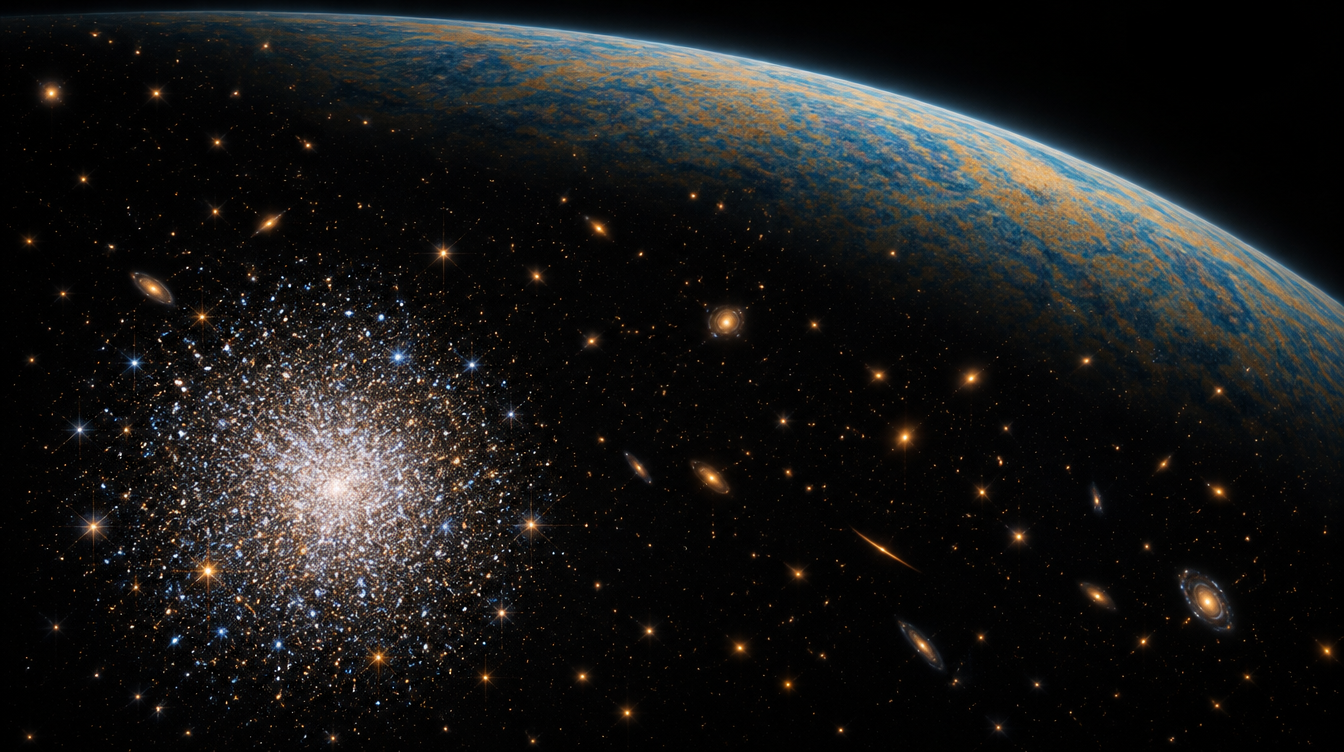
The remarkable part isn’t the number 13.8. It’s that three clocks built on different physics, the glow of a 380,000-year-old universe, the cooling of dead stars and the burn rate of ancient ones, give compatible answers once their error bars are counted. The expansion clock is the one that won’t settle, and as of November 2026 nobody knows why. That disagreement isn’t a crack in the age so much as a question about the model behind it. Either way, the answer will come from the same place this one did: more light, read more carefully.
About the Author
Author: King | Founder of Dark Cosmic Insights
King is the founder of Dark Cosmic Insights, a science storytelling platform exploring the strangest true stories hiding in space, science and AI. He digs into NASA, ESA and peer-reviewed research, separates what has been measured from what is still a mystery, and turns it into articles, data graphics and Shorts.
Follow the anomaly. Trace the source.