Here is a strange fact about the life cycle of a star: not one human has ever watched a star go through it. The Sun is about 4.6 billion years old; all of recorded history is a single frame of that film. Yet astronomers can tell you how the Sun will swell, shed its skin and fade.
Stranger still, some stars live so long that none of them has died yet. Others burn out in a few million years and blow themselves apart. The biggest difference comes down to one number set at birth: mass. This guide follows every branch, from birth cloud to white dwarf, neutron star or black hole, and shows how we know.
What’s observed, what’s modelled, what’s open. Star-forming clouds, red giants, planetary nebulae, white dwarfs, supernovae and neutron stars have all been observed directly. The timelines that link them, including the Sun’s future, are modelled with physics tested against real stars. Two things stay open: the exact mass that separates a neutron-star ending from a black-hole ending, and whether Earth survives the Sun’s red giant phase.
Quick Answer: What Is the Life Cycle of a Star?
The life cycle of a star begins in a cold cloud of gas and dust that collapses into a protostar. Once hydrogen fusion starts in its core, the star spends most of its life on the main sequence. What happens next depends most on birth mass. Objects under about 0.08 solar masses never become true stars (brown dwarfs). Red dwarfs live for hundreds of billions to trillions of years, depending on mass. Sun-like stars swell into red giants, shed planetary nebulae and leave white dwarfs. Stars above roughly 8 solar masses undergo core collapse, usually as supernovae, leaving a neutron star or a black hole.
What this article can and cannot establish. It can lay out the mass-based paths stars follow, with sourced thresholds and timescales, and the evidence behind them. It cannot give exact dividing lines: published estimates differ, and a star’s spin, chemistry and companions shift the outcome. Nor can it show you a red dwarf’s death or the Sun’s end; those are model predictions, labelled as such.
Table of Contents
The DCI Star Life Cycle Evidence Map
We keep what’s been seen separate from what’s been calculated.
| Question | What we know | Status | Key source |
|---|---|---|---|
| Are stars born in collapsing clouds? | Webb images protostars only a few hundred thousand years old in the Eagle Nebula | Observed | ESA/Webb |
| Are there “failed stars”? | Brown dwarfs exist, between 13 and 80 Jupiter masses | Observed | NASA |
| Does mass set a star’s lifetime? | From trillions of years at 0.1 solar masses to a few million at 60 | Modelled | CSIRO ATNF |
| Has any red dwarf died of old age? | No: lifetimes far exceed the universe’s 13.8 billion years | Modelled | Laughlin et al. 1997 |
| Do Sun-like stars end as white dwarfs? | White dwarfs sit at the centres of glowing planetary nebulae | Observed | ESA/Hubble |
| Where does core collapse begin? | Progenitor images give about 8.5 solar masses, +1/−1.5 | Measured | Smartt et al. 2009 |
| When will the Sun become a red giant? | Its later evolution begins in about 5 billion years; one model puts the red-giant-branch tip 7.6 billion years away | Modelled | NASA; Schröder & Smith 2008 |
| Will Earth survive the Sun’s giant phase? | One model says no; NASA says “possibly” engulfed | Open | Schröder & Smith 2008 |
| What mass splits neutron stars from black holes? | No clean line: exploding masses “do not form a simply connected set” | Open | Sukhbold et al. 2016 |
| Will the Sun explode as a supernova? | No: it is far below the core-collapse range | Not supported | NASA |
Status key: Observed = seen directly in telescope data. Measured = a number derived from observations, with error bars. Modelled = predicted by physics-based stellar models tested on real stars. Open = unresolved; credible sources disagree. Not supported = the evidence points the other way.
Cite this framework: Dark Cosmic Insights, “Life Cycle of a Star: How Birth Mass Shapes the Way Stars Die,” DCI Evidence Map, November 2026.
What Is the Life Cycle of a Star? The Stages in Brief
A star is a ball of gas that holds itself up by nuclear fusion: atoms in its core are squeezed together so hard that they merge, releasing energy. The stages of a star are just the chapters of a long fight between gravity pulling inward and that energy pushing outward.
Every true star shares the same opening chapters:
- Molecular cloud. A cold, dark cloud of gas and dust.
- Protostar. A collapsing clump that heats up but isn’t fusing hydrogen yet.
- Main sequence. Hydrogen fuses into helium in the core. NASA describes it as the longest phase of any star’s life (NASA Science, Star Basics).
After that, the story splits by mass. NASA’s star-types guide says main sequence stars range from about a tenth of the Sun’s mass to 200 times it, and make up around 90% of the universe’s stars (NASA Science, Types of Stars).
The key idea is counterintuitive: bigger stars have more fuel, but they die younger. A heavier star squeezes its core harder, runs hotter and burns its hydrogen far faster.
What Is a Nebula? Where Stars Are Born
A nebula is a cloud of gas and dust in space. Some are where stars are born; others are what dying stars leave behind. The birth kind are molecular clouds, cold enough for atoms to pair up into molecules.
NASA describes these clouds as ranging from 1,000 to 10 million times the Sun’s mass, and stretching across hundreds of light-years (NASA Science, Star Basics). When gravity wins in a dense pocket, it collapses and heats into a protostar, a baby star still gathering mass. After millions of years of this heating, the core gets hot and dense enough to fuse hydrogen, and a star switches on (NASA Science, Star Basics).
The Pillars of Creation: a nursery caught in the act
The most famous star nursery is the Pillars of Creation, towers of gas and dust inside the Eagle Nebula, about 6,500 light-years away. In Webb’s near-infrared view, newly formed stars show up as bright red orbs just outside the pillars. The young stars driving jets through the dust are estimated to be “only a few hundred thousand years old” (ESA/Webb, October 2022).
That makes star birth an observed stage, not a theory. Hubble photographed the same region in 1995 and 2014, and Webb went back in 2022 (ESA/Webb). We compare those views side by side in Hubble vs. Webb: the same nebula, two different pictures.

How Do Stars Die? Mass Shapes the Ending
Here is the whole life cycle of a star on one card: find the birth mass, read off the likely ending. Thresholds are approximate; each section below explains the uncertainty.

Where the numbers come from. The brown dwarf range of 13 to 80 Jupiter masses is NASA’s (Types of Stars); 80 Jupiter masses is close to 0.08 solar masses, which matches the minimum main-sequence mass used by Laughlin, Bodenheimer and Adams (1997). NASA gives below 8 solar masses for the red giant path, about 8 to 20 for neutron stars and above about 20 for stellar-mass black holes (NASA Science, Types of Stars; Black Hole Types). The ~0.5 line is a rough convention. NASA’s own pages differ: Space Place says at least five solar masses for a core-collapse supernova (NASA Space Place). We use 8, where the observational evidence points.
Mass isn’t the whole story. Companions matter: Sana and colleagues found that “over seventy per cent of all massive stars will exchange mass with a companion,” with a third of those ending in a merger (Science, 2012). Chemistry matters too, because a star’s metal content sets how much mass its winds strip away, which shifts where neutron stars and black holes form; rapid rotation can open other routes, such as jet-driven explosions (Heger et al. 2003). And core collapse doesn’t always make a bright supernova: one red supergiant of about 25 solar masses gave only a weak outburst in 2009, then faded to at least 5 magnitudes below its former brightness, which its observers read as “a failed SN” (Adams et al. 2017).
Brown Dwarfs: What Happens When a Star Is Too Small?
Some collapsing clumps never gather enough mass to become stars. These brown dwarfs are often called “failed stars.” NASA puts them between 13 and 80 times the mass of Jupiter (NASA Science, Types of Stars).
Their cores never get hot and dense enough to sustain ordinary hydrogen fusion, so they glow mainly from the heat of contraction, then dim. NASA notes they emit almost no visible light, though some have been seen in infrared (NASA Science, Types of Stars). Brown dwarfs don’t die; they fade.
Why Hasn’t a Single Red Dwarf Died Yet?
Red dwarfs are the small, cool, faint stars at the bottom of the main sequence. They’re also the most common: NASA says they make up around 75% of the Milky Way’s stellar population (NASA Science, Types of Stars).
A small star burns its fuel so slowly that its main-sequence life runs from hundreds of billions to trillions of years, depending on its mass. Sources differ, depending on the exact mass and model:
- CSIRO’s Australia Telescope National Facility tabulates about 200 billion years (2×10¹¹ years) for a star of 0.5 solar masses, at the heavy end of the red dwarf range, and about 2 trillion years (2×10¹² years) for a star of 0.1 solar masses (ATNF, Main Sequence Lifetime).
- Laughlin, Bodenheimer and Adams calculated about 10 trillion years (1.0×10¹³ years) of hydrogen burning for the lowest-mass main-sequence star (The Astrophysical Journal, 1997).
- NASA says some red dwarfs with a third of the Sun’s mass may live “up to about 14 trillion years” (NASA Science, Types of Stars).
Whichever figure you take, compare it with the age of the universe: about 13.8 billion years (NASA Science, Universe Overview). Even the shortest figure above, about 200 billion years for the heaviest red dwarfs, is more than 14 times longer. The universe simply isn’t old enough for any red dwarf to have run out of fuel.
How red dwarfs are predicted to end
The end of a red dwarf is purely modelled. Laughlin and colleagues found that stars with masses “M < 0.20 M⊙ will never evolve through a red giant stage” (Laughlin et al. 1997). Small red dwarfs churn their whole interior like boiling water (they’re fully convective), so they use almost all their hydrogen, not just the core’s.
In those models, these stars grow slowly brighter and bluer for trillions of years, then contract into helium white dwarfs (Laughlin et al. 1997).
What Is a Red Giant?
A red giant is an ageing star that has puffed up to enormous size while its surface cooled and reddened. When core hydrogen runs out, the core contracts and heats, hydrogen fuses in a shell around it, and the extra energy pushes the outer layers outward. NASA describes the star’s atmosphere expanding into a subgiant or giant, while the core goes on to fuse helium into carbon (NASA Science, Star Basics). NASA’s star guide says this path applies to main sequence stars below eight solar masses (Types of Stars).
Red giants are easy to observe. In the European Space Agency’s Gaia map of more than four million nearby stars, the red giant branch shows up as a distinct arm peeling away from the main sequence, where ageing stars grow bigger, brighter and redder (ESA, Gaia’s Hertzsprung-Russell diagram).
Massive stars swell into red supergiants. Betelgeuse, the red shoulder of Orion, is one: if it replaced the Sun, its surface would “extend past the orbit of Jupiter” (NASA Science, August 2020).
Then the star lets go
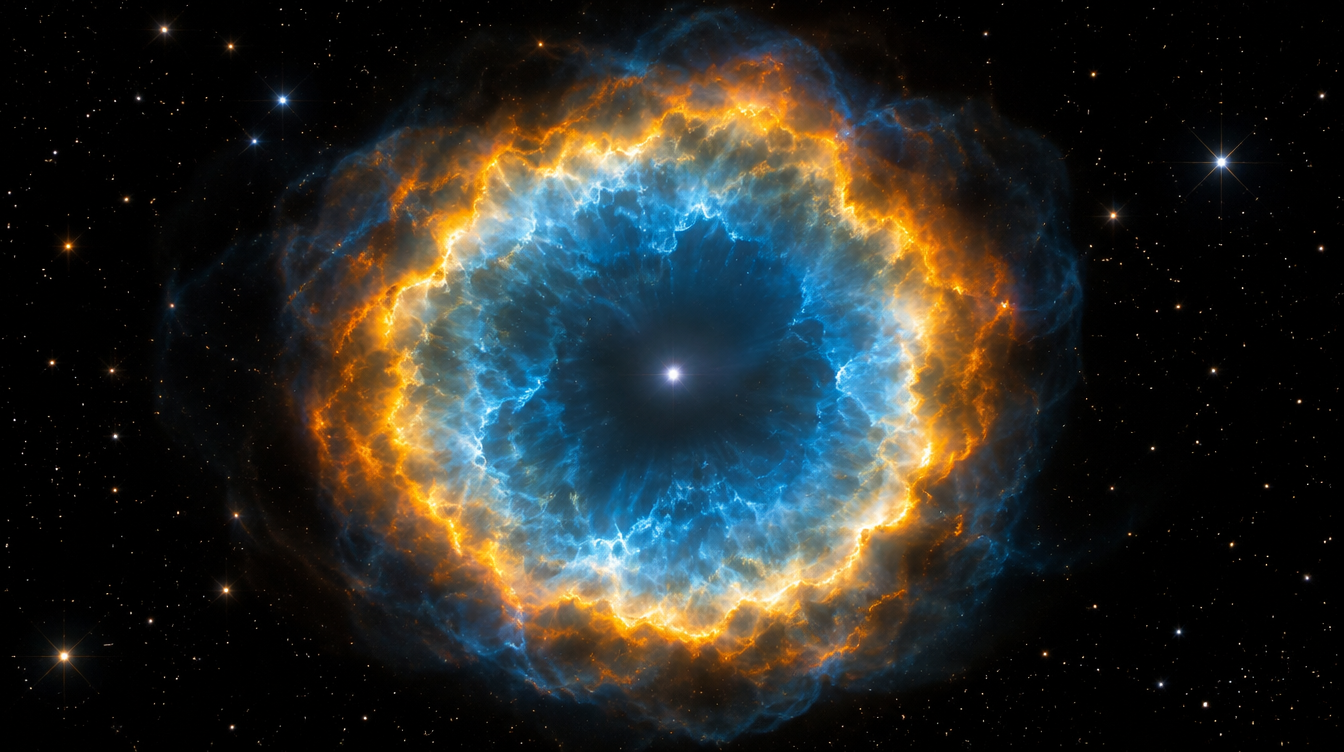
A red giant’s grip on its outer layers is weak. Stellar winds push them into space, and the exposed hot core’s ultraviolet light makes that gas glow. That glowing shell is a planetary nebula, a name left over from old telescopes, where these round clouds looked a bit like planets. They have nothing to do with planets.
A planetary nebula is brief. ESA/Hubble says they light up for around 10,000 years before the central star cools and the glow fades (ESA/Hubble, NGC 6565). A 2018 study says planetary nebulae mark the end of the active lives of about 90% of all stars (University of Manchester via EurekAlert, May 2018).
What Is a White Dwarf?
A white dwarf is the dense, hot core left when a Sun-like star sheds its outer layers. It no longer fuses anything; it shines with stored heat and slowly cools. NASA’s Imagine the Universe gives a typical white dwarf half the mass of the Sun, packed into a ball only slightly bigger than Earth (NASA Imagine the Universe, White Dwarfs). That gives a density of about 1×10⁹ kg/m³, roughly 200,000 times Earth’s average, and surface gravity about 100,000 times Earth’s. NASA’s star-types page puts it in kitchen terms: a teaspoon of white dwarf material would weigh more than a pickup truck (Types of Stars).
A newborn white dwarf is blazing hot, with a core temperature above 100,000 K (about 99,700 °C, or 179,500 °F) (NASA Imagine the Universe). It cools from there over billions of years.
The 1.4 solar mass ceiling
White dwarfs have a hard upper limit. A white dwarf is held up not by heat but by electrons that resist being squeezed any closer together. Above about 1.4 solar masses, the Chandrasekhar limit, that support fails (NASA Imagine the Universe).
A white dwarf in a close pair with another star can pull in matter, or merge with a second white dwarf. NASA Space Place notes that either can make a white dwarf explode (NASA Space Place). That’s the second major type of supernova.
What Will Happen to the Sun?
The Sun follows the red giant path. Every step after today is modelled, and the models don’t agree on every detail.

Today
NASA says the Sun formed about 4.6 billion years ago and is a little under halfway through its lifetime, and NASA expects it to stay on the main sequence for about another 5 billion years before becoming a red giant (NASA Science, Types of Stars; NASA Science, Sun Facts). The white dwarf stage comes later, after the red giant phase. Its core burns at about 15 million °C (27 million °F), while its visible surface is about 5,500 °C (10,000 °F) (NASA Sun Facts).
The slow brightening
A detailed solar model by Sackmann, Boothroyd and Kraemer gives a main-sequence life of 11 billion years, with the Sun reaching 1.1 times today’s brightness in 1.1 billion years and 1.4 times in 3.5 billion years (The Astrophysical Journal, 1993).
The red giant phase
In the same model, the Sun climbs the red giant branch to about 2,300 times today’s brightness and 170 times its present radius (Sackmann et al. 1993). With NASA’s solar radius of about 700,000 km (435,000 miles), that’s roughly 119 million km (74 million miles) (our conversion). NASA says the swollen Sun will be large enough to engulf Mercury and Venus, and possibly Earth (NASA Sun Facts).
A 2008 model by Schröder and Smith puts the tip of the red giant branch 7.59 billion years from now, with the Sun losing 0.332 solar masses along the way, and concludes Earth “will not be able to escape engulfment” (Monthly Notices of the Royal Astronomical Society, 2008). Mass loss lets the planets drift outward, but in their model not far enough.
These two numbers mark different moments, not competing estimates. NASA’s round figure of about 5 billion years is roughly when the Sun’s later evolution gets under way, as its core hydrogen runs low and it begins to swell. Schröder and Smith’s 7.59 billion years is the peak of the red giant phase, the tip of the red giant branch, reached after that slow climb.
NASA’s own wording is “possibly,” so we file Earth’s fate as Open.
The planetary nebula question
Models differ here too. Schröder and Smith predicted the dying Sun would be too faint to drive the final dusty wind needed for a regular planetary nebula (2008). A 2018 study by Gesicki, Zijlstra and Miller Bertolami, with faster-heating cores in its models, predicts the Sun “will eventually form a rather faint planetary nebula” (Nature Astronomy, 2018; arXiv). In their models the lowest mass that still makes a visible nebula is about 1.1 solar masses, close to the Sun’s (EurekAlert, May 2018).
The white dwarf ending
Every model ends with a white dwarf. Sackmann’s model gives a final mass of 0.541 solar masses, with a range of 0.51 to 0.58 depending on how much mass the Sun loses (1993). The late stages are brief in that model: about 100 million years of helium burning, then the final steps in well under a million years.
What Is a Supernova? How Massive Stars Die
A supernova is the explosion of a star, bright enough to “outshine their entire galaxies for a few days or even months” (NASA Space Place). Besides white dwarf explosions, there are core-collapse supernovae, the end of massive stars.
Why massive stars collapse
A massive star doesn’t stop at helium. NASA describes its core fusing on through carbon, oxygen, neon and magnesium, and in the largest stars, all the way to silicon making iron. The full sequence takes just a few million years, and the last stage, silicon to iron, lasts only days (NASA Science, Star Basics).
Iron is the dead end. Fusing it “requires energy instead of releasing it” (NASA Science, Star Basics). With no energy source left, the core collapses in an instant, rebounds, and in most cases a shock wave blows the star apart, scattering the oxygen, silicon, iron and other elements forged inside it. The very heaviest elements, such as gold, are a different story with more than one proposed source. In 2017 the glow from a neutron-star merger, GW170817, gave the first look at freshly made heavy elements, and Kasen and colleagues argued that such mergers “are a dominant mode of r-process production in the Universe” (Nature, 2017).
How massive is “massive”? The honest answer
The usual figure, about 8 solar masses, has observational support. Smartt and colleagues studied stars photographed before they exploded and estimated the minimum mass at 8.5 solar masses, +1/−1.5, meaning roughly 7 to 9.5 (Monthly Notices of the Royal Astronomical Society, 2009). That matches estimates for the heaviest white-dwarf progenitors.
They also found a puzzle: the heaviest exploding red supergiants came out at about 16.5 ± 1.5 solar masses, though nearby red supergiants reach about 25. The authors named this the red supergiant problem, and suggested some heavier stars may collapse to black holes with faint explosions nobody detects (Smartt et al. 2009).
SN 1987A: a supernova we caught
The best-studied nearby example is SN 1987A, in the Large Magellanic Cloud, about 160,000 light-years away. Three observatories detected a burst of neutrinos, ghostly particles from the collapsing core, about two hours before the visible light arrived (ESA/Webb, February 2024). In 2024, Webb found the “best evidence yet” of a newborn neutron star at its centre, through highly ionised argon, though the team says it isn’t yet definitive (ESA/Webb).
Supernovae can even be seen more than once: SN Refsdal, the supernova replay shows how a galaxy cluster’s gravity split one explosion’s light into several images arriving at different times.
They’re rare: NASA Space Place estimates two or three supernovae per century in a galaxy like ours, most hidden from us by dust (NASA Space Place).
Neutron Star vs. Black Hole: What’s the Difference?
A collapsing core leaves one of two remnants, depending on how much mass ends up in it. This is where the life cycle of a star gets genuinely uncertain.

Neutron stars: a sun crushed to city size
A neutron star forms when the core’s protons and electrons are crushed into neutrons, which can halt the collapse. NASA describes one as about 20 km (12.5 miles) across, with roughly the mass of a sun; a sugar cube of its material would weigh “about 1 trillion kilograms” (about 2.2 trillion pounds) on Earth (NASA Imagine the Universe, Neutron Stars). Spinning ones that sweep beams past Earth are pulsars.
Typical neutron stars come in around 1.4 solar masses; that’s the average in Sukhbold and colleagues’ explosion models (The Astrophysical Journal, 2016). Some are much heavier: one well-measured example, pulsar PSR J0740+6620, weighs 2.08 ± 0.07 solar masses, measured from the delay its companion’s gravity adds to its radio pulses (Fonseca et al., 2021).
Black holes: when nothing can stop the fall
If the remnant is too heavy, nothing halts the collapse, and it becomes a black hole: a region where escaping would take more than the speed of light. NASA’s Imagine the Universe says a Sun-mass object would have to be squeezed into a radius of about 3 km (1.9 miles) to become one (NASA Imagine the Universe, Black Holes). The size grows in step with mass, so 10 solar masses gives about 30 km (19 miles), our scaling.
For these stellar-mass black holes, NASA counts about 50 suspected or confirmed in the Milky Way and estimates there may be “as many as 100 million” in our galaxy (NASA Science, Black Hole Types).
The fuzzy border
- NASA’s rule of thumb: about 8 to 20 solar masses at birth makes a neutron star, more makes a black hole (NASA Types of Stars).
- Models complicate that rule. Simulating stars from 9 to 120 solar masses, Sukhbold and colleagues found that “the masses of exploding stars do not form a simply connected set”: explosions and black holes are interleaved, not split at one number (Sukhbold et al. 2016).
- Gravitational waves add a mystery. In 2019, LIGO and Virgo saw a merger involving an object of about 2.6 solar masses, inside a “mass gap” between the heaviest known neutron stars (no more than 2.5) and the lightest known black holes (about 5). Researchers said they could not tell whether it was the heaviest known neutron star or the lightest known black hole (LIGO Caltech, June 2020).
The honest status of this boundary is Open.
How Do Astronomers Know a Star’s Age and Mass?
No one lives long enough to watch a star evolve, but astronomers can see billions of stars at every stage at once, like learning how people age from a crowd rather than one lifetime. Our full guide to how astronomers measure stars goes deeper; here are the five main tools.
1. The Hertzsprung-Russell diagram
The Hertzsprung-Russell (H-R) diagram plots each star’s true brightness against its colour (which tracks its surface temperature). Stars fall into bands on it: main sequence, red giant branch, white dwarfs. ESA’s Gaia version plots “more than four million stars within five thousand light-years” of the Sun, about a hundred times more than the 1990s Hipparcos version (ESA).
2. Star clusters: same birthday, different masses
A star cluster is a group of stars born from the same cloud at about the same time and distance. The heaviest leave the main sequence first, so the “turnoff” point acts as a clock. CSIRO’s guide contrasts young h and χ Persei, still mostly on the main sequence, with old M67 and the globular cluster M55, whose high-mass stars are long gone (ATNF, Star Clusters).
3. Stellar models
Stellar models are computer simulations that follow a star’s physics through time. They’re tested by checking that model stars land where real cluster stars sit on the H-R diagram. The Sun’s future and every red dwarf lifetime in this article come from such models, which is why we label them Modelled.
4. Asteroseismology: listening to starquakes
Stars ring like bells: turbulence near their surfaces sets off vibrations that show up as tiny brightness flickers. Asteroseismology is “the study of stars by the observation of natural, resonant oscillations” (Chaplin & Miglio, Annual Review of Astronomy and Astrophysics, 2013). ESA explains that these vibrations reveal a star’s size and mass, and that fed into models, they provide what ESA calls “the only method to provide accurate and precise ages of stars” (ESA, Asteroseismology: the music of the stars). The Kepler and CoRoT space missions drove much of the recent progress.
5. Spectroscopy and binary stars
Spectroscopy splits starlight into a spectrum whose lines reveal temperature, chemistry and motion. When two stars orbit each other, their motions give their masses directly. That’s how the pulsar mass above was weighed: by timing how its companion’s gravity delays its signals (Fonseca et al. 2021). Measured masses anchor the models; the models fill in the timeline.
Myth vs. Fact: Will the Sun Explode?
| Myth | Fact |
|---|---|
| “The Sun will explode as a supernova.” | It’s far too light. Core collapse needs roughly 8 solar masses or more. The Sun will end as a white dwarf. |
| “Bigger stars live longer because they have more fuel.” | The reverse. CSIRO’s table gives about 3.4 million years at 60 solar masses, 10 billion at 1, and 2 trillion at 0.1. |
| “Every massive star becomes a black hole.” | Many leave neutron stars, and the dividing line isn’t a single number. |
| “Red dwarfs die as red giants.” | Models say the smallest never become red giants, and none has died yet anyway. |
| “Astronomers watched the Sun’s life cycle in other stars, so it’s proven.” | Each stage is observed in some star; linking them into one timeline is modelled. |
Lifetimes from CSIRO’s main-sequence table.
How Can You See a Star’s Life Cycle Yourself?
You can tour most of the life cycle of a star from a dark backyard.
- A star nursery: the Orion Nebula (M42), just below Orion’s belt, is visible to the naked eye from a dark site. NASA puts it about 1,500 light-years away, the closest large star-forming region, best seen in January (NASA Hubble, Messier 42).
- A main-sequence star: the Sun. Never look at it directly or through any optics without a certified solar filter.
- A red supergiant: Betelgeuse, Orion’s orange-red shoulder, about 725 light-years away (NASA Science).
- A cluster clock: the Pleiades in Taurus, a binocular favourite and a relatively young cluster (ATNF).
- A planetary nebula: the Ring Nebula (M57) in Lyra needs a telescope, but shows the same glowing-shell stage as Hubble’s NGC 6565, whose colours ESA compares to the Ring’s (ESA/Hubble).
Space images of these objects are processed; for what’s real colour and what’s mapped, see Are Space Photos Real?.
What Comes Next for Stellar Science?
All dates are as of November 2026.
- Vera C. Rubin Observatory (running now). Rubin began its 10-year Legacy Survey of Space and Time on June 29, 2026 (Rubin Observatory, Survey Progress). It can issue “up to seven million alerts” flagging sky changes, including stellar explosions (LAPP/IN2P3, July 2026).
- Nancy Grace Roman Space Telescope (launched). Roman lifted off on a SpaceX Falcon Heavy on August 30, 2026, on a five-year mission (NASA Roman blog, August 30, 2026). Its surveys target mainly galaxies and exoplanets.
- ESA’s PLATO (planned). PLATO will study tiny brightness variations in 200,000+ stars, including asteroseismology of Sun-like stars, expanding that sample from some hundreds to tens of thousands (ESA, Plato; ESA, Asteroseismology). ESA’s mission page lists launch as planned for April 2027, and an April 2026 ESA update says it is on track for early 2027.
- More Webb time on SN 1987A, planned to confirm its neutron star (ESA/Webb).
Life Cycle of a Star by the Numbers
- 13.8 billion years: the age of the universe, too young for any red dwarf to have died (NASA)
- 4.6 billion years: the Sun’s age (NASA Sun Facts)
- 13 to 80 Jupiter masses: the brown dwarf range (NASA)
- 75%: share of Milky Way stars that are red dwarfs (NASA)
- 8.5 (+1/−1.5) solar masses: the observed minimum for a core-collapse supernova (Smartt et al. 2009)
- 1.4 solar masses: the most a white dwarf can weigh (NASA)
- 170 solar radii: the Sun’s modelled size at the red giant tip, about 119 million km (74 million miles) (Sackmann et al. 1993)
- 15 million °C (27 million °F, about 15 million K): the Sun’s core today (NASA Sun Facts)
- 20 km (12.5 miles): the diameter of a typical neutron star (NASA)
- About 10,000 years: how long a planetary nebula glows (ESA/Hubble)
Life Cycle of a Star: FAQ
What are the main stages of a star’s life cycle?
A star forms in a molecular cloud, collapses into a protostar, then spends most of its life fusing hydrogen on the main sequence. After that, the path depends on mass. Sun-like stars become red giants, shed planetary nebulae and leave white dwarfs, while stars above about 8 solar masses undergo core collapse, usually as supernovae, and leave neutron stars or black holes.
How do stars die?
Stars die when they can no longer produce enough energy in their cores to hold back gravity. Sun-like stars swell into red giants and gently shed their outer layers, leaving white dwarfs, while the smallest red dwarfs are predicted to fade slowly over trillions of years. Massive stars build iron cores that collapse in an instant, usually triggering a supernova, though some may collapse to black holes with little or no visible explosion.
What is a white dwarf star?
A white dwarf is the hot, dense core left after a Sun-like star sheds its outer layers. A typical one has about half the Sun’s mass in a body only slightly bigger than Earth. It no longer fuses anything and slowly cools over billions of years.
What is the difference between a neutron star and a black hole?
A neutron star is an ultra-dense ball of neutrons about 20 km (12.5 miles) across, held up against further collapse. A black hole forms when the remnant is too heavy for anything to stop the collapse, creating a region light cannot escape. The exact mass dividing them is still an open question.
Will the Sun become a red giant?
Yes, according to stellar models. NASA puts the start of the Sun’s later evolution roughly 5 billion years away, and one detailed model puts the peak of the red giant phase, the tip of the red giant branch, 7.59 billion years from now. It will then end as a white dwarf of a little over half its current mass.
Will the Sun become a supernova?
No. The Sun is far below the roughly 8 solar masses needed for a core-collapse supernova. It will lose its outer layers and end as a white dwarf instead.
Why do massive stars have shorter lives?
Heavier stars squeeze their cores harder, so they run much hotter and burn fuel far faster. A 60-solar-mass star lasts only about 3.4 million years, while the Sun gets about 10 billion. Despite having more fuel, they spend it extravagantly.
What is a nebula?
A nebula is a cloud of gas and dust in space. Cold molecular clouds, such as the Eagle and Orion nebulae, are where stars are born. Planetary nebulae are a different kind: glowing shells of gas thrown off by dying Sun-like stars.
Your next step: tonight, find Orion. In one constellation you can see a star nursery (the Orion Nebula), a dying red supergiant (Betelgeuse) and hot young stars, three stages of the same life cycle, a few hundred to 1,500 light-years apart. Then open ESA’s Gaia H-R diagram and find where each one sits.
Sources and Further Reading
- NASA Science (updated August 12, 2026), Star Basics. Molecular clouds, protostars, main sequence, fusion through iron, core collapse.
- NASA Science (updated August 12, 2026), Types of Stars. Brown dwarf range, red dwarf share and lifetimes, mass thresholds, white dwarfs.
- NASA Science, Sun Facts. Age, temperatures, size, and the Sun’s red giant and white dwarf future.
- NASA Science, Universe Overview. Age of the universe.
- NASA Science, Black Hole Types. Stellar-mass black holes and Milky Way estimates.
- NASA Science (August 13, 2020), Hubble Finds that Betelgeuse’s Mysterious Dimming Is Due to a Traumatic Outburst.
- NASA Science, Messier 42 (Orion Nebula).
- NASA Goddard, Imagine the Universe, White Dwarfs, Neutron Stars and Black Holes.
- NASA Space Place, What Is a Supernova?
- NASA Roman blog (August 30, 2026), NASA’s Roman Space Telescope Launches.
- ESA/Webb (October 2022), Webb takes a stunning, star-filled portrait of the Pillars of Creation.
- ESA/Webb (February 2024), Webb finds evidence for neutron star at heart of young supernova remnant.
- ESA/Hubble (2015), The long goodbye (NGC 6565).
- ESA (2018), Gaia’s Hertzsprung-Russell diagram.
- ESA, Plato mission and Asteroseismology: the music of the stars.
- CSIRO Australia Telescope National Facility, Main Sequence Lifetime and Star Clusters.
- Laughlin, G., Bodenheimer, P. & Adams, F. C. (1997). The End of the Main Sequence. The Astrophysical Journal, 482, 420. doi:10.1086/304125
- Sackmann, I.-J., Boothroyd, A. I. & Kraemer, K. E. (1993). Our Sun. III. Present and Future. The Astrophysical Journal, 418, 457. doi:10.1086/173407
- Schröder, K.-P. & Smith, R. C. (2008). Distant future of the Sun and Earth revisited. Monthly Notices of the Royal Astronomical Society, 386, 155. arXiv:0801.4031
- Gesicki, K., Zijlstra, A. A. & Miller Bertolami, M. M. (2018). The mysterious cut-off of the Planetary Nebula Luminosity Function. Nature Astronomy. doi:10.1038/s41550-018-0453-9; University of Manchester release via EurekAlert.
- Smartt, S. J., Eldridge, J. J., Crockett, R. M. & Maund, J. R. (2009). The death of massive stars – I. Observational constraints on the progenitors of type II-P supernovae. Monthly Notices of the Royal Astronomical Society. doi:10.1111/j.1365-2966.2009.14506.x
- Sukhbold, T., Ertl, T., Woosley, S. E., Brown, J. M. & Janka, H.-T. (2016). Core-Collapse Supernovae from 9 to 120 Solar Masses Based on Neutrino-powered Explosions. The Astrophysical Journal. arXiv:1510.04643
- Sana, H., de Mink, S. E., de Koter, A., Langer, N., Evans, C. J., et al. (2012). Binary interaction dominates the evolution of massive stars. Science, 337, 444. arXiv:1207.6397
- Heger, A., Fryer, C. L., Woosley, S. E., Langer, N. & Hartmann, D. H. (2003). How Massive Single Stars End Their Life. The Astrophysical Journal. doi:10.1086/375341
- Adams, S. M., Kochanek, C. S., Gerke, J. R., Stanek, K. Z. & Dai, X. (2017). The search for failed supernovae with the Large Binocular Telescope: confirmation of a disappearing star. Monthly Notices of the Royal Astronomical Society. doi:10.1093/mnras/stx816
- Kasen, D., Metzger, B., Barnes, J., Quataert, E. & Ramirez-Ruiz, E. (2017). Origin of the heavy elements in binary neutron-star mergers from a gravitational wave event. Nature. arXiv:1710.05463
- Fonseca, E., Cromartie, H. T., Pennucci, T. T., Ray, P. S., Kirichenko, A. Yu., et al. (2021). Refined Mass and Geometric Measurements of the High-Mass PSR J0740+6620. The Astrophysical Journal Letters. doi:10.3847/2041-8213/ac03b8
- Chaplin, W. J. & Miglio, A. (2013). Asteroseismology of Solar-Type and Red-Giant Stars. Annual Review of Astronomy and Astrophysics. doi:10.1146/annurev-astro-082812-140938
- LIGO Caltech (June 23, 2020), LIGO-Virgo finds mystery object in “mass gap”.
- Vera C. Rubin Observatory, Survey Progress; LAPP/IN2P3 (July 2026), The Vera C. Rubin Observatory Begins the Largest Cosmic Film Ever Made.
Explore Next
- How a star’s mass and distance are earned: How Astronomers Measure Stars
- One explosion, seen again and again: SN Refsdal, the Supernova Replay
- The Pillars of Creation, two telescopes: Hubble vs. Webb: Same Nebula, Different View
- What the colours in space images mean: Are Space Photos Real?
- More stars and galaxies: Stars & Galaxies
- The three temperatures of space: How Cold Is Space?
- Why Venus beats Mercury: What Is the Hottest Planet?
- The 2006 vote and the debate: Why Is Pluto Not a Planet?
- Everything on DCI: Explore
How This Explainer Was Checked
Every number in this article links to the page or paper it came from, all fetched and checked on November 7, 2026. We relied on NASA, ESA, ESA/Webb, ESA/Hubble, CSIRO, LIGO and peer-reviewed papers; for papers, we checked the published abstracts. Where sources disagree, as on red dwarf lifetimes, the core-collapse threshold and the Sun’s timeline, we show the range and name each source rather than picking one. Unit conversions (km to miles, kelvin to °C and °F, solar radii to km) are DCI’s own, marked where they appear. Predictions about the far future, including the Sun’s red giant phase and the end of red dwarfs, are labelled Modelled, because no one can observe them. Images are labelled: real spacecraft or telescope images as OBSERVATION, illustrations as ILLUSTRATION, and our charts as DATA GRAPHIC. Nothing AI-generated is presented as a real image.
Final Thought: Mass Shapes Destiny, Evidence Is the Map
A star’s ending is largely written at its birth, in a single number. Too little mass and it never ignites. A little more and it outlives the universe as we know it. A Sun’s worth, and it swells, sheds a glowing shell and cools into a slowly fading ember. Many times more, and it usually tears itself apart, seeding space with oxygen, iron and other heavy elements. We will never watch one star do all of this. But by reading billions of stars at once, listening to them ring and weighing them in pairs, we’ve learned to read the whole life story from the snapshots.
About the Author
Author: King | Founder of Dark Cosmic Insights
King is the founder of Dark Cosmic Insights, a science storytelling platform exploring the strangest true stories hiding in space, science and AI. He digs into NASA, ESA and peer-reviewed research, separates what has been measured from what is still a mystery, and turns it into articles, data graphics and Shorts.
Follow the anomaly. Trace the source.