Here is an odd fact about the types of galaxies: the most famous diagram in the subject has been misread for about a century. Edwin Hubble sorted galaxies into a shape that looks like a tuning fork, and he called the round, smooth ones “early” and the spirals “late.” Generations of readers took that as a timeline. Hubble wrote, in a footnote, that he meant nothing of the kind.
The real story is better. A galaxy’s look comes down to a few physical things: how much cold gas it has left, whether it is still making stars, and whether its stars swirl together in a disk or swarm in all directions. This guide walks through each type, what shapes it, how galaxies can change, and how astronomers know any of it.
What’s observed, what’s modelled, what’s open. The shapes themselves are observed in millions of images, and the way stars move inside galaxies is measured from their light. How galaxies turn from one type into another is largely modelled, with simulations tested against what telescopes see. Two things remain open: exactly how and when the first disks formed, and whether the Milky Way will ever merge with Andromeda.
Quick Answer: What Are the Types of Galaxies?
The main types of galaxies are spirals (flat, rotating disks with arms, like the Milky Way), barred spirals (spirals with a bar of stars across the centre), ellipticals (smooth, oval swarms of mostly older stars with little gas), lenticulars (a disk and bulge but no arms) and irregulars (no regular shape). Dwarf galaxies, small and faint, are the most common of all. Edwin Hubble’s classification began in 1926 and was expanded later (the lenticular S0 class came after 1936), and it was drawn as the “tuning fork.” It is a sorting scheme by appearance, not an evolutionary sequence.
What this article can and cannot establish. It can describe each type, the physics that gives it its look, and the evidence behind that physics, with sources. It cannot give you one fixed “share” of each type in the universe, because counts depend on how deep a survey looks and who is doing the classifying. Nor can it say for certain what the Milky Way will become: that depends on a merger whose odds still swing with how Andromeda’s sideways motion is measured.
Table of Contents
The DCI Galaxy Types Evidence Map
We keep what’s been seen separate from what’s been inferred.
| Question | What we know | Status | Key source |
|---|---|---|---|
| Do galaxies come in distinct shapes? | Spirals, ellipticals, lenticulars and irregulars all appear in telescope images | Observed | NASA Science |
| Is the Milky Way a barred spiral? | Gaia data mapped its central bar in 3D for the first time in 2019 | Measured | ESA |
| Do stars move differently in ellipticals and spirals? | Disks rotate; the most massive ellipticals barely rotate, yet 66% of ellipticals in one survey are fast rotators | Measured | Emsellem et al. 2011 |
| Do outer stars orbit as fast as inner ones? | Yes, in Andromeda and about 60 other galaxies Rubin studied | Measured | Sky & Telescope |
| Why are ellipticals red and spirals blue? | Blue light comes from short-lived massive stars; when star birth stops, red stars remain | Modelled | Masters 2013 |
| Can mergers turn spirals into ellipticals? | Scientists think many ellipticals formed this way; NASA expects a Milky Way–Andromeda merger to make one | Modelled | NASA |
| Will the Milky Way merge with Andromeda? | A 2025 model gave close to 50% odds of no merger in 10 billion years; a 2026 model with newer Gaia motions gives a 90% chance of a merger | Open | Sawala et al. 2025; Wu et al. 2026, ApJL |
| Were there disk galaxies early in cosmic history? | Webb sees disks and a barred spiral about 2 billion years after the Big Bang | Observed | Costantin et al. 2023 |
| Is the tuning fork a timeline of galaxy evolution? | Hubble wrote that its time-related meanings were “deliberately disregarded” | Not supported | Baldry 2008 |
Status key: Observed = seen directly in telescope images. Measured = a number or pattern derived from observations, such as speeds from spectra. Modelled = explained or predicted by physics-based models tested against data. Open = unresolved; credible studies disagree or the answer depends on uncertain inputs. Not supported = the evidence points the other way.
Cite this framework: Dark Cosmic Insights, “Types of Galaxies: Spirals, Ellipticals and the Tuning Fork, Explained,” DCI Evidence Map, November 2026.
What Is a Galaxy?
NASA’s simple definition: a galaxy is “a huge collection of gas, dust, and billions of stars and their solar systems, all held together by gravity” (NASA Space Place). Ours, the Milky Way, holds an estimated 100 billion stars (estimates vary) in a disk about 100,000 light-years across (NASA, The Milky Way Galaxy). A light-year, the distance light travels in a year, is about 9.46 trillion km (5.88 trillion miles).
There are a lot of them. Hubble’s first Deep Field, built from 342 exposures taken between December 18 and 28, 1995, caught roughly 3,000 galaxies in a patch of sky about a thirteenth the width of the full Moon. The Ultra Deep Field of 2004 held about 10,000 (NASA Science, Hubble Deep Fields). With that many, sorting them by shape was the obvious first step.

What Is the Hubble Tuning Fork?
The Hubble tuning fork sorts galaxies by how they look. Edwin Hubble published the classification in “Extragalactic Nebulae,” The Astrophysical Journal, December 1926 (Crossref record); ESA/Hubble also dates the scheme to 1926 (ESA/Hubble, The Hubble tuning fork). The title shows the vocabulary of the day: galaxies were “extragalactic nebulae.”
Two dates are easy to mix up:
- 1926: the classification. The paper set out the sequence of types.
- 1936: the diagram. The fork-shaped drawing appeared in Hubble’s book The Realm of the Nebulae, according to both Allan Sandage (Sandage, via NASA/IPAC NED) and Karen Masters (Masters 2013).
The handle: ellipticals, E0 to E7
Ellipticals are numbered by how stretched they look: 10 × (1 − b/a), where b and a are the short and long axes of the outline on the sky. E0 looks round; E7 is the flattest (Swinburne COSMOS, Elliptical Galaxy). That describes the shape we see from Earth, not necessarily the true 3D shape.
The fork point: lenticulars, S0
Where the handle splits sit the S0 galaxies: prominent bulges, no spiral arms (Swinburne COSMOS, Hubble Classification). Sandage writes that “Hubble isolated the S0 class only after 1936” (Sandage, via NED).
The prongs: Sa to Sc, and SBa to SBc
One prong holds ordinary spirals, the other barred spirals, marked “B.” From a to c, bulges shrink and arms loosen: an Sa has a large bulge and tight, smooth arms; an Sc has a small bulge and loose arms broken into clumps of stars and glowing gas (Swinburne COSMOS).
Off the fork: irregulars
Irregular, dwarf and giant elliptical galaxies don’t fit neatly on the diagram, and ESA/Hubble calls the scheme somewhat too simple today, though its basic ideas hold (ESA/Hubble).

Myth vs. Fact: Is the Tuning Fork an Evolutionary Sequence?
The myth: galaxies start as ellipticals (“early”) and grow into spirals (“late”), like a tadpole becoming a frog.
The fact: Hubble said he didn’t mean that. In a footnote to the 1926 paper, he wrote that the time-related meanings of “early” and “late” had been “deliberately disregarded”; the terms could be read as a progression from simple to complex forms (Baldry 2008). In 1927 he added that the terms refer to “position in the sequence, and temporal connotations are made at one’s peril,” as quoted by ESA (ESA, Late-type galaxy). Baldry argues Hubble borrowed the words from star classification of the day; Masters calls the evolutionary reading a “common misconception” (Masters 2013).
Not every textbook agrees on Hubble’s private views. Swinburne’s COSMOS says Hubble first read his diagram as an early-to-late sequence, an interpretation “now known to be” false (Swinburne COSMOS). Both accounts agree on what matters: the fork is not a timeline.
| Myth | Fact |
|---|---|
| “Ellipticals grow into spirals.” | Not supported. The fork sorts by appearance. |
| “Early-type galaxies are younger.” | The labels are historical. Ellipticals mostly hold older stars. |
| “The tuning fork was drawn in 1926.” | The scheme is from 1926; the fork diagram from 1936. |
| “Ellipticals don’t rotate.” | Many do: in one survey, 66% of ellipticals were fast rotators. |
| “The Milky Way will definitely merge with Andromeda.” | Open: a 2025 model said near a coin flip over 10 billion years; a 2026 model says 90%. The answer depends on measurements still being refined. |
What Is a Spiral Galaxy?
A spiral galaxy is a flattened, rotating disk of stars, gas and dust, with a central bulge and arms winding outward. NASA says spirals “resemble giant rotating pinwheels” (NASA Science, Galaxy Types).
The key word is rotating: in the disk, the majority of stars orbit in the same direction (Swinburne COSMOS, Velocity Dispersion). That shared spin keeps the disk thin, the way spinning pizza dough flattens.
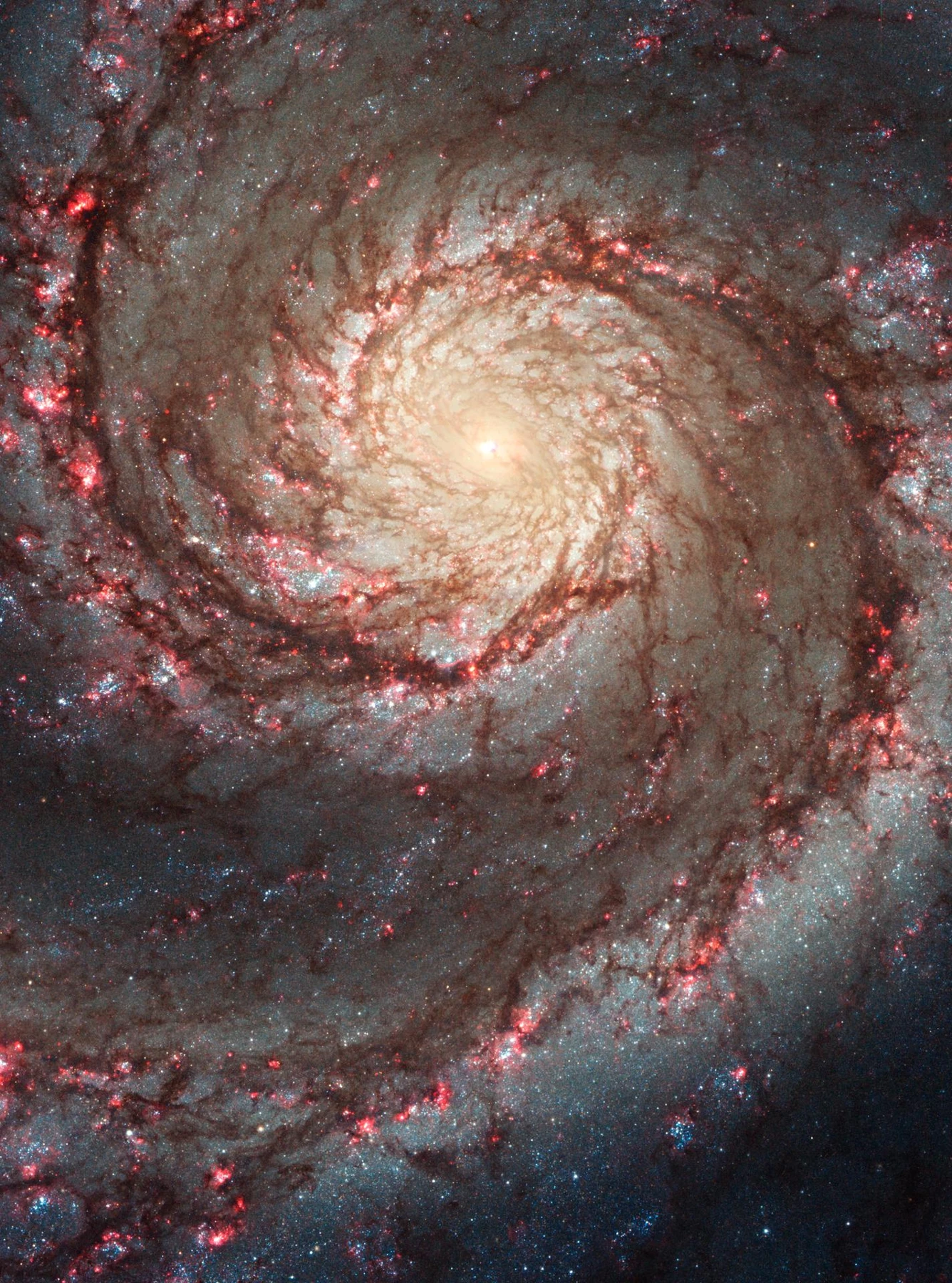
Spirals keep forming stars in their arms, and those regions make the galaxy look blue, while the centre is redder and smoother (AEGIS survey, Spiral vs. Elliptical). In Hubble’s image of the Whirlpool Galaxy (M51), glowing hydrogen traces the most luminous young stars along the arms (NASA Photojournal, PIA04230). M51 is about 31 million light-years away (about 2.9 × 10²⁰ km, or 1.8 × 10²⁰ miles), and its small companion, NGC 5195, appears to tug on one arm (NASA Hubble, Messier 51). For how such distances are earned, see how astronomers measure stars.
What Type of Galaxy Is the Milky Way?
The Milky Way is a barred spiral galaxy. NASA Science lists both the Milky Way and Andromeda as barred spirals (NASA Science, Galaxy Types), and NASA’s Imagine the Universe calls ours a “large barred spiral galaxy” (NASA).
A bar is an elongated band of stars, gas and dust through a spiral’s centre. Bars are common: NASA says barred spirals make up two-thirds of spirals (NASA Science).
How do we know, from inside? For decades the evidence was indirect. In 2019, ESA reported the first direct measurement of the bar, seen in 3D using Gaia’s second data release, infrared surveys and improved distances for about 150 million stars (ESA, Gaia starts mapping our galaxy’s bar). The Sun sits about 25,000 light-years from the centre (about 2.4 × 10¹⁷ km, or 1.5 × 10¹⁷ miles) and takes about 250 million years per orbit, per NASA; other sources give slightly different figures (NASA).
What Is an Elliptical Galaxy?
An elliptical galaxy is a smooth, oval or round swarm of stars with no obvious disk or arms. (Some do hide faint disk-like rotation, as the next section shows.) NASA describes ellipticals as less common than spirals, low in gas and dust, and generally older (NASA Science).
Little cold gas, little star birth
Ellipticals contain much less cold gas than spirals, so they lack the fuel for new stars (AEGIS survey). They’re dominated by “old, red, population II stars” (Swinburne COSMOS, Elliptical Galaxy).
Stars on random orbits
In many ellipticals, stars orbit in all different directions without coherent rotation (AEGIS survey). This is support by velocity dispersion: random motion, not spin, holds the galaxy up, and it’s measured from how broadened the spectral lines are (Swinburne COSMOS, Velocity Dispersion).
There’s a twist. When the ATLAS³D survey measured the stellar motions of 260 nearby early-type galaxies (ellipticals and lenticulars), 86% (224 of 260) were “fast rotators” with regular rotation; only 14% were slow rotators. That 86% mixes ellipticals with lenticulars, which have disks. Counting only the galaxies classified as ellipticals by eye, 66% were still fast rotators (Emsellem et al. 2011). The authors also note that some galaxies labelled E may be disk systems seen face-on, so the label alone doesn’t reveal whether a disk is there. Slow rotators dominate above about 2 × 10¹¹ solar masses (Cappellari 2016). So “round and non-rotating” fits the giants best.
A huge range of sizes
Ellipticals run from dwarfs as small as 0.3 kiloparsecs across (about 1,000 light-years; a kiloparsec is about 3,260 light-years) to rare giants spanning hundreds of kiloparsecs, with stellar masses from about 10⁷ to 10¹³ suns (Swinburne COSMOS).
The best-known giant, M87 in Virgo, has roughly 15,000 globular star clusters and a black-hole jet moving at nearly the speed of light. NASA’s Hubble page puts it 54 million light-years away (NASA Hubble, Messier 87); a NASA Spitzer release says about 55 million (NASA, PIA23122).
What Is a Lenticular Galaxy?
A lenticular galaxy (type S0) is a lens-shaped in-between: a bulge and disk like a spiral, but no arms and little ongoing star formation. NASA suggests they may be faded spirals that used up their gas, or products of merging spirals (NASA Science). Both origins are modelled; neither has been watched happening.
This is where the tidy categories blur. A Hubble image description puts the lenticular Mrk 820 “right where the fork divides” (NASA Image Library), and ESA/Hubble notes that the bulges of S0, Sa and Sb galaxies may closely resemble ellipticals (ESA/Hubble).
What Is an Irregular Galaxy?
An irregular galaxy has no regular shape. NASA says dwarf irregulars weigh about 100 million Suns and large irregulars about 10 billion (NASA Science). Irr I galaxies show some hint of structure, like the Magellanic Clouds; Irr II galaxies are completely disorganized (Swinburne COSMOS).
The Large Magellanic Cloud (LMC) shows how slippery labels are. NASA’s Astronomy Picture of the Day calls it a “dwarf irregular galaxy” about 163,000 light-years away, with roughly 10% to 20% of the Milky Way’s mass (NASA APOD, July 23, 2026). Caltech’s Spitzer page lists it as spiral, barred and irregular, about 160,000 light-years away in its text (Spitzer). Same galaxy; the label depends on which features you emphasize.
What are dwarf galaxies?
Dwarf galaxies are a size class, not a shape: dwarf ellipticals, dwarf irregulars and small spirals all count. A 2011 NASA Hubble release says “dwarf galaxies are the most common type of galaxy in the universe” (NASA Hubble, 2011). Because they’re faint, how many we count depends on how deep a survey sees.
What Makes a Galaxy Look the Way It Does?
Appearance comes down to three ingredients, plus a wild card.

1. Cold gas, the fuel. Cold gas is fuel for new stars; plentiful in spirals and irregulars. Ellipticals have much less, which is why they show little current star formation (Swinburne COSMOS).
2. Star birth, the colour. Young massive stars make a galaxy look blue. They live only a few hundred million years, so when star formation stops, massive stars die; older red stars remain (Masters 2013). Plot galaxies by colour and brightness and most fall into a blue cloud (mostly spirals) or a red sequence (mostly ellipticals and lenticulars), with a sparse green valley between (Masters 2013). For why massive stars die young, see our life cycle of a star explainer.
3. Motion, the shape. With ordered spin, stars orbiting together build a flat disk. With random orbits, stars moving every which way give a rounder shape (Swinburne COSMOS, Velocity Dispersion). Most galaxies mix the two: a spiral’s disk rotates while its bulge and halo show little rotation.
The wild card: mergers. Collisions can scramble disks into ellipticals, a modelled idea: NASA says ellipticals may come from collisions and mergers (NASA Science), and Cappellari describes slow rotators growing mainly through gas-poor mergers (Cappellari 2016).
Can a Galaxy Change Type?
Yes, but not along the tuning fork in a fixed order. The main routes are modelled and run in more than one direction:
- Fading. A spiral that runs out of gas stops forming stars and can end up looking lenticular (NASA Science).
- Merging. Colliding disks can leave a rounder, elliptical-like galaxy.
- Growing a bar. NASA says scientists think a bar is a sign that a spiral has reached full maturity (NASA Science). “Mature” here means a settled, orderly disk, not necessarily an old galaxy: Webb has spotted a Milky Way-like barred spiral seen as it was about 2 billion years after the Big Bang (Costantin et al. 2023).
Galaxy Zoo volunteers found a telling in-between group: red spirals, which keep their arms but form fewer stars than blue spirals of the same mass; about 75% are strongly barred (Masters 2013).
The Milky Way and Andromeda: three forecasts
These forecasts come from different years, data and models, so keep them apart; each is a dated model result, not an observation.
NASA’s 2012 forecast. Using Hubble measurements, NASA announced on May 31, 2012 that Andromeda, about 2.5 million light-years away and approaching at about 250,000 mph (about 400,000 km/h, our conversion), would collide with the Milky Way in about 4 billion years. The two would merge fully about 2 billion years later, roughly 6 billion years from now, into “a single elliptical galaxy.” The Sun would likely be moved, but Earth is not in danger of being destroyed (NASA). As of November 2026, that page still gives this timeline.
The 2025 reanalysis. A team led by Till Sawala (University of Helsinki) re-ran the numbers with Gaia and Hubble data, adding two smaller galaxies: M33 nudges Andromeda toward us, while the Large Magellanic Cloud pulls the Milky Way off course (UWA/The Conversation, June 3, 2025). In Nature Astronomy (June 2, 2025), they estimate “a probability of close to 50%” that there is no merger in the next 10 billion years (Sawala et al. 2025). Durham University’s release adds only a 2% chance of a collision in the next 5 billion years; where a merger happens, it’s more likely in eight to ten billion years (Durham University via EurekAlert!).
The 2025 study used no new data; it added more galaxies and carried the measurement uncertainties through.
The 2026 update. A Peking University team led by Hao Wu used the same kind of model but newer, corrected Gaia measurements of how Andromeda and M33 drift across the sky. In their preferred model the chance of a Milky Way–Andromeda merger within 10 billion years rises to 90%, with a median merger time of about 6.5 billion years (Wu et al. 2026, ApJL). They stress it isn’t settled: across the measurements’ 2-sigma range, the probability still runs from about 65% to 100%, and they say much more precise motions are needed for a firm answer.
So the status stays open. Each forecast is a dated model result that depends on measured motions and masses. The latest one leans strongly toward a merger, and a merger would likely build an elliptical.
How Do Astronomers Know a Galaxy’s Type?
Here’s the evidence chain. Our How We Know hub explains the general method.
Photographs. Shape is the first clue, but images are processed and colours often mapped from filters. In Hubble’s NGC 1300 image, red combines a near-infrared filter with light from glowing hydrogen (NASA Science, NGC 1300). See Are Space Photos Real?
Spectra and redshift. A galaxy’s spectrum reveals how its stars move: rotation shows up as redshifts changing across the galaxy, random motion as broadened lines (Swinburne COSMOS, Velocity Dispersion).
Rotation curves. In the early 1970s, Vera Rubin and Kent Ford found that stars far outside Andromeda’s bulge orbited at about the same rate as stars just inside it, not slower as expected. Rubin found similar results in about 60 other galaxies and concluded they hold roughly ten times more dark mass than visible matter (Sky & Telescope). The speeds are measured; dark matter is the leading explanation.
Citizen science. Galaxy Zoo launched in July 2007 (Zooniverse). Its first data paper reports more than 40 million classifications of nearly one million galaxies by about 100,000 volunteers (Lintott et al. 2008). Volunteer labels now train machines: Euclid’s first visual morphology catalogue measured 378,000 galaxies with models fine-tuned on Galaxy Zoo annotations (Euclid Collaboration 2025).
Deep fields. Light takes time to travel, so deep images show distant galaxies as they were long ago. In Hubble’s eXtreme Deep Field, most galaxies are “young and small, often colliding and merging together” (NASA Science, Hubble Deep Fields). Webb’s First Deep Field (July 2022; 12.5 hours of exposures) shows the cluster SMACS 0723 as it appeared 4.6 billion years ago, with thousands of galaxies behind it (ESA/Webb). Cluster lensing also drives our SN Refsdal supernova replay story.
Webb’s early disks
Each finding below is observed; what it means for galaxy formation is still being worked out.
- Many early disks. In Webb’s first deep field, Leonardo Ferreira’s team found disk galaxies dominate above redshift 1.5, with about 10 times more disks than Hubble had seen there (Ferreira et al. 2022).
- An early barred spiral. CEERS-2112 is a barred spiral seen when the universe was about 2 billion years old. Simulations had predicted bars would be almost absent that early (Costantin et al. 2023).
- A giant early disk. The “Big Wheel,” seen about 2 billion years after the Big Bang, is a rotating disk with an effective radius of about 10 kiloparsecs, about three times larger than similar-mass galaxies found before. It was observed mainly with Webb (University of Milano-Bicocca, March 17, 2025).
For how the two telescopes differ, see Hubble vs. Webb: Same Nebula, Different View.
How Can You See Different Types of Galaxies Yourself?
- A spiral, naked eye: Andromeda (M31), magnitude 3.1, is “easily visible with the unaided eye from a dark sky site,” best in November, which is now (NASA Hubble, Messier 31).
- A spiral with a companion: the Whirlpool (M51), magnitude 8.4, best in May with a small telescope (NASA Hubble, Messier 51).
- A giant elliptical: M87, magnitude 9.6, also easiest in May with a small telescope (NASA Hubble, Messier 87).
- An irregular dwarf: the Large Magellanic Cloud, from the Southern Hemisphere; seen in full, it would cover about 480 full moons of sky (Spitzer).
- Classify galaxies: Galaxy Zoo is open to everyone, with a Rubin Observatory project (possibly short-lived) and, since April 29, 2025, a Webb project (Zooniverse).
What Comes Next for Galaxy Science?
All dates are as of November 2026.
- Vera C. Rubin Observatory (running). Rubin began its 10-year Legacy Survey of Space and Time on June 29, 2026 (Rubin Observatory).
- Nancy Grace Roman Space Telescope (launched). Roman launched on August 30, 2026, on a five-year mission to “map billions of galaxies” (NASA Roman blog).
- ESA’s Euclid (release planned). ESA’s June 15, 2026 update plans the first stage of Data Release 1 for November 2026 and the full DR1 for mid-2027, exact dates to be announced (ESA). Its Q1 catalogue was “the first 0.4%” of about 100 million galaxies Euclid will resolve (Euclid Collaboration 2025).
Types of Galaxies by the Numbers
- 1926: Hubble’s classification paper (Crossref)
- 1936: the tuning fork diagram, in The Realm of the Nebulae (Sandage, via NED)
- Two-thirds: the share of spirals that are barred (NASA)
- 100,000 light-years (about 9.5 × 10¹⁷ km, or 5.9 × 10¹⁷ miles): the Milky Way’s disk (NASA)
- 2.5 million light-years (about 2.4 × 10¹⁹ km, or 1.5 × 10¹⁹ miles): the distance to Andromeda (NASA)
- 54 to 55 million light-years (about 5.1 to 5.2 × 10²⁰ km, or 3.2 × 10²⁰ miles): the distance to elliptical M87 (NASA)
- 66%: galaxies classified as ellipticals in the ATLAS³D sample that are fast rotators (86% when lenticulars are included) (Emsellem et al. 2011)
- About 10 kiloparsecs (about 3.1 × 10¹⁷ km, or 1.9 × 10¹⁷ miles): the Big Wheel’s effective radius (Milano-Bicocca)
- 40 million+: Galaxy Zoo classifications in its first data paper (Lintott et al. 2008)
- Close to 50% vs 90%: modelled odds for the Milky Way and Andromeda over the next 10 billion years: close to 50% chance of no merger in the 2025 study (Sawala et al. 2025), 90% chance of a merger in the 2026 study (Wu et al. 2026, ApJL)

Types of Galaxies: FAQ
How many kinds of galaxies are there?
Astronomers usually name five main shapes: spiral, barred spiral, elliptical, lenticular and irregular. Dwarf galaxies are a size class that cuts across those shapes. Detailed schemes split them further, such as E0 to E7 for ellipticals.
Is the Milky Way a spiral or a barred spiral?
It’s a barred spiral. NASA lists the Milky Way as a barred spiral, and ESA’s Gaia mission made the first direct 3D map of its central bar in 2019.
Did Hubble think ellipticals turn into spirals?
His published words say no. In 1926 he wrote that the time-related meaning of “early” and “late” was deliberately disregarded, and in 1927 he warned that such readings were made “at one’s peril.” Some textbooks still say he first read the sequence as evolutionary.
Why are elliptical galaxies red?
Because they have little cold gas left and make few new stars. Blue, massive stars live only a few hundred million years, so once star formation stops, the longer-lived red stars dominate the light.
Do elliptical galaxies rotate?
Many do. In the ATLAS³D survey of nearby early-type galaxies, 66% of the galaxies classified as ellipticals were fast rotators with regular rotation. Slow rotators tend to be the most massive ones.
Will the Milky Way collide with Andromeda?
Probably, but it isn’t settled. NASA’s 2012 forecast put a collision about 4 billion years away. A 2025 study in Nature Astronomy found close to a 50% chance of no merger in the next 10 billion years, while a 2026 study using newer Gaia measurements found a 90% chance of a merger, with a median merger time of about 6.5 billion years. The answer depends on how precisely Andromeda’s motion is measured.
What is the most common type of galaxy?
Dwarf galaxies, according to NASA. They are small and faint, so how many astronomers count depends on how deep a survey looks.
Can I help classify galaxies?
Yes. Galaxy Zoo, launched in 2007, lets anyone classify galaxies online, including Webb images since 2025. Volunteer classifications also help train machine-learning models for surveys like Euclid.
Your next step: on the next clear, moonless November night, find Andromeda with your eyes or binoculars: a barred spiral 2.5 million light-years away. Then try a few classifications on Galaxy Zoo.

Sources and Further Reading
- Hubble, E. P. (1926). Extragalactic nebulae. The Astrophysical Journal, 64, 321. doi:10.1086/143018 (record checked via Crossref).
- Baldry, I. K. (2008). Hubble’s galaxy nomenclature. Astronomy & Geophysics, 49, 5.25–5.26. doi:10.1111/j.1468-4004.2008.49525.x; preprint “What Hubble really meant by late and early type,” arXiv:0809.0125.
- Sandage, A. Classification and Stellar Content of Galaxies, §4.4, hosted by NASA/IPAC Extragalactic Database.
- Masters, K. L. (2013). A Zoo of Galaxies. Invited discourse. arXiv:1303.7118.
- Lintott, C. J., et al. (2008). Galaxy Zoo: morphologies derived from visual inspection of galaxies from the Sloan Digital Sky Survey. MNRAS, 389, 1179–1189. doi:10.1111/j.1365-2966.2008.13689.x.
- Emsellem, E., et al. (2011). The ATLAS3D project – III. MNRAS, 414, 888. doi:10.1111/j.1365-2966.2011.18496.x; arXiv:1102.4444.
- Cappellari, M. (2016). Structure and Kinematics of Early-Type Galaxies from Integral Field Spectroscopy. Annual Review of Astronomy and Astrophysics, 54, 597–665. doi:10.1146/annurev-astro-082214-122432.
- Sawala, T., et al. (2025). No certainty of a Milky Way–Andromeda collision. Nature Astronomy, 9, 1206–1217. doi:10.1038/s41550-025-02563-1; arXiv:2408.00064.
- Photos used in the DCI galaxy graphics, from the NASA Image and Video Library: M51, the Whirlpool (NASA, ESA, S. Beckwith (STScI) and the Hubble Heritage Team (STScI/AURA)); NGC 1300 (NASA, ESA and the Hubble Heritage Team (STScI/AURA); acknowledgment: P. Knezek (WIYN)); NGC 3610 (ESA/Hubble & NASA; acknowledgment: Judy Schmidt); NGC 4526 (ESA/Hubble & NASA; acknowledgment: Judy Schmidt); IC 3583 (ESA/Hubble & NASA); NGC 5477 (ESA/Hubble & NASA); NGC 5474 (ESA/NASA). Photos are cropped; labels and layout are DCI’s.
- Wu, H., Huang, Y., Zhang, H., Sun, G., & Shao, S. (2026). The fate of the Milky Way–Andromeda system: To merge or not? The Astrophysical Journal Letters, 1001, L19. doi:10.3847/2041-8213/ae5799.
- Plain-language summaries of Sawala et al.: Durham University via EurekAlert!; UWA/The Conversation.
- Costantin, L., et al. (2023). A Milky Way-like barred spiral galaxy at a redshift of 3. Nature, 623, 499–501. doi:10.1038/s41586-023-06636-x; University of Bath record.
- Ferreira, L., et al. (2022). Panic! at the Disks. The Astrophysical Journal Letters, 938, L2. doi:10.3847/2041-8213/ac947c; arXiv:2207.09428.
- Wang, W., et al. (2025). A giant disk galaxy two billion years after the Big Bang. Nature Astronomy, 9, 710–719. doi:10.1038/s41550-025-02500-2; University of Milano-Bicocca release.
- Euclid Collaboration: Walmsley, M., et al. (2025). Euclid Quick Data Release (Q1): First visual morphology catalogue. arXiv:2503.15310.
- NASA Science (updated August 12, 2026), Galaxy Types.
- NASA (May 31, 2012; updated January 23, 2025), NASA’s Hubble Shows Milky Way Is Destined for Head-On Collision.
- NASA Imagine the Universe, The Milky Way Galaxy; NASA Space Place, What Is a Galaxy?.
- NASA Hubble Messier Catalog: M31, M51, M87; NASA Science, Hubble Deep Fields; NASA (2011), Hubble Observes Young Dwarf Galaxies Bursting With Stars.
- ESA (July 16, 2019), Gaia starts mapping our galaxy’s bar; ESA/Hubble, The Hubble tuning fork; ESA (2023), Late-type galaxy; ESA/Webb, Webb’s First Deep Field.
- Swinburne University COSMOS encyclopedia: Elliptical Galaxy, Hubble Classification, Velocity Dispersion; AEGIS survey, Spiral vs. Elliptical.
- Sky & Telescope, Vera Rubin: Dark Matter Detective; Zooniverse, Galaxy Zoo research.
- Caltech/Spitzer, Our Chaotic Neighbor (LMC); NASA APOD (July 23, 2026), The Large Magellanic Cloud.
- Rubin Observatory, Survey Progress; NASA Roman blog (August 30, 2026), NASA’s Roman Space Telescope Launches; ESA, Euclid DR1 timeline.
- Images: NASA Science, Barred Spiral Galaxy NGC 1300 (NASA Image Library ID GSFC_20171208_Archive_e002154); NASA Image Library, The Two-faced Whirlpool Galaxy (M51, January 13, 2011 release); NASA Photojournal, PIA04230, Whirlpool Galaxy.
Explore Next
- How distances to galaxies and stars are earned: How Astronomers Measure Stars
- What makes blue stars die young: Life Cycle of a Star
- Two telescopes, one target: Hubble vs. Webb: Same Nebula, Different View
- What the colours in galaxy images mean: Are Space Photos Real?
- A galaxy cluster that replays a supernova: SN Refsdal, the Supernova Replay
- How DCI separates evidence from inference: How We Know
- More stars and galaxies: Stars & Galaxies
- Four strange worlds around Jupiter: How Many Moons Does Jupiter Have?
- Mars’s two small, dark moons: How Many Moons Does Mars Have?
- Everything on DCI: Explore
How This Explainer Was Checked
Every number in this article links to the page or paper it came from, all fetched and checked in November 2026. We relied on NASA, ESA, ESA/Hubble, ESA/Webb, university and observatory pages, and peer-reviewed papers; for papers, we checked the published abstracts or bibliographic records, and for Hubble’s 1926 footnote we relied on Baldry’s quotation of it. Where sources disagree, as on M87’s distance, the Large Magellanic Cloud’s label and what Hubble privately believed, we name each source rather than picking one. The three Milky Way–Andromeda forecasts (NASA 2012, Sawala et al. 2025, Wu et al. 2026) are shown separately, each dated, not merged into one number. Unit conversions (light-years and kiloparsecs to km and miles, mph to km/h) are DCI’s own. Images are labelled: real telescope images as OBSERVATION, illustrations as ILLUSTRATION, and our charts as DATA GRAPHIC. Nothing AI-generated is presented as a real image.

Final Thought: A Sorting Scheme, Not a Destiny
Hubble’s tuning fork has lasted a century because it does one job well: it gives a name to what we see. What it doesn’t do is tell a galaxy’s future. That’s written in quieter numbers: how much cold gas is left, how fast the stars still form, whether they swirl together or swarm. Even our own galaxy’s fate turned out to be less certain than the textbooks said. The shapes are a snapshot. The physics is the story.
About the Author
Author: King | Founder of Dark Cosmic Insights
King is the founder of Dark Cosmic Insights, a science storytelling platform exploring the strangest true stories hiding in space, science and AI. He digs into NASA, ESA and peer-reviewed research, separates what has been measured from what is still a mystery, and turns it into articles, data graphics and Shorts.
Follow the anomaly. Trace the source.