Put Hubble’s Pillars of Creation next to Webb’s and they hardly look like the same place. Hubble shows dark, solid towers of dust against a glowing green-blue haze. Webb shows ghostly, see-through columns sprinkled with red newborn stars. Nothing about the pillars suddenly changed. The two telescopes are looking at different kinds of light.
Hubble vs. Webb is one of the most searched comparisons in astronomy, and the Pillars of Creation are the perfect test case. Hubble made them famous in 1995. Webb photographed the same spot in 2022. Lay the pictures side by side and you get a lesson in how telescopes, light and image processing really work.
This guide explains what each telescope can see, why dust hides stars from one and not the other, where the colors in each picture come from, and why astronomers still need both. As always at Dark Cosmic Insights, we keep three things separate: what the telescopes observed, what has been measured, and what is still being modelled or debated.
In this guide
- Quick Answer: Why Do Hubble and Webb Images Look So Different?
- The DCI Hubble vs. Webb Evidence Map
- What Are the Pillars of Creation?
- Hubble vs. Webb: What’s the Difference Between the Two Telescopes?
- What Light Can Each Telescope See?
- Why Does Dust Hide Stars From Hubble but Not From Webb?
- What Is Webb Actually Showing in the Pillars?
- Are the Colors in Hubble and Webb Images Real?
- Is Webb Sharper Than Hubble?
- What Other Objects Have Both Telescopes Photographed?
- Myth vs. Fact: Hubble vs. Webb Edition
- How Can You Explore These Images Yourself?
- What Comes Next for Hubble and Webb?
- Hubble vs. Webb by the Numbers
- Frequently Asked Questions
- Sources and Further Reading
- Keep Exploring
- How This Explainer Was Checked
Quick Answer: Why Do Hubble and Webb Images Look So Different?
Quick Answer: Hubble mainly sees ultraviolet and visible light (about 0.1 to 2.5 microns). Webb sees infrared light (about 0.6 to 28.5 microns) with a mirror about 2.7 times wider. Dust clouds block much of the visible light Hubble collects, so Hubble shows their dark outsides. Longer infrared waves pass through dust more easily, so Webb sees the stars forming inside. Both pictures are real data. In both, scientists assign colors to each filter in wavelength order, and Webb’s infrared is invisible to human eyes anyway.
What this article can and cannot establish: We can explain the physics of light and dust and quote NASA’s published specifications and image notes, with a source for every number. We can’t tell you what the pillars would look like to your own eyes from close up, because no image of them is a simple photograph. Where astronomers still disagree, for example on whether the pillars have already been destroyed, we say so.
The DCI Hubble vs. Webb Evidence Map
Some claims about these two telescopes are rock solid. Others are popular but wrong. This map sorts them.
| Question | What we know | Status | Key source |
|---|---|---|---|
| Do Hubble and Webb see different light? | Hubble ~0.1–2.5 µm (UV, visible, some near-IR); Webb ~0.6–28.5 µm (infrared) | Measured | NASA, Hubble vs. Webb |
| Is Webb’s mirror bigger? | 6.5 m vs. 2.4 m; about 5.6 times the collecting area | Measured | NASA Webb Telescope Overview |
| Does infrared see through dust better? | Yes, longer waves slip past small dust grains more easily | Observed | NASA Infrared Astronomy |
| Are the newborn stars in Webb’s Pillars real? | Yes, red protostars and jets from young stars show in near-infrared | Observed | NASA/STScI 2022 |
| Are the colors real? | Real data, colors assigned per filter in wavelength order | Measured (method published) | NASA, How Webb images are made |
| Did the pillars change between 1995 and 2022? | Small, slow changes are detectable; the big visual jump is from wavelength | Observed | ESA/Hubble 2015 |
| Have the pillars already been destroyed? | A 2007 Spitzer idea suggested a supernova; others dispute it | Open / disputed | NASA JPL 2007; New Scientist 2007 |
| Did Webb replace Hubble? | No. Hubble still sees UV and visible light Webb can’t | Not supported | NASA; STScI 2026 |
Status key: Observed = seen directly in telescope images; Measured = quantified from data or published specifications; Open = still debated; Not supported = the evidence says no.
Cite this framework: Dark Cosmic Insights, “Hubble vs. Webb Evidence Map,” darkcosmicinsights.com, 2026.
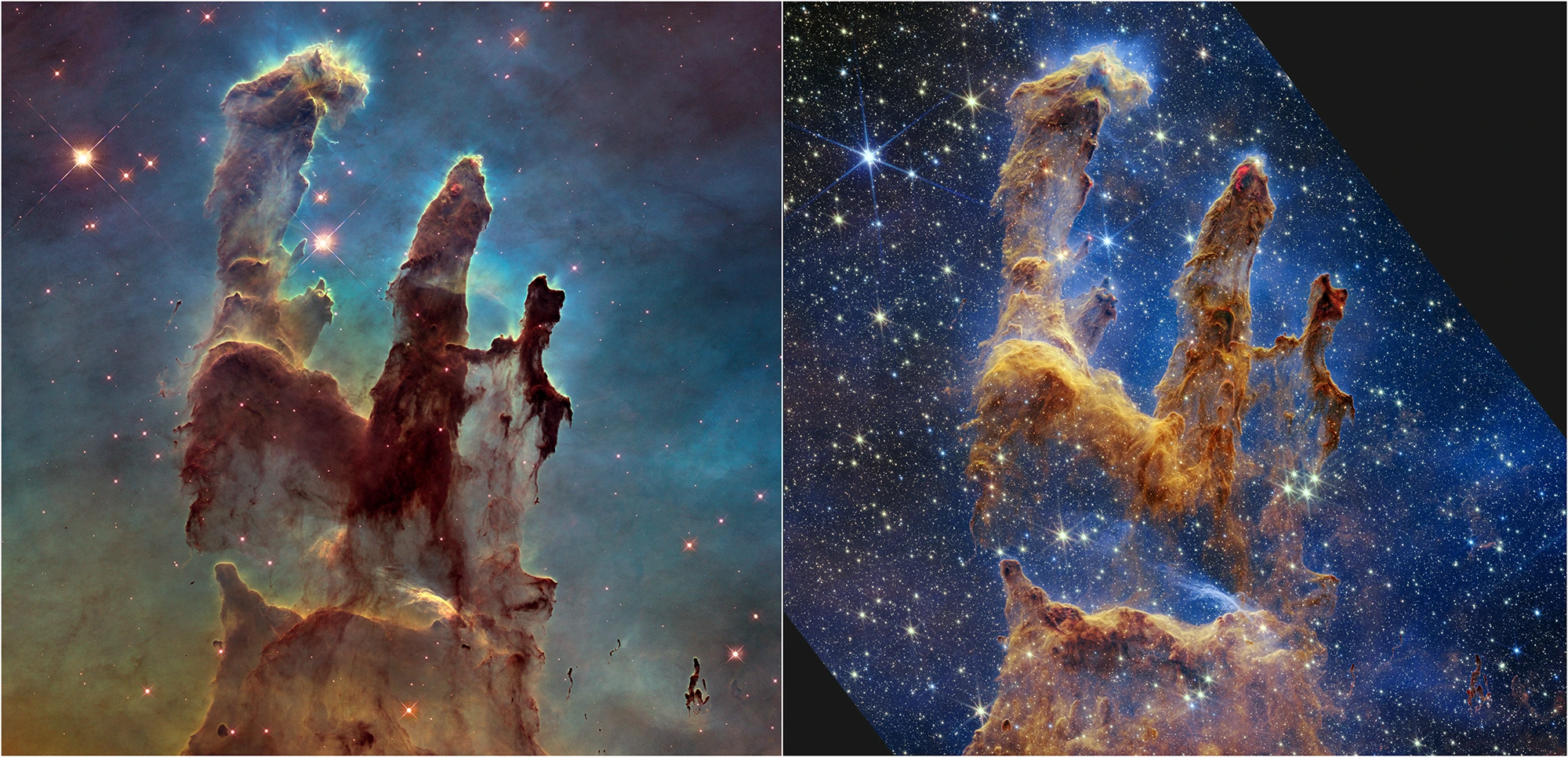
Same pillars. Same patch of sky. Two completely different pictures, because light comes in more colors than your eyes can see.
What Are the Pillars of Creation?
The Pillars of Creation are three towers of cold gas and dust inside the Eagle Nebula, also called Messier 16. NASA says the largest column is about four light-years tall, roughly 38 trillion kilometres (NASA). The whole Eagle Nebula is far bigger, about 70 by 55 light-years (NASA).
Hubble’s 1995 picture, taken by astronomers Jeff Hester and Paul Scowen, became one of the most famous science images ever made. It has appeared on stamps, shirts and film sets. In 2014, Hubble went back with its newer Wide Field Camera 3 and took a sharper, wider view (ESA/Hubble, 2015). Then on October 19, 2022, NASA released Webb’s near-infrared portrait of the same spot (NASA, 2022).
You’ll see two distances quoted. Webb’s 2022 releases use 6,500 light-years (NASA), while older NASA pages say about 7,000. Distances to nebulae are hard to pin down, and the newer figure reflects updated measurements. Either way, the light Webb caught left the pillars thousands of years ago.
The pillars exist because of nearby massive stars. Their ultraviolet light and winds blow away thin gas, but the dense tips of the pillars shield the material behind them, leaving long columns, a bit like sand behind a rock in the wind. ESA calls them “pillars of destruction” as much as creation, because the same starlight that sculpts them is slowly eating them away (ESA/Hubble).

Notice something about the 1995 and 2014 Hubble images: they look alike. Nineteen years apart, same telescope, same visible light, same general look. That’s a useful control. When the 2022 Webb image looks wildly different, the main reason isn’t time. It’s the kind of light.
Hubble vs. Webb: What’s the Difference Between the Two Telescopes?
Both are reflecting telescopes, which means they collect light with a curved main mirror instead of a lens. Past that, almost everything is different. NASA’s own comparison sums it up (NASA, Hubble vs. Webb):
| Hubble | Webb | |
|---|---|---|
| Main light | Ultraviolet and visible, some near-infrared | Near- and mid-infrared |
| Wavelengths | About 0.1–2.5 microns | About 0.6–28.5 microns |
| Main mirror | 2.4 m (7.9 ft), one piece of glass | 6.5 m (21.3 ft), 18 gold-coated beryllium segments |
| Collecting area | 4.55 m² | 25.37 m², about 5.6 times Hubble |
| Where it is | Orbits Earth about 483 km (300 mi) up | About 1.5 million km (1 million mi) away, near the L2 point |
| Temperature | Kept at about 21°C (70°F) | Under 50 K (about −223°C) |
| Launched | April 1990 | December 25, 2021 |
| Repairable? | Yes, serviced by astronauts five times | No, too far away |
Sources: NASA, Hubble vs. Webb; NASA Webb Telescope Overview and Fact Sheet (NASA, NASA). Rounded.
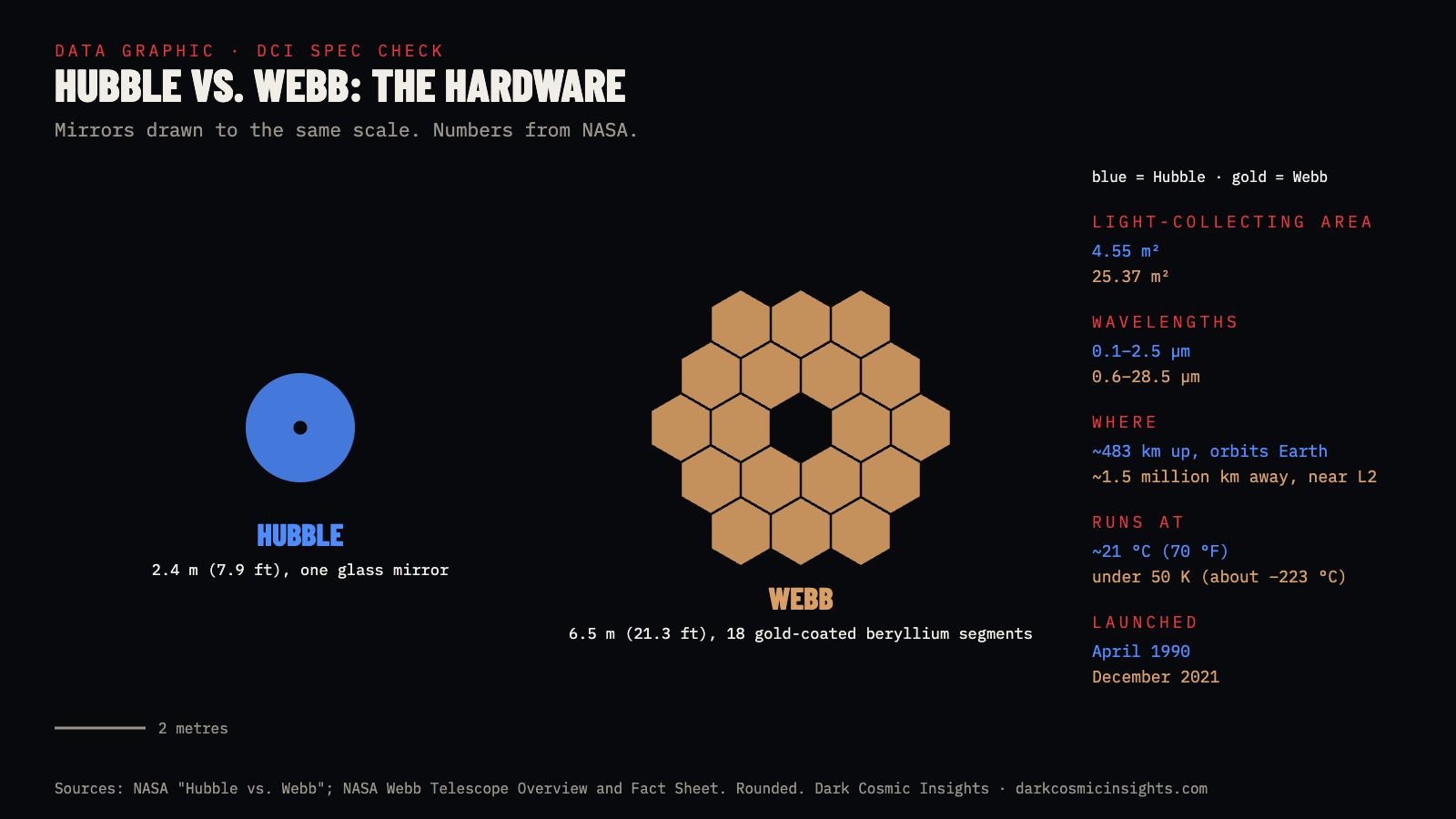
Why is Webb’s mirror made of beryllium instead of glass? A glass mirror that big would have been far too heavy to launch. Beryllium is light, stiff and holds its shape in deep cold. Each segment is coated with a layer of gold only about 100 nanometres thick, because gold reflects infrared light extremely well. NASA says the whole coating adds up to about 48 grams of gold, roughly the mass of a golf ball (NASA Fact Sheet).
And why does Webb live so far away? Infrared light is heat. Anything warm glows in infrared, including the Earth, the Moon and the telescope itself. Webb sits near a point in space called L2, where the Sun, Earth and Moon always stay on one side. A sunshield the size of a tennis court, made of five thin layers, blocks all three and keeps the mirror cold enough that its own warmth doesn’t drown out faint signals from space.
What Light Can Each Telescope See?
Light comes in many wavelengths, the distance between one wave crest and the next. Astronomers often measure them in microns (millionths of a metre). Human eyes only see a thin slice, from violet at about 0.4 microns to red at about 0.7 microns. Shorter than that is ultraviolet. Longer is infrared, which we feel as warmth on our skin.
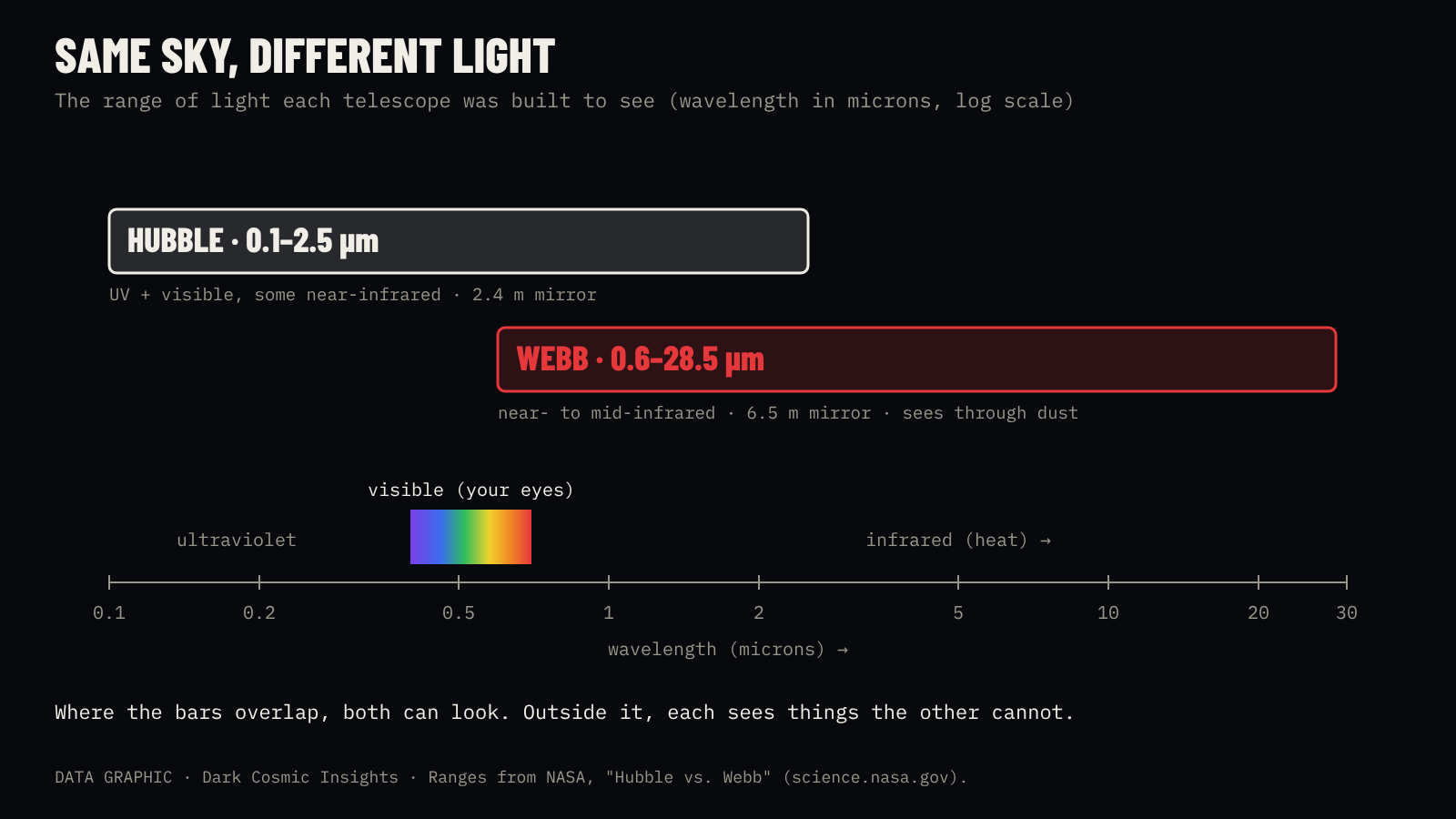
Hubble was built for ultraviolet and visible light, with some near-infrared added later. Webb starts at visible red and runs deep into the infrared. NASA describes the overlap as what makes the two “a formidable pair of observatories” that together cover a broad range (NASA).
Webb also carries two kinds of camera. NIRCam (Near-Infrared Camera) covers roughly 0.6 to 5 microns. MIRI (Mid-Infrared Instrument) covers longer waves, out to about 28 microns. MIRI’s detectors have to be even colder than the rest of the telescope, below 7 kelvin, so Webb carries a dedicated refrigerator called a cryocooler just for them. As you’ll see below, NIRCam and MIRI show the Pillars in surprisingly different ways too.
Why Does Dust Hide Stars From Hubble but Not From Webb?
Space dust is made of tiny grains of rock-like and carbon-rich material, most of them smaller than a micron. That’s close to the length of visible light waves, which makes dust very good at scattering and absorbing visible light. NASA puts it simply: visible light’s short wavelengths “are prone to bouncing off dust particles,” while longer infrared waves “slip past dust more easily” (NASA, Infrared Astronomy).
It’s the same reason fog hides car headlights but a thermal camera can still pick out warm bodies in smoke. The fog droplets interfere with short visible waves far more than with long infrared ones.
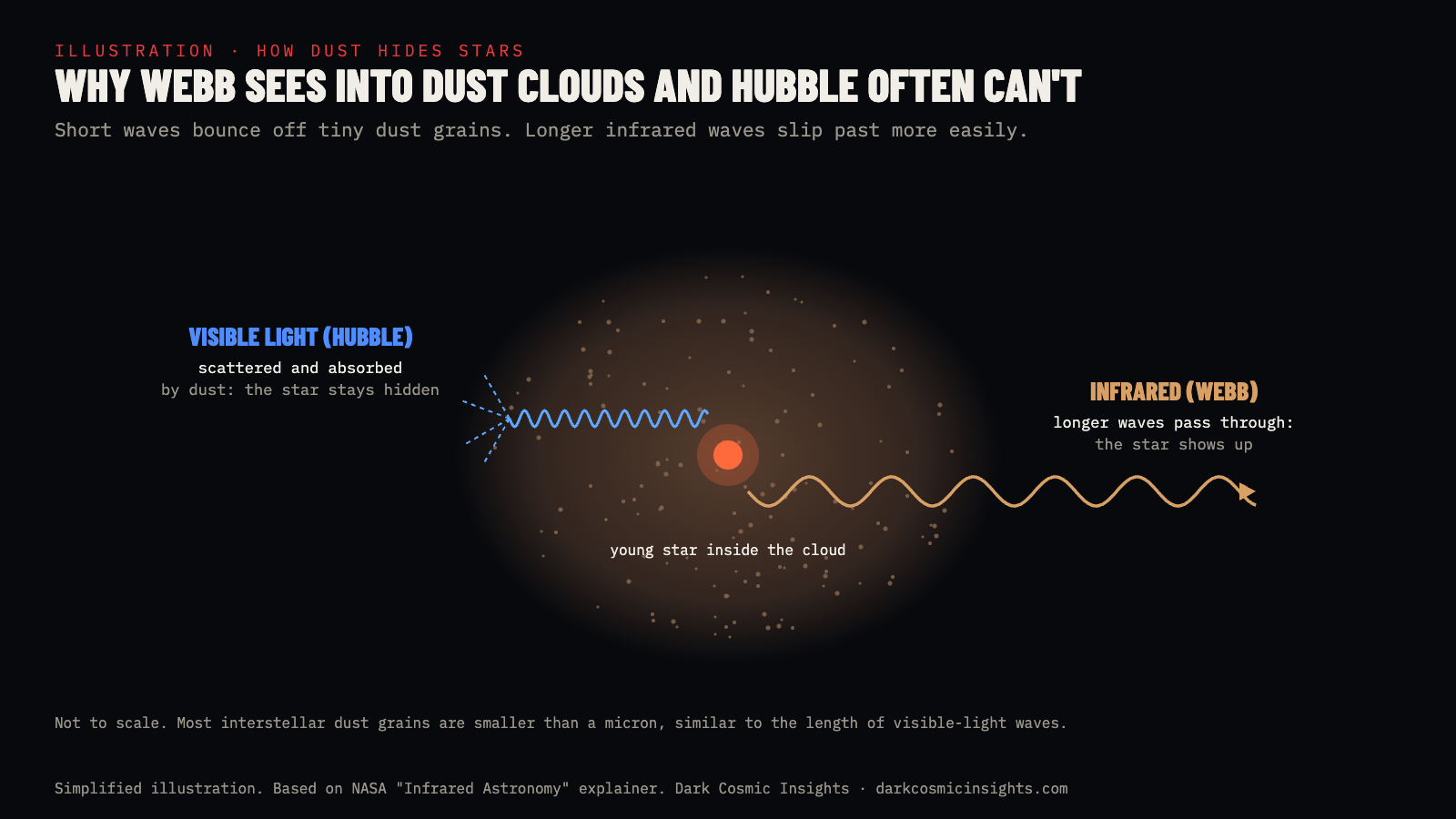
Stars are born inside dusty clouds, so this matters enormously. In visible light, a stellar nursery is a wall. In infrared, it becomes a window, and you can watch stars forming. That’s why Webb’s Pillars are full of newborn stars that Hubble’s visible-light view hides.
Here’s a detail most comparisons miss: Hubble can do this too, a little. Alongside its 2014 visible-light image, Hubble made a near-infrared version of the Pillars. In it, the towers turn into faint, wispy silhouettes against a background full of stars, and newborn stars appear inside the pillars (ESA/Hubble). Webb’s advantage is that it does infrared with a much bigger mirror, much colder optics and far more wavelengths.

What Is Webb Actually Showing in the Pillars?
Webb’s near-infrared image is full of details that NASA’s image team pointed out when it was released (NASA, 2022):
- Bright red orbs along the pillar edges are protostars, stars still forming. When knots of gas and dust become heavy enough, they collapse under their own gravity, heat up and eventually begin to shine.
- Wavy, lava-like lines at the edges of some pillars are ejections from stars still forming. Young stars periodically shoot out supersonic jets that slam into the surrounding clouds.
- Thousands of stars fill the background, many of them hidden in Hubble’s visible-light view.
- Few background galaxies. ESA notes that even near-infrared can’t see all the way through: the gas and dust between the stars, plus a thick dust lane in our own Milky Way, act “like a drawn curtain” (ESA/Webb).
Ten days later, NASA released Webb’s mid-infrared view from MIRI, and it looks different again. Most of the stars vanish, because stars are fainter at those longer wavelengths. Instead, the dust itself glows. NASA called the result “a chilling tone,” with seemingly endless layers of gas and dust taking center stage (NASA, 2022). That matters for science: MIRI’s data will help researchers work out how much dust is in the region and what it’s made of.
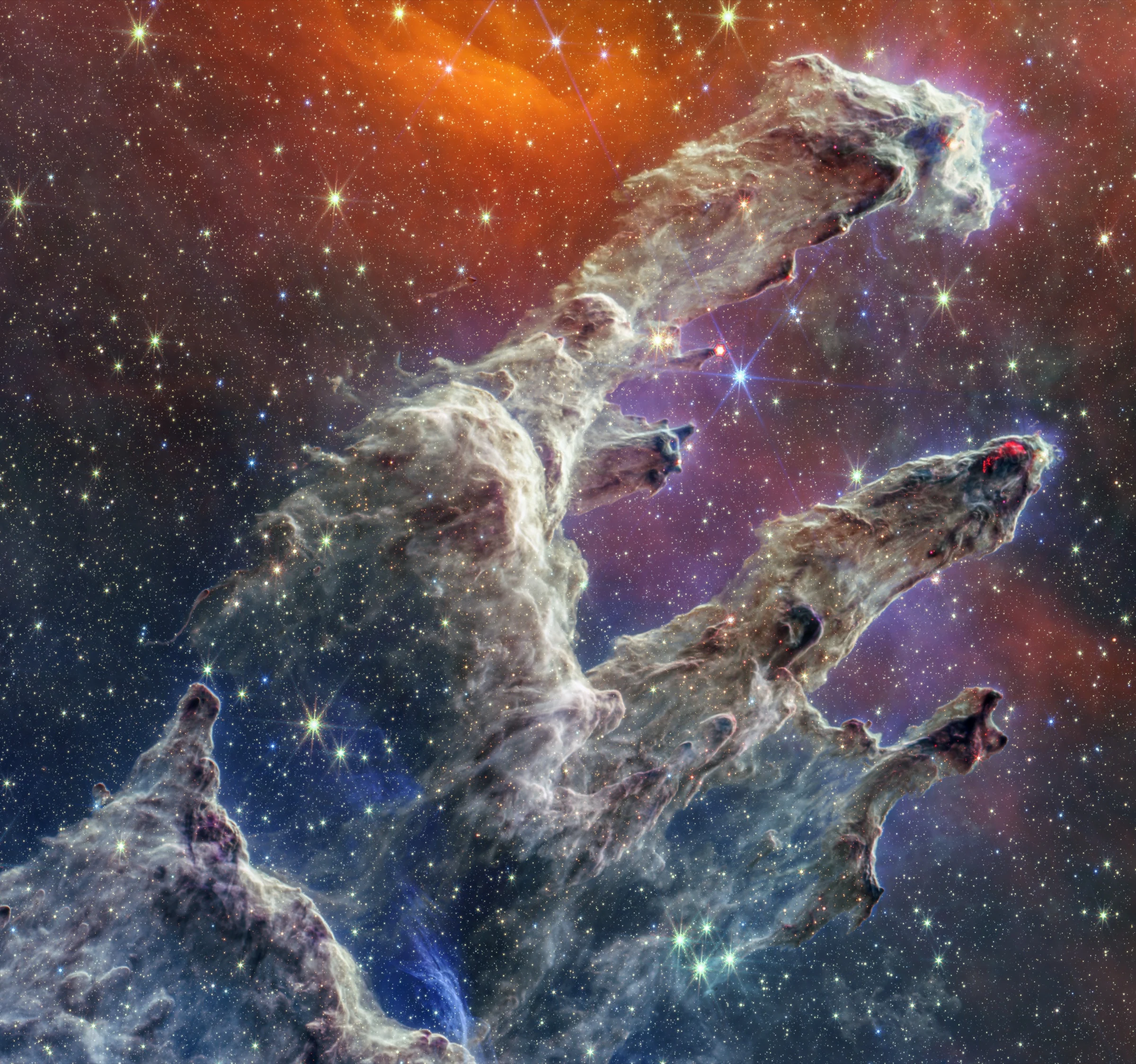
In the combined picture, released November 30, 2022, the densest dust is shown in deep indigo and the cooler, more diffuse dust in orange, draping across the top in a V shape (NASA). One object, three very different looks, depending on which slice of infrared you choose.
Are the Colors in Hubble and Webb Images Real?
This is the question we get most, and the honest answer is: the data are real, and the colors are assigned. That’s true for Hubble and Webb alike.
Space telescope cameras don’t take color photos the way a phone does. They take a series of black-and-white exposures, each through a different filter that lets in only a certain range of wavelengths. Image specialists then give each filter a color and stack them. For Webb, NASA says color is applied “chromatically”: the shortest wavelengths are assigned blue, slightly longer ones green and the longest red (NASA).

STScI image processor Joe DePasquale calls this chromatic ordering, and says the community prefers the term “representative color” to “false color,” because “false” suggests faking it. In his words, “the data is the data” (NASA Gravity Assist podcast). Webb’s NIRCam Pillars image, for example, used six filters, from F090W (0.9 microns) shown in purple to F470N (4.7 microns) shown in red (NASA).
The order is the same for both telescopes, but the wavelengths aren’t. In Hubble’s Pillars images, colors stand for glowing elements: oxygen, hydrogen, nitrogen and sulfur, each picked out with a narrow filter (NASA). In Webb’s, the colors mostly stand for different infrared wavelengths. That’s one reason the palettes feel so different, even before dust comes into it.
For a full guide to reading space images, including how to tell real data from artist’s concepts, see Are Space Photos Real? Natural Color, False Color and Artist’s Concepts.
Is Webb Sharper Than Hubble?
Not exactly, and this surprises people. A telescope’s sharpness, called resolution, depends on two things: mirror size (bigger is sharper) and wavelength (longer is blurrier). Webb’s mirror is about 2.7 times wider, but it works at longer wavelengths, so the two cancel out. NASA says Webb “delivers about the same resolution in near-infrared light as Hubble attains in visible light” (NASA).
Where Webb clearly wins is sensitivity. Its bigger mirror gathers more than six times as much light, letting it see objects up to 100 times fainter than Hubble can, according to NASA. NASA’s Webb team even says the telescope is sensitive enough to detect the heat of a bumblebee at the distance of the Moon (NASA).
That’s why Webb excels at the faintest, most distant galaxies, and why its images often look busier. More faint stars and galaxies make it into the frame.
What Other Objects Have Both Telescopes Photographed?
The Pillars are the most famous pair, but NASA has published side-by-side comparisons of many objects. Each one teaches something slightly different.
1. The Cosmic Cliffs in the Carina Nebula
One of Webb’s very first images, released in July 2022, showed the edge of a star-forming region called NGC 3324. Compared with Hubble’s view, Webb revealed hundreds of previously hidden stars and background galaxies. In Hubble’s version, red marks sulfur, blue marks oxygen and green marks hydrogen (NASA SVS).
2. The Crab Nebula
The Crab is the wreck of a star that exploded, seen from Earth in the year 1054. In Hubble’s 2005 visible-light image, orange filaments made mostly of hydrogen form a cage-like shell. Webb’s 2023 infrared view, from NIRCam and MIRI, shows glowing dust and a ghostly glow from particles spiraling around magnetic field lines, plus fine details of the material thrown out in the blast (NASA). The researchers are using Webb’s data to measure iron and nickel in the debris, which could reveal what kind of explosion made it (NASA, 2023).

3. Galaxy cluster MACS0416
This comparison shows Webb’s other superpower: seeing far back in time. As the universe expands, light from very distant galaxies gets stretched to longer, redder wavelengths. This is called redshift. Light that left a galaxy as visible light can arrive at Earth as infrared. In NASA’s MACS0416 comparison, Webb’s image shows galaxies that are invisible or barely visible to Hubble, because they are too distant or too dusty. Webb did it in about 22 hours of exposure, compared with 122 hours for Hubble’s image (NASA).

4. Spiral galaxies: dark dust vs. glowing dust
In side-by-side views of spiral galaxies such as NGC 4254, NASA points out a neat reversal. In Hubble’s images, dark lanes mark places where dust absorbs starlight. In Webb’s images, the same dust glows, because dust absorbs ultraviolet and visible light and then gives the energy back off as infrared (NASA). Same dust, opposite look.
Myth vs. Fact: Hubble vs. Webb Edition
| Myth | Fact |
|---|---|
| “Webb replaced Hubble.” | Webb can’t see ultraviolet light, and Hubble’s visible-light work is still in high demand. In 2025, 37% of Webb papers also used Hubble data (STScI, 2026). |
| “Webb’s colors are fake.” | The colors are assigned to invisible wavelengths in a consistent order. The structure and brightness come straight from the data. |
| “Hubble’s colors are what you’d see.” | Hubble’s Pillars colors also come from filters, many picking out single elements like oxygen and sulfur. Neither image is a snapshot your eyes would take. |
| “The pillars changed a lot between 1995 and 2022.” | Small changes over decades can be measured, but the dramatic difference between Hubble and Webb comes from wavelength. |
| “Webb sees through everything.” | Infrared passes dust more easily, not perfectly. The densest dust still blocks the view, and the Milky Way’s own dust hides most background galaxies behind the Pillars. |
| “The Pillars of Creation are already gone.” | That’s an unproven idea. In 2007 a Spitzer team suggested a supernova shock wave may have hit them about 6,000 years ago (NASA JPL), but other astronomers argued a young supernova remnant should give off much stronger radio and X-ray signals (New Scientist). |
Infrared doesn’t only reveal hidden stars. It also reveals hidden pigments here on Earth. The same principle lets researchers spot a 4,500-year-old color glowing in infrared on ancient artifacts. Read how in Egyptian Blue: The Ancient Pigment That Glows in Infrared.
How Can You Explore These Images Yourself?
- Use the official comparison pages. NASA’s Webb and Hubble asset pages list exactly which filters made each image and which color each was given. Look for the “Color Info” section, as on the Webb Pillars compass image.
- Download the raw data. Every Webb and Hubble observation goes into public archives. You can search them through STScI’s MAST portal and the ESA archives listed on ESA/Webb, and try stacking filters yourself.
- Find the Eagle Nebula in the sky. NASA says the Eagle Nebula is bright enough to spot through a small telescope and is best seen in July. Making out the Pillars themselves takes a large telescope and good conditions (NASA).
- Run your own color test. Take any Webb image’s filter list and redo the color order backward, with long wavelengths blue and short ones red. You’ll see right away how much the look depends on choices, and how little the structure does.
What Comes Next for Hubble and Webb?
- Hubble is still working, with fewer gyroscopes. Since June 2024 it has operated in a reduced one-gyro mode, and STScI reported in April 2026 that the mode’s performance “continues to be excellent” (STScI, 2026).
- Hubble’s orbit is slowly sinking. NASA says it is likely to re-enter the atmosphere in the 2033 to 2034 timeframe. On October 29, 2026, NASA asked companies for ideas on boosting it higher, servicing it or bringing it down safely, with responses due November 30 (NASA, 2026).
- Webb has fuel for 20+ years. Its precise launch left enough propellant for more than a 20-year science lifetime, though other hardware could limit that (NASA Webb FAQ).
- A new telescope just joined them. NASA’s Nancy Grace Roman Space Telescope launched on August 30, 2026, heading for the same L2 region as Webb. It has Hubble-like sharpness in infrared with a far wider view, and NASA expects its first images by early 2027 (NASA, 2026).
Hubble and Webb are also teaming up on planets in our own solar system. In 2026, Hubble tracked a brand-new 10-sided pattern around Saturn’s south pole, which Webb will keep watching. Read the full story in Jupiter’s Polar Cyclones vs. Saturn’s Hexagon.
Hubble vs. Webb by the Numbers
- 2.4 m vs. 6.5 m (7.9 ft vs. 21.3 ft): main mirror width.
- 4.55 m² vs. 25.37 m²: light-collecting area, about 5.6 times more for Webb.
- 0.1–2.5 µm vs. 0.6–28.5 µm: the wavelengths each telescope covers.
- 483 km vs. 1.5 million km (300 mi vs. 1 million mi): distance from Earth.
- 21°C vs. under 50 K (70°F vs. about −370°F): operating temperature.
- 18: hexagonal segments in Webb’s mirror, each 1.32 m (4.3 ft) across.
- About 48 g: the gold coating Webb’s mirror, roughly a golf ball’s mass.
- About 4 light-years: height of the tallest Pillar of Creation.
- 6,500 light-years: distance to the Pillars used in Webb’s 2022 releases.
- 22 vs. 122 hours: Webb’s and Hubble’s exposure times for the MACS0416 comparison.
Frequently Asked Questions
What is the main difference between Hubble and Webb?
Hubble mainly sees ultraviolet and visible light, while Webb sees infrared light. Webb also has a much larger mirror, 6.5 m compared with Hubble’s 2.4 m, and orbits far from Earth to stay cold. The two are designed for different jobs and work best together.
Did the Pillars of Creation change between Hubble and Webb?
Not in any way you’d notice by eye. Astronomers can measure small changes over decades, but the dramatic difference between the images comes from the telescopes seeing different wavelengths: visible light for Hubble, infrared for Webb.
Is Webb better than Hubble?
Webb is far more sensitive and sees infrared that Hubble can’t, so it wins for very faint, distant or dust-hidden objects. Hubble sees ultraviolet and visible light that Webb can’t. In near-infrared, Webb’s sharpness is about the same as Hubble’s in visible light.
Are Webb’s colors fake?
No. They’re assigned, not invented. Infrared is invisible to us, so image specialists give each filter a visible color in wavelength order, shortest as blue and longest as red. The shapes and brightness come straight from the data.
Why can Webb see through dust?
Dust grains are tiny, close in size to visible light waves, so they scatter and absorb visible light well. Longer infrared waves slip past them more easily. Webb sees deeper into dust, though the thickest clouds can still block its view.
Why does Webb have to be so cold?
Infrared light is heat, and a warm telescope glows in infrared itself. Webb’s five-layer sunshield keeps its mirror and instruments under 50 K, about −223°C, so its own warmth doesn’t swamp faint signals from space.
Is Hubble still working?
Yes. Since 2024 Hubble has operated with one gyroscope, and STScI reported in 2026 that it’s still performing well. NASA predicts it could re-enter the atmosphere around 2033 to 2034, and in October 2026 asked industry for ideas to boost or service it.
Have the Pillars of Creation been destroyed?
Nobody knows for sure. A 2007 study using the Spitzer Space Telescope suggested a supernova shock wave may have reached them thousands of years ago, but other astronomers dispute that interpretation. Either way, the pillars still appear intact in the light reaching us now.
Sources and Further Reading
- NASA. Hubble vs. Webb. NASA Science.
- NASA. Webb Telescope Overview and Webb Fact Sheet; Webb FAQs.
- NASA (2022). NASA’s Webb Takes Star-Filled Portrait of Pillars of Creation; Haunting Portrait: NASA’s Webb Reveals Dust, Structure in Pillars of Creation; Pillars of Creation (NIRCam and MIRI Composite Image).
- STScI (2022). Pillars of Creation (Hubble and Webb Images Side by Side); NASA image page: side-by-side comparison.
- ESA/Hubble (2015). Revisiting an icon: Hubble captures the Pillars of Creation twenty years on (heic1501).
- NASA. Pillars of Creation 1995 and The Pillars of Creation (2018).
- ESA/Webb. Webb’s Instruments Showcase the Pillars of Creation (weic2218d).
- NASA. How Are Webb’s Full-Color Images Made?; ESA/Webb, Image Processing.
- NASA Gravity Assist (2022). How We Make Webb (and Hubble) Images, with Joe DePasquale (STScI).
- NASA. Infrared Astronomy; Webb and Hubble’s Views of Spiral Galaxy NGC 4254.
- NASA (2023). Crab Nebula (Webb and Hubble Comparison); The Crab Nebula Seen in New Light by NASA’s Webb.
- NASA (2023). MACS 0416 (Hubble and Webb Compared). NASA SVS (2022), Carina Nebula Webb vs Hubble.
- NASA JPL (2007). Famous Space Pillars Feel the Heat of Star’s Explosion; Shiga, D. (2007), “Pillars of creation” destroyed by supernova, New Scientist.
- STScI (2026). Hubble Mission Office Update, Space Telescope Users Committee, April 2026.
- NASA (2026). NASA Explores Potential Commercial Servicing for Hubble Telescope; NASA’s Dark Universe-Seeking Nancy Grace Roman Space Telescope Launches.
Keep Exploring
Want to read space images like a pro? Start with Are Space Photos Real?. See why dust and infrared matter for measuring starlight in How Astronomers Measure a Star They Can Never Visit. Follow Hubble to Saturn in Jupiter’s Polar Cyclones vs. Saturn’s Hexagon, and see infrared at work on ancient art in Egyptian Blue.
How This Explainer Was Checked
Every number in this article comes from an official NASA, ESA or STScI page or a published release, linked above. Images labeled OBSERVATION are real telescope data, with the type of light (visible, near-infrared, mid-infrared) stated in the caption; their colors are assigned to filters, as explained in the article. Images labeled ILLUSTRATION or DATA GRAPHIC are original Dark Cosmic Insights diagrams based on the cited sources. Where a claim is disputed, we say so.
About The Author
Author: King | Founder of Dark Cosmic Insights
King is the founder of Dark Cosmic Insights, a science storytelling platform exploring the strangest true stories hiding in space, science and AI. Through Dark Cosmic Insights, King digs into NASA, ESA and peer-reviewed research, separates what has been measured from what is still a mystery, and turns real discoveries into clear articles, original data graphics and Shorts that help curious people see the universe more clearly.
Follow the anomaly. Trace the source. 🔭
November 5, 2026