The most famous picture of a black hole doesn’t show the black hole. It shows a lopsided ring of glowing gas around a dark centre, and the event horizon itself is smaller than that dark patch: about 2.5 times smaller, according to the team that made the image (Event Horizon Telescope, April 10, 2019). So what is a black hole, if even its portrait is really a picture of its surroundings?
A black hole gives off no light of its own, yet astronomers have weighed one by watching stars swing around it, caught hundreds colliding through ripples in space, and found dormant ones by the wobble of a companion star. Here’s what a black hole is, how they form, and the evidence that shows they’re real.
Observed, modelled, open. Stars orbiting the Milky Way’s central black hole, X-rays from Cygnus X-1, gravitational waves from black-hole mergers, the shadow images of M87* and Sagittarius A*, and stars circling dark Gaia companions are observed or measured. How massive stars collapse into black holes, and Hawking radiation (predicted, not observed), are modelled. What lies at the very centre, the so-called singularity, and how the earliest supermassive black holes formed are still open.
Quick Answer: What Is a Black Hole?
A black hole is a region of space where matter is packed so tightly that its gravity lets nothing escape, not even light (NASA Science, Black Hole Basics). The boundary of no return is the event horizon, which is not a solid surface. Many black holes form when very massive stars collapse; supermassive black holes, hundreds of thousands to billions of times the Sun’s mass, sit at the centres of large galaxies. Because black holes emit no light themselves, astronomers find them through their effects: orbiting stars, glowing hot gas, gravitational waves and shadow images.
What this article can and cannot establish. It can show the evidence that black holes exist, with dated, sourced numbers, and explain what each measurement does and doesn’t prove. It cannot tell you what happens at a black hole’s centre, because the laws of physics as we know them likely break down there, and it can’t confirm Hawking radiation, which has been predicted but never detected.
Table of Contents
The DCI Evidence Map: Black Holes
| Question | What we know | Status | Key source |
|---|---|---|---|
| Is there a supermassive compact object at the Milky Way’s centre? | Star orbits show about 4 million solar masses in a region no larger than our solar system | Measured | Nobel Prize in Physics 2020 |
| Do black holes merge and send out gravitational waves? | GW150914: black holes of about 36 and 29 solar masses merged into one of about 62 | Observed | Abbott et al. 2016 |
| Can we image a black hole’s shadow? | The EHT imaged M87* (2019) and Sagittarius A* (2022) | Observed | EHT 2019 · EHT 2022 |
| Is Cygnus X-1 a black hole? | Its dark companion has 21.2 ± 2.2 solar masses | Measured | Miller-Jones et al. 2021 |
| What is the nearest known black hole? | Gaia BH1, about 1,500 light-years away (NASA); 480 parsecs in the discovery paper | Measured | NASA · El-Badry et al. 2023 |
| Does a black hole’s horizon area grow when two merge? | GW250114 matched Hawking’s area theorem at 99.999 percent confidence | Measured | LIGO, Sept 2025 |
| How do stellar black holes form? | Collapse of a massive star’s core, for stars of about 20 solar masses or more | Modelled | NASA, Black Hole Types |
| Do black holes give off Hawking radiation? | Predicted in 1974; never detected; searches set limits only | Modelled | Fermi-LAT search, 2018 |
| Is there a singularity at the centre? | General relativity predicts one; whether it is physical is unknown | Open | NASA, Black Hole Anatomy |
| Do black holes suck in everything around them? | From a distance, a black hole pulls like any other object of the same mass | Not supported | McDonald Observatory |
Status key: Observed = seen directly in images, spectra or detector signals. Measured = a number or detection with stated uncertainty. Modelled = inferred from measurements through a physical model, or predicted by theory, and dependent on assumptions. Open = unresolved; the evidence is incomplete or points different ways. Not supported = no evidence for the claim.
Cite this framework: “DCI Evidence Map: Black Holes,” Dark Cosmic Insights, November 2026, darkcosmicinsights.com/what-is-a-black-hole/.
What Does “Black Hole” Actually Mean?
Start with the name, because it misleads. NASA notes that black holes aren’t really holes at all: they’re enormous concentrations of matter packed into very small spaces (NASA Science, Black Hole Basics). The “black” part is accurate. The “hole” part isn’t.
The key idea is escape velocity, the speed needed to break free of an object’s gravity. From Earth it’s about 11.2 km/s (about 25,000 mph), and it rises if you squeeze the same mass into a smaller ball (NASA Imagine the Universe). Squeeze a mass hard enough and the escape velocity reaches the speed of light. That’s a black hole.
Three terms do most of the work in this guide:
- Event horizon: the boundary where the escape velocity equals the speed of light. Inside it, nothing gets out.
- Singularity: the point at the centre where, according to general relativity, matter is crushed to infinite density. Whether it really exists is open.
- Accretion disk: gas spiralling toward the black hole, heated until it glows; NASA calls it the main light source from a black hole (NASA Science, Black Hole Anatomy).
Black holes come in a range of sizes. NASA’s types page describes three mass classes, stellar-mass, intermediate-mass and supermassive, and stresses that the ranges are approximate. It also describes primordial black holes: not a fourth mass class but a proposed early-universe origin, still hypothetical (NASA Science, Black Hole Types).

What Is the Event Horizon?
The event horizon is the edge of a black hole. NASA calls it the black hole’s surface in a loose sense: inside it, escaping would require travelling faster than light (NASA Science, Black Hole Anatomy). Imagine the Universe calls it the “point of no return” and stresses that it isn’t a physical surface (NASA Imagine the Universe).
The Schwarzschild radius
For a black hole that doesn’t spin, the horizon’s size is set by its mass. That size is the Schwarzschild radius, first derived by Karl Schwarzschild in 1916. Swinburne University’s astronomy encyclopedia defines it as “the radius of the event horizon surrounding a non-rotating black hole” (Swinburne COSMOS, Schwarzschild Radius).
- Squeeze the Sun into a black hole and its Schwarzschild radius would be about 3 km (about 1.9 miles).
- Squeeze Earth and it would be about 8.7 mm (about a third of an inch).
NASA’s Imagine the Universe gives the same rounded figures, about 3 km and about 9 mm. The Sun will never actually do this; it isn’t massive enough.
The radius grows in step with the mass. Scaling the 3 km figure to about 4 million solar masses, like the black hole at our galaxy’s centre, gives roughly 12 million km (about 7.5 million miles). That’s DCI’s arithmetic for an idealised non-spinning case, not a published measurement.
Can Light Escape a Black Hole?
Not from inside the event horizon. NASA’s basic definition is that at the event horizon, gravity is strong enough that “nothing – not even light – can escape” (NASA Science, Black Hole Basics). But plenty of light comes from just outside the horizon, and that’s what astronomers see.
Glowing disks and jets
Infalling gas spirals into an accretion disk that heats up and shines, often in X-rays. Some of it is rerouted into a pair of jets that fire particles out at close to the speed of light; for supermassive black holes, NASA says these jets can stretch for hundreds of thousands of light-years (NASA Science, Black Hole Anatomy).
Rings of bent light
Closer in, gravity bends light so strongly that some of it loops around the black hole before escaping. NASA’s anatomy page describes “thin rings of light” at the edge of the black hole’s shadow: distorted images of the accretion disk, made by light that orbited the black hole one or more times (NASA Science, Black Hole Anatomy).
Hawking radiation is sometimes described as light escaping a black hole, but it isn’t light from inside the horizon: in theory it arises from quantum processes at the black hole, and nothing from the interior gets out. It is predicted, not observed; we come back to it below.
How Do Black Holes Form?
The best-understood route is the death of a very massive star. NASA explains that one type of black hole forms when massive stars run out of fuel and explode as supernovae (NASA Science, Black Hole Basics), leaving a collapsing core behind.
NASA’s types page says that when a star of more than about eight times the Sun’s mass runs out of fuel, its core collapses. If the star was near that threshold, it leaves a city-sized neutron star, an ultra-dense stellar remnant; if it had around 20 times the Sun’s mass or more, the core collapses into a black hole (NASA Science, Black Hole Types). NASA gives no exact cutoff between the two outcomes. Our guide to the life cycle of a star follows the full path, and What Is a Nebula? covers the debris a supernova leaves.
The theory is well tested. Half of the 2020 Nobel Prize in Physics went to Roger Penrose “for the discovery that black hole formation is a robust prediction of the general theory of relativity” (Nobel Prize, October 6, 2020).
Growing bigger
NASA says stellar-mass black holes grow by colliding with stars and other black holes. Intermediate-mass black holes, roughly 100 to hundreds of thousands of solar masses, may have formed that way, but candidates have been hard to confirm. Supermassive black holes hold hundreds of thousands to billions of solar masses, and almost every large galaxy has one at its centre. Their origin is open: some formed within the first billion years after the Big Bang, possibly from the collapse of supermassive stars (NASA Science, Black Hole Types). Our guide to types of galaxies shows where they live.
Primordial black holes describe a proposed origin rather than a mass class: scientists theorize they formed in the universe’s first second, when pockets of hot material may have been dense enough to collapse. NASA says there’s no definitive proof they exist.
How Do We See Black Holes If They Emit No Light?
This is the question that makes black holes such a good test of how we know anything in astronomy. You can’t point a telescope at the black hole itself. Instead, NASA lists the effects astronomers look for: glowing accretion disks, stars orbiting something unseen, gravitational waves, and gravitational lensing, the bending of background light, which NASA says can reveal isolated black holes (NASA Science, Black Hole Basics).
The next five sections take the strongest lines of evidence one at a time: star orbits, an X-ray glow, merger ripples in spacetime, shadow images, and wobbling stars.

How Did Star Orbits Reveal a Supermassive Black Hole at the Milky Way’s Centre?
Since the early 1990s, teams led by Reinhard Genzel and Andrea Ghez mapped the orbits of the brightest stars near the centre of the Milky Way, around a radio source called Sagittarius A* (“A-star”). Both found the stars racing around an invisible object of about 4 million solar masses, packed into a region no larger than our solar system. The Nobel committee called a supermassive black hole the only currently known explanation, and Genzel and Ghez shared half of the 2020 physics prize (Nobel Prize, October 6, 2020).
The star that tells the story best is S2 (ESO, July 26, 2018):
- It takes about 16 years to complete one highly elongated orbit.
- At closest approach, in May 2018, it passed less than 20 billion km (about 12 billion miles) from the black hole, about 1,500 times its Schwarzschild radius.
- It was moving at more than 25 million km/h (about 15.5 million mph), almost 3% of the speed of light.
The redshift result came from combined measurements on ESO’s Very Large Telescope: the GRAVITY instrument tracked S2’s changing position, and the SINFONI spectrograph measured its velocity toward and away from Earth. Together they showed S2’s light stretched to longer wavelengths by the black hole’s gravity, the gravitational redshift general relativity predicts; the results don’t fit Newton’s gravity (ESO, July 26, 2018; GRAVITY Collaboration 2018, A&A 615, L15).
How far away is it? ESO’s 2018 release says about 26,000 light-years; the Event Horizon Telescope’s 2022 release says about 27,000 (EHT, May 12, 2022). We give both.
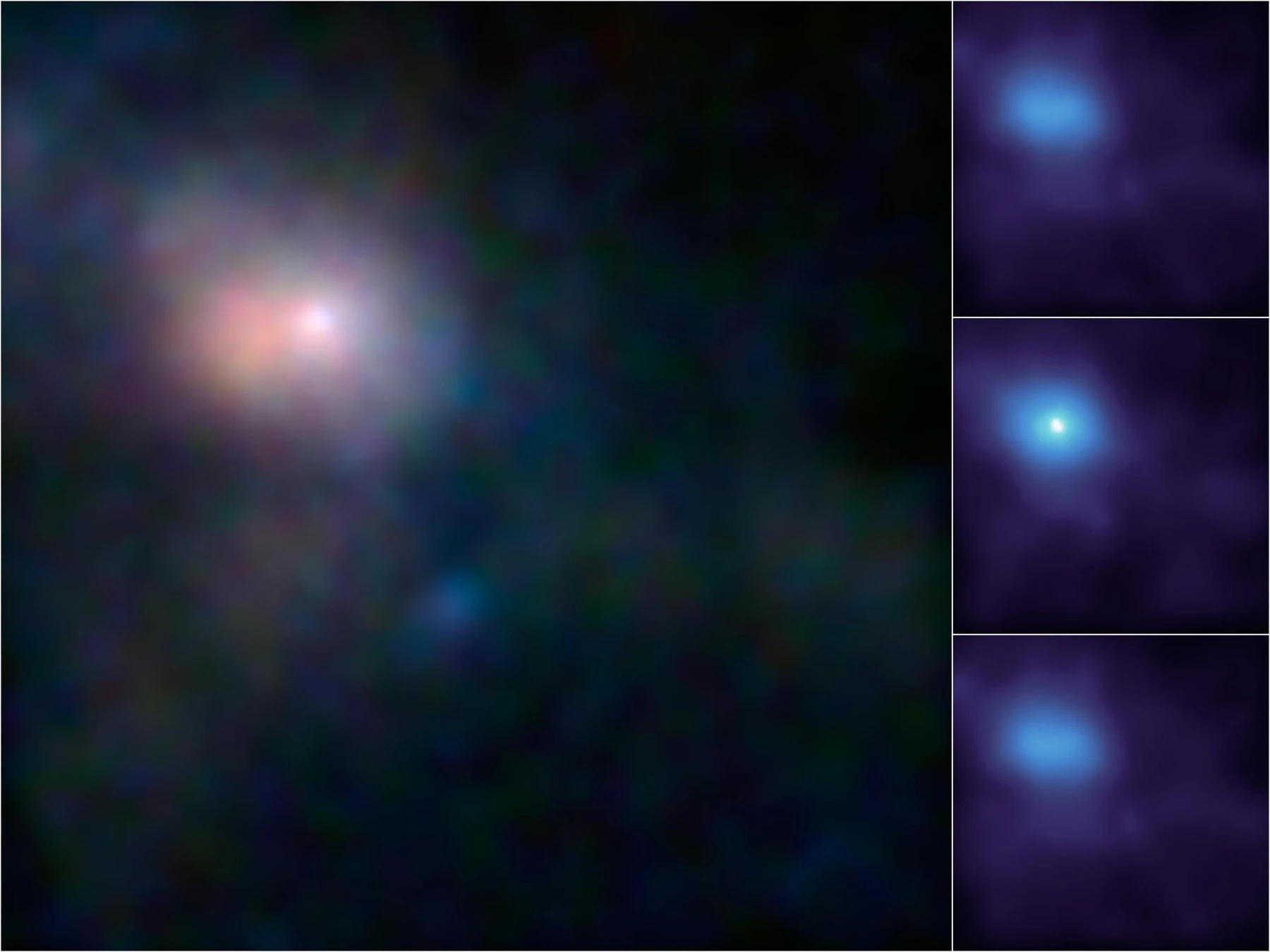
The black hole isn’t always quiet. NASA’s NuSTAR X-ray telescope caught a flare over two days in July, with matter heated at the peak to about 100 million °C (about 180 million °F, or about 100 million K); NASA released the images in October 2012 (NASA Photojournal, PIA16213).
How Did X-Rays Expose Cygnus X-1?
In 1964, Geiger counters on a suborbital rocket picked up a strong X-ray source in the constellation Cygnus (University of Amsterdam, February 18, 2021). That source, Cygnus X-1, is what a 2021 AAAS release calls a well-studied stellar-mass black hole in our galaxy (EurekAlert!/AAAS, February 18, 2021).
It’s an X-ray binary: a black hole and a massive blue companion star. Material drawn from the star heats up as it falls toward the black hole and shines in X-rays (Chandra X-ray Center, November 17, 2011). The pair orbit each other about every five and a half days. Scientists weren’t convinced at first: in 1974, Stephen Hawking bet that Cygnus X-1 was not a black hole, and he conceded in 1990 (University of Amsterdam).
The 2021 reweighing
In 2021, a team led by James Miller-Jones used the Very Long Baseline Array radio telescopes to remeasure the system’s distance, which changed its mass (Miller-Jones et al. 2021, Science 371, 1046):
- Mass: 21.2 ± 2.2 solar masses, up from a previous best estimate of about 15 (University of Amsterdam).
- Distance: 2.22 kiloparsecs (+0.18/−0.17), about 7,240 light-years by DCI’s conversion (arXiv:2102.09091).
Older figures are still online: Chandra’s 2011 release gave about 14.8 solar masses and about 6,070 light-years (Chandra, 2011). For how distances and masses are measured, see how astronomers measure stars.
How Do Gravitational Waves Reveal Black Holes?
When two black holes spiral together and merge, they send ripples through spacetime, gravitational waves, that giant laser detectors on Earth feel as tiny stretches and squeezes.
GW150914: the first one
On September 14, 2015, at 09:50:45 UTC, both LIGO detectors, in Livingston, Louisiana, and Hanford, Washington, recorded the same signal, Livingston 7 milliseconds first (LIGO Caltech, February 11, 2016). The discovery paper reported (Abbott et al. 2016, Phys. Rev. Lett. 116, 061102):
- Black holes of about 36 and 29 solar masses merged into one of about 62, radiating about 3 solar masses’ worth of energy as gravitational waves.
- The peak strain was 1.0 × 10⁻²¹: a stretch of about one part in a thousand billion billion.
- The source lay 410 (+160/−180) megaparsecs away; LIGO describes the merger as happening 1.3 billion years ago.
The announcement came on February 11, 2016. LIGO spokesperson Gabriela González called it “the beginning of a new era” (LIGO Caltech).
From one to hundreds, as of November 2026
The LIGO-Virgo-KAGRA (LVK) collaboration lists detections in its Gravitational-Wave Transient Catalog (GWTC):
| Milestone | Count | Source |
|---|---|---|
| First three observing runs | 90 signals | LIGO, March 2026 |
| GWTC-4.0 (data May 2023 to January 2024) | 128 new candidates | LIGO, March 2026 |
| Catalogue through the first O4 segment, as counted in November 2025 | 218 confident detections | LVK, November 18, 2025 |
| Same period, updated in the GWTC-5.0 paper | 229 candidates | GWTC-5.0 paper, LIGO-P2600152 |
| GWTC-5.0 (data April 10, 2024 to January 28, 2025) | 161 new; 390 candidates in total | GWTC-5.0 paper · LIGO, May 2026 |
Why 390 and not 218 plus 161? The GWTC-5.0 paper presents updated results for everything up to the first part of O4, now identifying 229 candidates instead of the earlier 218, and adds 161 new ones: 229 plus 161 is 390, counting candidates with at least a 50 percent probability of being astrophysical (GWTC-5.0, LIGO-P2600152). LIGO says the detections are mainly black hole mergers, with a handful involving neutron stars (LIGO, September 2025). The fourth observing run, O4, ran from May 24, 2023 to November 18, 2025 and produced roughly 250 significant candidates in real-time alerts; candidates are analysed in detail before entering the catalogue (LVK, November 18, 2025).
Testing Hawking’s area theorem
GW250114, which arrived on January 14, 2025, came from two black holes of roughly 30 to 40 solar masses each. LIGO reports that the total horizon area grew from about 240,000 square km (about 93,000 square miles) to about 400,000 square km (about 154,000 square miles), consistent with Hawking’s area theorem at 99.999 percent confidence (LIGO, September 2025). That’s a measured test of a Hawking prediction, and a different idea from Hawking radiation, which has not been detected.
What Do the Black Hole “Photos” Really Show?
The Event Horizon Telescope (EHT) linked eight radio observatories into a single Earth-sized virtual telescope, observing at a wavelength of 1.3 mm (EHT, April 10, 2019; EHT, May 12, 2022).
M87*: April 10, 2019
The first image showed the black hole at the centre of the galaxy Messier 87, about 55 million light-years away, with about 6.5 billion solar masses. EHT director Sheperd Doeleman announced: “We have taken the first picture of a black hole.” The release adds that the event horizon is about 2.5 times smaller than the shadow it casts, and just under 40 billion km (about 25 billion miles) across (EHT, April 10, 2019; EHT Collaboration 2019, ApJL 875, L1). NASA’s anatomy page puts the shadow at roughly twice the horizon’s size instead (NASA Science, Black Hole Anatomy). We show both.
Sagittarius A*: May 12, 2022
The EHT’s image of our own galaxy’s black hole came from observations in April 2017. Sagittarius A* is more than a thousand times smaller and less massive than M87*, yet the two look remarkably similar near their horizons. EHT project scientist Geoffrey Bower said “the size of the ring agreed with predictions from Einstein’s Theory of General Relativity” (EHT, May 12, 2022; EHT Collaboration 2022, ApJL 930, L12). On the sky, the EHT says, it looks about as big as a doughnut on the Moon would.
What you’re actually looking at
The ring is hot gas and bent light, not the black hole. The dark centre is the shadow, larger than the horizon. And the image is a reconstruction from radio data, not a snapshot your eye could take; Are Space Photos Real? explains how images like this are made.
What Is the Closest Black Hole to Earth?
NASA’s black hole page, updated August 12, 2026, names Gaia BH1 as the nearest known black hole, about 1,500 light-years away (NASA Science, Black Hole Basics).
ESA’s Gaia spacecraft found it the quiet way: a Sun-like star tracing an orbit around something unseen.
Three wobbling stars
- Gaia BH1: a dark companion of 9.62 ± 0.18 solar masses, orbited every 185.6 days by a Sun-like star of 0.93 solar masses, at 480 parsecs, about 1,570 light-years by DCI’s conversion. The 2022 discovery paper called it “the nearest known black hole by a factor of 3” (El-Badry et al. 2023, MNRAS; arXiv:2209.06833).
- Gaia BH2: a dark companion of 8.9 ± 0.3 solar masses, orbited every 1,277 days by a red giant of about 1 solar mass, at 1,160 parsecs, about 3,780 light-years (El-Badry et al. 2023, MNRAS; arXiv:2302.07880).
- Gaia BH3: about 33 solar masses, 1,926 light-years away in the constellation Aquila, orbited by an old giant star. ESA said it was the first time a stellar-origin black hole this big had been spotted in the Milky Way (ESA, April 16, 2024; Gaia Collaboration 2024, A&A).
NASA’s rounded 1,500 light-years and the paper’s 480 parsecs (about 1,570 light-years) describe the same object.

What Is Inside a Black Hole?
Here the evidence runs out. General relativity predicts a singularity at the centre, where matter is crushed to infinite density. But NASA says astronomers don’t yet know whether the singularity is a physical structure or a mathematical one (NASA Science, Black Hole Anatomy), and Imagine the Universe adds that the laws of physics likely break down there (NASA Imagine the Universe). Status: Open.
No signal comes out from inside the horizon, so no telescope can test this directly. LIGO reports that GW250114 matched general relativity’s expectations in every test (LIGO, February 4, 2026).
What would happen if you fell in?
NASA Space Place describes what a spacecraft would feel close to a black hole: gravity on the near side is much stronger than on the far side, so it gets stretched, an effect called spaghettification (NASA Space Place, Black Holes). Where that becomes destructive depends on the black hole’s mass. NASA notes that stellar-mass black holes have stronger tidal forces that can rip objects apart before they reach the horizon, while in its 2024 simulation of a black hole of 4.3 million solar masses, the falling camera is destroyed only about 12.8 seconds after crossing the horizon (NASA Goddard, May 6, 2024). These are thought experiments and simulations built on known physics, not observations.
Do Black Holes Ever Die?
According to theory, perhaps, through Hawking radiation, named after Stephen Hawking, whose 1974 Nature paper was titled “Black hole explosions?” (Hawking 1974). Here is what is and isn’t established:
- Predicted: NASA’s types page says the smallest hypothetical primordial black holes may have evaporated through quantum processes, while more massive ones could still exist (NASA Science, Black Hole Types).
- Searched for: Black holes below roughly 10¹⁵ grams are expected to give off gamma rays that NASA’s Fermi Large Area Telescope could detect. A 2018 Fermi search of 318 unidentified gamma-ray sources found none with the spectrum and motion expected of a nearby evaporating black hole, and set an upper limit on how often such evaporations happen near Earth (Fermi LAT Collaboration, arXiv:1802.00100).
- Not observed: No detection of Hawking radiation has been reported in the sources we checked. A non-detection is not proof of absence; the Fermi result is a limit, not a ruling.
Status: Modelled (predicted, not observed). Keep it separate from Hawking’s area theorem, which GW250114 tested and matched.
Myth vs. Fact: Black Holes
| Myth | Fact |
|---|---|
| “Black holes suck in everything around them.” | From a distance, a black hole pulls like any other object of the same mass (McDonald Observatory). |
| “If the Sun became a black hole, Earth would fall in.” | “There would be no change in Earth’s orbit,” says the University of Texas McDonald Observatory (McDonald Observatory). |
| “The Sun will become a black hole.” | The Sun is not massive enough; it will end as a white dwarf (McDonald Observatory). |
| “A black hole is a hole you could crash into.” | The event horizon is not a solid surface (NASA Imagine the Universe). |
| “Black holes are portals to other universes.” | NASA’s Blueshift team says they are not portals; the conditions the maths would need likely never occur (NASA Goddard Blueshift, 2010). |
| “Hawking radiation has been detected.” | It is predicted, not observed. Searches have set limits only. |
How Can You Explore Black Holes Yourself?
Find the star that feeds Cygnus X-1
Cygnus X-1’s companion, HDE 226868, shines at about magnitude 9: too faint for the naked eye, visible in a small telescope. BBC Sky at Night magazine suggests star-hopping to it from Eta Cygni, a naked-eye star of about magnitude 3.9 in the neck of the Swan, between Sadr and Albireo (BBC Sky at Night). That’s a UK magazine; wherever you are, check a local sky chart for when Cygnus is up.
Follow the gravitational-wave alerts
LIGO, Virgo and KAGRA post public candidate events on GraceDB, organised by observing run (GraceDB). When we checked in November 2026, its public lists ran from O3 to O4c.
What Comes Next for Black Hole Science?
- Gaia Data Release 4: December 2, 2026. ESA lists DR4, based on 66 months of data, for that date, and DR5 “not before the end of 2030” (ESA Gaia, Data release scenario). Gaia BH3 was spotted in pre-release Gaia data.
- Final O4 gravitational-wave data. The GWTC-5.0 announcement said the final portion of O4 data is scheduled for public release in December (LIGO, May 2026).
- The next LVK observing run. When O4 ended, the collaboration said it envisioned a six-month observing run beginning in late summer or early fall of 2026, with detectors joining as available (LVK, November 18, 2025). We could not confirm from an LVK page whether it has started, as of November 2026.
- A new EHT dish in Africa. On March 9, 2026, the EHT reported a contract agreement for building the Africa Millimetre Telescope in Namibia, aimed at sharper black hole movies; no construction timeline was given (EHT).
- LISA, about 2035. ESA adopted the Laser Interferometer Space Antenna on January 26, 2024, with its three spacecraft planned to launch in 2035, to catch black hole mergers from stellar-mass up to supermassive (University of Portsmouth, January 2024).
Black Holes by the Numbers
- 3 km (1.9 miles): the Schwarzschild radius the Sun would have if squeezed into a black hole; Earth’s would be 8.7 mm (0.34 inch) (Swinburne COSMOS)
- 26,000 to 27,000 light-years: the distance to Sagittarius A*, depending on the source (ESO 2018; EHT 2022); 26,000 light-years is roughly 246,000 trillion km (153,000 trillion miles), by DCI’s conversion
- 6.5 billion: solar masses in M87*, the first black hole imaged, about 55 million light-years away (EHT)
- Just under 40 billion km (25 billion miles): the width of M87*’s event horizon (EHT)
- About 1,500 light-years: the distance to Gaia BH1, the nearest known black hole (NASA), about 14 million billion km (8.8 million billion miles) by DCI’s conversion
- 21.2 ± 2.2: solar masses in Cygnus X-1’s black hole (Miller-Jones et al. 2021)
- 390: candidate gravitational-wave signals catalogued by the LVK, as of GWTC-5.0 in 2026 (LIGO)
- About 100 million °C (180 million °F; about 100 million K): the peak temperature of matter in a flare near Sagittarius A* seen by NuSTAR (image released October 2012) (NASA, PIA16213)
Black Holes: FAQ
Could the Sun ever turn into a black hole?
No. The Sun is not massive enough to collapse into a black hole and is expected to end as a white dwarf. NASA says stars of around 20 times the Sun’s mass or more leave black holes when their cores collapse.
How big is a black hole?
It depends on its mass. A non-spinning black hole with the Sun’s mass would have an event horizon radius of about 3 km (1.9 miles), while M87*’s event horizon is just under 40 billion km (25 billion miles) across. The horizon’s size grows in step with the mass.
Would Earth be pulled in if a black hole replaced the Sun?
No. From a distance, a black hole pulls like any other object of the same mass, so a black hole with the Sun’s mass would leave Earth’s orbit unchanged. The McDonald Observatory’s fact-versus-fiction guide makes exactly this point.
Has anyone ever seen a black hole directly?
Not the black hole itself, because no light escapes from inside the event horizon. The Event Horizon Telescope has imaged the shadows of M87* (2019) and Sagittarius A* (2022), outlined by glowing gas and bent light just outside the horizon.
How many black holes have gravitational-wave detectors found?
As of the GWTC-5.0 catalogue update in 2026, the LIGO-Virgo-KAGRA collaboration lists 390 candidate gravitational-wave signals in total. LIGO says these are mainly black hole mergers, with a handful involving neutron stars.
What happens if you fall into a black hole?
Close to a black hole, gravity on your near side would be much stronger than on your far side, stretching you out, an effect called spaghettification. Where that happens depends on the mass: NASA says a stellar-mass black hole can tear objects apart before they reach the horizon, while near a supermassive one the stretching becomes destructive only after crossing it, in NASA’s simulation.
Is Hawking radiation real?
It is a theoretical prediction that has never been detected, and it would not be light escaping from inside the horizon. Searches, such as a 2018 Fermi telescope search for evaporating primordial black holes, have found no signal and set limits only.
How far away is Sagittarius A*?
About 26,000 to 27,000 light-years, depending on the source: ESO’s 2018 release says about 26,000, and the Event Horizon Telescope’s 2022 release says about 27,000. It sits at the centre of the Milky Way, hidden behind dust in visible light.
Your next step: the next time you see a black hole headline, ask which of the five kinds of evidence it rests on: star orbits, X-rays, merger ripples, a shadow image or a wobbling star. Then check NASA’s black hole basics page for the current “nearest” and “heaviest” figures, and the LIGO news page for the latest catalogue count.

Sources and Further Reading
- NASA Science (updated August 12, 2026), Black Hole Basics, Black Hole Types and Black Hole Anatomy.
- NASA Imagine the Universe, Black Holes; NASA Space Place, What Is a Black Hole?.
- Swinburne University of Technology, COSMOS encyclopedia, Schwarzschild Radius.
- Nobel Prize Outreach (October 6, 2020), The Nobel Prize in Physics 2020, press release.
- ESO (July 26, 2018), First Successful Test of Einstein’s General Relativity Near Supermassive Black Hole; GRAVITY Collaboration (2018), “Detection of the gravitational redshift in the orbit of the star S2 near the Galactic centre massive black hole,” Astronomy & Astrophysics 615, L15, doi:10.1051/0004-6361/201833718.
- NASA Photojournal (October 23, 2012), PIA16213: First Look at Milky Way’s Monster in High-Energy X-ray Light; PIA12348: Great Observatories’ Unique Views of the Milky Way.
- Miller-Jones, J. C. A., et al. (2021), “Cygnus X-1 contains a 21–solar mass black hole—Implications for massive star winds,” Science 371, 1046–1049, doi:10.1126/science.abb3363 (arXiv:2102.09091); University of Amsterdam (February 18, 2021), Historic black hole more massive than previously thought; AAAS via EurekAlert! (February 18, 2021), news release.
- Chandra X-ray Center (November 17, 2011), Cygnus X-1.
- LIGO Scientific, Virgo and KAGRA Collaborations, “GWTC-5.0: Observations from the Second Part of the Fourth LIGO-Virgo-KAGRA Observing Run and Updates to the Gravitational-Wave Transient Catalog,” LIGO document P2600152.
- NASA Goddard Space Flight Center (May 6, 2024), New NASA Black Hole Visualization Takes Viewers Beyond the Brink.
- Abbott, B. P., et al. (LIGO Scientific Collaboration and Virgo Collaboration) (2016), “Observation of Gravitational Waves from a Binary Black Hole Merger,” Physical Review Letters 116, 061102, doi:10.1103/PhysRevLett.116.061102 (arXiv:1602.03837); LIGO Caltech (February 11, 2016), Gravitational Waves Detected 100 Years After Einstein’s Prediction.
- LIGO Scientific Collaboration news: Ten years later, LIGO is a black-hole hunting machine (September 2025); LVK wraps up its fourth observing run (November 18, 2025); Exceptional tests of general relativity with GW250114 (February 4, 2026); GWTC-4.0 (March 5, 2026); GWTC-5.0 (May 26, 2026).
- Event Horizon Telescope (April 10, 2019), Astronomers Capture First Image of a Black Hole; EHT Collaboration (2019), “First M87 Event Horizon Telescope Results. I. The Shadow of the Supermassive Black Hole,” ApJL 875, L1, doi:10.3847/2041-8213/ab0ec7.
- Event Horizon Telescope (May 12, 2022), Astronomers Reveal First Image of the Black Hole at the Heart of Our Galaxy; EHT Collaboration (2022), “First Sagittarius A* Event Horizon Telescope Results. I. The Shadow of the Supermassive Black Hole in the Center of the Milky Way,” ApJL 930, L12, doi:10.3847/2041-8213/ac6674.
- El-Badry, K., Rix, H.-W., Quataert, E., et al. (2023), “A Sun-like star orbiting a black hole,” MNRAS, doi:10.1093/mnras/stac3140 (arXiv:2209.06833); El-Badry, K., Rix, H.-W., Cendes, Y., et al. (2023), “A red giant orbiting a black hole,” MNRAS, doi:10.1093/mnras/stad799 (arXiv:2302.07880).
- Gaia Collaboration, Panuzzo, P., et al. (2024), “Discovery of a dormant 33 solar-mass black hole in pre-release Gaia astrometry,” Astronomy & Astrophysics, doi:10.1051/0004-6361/202449763; ESA (April 16, 2024), Sleeping giant surprises Gaia scientists.
- ESA Gaia, Data release scenario.
- Hawking, S. W. (1974), “Black hole explosions?,” Nature 248, 30–31, doi:10.1038/248030a0.
- Fermi LAT Collaboration (2018, arXiv submission January 31), “Search for Gamma-Ray Emission from Local Primordial Black Holes with the Fermi Large Area Telescope,” arXiv:1802.00100.
- University of Texas McDonald Observatory, Black Holes: Fact vs. Fiction; NASA Goddard Blueshift (December 17, 2010), Black holes: fact or fiction?.
- BBC Sky at Night Magazine, How to see black hole Cygnus X-1.
- LIGO/Virgo/KAGRA, GraceDB, the public gravitational-wave candidate event database.
- University of Portsmouth (January 26, 2024), ESA gives go-ahead for flagship gravitational-wave observatory in space.
Explore Next
- How a star ends up as a black hole: The Life Cycle of a Star
- Where supermassive black holes live: Types of Galaxies
- The debris a supernova leaves behind: What Is a Nebula?
- How to read X-ray and radio images: Are Space Photos Real?
- How masses and distances are measured: How Astronomers Measure Stars
- How a claim earns its label: How We Know
- More from deep space: Stars & Galaxies
- Read next: How Old Is the Universe?
- Read next: What Is Dark Matter?
- Read next: What Is Tidal Locking?
- Read next: Why Is Neptune Blue?
How This Explainer Was Checked
Every number in this article was checked in November 2026 against the source linked beside it: NASA Science, NASA Imagine the Universe, NASA Space Place, the NASA Image and Video Library and Photojournal, ESA and ESO releases, the Nobel Prize press release, the Event Horizon Telescope, LIGO and LVK news pages, and peer-reviewed papers, with DOIs given where they exist (paper details confirmed through Crossref and arXiv records). Where sources give different values, as for the distance to Sagittarius A* (26,000 vs. 27,000 light-years), the shadow-to-horizon ratio (about twice vs. about 2.5 times), and Cygnus X-1’s mass and distance (2011 vs. 2021), we show both. Parsec-to-light-year, kilometre, mile and temperature conversions, and the Schwarzschild radius scaled to Sagittarius A*, are DCI’s arithmetic. Black hole formation by stellar collapse and Hawking radiation (predicted, not observed) are labelled Modelled; the singularity and the origin of the earliest supermassive black holes are labelled Open; the idea that black holes suck in everything around them is labelled Not supported. The Event Horizon Telescope images are credited to the EHT Collaboration, so we describe them rather than reproduce them. Images are labelled: real spacecraft or telescope images as OBSERVATION, illustrations as ILLUSTRATION, and our charts as DATA GRAPHIC. Nothing AI-generated is presented as a real image.
Final Thought: Seeing by What Moves
A black hole is the one object in astronomy defined by what it hides. Yet we know where Sagittarius A* sits because stars bend around it, we know Cygnus X-1’s mass because a blue giant circles it every five and a half days, and we know black holes merge because LIGO’s detectors felt space stretch by about one part in a thousand billion billion. The centre, the singularity, is still beyond the reach of any measurement, and Hawking radiation is still a prediction. Everything else, we’ve learned by watching what moves.
About the Author
Author: King | Founder of Dark Cosmic Insights
King is the founder of Dark Cosmic Insights, a science storytelling platform exploring the strangest true stories hiding in space, science and AI. He digs into NASA, ESA and peer-reviewed research, separates what has been measured from what is still a mystery, and turns it into articles, data graphics and Shorts.
Follow the anomaly. Trace the source.