Jupiter has no ground. If you fell into it, you’d sink through clouds of ammonia ice, then into thicker, hotter gas, until the pressure became so extreme that hydrogen started acting like a liquid metal. You’d never land on anything.
And at the very center, there may not be a neat, solid ball at all. NASA says its Juno spacecraft found that Jupiter’s “core is much larger than expected, and not solid,” describing it as “fuzzy” and partially dissolved (NASA). Jupiter is more than twice as massive as all the other planets combined (NASA), and almost all of that is the two lightest elements in the universe.
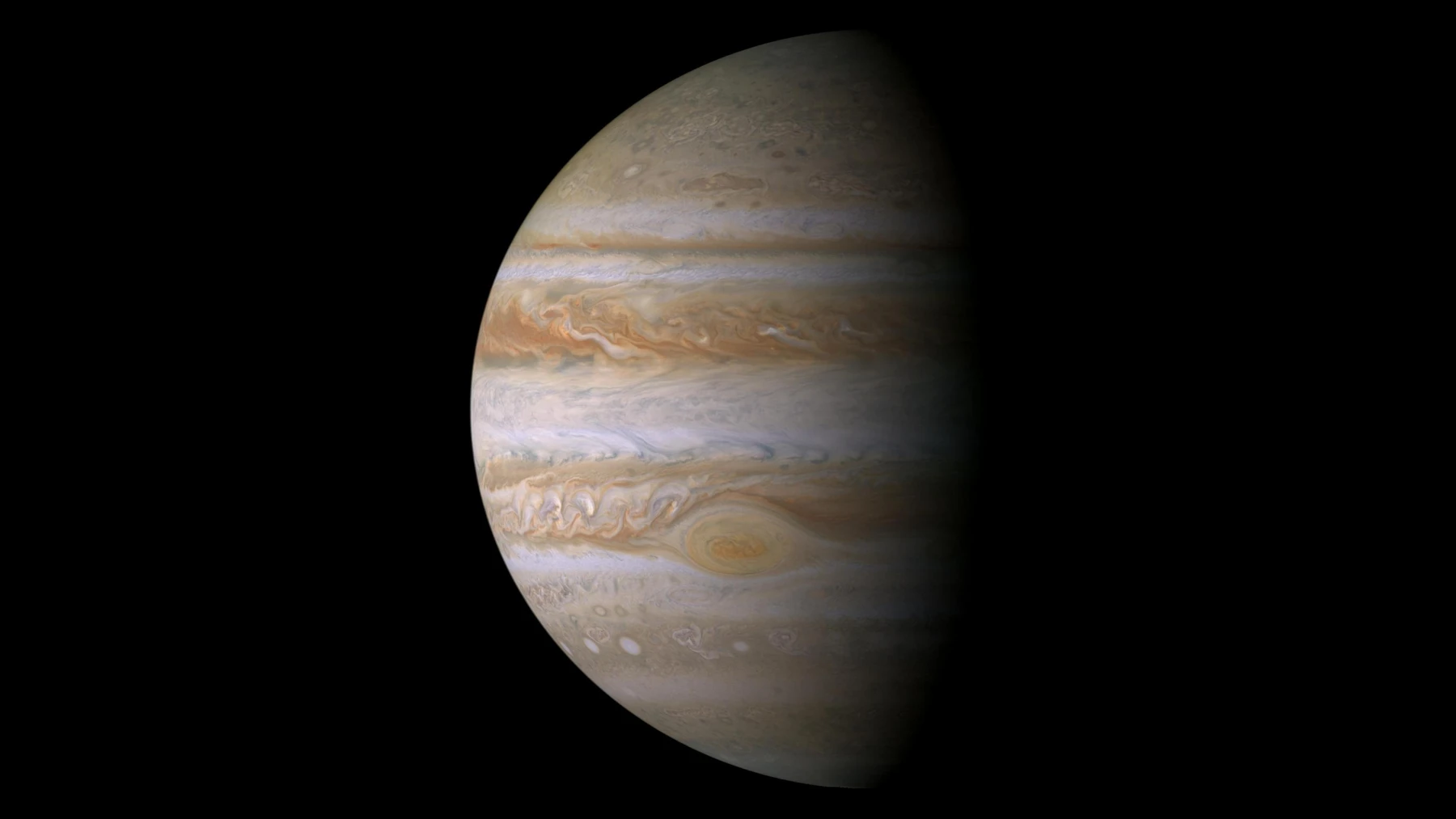
Observed, measured, modelled, open. Jupiter’s cloud-top makeup is measured by spacecraft and a probe that dropped into it. Its mass, density and spin are measured. Its deep layers and fuzzy core are modelled from Juno’s gravity data. How much water Jupiter holds overall is still partly open.
Quick Answer: What Is Jupiter Made Of?
Jupiter is mostly hydrogen and helium. NASA’s fact sheet lists its atmosphere as about 89.8 percent hydrogen and 10.2 percent helium by volume, with traces of methane, ammonia, water and other gases (NASA NSSDC). Its top clouds are probably ammonia ice, with a middle layer of ammonium hydrosulfide (NASA). Deeper down, hydrogen becomes an electrically conducting liquid metal. At the center, Juno found a “fuzzy” core, “much larger than expected, and not solid.” Jupiter has no solid surface. And it spins fast: one day lasts about 9.9 hours (NASA).
What this article can and cannot establish. It can show you what Jupiter’s atmosphere is made of, what spacecraft and the Galileo probe measured, and what Juno’s gravity data reveal about its interior. It cannot show you Jupiter’s deep interior directly. The Galileo probe sampled the atmosphere below the visible cloud tops, but no probe has reached the deep interior. Everything deeper comes from models fitted to measurements, and some of those models still disagree.
Table of Contents
The DCI Evidence Map: What Jupiter Is Made Of
| Question | What we know | Status | Key source |
|---|---|---|---|
| What’s the atmosphere made of? | About 89.8% hydrogen, 10.2% helium | Measured | NASA NSSDC |
| What are the clouds made of? | Ammonia ice on top, ammonium hydrosulfide below | Modelled | NASA |
| Does Jupiter have a surface? | No well-defined surface; pressure over 1,000 bars deep down | Measured | NASA NSSDC |
| Is there metallic hydrogen? | Yes, deep inside, conducting electricity | Modelled | NASA |
| Is the core solid? | Juno points to a large, fuzzy, partly dissolved core | Modelled | NASA |
| How much water? | About 0.25% of molecules at the equator | Measured | NASA/JPL, 2020 |
| How long is a day? | About 9.9 hours | Measured | NASA |
Status key: Observed = seen directly. Measured = a number with a stated uncertainty or a direct measurement. Modelled = inferred from measurements through a physical model, dependent on assumptions. Open = unresolved; the evidence is incomplete or points different ways. Not supported = the evidence goes against the claim, or there is none for it.
Cite this framework: “DCI Evidence Map: What Jupiter Is Made Of,” Dark Cosmic Insights, November 2026, darkcosmicinsights.com/what-is-jupiter-made-of/.
What Is Jupiter’s Atmosphere Made Of?
Hydrogen and helium
By volume, NASA’s fact sheet lists Jupiter’s atmosphere as about 89.8 percent molecular hydrogen and 10.2 percent helium (NASA NSSDC). NASA says Jupiter “has the same ingredients as a star, but it did not grow massive enough to ignite” (NASA).
The trace gases
The rest is a sprinkle of other molecules, measured in parts per million (ppm). The fact sheet lists about 3,000 ppm methane, 260 ppm ammonia, 28 ppm hydrogen deuteride, 5.8 ppm ethane and 4 ppm water, noting that water “varies with pressure” (NASA NSSDC). These tiny amounts matter a lot: they make the clouds and colors.
Compared with Saturn
Saturn is made of the same ingredients in different proportions. NASA’s Saturn fact sheet lists about 96.3 percent hydrogen and 3.25 percent helium in its atmosphere (NASA NSSDC, Saturn). We look at why Saturn’s upper atmosphere seems short on helium in What Is Saturn Made Of?.

What Are Jupiter’s Clouds Made Of?
Three cloud layers
NASA describes Jupiter’s weather layer as “cold, windy clouds of ammonia and water” (NASA). “The top cloud is probably made of ammonia ice, while the middle layer is likely made of ammonium hydrosulfide crystals.” Deeper still are thought to be water clouds. NASA’s fact sheet lists Jupiter’s aerosols as ammonia ice, water ice and ammonia hydrosulfide (NASA NSSDC).
Where the colors come from
The white and orange stripes come from those clouds and from what’s mixed into them. NASA says the colors may come from “plumes of sulfur and phosphorus-containing gases rising from the planet’s warmer interior” (NASA). The darker stripes are called belts and the lighter ones zones. We dig into Jupiter’s colors and its Great Red Spot in a companion article.
The Galileo Probe: Dropping Into Jupiter
57 minutes inside a giant
In December 1995, NASA’s Galileo mission dropped a probe into Jupiter. NASA says it stopped transmitting 57 minutes into its descent, after reaching about 120 km (75 miles) deep, where the pressure was about 22 bar (NASA/JPL, 2020).
The missing water
The probe brought a surprise. Scientists “were dismayed to find ten times less water than expected,” and the amount of water still seemed to be rising at the deepest point measured (NASA/JPL, 2020). NASA says the probe “may have just been unlucky, sampling an unusually dry and warm meteorological spot on Jupiter.”
Juno finds more water
In 2020, using Juno’s Microwave Radiometer, scientists reported in Nature Astronomy that near the equator, “water makes up about 0.25% of the molecules in Jupiter’s atmosphere – almost three times that of the Sun” (NASA/JPL, 2020). That Sun comparison isn’t about water molecules floating in the Sun. JPL explains that “the comparison is based not on liquid water but on the presence of its components, oxygen and hydrogen, present in the Sun” (NASA/JPL, 2020). In other words, it compares Jupiter’s oxygen-to-hydrogen mix with the Sun’s. Juno scientist Cheng Li said, “We found the water in the equator to be greater than what the Galileo probe measured.” Whether that value holds across the whole planet is still open.
What’s Inside Jupiter?
No probe has reached Jupiter’s deep interior. The Galileo probe sampled the atmosphere below the visible cloud tops, down to about 22 bar, but everything deeper comes from models matched to Jupiter’s gravity, magnetic field and shape, much of it measured by Juno.
Layer by layer
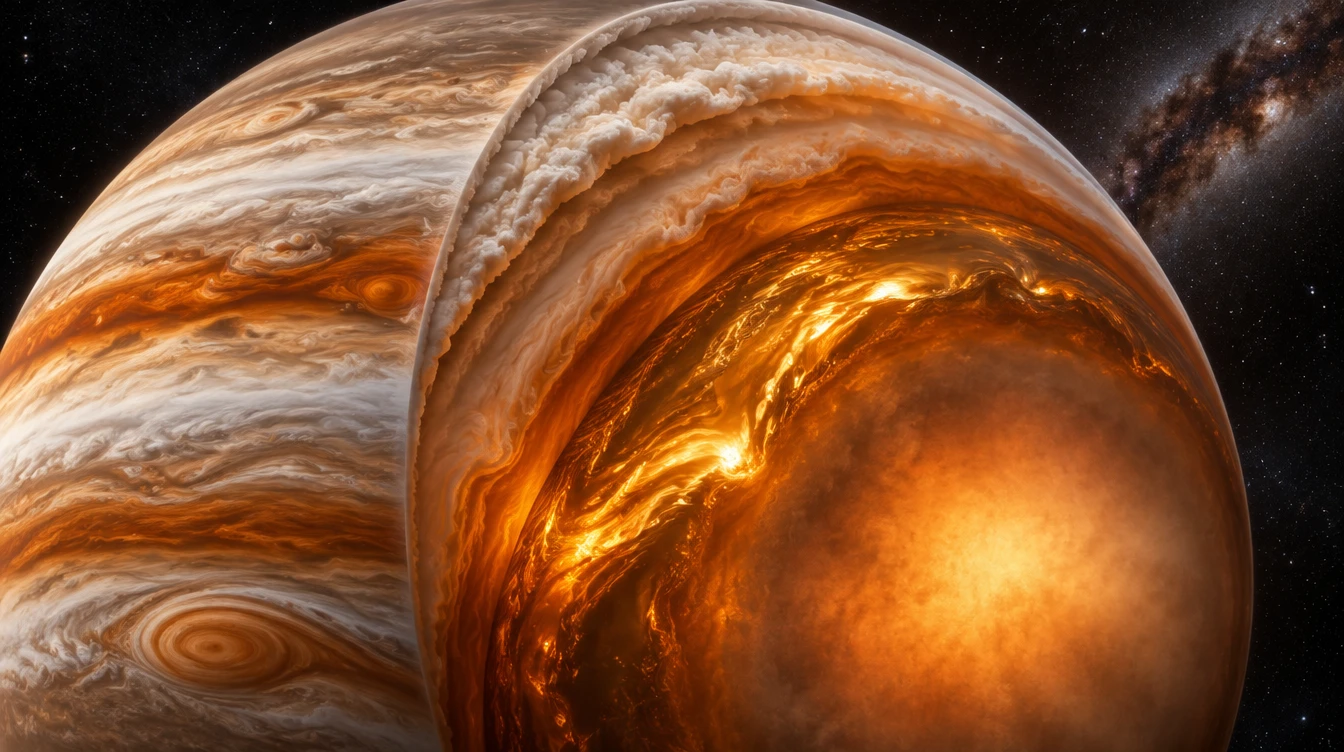
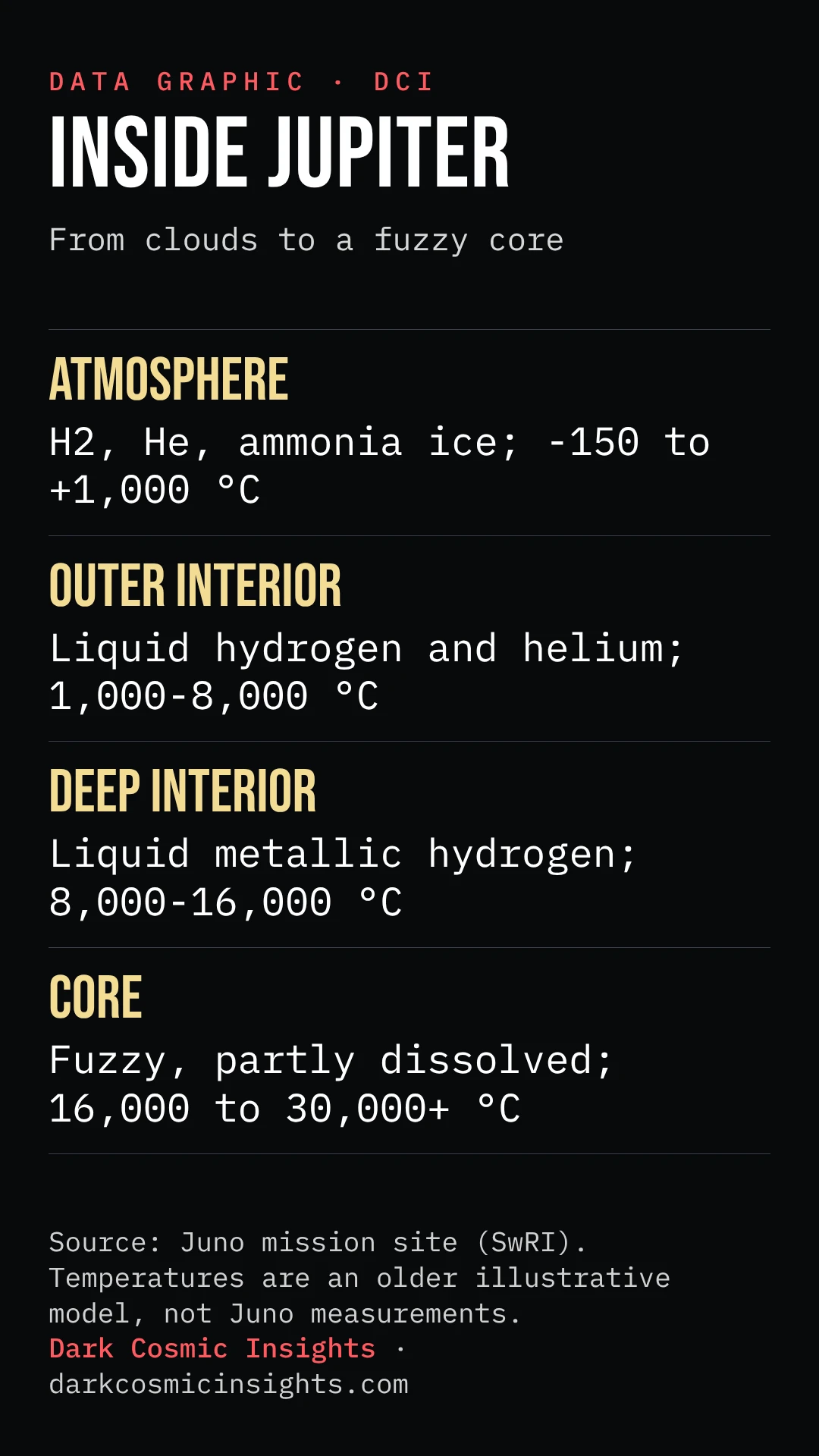
The Juno mission’s website at the Southwest Research Institute describes four broad zones (Juno mission, SwRI). Treat the temperatures as an older illustrative model, not a result Juno measured:
- Atmosphere: hydrogen, helium and methane, with water droplets and ammonia ice. Pressure reaches about 1,000 times Earth’s sea-level pressure, and temperatures range from about −150 to +1,000 °C.
- Outer interior: liquid hydrogen and helium, with temperatures of about 1,000 to 8,000 °C.
- Deep interior: liquid metallic hydrogen, with temperatures of about 8,000 to 16,000 °C and pressures up to about 45 million times Earth’s.
- Core: composition and state uncertain, with temperatures estimated at 16,000 to over 30,000 °C.
Metallic hydrogen
Squeeze hydrogen hard enough and its electrons break loose, so it conducts electricity like a metal. NASA says this deep layer is “making the liquid electrically conducting like metal” (NASA). Currents in it are thought to power Jupiter’s magnetic field, which NASA says is “16 to 54 times as powerful as that of the Earth.”
A fuzzy core
Scientists long expected a compact, rocky core. Juno’s gravity measurements told a different story. NASA says Juno found “the core is much larger than expected, and not solid,” describing it as fuzzy and partially dissolved (NASA). The Juno team’s own site notes that “No one knows where exactly the core begins nor does anyone know whether the boundary is well-defined or gradual” (Juno mission, SwRI). We compare it with Saturn’s fuzzy core in What Is Saturn Made Of?.
Does Jupiter Have a Solid Surface?
No ground to stand on
No. NASA’s fact sheet lists Jupiter’s surface pressure as “much greater than 1000 bars,” with no well-defined surface (NASA NSSDC). The gas just gets thicker and hotter with depth until it becomes liquid. There’s no point where you’d hit solid ground.
So how do we measure its size?
Scientists measure Jupiter’s size at the 1-bar level, about Earth’s sea-level air pressure. There, NASA’s fact sheet lists an equatorial radius of 71,492 km (NASA NSSDC). In 2026, Juno refined that: NASA reported that Jupiter is about 8 km narrower at the equator and 24 km flatter at the poles than the older values suggested (NASA, 2026). We cover the size update in What Is the Biggest Planet?.
Light for its size
All that gas makes Jupiter much less dense than Earth. Its mean density is about 1,326 kg/m³, compared with Earth’s 5,513, even though its mass is about 318 Earths (NASA NSSDC).
How Long Is a Day on Jupiter?
Under 10 hours
NASA says “one day on Jupiter takes 9.9 hours” (NASA). NASA’s fact sheet gives the sidereal rotation period as 9.925 hours, about 9 hours 55 minutes (NASA NSSDC). That’s the shortest day of any planet.
A squashed shape
Because Jupiter is so big and spins so quickly, its equator bulges outward. NASA’s fact sheet gives Jupiter a flattening of 0.06487, about 19 times Earth’s (NASA NSSDC).
Fast winds, too
Jupiter’s spin helps drive powerful winds. The fact sheet lists winds of up to 150 meters per second below 30 degrees latitude (NASA NSSDC), more than 500 km/h. Those winds stretch the clouds into Jupiter’s famous stripes.

Myth vs. Fact: What Jupiter Is Made Of
| Myth | Fact | Status |
|---|---|---|
| “You could land on Jupiter.” | It has no solid surface; the gas just thickens. | Measured |
| “Jupiter has a small rocky core.” | Juno points to a large, fuzzy, partly dissolved core. | Modelled |
| “Jupiter is made of poisonous gas.” | It’s mostly hydrogen and helium. | Measured |
| “The Galileo probe proved Jupiter is dry.” | It hit a dry spot; Juno found more water at the equator. | Measured |
| “Jupiter is a failed star.” | NASA: same ingredients as a star, but never massive enough to ignite. | Modelled |
| “Jupiter spins slowly because it’s huge.” | Its day is only about 9.9 hours. | Measured |
How Can You Explore Jupiter’s Makeup Yourself?
See its clouds through a telescope
Even a small telescope shows Jupiter’s cloud belts, the visible top of its atmosphere. Jupiter is bright and easy to find; NASA’s fact sheet lists it at about magnitude −2.7 at mean opposition (NASA NSSDC).
Watch it spin
Because a Jupiter day is under 10 hours, you can see its features move in a single night. Watch for a few hours and cloud features will travel across the disk.
Browse Juno’s images
The Juno mission shares raw JunoCam images that anyone can process. Explore them, and NASA’s Juno science, on NASA’s Juno page.
What Jupiter Is Made Of, by the Numbers
| Measure | Value | Source |
|---|---|---|
| Hydrogen / helium (by volume) | 89.8% / 10.2% | NASA NSSDC |
| Methane / ammonia | about 3,000 / 260 ppm | NASA NSSDC |
| Water at the equator | about 0.25% of molecules | NASA/JPL, 2020 |
| Mean density | 1,326 kg/m³ | NASA NSSDC |
| Mass | about 318 Earths | NASA NSSDC |
| Temperature at 1 bar | 165 K (−108 °C) | NASA NSSDC |
| Day length | about 9.9 hours | NASA |
| Core temperature (older illustrative model) | 16,000 to 30,000+ °C | Juno mission, SwRI |
Values are as of November 2026.
Jupiter Composition FAQ
What is Jupiter mostly made of?
Hydrogen and helium. NASA’s fact sheet lists Jupiter’s atmosphere as about 89.8 percent hydrogen and 10.2 percent helium by volume, with small amounts of methane, ammonia, water and other gases. Deep inside, the hydrogen is squeezed into a liquid metal.
Can you stand on Jupiter?
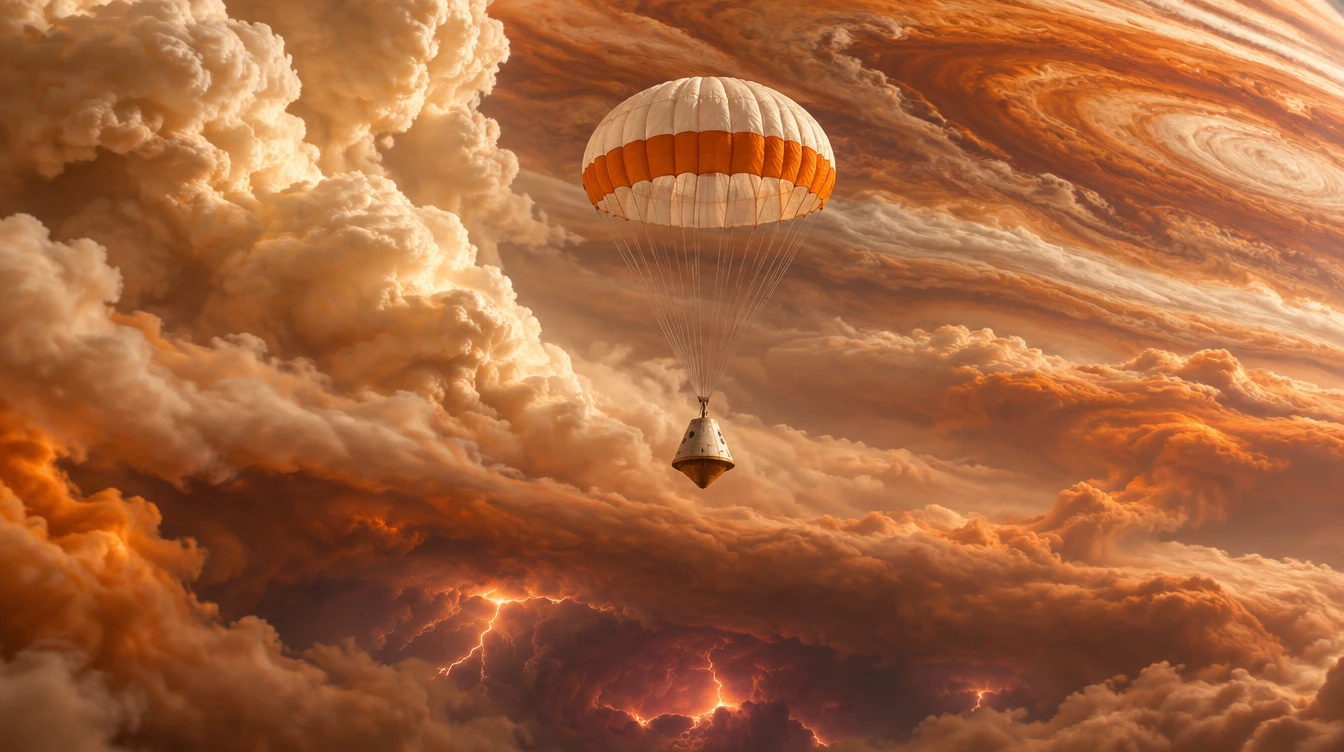
No. Jupiter has no solid surface. The gas simply gets thicker and hotter as you go down, turning to liquid. NASA lists the pressure deep down as far more than 1,000 times Earth’s, so even a spacecraft would be crushed long before reaching any center.
Does Jupiter have a core?
Yes, but not the kind scientists expected. NASA says Juno’s measurements show the core is much larger than expected and not solid, described as fuzzy and partly dissolved into the layers around it. Where it begins and how sharp its edge is are still unknown.
What is metallic hydrogen?
It’s hydrogen under such extreme pressure that its electrons break free, letting it conduct electricity like a metal. Deep inside Jupiter, this liquid metallic hydrogen is thought to generate the planet’s enormous magnetic field.
How much water is on Jupiter?
Near the equator, Juno found that water makes up about 0.25 percent of the molecules in Jupiter’s atmosphere, almost three times the Sun’s share, comparing Jupiter’s oxygen-to-hydrogen mix with the Sun’s. The Galileo probe found much less in 1995, but NASA says it may have sampled an unusually dry and warm spot.
What are Jupiter’s clouds made of?
NASA says the top clouds are probably ammonia ice, with a middle layer likely made of ammonium hydrosulfide crystals. Water clouds are thought to lie deeper. The colors may come from sulfur and phosphorus compounds rising from the warmer interior.
How long is a day on Jupiter?
About 9.9 hours, according to NASA, or about 9 hours 55 minutes. That’s the shortest day of any planet. The fast spin also makes Jupiter bulge at its equator and helps drive its powerful winds.
Is Jupiter a failed star?
Not really. NASA says Jupiter has the same ingredients as a star but did not grow massive enough to ignite. It’s a giant planet made of star-like material, not a star that almost happened.
Your next step: next time Jupiter is up, find it with binoculars or a small telescope and look for its cloud belts. You’ll be looking at the ammonia ice tops of a world with no ground beneath them.

Sources and Further Reading
- NASA Science, Jupiter: Facts; Jupiter; Juno.
- NASA Space Science Data Coordinated Archive, Jupiter Fact Sheet; Saturn Fact Sheet.
- NASA/JPL (February 18, 2020), Findings From NASA’s Juno Update Jupiter Water Mystery.
- NASA Science (February 4, 2026), NASA’s Juno Mission Redefines Size, Shape of Jupiter.
- Southwest Research Institute, Juno mission, Inside the Giant: The Interior.
- NASA, PIA04866: Cassini Jupiter Portrait.
Explore Next
- The full Jupiter guide: Jupiter: Facts, Moons and the Great Red Spot
- Jupiter ranked against every planet: What Is the Biggest Planet?
- Its family of moons: How Many Moons Does Jupiter Have?
- Its strange polar storms: Jupiter’s Polar Cyclones vs. Saturn’s Hexagon
- Its neighbor’s recipe: What Is Saturn Made Of?
- Every planet in one place: Solar System Explorer
- Its stripes and the Great Red Spot: What Color Is Jupiter?
- Its faint, dusty rings: Does Jupiter Have Rings?
- How far away it is: How Far Is Jupiter?
- How a claim earns its label: How We Know
How This Explainer Was Checked
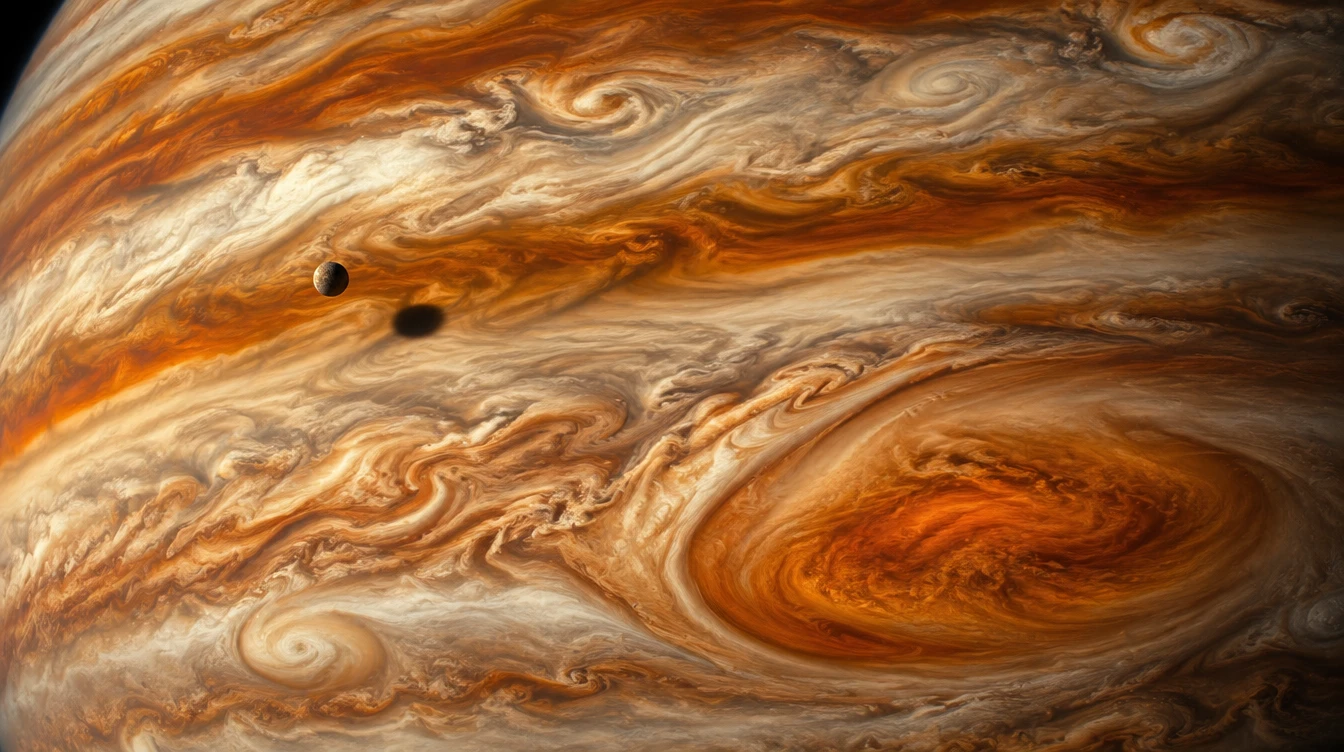
Every number in this article was checked in November 2026 against the source linked beside it: NASA’s Jupiter facts and Jupiter pages, NASA’s Jupiter and Saturn fact sheets, NASA/JPL’s 2020 Juno water release, NASA’s 2026 Juno shape update and the Juno mission’s interior page at the Southwest Research Institute. Atmospheric composition, density, mass and day length are labelled Measured. Cloud layers below the visible tops, metallic hydrogen and the fuzzy core are labelled Modelled. Jupiter’s overall water content is labelled Open. Interior temperatures and pressures are model estimates from the Juno mission site. The flattening ratio and wind speed in km/h are DCI calculations. Images are labelled: real spacecraft images as OBSERVATION, illustrations as ILLUSTRATION, and our charts as DATA GRAPHIC. Nothing AI-generated is presented as a real image.
Final Thought: A World Made of Almost Nothing
Jupiter is the biggest thing in the solar system after the Sun, and it’s built from the simplest ingredients there are: hydrogen and helium. No rock to stand on, no clear edge to its core, just gas thickening into liquid metal under unimaginable pressure. Juno is still revealing what lies beneath those clouds, and every answer so far has turned out stranger than we expected.
About the Author
Author: King | Founder of Dark Cosmic Insights
King is the founder of Dark Cosmic Insights, a science storytelling platform exploring the strangest true stories hiding in space, science and AI. He digs into NASA, ESA and peer-reviewed research, separates what has been measured from what is still a mystery, and turns it into articles, data graphics and Shorts.
Follow the anomaly. Trace the source.