Jupiter is one of the most colorful planets in the solar system. NASA describes its “colorful cloud bands of tan, brown, white, and orange” (NASA), wrapped around a giant red storm, the Great Red Spot. A 2024 study measured it at about 14,000 km long, roughly 1.1 times Earth’s width (AGU, 2024; DCI comparison). It has been tracked since at least 1831, and a spot was reported in the same place in the 1600s, though that study suggests today’s storm may not be the same one.
But the colors raise questions scientists still argue about. What actually paints Jupiter’s stripes? Why is the Great Red Spot red? And why has it been shrinking for over a century? Some of those answers are solid. Some are still very much open.

Observed, measured, modelled, open. Jupiter’s colors and the Great Red Spot’s shrinking are observed and measured by spacecraft and Hubble. The cloud layers behind the colors are modelled. What makes the Great Red Spot red is still open.
Quick Answer: What Color Is Jupiter?
Jupiter is striped in cream, white, tan, brown and orange. NASA calls them “colorful cloud bands of tan, brown, white, and orange” (NASA). The lighter stripes are called zones and the darker orange ones belts (NASA). The top clouds are probably white ammonia ice, and NASA says the colors may come from “plumes of sulfur and phosphorus-containing gases rising from the planet’s warmer interior.” Its most famous feature, the Great Red Spot, is a storm wider than Earth that has shrunk from about 25,500 miles long in the late 1800s to about 10,250 miles across by 2014 (NASA). Why it’s red is still unsolved.
What this article can and cannot establish. It can show you Jupiter’s colors in true-color spacecraft images, explain the belts and zones, and track the Great Red Spot’s measured shrinking. It cannot tell you for certain what chemical makes the Great Red Spot red, because the leading explanations still compete.
Table of Contents
The DCI Evidence Map: Jupiter’s Colors
| Question | What we know | Status | Key source |
|---|---|---|---|
| What color is Jupiter? | Tan, brown, white and orange bands | Observed | NASA |
| What are the stripes? | Light zones and dark belts | Observed | NASA |
| What makes the colors? | Possibly sulfur and phosphorus compounds from below | Modelled | NASA |
| How big is the Great Red Spot? | About 10,250 miles across in 2014 | Measured | NASA, 2014 |
| Is it shrinking? | Yes, from about 25,500 miles long in the late 1800s | Measured | NASA, 2014 |
| Why is it red? | Sunlight-made “sunburn” vs. other chemistry | Open | NASA, 2014 |
| Why is it shrinking? | Small eddies may play a role; not explained | Open | NASA, 2014 |
Status key: Observed = seen directly. Measured = a number with a stated uncertainty or a direct measurement. Modelled = inferred from measurements through a physical model, dependent on assumptions. Open = unresolved; the evidence is incomplete or points different ways. Not supported = the evidence goes against the claim, or there is none for it.
Cite this framework: “DCI Evidence Map: Jupiter’s Colors,” Dark Cosmic Insights, November 2026, darkcosmicinsights.com/what-color-is-jupiter/.
Why Is Jupiter Striped?
Belts and zones
Jupiter’s stripes have names. NASA says “the dark orange stripes are called belts, while the lighter bands are called zones” (NASA). They run parallel to the equator, wrapping all the way around the planet.
Stretched by wind and spin
Jupiter spins once every 9.9 hours, the shortest day of any planet (NASA), and its winds blow at up to 150 meters per second at lower latitudes (NASA NSSDC). Those fast, east-west winds stretch the clouds into long bands around the planet.
Layers of cloud
The bands are made of cloud, and Jupiter has several cloud layers stacked on top of each other, so what you see depends on which layer is showing. We cover what those layers are made of in What Is Jupiter Made Of?.
What Gives Jupiter Its Colors?
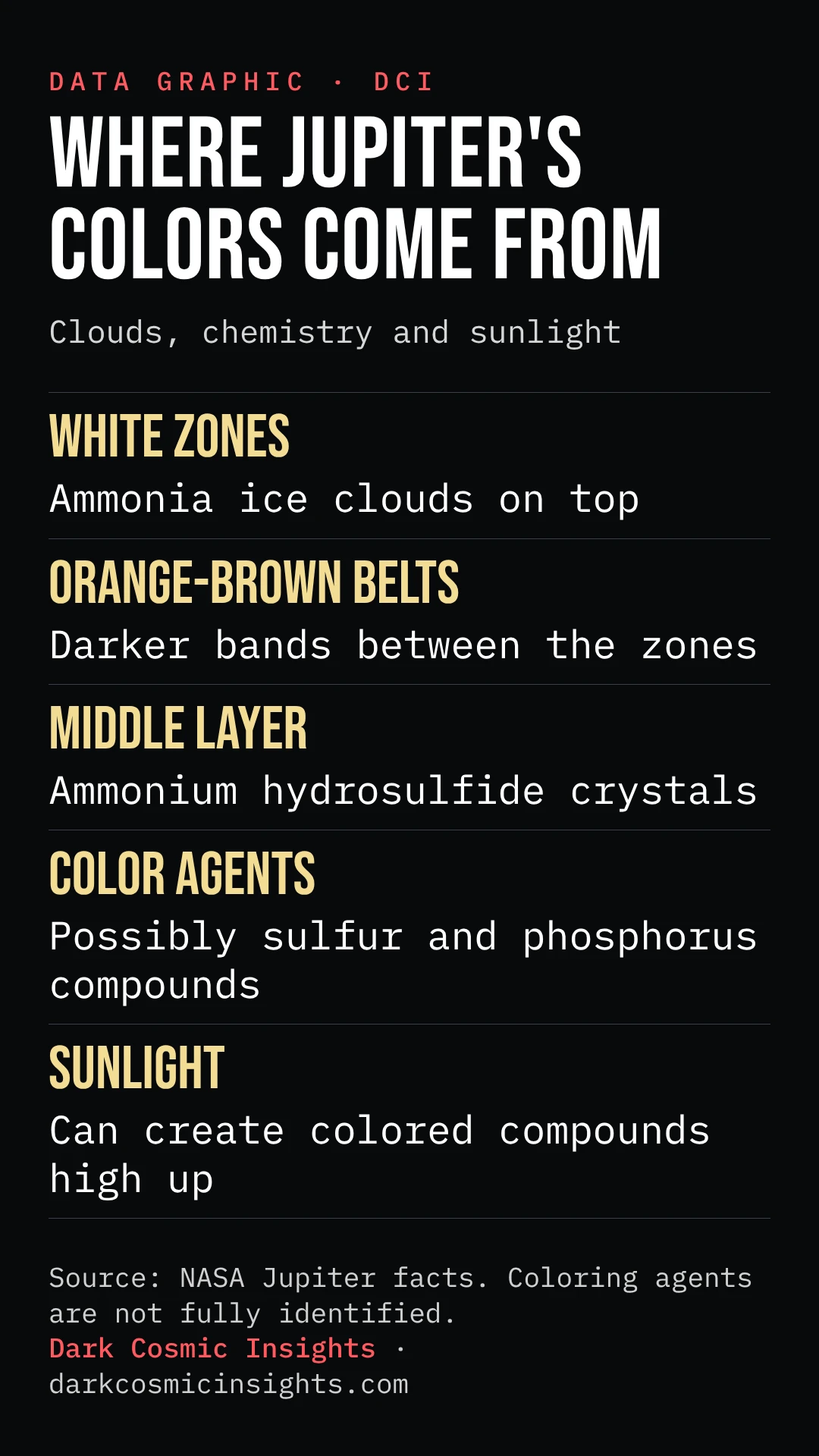
White ammonia ice on top
NASA says “the top cloud is probably made of ammonia ice, while the middle layer is likely made of ammonium hydrosulfide crystals” (NASA).
Mystery coloring agents
The oranges, browns and reds need something more. NASA says the colors may come from “plumes of sulfur and phosphorus-containing gases rising from the planet’s warmer interior” (NASA). Scientists often call the unknown coloring compounds “chromophores,” meaning “color carriers.” Exactly which molecules they are is still being worked out.
Sunlight changes chemistry
Sunlight matters too. Ultraviolet light from the Sun can break molecules apart high in Jupiter’s atmosphere and create new, colored compounds. That’s the core of one leading explanation for the Great Red Spot’s color, which we’ll get to below.
The Great Red Spot
A storm bigger than Earth
The Great Red Spot is a giant storm, an anticyclone, in Jupiter’s southern hemisphere. NASA’s Jupiter facts page still describes it as “twice as wide as Earth,” but it has shrunk: a 2024 study in Geophysical Research Letters put it at about 14,000 km (8,700 miles) long (AGU, 2024), roughly 1.1 times Earth’s diameter of 12,756 km (DCI comparison from NASA NSSDC, Earth). In 2024 NASA still called it “an anticyclone large enough to swallow Earth” (NASA, 2024).
How old is it?
NASA says the Great Red Spot “has been observed on the giant planet for more than 300 years” (NASA). That count reaches back to 1665, when Giovanni Domenico Cassini saw a dark oval at the same latitude and called it the “Permanent Spot.” Observers lost track of it after 1713. A clear oval wasn’t seen there again until 1831 (AGU, 2024).
In 2024, a team led by Agustín Sánchez-Lavega compared those old records and concluded “it is highly unlikely that the current Great Red Spot was the ‘Permanent Spot’ observed by Cassini” (AGU, 2024). So today’s storm has been watched since at least 1831. Whether it’s the same storm Cassini saw is open.
Swirling clouds at different heights
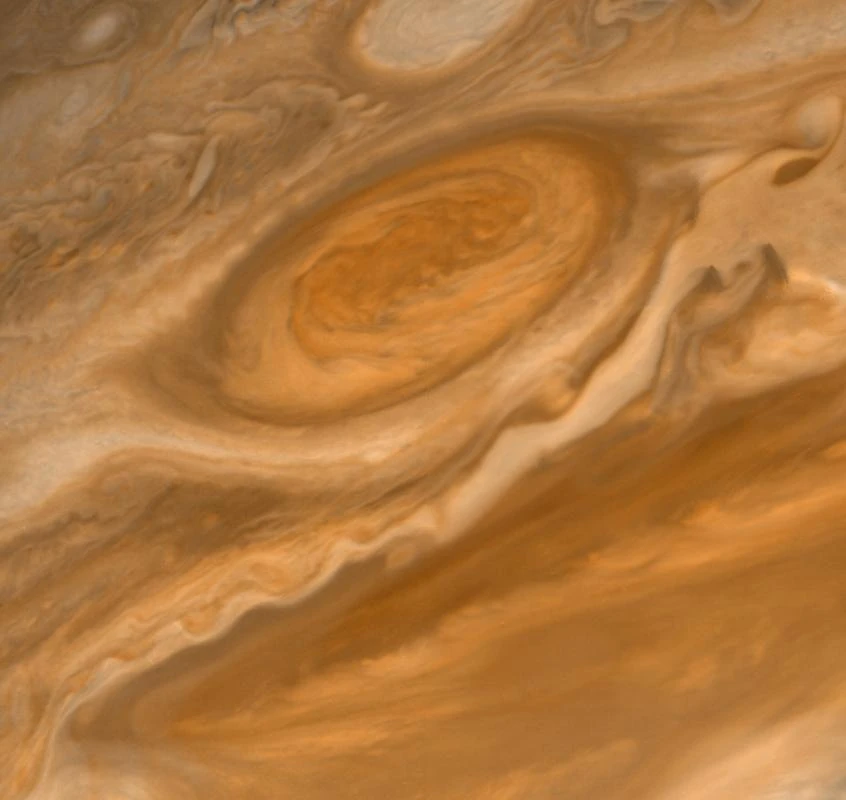
When Voyager 1 approached Jupiter in 1979, scientists noticed the colors around the spot. NASA says Voyager scientists “saw that different colors in clouds around the Great Red Spot imply that the clouds swirl around the spot at varying altitudes” (NASA, PIA00235).
Is the Great Red Spot Shrinking?
Yes, for more than a century
In 2014, NASA reported that Hubble had measured the Great Red Spot at “approximately 10,250 miles across,” its smallest size ever measured (NASA, 2014). That’s about 16,500 km (DCI conversion). Historic observations in the late 1800s gauged it “as large as 25,500 miles on its long axis,” and when Voyager flew past in 1979 it measured “14,500 miles across.”
Faster shrinkage reported in 2014
NASA’s 2014 report said amateur observations starting in 2012 showed it shrinking faster at that time, “by 580 miles per year,” and “changing its shape from an oval to a circle” (NASA, 2014). Hubble images show the change clearly: the spot was just under 21,000 km across in 1995, just under 18,000 km in 2009, and about 16,000 km in 2014 (NASA/ESA, Hubble comparison).

Why is it shrinking?
That’s still open. In 2014, NASA’s Amy Simon said, “In our new observations it is apparent very small eddies are feeding into the storm,” and her team suggested those eddies “may be responsible for the accelerated change” (NASA, 2014). But the cause hasn’t been pinned down.
It’s also wobbling
In 2024, NASA reported that Hubble watched the Great Red Spot from December 2023 to March 2024 and saw it “jiggling like a bowl of gelatin,” going through a roughly 90-day oscillation in shape and speed (NASA, 2024). “While we knew its motion varies slightly in its longitude, we didn’t expect to see the size oscillate,” Simon said. The team expects the storm to “keep shrinking before taking on a stable, less-elongated, shape.”
Why Is the Great Red Spot Red?
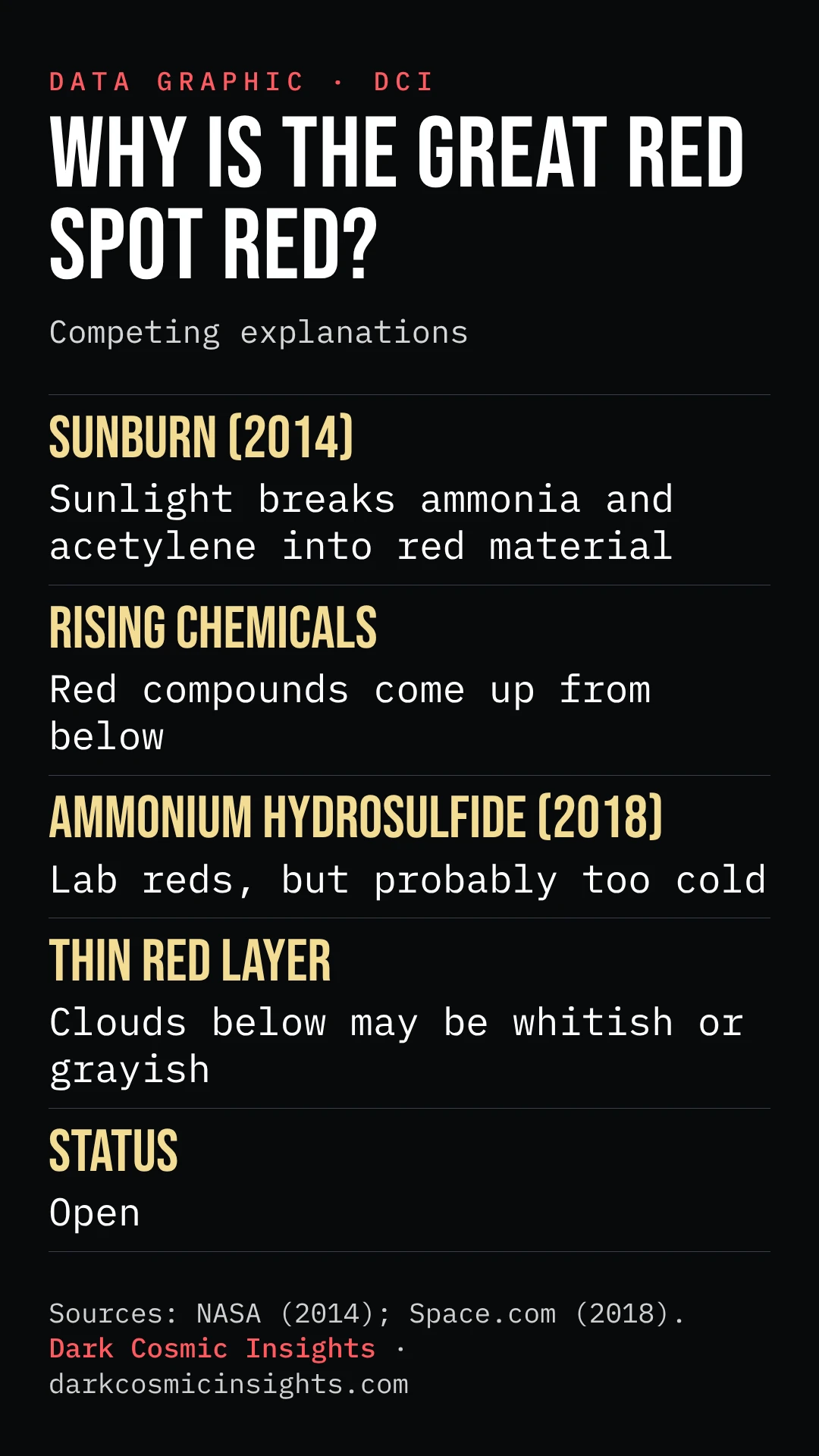
The “sunburn” idea
In 2014, NASA scientists Kevin Baines, Bob Carlson and Tom Momary combined Cassini’s 2000 Jupiter flyby data with lab experiments. They exposed ammonia and acetylene to ultraviolet light, which “produced a reddish material” (NASA, 2014). Their conclusion: the color is “likely a product of simple chemicals being broken apart by sunlight in the planet’s upper atmosphere.” Baines added, “Under the reddish ‘sunburn’ the clouds are probably whitish or grayish.”
The competing idea
That finding contradicted a competing theory: that red chemicals rise from deep below the clouds (NASA, 2014). And the debate hasn’t ended. In 2018, Space.com reported on lab work by Mark Loeffler and Reggie Hudson testing ammonium hydrosulfide hit with simulated cosmic rays, which produced reddish tints at low temperatures, though the researchers said those reds were “probably too cold” to explain the spot (Space.com, 2018).
Status: open
So the honest answer is that the Great Red Spot’s red is still a mystery. Space.com summed it up in 2018: “the source of its distinctive color remains a mystery.”
Are Jupiter Photos Real Color?
True color vs. enhanced color
Some Jupiter images show roughly what your eyes would see. NASA calls the image at the top of this article a “true-color simulated view,” built from Cassini images (NASA, PIA02873). Many of Juno’s dramatic images, though, are “enhanced color,” with colors and contrast pushed further to bring out detail. Many are processed by citizen scientists from Juno’s public JunoCam data.
Read the caption
Enhanced color isn’t fake. It’s a tool. But it means the swirls of electric blue and deep orange you see online may be stronger than Jupiter really looks. The caption tells you which kind you’re seeing. We explain how to read space images in Are Space Photos Real?.
Jupiter vs. Saturn: Why Is Jupiter More Colorful?
Jupiter and Saturn are made of similar ingredients, but Jupiter’s colors are much bolder. NASA puts it this way: “In contrast to the bold red, orange and white clouds of Jupiter, Saturn’s clouds are overlain by a thick layer of haze” (NASA). Saturn is colder, so its cloud tops sit deeper. We look at Saturn’s softer palette in What Color Is Saturn?.
Myth vs. Fact: Jupiter’s Colors
| Myth | Fact | Status |
|---|---|---|
| “Jupiter is just orange.” | It’s tan, brown, white and orange in bands. | Observed |
| “The Great Red Spot is permanent and unchanging.” | It has shrunk since the 1800s and wobbles in size. | Measured |
| “Scientists know why the spot is red.” | Competing explanations; still unsolved. | Open |
| “The whole Great Red Spot is red inside.” | One model says only a thin top layer is red. | Modelled |
| “Vivid Juno images show Jupiter’s real colors.” | Many are enhanced to bring out detail. | Observed |
| “Jupiter’s stripes are painted on.” | They’re cloud bands stretched by fast winds. | Observed |
How Can You See Jupiter’s Colors Yourself?
With a small telescope
Jupiter is easy to find and spectacular in a small telescope. NASA’s fact sheet lists it at about magnitude −2.7 at mean opposition (NASA NSSDC), brighter than any star at night. You’ll see at least two dark belts, and on steady nights, more detail.
Hunt for the Great Red Spot
The Great Red Spot moves into view as Jupiter rotates every 9.9 hours, so it isn’t always facing us. On a good night with a decent telescope, it can appear as a pale oval in the southern hemisphere, much less vivid than in spacecraft images. Observing guides and apps can tell you when it’s facing Earth.
Time it right
Jupiter is best around opposition, when it’s opposite the Sun and up all night. Oppositions come about every 399 days (NASA NSSDC). The next one is February 11, 2027 (Royal Observatory Greenwich).
Jupiter’s Colors by the Numbers
| Measure | Value | Source |
|---|---|---|
| Colors | tan, brown, white and orange | NASA |
| Great Red Spot width (2014) | about 10,250 miles | NASA, 2014 |
| Late 1800s | about 25,500 miles (long axis) | NASA, 2014 |
| 1979 (Voyager) | about 14,500 miles | NASA, 2014 |
| Shrink rate reported in 2014 (from 2012) | about 580 miles per year (historical rate) | NASA, 2014 |
| Watched since | at least 1831 (a 1665–1713 spot may be a different storm) | AGU, 2024 |
| Size wobble | about a 90-day cycle (2023–24) | NASA, 2024 |
| Brightness at opposition | about magnitude −2.7 | NASA NSSDC |
Sources checked November 2026; measurement dates shown above.

Jupiter Color FAQ
What color is Jupiter?
Jupiter is striped in tan, brown, white and orange, as NASA describes it. The light bands are called zones and the darker orange bands belts. Its famous Great Red Spot adds a reddish oval in the southern hemisphere.
Why is Jupiter striped?
Jupiter spins once every 9.9 hours and has powerful east-west winds that stretch its clouds into bands around the planet. NASA calls the lighter bands zones and the darker orange ones belts.
What makes Jupiter’s colors?
NASA says the top clouds are probably white ammonia ice, with ammonium hydrosulfide below. The oranges and browns may come from sulfur and phosphorus compounds rising from the warmer interior, and sunlight can create colored compounds too. The exact chemicals aren’t fully identified.
Why is the Great Red Spot red?
Nobody knows for sure. A 2014 NASA study suggested sunlight breaks apart ammonia and acetylene high up, making a reddish “sunburn” on top of paler clouds. Other researchers favor different chemistry, and the question is still open.
Is the Great Red Spot shrinking?
Yes. It measured about 25,500 miles long in the late 1800s, 14,500 miles across in 1979 and about 10,250 miles in 2014, Hubble’s smallest measurement then. In 2024, Hubble saw it wobble in size on a roughly 90-day cycle.
How big is the Great Red Spot?
A 2024 study put it at about 14,000 km (8,700 miles) long, about 1.1 times Earth’s width, still big enough to swallow our planet. In 2014, Hubble measured it at about 10,250 miles, or about 16,500 km, across. It has been getting smaller and rounder for decades.
Will the Great Red Spot disappear?
Nobody can say. In 2024, NASA’s Hubble team said they expect it to keep shrinking before taking on a stable, less elongated shape. Whether it ever vanishes completely isn’t something current measurements can predict.
Can I see the Great Red Spot with a telescope?
Often, yes, with a decent backyard telescope on a steady night, when the spot is facing Earth. It usually looks paler than the vivid red in spacecraft images. Jupiter’s rotation brings it into view every 9.9 hours.
Your next step: next time Jupiter is up, point a small telescope at it and count its dark belts. Then check whether the Great Red Spot is facing Earth that night, and see if you can catch it.

Sources and Further Reading
- NASA Science, Jupiter: Facts; Jupiter; Deep Clouds.
- NASA Space Science Data Coordinated Archive, Jupiter Fact Sheet.
- NASA Science (2014), NASA’s Hubble Shows Jupiter’s Great Red Spot is Smaller than Ever Measured.
- NASA Science (October 9, 2024), NASA’s Hubble Watches Jupiter’s Great Red Spot Behave Like a Stress Ball.
- NASA Science (November 2014), Jupiter’s Great Red Spot is a Sunburn.
- Space.com (February 5, 2018), What Makes Jupiter’s Great Spot Red? It’s Still a Mystery.
- NASA, PIA02873: High Resolution Globe of Jupiter; PIA00456; PIA00235; NASA/ESA Hubble Great Red Spot comparison.
- Royal Observatory Greenwich, What is a planet in opposition?
Explore Next
- The full Jupiter guide: Jupiter: Facts, Moons and the Great Red Spot
- What’s under the clouds: What Is Jupiter Made Of?
- Saturn’s softer, seasonal colors: What Color Is Saturn?
- How to tell true color from enhanced: Are Space Photos Real?
- Jupiter’s strange polar storms: Jupiter’s Polar Cyclones vs. Saturn’s Hexagon
- Every planet in one place: Solar System Explorer
- Its faint, dusty rings: Does Jupiter Have Rings?
- How far away Jupiter is: How Far Is Jupiter?
- How a claim earns its label: How We Know
How This Explainer Was Checked
Every number and quote in this article was checked in November 2026 against the source linked beside it: NASA’s Jupiter facts, Jupiter and Deep Clouds pages, NASA’s Jupiter fact sheet, NASA’s 2014 Hubble and “sunburn” releases, NASA’s 2024 Hubble release, Space.com’s 2018 report on the Loeffler and Hudson lab work, NASA’s image pages and the Royal Observatory Greenwich opposition table. Great Red Spot sizes are given in the units each source used; the kilometer conversion of the 2014 width is a DCI calculation. Colors and the spot’s shrinking are labelled Observed and Measured. Cloud layers and the “sunburn” model are labelled Modelled. The cause of the red color and the shrinking are labelled Open. Images are labelled: real spacecraft and telescope images as OBSERVATION, illustrations as ILLUSTRATION, and our charts as DATA GRAPHIC. Nothing AI-generated is presented as a real image.

Final Thought: An Old Storm, Still Changing
Jupiter’s colors look like they’ve been painted on forever. They haven’t. The Great Red Spot has been shrinking for more than a century, wobbling as it goes, and we still can’t say for sure what makes it red. One of the most colorful planets in the solar system is also one of its most unfinished stories.
About the Author
Author: King | Founder of Dark Cosmic Insights
King is the founder of Dark Cosmic Insights, a science storytelling platform exploring the strangest true stories hiding in space, science and AI. He digs into NASA, ESA and peer-reviewed research, separates what has been measured from what is still a mystery, and turns it into articles, data graphics and Shorts.
Follow the anomaly. Trace the source.