Saturn is the color of butterscotch. Or pale gold. Or cream with faint tan stripes. Every description sounds a little different, because Saturn doesn’t have one strong color the way Mars is red or Neptune is blue. NASA says simply that “the planet is many different shades of yellow, brown, and gray” (NASA).
What makes Saturn really interesting is that its colors change. When NASA’s Cassini spacecraft arrived in 2004, Saturn’s northern hemisphere was deep in winter and glowing an unexpected blue. By the time Cassini’s mission ended in 2017, that same pole had faded to gold. Saturn has seasons, and you can see them in its colors.

Observed, measured, modelled, open. Saturn’s pale gold color and its seasonal color shifts are observed in natural-color images. The thick haze over its clouds is observed. Why exactly the winter hemisphere turns blue is partly modelled: the leading explanation involves ring shadows and haze chemistry. Some details of Saturn’s color are still open.
Quick Answer: What Color Is Saturn?
Saturn is a pale gold or yellowish tan, with faint bands. NASA describes it as “many different shades of yellow, brown, and gray” (NASA). Its colors look softer than Jupiter’s because “Saturn’s clouds are overlain by a thick layer of haze” (NASA). Saturn’s colors also change with its long seasons: Cassini saw the winter hemisphere turn blue, and watched the north pole shift “from a bluish color to a more golden hue” between 2012 and 2016 as summer approached (NASA/JPL, PIA21049). The rings, seen from Saturn’s cloud tops, “would look mostly white” (NASA).
What this article can and cannot establish. It can show you Saturn’s color in natural-color spacecraft images, explain what softens its colors, and walk through the seasonal color changes Cassini and Hubble recorded. It cannot give you a single “official” color. Natural color depends on lighting, season and processing, and the exact chemistry behind every shade is still being studied.
Table of Contents
The DCI Evidence Map: Saturn’s Color
| Question | What we know | Status | Key source |
|---|---|---|---|
| What color is Saturn? | Shades of yellow, brown and gray | Observed | NASA |
| Why are its colors muted? | A thick haze covers the clouds | Observed | NASA |
| Why are its clouds deeper than Jupiter’s? | Saturn is colder | Modelled | NASA |
| Did Saturn’s north turn blue? | Yes, in winter early in Cassini’s mission | Observed | NASA/JPL, PIA10558 |
| Why blue? | Ring shadow and less haze, leaving clearer skies | Modelled | Phys.org on AGU 2018 |
| Did the hexagon change color? | Bluish to golden, 2012 to 2016 | Observed | NASA/JPL, PIA21049 |
| What color are the rings? | Mostly white from Saturn’s cloud tops | Modelled | NASA |
Status key: Observed = seen directly. Measured = a number with a stated uncertainty or a direct measurement. Modelled = inferred from measurements through a physical model, dependent on assumptions. Open = unresolved; the evidence is incomplete or points different ways. Not supported = the evidence goes against the claim, or there is none for it.
Cite this framework: “DCI Evidence Map: Saturn’s Color,” Dark Cosmic Insights, November 2026, darkcosmicinsights.com/what-color-is-saturn/.
Why Is Saturn Pale Gold?
Mostly hydrogen and helium, plus traces
Saturn’s atmosphere is mostly hydrogen and helium, which don’t add much color on their own. NASA’s Hubble team writes that Saturn’s atmosphere “is mostly hydrogen and helium” with trace gases that “give it a yellowish-brown color” (NASA, 2020). We break down what the planet is made of in What Is Saturn Made Of?.
A haze blanket
The bigger reason Saturn looks soft and creamy is haze. NASA puts it this way: “In contrast to the bold red, orange and white clouds of Jupiter, Saturn’s clouds are overlain by a thick layer of haze” (NASA). The haze acts a bit like a frosted glass over the cloud bands, blending their colors together.
Clouds sit deeper
There’s another difference. NASA explains that “the visible cloud tops on Saturn are deeper in its atmosphere due to the planet’s cooler temperatures” (NASA). Saturn is farther from the Sun and colder than Jupiter, so its clouds form lower down, under more atmosphere and haze. The result is the pale, low-contrast stripes Saturn is known for.

Why Does Saturn Look Less Colorful Than Jupiter?
Bold Jupiter, gentle Saturn
Put Jupiter and Saturn side by side and Jupiter wins on color every time: deep orange belts, white zones and the red Great Red Spot. Saturn’s bands are there, but quieter. The reason is the one NASA gives above: Saturn’s haze covers its clouds, and its colder atmosphere pushes those clouds deeper (NASA).
Same ingredients, different look
Both planets are mostly hydrogen and helium. The difference in color comes down to temperature, where the clouds form and how much haze sits on top, not a completely different recipe. We compare the two planets’ poles in Jupiter’s Polar Cyclones vs. Saturn’s Hexagon.
Saturn’s Seasons Change Its Colors
Saturn is tilted on its axis by about 26.7 degrees (NASA NSSDC), a little more than Earth. And it takes about 29.4 Earth years to orbit the Sun (NASA). So each season on Saturn lasts roughly seven Earth years. That’s long enough for its atmosphere, and its colors, to change noticeably.
A blue winter
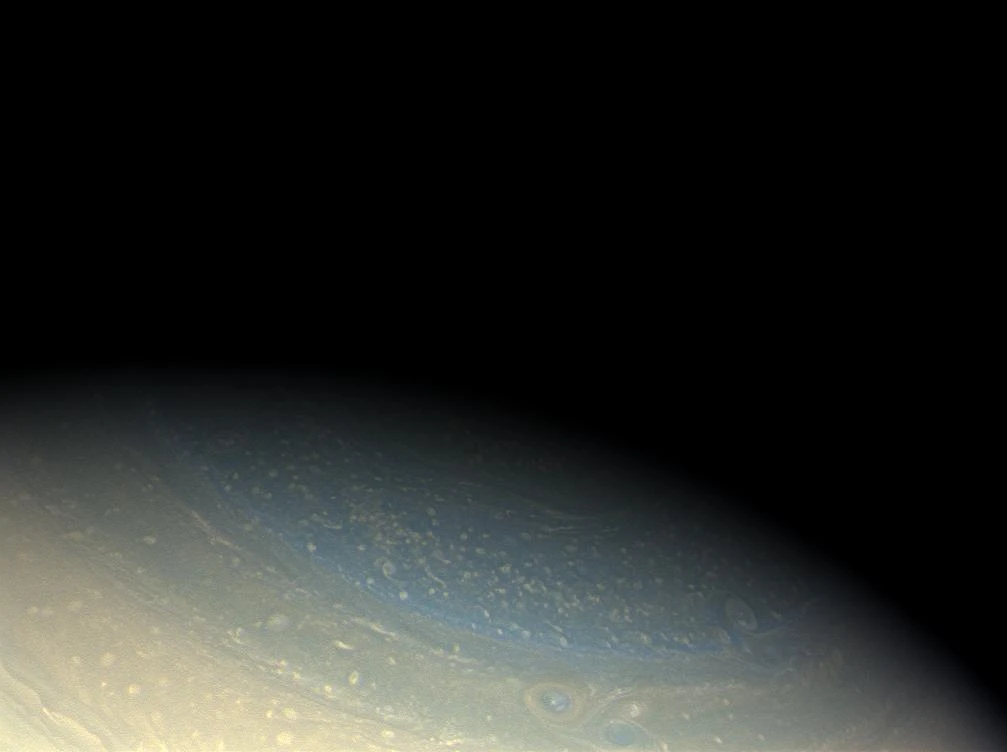
When Cassini arrived in 2004, Saturn’s northern hemisphere was in winter. It looked blue. In 2009, NASA released a true-color Cassini image and wrote that “the azure blue of Saturn’s winter hemisphere during the early Cassini prime mission still remains a puzzle” (NASA/JPL, PIA10558). That image was made by combining views taken through red, green and blue filters, the way a regular camera builds a color photo.
Why winter turns blue
The leading explanation came from Cassini scientists, presented at the American Geophysical Union’s 2018 Fall Meeting. As reported by Phys.org, Saturn’s rings cast a shadow on the winter hemisphere, cutting off sunlight. With less sunlight, the chemical reactions that make haze slow down, and the existing haze particles clump into heavier grains and sink out of view, leaving clearer skies (Phys.org, 2018). Cassini deputy project scientist Scott Edgington said, “I think everyone was kind of surprised by why the atmosphere was blue.”
With less of the yellowish haze in the way, the clearer atmosphere looks blue. This explanation is modelled: it fits the observations and the chemistry, but it was presented as conference research rather than settled fact.
The hexagon turns gold
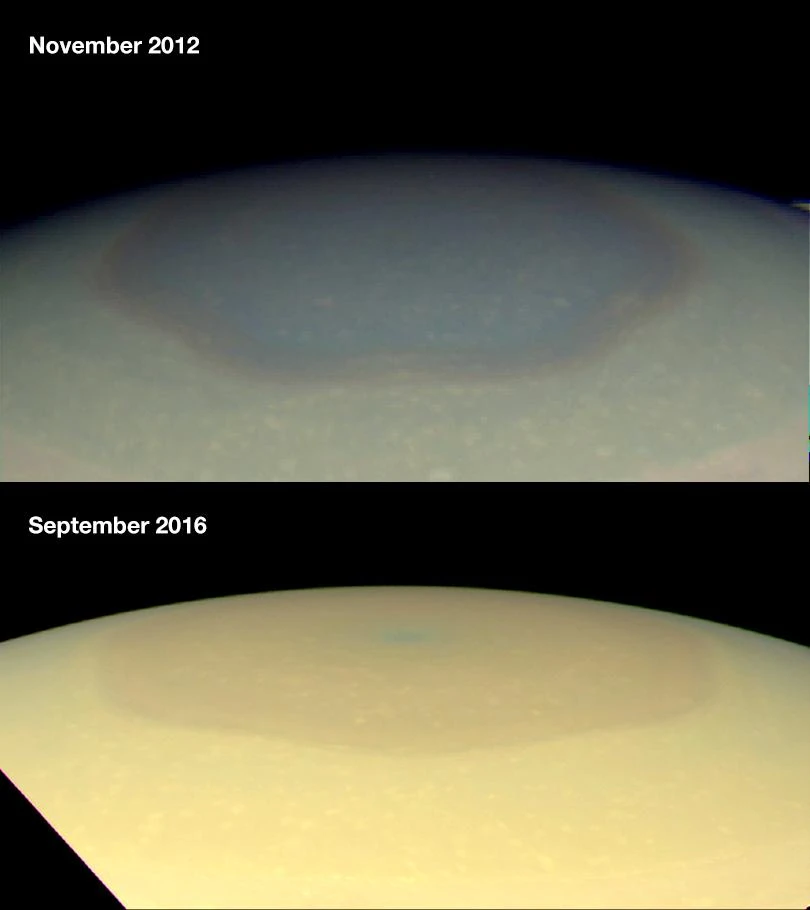
The change also worked in reverse. NASA compared natural-color Cassini images of Saturn’s north pole taken between 2012 and 2016 and saw “the change from a bluish color to a more golden hue” inside the six-sided jet stream known as the hexagon (NASA/JPL, PIA21049).
NASA says the change may be seasonal, linked to “increased production of photochemical hazes in the atmosphere” as the north pole headed toward summer solstice in May 2017. Since the 2009 equinox, the pole had “been basking in continuous sunshine.” NASA also suggested the hexagon may act as a barrier that keeps hazes from outside it from drifting in, and that atmospheric circulation and seasonal heating could play a role too.

Watching it from Earth
Hubble keeps tracking these changes. In 2020, NASA said a Hubble image showed a reddish haze over the northern hemisphere that “may be due to heating from increased sunlight,” while the “just-now-visible south pole has a blue hue” (NASA, 2020). The winter pole was blue again, this time in the south.
In 2021, NASA reported that from 2018 to 2020, Hubble saw Saturn’s equator get 5 to 10 percent brighter and its winds change slightly. Lead author Amy Simon of NASA Goddard said, “These small year-to-year changes in Saturn’s color bands are fascinating” (NASA, 2021).
What Color Are Saturn’s Rings?
Mostly white, up close
NASA says “the rings would look mostly white if you looked at them from the cloud tops of Saturn” (NASA). That fits what they’re made of: chunks of water ice, mixed with some rock and coated with dust.
Subtle tints
In natural-color images, the rings show faint variations. When Cassini took its 2004 approach image, NASA noted “subtle color differences across the planet’s middle B ring” and said color variations “generally imply different compositions” (NASA, PIA05389). In other words, the faint tints in the rings are clues to what’s mixed into the ice.
We count and name the rings in How Many Rings Does Saturn Have? and look at whether they’re disappearing in Are Saturn’s Rings Disappearing?.
Are Saturn Photos Real Color?
Natural color
Many Cassini images are labelled “natural color” or “true color.” Those are built by combining images taken through red, green and blue filters, close to what a human eye would see, though the brightness and contrast may still be adjusted. The blue winter image was made exactly that way (NASA/JPL, PIA10558).
False color is a tool, not a fake
Other images use colors to show light our eyes can’t see. A 2011 Cassini image of a huge storm assigned three infrared wavelengths to red, green and blue. In that view, the storm shows up as yellow because it’s bright in two of those wavelengths, not because it’s yellow to the eye (NASA/JPL, PIA14119). Likewise, a 2003 Hubble infrared image, which ESA called “false-colour,” used blue to mark a clear atmosphere down to the main cloud layer and green and yellow to mark haze above it (ESA).
The rule of thumb: check the caption. If it says natural color or true color, you’re looking at roughly what an eye would see. If it says false color, enhanced color or infrared, the colors are a map. We go deeper in Are Space Photos Real?.

What Color Is Saturn From Earth?
A bright point of light
To the naked eye, Saturn looks like a steady, bright point of light, not a disc. At opposition its brightness averages about magnitude 0.7 on its own, and around magnitude 0.05 with the rings included (NASA NSSDC). NASA notes that Saturn is “the farthest planet from Earth discovered by the unaided human eye” (NASA).
Through a telescope
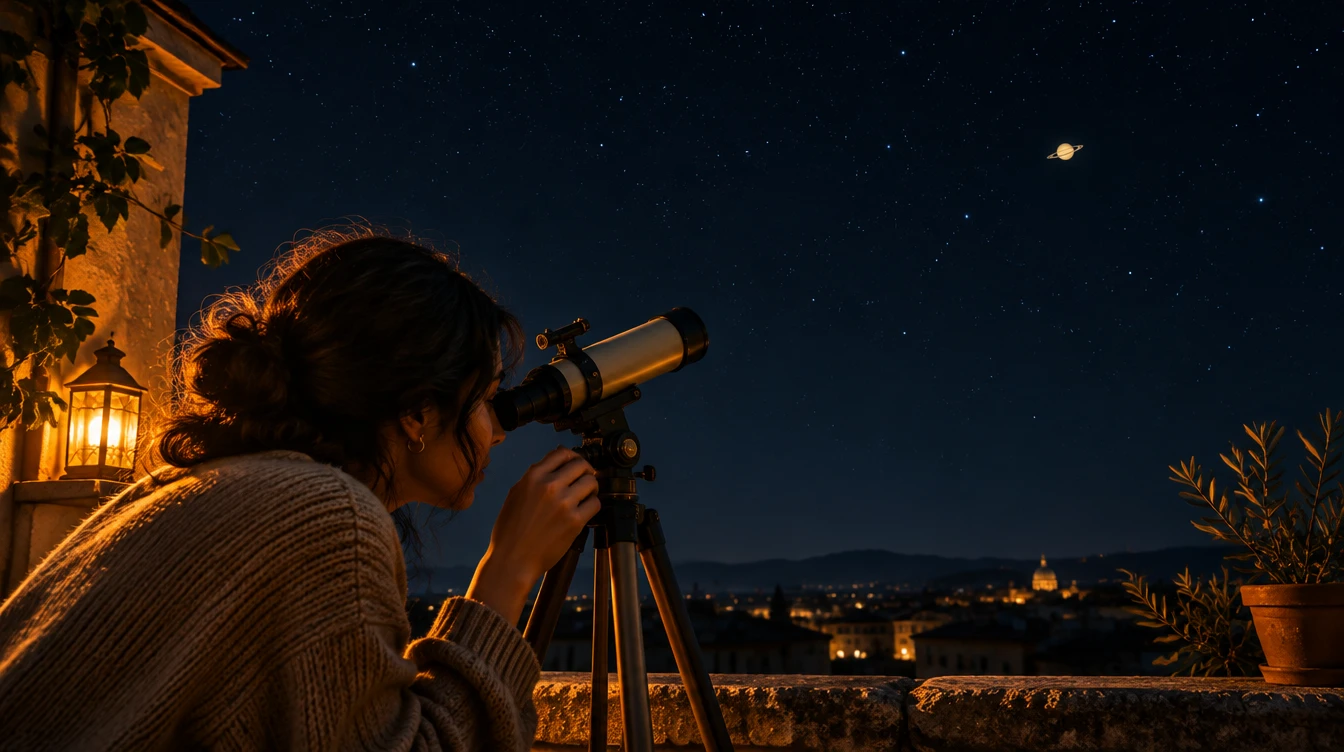
Through a small telescope, Saturn shows a creamy, pale yellow disc with the rings around it, and on a steady night you may see a darker band or two. The colors in big observatory or spacecraft images are richer because of long exposures, larger apertures and processing.
Myth vs. Fact: Saturn’s Color
| Myth | Fact | Status |
|---|---|---|
| “Saturn is bright orange like Jupiter.” | It’s paler: shades of yellow, brown and gray. | Observed |
| “Saturn is always the same color.” | Its colors change with its seven-year seasons. | Observed |
| “Saturn’s blue north pole was photo editing.” | Cassini’s true-color images showed it blue. | Observed |
| “Scientists fully understand the blue.” | Ring shadow and less haze is the leading idea. | Modelled |
| “False-color images are fake.” | They map invisible light to colors on purpose. | Observed |
| “The rings are gold.” | From Saturn’s cloud tops, they’d look mostly white. | Modelled |
How Can You See Saturn’s Color Yourself?
Use a small telescope
Even a modest telescope shows Saturn’s pale yellow disc and its rings. Try a few different nights: steadier air shows more of the faint bands.
Time it right
Saturn is easiest to see around opposition. NASA said Saturn reached opposition on October 4, 2026, when it “rises around sunset and stays visible for much of the night” (NASA). It stays well placed in the evening sky for months afterward.
Compare real images
Look at Cassini’s natural-color views side by side, such as PIA21049’s 2012 and 2016 north pole images, in NASA’s Photojournal. Read each caption to see whether it’s natural or false color.
Saturn’s Color by the Numbers
| Measure | Value | Source |
|---|---|---|
| Overall color | shades of yellow, brown and gray | NASA |
| Axial tilt | 26.73° | NASA NSSDC |
| Year length | about 29.4 Earth years | NASA |
| Each season | about 7 Earth years (DCI estimate) | NASA |
| North pole color shift | bluish to golden, 2012 to 2016 | NASA/JPL |
| Northern summer solstice | May 2017 | NASA/JPL |
| Equator brightening (2018–2020) | 5 to 10 percent | NASA, 2021 |
| Brightness at opposition | about magnitude 0.7 (0.05 with rings) | NASA NSSDC |
Values are as of November 2026.
Saturn Color FAQ
Is Saturn yellow or gold?
Both descriptions work. NASA calls Saturn many shades of yellow, brown and gray. In natural-color images it usually looks pale gold or butterscotch, with soft bands rather than the bold stripes you see on Jupiter.
Why is Saturn yellow?
Its atmosphere is mostly hydrogen and helium, and trace gases give it a yellowish-brown tint. A thick haze over the clouds softens and blends the colors, and because Saturn is cold, its cloud tops sit deeper in the atmosphere than Jupiter’s.
Why did Saturn’s north pole look blue?
When Cassini arrived, the north was in winter. The leading explanation is that the rings shaded that hemisphere, so less haze formed and existing haze sank out of view. With less haze in the way, the clearer atmosphere looked blue.
Does Saturn change color?
Yes. Saturn’s long seasons change its colors. Cassini saw the north pole shift from bluish to golden between 2012 and 2016, and in 2020 Hubble saw a blue hue at the newly visible south pole while a reddish haze sat over the north.
What color are Saturn’s rings?
Seen from Saturn’s cloud tops, NASA says the rings would look mostly white, because they’re made mainly of water ice. In images they can show faint tints, and scientists use those subtle color differences as clues to what’s mixed into the ice.
Are Saturn’s colors in NASA photos real?
Many are. Images labelled natural color or true color are built from red, green and blue filters, close to what eyes would see. Others use false color to show invisible light. The caption tells you which kind of image you’re looking at.
Why is Jupiter more colorful than Saturn?
NASA says Saturn’s clouds are covered by a thick layer of haze, and because Saturn is colder, its visible cloud tops sit deeper in the atmosphere. Jupiter’s bold reds, oranges and whites are easier to see because there’s less in the way.
What color is Saturn to the naked eye?
To the naked eye it’s just a bright, steady point of light, not a colored disc. Through a small telescope you’ll see a pale, creamy yellow ball with rings around it and, on good nights, a faint band or two.
Your next step: pull up Cassini’s 2012 and 2016 views of Saturn’s north pole side by side, then compare them with the planet through a backyard telescope. You’ll be seeing the same world in two different seasons.
Sources and Further Reading
- NASA Science, Saturn: Facts; Saturn; Deep Clouds.
- NASA Space Science Data Coordinated Archive, Saturn Fact Sheet.
- NASA/JPL, PIA10558: A Blue Northern Mystery (2009); PIA21049: Changing Colors in Saturn’s North (2016); PIA14119: Updrafts of Large Ammonia Crystals in Saturn Storm.
- NASA, PIA05389: Saturn in Color (2004).
- NASA Science (July 23, 2020), Hubble Sees Summertime on Saturn; (March 18, 2021), Hubble Sees Changing Seasons on Saturn.
- Phys.org (December 2018), Rings make Saturn shadier, bluer and less hazy in winter, on research presented at the AGU Fall Meeting.
- ESA (2003), Hazy shades of Saturn.
- NASA Science (October 2026), What’s Up: October 2026 Skywatching Tips from NASA.
Explore Next
- The full Saturn guide: Saturn: Facts, Rings, Moons and Your Questions
- Seven, eight or thousands: How Many Rings Does Saturn Have?
- Distance, travel time and the 29-year Saturn year: How Far Is Saturn?
- Size, mass and the bathtub question: How Big Is Saturn?
- What’s under the haze: What Is Saturn Made Of?
- The ten-sided wave at the south pole: Saturn’s Decagon
- Saturn’s pole next to Jupiter’s: Jupiter’s Polar Cyclones vs. Saturn’s Hexagon
- How to tell real color from false color: Are Space Photos Real?
- The rings, and whether they’re vanishing: Are Saturn’s Rings Disappearing?
- How cold Saturn really is: How Cold Is Saturn?
- Jupiter’s bolder colors: What Color Is Jupiter?
- How a claim earns its label: How We Know
How This Explainer Was Checked
Every number and quote in this article was checked in November 2026 against the source linked beside it: NASA’s Saturn facts and Deep Clouds pages, NASA’s Saturn fact sheet, NASA/JPL image releases PIA05389, PIA10558, PIA21049 and PIA14119, NASA’s Hubble releases from 2020 and 2021, ESA’s 2003 Hubble infrared release and Phys.org’s report on research presented at the 2018 AGU Fall Meeting. Saturn’s colors and color changes are labelled Observed. The explanation for the blue winter hemisphere is labelled Modelled. The length of a Saturn season is a DCI estimate from the 29.4-year orbit and is labelled as one. Images are labelled: real spacecraft images as OBSERVATION, illustrations as ILLUSTRATION, and our charts as DATA GRAPHIC. Nothing AI-generated is presented as a real image.
Final Thought: A Planet That Changes Its Coat
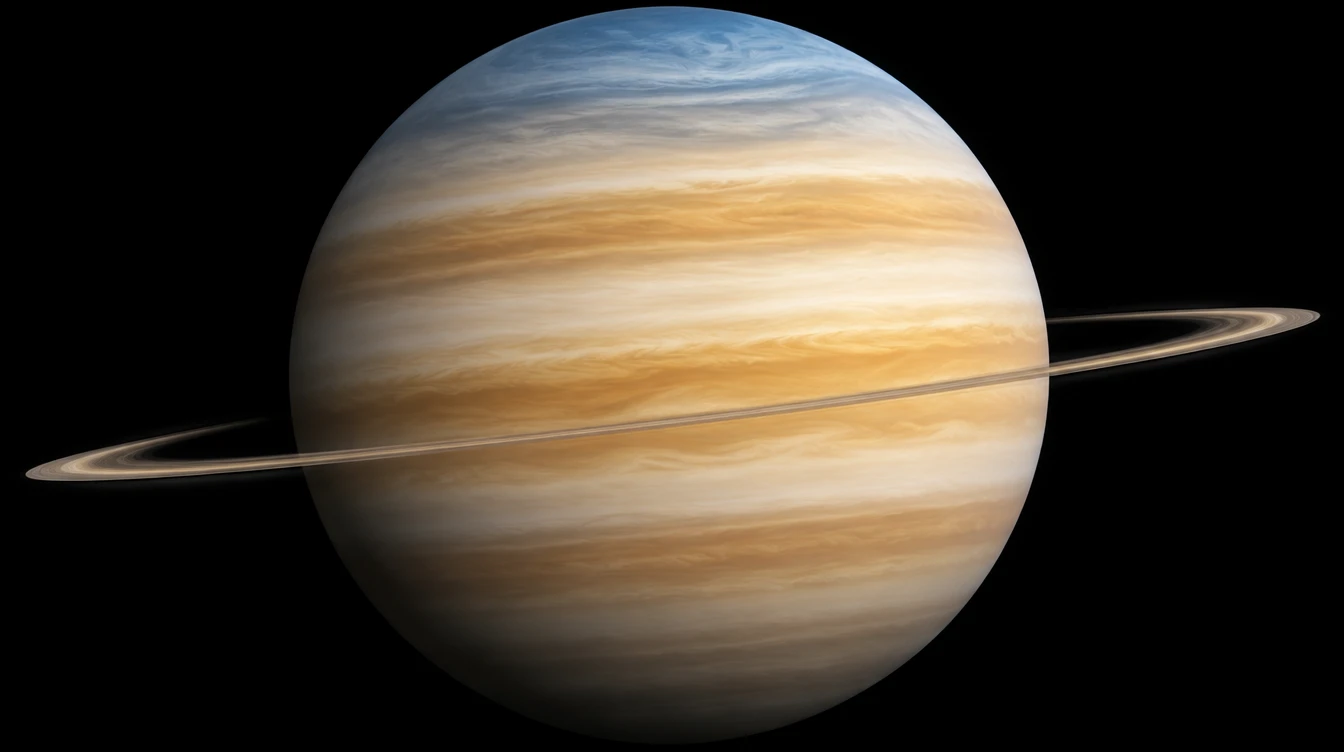
Saturn’s color is easy to describe and surprisingly hard to pin down. It’s pale gold most of the time, softened by haze. But give it a few Earth years and a change of season, and a pole can turn blue or fade back to gold. The planet we see is never quite the same planet twice.
About the Author
Author: King | Founder of Dark Cosmic Insights
King is the founder of Dark Cosmic Insights, a science storytelling platform exploring the strangest true stories hiding in space, science and AI. He digs into NASA, ESA and peer-reviewed research, separates what has been measured from what is still a mystery, and turns it into articles, data graphics and Shorts.
Follow the anomaly. Trace the source.