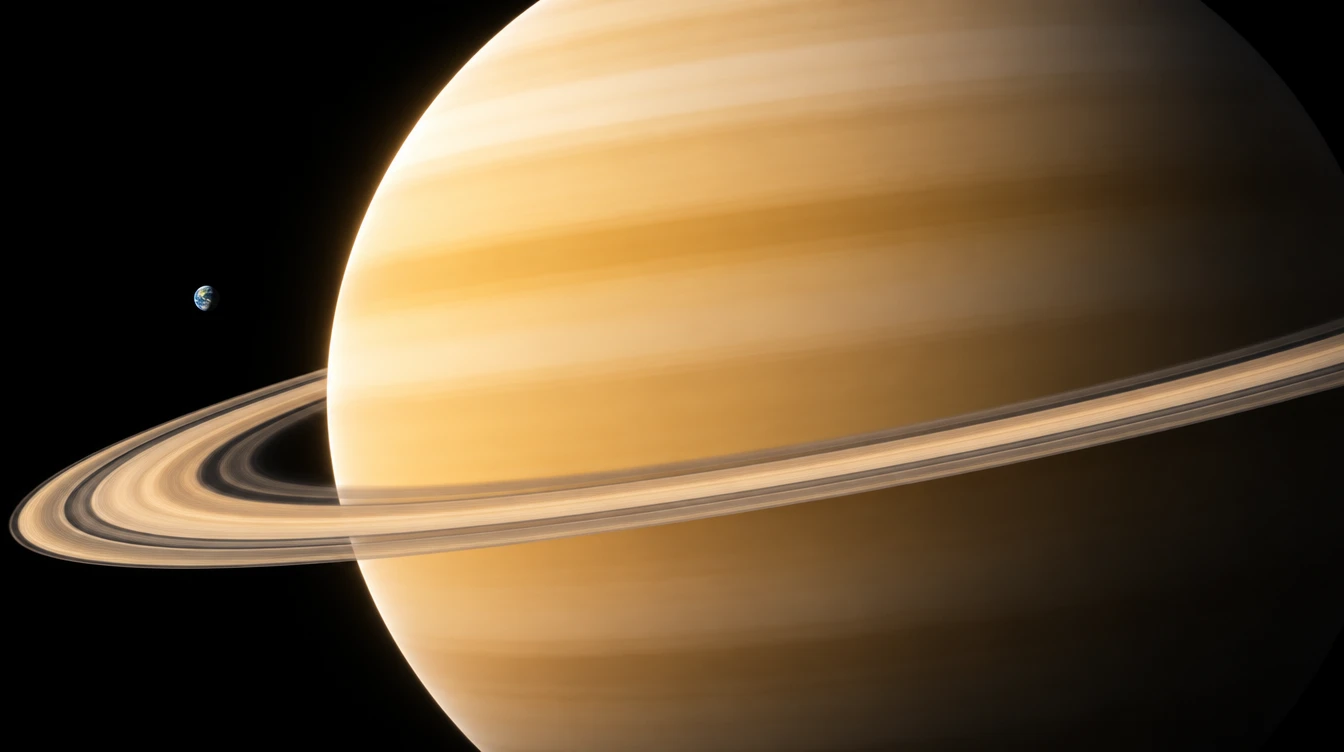
If Earth were a nickel, Saturn would be a volleyball. That’s NASA’s own comparison (NASA), and it’s a good start. Saturn is the second-largest planet in the solar system, about nine times wider than Earth, with room inside for more than 760 Earths.
But Saturn’s size comes with strange twists. It’s so light for its size that its average density is lower than water’s. It spins so fast that it bulges at the equator and looks visibly squashed. And its rings stretch so far that, laid next to Earth, they’d cover most of the distance to the Moon.

Observed, measured, modelled, open. Saturn’s size, mass, density and gravity are all measured, mostly from spacecraft tracking and images. The comparisons in this article, such as how many Saturns fit in the Sun, are DCI calculations from NASA’s measurements, labelled as such.
Quick Answer: How Big Is Saturn?
Saturn is about 120,500 km (74,897 miles) across at its equator, which makes it 9 times wider than Earth (NASA). By volume it could hold about 764 Earths, and it has about 95 times Earth’s mass (NASA NSSDC). It’s the second-largest planet, after Jupiter. Despite its size, its average density is only 687 kg/m³, less than water, and NASA says it “could float in a bathtub if such a colossal thing existed” (NASA). Its main rings reach about 136,780 km from its center (NASA NSSDC).
What this article can and cannot establish. It can give you Saturn’s measured size, mass, density and gravity, and compare them with Earth, Jupiter and the Sun. It cannot give one simple “radius,” because Saturn has no solid surface and isn’t a perfect sphere. Its size is measured at a set pressure level, 1 bar, about Earth’s sea-level air pressure.
Table of Contents
The DCI Evidence Map: Saturn’s Size
| Question | What we know | Status | Key source |
|---|---|---|---|
| How wide is Saturn? | About 120,500 km at the equator | Measured | NASA |
| How many Earths fit? | Volume of about 764 Earths | Measured | NASA NSSDC |
| How heavy is it? | About 95 Earth masses | Measured | NASA NSSDC |
| Is it really round? | No: about 10% wider at the equator than pole to pole | Measured | NASA NSSDC |
| Could it float? | Average density is less than water | Measured | NASA |
| How strong is its gravity? | About 0.92 times Earth’s at the equator and 1.24 times at the poles, including spin | Measured | NASA NSSDC |
| How many Saturns fit in the Sun? | About 1,700 by volume | DCI calculation | NASA NSSDC |
Status key: Observed = seen directly. Measured = a number with a stated uncertainty or a direct measurement. Modelled = inferred from measurements through a physical model, dependent on assumptions. Open = unresolved; the evidence is incomplete or points different ways. Not supported = the evidence goes against the claim, or there is none for it. DCI calculation = our arithmetic from the linked measurement.
Cite this framework: “DCI Evidence Map: Saturn’s Size,” Dark Cosmic Insights, November 2026, darkcosmicinsights.com/how-big-is-saturn/.
How Wide Is Saturn?
Across the equator
NASA says that “with an equatorial diameter of about 74,897 miles (120,500 kilometers), Saturn is 9 times wider than Earth” (NASA). NASA’s fact sheet gives the equatorial radius as 60,268 km, measured at the 1-bar pressure level, compared with Earth’s 6,378 km (NASA NSSDC).
Pole to pole
Measured through the poles, Saturn is smaller. Its polar radius is 54,364 km, so the planet is about 108,700 km tall from pole to pole, versus about 120,500 km wide at the equator (NASA NSSDC). That’s a difference of about 11,800 km, almost the full width of Earth (DCI calculation).
Why it’s squashed
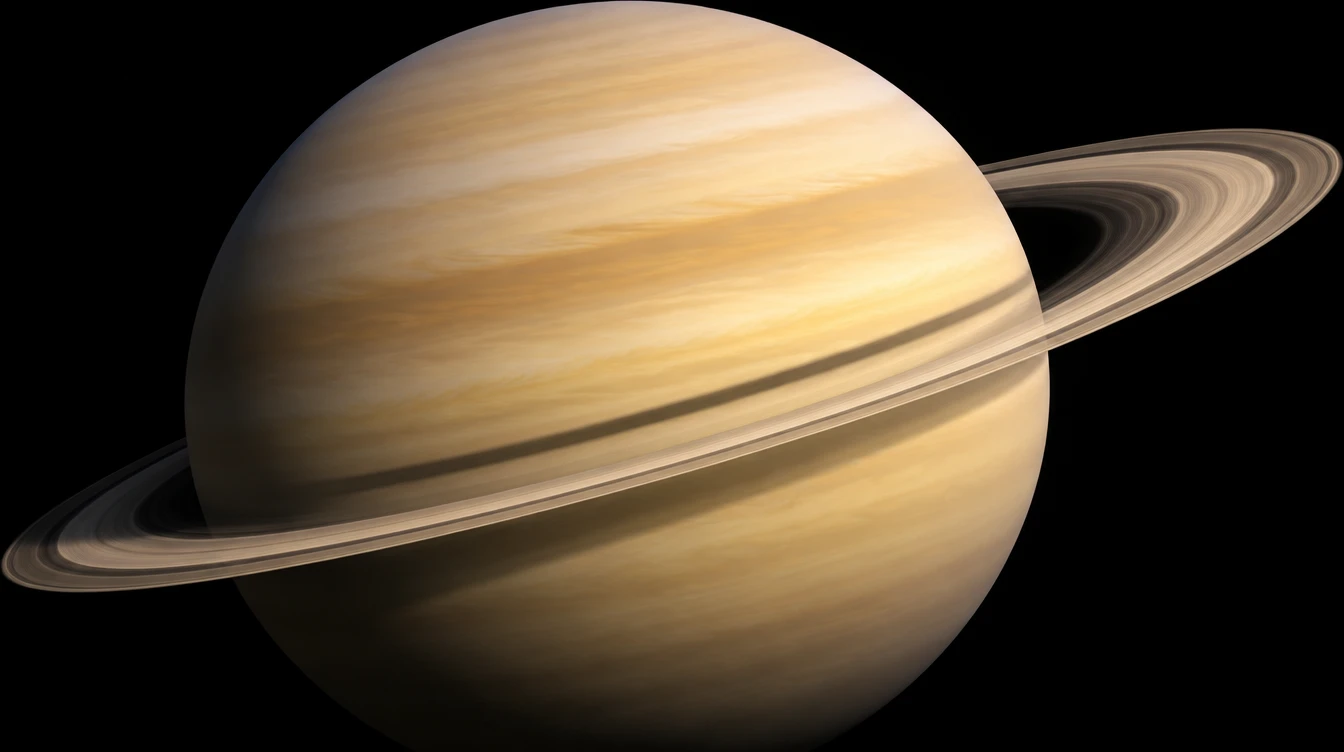
Saturn spins fast. A day there lasts only about 10.7 hours (NASA). For a huge, mostly fluid planet, that spin flings material outward at the equator. NASA’s fact sheet gives Saturn a flattening of 0.098, about 29 times Earth’s (NASA NSSDC). In photos, you can see it: Saturn looks slightly wider than it is tall.
Why “1 bar”?
Saturn has no solid ground to measure from. We explain why in What Is Saturn Made Of?. So scientists measure its size at the level where the atmospheric pressure is 1 bar, close to the air pressure at sea level on Earth. That gives every gas giant a fair, consistent “edge.”

How Many Earths Fit Inside Saturn?
About 764 by volume
NASA’s fact sheet gives Saturn’s volume as about 82,713 × 10¹⁰ km³, which is 763.59 times Earth’s (NASA NSSDC). So if you could melt Earths down and pour them in, you’d need about 764 to fill Saturn.
Fewer if they stay round
Real, solid Earths wouldn’t pack perfectly. Round balls always leave gaps between them, so fewer whole Earths would actually fit. The 764 figure is a volume comparison, not a packing count.
The nickel and the volleyball
NASA’s everyday version: “If Earth were the size of a nickel, Saturn would be about as big as a volleyball” (NASA).
How Heavy Is Saturn?
About 95 Earths
Saturn’s mass is about 568 × 10²⁴ kg, or 95.16 Earth masses (NASA NSSDC). That sounds like a lot until you compare it with the volume. Saturn has 764 times Earth’s space but only 95 times its mass.
Lighter than water, on average
That mismatch gives Saturn a very low average density: 687 kg/m³, compared with Earth’s 5,513 and water’s 1,000 (NASA NSSDC). NASA says “Saturn is the only planet in our solar system with an average density that is less than water,” and that it “could float in a bathtub if such a colossal thing existed” (NASA).
The catch
The bathtub is a thought experiment, not a real prediction. Saturn isn’t uniform: it’s mostly light hydrogen and helium outside, with denser material deep inside. The “float” idea only works for its average density, and no bathtub could exist at that scale. Still, it’s a great way to picture how puffy Saturn is.
How Strong Is Saturn’s Gravity?
About 14 percent stronger than Earth’s
Here’s a surprise. Even though Saturn is 95 times as massive as Earth, NASA’s fact sheet gives its “mean” gravity at the 1-bar level as only about 11.19 m/s², about 1.14 times Earth’s 9.82. That figure is a reference calculation: NASA defines it as the planet’s mass-based pull at its average radius, “not including the effects of rotation” (NASA NSSDC notes). It isn’t what a scale would actually read anywhere on Saturn.
Lighter at the equator, heavier at the poles
What you’d actually feel depends on where you are, because Saturn spins so fast. NASA’s fact sheet lists the effective pull at the equator, including the effect of rotation, as 8.96 m/s², about 0.92 times Earth’s, and at the poles as 12.14 m/s², about 1.24 times Earth’s (NASA NSSDC). So at Saturn’s equator you’d feel slightly lighter than on Earth, and near the poles noticeably heavier.
Why not 95 times?
Gravity depends on mass and on how far you are from the center. Saturn’s 1-bar level is about nine times farther from its center than Earth’s surface is from ours. All that extra distance cancels out most of the extra mass. If you could float at Saturn’s 1-bar level with a bathroom scale, one that reads 70 kg on Earth would read about 64 kg at the equator and about 87 kg near the poles (DCI calculation from NASA’s equator and pole values).
Hard to leave
Escaping Saturn is another story. Its escape velocity is 35.5 km/s, about 3.2 times Earth’s 11.19 km/s (NASA NSSDC). Leaving Saturn would take a much more powerful rocket than leaving Earth.
How Does Saturn Compare to Jupiter and the Sun?
Saturn vs. Jupiter
Jupiter is the only planet bigger than Saturn. Using NASA’s fact sheets, Saturn’s equatorial radius is about 84 percent of Jupiter’s, its volume is about 58 percent, and its mass is only about 30 percent (DCI calculations from NASA NSSDC, Jupiter and Saturn). So Saturn is nearly as wide as Jupiter but far lighter. Jupiter’s average density is about 1,326 kg/m³, nearly twice Saturn’s. We rank all eight planets in What Is the Biggest Planet?.
Saturn vs. the Sun
The Sun’s volumetric mean radius is about 695,700 km (NASA NSSDC). That’s about 12 times Saturn’s average radius, so roughly 1,700 Saturns would fit inside the Sun by volume (DCI calculation). Even the second-largest planet is small next to our star.
Saturn vs. its own moons
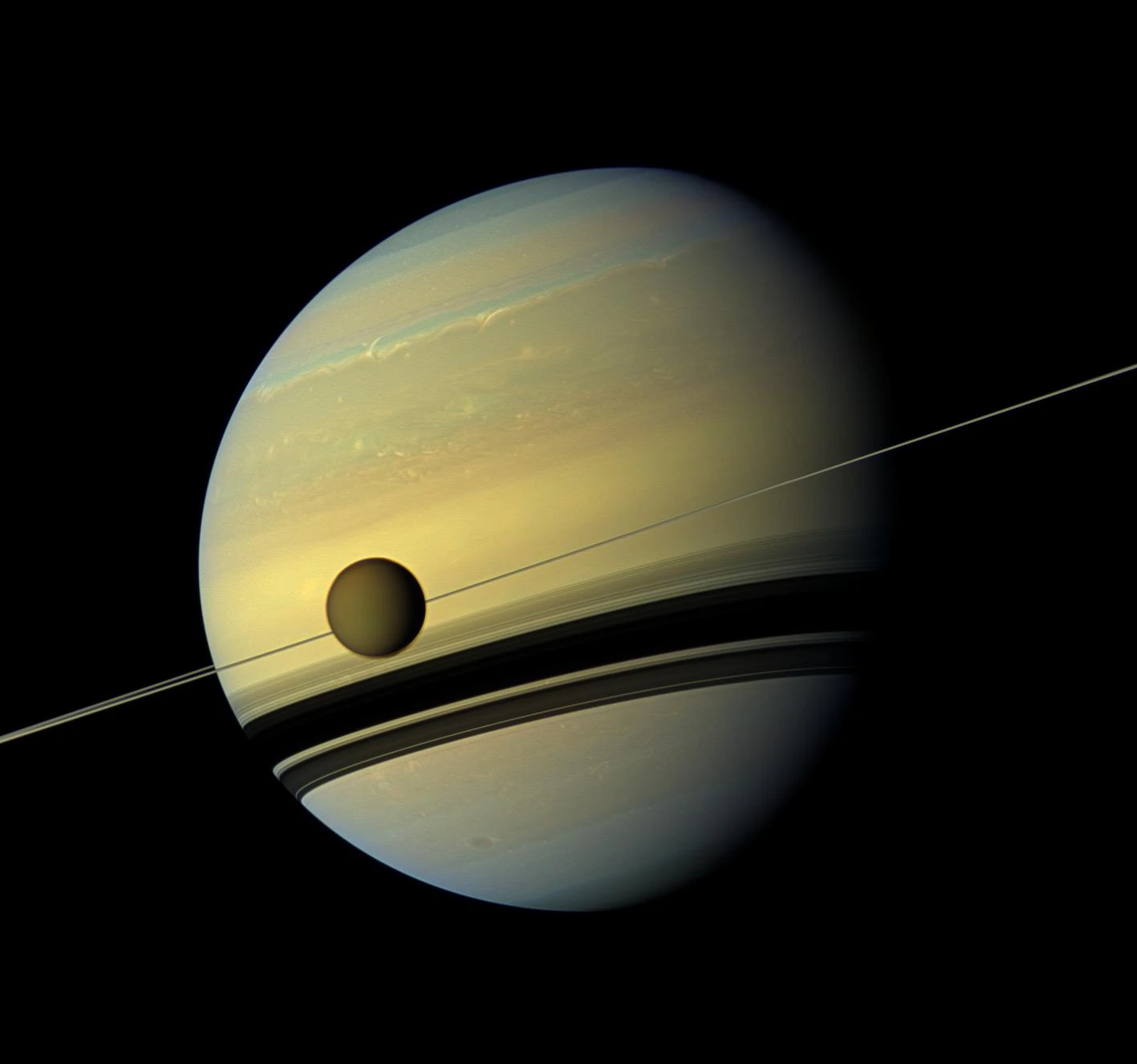
Saturn’s moons range from tiny moonlets to Titan, “Saturn’s largest moon” and “the only moon in our solar system known to have a substantial atmosphere” (NASA). Next to Saturn, even Titan looks small, as the section image above shows. We cover the whole family in How Many Moons Does Saturn Have?.

How Big Are Saturn’s Rings?
Main rings: most of the way to the Moon
Saturn’s bright A ring ends about 136,780 km from the planet’s center (NASA NSSDC). Edge to edge, that makes the main rings about 273,000 km across. That’s about 70 percent of the average distance from Earth to the Moon, about 384,400 km (DCI calculation).
The wider system
NASA says “Saturn’s ring system extends up to 175,000 miles (282,000 kilometers) from the planet” (NASA). The faint E ring reaches about 480,000 km from Saturn’s center (NASA NSSDC). And the giant, faint Phoebe ring starts about 6 million km out (NASA, 2009).
But paper-thin
For all that width, NASA says “the vertical height is typically about 30 feet (10 meters) in the main rings” (NASA). Imagine a sheet hundreds of thousands of kilometers across and about as thick as a three-story building. We name every ring in How Many Rings Does Saturn Have?, and explain what they’re made of and whether they’re vanishing in Are Saturn’s Rings Disappearing?.

Myth vs. Fact: Saturn’s Size
| Myth | Fact | Status |
|---|---|---|
| “Saturn is the biggest planet.” | It’s second, after Jupiter. | Measured |
| “Saturn is perfectly round.” | It’s about 10% wider at the equator than pole to pole. | Measured |
| “Saturn’s gravity is 95 times Earth’s.” | At the 1-bar level it’s about 0.92 times at the equator and 1.24 times at the poles. | Measured |
| “Saturn would really float in water.” | Only its average density is lower than water. | Measured |
| “Exactly 764 Earths would fit inside.” | That’s a volume ratio; round Earths would leave gaps. | DCI calculation |
| “Saturn’s rings are thick.” | The main rings are typically about 10 m thick. | Measured |
How Can You See Saturn’s Size for Yourself?
Through a telescope
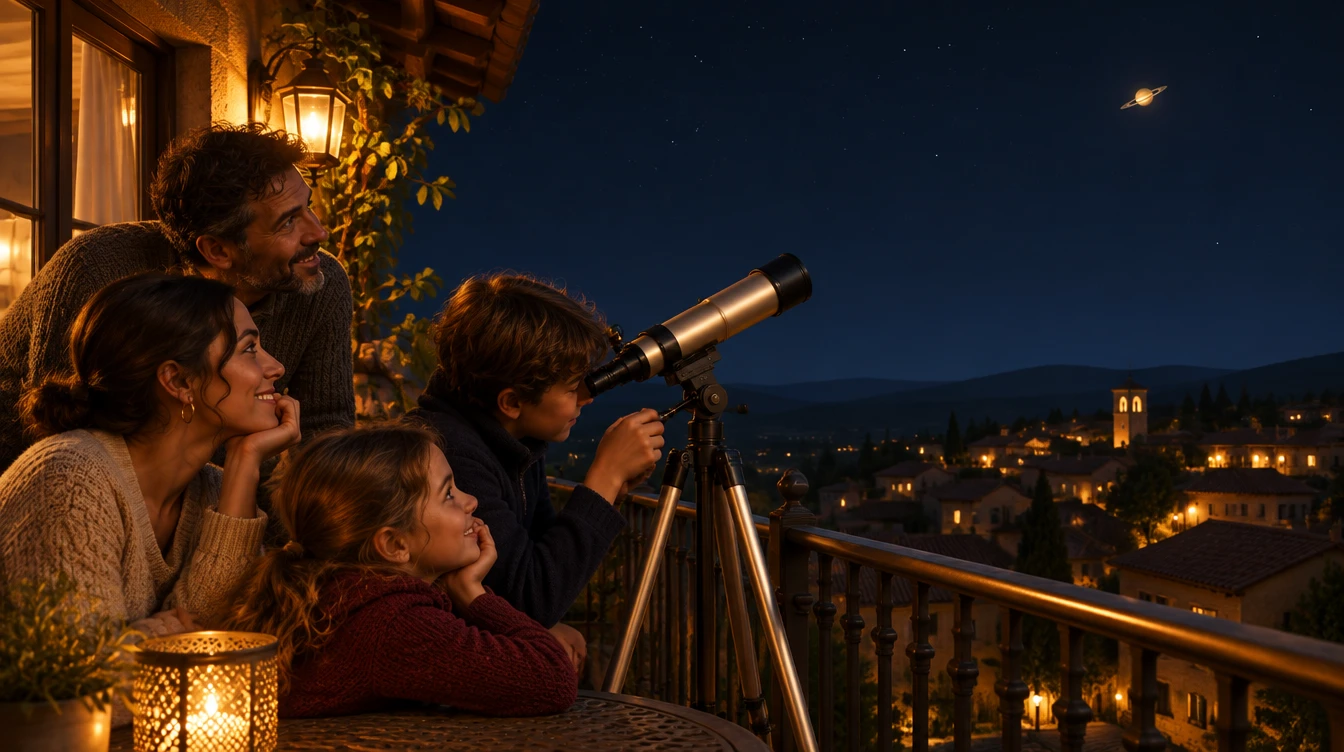
Even a small telescope shows Saturn as a disc with rings, not a point. At opposition, Saturn appears about 18.8 arcseconds across on average (NASA NSSDC). That’s tiny, about 1/100 the width of the full Moon, but enough to show the rings.
Spot the squash
On a steady night with good magnification, look closely. Saturn’s globe looks a little wider than it is tall. You’re seeing the flattening caused by its fast spin.
When to look
NASA said Saturn reached opposition on October 4, 2026, when it “rises around sunset and stays visible for much of the night” (NASA). It stays well placed in the evening sky for months afterward.
Saturn’s Size by the Numbers
| Measure | Value | Source |
|---|---|---|
| Equatorial diameter | about 120,500 km (74,897 mi) | NASA |
| Equatorial / polar radius | 60,268 / 54,364 km (1 bar) | NASA NSSDC |
| Volume | 763.59 Earths | NASA NSSDC |
| Mass | 95.16 Earths (568.32 × 10²⁴ kg) | NASA NSSDC |
| Mean density | 687 kg/m³ (water: 1,000) | NASA NSSDC |
| Effective gravity at 1 bar | 8.96 m/s² at the equator (0.92 × Earth), 12.14 at the poles (1.24 ×) | NASA NSSDC |
| Escape velocity | 35.5 km/s | NASA NSSDC |
| Flattening | 0.098 (Earth: 0.003) | NASA NSSDC |
| Main rings across | about 273,000 km (DCI calculation) | NASA NSSDC |
Values are as of November 2026.
Saturn Size FAQ
How big is Saturn compared to Earth?
Saturn is about nine times wider than Earth, about 764 times larger by volume and about 95 times more massive. NASA’s comparison: if Earth were a nickel, Saturn would be about the size of a volleyball.
How many Earths can fit inside Saturn?
About 764 by volume, according to NASA’s fact sheet. That’s a volume comparison, though. If you tried to pack in solid, round Earths, the gaps between them would mean fewer whole Earths actually fit.
Is Saturn bigger than Jupiter?
No. Jupiter is the largest planet, and Saturn is second. Saturn is about 84 percent as wide as Jupiter but has only about 30 percent of its mass, which is why Saturn’s average density is so much lower.
Could Saturn really float in water?
Only in theory. Saturn’s average density, 687 kg/m³, is lower than water’s, so NASA says it could float in a bathtub if one that big existed. But Saturn isn’t uniform inside, and no such bathtub could exist, so it’s a way to picture its low density.
Would you weigh more on Saturn?
It depends where. Including Saturn’s fast spin, a scale reading 70 kg on Earth would read about 64 kg at the 1-bar level near the equator and about 87 kg near the poles. So you’d feel lighter at the equator and heavier at the poles. There’s no surface to stand on, though.
Why is Saturn flattened?
It spins very fast, once every 10.7 hours or so. For a huge, mostly fluid planet, that spin pushes material outward at the equator. Saturn is about 120,500 km wide but only about 108,700 km from pole to pole.
How big are Saturn’s rings?
The main rings span about 273,000 km from edge to edge, roughly 70 percent of the distance from Earth to the Moon, yet they’re typically only about 10 meters thick. Fainter rings reach much farther, out to the giant Phoebe ring millions of kilometers away.
How many Saturns would fit in the Sun?
About 1,700, by volume. The Sun’s average radius is about 695,700 km, roughly 12 times Saturn’s, so even the second-largest planet is small next to our star.
Your next step: next time you see Saturn through a telescope, look for its slightly squashed shape. That flattening is the signature of a planet nine times Earth’s width spinning a day in under 11 hours.
Sources and Further Reading
- NASA Science, Saturn: Facts; Titan.
- NASA Space Science Data Coordinated Archive, Saturn Fact Sheet; Jupiter Fact Sheet; Sun Fact Sheet; Saturnian Rings Fact Sheet; Notes on the Fact Sheets.
- NASA, PIA17218: A Farewell to Saturn (2017); PIA14922: Colorful Colossuses and Changing Hues (2012).
- NASA Science (October 6, 2009), NASA Space Telescope Discovers Largest Ring Around Saturn.
- NASA Science (October 2026), What’s Up: October 2026 Skywatching Tips from NASA.
Explore Next
- The full Saturn guide: Saturn: Facts, Rings, Moons and Your Questions
- Seven, eight or thousands: How Many Rings Does Saturn Have?
- Why Saturn looks pale gold, and why its poles turn blue: What Color Is Saturn?
- Distance, travel time and the 29-year Saturn year: How Far Is Saturn?
- All eight planets ranked by size: What Is the Biggest Planet?
- What fills all that volume: What Is Saturn Made Of?
- The rings, and whether they’re disappearing: Are Saturn’s Rings Disappearing?
- Saturn’s moons, from Titan down: How Many Moons Does Saturn Have?
- Every planet in one place: Solar System Explorer
- How cold Saturn really is: How Cold Is Saturn?
- How a claim earns its label: How We Know
How This Explainer Was Checked
Every number in this article was checked in November 2026 against the source linked beside it: NASA’s Saturn facts and Titan pages, and NASA’s fact sheets for Saturn, Jupiter, the Sun and Saturn’s rings. Ratios between Saturn and Jupiter, the number of Saturns that fit in the Sun, the pole-to-pole difference, the weight example and the ring span compared with the Earth–Moon distance are DCI calculations from NASA’s numbers, labelled as such. The Earth–Moon distance used is about 384,400 km. Saturn’s dimensions are measured at the 1-bar pressure level, because it has no solid surface. Images are labelled: real spacecraft images as OBSERVATION, illustrations as ILLUSTRATION, and our charts as DATA GRAPHIC. Nothing AI-generated is presented as a real image.
Final Thought: Huge, Light and Spinning Fast
Saturn breaks the rules you’d expect from something so big. It’s nine Earths wide but less dense than water. It’s 95 times Earth’s mass, yet at its equator you’d actually feel a little lighter than on Earth. Its rings would reach most of the way to our Moon, yet they’re about as thick as a building is tall. Saturn isn’t just big. It’s big in all the strangest ways.
About the Author
Author: King | Founder of Dark Cosmic Insights
King is the founder of Dark Cosmic Insights, a science storytelling platform exploring the strangest true stories hiding in space, science and AI. He digs into NASA, ESA and peer-reviewed research, separates what has been measured from what is still a mystery, and turns it into articles, data graphics and Shorts.
Follow the anomaly. Trace the source.