Ask how many rings Saturn has and you can get three very different answers. Seven. Eight. Thousands. The surprising part is that all three are correct. It depends on whether you count the big named rings, include a giant ring that’s invisible to the eye, or zoom in the way the Voyager and Cassini spacecraft did and see the bright rings break apart into thousands of thinner bands.
Saturn’s rings look like a single solid disc in a small telescope. Up close, they’re nothing like that. They’re “billions (if not trillions) of chunks of water ice” orbiting the planet, sorted into rings, gaps, waves and wisps by Saturn’s gravity and the gravity of its moons (NASA, Cassini rings).
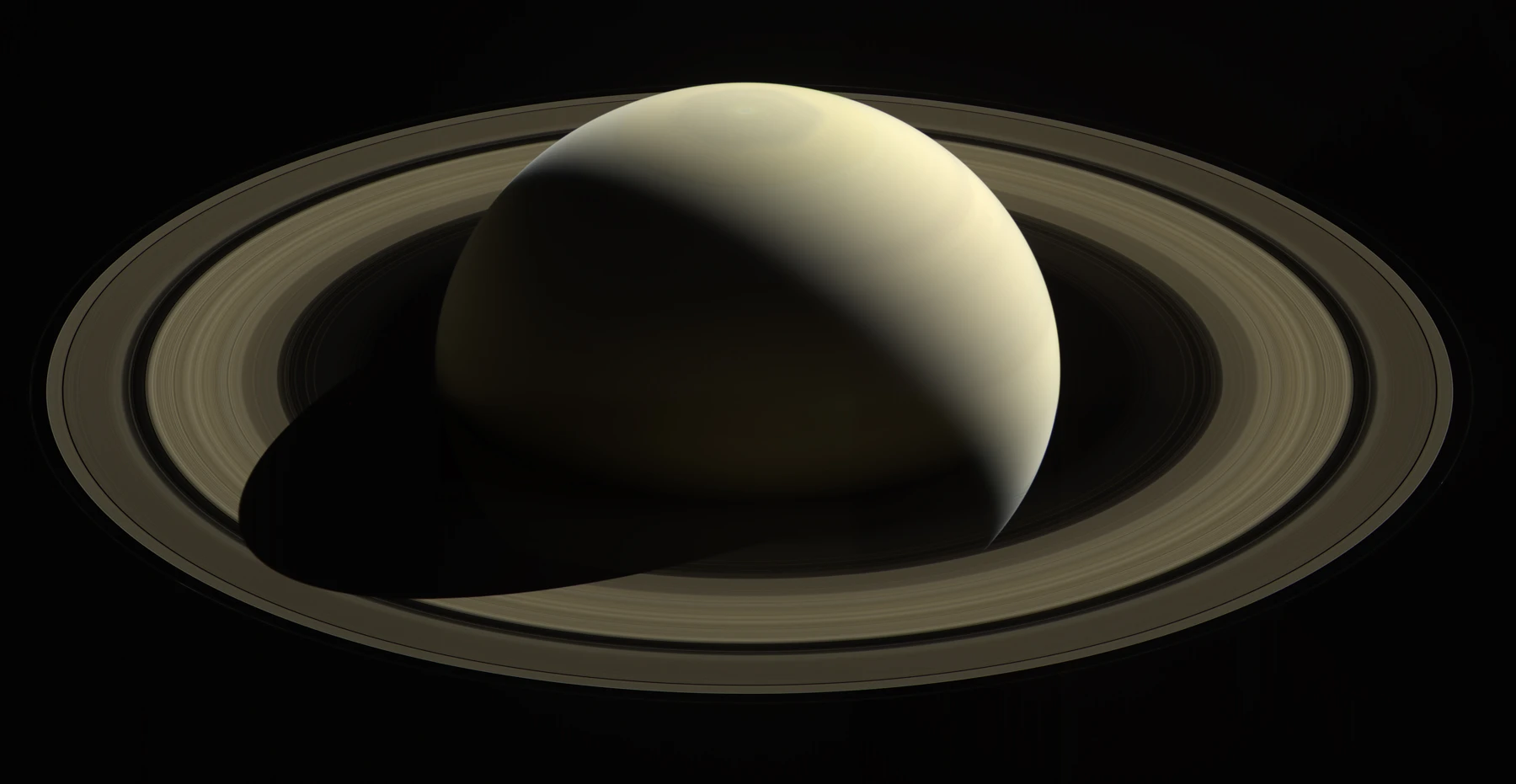
Observed, measured, modelled, open. The main rings, gaps and the giant Phoebe ring are observed. Their positions and thickness are measured. How moons carve the gaps is modelled with physics that matches what Cassini saw. The total number of rings is open, because it depends on where you draw the line between a ring and a ringlet.
Quick Answer: How Many Rings Does Saturn Have?
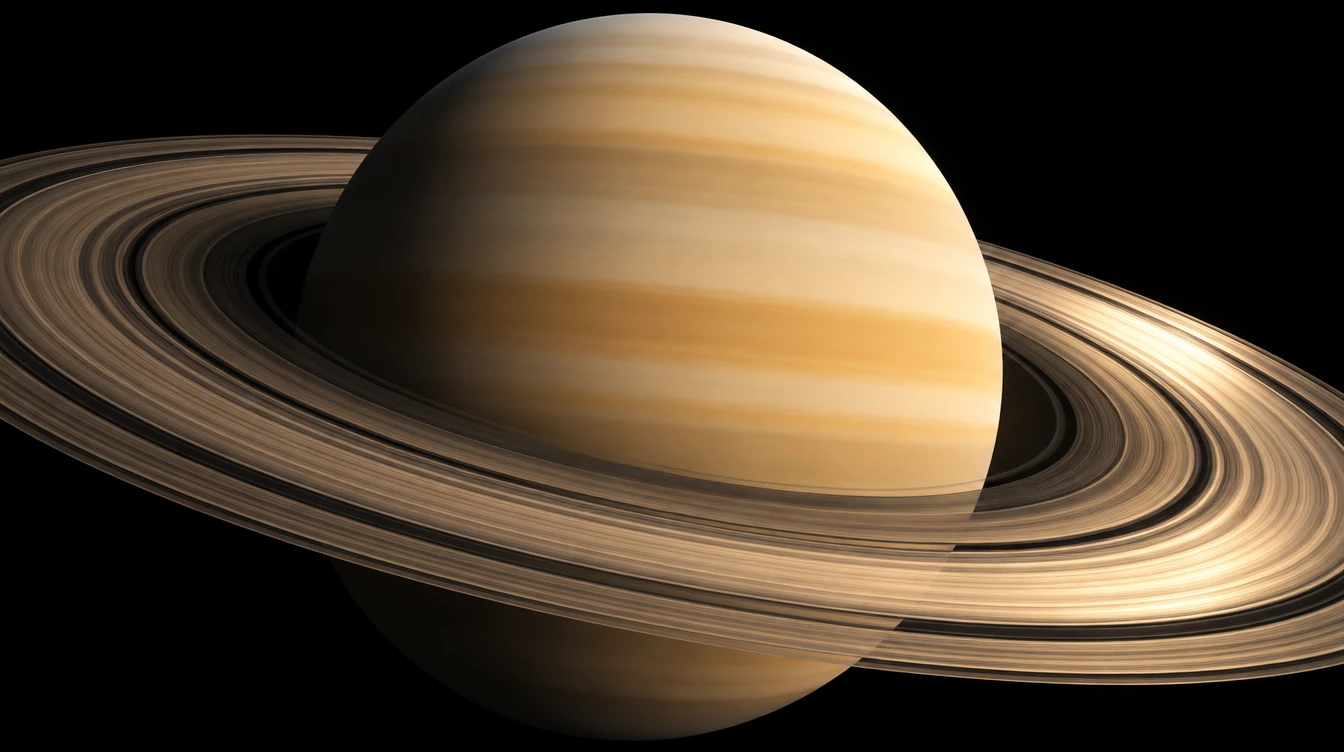
Saturn has seven main rings, named with letters in the order they were discovered: from the planet outward, the D, C, B, A, F, G and E rings (NASA). Count the enormous, faint Phoebe ring found in 2009 and you get eight. But the Voyager flybys showed that “these seven ring groups are made up of thousands of smaller rings,” and “the exact number is not known” (Caltech IPAC, Cool Cosmos). On top of that, Cassini found fainter rings and arcs tied to small moons. So the honest answer is: seven main rings, one giant outer ring, and thousands of ringlets.
What this article can and cannot establish. It can show you the named rings, the major gaps and the moons that shape them, using NASA’s ring measurements. It cannot give one official total, because no single count exists: ringlets blur into each other, and different sources group them differently.
Table of Contents
The DCI Evidence Map: Saturn’s Rings, Counted
| Question | What we know | Status | Key source |
|---|---|---|---|
| How many main rings? | Seven lettered rings: D, C, B, A, F, G, E | Observed | NASA |
| Are there more? | Thousands of smaller rings inside the main groups | Observed | Caltech IPAC |
| What’s the biggest ring? | The Phoebe ring, starting about 6 million km out | Observed | NASA, 2009 |
| How thick are the main rings? | Typically about 10 m (30 ft) | Measured | NASA |
| What are they made of? | Chunks of water ice, with some rock and dust | Observed | NASA |
| What keeps gaps open? | Small moons such as Pan and Daphnis | Observed | NASA, Pan |
| What’s the exact total? | Not known; depends on the counting rule | Open | Caltech IPAC |
Status key: Observed = seen directly. Measured = a number with a stated uncertainty or a direct measurement. Modelled = inferred from measurements through a physical model, dependent on assumptions. Open = unresolved; the evidence is incomplete or points different ways. Not supported = the evidence goes against the claim, or there is none for it.
Cite this framework: “DCI Evidence Map: Saturn’s Rings, Counted,” Dark Cosmic Insights, November 2026, darkcosmicinsights.com/how-many-rings-does-saturn-have/.
Why Are Saturn’s Rings Named With Letters?
Named in order of discovery
Saturn’s rings are “named alphabetically in the order they were discovered” (NASA). That’s why the letters look scrambled when you list them from the planet outward. The bright rings everyone sees in a telescope came first: A, B and C. NASA notes that “rings D, E, F, and G are fainter and more recently discovered.”
The order from Saturn outward
Starting at the planet and moving out, NASA lists “the D ring, C ring, B ring, Cassini Division, A ring,” then the F, G and E rings beyond (NASA). Here’s where each one sits, using NASA’s Saturnian Rings Fact Sheet, measured as distance from Saturn’s center (NASA NSSDC):
- D ring: about 66,900 to 74,510 km. Faint and closest to the planet.
- C ring: about 74,658 to 91,975 km. Dimmer than the B ring.
- B ring: about 91,975 to 117,507 km. The brightest and densest ring.
- Cassini Division: the dark gap between the B and A rings.
- A ring: about 122,340 to 136,780 km. The outer bright ring.
- F ring: a narrow ring at about 139,826 km.
- G ring: about 166,000 to 173,000 km.
- E ring: about 180,000 to 480,000 km. Wide and faint.
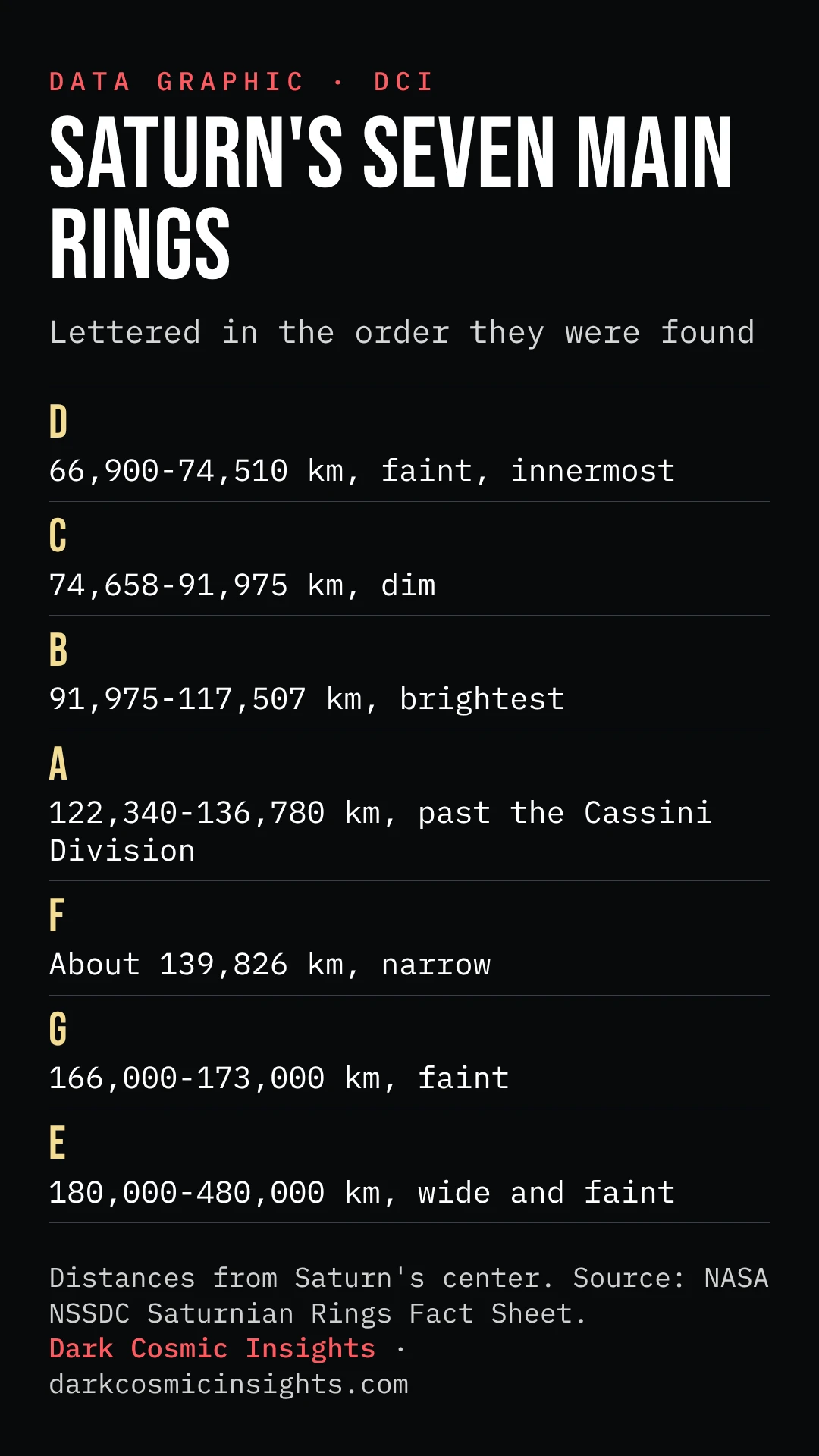
The D, C, B and A rings plus the Cassini Division are what most people picture as “Saturn’s rings.” The rest are much fainter and mostly show up in spacecraft images.
So Why Do Some People Say Thousands?
Voyager zoomed in
When Voyager 1 and Voyager 2 flew past Saturn in 1980 and 1981, their close-up images changed the count completely. Caltech’s IPAC explains that the views “showed that these seven ring groups are made up of thousands of smaller rings” (Caltech IPAC). A ring that looks smooth from Earth turns out to be a stack of narrower bands, like grooves in a record.
Where do you draw the line?
This is why the exact number is open. Is a narrow band inside the B ring its own ring, or just structure within the B ring? Is a thin strip inside a gap a ring or a “ringlet”? NASA’s ring fact sheet even lists features such as the Titan ringlet at about 77,871 km and the Maxwell gap and ringlet at about 87,491 km inside the C ring (NASA NSSDC), and points to the Planetary Data System for “a full listing of small ringlets and faint rings.” Different counting rules give different totals, so nobody quotes a single official number.
So the count you hear depends on the question being answered:
- “How many main rings?” Seven.
- “How many rings, including the giant outer one?” Eight.
- “How many rings and ringlets in total?” Thousands, exact number unknown.
What Are the Gaps in Saturn’s Rings?
The rings aren’t one continuous sheet. They have gaps, and several of those gaps have small moons living in them.
The Cassini Division
The biggest gap you can see from Earth is the Cassini Division between the B and A rings. NASA’s Goddard Space Flight Center notes that “In 1675, Cassini discovered a narrow gap that splits Saturn’s ring system into two parts” (NASA GSFC). Using NASA’s fact sheet values for the outer edge of the B ring and the inner edge of the A ring, the division is about 4,800 km wide (DCI calculation from NASA NSSDC). Despite looking empty, it isn’t completely clear: the fact sheet gives it an optical depth of 0 to 0.1, meaning thin ring material still sits in parts of it.
The Encke Gap and Pan
Out in the A ring sits the Encke Gap, at about 133,410 km from Saturn’s center. A tiny moon called Pan, about 14 km in average radius, “is responsible for keeping the Encke Gap open” (NASA, Pan). Pan was found in 1990 by M. R. Showalter in Voyager 2 images taken nine years earlier.
The Keeler Gap and Daphnis
Near the outer edge of the A ring is the narrower Keeler Gap, at about 136,487 km. Scientists predicted a moon was there from “the ripples observed along the edge of the Keeler Gap,” and Cassini found Daphnis on May 1, 2005 (NASA, Daphnis). Daphnis is only a few kilometers across, but its gravity is “sculpting the edge of the Keeler Gap into waves.”
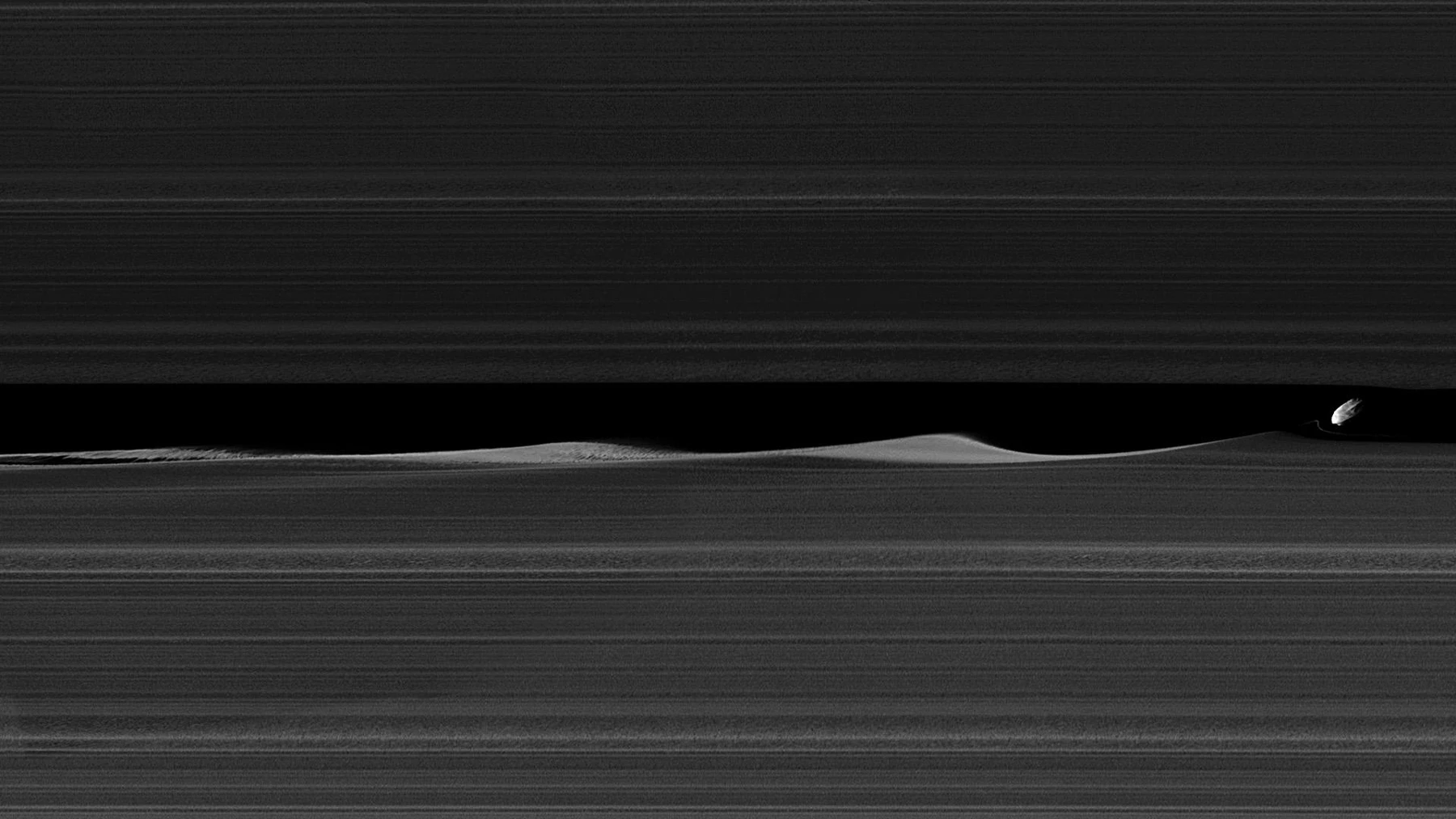
Shepherds at the F ring
The narrow F ring sits just outside the A ring. NASA says the moon Prometheus “acts as a shepherding moon, constraining the extent of the inner edge of Saturn’s F Ring” (NASA, Prometheus). A shepherd moon’s gravity nudges ring particles back into line, which helps keep a narrow ring narrow.
The Hidden Rings Cassini Found
Beyond the bright rings, Cassini found faint rings that are made by, and named after, small moons.
The Janus/Epimetheus ring
A faint ring sits between the G ring and the bright main rings. NASA says it “is coincident with the orbits of Saturn’s moons Janus and Epimetheus” (NASA, PIA08328).
The Pallene ring
Cassini also imaged “a faint narrow band, about 2,500 kilometers (about 1,550 miles) across, between the E ring and the G ring,” along the orbit of the tiny moon Pallene, which is only about 4 km across (NASA, PIA08328).
Ring arcs that never close
Some material never forms a full circle. In 2008, Cassini images confirmed a faint ring arc near the moon Methone and found one near Anthe. NASA says these arcs are likely “material knocked off these small moons by micrometeoroid impacts,” held in a narrow stretch of orbit by a gravitational resonance with the moon Mimas, so it can’t spread into a full ring (NASA, 2008).
Where the E ring comes from
The wide E ring has its own supplier. “Cassini found that water jets from the moon Enceladus provide much of the material in Saturn’s E-ring” (NASA, Cassini rings). That makes the E ring a ring that is still being fed today.
The Biggest Ring of All: The Phoebe Ring
Found in infrared
In October 2009, NASA announced that its Spitzer Space Telescope had found a ring far larger than any of the others. The team, led by Anne Verbiscer of the University of Virginia with Douglas Hamilton and Michael Skrutskie, published the discovery in Nature (NASA, 2009).
How big is it?
NASA’s 2009 announcement says the ring’s material “starts about six million kilometers (3.7 million miles) away from the planet,” and its “vertical height is about 20 times the diameter of the planet.” It would take “about one billion Earths stacked together to fill the ring.” The ring is made of “a thin array of ice and dust particles,” linked to the moon Phoebe, which orbits inside it.
In 2015, follow-up data from NASA’s WISE spacecraft suggested the ring is even bigger, stretching from about 100 to 270 times Saturn’s radius, roughly 6 million to 16.2 million km, with the researchers calling those estimates conservative (Space.com, 2015).
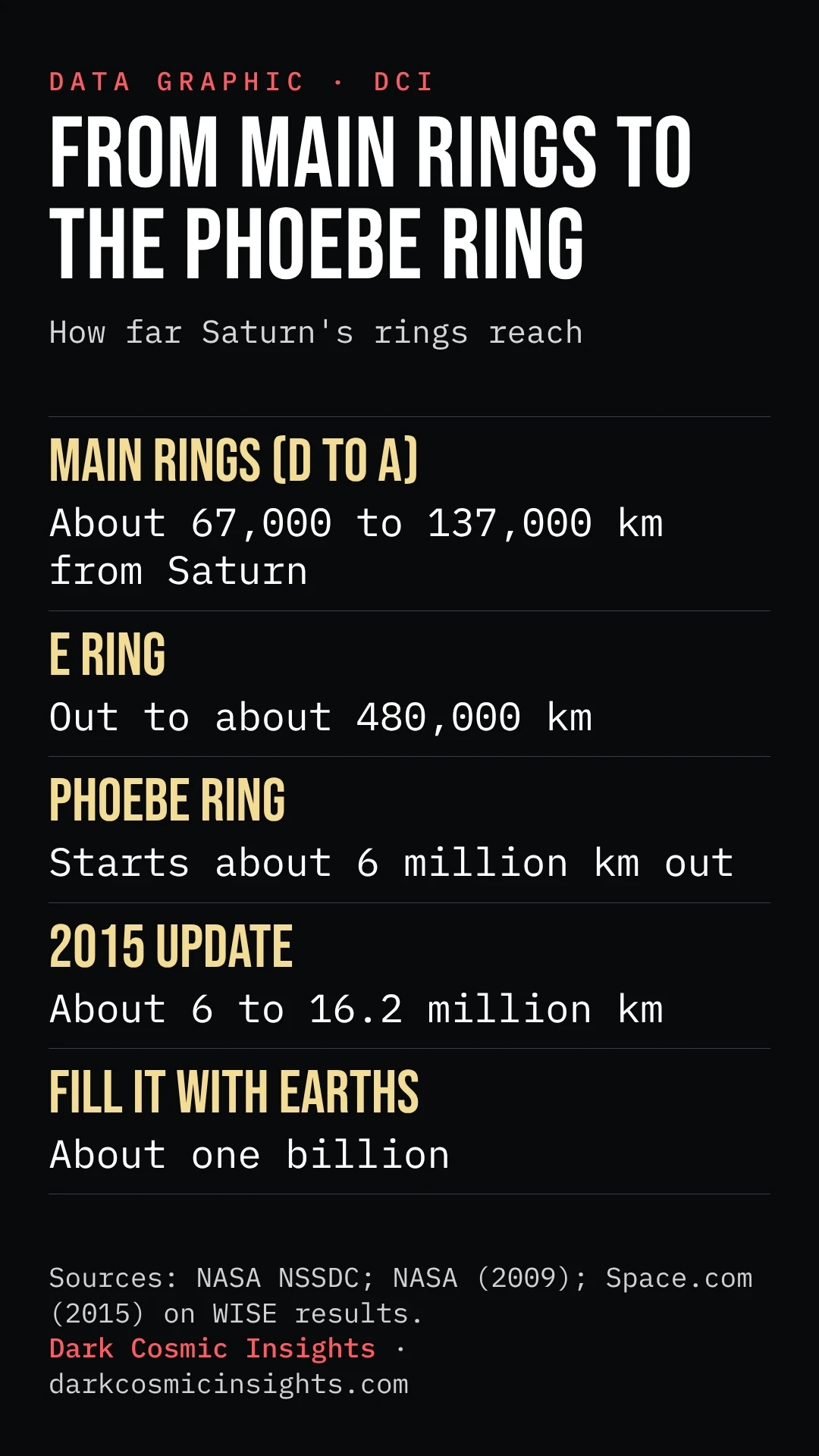
Why you’ve never seen it
The Phoebe ring is extremely faint and spread thin, which is why it went unnoticed until an infrared telescope looked for it. NASA’s announcement also connects it to a long-standing puzzle: the dark face of the moon Iapetus, a region called Cassini Regio (NASA, 2009).
What Are Saturn’s Rings Made Of?
Mostly water ice
NASA describes the rings as “billions of small chunks of ice and rock coated with other materials such as dust” (NASA). Cassini’s ring science page puts it even more simply: “billions (if not trillions) of chunks of water ice” (NASA, Cassini rings).
Sizes from grains to chunks
The particles range from tiny grains to much larger chunks. That variety, and how clean the ice is, is part of a bigger debate about how old the rings are, which we cover in Are Saturn’s Rings Disappearing?.
Incredibly thin
For all their size, the main rings are thin. NASA says “the vertical height is typically about 30 feet (10 meters) in the main rings” (NASA). NASA’s fact sheet lists thicknesses of roughly 5 to 30 m for the C, B and A rings (NASA NSSDC).
Why Does Saturn Have Rings?
The short answer
Saturn has rings because there’s a supply of icy material in orbit close to the planet, and Saturn’s moons and gravity keep it organized into rings rather than letting it clump into a moon. Where that material originally came from is still debated.
The leading ideas
NASA notes that if the rings formed recently, the leading candidates are a comet that came too close and was torn apart, or the breakup of earlier icy moons (NASA, 2019). Other scientists argue the rings could be much older. Whether the rings are young or ancient is still open, and we lay out both sides in Are Saturn’s Rings Disappearing?.
Not the only ringed planet
Jupiter, Uranus and Neptune have rings too, but they’re far fainter and darker. Saturn’s are the only ones bright enough to see easily in a small backyard telescope.
A Short History of Counting Saturn’s Rings
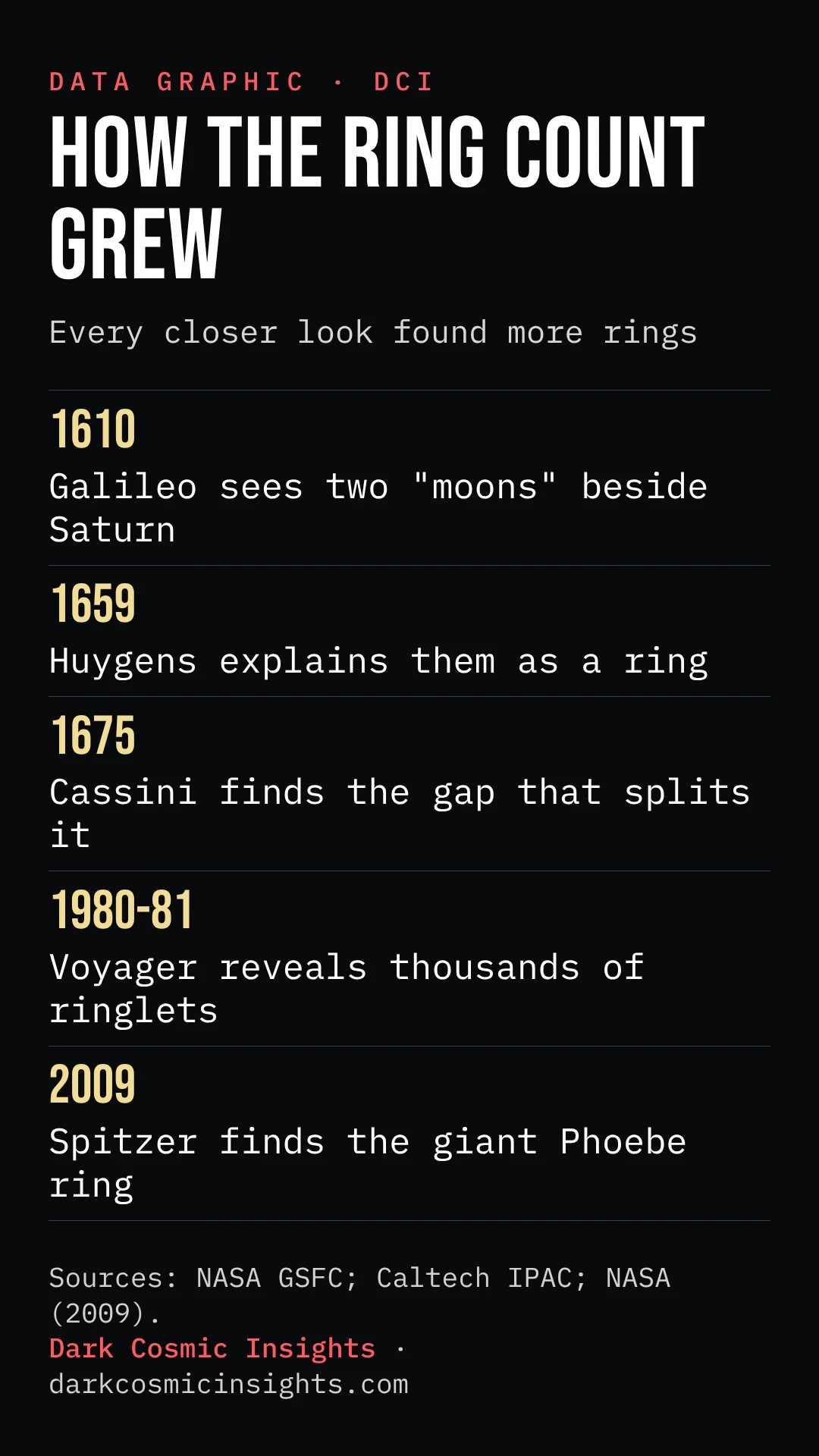
1610: Galileo’s puzzling view
NASA Goddard notes that “Galileo Galilei was the first to observe Saturn with a telescope in 1610.” His telescope was too crude to show the rings clearly, and he thought he was seeing “two large moons on either side of Saturn” (NASA GSFC).
1659: Huygens works it out
With better optics, Christiaan Huygens “correctly deduced that the ‘arms’ were actually a ring system,” NASA Goddard says. Huygens also discovered Titan.
1675: One ring becomes two
Giovanni Domenico Cassini found the dark gap now named after him, splitting the bright rings into what we call the A and B rings (NASA GSFC).
1800s: Not a solid sheet
Later in the 19th century, James Keeler showed that “the ring system is not a uniform sheet but actually comprised of small particles” (NASA GSFC).
1979 to 2017: Spacecraft
Pioneer 11 and the two Voyagers flew past, and Voyager revealed thousands of ringlets. Then Cassini orbited Saturn from 2004 until it plunged into the planet on September 15, 2017 (NASA), finding moon-made rings, ring arcs and the waves Daphnis carves in the Keeler Gap.
Myth vs. Fact: Saturn’s Rings
| Myth | Fact | Status |
|---|---|---|
| “Saturn has one big ring.” | It has seven main rings, plus the giant Phoebe ring. | Observed |
| “Saturn has exactly seven rings.” | Seven main rings contain thousands of smaller rings. | Observed |
| “The rings are solid.” | They’re billions of separate chunks of ice and rock. | Observed |
| “The gaps are empty.” | Gaps can hold thin material and even small moons. | Observed |
| “The rings are thick.” | The main rings are typically about 10 m thick. | Measured |
| “Scientists know the exact number.” | The total depends on how ringlets are counted. | Open |
How Can You See Saturn’s Rings Yourself?
With a small telescope
Saturn’s rings are visible in even a small telescope. On a steady night, with enough magnification, you may be able to spot the dark Cassini Division between the A and B rings.
Pick your timing
Saturn is easiest to see around opposition, when Earth passes between the Sun and Saturn. In 2026, NASA said Saturn reached opposition on October 4, “so it rises around sunset and stays visible for much of the night” (NASA). Saturn stays in the evening sky for months afterward.
Expect the rings to look thin for now
After turning edge-on to Earth in 2025, the rings are still opening up again, so they look narrower than in the photos you may know. They’ll widen year by year.
Explore Cassini’s images
Browse Cassini’s ring images in NASA’s Photojournal, including close-ups of Pan in the Encke Gap and Daphnis in the Keeler Gap.
Saturn’s Rings by the Numbers
| Measure | Value | Source |
|---|---|---|
| Main rings | 7 (D, C, B, A, F, G, E) | NASA |
| Including the Phoebe ring | 8 | NASA, 2009 |
| Smaller rings | thousands, exact number unknown | Caltech IPAC |
| Main ring thickness | about 10 m (30 ft) | NASA |
| A ring outer edge | about 136,780 km from Saturn’s center | NASA NSSDC |
| E ring outer edge | about 480,000 km | NASA NSSDC |
| Cassini Division width | about 4,800 km (DCI calculation) | NASA NSSDC |
| Phoebe ring | starts about 6 million km out | NASA, 2009 |
| First telescope view | 1610, Galileo | NASA GSFC |
Values are as of November 2026.
Saturn’s Rings FAQ
How many rings does Saturn have in total?
Nobody has an exact total. Saturn has seven main lettered rings and a giant faint ring called the Phoebe ring, and the main rings are made of thousands of smaller ringlets. Because ringlets blend together, the total depends on how you count them.
What are the names of Saturn’s rings?
The seven main rings are lettered in the order they were discovered. From Saturn outward they are the D, C, B, A, F, G and E rings, with the Cassini Division between B and A. The largest of all, the faint Phoebe ring, lies far beyond them.
Which of Saturn’s rings is the biggest?
The Phoebe ring, by far. NASA says its material starts about 6 million km from Saturn and that it would take about a billion Earths to fill it. Among the classic rings, the B ring is the brightest and the E ring is the widest.
Why does Saturn have rings?
Saturn has a supply of icy material orbiting close to it, organized into rings by the planet’s gravity and its moons. Where that material first came from, perhaps a broken-up comet or icy moons, is still debated, along with how old the rings are.
What are Saturn’s rings made of?
Mostly water ice, in chunks that range from tiny grains to much larger pieces, mixed with some rock and coated with dust. That icy makeup is why the rings are so bright compared with the dark rings of Jupiter, Uranus and Neptune.
What is the Cassini Division?
It’s the dark gap between Saturn’s A and B rings, discovered by Giovanni Domenico Cassini in 1675. It’s about 4,800 km wide based on NASA’s ring measurements, and it isn’t totally empty: thin ring material still orbits inside it.
Do moons live inside Saturn’s rings?
Yes. The tiny moon Pan orbits in the Encke Gap and keeps it open, and Daphnis orbits in the Keeler Gap, raising waves in the ring edges. Other small moons, such as Prometheus, shepherd the narrow F ring.
Can you see Saturn’s rings without a telescope?
Not with the naked eye. Saturn looks like a bright point of light. Even a small telescope shows the rings, and around opposition, when Saturn is up most of the night, is a good time to look.
Your next step: next clear night that Saturn is up, point even a small telescope at it and look for the dark gap between the bright rings. That’s the Cassini Division, first spotted in 1675.

Sources and Further Reading
- NASA Science, Saturn: Facts; Cassini: Saturn Rings.
- NASA Space Science Data Coordinated Archive, Saturnian Rings Fact Sheet.
- Caltech IPAC Cool Cosmos, How many rings does Saturn have?
- NASA Science (October 6, 2009), NASA Space Telescope Discovers Largest Ring Around Saturn; Verbiscer, A. J., Skrutskie, M. F., & Hamilton, D. P. (2009), Nature, 461, 1098–1100.
- Space.com (June 10, 2015), Biggest Ring Around Saturn Just Got Supersized, on Hamilton et al. 2015, Nature.
- NASA Science, Pan; Daphnis; Prometheus.
- NASA/JPL, PIA08328: Moon-Made Rings; NASA (September 5, 2008), Cassini Images Ring Arcs Among Saturn’s Moons.
- NASA Goddard, History of Saturn observations.
- NASA Science (January 17, 2019), NASA’s Cassini Data Show Saturn’s Rings Relatively New.
- NASA Science (October 2026), What’s Up: October 2026 Skywatching Tips from NASA.
Explore Next
- The moon that feeds the E ring: Enceladus’s Geysers
- The full Saturn guide: Saturn: Facts, Rings, Moons and Your Questions
- Why Saturn looks pale gold, and why its poles turn blue: What Color Is Saturn?
- Distance, travel time and the 29-year Saturn year: How Far Is Saturn?
- Size, mass and the bathtub question: How Big Is Saturn?
- Are the rings going away, and how old are they? Are Saturn’s Rings Disappearing?
- Inside the planet the rings circle: What Is Saturn Made Of?
- The moons that shepherd the rings, and the rest of the family: How Many Moons Does Saturn Have?
- The new ten-sided wave at the south pole: Saturn’s Decagon
- Every planet in one place: Solar System Explorer
- Jupiter’s faint, dusty rings: Does Jupiter Have Rings?
- How a claim earns its label: How We Know
How This Explainer Was Checked
Every number in this article was checked in November 2026 against the source linked beside it: NASA’s Saturn facts and Cassini ring pages, NASA’s Saturnian Rings Fact Sheet, Caltech IPAC, NASA’s moon pages for Pan, Daphnis and Prometheus, NASA’s 2009 Phoebe ring announcement and NASA Goddard’s ring history. The Cassini Division width is a DCI calculation from NASA’s ring-edge values and is labelled as one. The 2015 Phoebe ring update is attributed to Space.com’s report on the WISE results. The total number of rings is labelled Open, because it depends on a counting rule, not on missing data. Images are labelled: real spacecraft images as OBSERVATION, illustrations as ILLUSTRATION, and our charts as DATA GRAPHIC. Nothing AI-generated is presented as a real image.
Final Thought: Seven, Eight or Thousands
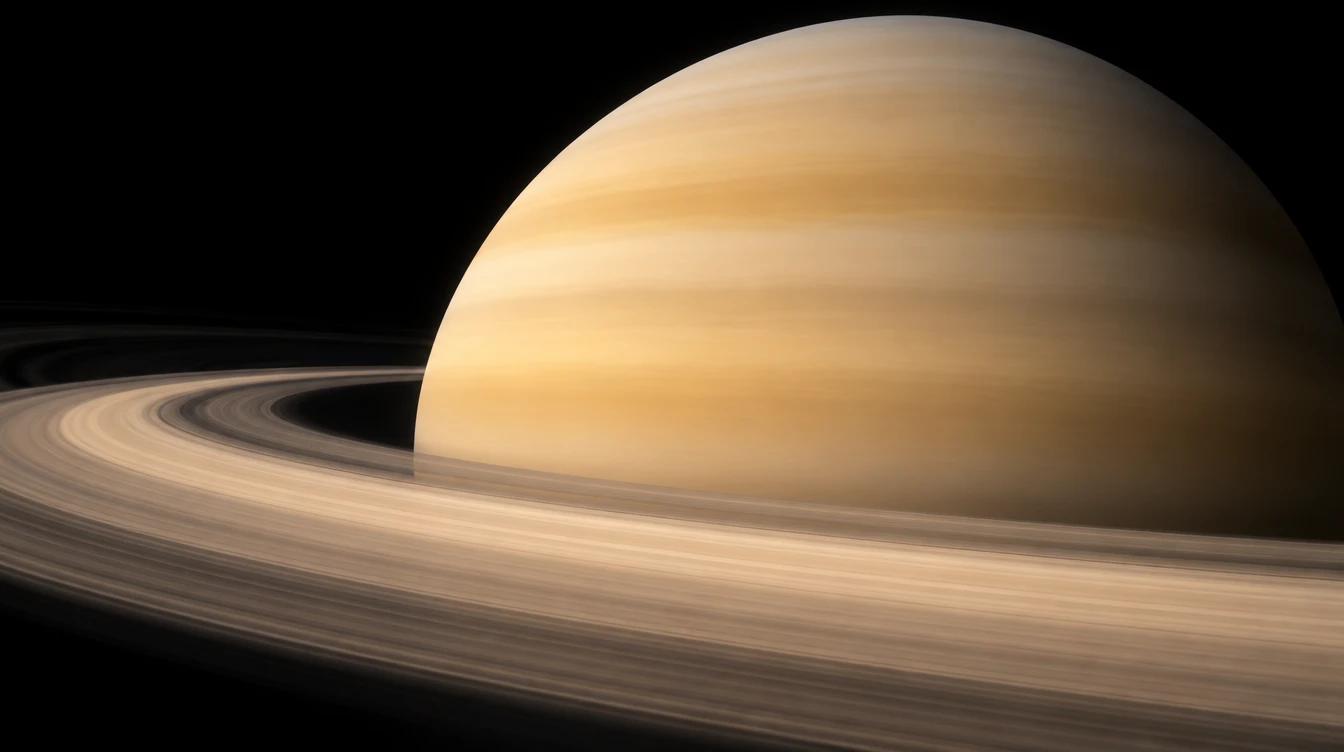
The number of Saturn’s rings isn’t a trick question, but it is a lesson in how science counts things. From Earth, Saturn wears a ring or two. Galileo saw two “moons.” Cassini split them in two. Voyager shattered them into thousands. Spitzer found one so big it would swallow a billion Earths. Every time we looked closer, the count went up, and it may not be done yet.
About the Author
Author: King | Founder of Dark Cosmic Insights
King is the founder of Dark Cosmic Insights, a science storytelling platform exploring the strangest true stories hiding in space, science and AI. He digs into NASA, ESA and peer-reviewed research, separates what has been measured from what is still a mystery, and turns it into articles, data graphics and Shorts.
Follow the anomaly. Trace the source.