On October 28, 2015, NASA’s Cassini spacecraft dove through a spray of ice and gas shooting out of Saturn’s moon Enceladus. It was Cassini’s “last, and deepest, dive through the plume.” Its instruments found that nearly 98 percent of the gas was water, and about 1 percent was hydrogen, a hint of chemistry happening on a hidden seafloor (NASA JPL, 2017).
Enceladus is only about 500 km (310 miles) across (NASA). Yet it’s one of the few places beyond Earth where a spacecraft has actually flown through material coming from an ocean.
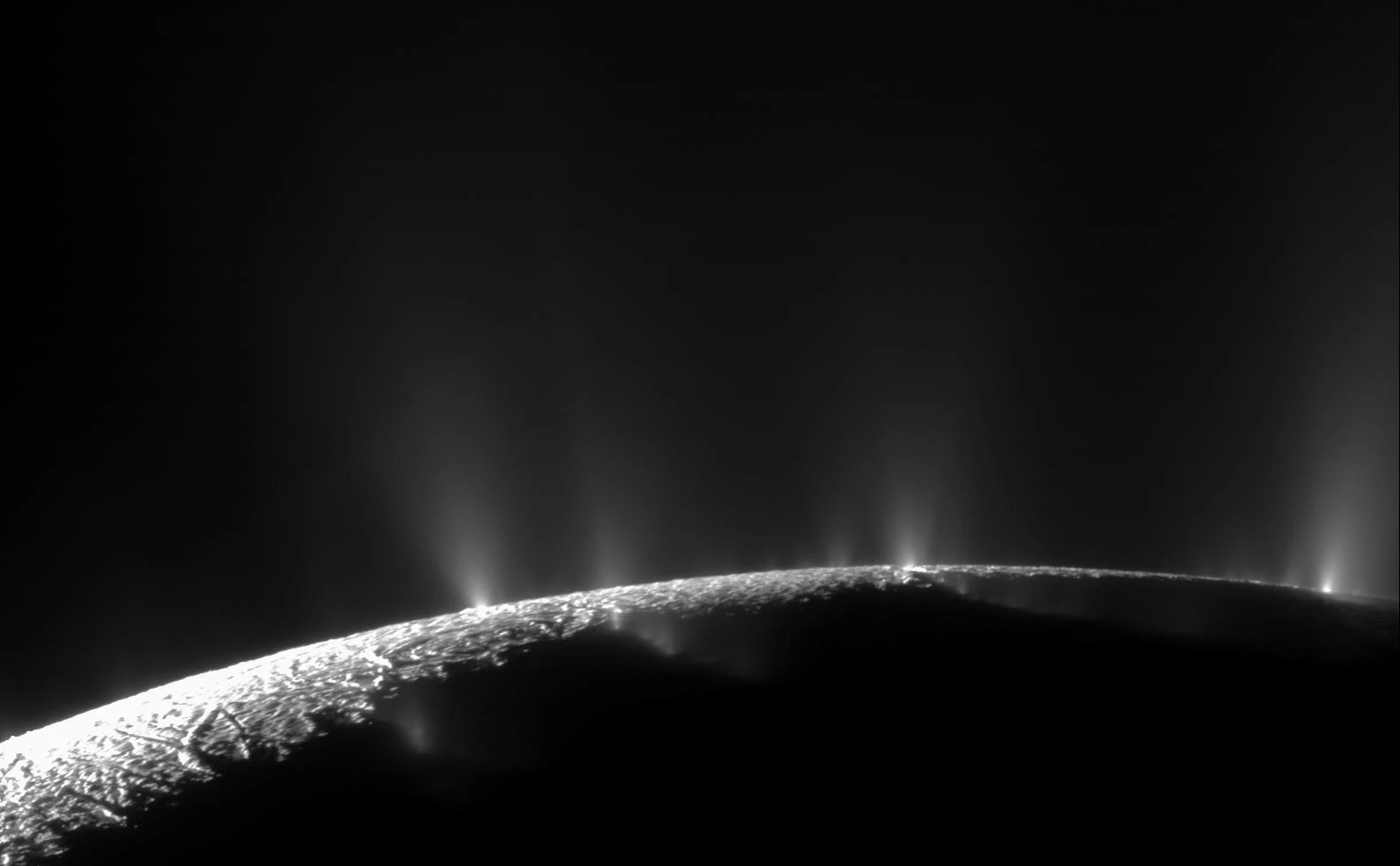
Observed, measured, modelled, open. The geysers are observed directly in Cassini’s images. What’s in them, water, salts, silica, hydrogen and organic molecules, was measured by flying through the spray. The global ocean beneath the ice, and hot water reacting with rock on its floor, are modelled from those measurements. Whether that ocean could support life is open.
Quick Answer: What Are Enceladus’s Geysers?
Enceladus’s geysers are jets of water vapor and ice particles that erupt from warm fractures near the moon’s south pole, nicknamed the “tiger stripes.” NASA’s Cassini spacecraft discovered them in 2005 (NASA) and later counted 101 distinct geysers (NASA JPL, 2014). They’re fed by a global ocean beneath the ice, confirmed in 2015 from the way the moon wobbles (NASA JPL, 2015). Cassini measured salts, silica, hydrogen and organic molecules in the spray, and a 2023 study found phosphorus too (University of Arizona, 2023). There’s no evidence of life.
What this article can and cannot establish. It can explain what the geysers are, what Cassini measured in them, and how those measurements point to a global ocean with hydrothermal activity. It can’t say whether anything lives in that ocean, because no mission has been able to test for life.
Table of Contents
The DCI Evidence Map: Enceladus’s Geysers and Ocean
| Question | What we know | Status | Key source |
|---|---|---|---|
| Does Enceladus have geysers? | Yes, discovered by Cassini in 2005 | Observed | NASA |
| How many? | 101 distinct geysers along the tiger stripes | Observed | NASA JPL, 2014 |
| What’s in the plume gas? | About 98% water, about 1% hydrogen, plus CO2 and methane | Measured | NASA JPL, 2017 |
| Are there salts, silica and organics? | Yes, plus phosphate in E ring grains | Measured | NASA; UArizona, 2023 |
| Is there a global ocean? | Yes, inferred from the moon’s wobble | Modelled | NASA JPL, 2015 |
| Is there hydrothermal activity? | Hydrogen and silica point to it | Modelled | NASA JPL, 2017 |
| Could the ocean support life? | It has “nearly all” the ingredients; unknown | Open | NASA JPL, 2017 |
| Has life been found? | No | Not supported | NASA JPL, 2018 |
Status key: Observed = seen directly. Measured = a number with a stated uncertainty or a direct measurement. Modelled = inferred from measurements through a physical model, dependent on assumptions. Open = unresolved; the evidence is incomplete or points different ways. Not supported = the evidence goes against the claim, or there is none for it.
Cite this framework: “DCI Evidence Map: Enceladus’s Geysers and Ocean,” Dark Cosmic Insights, November 2026, darkcosmicinsights.com/enceladus-geysers/.
What Is Enceladus?
A small, bright moon of Saturn
Enceladus is “only about 310 miles (500 kilometers) across,” NASA says (NASA). We cover Saturn’s other moons in How Many Moons Does Saturn Have?
The shiniest thing in the solar system
NASA calls Enceladus “the most reflective body in the solar system.” Its bright white surface is kept fresh partly by ice particles from the geysers falling back down (NASA).
Frigid on the outside
The surface is “extremely cold, about minus 330 degrees Fahrenheit (minus 201 degrees Celsius),” NASA says (NASA). That makes the liquid water hidden beneath it all the more surprising.
Where Do Enceladus’s Geysers Come From?
The tiger stripes
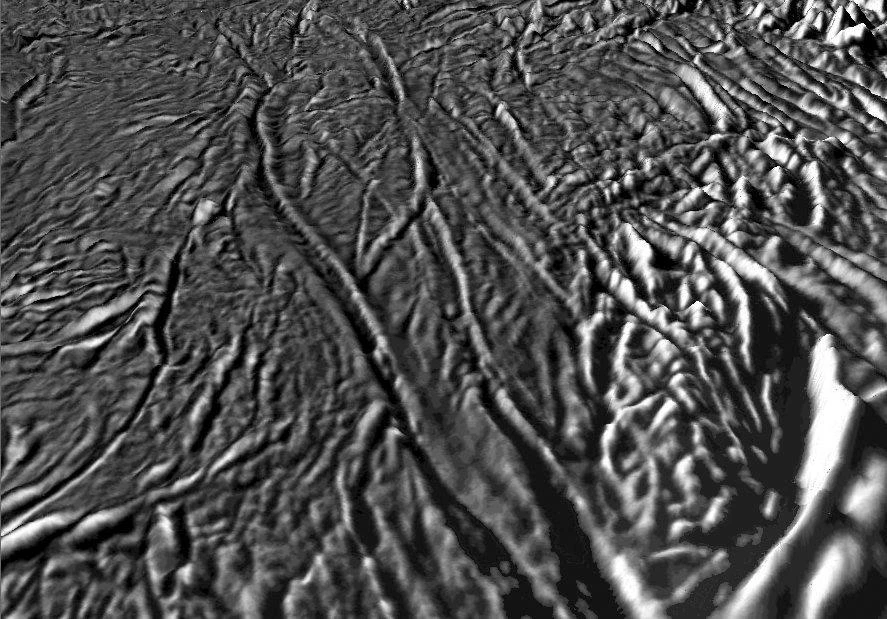
The jets erupt from “relatively warm fractures in the crust, which scientists informally call the ‘tiger stripes,’” near the south pole (NASA). There are four prominent stripes (NASA JPL, 2014).
101 geysers
In 2014, Cassini scientists “identified 101 distinct geysers erupting on Saturn’s icy moon Enceladus.” They concluded that “the only plausible source of the material forming the geysers is the sea now known to exist beneath the ice shell” (NASA JPL, 2014).
Thin ice at the south pole
NASA notes the ice shell may be only 1 to 5 km thick at the south pole (NASA), which helps explain why water can escape there.
How fast and how far
The material erupts at roughly 800 mph (about 1,300 km/h), NASA says, and most of the ice falls back onto the surface (NASA). The rest escapes into orbit around Saturn.
How Do We Know Enceladus Has an Ocean?
Step 1: the plumes (observed)
The geysers themselves showed there was water beneath the surface. But were they coming from local pockets or a big body of water?
Step 2: a regional sea (2014)
Cassini measured Enceladus’s gravity during close passes over the south pole. In 2014, scientists “announced strong evidence for a regional sea” (NASA JPL, 2015).
Step 3: a global ocean (2015)
Then the team measured a tiny wobble, called a libration, in Enceladus’s rotation, using “more than seven years’ worth of images.” The wobble “can only be accounted for if its outer ice shell is not frozen solid to its interior.” As team member Matthew Tiscareno put it, “This proves that there must be a global layer of liquid separating the surface from the core” (NASA JPL, 2015).
Measured vs. inferred
The wobble is measured. The global ocean is inferred from it through a physical model of the moon’s interior. It’s a very strong inference, but we label it Modelled, because no one has seen the water below.
What’s in Enceladus’s Plumes?
Mostly water, plus gases
Cassini’s Ion and Neutral Mass Spectrometer found that “nearly 98 percent of the gas in the plume is water, about 1 percent is hydrogen,” with the rest a mix of other molecules (NASA JPL, 2017). NASA lists water vapor, carbon dioxide, methane, “perhaps a little ammonia,” salts and silica (NASA).
Organic molecules
NASA says organic material in the plume was “about 20 times denser than scientists expected” (NASA). In 2018, a study in Nature reported “much larger, heavier molecules than ever before” coming from Enceladus (NASA JPL, 2018). Organic means carbon-based; it doesn’t mean biological. Such molecules can also form through ordinary chemistry.
Phosphorus
In June 2023, a team led by Frank Postberg reported in Nature that they had found sodium phosphate in Cassini’s Cosmic Dust Analyzer data from grains in Saturn’s E ring, which is fed by the plume. Phosphorus is “a key ingredient for life” (University of Arizona, 2023).

Are There Hydrothermal Vents on Enceladus?
Two independent clues
Two kinds of evidence suggest hot water is reacting with rock on Enceladus’s seafloor:
- Silica nanograins: Saturn’s E ring contains “peculiar nanograins of silica,” which NASA says point to hydrothermal activity beneath the ice (NASA).
- Hydrogen: JPL called the plume’s hydrogen “an independent line of evidence that hydrothermal activity is taking place in the Enceladus ocean” (NASA JPL, 2017).
Why hydrogen matters
Heat and food aren’t the same thing. Heat from inside Enceladus keeps its ocean liquid, but life needs chemical energy it can use. On Earth, some microbes get that from hydrogen. Finding hydrogen at Enceladus means a possible chemical energy source exists there too. That doesn’t mean anything is using it.
Still an inference
No one has seen a vent on Enceladus. The hydrothermal activity is modelled from the chemistry Cassini measured.
Could There Be Life on Enceladus?
“Nearly all” the ingredients
JPL said Enceladus “has nearly all of these ingredients for habitability”: liquid water, chemical energy and the right elements (NASA JPL, 2017). The 2023 phosphorus discovery added another key element (University of Arizona, 2023).
Habitable isn’t inhabited
JPL described the large organic molecules as bolstering “the hypothesis that the ocean of Enceladus may be a habitable environment for life” (NASA JPL, 2018). Habitable means conditions life could use. There’s no evidence that life exists there.
Cassini wasn’t built to find life
Cassini could measure what was in the spray, but it wasn’t equipped to test for life.
Its mission also had a careful ending. After 13 years at Saturn, nearly out of propellant, Cassini was steered into Saturn’s atmosphere on September 15, 2017, its Grand Finale. NASA chose that ending to keep Saturn’s moons, especially Enceladus and Titan, uncontaminated, with the goal “to ensure Saturn’s moons remain pristine for future exploration” (NASA). In other words, the moon that might be habitable was protected from any Earth microbes that could have hitched a ride on the spacecraft.
That leaves the big questions for the next spacecraft. Everything known about the plume today comes from Cassini’s flybys and from telescopes like Webb watching from far away. A future mission with instruments designed for the job could sample the spray directly and look for signs that something in the ocean is alive.
How Far Do the Geysers Reach?
Webb’s 6,000-mile plume
In November 2022, the James Webb Space Telescope observed a water vapor plume from Enceladus “more than 6,000 miles long” (reported in 2023), far larger than the moon itself (SwRI, 2023). That’s about 9,700 km, nearly 20 times Enceladus’s width (DCI conversion and comparison).
Feeding Saturn’s E ring
Webb also traced where the water vapor goes. About 30 percent stays in a doughnut-shaped torus that sits along Saturn’s E ring, and the other 70 percent spreads beyond that torus to supply the rest of the Saturn system (NASA, 2023). That split describes vapor, not the icy grains: NASA says most of the ice falls back onto Enceladus like snow, with only a small fraction reaching the E ring (NASA) (SwRI, 2023). We cover Saturn’s rings in How Many Rings Does Saturn Have?

What’s Next for Enceladus?
ESA’s planned mission
The European Space Agency is studying a large mission to Enceladus, its fourth Large-class mission and the first flagship of its Voyage 2050 program. ESA’s mission is under study for a launch in the 2040s; the schedule is provisional (ESA, 2026). It aims to “sample the plumes” and make measurements on the surface, searching for prebiotic chemistry and signs of life (ESA). The mission is still under study.
Until then: Webb
Telescopes like Webb can keep watching the plume from afar, measuring how much water escapes and what it contains.
A Timeline of Discovery
Each step built on the one before. All dates are from NASA, JPL and partner releases:
- 2005: Cassini discovers “icy water particles and gas” gushing from Enceladus’s surface (NASA).
- 2014: Gravity data give “strong evidence for a regional sea,” and scientists map 101 distinct geysers along the tiger stripes (NASA JPL, 2015; NASA JPL, 2014).
- September 2015: The moon’s wobble reveals a global ocean (NASA JPL, 2015).
- October 28, 2015: Cassini’s deepest dive through the plume detects hydrogen, announced in April 2017 (NASA JPL, 2017).
- June 2018: Large, complex organic molecules are reported in Nature (NASA JPL, 2018).
- November 2022: Webb observes a plume more than 6,000 miles long, reported in May 2023 (SwRI, 2023).
- June 2023: Phosphate is reported in E ring grains (University of Arizona, 2023).
Over nearly two decades, the picture moved from “a moon with jets” to “a moon with a global, chemically active ocean.” What hasn’t changed is the biggest unknown: whether that ocean holds life.
Myth vs. Fact: Enceladus’s Geysers
| Myth | Fact | Status |
|---|---|---|
| “Enceladus’s geysers are like Old Faithful, hot water bursting out.” | They’re jets of vapor and ice escaping into space from a frigid moon. | Observed |
| “Scientists have seen Enceladus’s ocean.” | It’s inferred from the moon’s wobble and the plumes. | Modelled |
| “Organic molecules mean life.” | Organic just means carbon-based; they can form without life. | Measured |
| “Life has been found on Enceladus.” | There’s no evidence of life. | Not supported |
| “The plumes are small.” | Webb saw one more than 6,000 miles long. | Observed |
| “Enceladus is too small to have an ocean.” | Its wobble shows a global liquid layer. | Modelled |
How Can You Explore Enceladus Yourself?
Find Saturn
Saturn is easy to spot with the naked eye when it’s well placed, and a small telescope shows its rings. Enceladus itself is a much harder target.
Browse Cassini’s images
NASA’s image library holds thousands of Cassini pictures of Enceladus, including the backlit jets and close-ups of the tiger stripes. Search for “Enceladus plume” at images.nasa.gov.
Compare with Europa
Jupiter’s moon Europa also hides an ocean, but its plumes are unconfirmed, and its ice shell is estimated at 15 to 25 km overall, far thicker than the 1 to 5 km that may cover Enceladus’s south pole. We compare the evidence in Does Europa Have an Ocean?
Enceladus by the Numbers
| Measure | Value | Source |
|---|---|---|
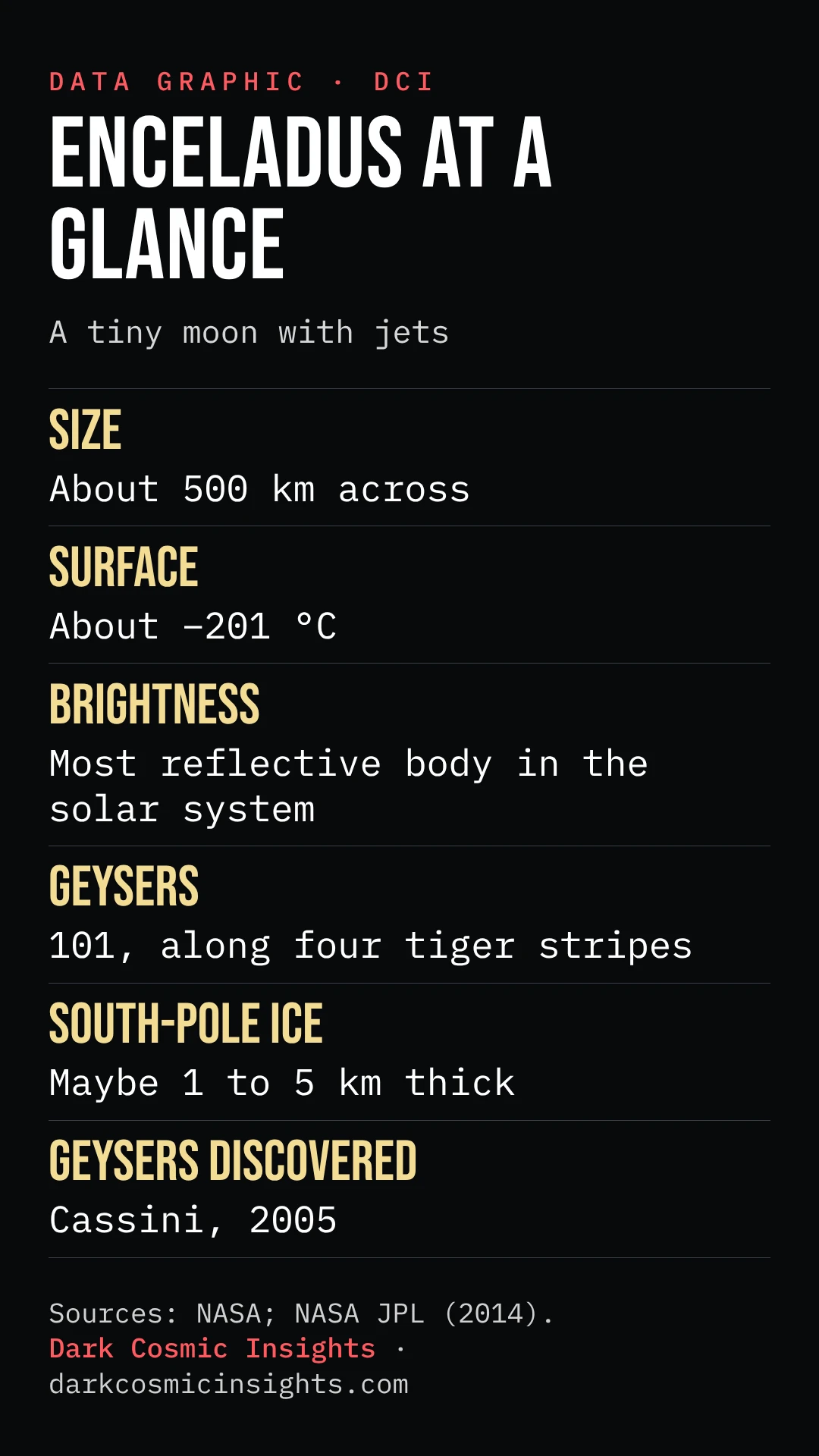
| Diameter | about 500 km (310 mi) | NASA |
| Surface temperature | about −201 °C (−330 °F) | NASA |
| Geysers discovered | 2005 | NASA |
| Number of geysers | 101 | NASA JPL, 2014 |
| Global ocean confirmed | September 2015 | NASA JPL, 2015 |
| Plume gas | ~98% water, ~1% hydrogen | NASA JPL, 2017 |
| South-pole ice | maybe 1 to 5 km | NASA |
| Eruption speed | roughly 800 mph | NASA |
| Webb plume | more than 6,000 miles long | SwRI, 2023 |
| ESA mission launch | 2040s, provisional | ESA, 2026 |
Sources checked November 2026.

Enceladus Geysers FAQ
What are Enceladus’s geysers?
Jets of water vapor and ice particles that erupt from warm fractures, the “tiger stripes,” near the moon’s south pole. Cassini discovered them in 2005 and later counted 101 distinct geysers.
Does Enceladus have an ocean?
Yes, a global one, inferred from a tiny wobble in the moon’s rotation that Cassini measured. The geysers are fed by that ocean, which lies beneath the icy crust.
What is in Enceladus’s plumes?
Mostly water, about 98 percent of the gas, plus about 1 percent hydrogen, carbon dioxide, methane, salts, silica and organic molecules. Grains in Saturn’s E ring also contain phosphate.
Are there hydrothermal vents on Enceladus?
Probably. Silica grains and hydrogen in the plume point to hot water reacting with rock on the seafloor. No one has seen a vent directly.
Could there be life on Enceladus?
No one knows. JPL said Enceladus has nearly all the ingredients for habitability, and phosphorus was found in 2023, but there’s no evidence of life.
How big are Enceladus’s plumes?
In observations made in November 2022, Webb saw a water vapor plume more than 6,000 miles long, far wider than the moon itself. About 30% of the vapor stays in a torus along Saturn’s E ring and 70% spreads beyond it. Most of the icy grains, by contrast, fall back onto Enceladus.
Why is Enceladus so bright?
Its surface is fresh ice, partly kept clean by plume particles falling back down. NASA calls it the most reflective body in the solar system.
Will a spacecraft go back to Enceladus?
ESA is studying a large Enceladus mission for a launch in the 2040s; the schedule is provisional. It would sample the plumes and make measurements on the surface.
Your next step: look up Cassini’s backlit images of Enceladus’s jets. Each bright streak is ocean water, frozen into ice and flung into space.

Sources and Further Reading
- NASA Science, Enceladus.
- NASA JPL (July 28, 2014), Cassini Spacecraft Reveals 101 Geysers and More on Icy Saturn Moon.
- NASA JPL (September 15, 2015), Cassini Finds Global Ocean in Saturn’s Moon Enceladus.
- NASA JPL (April 13, 2017), NASA Missions Provide New Insights into ‘Ocean Worlds’ in Our Solar System.
- NASA JPL (June 27, 2018), Complex Organics Bubble up from Enceladus.
- University of Arizona (June 30, 2023), Phosphate found on Enceladus boosts chances for life, on Postberg et al. (2023), Nature.
- Southwest Research Institute (May 30, 2023), Webb telescope finds towering plume of water escaping Saturn moon.
- ESA, L4 to Enceladus.
- ESA (2026), Science Programme presentation, L4 Enceladus slide.
- NASA (May 30, 2023), Webb Maps Surprisingly Large Plume Jetting From Saturn’s Moon Enceladus.
- NASA Photojournal, Tiger Stripes on Enceladus: Fracture Zones and Plumes Sources (PIA10352).
- NASA images: PIA11688, PIA10352, PIA19656, PIA21900, PIA17144.
Explore Next
- Jupiter’s ocean moon: Does Europa Have an Ocean?
- Enceladus’s family: How Many Moons Does Saturn Have?
- Everything Saturn: Saturn guide
- The ring Enceladus feeds: How Many Rings Does Saturn Have?
- Another icy world: NASA’s Dragonfly Mission to Titan
- What libration and hydrothermal mean: Space Glossary
- How a claim earns its label: How We Know
How This Explainer Was Checked
Every number and quote in this article was checked in November 2026 against the source linked beside it: NASA’s Enceladus page, NASA JPL’s 2014, 2015, 2017 and 2018 releases, the University of Arizona’s 2023 phosphate release, SwRI’s and NASA’s 2023 Webb plume releases, and ESA’s L4 page and 2026 science programme presentation. The geysers and plume size are labelled Observed; plume composition Measured; the global ocean and hydrothermal activity Modelled; habitability Open; life Not supported. The kilometer conversions and size comparison are DCI calculations. Images are labelled: real Cassini images as OBSERVATION, the 3D tiger-stripe view as a DATA RECONSTRUCTION with its 20× vertical exaggeration noted, illustrations as ARTIST’S CONCEPT, our charts as DATA GRAPHIC. Nothing AI-generated is presented as a real image.

Final Thought: An Ocean That Comes to You
Most ocean worlds hide their water under miles of ice. Enceladus sprays it into space. Cassini sampled that spray and the E ring it feeds, and tasted an ocean: salt, hydrogen and organic molecules in the plume, and phosphorus in the ring’s ice grains. We still don’t know if anything lives down there, but few places in the solar system have offered such a direct sample of what’s beneath the surface.
About the Author
Author: King | Founder of Dark Cosmic Insights