Every person who has ever looked up has seen the same Moon. The craters and dark plains you see tonight are the ones the first stargazers saw, because the Moon turns on its axis exactly once for every trip around Earth. NASA calls this synchronous tidal locking (NASA Science, Tidal Locking). One face always points our way, and thanks to a slow apparent rocking called libration, we see about 59% of the Moon’s surface over time, not just half (NASA SVS, Moon Phase and Libration, 2026; NASA SVS, Moon Wobble).
So what is tidal locking, and why did it happen? It isn’t a coincidence. It’s the end state of a slow tug of war between gravity and rock, and it’s still going on: the tides that locked the Moon are slowing Earth’s spin and pushing the Moon away, and lasers bounced off mirrors on the lunar surface measure the drift.
Observed, modelled, open. That the Moon spins once per orbit, that libration lets us see about 59% of it, and that it is drifting away are observed or measured. How tides slowed the Moon’s spin is modelled, and so is the projection that Earth could one day lock to the Moon. Why Mercury settled into its 3:2 spin is open, and the locking of exoplanets is modelled, inferred from physics rather than seen.
Quick Answer: What Is Tidal Locking?
Tidal locking is when a moon or planet spins on its axis in exactly the time it takes to orbit its partner, so one face always points the same way. Our Moon is the best-known example: it rotates once every 27.3217 days, the same as its orbit (NASA NSSDCA, Moon Fact Sheet). Earth’s gravity once raised a lagging bulge on the young Moon, and the flexing drained spin energy until spin matched orbit (NASA Science). Pluto and Charon are locked to each other. Mercury is not locked.
What this article can and cannot establish. It can show which locked worlds are measured (the Moon, Pluto and Charon), how tidal locking works in NASA’s explanation, and what lunar laser ranging records. It cannot say how fast the young Moon spun or how many years locking took, because no source we found gives those figures. It also cannot confirm that any exoplanet is locked: for planets like TRAPPIST-1 b, locking is expected from theory, and Webb’s data are consistent with it.
Table of Contents
The DCI Evidence Map: Tidal Locking
| Question | What we know | Status | Key source |
|---|---|---|---|
| Does the Moon always show us the same face? | Yes: it rotates in 655.720 hours (27.3217 days), the same as its orbit | Measured | NASA NSSDCA |
| How much of the Moon can we see from Earth? | About 59% over time, thanks to libration | Observed | NASA SVS |
| What locked the Moon? | A lagging tidal bulge and energy lost as heat slowed its spin | Modelled | NASA Science |
| Is the Moon moving away? | About 3.8 cm (1.5 inches) per year, from lunar laser ranging | Measured | NASA JPL |
| Is Earth’s day getting longer? | Yes, by an average +1.8 ms per century (720 BC to AD 2015) | Measured | Stephenson et al. 2016 |
| Will Earth lock to the Moon? | A projection of about 50 billion years, far longer than the Sun has | Modelled | NASA Science |
| Are Pluto and Charon locked to each other? | Yes: both turn once in about 153 hours | Measured | NASA, Pluto Facts |
| Is Mercury tidally locked? | No: 3 spins for every 2 orbits, found by radar in 1965 | Measured | Pettengill & Dyce 1965 |
| Why did Mercury settle into 3:2? | One proposed mechanism: chaotic swings in its orbit’s shape | Open | Correia & Laskar 2004 |
| Are TRAPPIST-1 and other close-in exoplanets locked? | Expected from tidal theory; Webb data consistent | Modelled | NASA, Webb |
Status key: Observed = seen directly in images or data. Measured = a number or detection with stated precision. Modelled = inferred from measurements through a physical model, dependent on assumptions. Open = unresolved; the evidence is incomplete or points different ways. Not supported = no evidence for the claim.
Cite this framework: “DCI Evidence Map: Tidal Locking,” Dark Cosmic Insights, November 2026, darkcosmicinsights.com/what-is-tidal-locking/.
What Is Tidal Locking, in Plain Terms?
Picture two dancers holding hands and turning in a circle. Each always faces the other, yet each also turns all the way around once per lap. That’s tidal locking: the locked body spins, but its spin is matched to its orbit.
- Synchronous rotation means the spin period equals the orbit period.
- A spin-orbit resonance is a simple whole-number ratio between spins and orbits. Synchronous rotation is the 1:1 case; Mercury, as we’ll see, is 3:2.
The word “tidal” matters. The gravity that raises ocean tides on Earth also stretches solid bodies, and that stretching does the locking. NASA says all of the solar system’s large moons are tidally locked to their planets, some binary stars are locked to each other, and evidence is growing that many exoplanets are locked to their stars (NASA Science). For a tour of every planet and its moons, see the Solar System Explorer.
Why Do We Only See One Side of the Moon?
Because the Moon’s day and its month are the same length. NASA’s Moon Fact Sheet lists a sidereal orbit period of 27.3217 days and a sidereal rotation period of 655.720 hours, which is the same 27.3217 days (NASA NSSDCA). “Sidereal” means measured against the distant stars.
As the Moon moves a quarter of the way around Earth, it also turns a quarter of the way on its axis, so the face that pointed at Earth still points at Earth. After a full orbit, it has spun exactly once. The hemisphere we never see directly is the far side.
Don’t confuse this with the phase cycle. New Moon to new Moon takes 29.53 days, the synodic period (NASA NSSDCA), because Earth moves around the Sun during the month. Phases change how much of the near side is lit, not which side faces us.
How Do Tides Lock a Moon’s Spin?
NASA’s explanation runs in five steps (NASA Science). Its status is Modelled: it’s the physics that accounts for what we measure, but no one watched it happen.

- Gravity stretches the Moon. Earth’s pull stretched the Moon into a slight football shape. Early on, when the Moon was closer and less solid, the stretching was stronger.
- The bulge lags. Material takes time to rise and fall, so the bulge lagged behind and was never quite lined up with Earth’s pull.
- Gravity tugs back. Earth kept pulling the bulge back toward alignment, a tug of war in which each flex released energy as heat.
- The spin slows. That lost energy came out of the Moon’s rotation, which slowed until one spin matched one orbit.
- Locked. With spin and orbit matched, the bulge no longer sweeps around the Moon, so the big spin-slowing tug of war ends. Tidal flexing doesn’t stop entirely: Earth still flexes the Moon’s rock every month, and the Moon’s spin stays matched to its orbit as that orbit slowly changes.
Step 4 implies the young Moon once spun faster, but NASA’s page gives no starting rate, and we found no source that does.
How long does tidal locking take?
NASA gives a general answer, not a date for our Moon: large moons “synchronize early in their existence, within hundreds of thousands of orbits” (NASA Science). The same page says the Moon’s locking began as soon as it formed, after a collision early in Earth’s history. NASA’s Moon Facts page describes that collision as a Mars-sized body hitting Earth (NASA Science, Moon Facts). Notice the unit: orbits, not years. “How many years did our Moon take?” has no sourced answer beyond “early.”
Is the Moon Tidally Locked, or Does It Not Spin at All?
The Moon is tidally locked, and it does spin. This is the most common mix-up.
If the Moon didn’t rotate, it would keep pointing the same way relative to the stars, and as it travelled around Earth we’d see the near side at one point in the month and the far side two weeks later. We don’t. The rotation shows up in the numbers: 655.720 hours for one turn (NASA NSSDCA), a Measured value equal to the orbit period.
Earth still flexes the Moon today, while its spin stays matched to its orbit. NASA JPL reports that Earth’s pull makes the Moon’s rock bulge enough to move the laser-ranging mirrors up to 6 inches (15 cm) each month (NASA JPL).
What Is Libration, and Why Do We See 59% of the Moon?
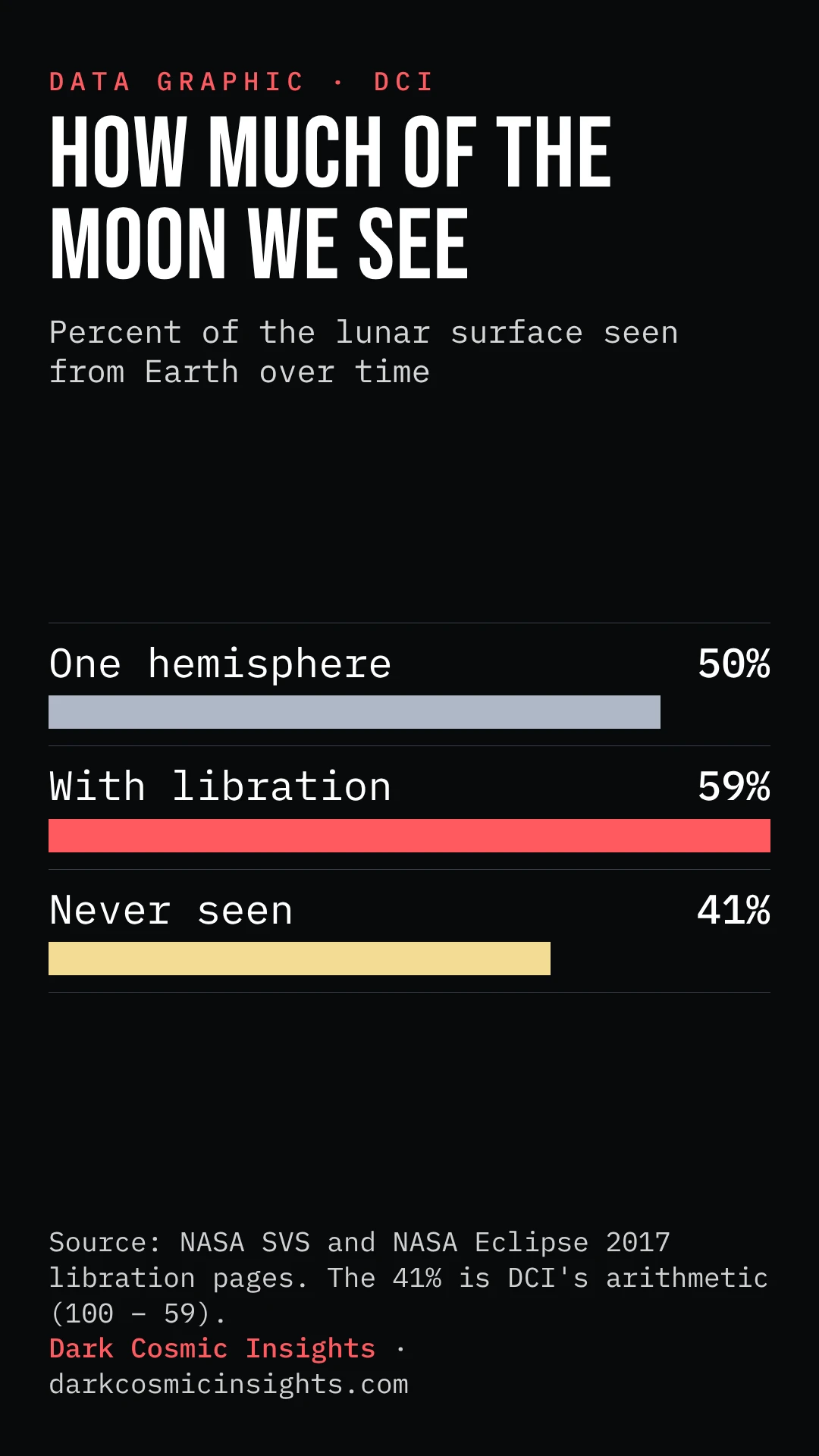
If the Moon showed us exactly one hemisphere, we’d only ever see 50% of it. In fact, over time, we see about 59 percent of the lunar surface (NASA SVS, Moon Wobble). The extra comes from libration, a slow apparent rocking that lets us peek around the Moon’s edges.
NASA describes three causes (NASA, What’s Lunar Libration?, archived Eclipse 2017 page):
East-west rocking: an oval orbit
The Moon’s orbit is “slightly eccentric (oval shaped).” The Moon moves faster when nearer Earth and slower when farther away, while its spin stays steady, so we see a little beyond the east and west edges in turn. The Fact Sheet gives an eccentricity of 0.0549, a mean perigee (closest point) of 363,300 km (about 225,700 miles) and a mean apogee (farthest point) of 405,500 km (about 252,000 miles) (NASA NSSDCA).
North-south nodding: a tilted orbit
This one depends on the Moon’s equator, not just its orbit. NASA’s Scientific Visualization Studio gives the angle between the Moon’s equator and its orbital plane as 6.68°, and says libration in latitude is mostly an effect of that tilt (NASA SVS, Libration in Latitude). As the Moon goes around, its north pole tips toward us for part of the month and its south pole for the other part, so we see a little past each pole in turn. (Separately, the orbit itself is tilted 5.145° to the ecliptic, the plane of Earth’s orbit (NASA NSSDCA).)
Where you stand on Earth
A much smaller effect: observers far north see slightly more of the Moon’s north, and observers far south slightly more of its south.
None of this breaks the lock. Libration is a change in our viewing angle, not a wobble that undoes synchronous rotation.
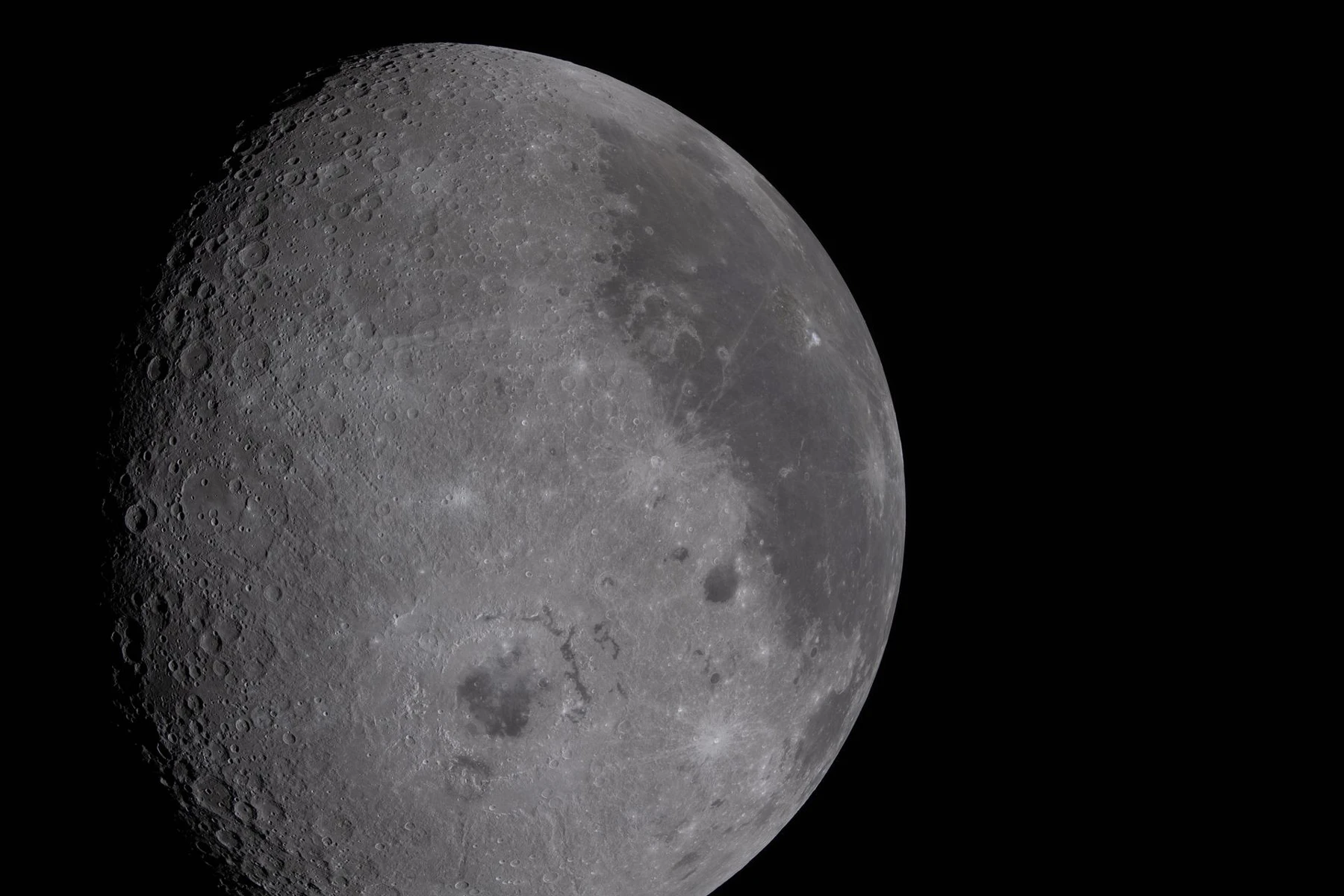
One feature shows it at work. Orientale basin, 600 miles (about 965 km) wide, lies along the boundary between the near and far sides and, as NASA puts it, “is sometimes partly visible from Earth.” Just northeast of it is Grimaldi crater, a round, very dark spot with a lava floor (NASA Image Library, art002e012183).
What Is on the Far Side of the Moon?
Nobody saw the far side of the Moon until October 7, 1959, when the Soviet Luna 3 probe looked back at it, sunlit, from about 63,500 km (39,457 miles) away. Its 29 photographs covered 70% of the far side; they were noisy and low-resolution, but “many features could be recognized” (NASA Science, First Close-up of the Far Side of Moon). NASA’s catalogue describes a far side that looks very different from the near side, without the near side’s dark plains (NASA NSSDCA, Luna 3 image). One measured difference: the crust is about 60 km (37 miles) thick on the far side and about 40 km (25 miles) on the near side (NASA Science, Moon Facts).
Landers came much later. China’s Chang’e 4 made the first controlled landing on the far side on January 3, 2019, inside the 180 km (about 112 mile) Von Kármán crater, and NASA’s Lunar Reconnaissance Orbiter later photographed it (Spaceflight Now, February 18, 2019). Chang’e 6 landed in the Apollo basin, within the South Pole-Aitken Basin, on June 1, 2024 (UTC), and returned far-side samples on June 25, 2024 (The Planetary Society).
On April 6, 2026, NASA’s Artemis II crew spent about seven hours photographing the Moon as Orion flew around the far side. With the whole Moon between them and Earth, they lost signal and regained contact about 40 minutes later, a direct consequence of the far side never facing us (NASA Image Library, art002e016247; art002e021169).
How Do We Know the Moon Is Drifting Away From Earth?
With lasers. Apollo astronauts left retroreflector arrays, panels of glass corner cubes that send light straight back where it came from: 100 cubes at Apollo 11, 100 at Apollo 14 and 300 at Apollo 15. Observatories fire laser pulses at them and time the round trip, measuring the distance “to within a fraction of an inch (a few millimeters).” The result: the Earth-Moon distance grows by 1.5 inches (3.8 centimeters) a year (NASA JPL, July 24, 2019). NASA Goddard’s eclipse site gives the same rate (NASA GSFC, Measuring the Moon’s Distance). This is Measured, the kind of evidence chain we trace on our How We Know page.
Other NASA pages round it differently: about 1.5 inches (4 cm) a year on the Tidal Locking page, about an inch a year on Moon Facts (NASA Science, Tidal Locking; NASA Science, Moon Facts). We use the laser-ranging figure, 3.8 cm.
Why the Moon moves outward
Tides on Earth do the pushing. The Moon raises ocean bulges on Earth, and “Earth’s spin carries the tidal bulge forward,” a little ahead of the Moon (NASA Science, Tides). In NASA’s explanation, Earth’s oceans supply most of the energy that moves the Moon outward, the same interaction slows Earth’s rotation, and the Moon’s drift is slowing over time (NASA Science, Tidal Locking).
Laser ranging has revealed more than the drift. JPL credits it with showing that the Moon has a fluid core (NASA JPL).
Is Earth’s day getting longer?
Yes. A 2016 study of eclipse records from 720 BC to AD 2015 found the length of day increasing at an average +1.8 milliseconds per century. Tidal friction alone predicts +2.3 ms per century; the authors attribute the gap mainly to post-glacial rebound and core–mantle coupling (Stephenson, Morrison & Hohenkerk 2016). That’s roughly two milliseconds per century on the historical average: tiny, but it adds up over geological time.
The Moon is changing in another way too, cooling and shrinking, a separate story told in Why Is the Moon Shrinking?
Will Earth Become Tidally Locked to the Moon?
In principle, but almost certainly not in practice. NASA says that in about 50 billion years, if the Sun’s eventual death could somehow be avoided, the Moon would be far enough away that Earth would lock to it too, and only people on one half of Earth would ever see the Moon (NASA Science, Tidal Locking). That’s a Modelled projection, framed by NASA as a what-if.
The Sun won’t wait. NASA places it a little less than halfway through its life, with “another 5 billion years or so” before it becomes a white dwarf, after swelling into a red giant that engulfs Mercury and Venus and possibly Earth (NASA Science, Sun Facts). Live Science quoted Northern Arizona University’s David Trilling saying the Earth-Moon system “will almost certainly be disrupted and destroyed” then (Live Science, April 22, 2023).
So the physics points toward an Earth locked to the Moon, but on a timescale about ten times the Sun’s remaining lifetime as NASA describes it.
How Are Pluto and Charon Locked to Each Other?
Pluto and Charon are the solar system’s best-known case of mutual tidal locking: NASA says the same surfaces of the two always face each other (NASA Science, Charon).
The numbers line up. Charon orbits Pluto every 6.4 Earth days. NASA’s Pluto page gives that orbit as 153 hours, the same time Pluto takes to rotate once (NASA Science, Pluto Facts). This is Measured. From Pluto, Charon “neither rises nor sets, but hovers over the same spot on Pluto’s surface” (same page). From Pluto’s other hemisphere, you’d never see it.
The pair is unusual. Charon is 1,214 km (754 miles) across, about half the size of Pluto, whose equatorial diameter is about 2,377 km (1,477 miles), and the two are only 19,640 km (12,200 miles) apart (NASA, Charon; NASA, Pluto Facts). Pluto’s four small moons are a different case: NASA suggests Charon’s large size and mass may keep them from syncing up (NASA Science, Tidal Locking).
Charon was discovered in June 1978 by James Christy and Robert Harrington at the U.S. Naval Observatory in Flagstaff, Arizona (NASA, Charon). For why Pluto is a dwarf planet, see Why Is Pluto Not a Planet?
Is Mercury Tidally Locked to the Sun?
No, and it’s a famous correction. Before 1965, the accepted rotation period for Mercury was 88 days, the same as its orbit, which would have locked it to the Sun.
In April 1965, G. H. Pettengill and R. B. Dyce bounced radar off Mercury from the Arecibo Observatory (Pettengill & Dyce 1965, Nature). Radar showed a rotation period of about 59 days, “rather than the previously accepted value of 88 days,” as a 1969 MIT thesis on NASA’s Technical Reports Server summarised it; radar and telescope data together pointed to three rotations for every two orbits (Counselman 1969, NASA NTRS).
Today’s values: a sidereal rotation period of 1,407.6 hours (58.65 days) and an orbit of 87.969 days (NASA NSSDCA, Mercury Fact Sheet). The orbit is 1.4999 times the spin: a 3:2 spin-orbit resonance, three spins for every two orbits. It’s Measured, and it’s still a tidal resonance, just not a 1:1 lock. One sunrise-to-sunrise day lasts 176 Earth days, and NASA gives daytime highs of 430°C (800°F, about 700 K) and night lows of about −180°C (−290°F, about 93 K) (NASA Science, Mercury Facts).
Why 3:2 and not 1:1?
This part is Open. Mercury’s orbit is far more oval than the Moon’s, with an eccentricity of 0.2056 against 0.0549 (NASA NSSDCA). A 2004 study found a simple tidal model makes 3:2 capture unlikely, and that core-mantle friction needs “very specific values of the core viscosity.” It proposed that chaotic swings could push Mercury’s eccentricity above 0.325; in 1,000 simulations over 4 billion years, 3:2 was the most likely outcome, at 55.4% (Correia & Laskar 2004, Nature). That’s one proposed mechanism, model-dependent. Tides also help explain why Mercury and Venus have no moons; see Why Mercury and Venus Have No Moons.
Which Planets Are Tidally Locked?
In our solar system, NASA’s examples of tidal locking are moons and the Pluto-Charon pair (NASA Science), and Mercury turned out to be 3:2 instead. For tidally locked planets, we look to other stars, where the status changes from measured to Modelled.
TRAPPIST-1
In February 2017, NASA announced seven Earth-size planets around TRAPPIST-1, about 40 light-years away, adding that “The planets may also be tidally locked to their star” (NASA JPL, February 22, 2017). Note the “may.”
In 2023, Webb measured heat from the innermost planet, TRAPPIST-1 b, by watching the dip as it passed behind its star. NASA reports a dayside temperature of about 500 kelvins (about 230°C or 440°F, our conversion; NASA rounds to roughly 450°F), pointing to no significant atmosphere (NASA Science, March 27, 2023). The paper finds the data most consistent with heat re-radiated from the dayside only (Greene et al. 2023, Nature). Co-author Pierre-Olivier Lagage called it “tidally locked, with one side facing the star at all times.” We label that Modelled: Webb measured dayside heat, and locking is the theory-based expectation the data fit. None of our sources reports a direct measurement of its rotation.
WASP-43 b, a hot Jupiter
Webb also mapped WASP-43 b, a giant planet that orbits its star in about 19.5 hours and is “probably tidally locked.” Its dayside averages about 1,250°C (about 1,520 K, 2,280°F) and its nightside about 600°C (about 870 K, 1,110°F), with Kelvin and Fahrenheit as our conversions (NASA Science, April 30, 2024; Bell et al. 2024). A permanent day side and night side is what locking predicts, and the contrast fits it.
Why it matters
Whether a locked rocky planet can keep an atmosphere and carry heat to its dark side is Open. Webb’s Rocky Worlds program, observing since July 2025, targets rocky planets around low-mass M-dwarf stars; its documentation says “each planet is tidally locked,” so most heat Webb sees comes from the day side (STScI Newsletter, October 8, 2025). That’s an observing assumption from theory, not a measurement of each spin.

Myth vs. Fact: Tidal Locking
| Myth | Fact |
|---|---|
| “The Moon doesn’t spin.” | It spins once every 27.3217 days, exactly once per orbit. That’s why one face points at us. |
| “The far side is the dark side.” | NASA calls that “misleading”: the far side gets full sunlight at different times, like the near side (NASA, Moon Facts). |
| “We can only ever see 50% of the Moon.” | Libration lets us see about 59% over time. |
| “Mercury always shows one face to the Sun.” | Radar in 1965 showed it spins 3 times for every 2 orbits. |
| “Earth will soon lock to the Moon.” | NASA’s projection is about 50 billion years, far beyond the Sun’s remaining lifetime. |
| “Tidally locked exoplanets are confirmed.” | Exoplanet locking is expected from theory; spins are not measured directly. |
The “dark side” phrase is the big one. Because the far side is lit in turn, at full Moon it is in darkness, and at new Moon, when the near side faces away from the Sun, it is the half in sunlight. Before Luna 3, “dark” could fairly have meant “unseen.”
How Can You See Libration Yourself?
You don’t need a telescope, just binoculars and clear nights across a month or two.
- Pick a landmark near the edge. Grimaldi crater, the very dark round spot by Orientale near the Moon’s edge (NASA Image Library), works well. Note how close it sits to the limb.
- Look again at the same phase in following months. Phases repeat every 29.53 days (NASA NSSDCA), so comparing like with like removes the lighting change; what’s left is libration, which shifts the crater nearer to or farther from the limb.
- Watch for Orientale. When libration tips that edge toward us, look just beyond Grimaldi for the basin’s outer rings on the limb.
- Use NASA’s free tool. NASA’s Scientific Visualization Studio publishes an hourly “Moon Phase and Libration, 2026” animation with a Dial-A-Moon feature: enter a time and see how the Moon looks, including how far it’s tipped. When the sub-Earth point moves west of the 0° meridian, more of the western edge shows (NASA SVS).
- Photograph it through binoculars at the same phase in two different months and compare.
What Comes Next for Tidal Locking Research?
- New mirrors on the Moon. The Next Generation Lunar Retroreflector, NGLR-1, landed on March 2, 2025, on Firefly Aerospace’s Blue Ghost lander. Stations in France and Germany recorded returns on March 3 and 4, with distance precision under a millimetre, and Apache Point Observatory in New Mexico on March 20; the project says more observations are needed to tighten error bars (University of Maryland, NGLR).
- Webb’s Rocky Worlds. Begun in July 2025 with 500 hours of Webb time and 250 hours of Hubble time, it targets nine rocky planets and runs for a few years, with a community workshop planned for the end of 2026 (STScI).
- Far-side views from 2026. Artemis II photographed the far side on April 6, 2026, including Orientale and the Hertzsprung basin (NASA Image Library, art002e009287). NASA says the science community is investigating a glow seen around the Moon during the flyby’s eclipse (art002e016324).
We don’t list crewed landing dates, because plans shift; check NASA’s Artemis pages for the schedule as of November 2026.
Tidal Locking by the Numbers
- 27.3217 days: the Moon’s orbit period, and its rotation period (655.720 hours) (NASA NSSDCA)
- About 59%: how much of the Moon’s surface we see over time, thanks to libration (NASA SVS)
- 3.8 cm (1.5 inches) per year: the Moon’s measured drift away from Earth (NASA JPL)
- 384,400 km (238,855 miles): the Moon’s average distance from Earth (NASA, Moon Facts)
- +1.8 ms per century: average lengthening of Earth’s day, 720 BC to AD 2015 (Stephenson et al. 2016)
- About 50 billion years: NASA’s projection for Earth locking to the Moon, if the Sun’s death could be avoided (NASA Science)
- About 153 hours: both Pluto’s day and Charon’s orbit (NASA, Pluto Facts)
- 19,640 km (12,200 miles): the distance between Pluto and Charon (NASA, Charon)
- 3:2: Mercury’s spins per orbits; one solar day there lasts 176 Earth days (NASA NSSDCA; NASA Science)
- About 500 K (about 230°C, 440°F): TRAPPIST-1 b’s dayside temperature measured by Webb (NASA Science)

Tidal Locking: FAQ
Does the Moon spin on its axis?
Yes. The Moon rotates once every 27.3217 days, the same time it takes to orbit Earth. That matched spin is why one face always points toward us; without it, we would see every side over a month.
Is there a dark side of the Moon?
Not in the sense of a side that never gets sunlight. The far side is lit in turn as the Moon orbits, and it is the sunlit half at new Moon. NASA calls the “dark side” phrase misleading; “far side” is the accurate term.
How fast is the Moon drifting away from Earth?
Lunar laser ranging measures about 3.8 cm (1.5 inches) per year, according to NASA JPL. Some NASA pages round this to about an inch or about 4 cm. The drift comes from tides on Earth and is slowing over time.
How much of the Moon’s surface can be seen from Earth?
About 59% over time, according to NASA. The Moon’s oval orbit and the tilt between its equator and orbital plane make it appear to rock slightly, a motion called libration, so we glimpse a little beyond its edges. About 41% is never visible from Earth.
Are any planets in our solar system tidally locked to the Sun?
Mercury, the closest planet, is not: it was once thought to be, but radar in 1965 showed it spins three times for every two orbits. NASA’s examples of tidal locking in the solar system are moons, including Earth’s Moon, and the Pluto-Charon pair.
Will Earth always see the same face of the Moon?
For any timescale that matters to us, yes. The Moon is stably locked, and libration only shifts the view slightly. Earth itself would lock to the Moon only after about 50 billion years, a NASA projection far longer than the Sun’s remaining lifetime.
What would a tidally locked planet be like?
One side would face its star permanently and the other would stay dark. Webb has measured a large day-night temperature contrast on the hot giant planet WASP-43 b. Whether rocky locked planets can keep atmospheres that spread heat is still open.
Why does Charon never rise or set on Pluto?
Because Pluto and Charon are mutually locked. Pluto turns once in about 153 hours, the same time Charon takes to orbit, so Charon hangs over the same spot. From Pluto’s other hemisphere, Charon is never visible.
Your next step: open NASA’s Moon Phase and Libration, 2026 page, set Dial-A-Moon to tonight, then to the same phase a month or two later, and compare the edges. Then step outside with binoculars and find Grimaldi near the limb. You’ll be watching tidal locking, and the libration that softens it, in real time.
Sources and Further Reading
- NASA Science (originally published June 6, 2023; updated July 23, 2026), Tidal Locking. Mechanism, “hundreds of thousands of orbits,” the 50-billion-year projection, Pluto-Charon and exoplanets.
- NASA NSSDCA, D. R. Williams (updated January 11, 2024), Moon Fact Sheet and Mercury Fact Sheet.
- NASA Science (updated February 12, 2026), Moon Facts and Tides.
- NASA Scientific Visualization Studio (October 20, 2011; updated May 3, 2023), Moon Wobble; (December 11, 2025; updated February 18, 2026), Moon Phase and Libration, 2026.
- NASA Scientific Visualization Studio (June 24, 2024), Moon Essentials: Libration in Latitude.
- NASA, What’s Lunar Libration? (archived Eclipse 2017 page, hosted by NASA Goddard).
- NASA JPL (July 24, 2019), The Apollo Experiment That Keeps On Giving.
- NASA GSFC Eclipse Web Site, Measuring the Moon’s Distance.
- Stephenson, F. R., Morrison, L. V., & Hohenkerk, C. Y. (2016). Measurement of the Earth’s rotation: 720 BC to AD 2015. Proceedings of the Royal Society A, 472(2196), 20160404. doi:10.1098/rspa.2016.0404 (PMC record)
- NASA Science (updated September 17, 2026), Sun Facts.
- Choi, C. Q. (April 22, 2023). Will Earth ever lose its moon? Live Science.
- NASA Science (updated November 3, 2024), Charon; (updated April 22, 2025), Pluto Facts.
- Pettengill, G. H., & Dyce, R. B. (1965). A radar determination of the rotation of the planet Mercury. Nature, 206, 1240. doi:10.1038/2061240a0
- Counselman, C. C., III (1969). Spin-Orbit Resonance of Mercury. Doctoral thesis, Massachusetts Institute of Technology. NASA Technical Reports Server
- Correia, A. C. M., & Laskar, J. (2004). Mercury’s capture into the 3/2 spin-orbit resonance as a result of its chaotic dynamics. Nature, 429, 848–850. doi:10.1038/nature02609
- NASA Science (updated April 25, 2025), Mercury Facts.
- NASA JPL (February 22, 2017), NASA Telescope Reveals Largest Batch of Earth-Size, Habitable-Zone Planets Around Single Star.
- NASA Science (March 27, 2023; updated August 28, 2025), Webb Measures the Temperature of a TRAPPIST-1 Exoplanet.
- Greene, T. P., Bell, T. J., Ducrot, E., Dyrek, A., Lagage, P.-O., & Fortney, J. J. (2023). Thermal emission from the Earth-sized exoplanet TRAPPIST-1 b using JWST. Nature, 618, 39–42. doi:10.1038/s41586-023-05951-7
- NASA Science (April 30, 2024; updated September 21, 2026), NASA’s Webb Maps Weather on Planet 280 Light-Years Away; Bell, T. J., et al. (2024). Nightside clouds and disequilibrium chemistry on the hot Jupiter WASP-43b. Nature Astronomy, 8(7), 879–898. doi:10.1038/s41550-024-02230-x
- Space Telescope Science Institute (October 8, 2025), Webb and Hubble’s Rocky Worlds Program Is Fully Underway: What to Expect. STScI Newsletter, 42(2).
- NASA Science (February 14, 2018), First Close-up of the Far Side of Moon; NASA NSSDCA Photo Gallery, Luna 3 image.
- Spaceflight Now (February 18, 2019), NASA orbiter spots Chinese lander on the Moon.
- The Planetary Society, Chang’e-6: Collecting the first lunar farside samples.
- NASA Image and Video Library (April 6, 2026), Artemis II lunar flyby images: art002e009287, art002e012183, art002e016247, art002e021169, art002e016324.
- University of Maryland, NGLR: Next Generation Lunar Retroreflector.
Explore Next
- Every planet, its moons and our guides: Solar System Explorer
- The Moon is changing in another way: Why Is the Moon Shrinking?
- Charon’s partner and the dwarf planet debate: Why Is Pluto Not a Planet?
- Mercury’s tides and missing moons: Why Mercury and Venus Have No Moons
- Hundreds of moons, the large ones locked: Which Planet Has the Most Moons?
- How a claim earns its label: How We Know
- More from the planets: Planets & Moons
- Read next: How Old Is the Universe?
- Read next: What Is a Black Hole?
- Read next: What Is Dark Matter?
- Read next: Why Is Neptune Blue?
How This Explainer Was Checked
Every number in this article was checked in November 2026 against the source linked beside it: NASA’s Moon and Mercury fact sheets, NASA Science, JPL, Goddard and Scientific Visualization Studio pages, the NASA Image and Video Library, STScI, and peer-reviewed papers with DOIs. The Moon’s drift rate is the lunar-laser-ranging figure from NASA JPL and NASA Goddard (3.8 cm a year); other NASA pages round it to about 1 inch or about 4 cm, and we say so. Mile conversions, the Mercury spin ratio, the 41% never-seen figure and the Kelvin and Fahrenheit conversions for TRAPPIST-1 b and WASP-43 b are DCI’s arithmetic. The Moon’s locking, Pluto and Charon’s mutual locking, Mercury’s 3:2 spin, the Moon’s drift and Earth’s lengthening day are labelled Measured; libration’s 59% is labelled Observed; the tidal mechanism and the 50-billion-year Earth projection are labelled Modelled; the cause of Mercury’s 3:2 capture is labelled Open; exoplanet locking is labelled Modelled. Chang’e mission dates come from Spaceflight Now and The Planetary Society, attributed in place. Images are labelled: real spacecraft or telescope images as OBSERVATION, illustrations as ILLUSTRATION, and our charts as DATA GRAPHIC. Nothing AI-generated is presented as a real image.

Final Thought: A Dance That Is Still Going On
Tidal locking sounds like an ending, a moon frozen in place. It’s really a record of motion. The Moon turned once per orbit long before anyone looked up, but the tides that locked it are still at work: stretching its rock, slowing Earth’s day by roughly two milliseconds per century on the historical average, and nudging the Moon outward by a few centimetres a year, measured by lasers aimed at mirrors astronauts left behind. The face we see is the same one every human has seen. The distance to it never is.
About the Author
Author: King | Founder of Dark Cosmic Insights
King is the founder of Dark Cosmic Insights, a science storytelling platform exploring the strangest true stories hiding in space, science and AI. He digs into NASA, ESA and peer-reviewed research, separates what has been measured from what is still a mystery, and turns it into articles, data graphics and Shorts.
Follow the anomaly. Trace the source.