The nearest star beyond the Sun is so faint you can’t see it without a telescope. Proxima Centauri is a small red dwarf that the European Southern Observatory describes as “too faint to be seen with the unaided eye” (ESO, 2016). Yet it’s about 4.24 light-years away, closer than any other star we know (NASA).
It lies near “the much brighter pair of stars known as Alpha Centauri AB,” ESO notes. And orbiting Proxima is a planet that sits in the zone where liquid water could exist on its surface. Our closest neighbors turn out to be some of the most interesting places in the galaxy.
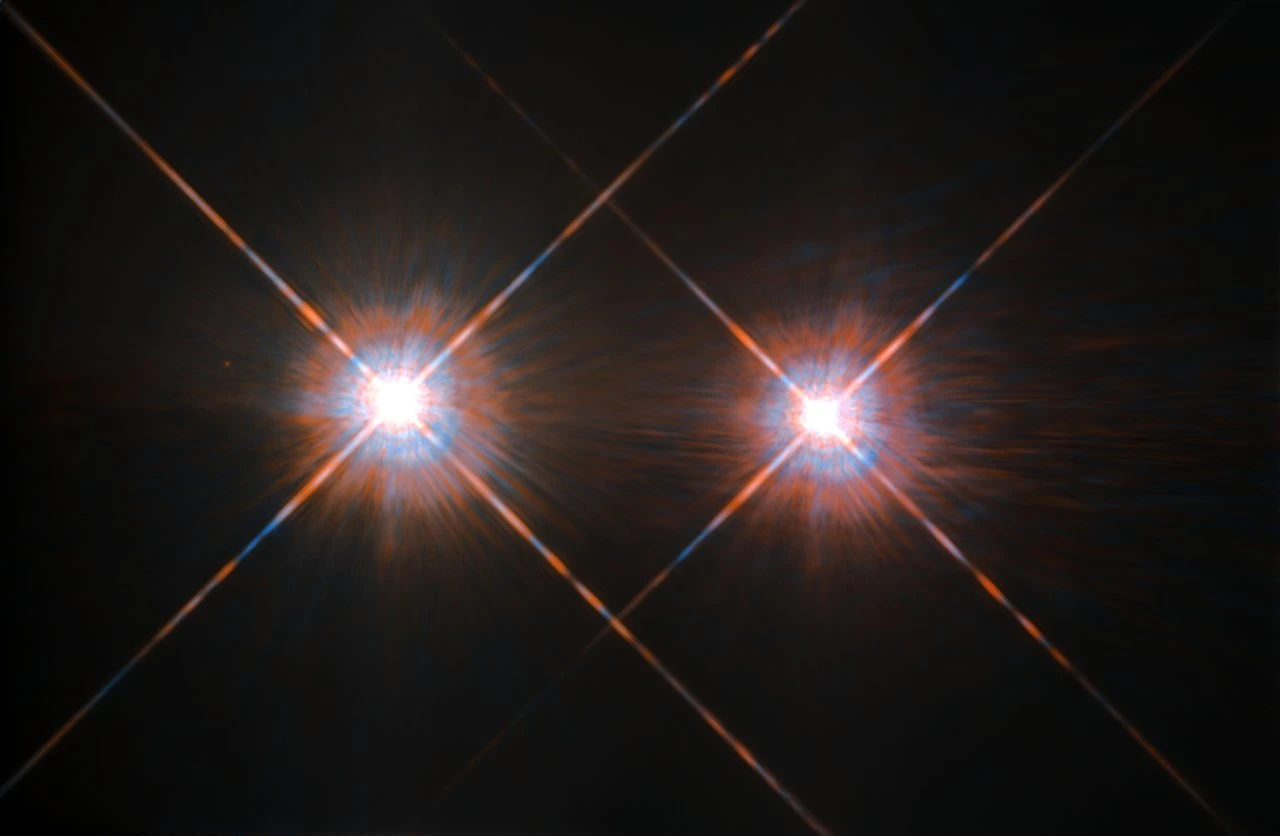
Observed, measured, modelled, open. The distances to Proxima Centauri and Alpha Centauri are measured with parallax. Proxima’s planet, Proxima b, is measured through the wobble it causes in its star. Whether Proxima b has an atmosphere or could support life is still open. Travel times are DCI calculations, labelled as such.
Quick Answer: What’s the Closest Star to Earth?
The closest star to Earth is the Sun, about 149.6 million km away, or about 8.3 light-minutes (NASA NSSDC). The next closest is Proxima Centauri, a red dwarf about 4.24 light-years, or 40.15 trillion km (24.95 trillion miles), away (NASA). It’s part of the Alpha Centauri system, whose two bright stars, Alpha Centauri A and B, are about 4.4 light-years away (OpenStax). The nearest single star beyond the Sun is Barnard’s Star, about 6 light-years away (NASA, 2025).
What this article can and cannot establish. It can give you the measured distances to our nearest stars, how they’re measured, and what’s known about their planets. It can’t tell you whether those planets are habitable or have life, because no telescope has yet measured their atmospheres, and published approximations of Proxima’s distance differ slightly; this guide uses NASA’s approximately 4.24 light-years.
Table of Contents
The DCI Evidence Map: The Closest Stars
| Question | What we know | Status | Key source |
|---|---|---|---|
| What’s the closest star? | The Sun, about 8.3 light-minutes away | Measured | NASA NSSDC |
| What’s the next closest? | Proxima Centauri, about 4.24 light-years | Measured | NASA |
| How far are Alpha Centauri A and B? | About 4.4 light-years | Measured | OpenStax |
| Is Proxima part of Alpha Centauri? | Yes, gravitationally bound to A and B | Measured | ESO, 2016 |
| Can you see Proxima by eye? | No; it’s too faint | Observed | ESO, 2016 |
| Does Proxima have a planet? | Yes, Proxima b, in the habitable zone | Measured | ESO, 2016 |
| Could Proxima b support life? | Unknown | Open | ESO, 2016 |
| What’s the nearest single star? | Beyond the Sun, Barnard’s Star, about 6 light-years, with four planets | Measured | NASA, 2025 |
Status key: Observed = seen directly. Measured = a number with a stated uncertainty or a direct measurement. Modelled = inferred from measurements through a physical model, dependent on assumptions. Calculated = worked out from measured values rather than measured directly. Open = unresolved; the evidence is incomplete or points different ways. Not supported = the evidence goes against the claim, or there is none for it.
Cite this framework: “DCI Evidence Map: The Closest Stars,” Dark Cosmic Insights, November 2026, darkcosmicinsights.com/whats-the-closest-star-to-earth/.
Is the Sun the Closest Star to Earth?
Yes
The Sun is a star, and it’s by far the closest one. NASA describes it as “a 4.5 billion-year-old yellow dwarf star” (NASA). NASA’s fact sheet puts its average distance from Earth at 149.6 million km (NASA NSSDC).
8.3 light-minutes
Light takes about 8.3 minutes to cross that gap (DCI calculation). So the Sun is about 8.3 light-minutes away, while the next star is more than four light-years away. That’s roughly 268,000 times farther (DCI calculation).
Why the question usually means “after the Sun”
When people ask about the closest star, they usually mean the closest star you’d see at night. That’s where Proxima Centauri and Alpha Centauri come in. We explore our own star in How Hot Is the Sun? and How Old Is the Sun?
How Far Is Proxima Centauri?
About 4.24 light-years
NASA gives Proxima Centauri’s distance as about 4.24 light-years, or roughly 24.95 trillion miles (40.15 trillion km) (NASA). NASA’s Hubble page gives 4.2 light-years (1.3 parsecs) (NASA), and the OpenStax astronomy textbook gives 4.25 light-years (OpenStax). Published approximations differ slightly; this guide uses NASA’s approximately 4.24 light-years.
Light that left years ago
The light from Proxima reaching Earth today left the star about 4.24 years ago (DCI calculation). If Proxima changed tonight, we wouldn’t know for more than four years.
On a shrunken scale
Shrink the Sun to the size of a grapefruit, about 10 cm across, and Earth would be a grain of sand about 11 meters away. Proxima Centauri would be about 2,900 km away (DCI calculations from NASA’s figures).

What Is the Alpha Centauri System?
Two bright stars and a faint third
Alpha Centauri is the closest star system to the Sun. Its two bright stars, Alpha Centauri A and B, orbit each other. OpenStax says “these two stars are 4.4 light-years from us” and that “Alpha Centauri itself is a binary star—two stars in mutual revolution” (OpenStax).
Proxima’s place in it
Proxima Centauri sits slightly closer to us than A and B, and it’s gravitationally bound to them. In 2016, astronomers “concluded that the three stars do indeed form a bound system” (ESO, 2016). Hubble’s image description of A and B also counts Proxima as the system’s third member, Alpha Centauri C (NASA).
A southern sky sight
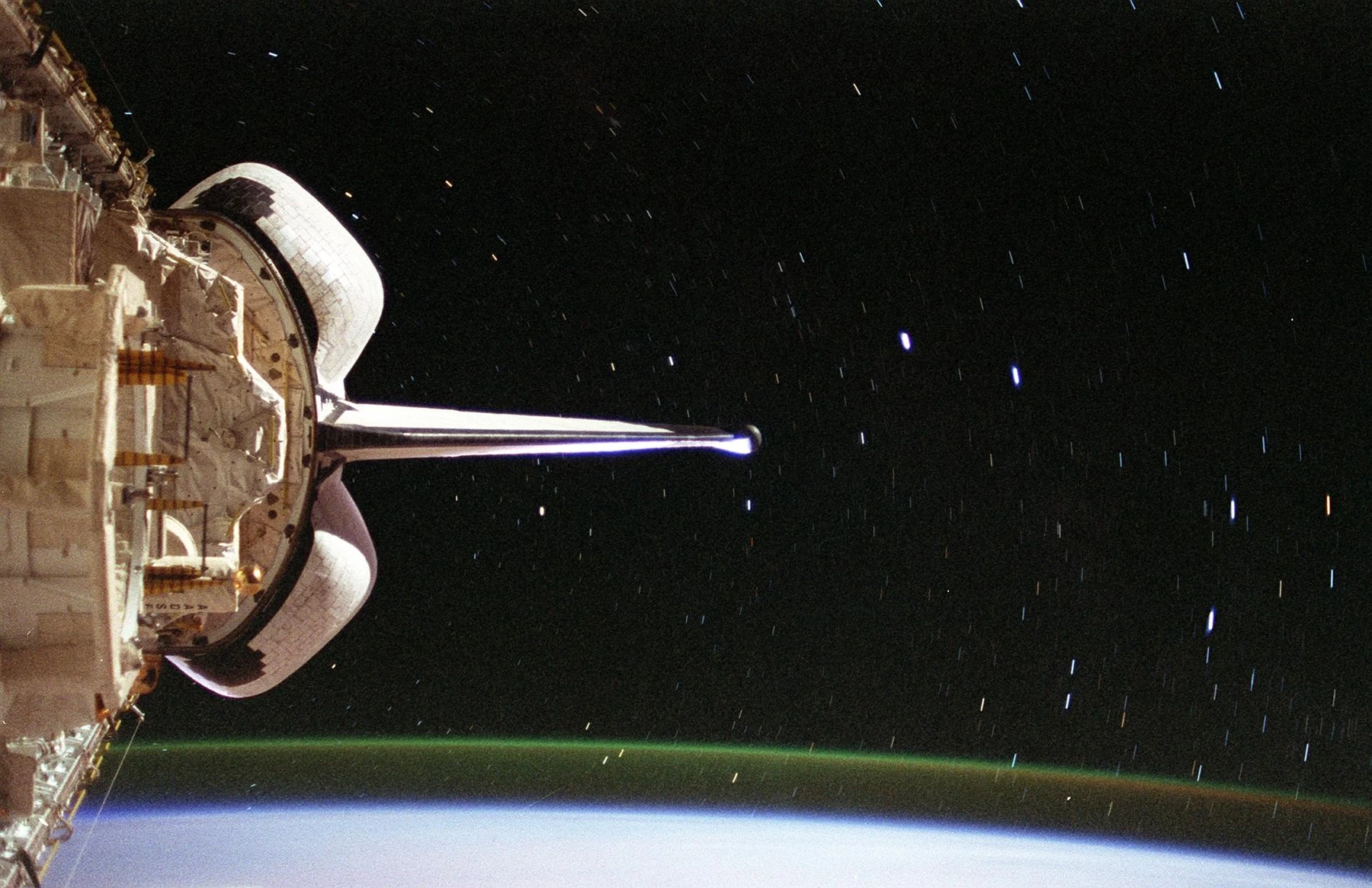
Alpha Centauri is in the southern constellation Centaurus. It’s easy to see from the Southern Hemisphere, where it sits close to the Southern Cross, as astronauts photographed from the space shuttle Columbia in 1996 (NASA).
What Kind of Star Is Proxima Centauri?
A red dwarf
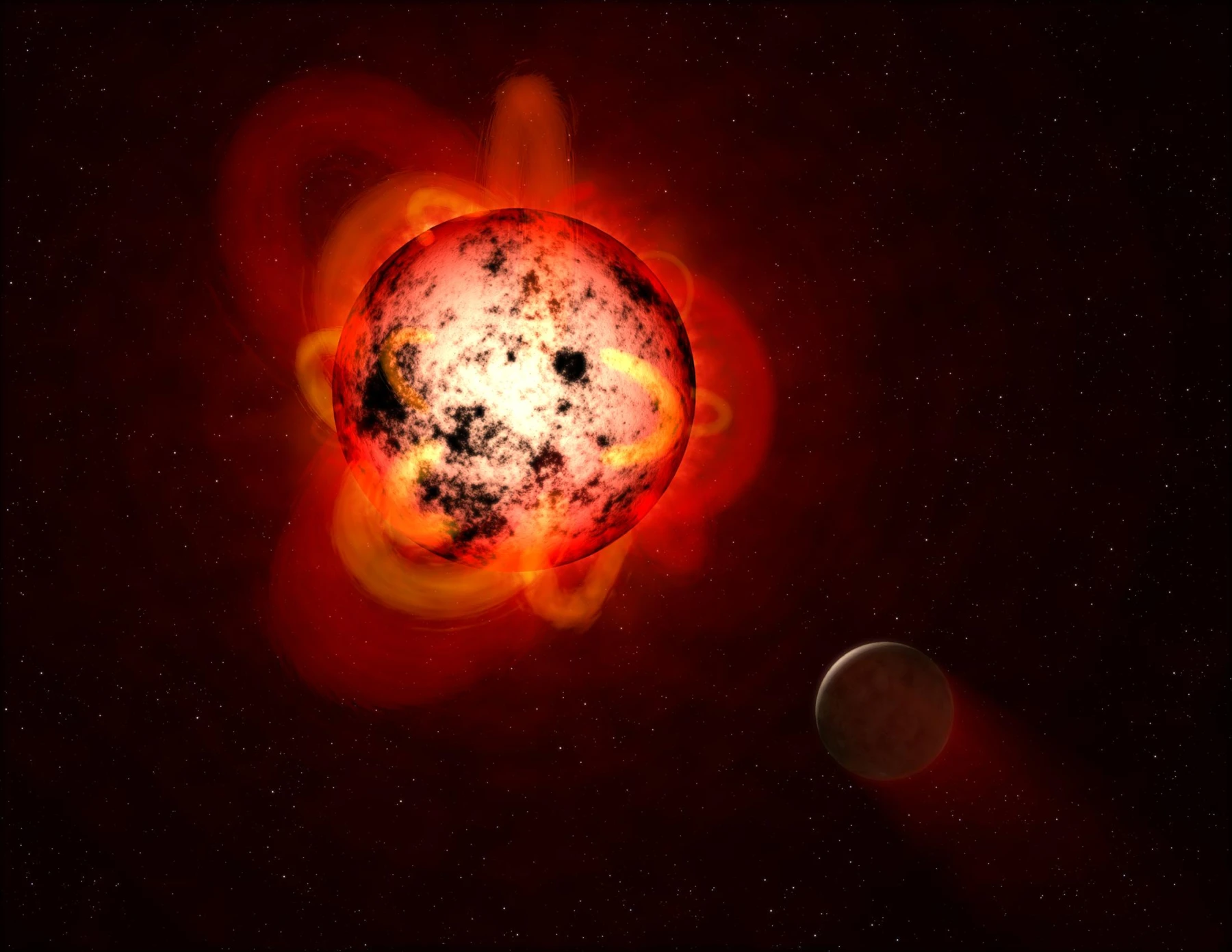
Proxima is a red dwarf, a small, cool star much fainter than the Sun. ESO says “the star itself is far fainter than the Sun” (ESO, 2016).
Too faint to see
Even though it’s the closest star after the Sun, Proxima is “too faint to be seen with the unaided eye,” ESO says (ESO, 2016). You need a telescope to find it.
An active, flaring star
Red dwarfs tend to be restless. ESO notes that “red dwarfs like Proxima Centauri are active stars,” and that Proxima produces “ultraviolet and X-ray flares” that could affect any planet orbiting close by (ESO, 2016).
Does the Closest Star Have Planets?
Proxima b
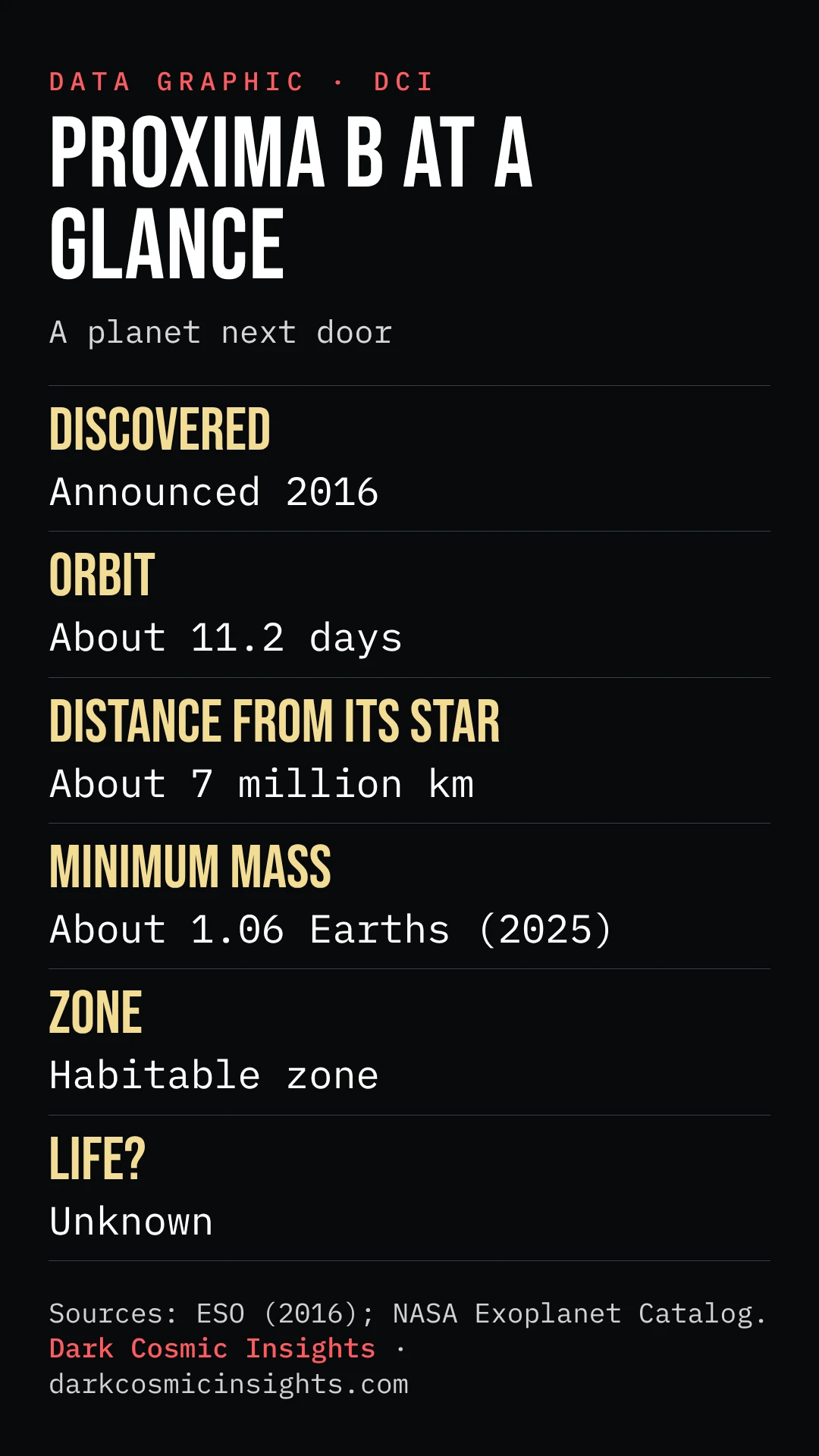
Yes. In 2016, astronomers announced Proxima b, a planet orbiting Proxima Centauri. ESO’s release said it orbits “every 11 days,” at “about 7 million kilometres” from its star, with “a mass at least 1.3 times that of the Earth,” and that it “lies well within the habitable zone” (ESO, 2016). NASA’s exoplanet catalog lists its orbital period as 11.2 days (NASA). A 2025 analysis using the NIRPS spectrograph revised its minimum mass to about 1.06 Earth masses (Suárez Mascareño et al. 2025). Its true mass is unknown, because the wobble method gives only a lower limit.
Habitable zone, not habitable
The habitable zone is the range of distances where a planet could have the right temperature for liquid water on its surface. Being in that zone doesn’t mean a planet has water, air or life. Proxima’s flares could strip away an atmosphere, which is one reason scientists label its habitability open.
How it was found
Proxima b wasn’t photographed. It was found by the tiny wobble it causes in its star, measured as shifts in the star’s light, a method called radial velocity. ESO noted that data taken while the star was flaring “were excluded from the final analysis” (ESO, 2016).
What’s the Nearest Single Star?
Barnard’s Star
The Sun’s nearest neighbor after the Alpha Centauri system is Barnard’s Star, a red dwarf about 6 light-years away. NASA calls it “the nearest single star”: beyond the Sun, it’s the closest star that isn’t part of a multiple-star system (NASA, 2025).
Four small planets
In March 2025, astronomers confirmed that Barnard’s Star has four planets, with minimum masses of about 0.19 to 0.34 Earth masses, combining data from the MAROON-X instrument on the Gemini North telescope in Hawaiʻi with earlier ESPRESSO data from ESO’s Very Large Telescope (Gemini/NOIRLab, 2025; NASA, 2025).
Neighbors are mostly red dwarfs
Proxima and Barnard’s Star are both red dwarfs, and both are too dim to see with the naked eye. Close doesn’t mean bright.
How Do We Measure the Distance to the Nearest Stars?
Parallax
The distance to nearby stars is measured with parallax. As Earth orbits the Sun, a nearby star appears to shift slightly against much more distant stars. The size of that shift gives the distance by geometry. One parsec, about 3.26 light-years, is the distance at which that shift would be one arcsecond (OpenStax).
Proxima’s tiny shift
At about 1.3 parsecs, Proxima’s parallax is less than one arcsecond, smaller than the width of a coin seen from several kilometers away (DCI comparison). Even the closest star moves only a tiny bit.
From Hipparcos to Gaia
Space telescopes revolutionized the measurement. OpenStax notes that the Hipparcos satellite, launched in 1989, measured accurate parallaxes to about 300 light-years, (OpenStax). ESA’s Gaia, whose science observations ended in 2025 (ESA), mapped stellar positions and parallaxes with exceptionally high precision; analysis of its data continues.

How Long Would It Take to Get to the Closest Star?
Light: 4.24 years
Light, the fastest thing there is, takes about 4.24 years to reach Proxima Centauri.
Voyager 1: about 75,000 years
NASA’s Voyager 1 is “cruising at nearly 38,000 mph (61,000 kph)” (NASA). At that speed, covering 4.24 light-years would take about 75,000 years (DCI calculation). Voyager 1 isn’t headed toward Proxima, but the number shows the gap. On November 18, 2026, Voyager 1 reaches its first light-day from Earth, as we explain in What Is a Light-Year?
By car: about 46 million years
At a steady 100 km/h, driving 40.15 trillion km would take about 46 million years (DCI calculation).
What Would It Take to Talk to Proxima b?
A message takes 4.24 years
Radio signals travel at the speed of light. A message sent from Earth to Proxima b would take about 4.24 years to arrive, and any reply another 4.24 years to come back, about 8.5 years for a single exchange (DCI calculation from NASA’s distance).
Compare that with Voyager
At its November 18, 2026, milestone, a command sent to Voyager 1 takes about a full day to arrive (NASA). Proxima b is about 1,550 times farther away than that one light-day (DCI calculation).
Still the closest place to look
Even so, because Proxima is the nearest star beyond the Sun (ESO, 2016), Proxima b is among the nearest known exoplanets, and one of the most tempting targets for future telescopes.
Myth vs. Fact: The Closest Star
| Myth | Fact | Status |
|---|---|---|
| “The closest star is Alpha Centauri.” | It’s the Sun; after that, Proxima Centauri is slightly closer than Alpha Centauri A and B. | Measured |
| “The closest star is the brightest star.” | Proxima is too faint to see by eye. | Observed |
| “The Sun isn’t really a star.” | It is: NASA calls it a yellow dwarf star. | Measured |
| “Proxima b is a confirmed habitable world.” | It’s in the habitable zone; whether it’s habitable is unknown. | Open |
| “Light from nearby stars is instant.” | Proxima’s light takes about 4.24 years to reach us. | Measured |
| “We could reach the nearest star in a lifetime.” | With today’s spacecraft, it would take tens of thousands of years. | Calculated |
How Can You See Our Nearest Stars?
From the Southern Hemisphere
Alpha Centauri is easy to spot from southern latitudes as a brilliant point near the Southern Cross. To the naked eye, A and B blend into one star.
Proxima needs a telescope
Proxima Centauri is too faint to see without a telescope (ESO, 2016). Star-charting apps can show where it sits, near Alpha Centauri.
Barnard’s Star from the north
Barnard’s Star is in the constellation Ophiuchus, but it’s also too faint for the naked eye. A modest telescope and a good star chart will find it.
The Closest Stars by the Numbers
| Measure | Value | Source |
|---|---|---|
| The Sun | about 149.6 million km, 8.3 light-minutes | NASA NSSDC |
| Proxima Centauri | about 4.24 light-years (40.15 trillion km) | NASA |
| Proxima in parsecs | about 1.3 | NASA |
| Alpha Centauri A and B | about 4.4 light-years | OpenStax |
| Barnard’s Star | about 6 light-years | NASA, 2025 |
| Proxima b orbit | about 11.2 days | NASA |
| Proxima b distance from star | about 7 million km | ESO, 2016 |
| Barnard’s Star planets | four; minimum masses about 0.19–0.34 Earths | NASA, 2025 |
| Voyager 1 to Proxima’s distance | about 75,000 years (DCI calculation) | NASA |
| One parsec | about 3.26 light-years | OpenStax |
Sources checked November 2026.
Closest Star FAQ
What is the closest star to Earth?
The Sun, about 149.6 million km away, or about 8.3 light-minutes. After the Sun, the closest star is Proxima Centauri, about 4.24 light-years away.
How far away is Proxima Centauri?
About 4.24 light-years, or about 40.15 trillion km (24.95 trillion miles), NASA says. Published approximations differ slightly, from about 4.2 to 4.25 light-years; this guide uses NASA’s approximately 4.24.
Can you see Proxima Centauri with the naked eye?
No. ESO describes it as too faint to be seen with the unaided eye. Its brighter neighbors, Alpha Centauri A and B, are easy to see from the Southern Hemisphere.
Is Alpha Centauri the closest star?
Alpha Centauri is the closest star system. Its third member, Proxima Centauri, is the closest individual star after the Sun. Alpha Centauri A and B are about 4.4 light-years away.
Does Proxima Centauri have planets?
Yes. Proxima b, announced in 2016, orbits every 11.2 days in the star’s habitable zone. Whether it has an atmosphere or could support life is unknown.
What is the nearest single star?
Beyond the Sun, it’s Barnard’s Star, a red dwarf about 6 light-years away. In 2025, astronomers confirmed it has four small planets.
How long would it take to get to the nearest star?
Light takes about 4.24 years. At Voyager 1’s speed of about 61,000 km per hour, the trip would take roughly 75,000 years.
How do astronomers measure the distance to the nearest stars?
With parallax: they measure how much a star seems to shift as Earth orbits the Sun. The smaller the shift, the farther the star.
Your next step: if you’re ever under southern skies, find the Southern Cross, then follow the two bright pointer stars nearby. The brighter one is Alpha Centauri, the nearest star system to our own.

Sources and Further Reading
- NASA Space Science Data Coordinated Archive, Sun Fact Sheet.
- NASA Science, Sun: Facts.
- NASA Science, Voyager 1: What Is a Light-Day?
- NASA Science, Hubble Image of Proxima Centauri.
- ESO (August 24, 2016), Planet Found in Habitable Zone Around Nearest Star.
- NASA Science, Exoplanet Catalog: Proxima Centauri b.
- ESO (December 22, 2016), Proxima Centauri bound to Alpha Centauri A and B.
- Suárez Mascareño, A. et al. (2025), Diving into the planetary system of Proxima with NIRPS, Astronomy & Astrophysics 700, A11.
- Gemini/NOIRLab (March 2025), Barnard’s Star planets; ESA, Gaia end of observations.
- NASA Science (2025), Discovery Alert: Four Little Planets, One Big Step.
- Fraknoi, A., Morrison, D. and Wolff, S. C., Astronomy 2e, Section 19.2: Surveying the Stars, OpenStax.
- NASA images: Hubble’s Alpha Centauri A and B, STS075-351-022, PIA21473, ISS042E036158, PIA12348.
Explore Next
- The ruler for star distances: What Is a Light-Year?
- From the nearest star to the edge: How Big Is the Universe?
- Our own star, layer by layer: How Hot Is the Sun?
- What red dwarfs become: The Life Cycle of a Star
- Worlds without stars: Rogue Planets
- What parallax and parsec mean: Space Glossary
- How a claim earns its label: How We Know
How This Explainer Was Checked
Every number and quote in this article was checked in November 2026 against the source linked beside it: NASA’s Sun fact sheet and Sun facts, NASA’s Voyager light-day page, NASA’s Hubble Proxima page and Alpha Centauri image description, ESO’s 2016 Proxima b release, NASA’s exoplanet catalog, NASA’s 2025 Barnard’s Star discovery alert, and OpenStax Astronomy 2e. Star distances and planet properties are labelled Measured; Proxima’s faintness Observed; habitability Open. The Sun’s light time, the distance ratio, the scale model, and travel times are DCI calculations. Images are labelled: real telescope, shuttle and station photos as OBSERVATION, illustrations as ARTIST’S CONCEPT, our charts as DATA GRAPHIC. Nothing AI-generated is presented as a real image.
Final Thought: Close, by Cosmic Standards
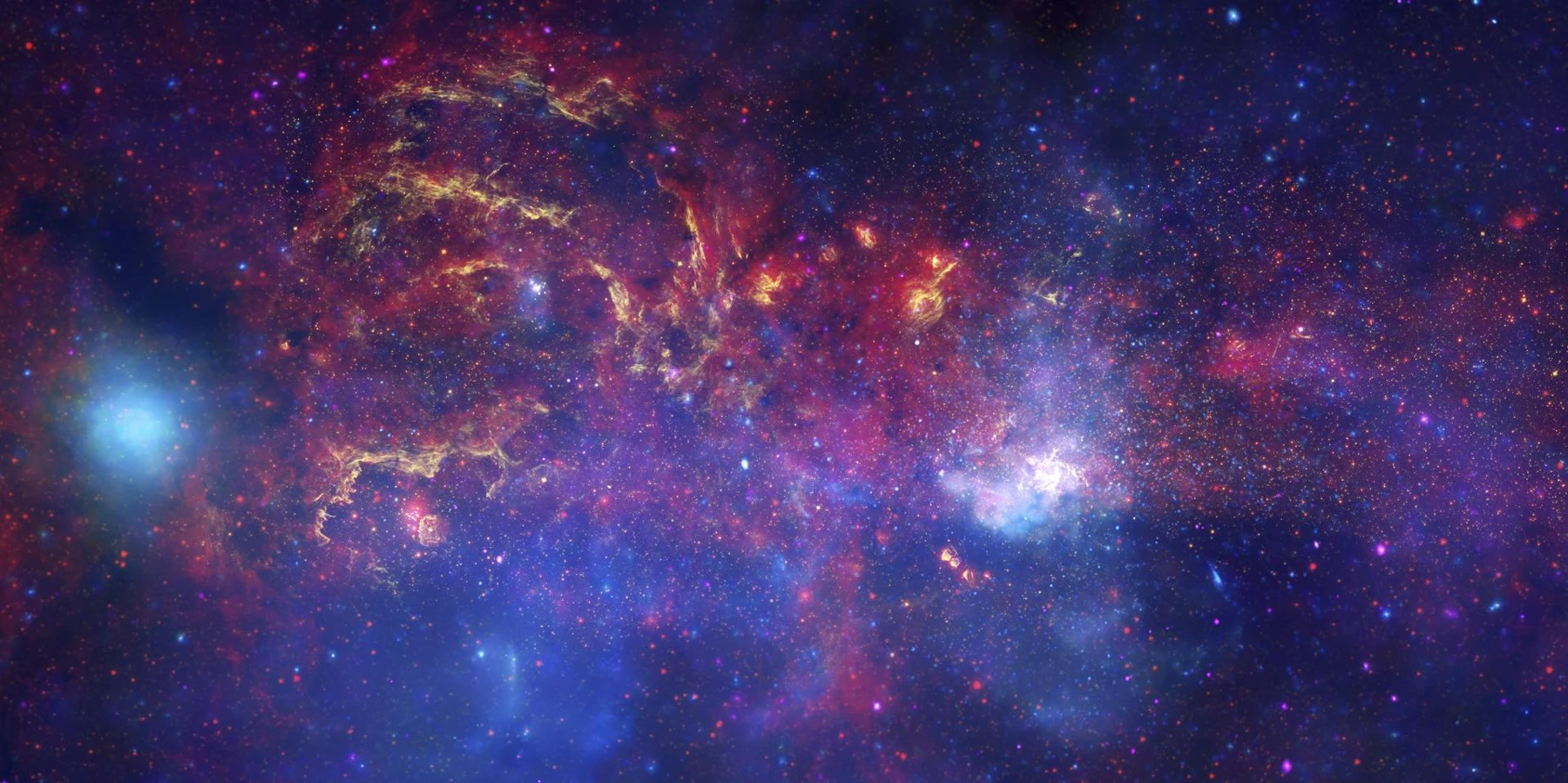
The nearest star beyond the Sun is so close, by galactic standards, that its light reaches us in just over four years. It’s also so far that Voyager 1, at its current speed, would need about 75,000 years to cover that distance. Somewhere in that gap sits a small planet in a habitable zone, waiting for telescopes powerful enough to tell us what it’s really like.
About the Author
Author: King | Founder of Dark Cosmic Insights