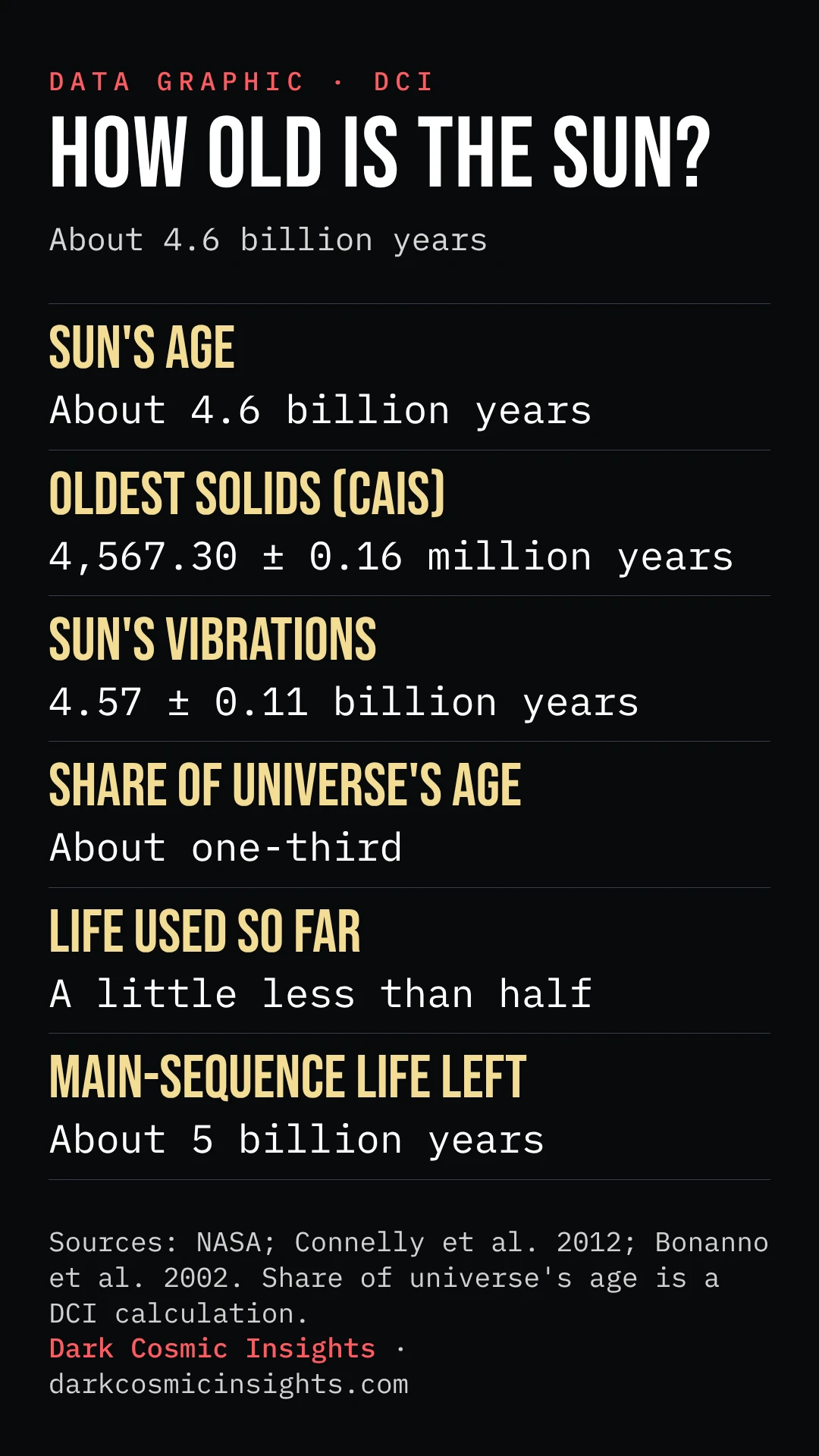
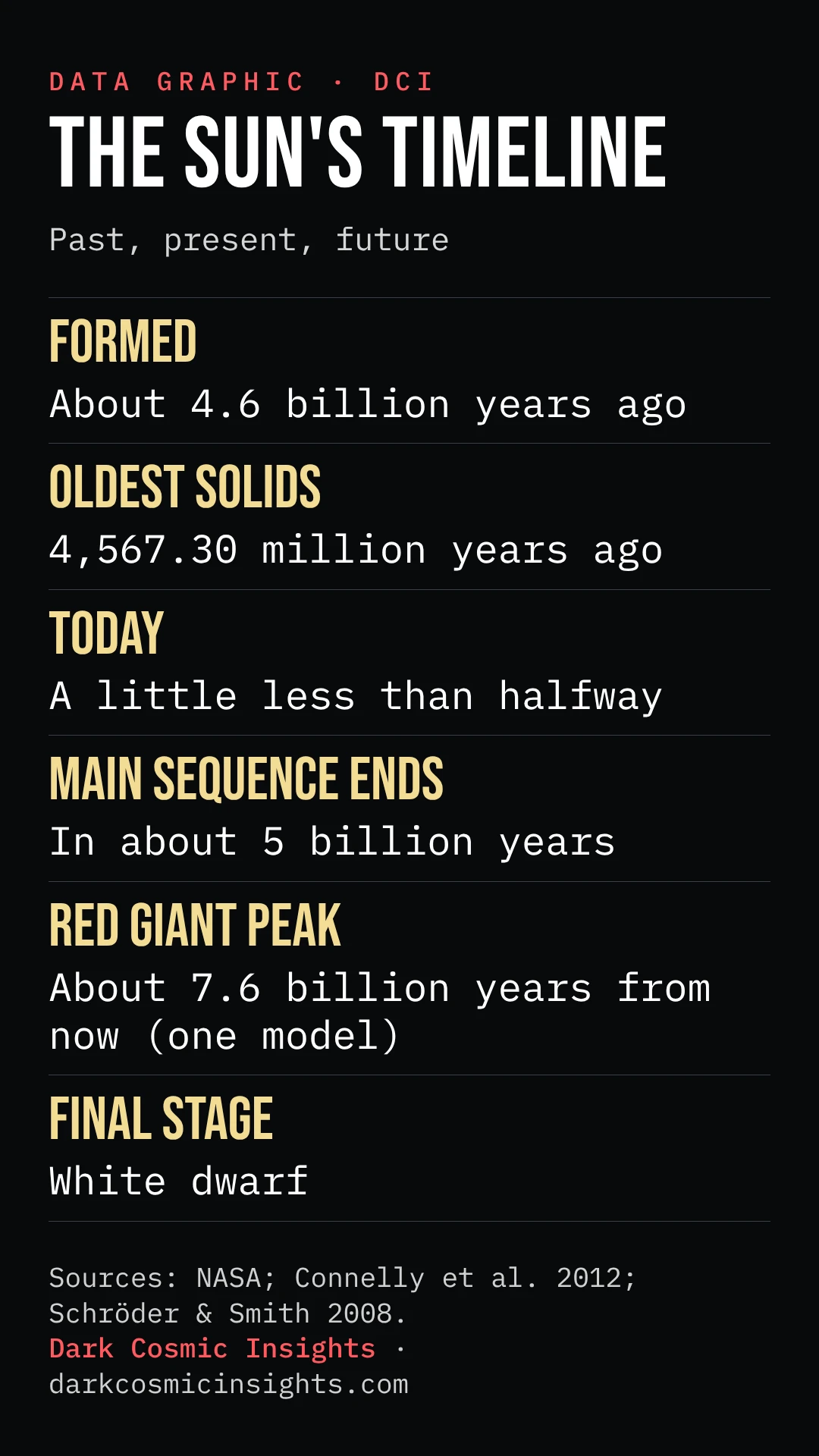
Some of the oldest solid objects in the solar system have fallen to Earth inside meteorites. They’re tiny white flecks called calcium-aluminum-rich inclusions, or CAIs. In 2012, a team led by James Connelly dated them to 4,567.30 million years old, give or take 0.16 million years (Connelly et al. 2012, Science).
That precision belongs to those grains, not to the Sun’s exact birthday. But because they formed in the disk around the newborn Sun, they anchor the Sun’s approximate age, about 4.6 billion years, for a star nobody can touch, sample or drill into.
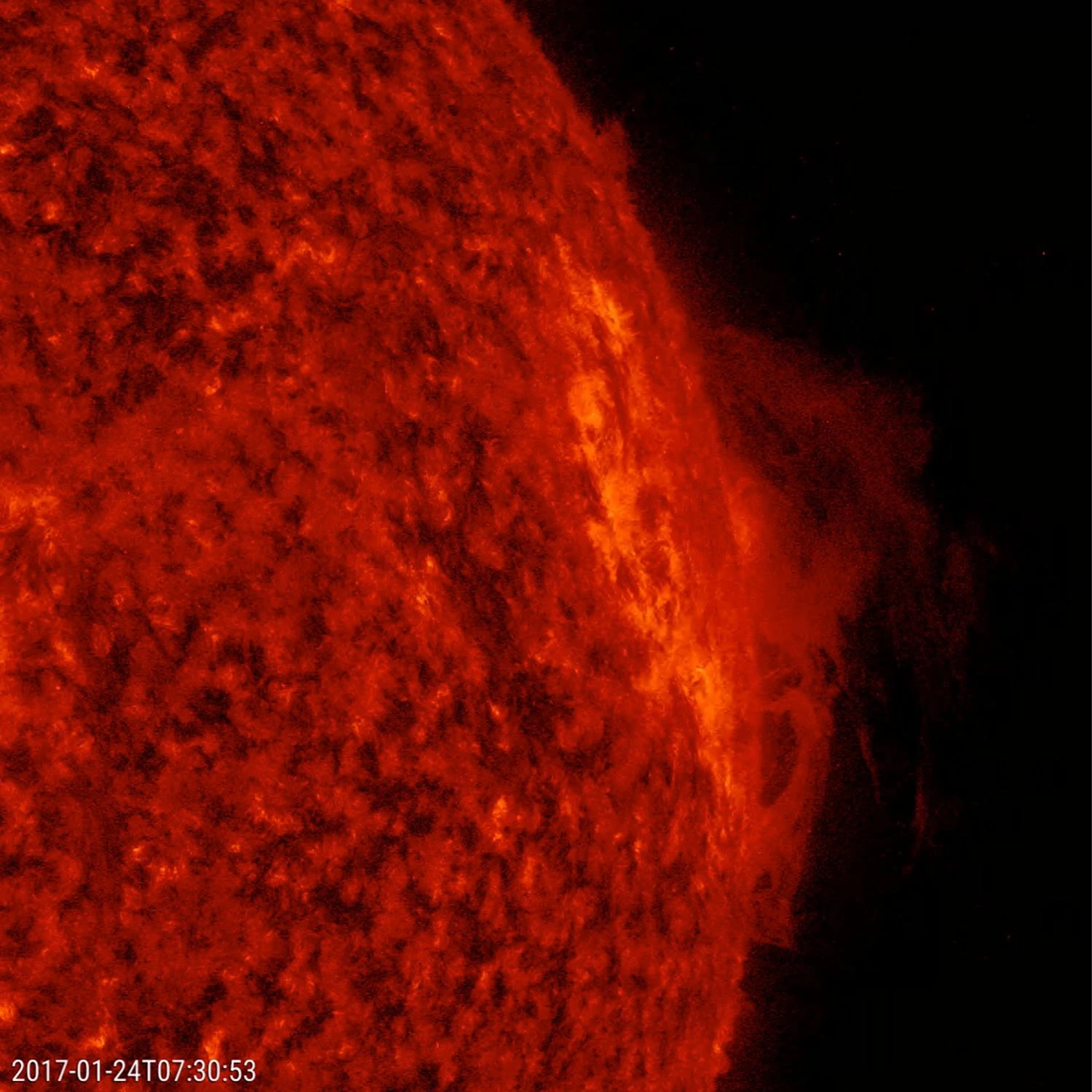
Observed, measured, modelled, open. The age of the oldest meteorite grains is measured with radioactive clocks. The Sun’s age is modelled from those measurements and from models of the Sun’s interior, which independently give the same answer. How long the Sun has left is modelled from the physics of stars. Exactly what will happen to Earth in the far future is still open.
Quick Answer: How Old Is the Sun?
The Sun is about 4.6 billion years old. NASA says it “formed about 4.6 billion years ago” from a spinning cloud of gas and dust (NASA). Scientists date it using the oldest solids in the solar system, CAIs found in meteorites, which formed 4,567.30 ± 0.16 million years ago (Connelly et al. 2012). Studies of the Sun’s own vibrations give a matching age of 4.57 ± 0.11 billion years (Bonanno et al. 2002). NASA says the Sun is “a little less than halfway through its lifetime,” with about 5 billion years of core hydrogen fusion left, followed by red giant stages and, much later, a white dwarf.
What this article can and cannot establish. It can explain how scientists date the Sun, why two different methods agree, and what models say about the Sun’s future. It can’t give the Sun’s age to the exact year, because the Sun formed over a stretch of time rather than in one instant, and it can’t say for certain whether Earth will survive the Sun’s distant future, because the models still disagree on details.
Table of Contents
The DCI Evidence Map: The Sun’s Age
| Question | What we know | Status | Key source |
|---|---|---|---|
| How old is the Sun? | About 4.6 billion years | Modelled | NASA |
| How old are the oldest solids? | 4,567.30 ± 0.16 million years | Measured | Connelly et al. 2012 |
| What do the Sun’s vibrations say? | 4.57 ± 0.11 billion years | Modelled | Bonanno et al. 2002 |
| How did the Sun form? | From a collapsing, spinning cloud of gas and dust | Modelled | NASA |
| How far through its life is it? | “A little less than halfway,” NASA says | Modelled | NASA |
| How long does it have left? | About 5 billion more years of core hydrogen fusion; red giant and white dwarf stages follow | Modelled | NASA |
| When will it peak as a red giant? | One model says about 7.6 billion years from now | Modelled | Schröder & Smith 2008 |
| Will Earth survive? | Debated; one model says Earth will be engulfed | Open | Schröder & Smith 2008 |
Status key: Observed = seen directly. Measured = a number with a stated uncertainty or a direct measurement. Modelled = inferred from measurements through a physical model, dependent on assumptions. Calculated = worked out from measured values rather than measured directly. Open = unresolved; the evidence is incomplete or points different ways. Not supported = the evidence goes against the claim, or there is none for it.
Cite this framework: “DCI Evidence Map: The Sun’s Age,” Dark Cosmic Insights, November 2026, darkcosmicinsights.com/how-old-is-the-sun/.
How Old Is the Sun?
About 4.6 billion years
NASA’s answer is about 4.6 billion years. Its Sun facts page describes “a 4.5 billion-year-old yellow dwarf star” and says the Sun “formed about 4.6 billion years ago” (NASA). The small difference is rounding: the best estimates sit near 4.57 billion years.
A third of the universe’s age
The universe is about 13.8 billion years old, as we explain in How Old Is the Universe? That makes the Sun about one-third the age of the universe (DCI calculation).
Older than Earth, barely
The Sun and its planets formed from the same cloud, within a short time of each other. The 2012 meteorite study found that the solid grains called chondrules kept forming for at least the first three million years after the CAIs (ScienceDaily, on Connelly et al. 2012; Bollard et al. 2015). Those dates mark when planet-building ingredients formed, not when whole planets finished assembling, which took longer. On a cosmic scale, the Sun, Earth and the other planets are siblings.
How Do We Know How Old the Sun Is?
We can’t date the Sun directly
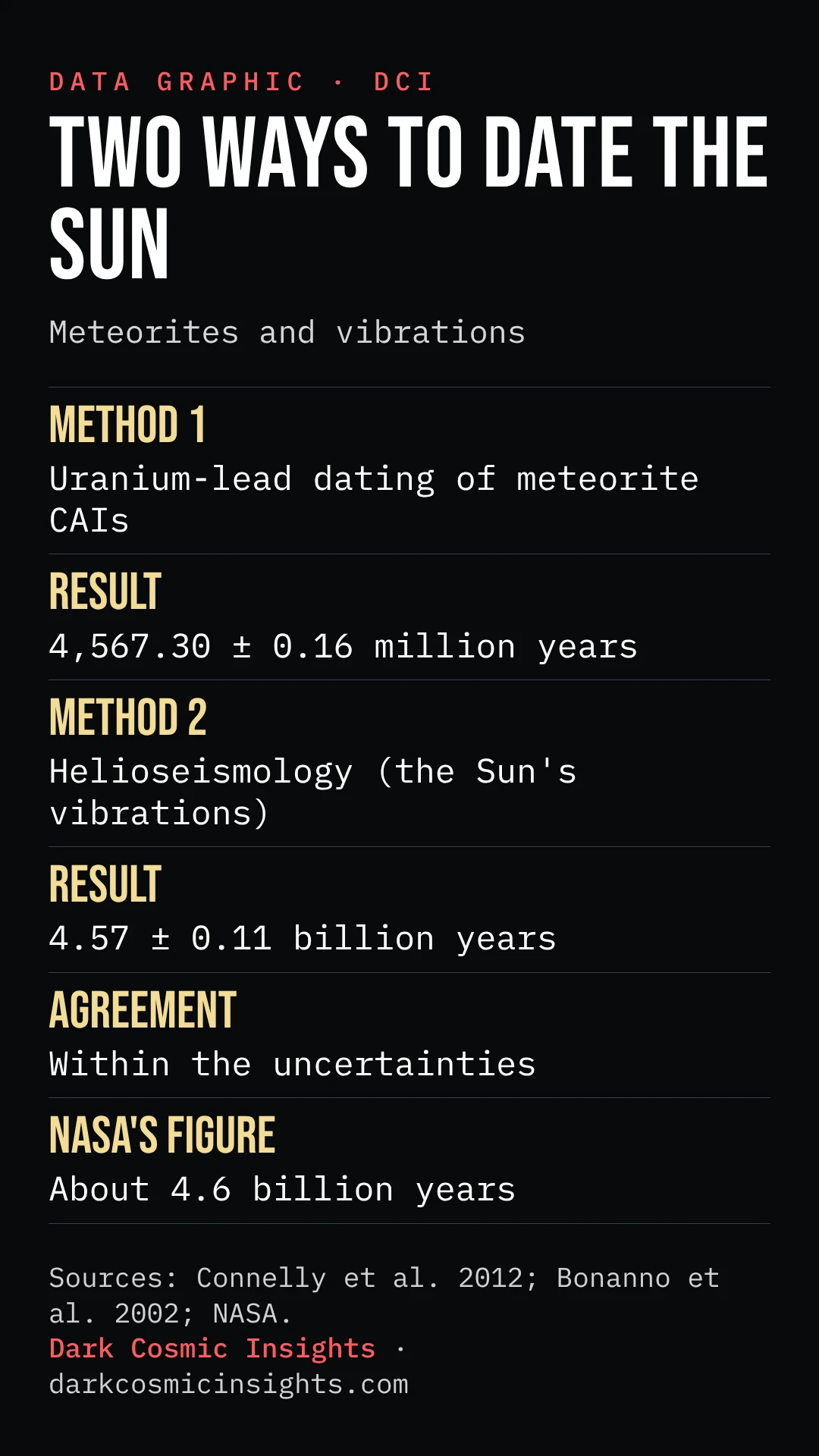
There’s no rock sample from the Sun to test. Instead, scientists use two independent routes: the oldest material in the solar system, and the Sun’s own interior. Both give nearly the same number.
Route 1: the oldest meteorites
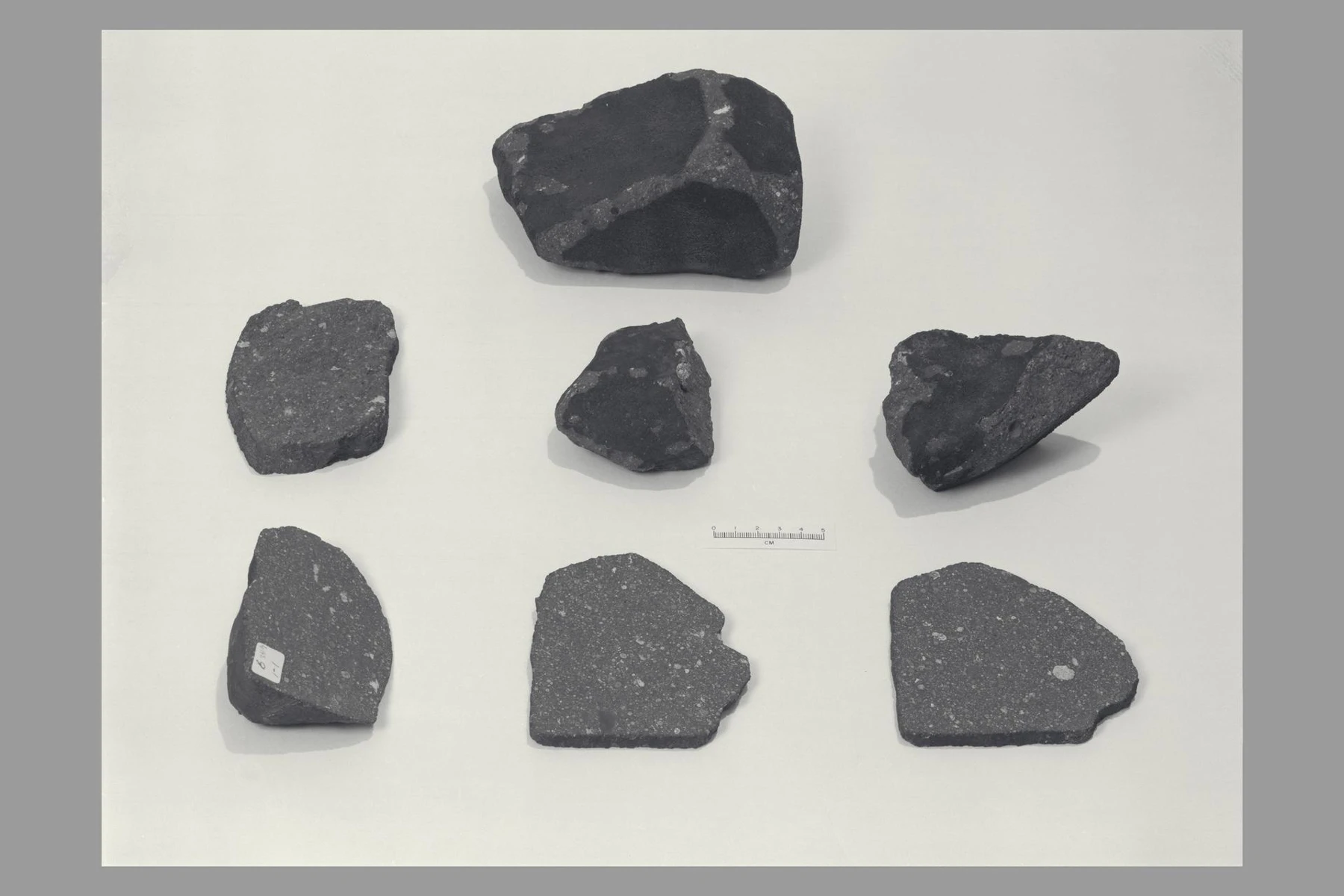
Some meteorites, called chondrites, are leftovers from the cloud that built the planets. They never melted inside a planet, so they still hold the solar system’s first solids. Inside them are CAIs, which formed as the young Sun’s disk of gas cooled. Their age is the closest thing we have to the solar system’s birth date.
Radioactive clocks
To date CAIs, scientists measure uranium and the lead it decays into. Uranium turns into lead at a known, steady rate, so the ratio of lead to uranium in a grain works like a clock that started when the grain formed. The 2012 study used “improved methods of analysis of uranium and lead isotopes” (ScienceDaily, 2012).
The result: 4,567.30 million years
Connelly and colleagues, publishing in Science in 2012, dated CAIs to 4,567.30 ± 0.16 million years ago (Connelly et al. 2012; value as cited in Bollard et al. 2015). That uncertainty of about 160,000 years applies to the CAIs themselves. It dates the solar system’s first solids, which anchor the Sun’s approximate age of about 4.6 billion years rather than fixing its exact birthday.
Why the meteorite age is the Sun’s age
The Sun formed at the center of the same spinning cloud of gas and dust, NASA explains (NASA). So the oldest solids that condensed in that cloud mark when the Sun’s own story was well under way. That’s why the CAI age is widely used as the age of the solar system, and as a close stand-in for the Sun’s age.
Can the Sun’s Vibrations Tell Its Age?
The Sun rings like a bell
The Sun’s surface constantly ripples with sound waves bouncing around inside it. Studying those vibrations is called helioseismology, the solar version of using earthquakes to study Earth’s interior. The vibrations reveal the Sun’s internal structure, including how much of the hydrogen in its core has already turned into helium.
A second, independent age
As a star ages, fusion slowly changes the makeup of its core, and that changes how it vibrates. In 2002, Alfio Bonanno, Hartmut Schlattl and Lucio Paternò matched models of the Sun to its measured vibrations and found a best-fit age of 4.57 ± 0.11 billion years (Bonanno et al. 2002).
Two methods, one answer
They called it “remarkably good agreement with the meteoritic value for the solar age.” One method reads radioactive clocks in tiny grains; the other reads the Sun’s interior through sound. Getting the same answer both ways is strong evidence the age is right.
How Did the Sun Form?
From a spinning cloud
NASA says the Sun “formed about 4.6 billion years ago” from a spinning cloud of gas and dust (NASA). Gravity pulled the cloud inward. As it shrank, it spun faster and flattened into a disk, with most of the material collecting at the center.
Ignition
The center grew hotter and denser until hydrogen began fusing into helium. NASA explains that in the core, “hydrogen is fused to form helium,” which powers “the Sun’s heat and light” (NASA). That’s when the Sun became a true star.
Leftovers became planets
The rest of the disk clumped into grains, then rocks, then planets, moons and asteroids. CAIs are among the very first of those grains, which is why they make such a good clock.
How Long Will the Sun Last?
A little less than halfway
NASA says “scientists predict the Sun is a little less than halfway through its lifetime” (NASA). It has about 5 billion more years of fusing hydrogen in its core. The red giant stages come after that, and the white dwarf later still. Add 4.6 billion years so far to about 5 billion still ahead, and the Sun’s life as a core hydrogen-burning star comes to roughly 10 billion years (DCI calculation).
What powers it now
Today the Sun is a stable, middle-aged star, steadily fusing hydrogen in its core. It’s what astronomers call a main sequence star, the longest and calmest stage of a star’s life. We explain all the stages in The Life Cycle of a Star.
What runs out
Eventually, the hydrogen in the core runs low. Fusion moves outward into a shell around the core, and the Sun begins to change in ways that will transform the whole solar system.
What Happens When the Sun Gets Old?
Red giant
When core hydrogen runs out, the Sun will swell into a red giant, a huge, cooler, much brighter star. A 2008 model by Klaus-Peter Schröder and Robert Connon Smith puts the tip of that red giant phase about 7.59 billion years from now, with the Sun losing about a third of its mass along the way (Schröder & Smith 2008).
What about Earth?
This is where the science is less certain. Schröder and Smith concluded that Earth “will not be able to escape engulfment” by the expanding Sun (Schröder & Smith 2008). Other models differ on the details, because the outcome depends on how much mass the Sun loses and how fast. We label Earth’s fate Open.
White dwarf
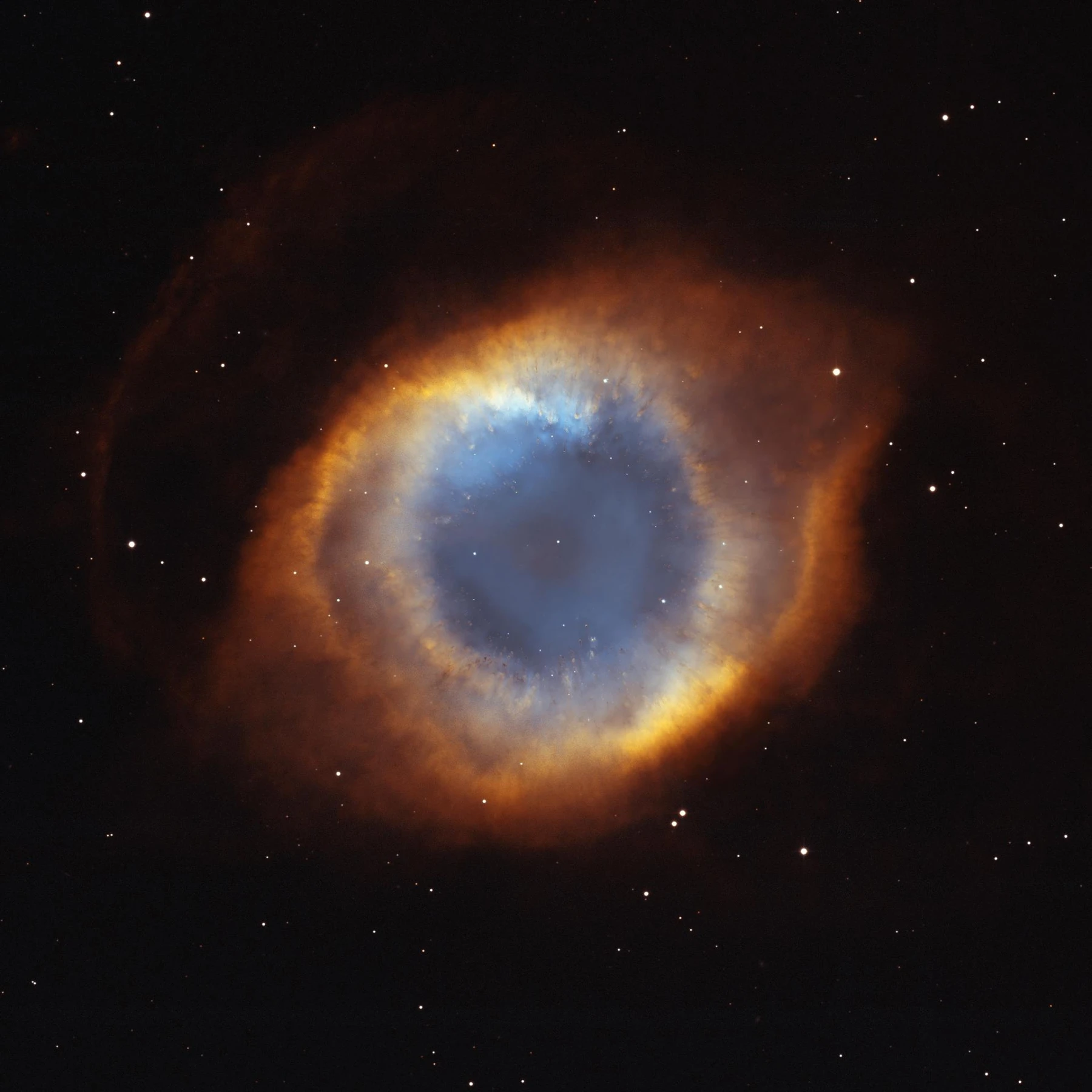
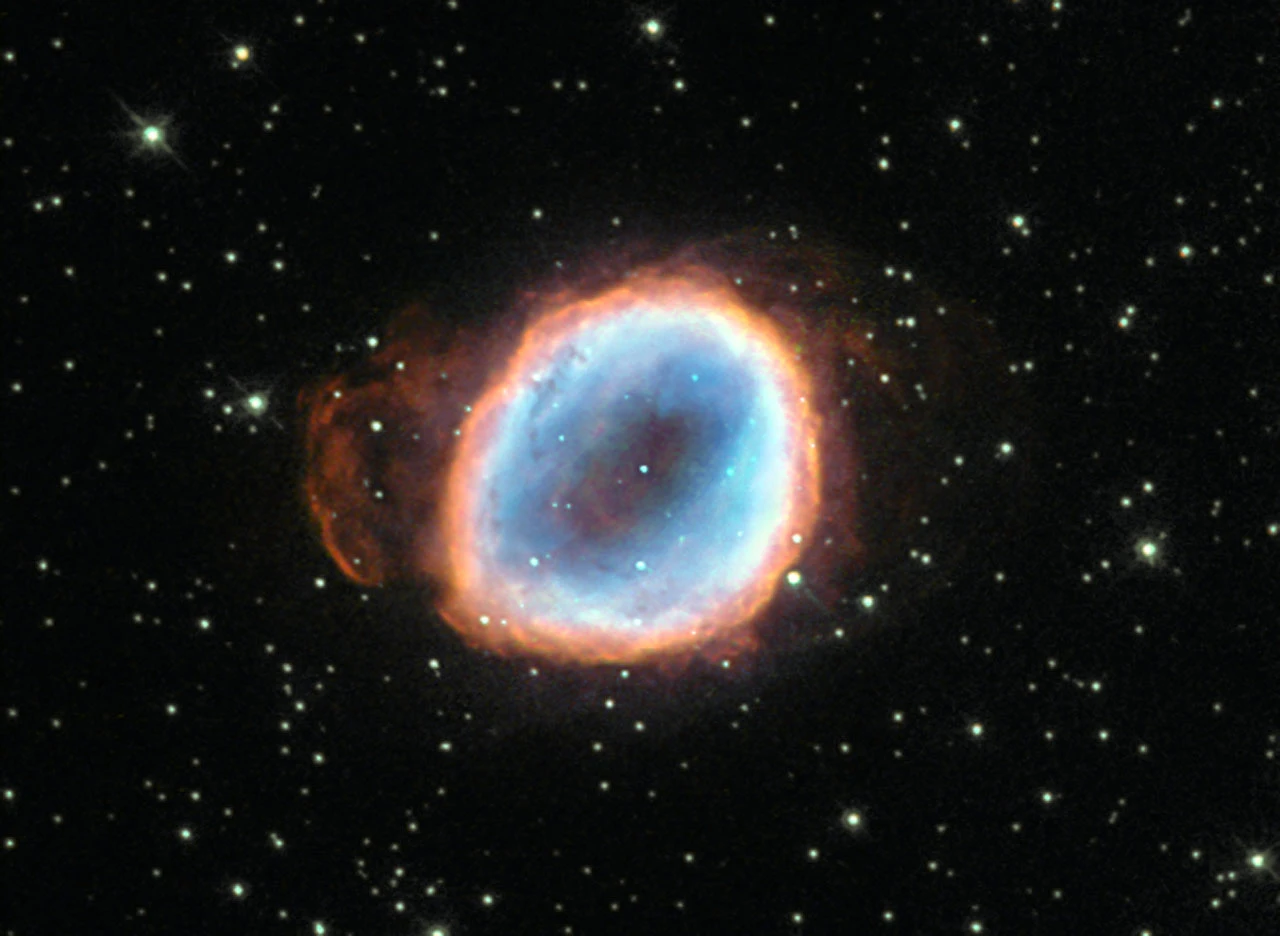
After the red giant phase, the Sun will shed its outer layers, which may glow for a while as a planetary nebula. What’s left will be a white dwarf, the Sun’s hot, dense leftover core, which slowly cools over billions of years. That’s the Sun’s final stage, after roughly 5 billion more years of core hydrogen fusion and the red giant stages that follow (NASA).
No supernova
The Sun isn’t massive enough to explode as a supernova. NASA places the dividing line at about 8 times the Sun’s mass: lighter stars end as white dwarfs (NASA, Types of Stars). We explain the heavier paths in The Life Cycle of a Star.
Myth vs. Fact: The Sun’s Age
| Myth | Fact | Status |
|---|---|---|
| “The Sun is as old as the universe.” | It’s about 4.6 billion years old, about one-third the universe’s age. | Modelled |
| “Scientists guessed the Sun’s age.” | Two independent methods, meteorites and the Sun’s vibrations, agree. | Measured |
| “The Sun will explode as a supernova.” | It’s not massive enough; it will become a white dwarf. | Modelled |
| “The Sun is about to run out of fuel.” | It has about 5 billion years left as it is now, NASA says. | Modelled |
| “Earth will definitely be swallowed.” | One model says yes; the outcome is still debated. | Open |
| “The planets are much younger than the Sun.” | Their building blocks formed within a few million years of the oldest solids; whole planets took longer to finish assembling. | Measured |
How Can You See the Sun’s Story Yourself?
Visit a meteorite collection
Many natural history museums display chondrite meteorites, some with CAIs visible as small white flecks. You can look at material older than Earth itself.
See the Sun’s future in other stars
Planetary nebulae, the glowing shells of dying Sun-like stars, show what our Sun’s distant future may look like. The Helix Nebula is one of the closest and is a favorite target for astrophotographers.
Watch the Sun safely
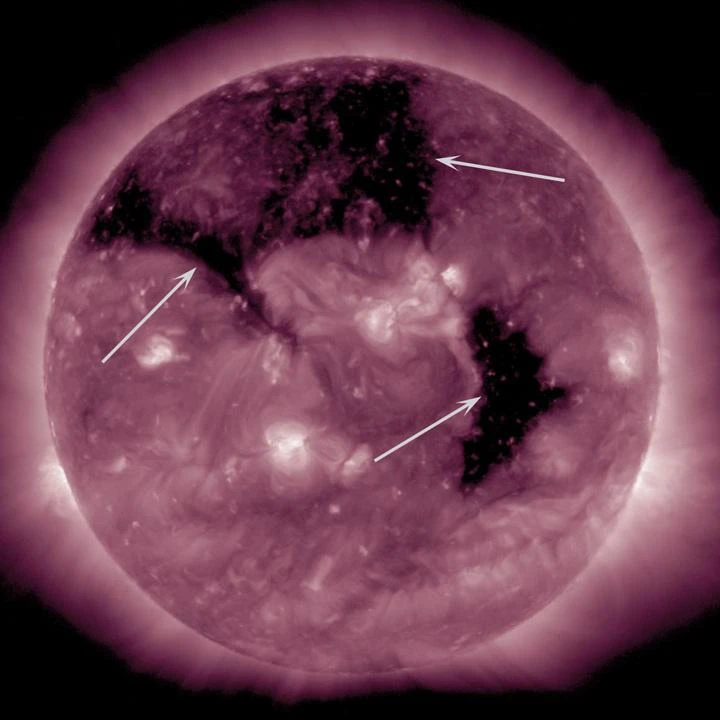
NASA’s Solar Dynamics Observatory posts new images of the Sun throughout the day. Never look at the Sun directly; NASA’s eclipse safety page explains how to view it safely (NASA). We cover the Sun’s temperatures in How Hot Is the Sun?
The Sun’s Age by the Numbers
| Measure | Value | Source |
|---|---|---|
| Age of the Sun | about 4.6 billion years | NASA |
| Oldest solids (CAIs) | 4,567.30 ± 0.16 million years | Connelly et al. 2012 |
| Helioseismic age | 4.57 ± 0.11 billion years | Bonanno et al. 2002 |
| Chondrule formation | continued for at least ~3 million years after the CAIs | ScienceDaily, 2012 |
| Life used so far | a little less than half | NASA |
| Main-sequence life left | about 5 billion years | NASA |
| Red giant tip (one model) | about 7.59 billion years from now | Schröder & Smith 2008 |
| Mass lost by then (same model) | about a third | Schröder & Smith 2008 |
| Share of the universe’s age | about one-third (DCI calculation) | How Old Is the Universe? |
| Total main-sequence life | roughly 10 billion years (DCI calculation) | NASA |
Sources checked November 2026.
Sun Age FAQ
How old is the Sun?
About 4.6 billion years, NASA says. The most precise estimates come from meteorite grains dated to 4,567.30 million years and from the Sun’s vibrations, which give 4.57 billion years.
How do scientists know how old the Sun is?
They date the oldest solids in the solar system, grains called CAIs found in meteorites, using uranium-lead radioactive clocks. Studies of the Sun’s vibrations, called helioseismology, give a matching age.
Is the Sun older than Earth?
Slightly. The Sun and the planets formed from the same cloud of gas and dust. Planet-building grains kept forming for at least a few million years after the oldest solids, and whole planets took longer to finish assembling.
How long will the Sun last?
NASA says the Sun is a little less than halfway through its life. It has about 5 billion more years of fusing hydrogen in its core; after that come the red giant stages and, later, a white dwarf.
Will the Sun become a red giant?
Yes. When the hydrogen in its core runs out, the Sun will swell into a red giant. One 2008 model puts the peak of that phase about 7.6 billion years from now.
Will the Sun swallow Earth?
Possibly. One detailed 2008 model concluded that Earth will not escape engulfment, but other models differ on the details. Scientists haven’t settled it.
Will the Sun explode?
No. The Sun isn’t massive enough to become a supernova. After its red giant phase, it will shed its outer layers and become a white dwarf.
How old is the solar system?
About 4.57 billion years, based on the oldest solids in meteorites, dated to 4,567.30 ± 0.16 million years. That’s also the best estimate for when the Sun formed.
Your next step: look for a chondrite meteorite on your next museum visit. If it has small white flecks, you may be looking at grains that formed around the same time as the Sun itself.
Sources and Further Reading
- NASA Science, Sun: Facts.
- Connelly, J. N., Bizzarro, M., Krot, A. N., Nordlund, Å., Wielandt, D. and Ivanova, M. A. (2012), The Absolute Chronology and Thermal Processing of Solids in the Solar Protoplanetary Disk, Science 338, 651.
- ScienceDaily (November 2, 2012), New theory on formation of solar system’s first stuff.
- Bollard, J., Connelly, J. N. and Bizzarro, M. (2015), Pb-Pb dating of individual chondrules from the CBa chondrite Gujba, Meteoritics & Planetary Science 50(7).
- Bonanno, A., Schlattl, H. and Paternò, L. (2002), The age of the Sun and the relativistic corrections in the EOS, Astronomy & Astrophysics, doi:10.1051/0004-6361:20020749.
- Schröder, K.-P. and Smith, R. C. (2008), Distant future of the Sun and Earth revisited, Monthly Notices of the Royal Astronomical Society.
- NASA Science, Types of Stars; Eclipse Safety.
- NASA images: PIA11237, ARC-1971-A71-7431, PIA18164, PIA19950, NGC 6565.
Explore Next
- How hot our star is, layer by layer: How Hot Is the Sun?
- Every stage from birth to white dwarf: The Life Cycle of a Star
- The bigger timeline: How Old Is the Universe?
- The neighbor that formed with us: How Far Is the Moon?
- All eight planets side by side: Solar System Explorer
- What white dwarf and red giant mean: Space Glossary
- How a claim earns its label: How We Know
How This Explainer Was Checked
Every number and quote in this article was checked in November 2026 against the source linked beside it: NASA’s Sun facts, Connelly et al. (2012) in Science and ScienceDaily’s report on it, Bollard et al. (2015) for the published CAI value, Bonanno et al. (2002), Schröder and Smith (2008), NASA’s Types of Stars page and NASA’s eclipse safety page. The CAI age is labelled Measured; the Sun’s age, its formation, its remaining lifetime and its red giant future are labelled Modelled; Earth’s fate is labelled Open. The share of the universe’s age and the total main-sequence lifetime are DCI calculations. Images are labelled: real spacecraft, telescope and museum photos as OBSERVATION, our charts as DATA GRAPHIC. Nothing AI-generated is presented as a real image.
Final Thought: A Middle-Aged Star
Our Sun has been shining for about 4.6 billion years, and it’s not quite halfway done. We know its age not from the Sun itself, but from tiny grains that formed alongside it and from the sound waves ringing through its interior. Two very different clocks, one answer: the Sun is old, steady and still in its prime.
About the Author
Author: King | Founder of Dark Cosmic Insights