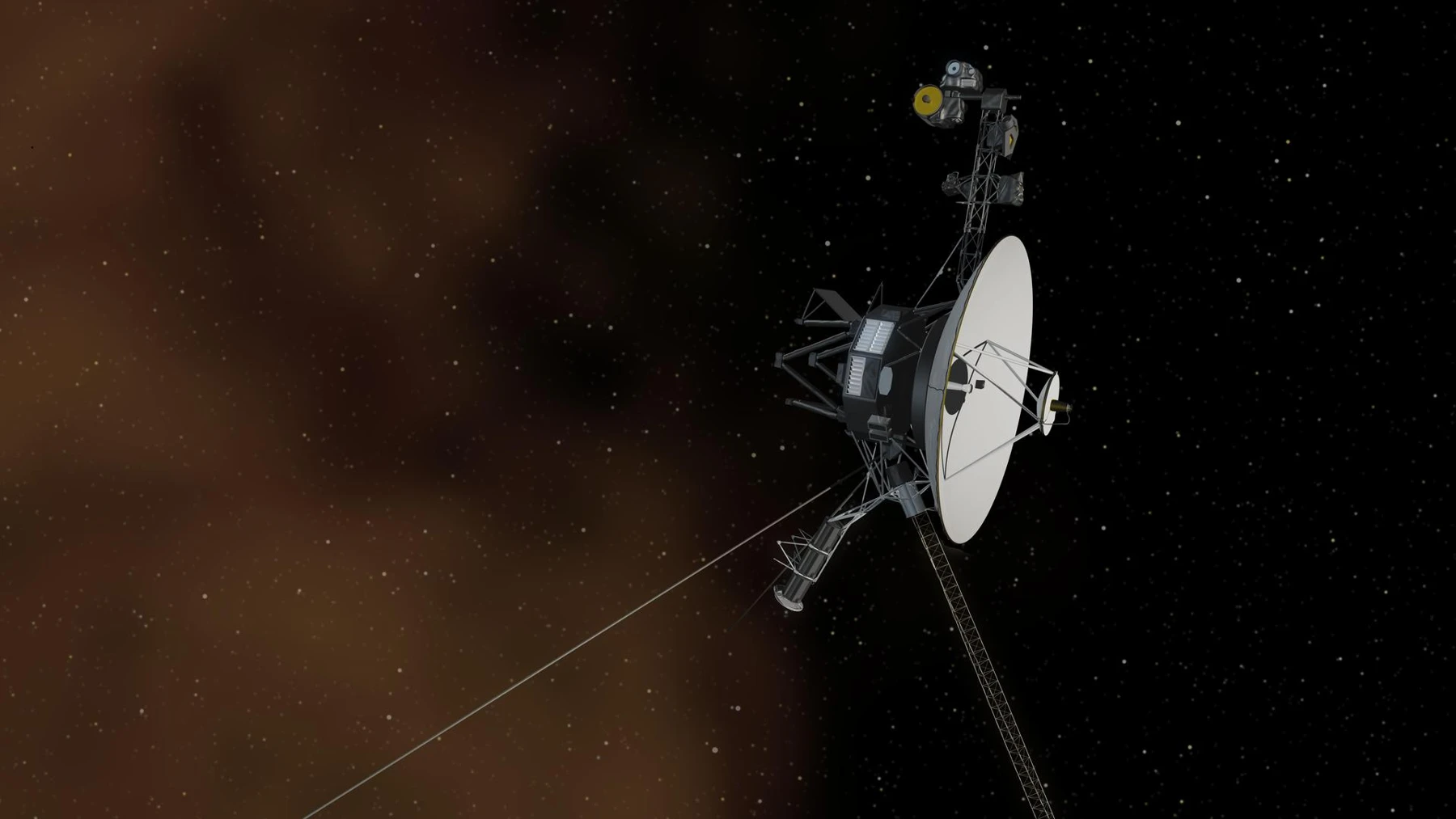
On November 18, 2026, at 5:16 a.m. Eastern time, NASA’s Voyager 1 is expected to reach one light-day from Earth. That’s about 25.9 billion km (16.1 billion miles), the distance light covers in 24 hours (NASA). It has taken Voyager 1 more than 49 years to get there.
A light-year is 365 and a quarter of those light-days. At Voyager 1’s current speed, crossing a single light-year would take roughly 17,700 years (DCI calculation). And the nearest star beyond the Sun is more than four light-years away.
Observed, measured, modelled, open. The light-year is a defined unit: its length follows exactly from the speed of light and the length of a Julian year. Distances to nearby stars are measured with parallax. Distances to faraway galaxies are modelled, using methods that depend on assumptions about the universe. Conversions here are DCI calculations from official figures, labelled as such.
Quick Answer: What Is a Light-Year?
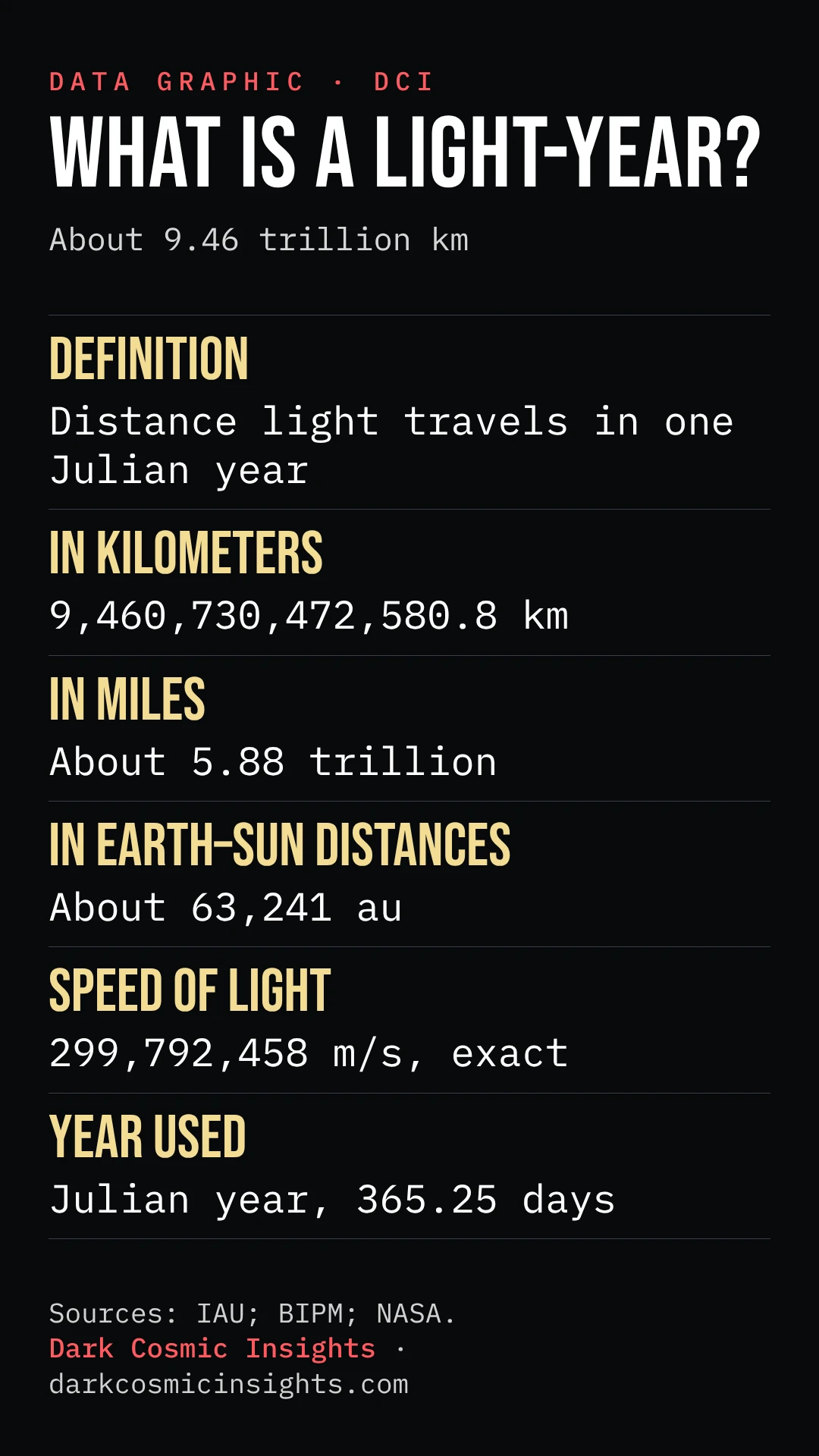
A light-year is the distance light travels in one year. It’s a measure of distance, not time. The International Astronomical Union (IAU) defines it as the distance light travels in a vacuum in one Julian year of 365.25 days: 9,460,730,472,580.8 km, or about 63,241 astronomical units (IAU). NASA rounds it to about 5.88 trillion miles (9.46 trillion km) (NASA). The nearest star beyond the Sun, Proxima Centauri, is about 4.24 light-years away.
What this article can and cannot establish. It can give you the exact definition of a light-year, how it compares with other units, and how astronomers measure distances in light-years. It can’t give equally precise distances for faraway galaxies, because those depend on models of how the universe has expanded while their light was traveling.
Table of Contents
The DCI Evidence Map: The Light-Year
| Question | What we know | Status | Key source |
|---|---|---|---|
| What is a light-year? | The distance light travels in one Julian year in a vacuum | Defined | IAU |
| How far is that? | 9,460,730,472,580.8 km, about 63,241 au | Defined | IAU |
| How fast is light? | Exactly 299,792,458 meters per second | Defined | BIPM |
| How far is a light-day? | About 25.9 billion km (16.1 billion miles) | Defined | NASA |
| When does Voyager 1 reach one light-day? | Expected November 18, 2026 | Calculated | NASA |
| How far is the nearest star beyond the Sun? | About 4.24 light-years | Measured | NASA |
| How big is a parsec? | About 3.26 light-years | Defined | OpenStax Astronomy 2e |
| How far are distant galaxies? | Depends on cosmological models | Modelled | Britannica |
Status key: Defined = fixed by an official definition, not measured. Observed = seen directly. Measured = a number with a stated uncertainty or a direct measurement. Modelled = inferred from measurements through a physical model, dependent on assumptions. Calculated = worked out from measured or defined values. Open = unresolved. Not supported = the evidence goes against the claim, or there is none for it.
Cite this framework: “DCI Evidence Map: The Light-Year,” Dark Cosmic Insights, November 2026, darkcosmicinsights.com/what-is-a-light-year/.
How Far Is a Light-Year?
About 9.46 trillion km
The IAU gives the light-year as 9,460,730,472,580.8 km (IAU). Rounded, that’s about 9.46 trillion km, or about 5.88 trillion miles, as NASA puts it (NASA).
About 63,000 Earth–Sun distances
Astronomers often measure distances inside the solar system in astronomical units (au). The IAU defines one au as exactly 149,597,870,700 meters, close to the average Earth–Sun distance. A light-year is about 63,241 au (IAU). So if you shrank the Earth–Sun distance to 1 centimeter, a light-year would be about 632 meters long (DCI calculation).
Hard to picture
A trillion of anything is hard to imagine. Here’s another way in: light travels about 299,792 km every second. Keep that up for a full year without stopping, and you’ve gone one light-year.
How Is a Light-Year Defined?
Two exact ingredients
A light-year is built from two fixed numbers. The first is the speed of light in a vacuum. The meter itself is defined by fixing that speed at exactly 299,792,458 meters per second (BIPM). It isn’t measured anymore; it’s set.
The Julian year
The second ingredient is the year. Calendar years vary (leap years have an extra day), so astronomers use the Julian year, which the IAU fixes at 365.25 days, or 31,557,600 seconds (IAU).
Multiply them together
Multiply 299,792,458 meters per second by 31,557,600 seconds, and you get exactly 9,460,730,472,580,800 meters, or 9,460,730,472,580.8 km. That’s why the IAU’s figure has a decimal point at the end: it isn’t rounded. It’s exact by definition.
Is a Light-Year a Unit of Time or Distance?
Distance
Despite the word “year,” a light-year measures distance. NASA’s glossary describes it as “a measure of distance, the distance light travels in one year” (NASA). Saying a star is “four light-years away” means it’s four times the distance light covers in a year.
Why the name confuses people
Everyday speech sometimes uses “light-years” to mean “a long time,” as in “light-years ahead.” That’s a figure of speech, not the scientific meaning.
But it does tell you about time
There’s one link to time. A star 4.24 light-years away is seen by light that left it about 4.24 years ago. So distances in light-years double as “lookback times” for nearby objects: the farther away something is, the further into its past you’re seeing.
Light-Seconds, Light-Minutes and Light-Days
Smaller cousins
The same idea works for any time span:
- A light-second is about 299,792 km, more than seven times around Earth’s equator (DCI calculation).
- A light-minute is about 18 million km (DCI calculation).
- A light-day is about 25.9 billion km (16.1 billion miles), NASA says (NASA).
The solar system in light-time
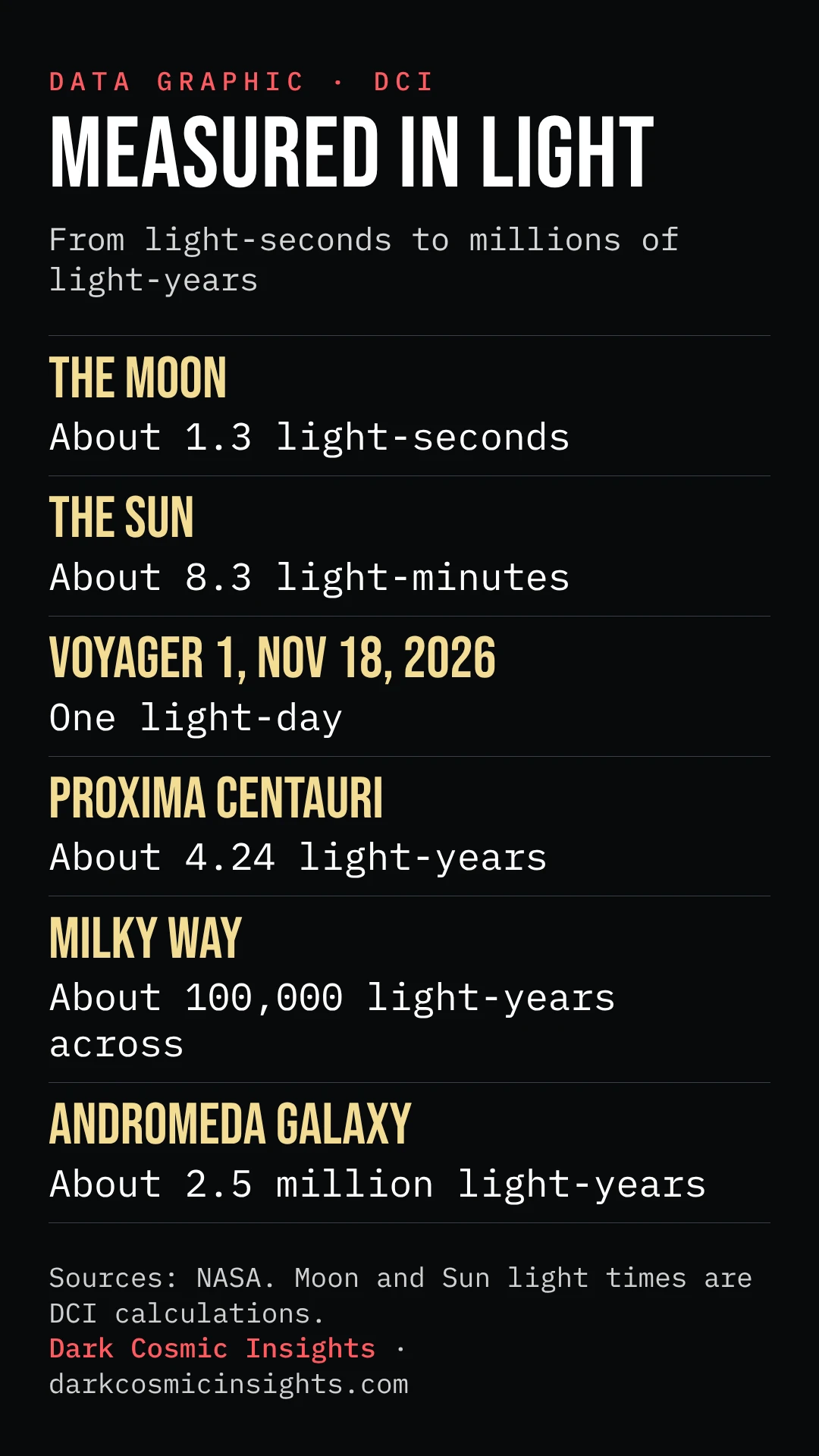
The Moon is about 1.3 light-seconds away, as we explain in How Far Is the Moon? The Sun is about 8.3 light-minutes away (DCI calculation from NASA’s 149.6 million km). Mars ranges from about 3 to 22 light-minutes, as we cover in How Far Is Mars?
Voyager 1’s milestone
Voyager 1 launched on September 5, 1977. NASA expects it to reach one light-day from Earth on Wednesday, November 18, 2026, at 5:16:07 a.m. EST (NASA). At that milestone, a signal takes about 24 hours to reach it one way, and an immediate round trip takes roughly 48 hours. Those times keep growing as Voyager moves farther away.
How Long Would It Take to Travel a Light-Year?
Voyager 1: about 17,700 years
NASA says Voyager 1 is “cruising at nearly 38,000 mph (61,000 kph)” (NASA). At that speed, one light-year would take about 17,700 years, and the 4.24 light-years to Proxima Centauri about 75,000 years (DCI calculations). Voyager 1 isn’t headed toward Proxima, but the numbers show the scale.
By car
At 100 km/h without stopping, driving one light-year would take about 10.8 million years (DCI calculation).
Light itself: one year
Light, of course, does it in exactly one year. Nothing with mass can travel as fast as light, which is why the light-year is such a useful yardstick: it’s the fastest any signal can cross that distance.
How Big Is a Light-Year Compared With the Solar System?
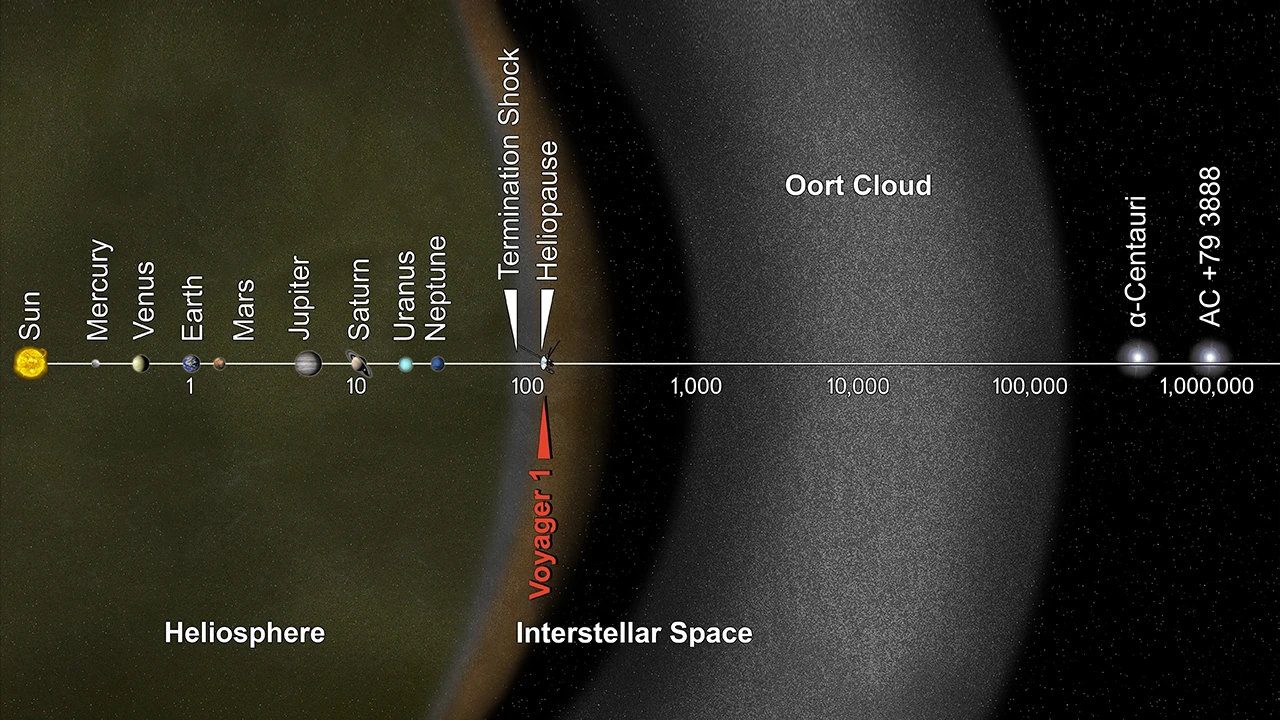
Neptune is about 4 light-hours away
Neptune, the most distant planet, orbits about 30 au from the Sun, NASA notes (NASA). That’s roughly 4.2 light-hours (DCI calculation). A light-year is about 2,100 times farther than Neptune (DCI calculation from the IAU’s 63,241 au).
Voyager’s half-century in light-time
Voyager 1 has been traveling for more than 49 years and is only now reaching one light-day. A light-year is 365.25 light-days, so Voyager 1 has crossed less than 0.3 percent of a single light-year (DCI calculation).
The gap between stars
Almost everything humans have explored sits within a few light-hours of the Sun. The nearest star beyond it is more than four light-years away. Between those two scales lies a vast, mostly empty gulf, which is exactly why the light-year exists.
Why Do Astronomers Use Light-Years?
Kilometers get unwieldy
Distances between stars are so large that kilometers become unreadable. The nearest star beyond the Sun is about 40.15 trillion km away, NASA says (NASA). “About 4.24 light-years” is far easier to say and compare.
Light-years in the galaxy
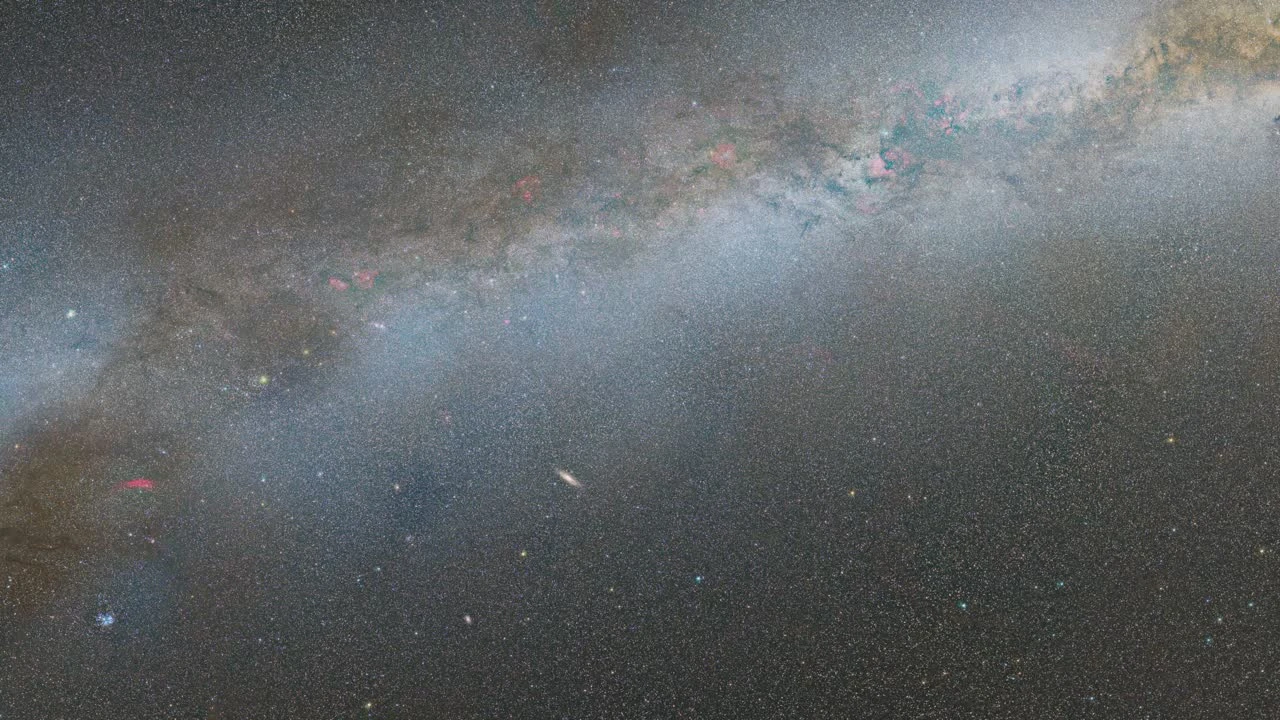
Our galaxy, the Milky Way, is about 100,000 light-years across, according to NASA (NASA). The Andromeda Galaxy, the large spiral galaxy nearest us, is about 2.5 million light-years away (NASA).
Lookback time
Because light takes time to travel, distance and time are linked. NASA’s Webb telescope has confirmed a galaxy called MoM-z14 as it was only about 280 million years after the big bang (NASA, 2026). For very distant objects, though, distance in light-years gets tricky, because the universe has been expanding while the light traveled. We explain that in How Big Is the Universe?
Light-Year vs. Parsec: What’s the Difference?
The parsec
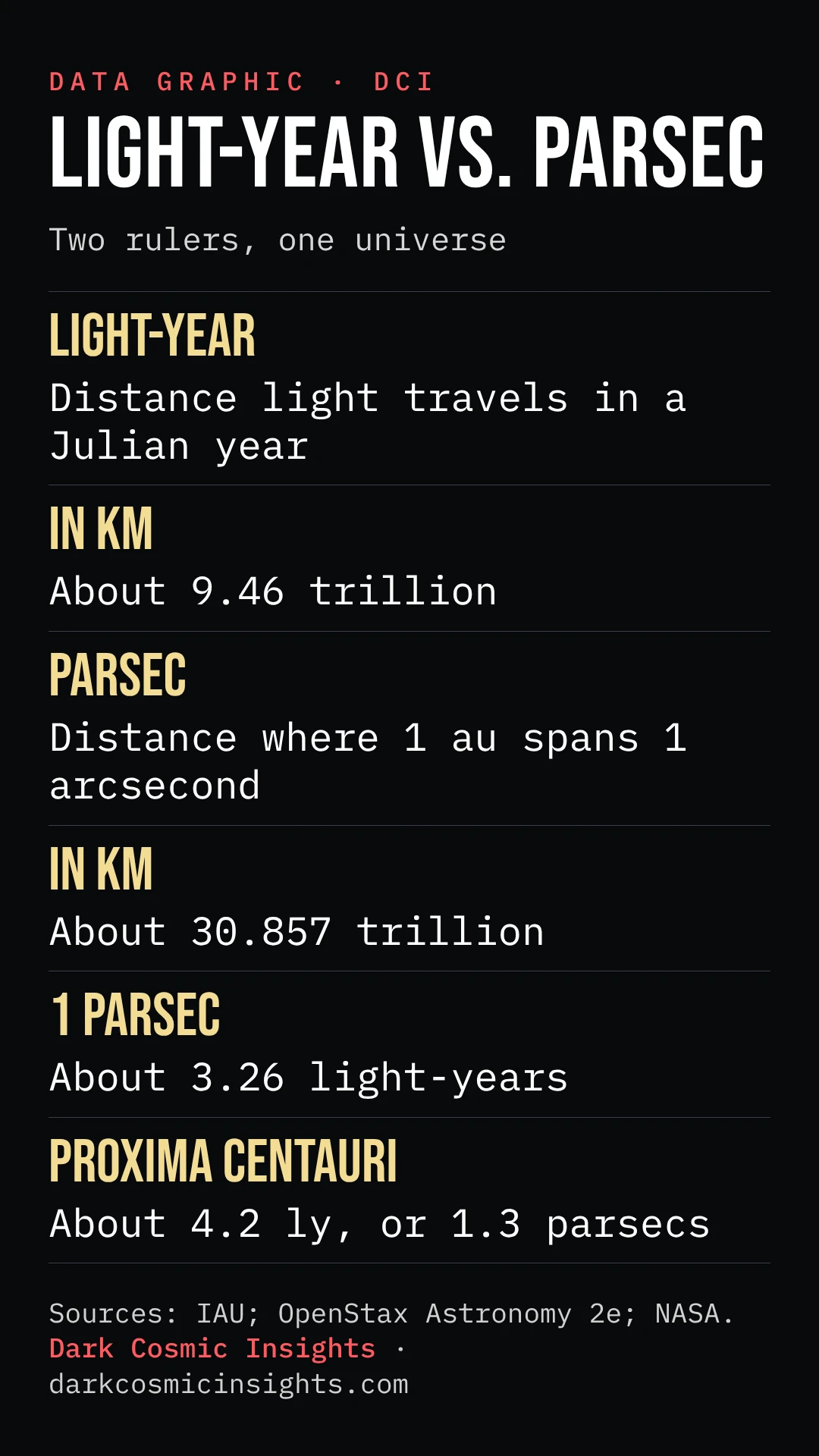
Professional astronomers often use the parsec instead. It’s defined by geometry: the distance at which one astronomical unit spans an angle of one arcsecond, a tiny fraction of a degree (IAU). The name comes from “parallax of one arcsecond.”
About 3.26 light-years
One parsec equals about 3.26 light-years, or about 31 trillion km (OpenStax Astronomy 2e). NASA gives Proxima Centauri’s distance as about 4.2 light-years (1.3 parsecs) (NASA).
Why two units?
The parsec connects directly to how star distances are measured, by parallax, which makes it convenient for astronomers. The light-year connects directly to the speed of light, which makes it easier for everyone else to picture. Both describe the same distances.
How Do Astronomers Measure Distances in Light-Years?
Parallax for nearby stars
As Earth orbits the Sun, nearby stars seem to shift slightly against more distant ones. That shift is called parallax. Measuring the angle gives the distance by simple geometry. The European Space Agency’s Gaia spacecraft, whose science observations ended in 2025 (ESA), mapped stellar positions and parallaxes with exceptionally high precision; analysis of its data continues.
Standard candles farther out
For more distant objects, astronomers use stars whose true brightness is known, called standard candles. Comparing how bright they look with how bright they really are gives the distance. Pulsating stars called Cepheid variables are a classic example. NASA describes the galaxy NGC 5468, about 130 million light-years from Earth, as “the farthest galaxy where Cepheids have been well measured” (NASA, 2024).
Models for the most distant galaxies
For the farthest galaxies, astronomers measure redshift, how much the light has been stretched by cosmic expansion, and convert it to a distance using a model of the universe. That’s why we label those distances Modelled.
Myth vs. Fact: Light-Years
| Myth | Fact | Status |
|---|---|---|
| “A light-year is a unit of time.” | It’s a distance: how far light goes in a year. | Defined |
| “A light-year is a rough figure.” | It’s exact: 9,460,730,472,580.8 km. | Defined |
| “The nearest star is light-years away.” | The nearest star is the Sun, 8.3 light-minutes away. | Calculated |
| “A parsec is a time unit.” | It’s a distance, about 3.26 light-years. | Defined |
| “We see distant stars as they are now.” | We see them as they were when their light left. | Observed |
| “Spacecraft have traveled light-years.” | Voyager 1 reaches its first light-day in November 2026. | Calculated |
How Can You See Light-Years for Yourself?
Find Andromeda
On a dark, moonless autumn night in the Northern Hemisphere, the Andromeda Galaxy appears as a faint smudge in the constellation Andromeda. That light left the galaxy about 2.5 million years ago (NASA).
Mark Voyager’s day
On November 18, 2026, Voyager 1 crosses one light-day (NASA). It’s a good night to think about how small a light-day is next to a light-year.
Look at the Sun’s light (safely)
Sunlight reaching you left the Sun about 8.3 minutes earlier. Never look at the Sun directly; we cover safe viewing in How Hot Is the Sun?
The Light-Year by the Numbers
| Measure | Value | Source |
|---|---|---|
| One light-year | 9,460,730,472,580.8 km | IAU |
| In miles | about 5.88 trillion | NASA |
| In astronomical units | about 63,241 au | IAU |
| Speed of light | 299,792,458 m/s, exact | BIPM |
| Julian year | 365.25 days | IAU |
| One light-day | about 25.9 billion km (16.1 billion mi) | NASA |
| One parsec | about 3.26 light-years | OpenStax |
| Proxima Centauri | about 4.24 light-years | NASA |
| Milky Way width | about 100,000 light-years | NASA |
| Andromeda Galaxy | about 2.5 million light-years | NASA |
Sources checked November 2026.
Light-Year FAQ
What is a light-year in simple terms?
It’s the distance light travels in one year, about 9.46 trillion km or 5.88 trillion miles. It’s used to measure the huge distances between stars and galaxies.
Is a light-year time or distance?
Distance. The word “year” refers to how long the light travels, not to the measurement itself. A star four light-years away is four times as far as light goes in a year.
How many miles are in a light-year?
About 5.88 trillion miles, NASA says. In kilometers, the IAU gives exactly 9,460,730,472,580.8 km.
How long would it take to travel one light-year?
Light takes exactly one year. Voyager 1, at about 61,000 km per hour, would need about 17,700 years. A car at 100 km/h would need about 10.8 million years.
How far is a light-day?
About 25.9 billion km, or 16.1 billion miles. Voyager 1 is expected to reach that distance from Earth on November 18, 2026.
What is the difference between a light-year and a parsec?
A parsec is about 3.26 light-years. It’s defined by geometry, the distance at which one astronomical unit spans one arcsecond, while the light-year is defined by the speed of light.
How far away is the nearest star in light-years?
The nearest star beyond the Sun, Proxima Centauri, is about 4.24 light-years away. The Sun itself is about 8.3 light-minutes away.
Why do we see the past when we look at stars?
Because their light takes time to reach us. Light from a star 100 light-years away left it about 100 years ago, so we see the star as it was then.
Your next step: on November 18, 2026, remember Voyager 1 crossing its first light-day. Then look up at any star you can see. Its light set out years, centuries or millennia ago.
Sources and Further Reading
- International Astronomical Union, Measuring the Universe: The IAU and Astronomical Units.
- BIPM, SI base unit: metre.
- NASA Science, Voyager 1: What Is a Light-Day?
- NASA Science, Basics of Space Flight Glossary.
- NASA Science, Hubble Image of Proxima Centauri.
- NASA (March 11, 2024), NASA’s Webb, Hubble Telescopes Affirm Universe’s Expansion Rate, Puzzle Persists.
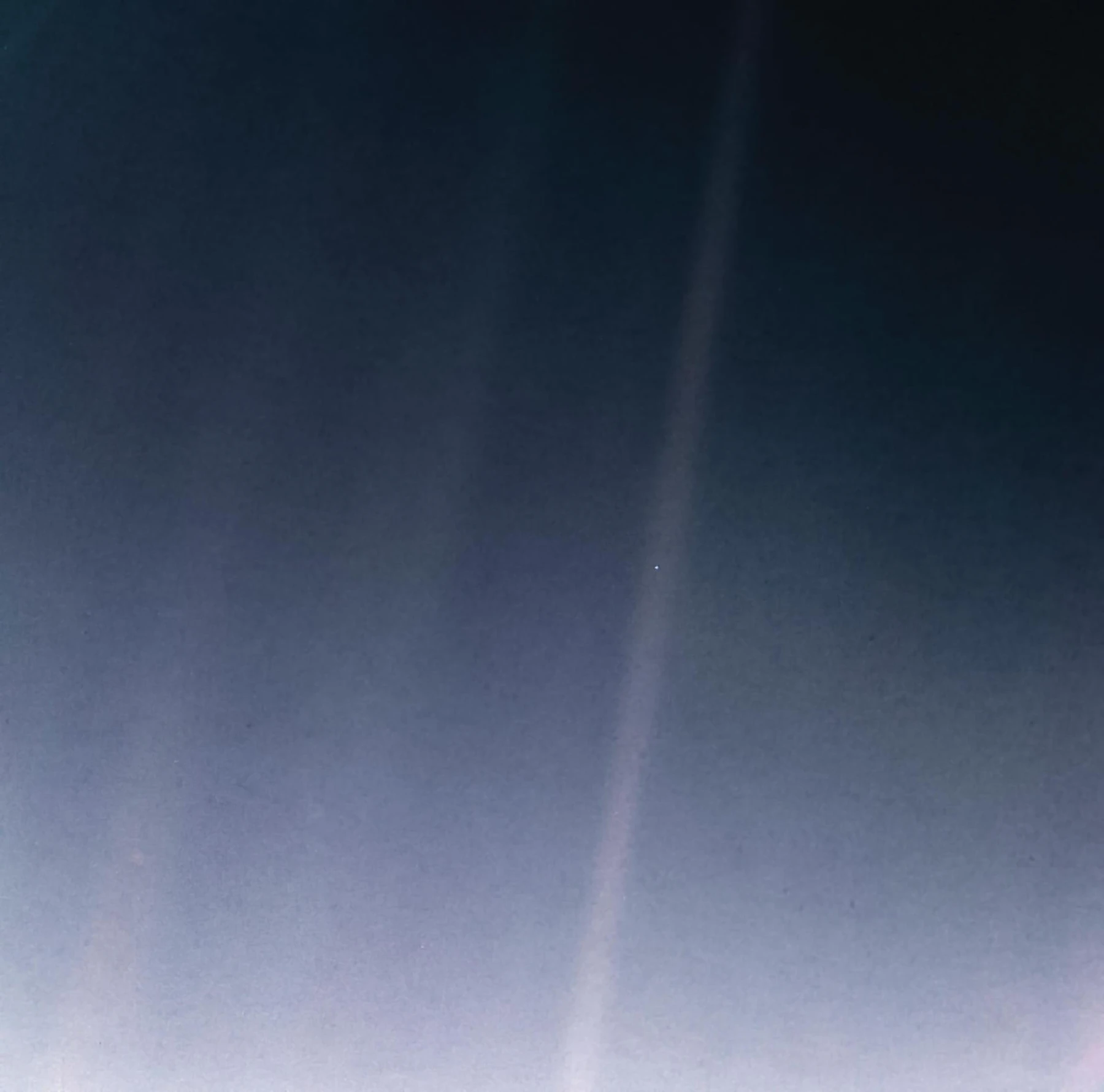
- NASA Science, Voyager 1’s Pale Blue Dot; ESA, Gaia end of observations.
- NASA Imagine the Universe, The Milky Way Galaxy.
- NASA Science, Messier 31 (The Andromeda Galaxy).
- NASA (January 28, 2026), NASA Webb Pushes Boundaries of Observable Universe Closer to Big Bang.
- Fraknoi, A., Morrison, D. and Wolff, S. C., Astronomy 2e, Section 19.2: Surveying the Stars, OpenStax.
- Britannica, Observable universe.
- NASA images: PIA23645, Solar System in Perspective, PIA17462, Andromeda panorama, PIA01967.
Explore Next
- The nearest stars, measured: What’s the Closest Star to Earth?
- From light-years to the edge: How Big Is the Universe?
- 1.3 light-seconds away: How Far Is the Moon?
- Our star, 8 light-minutes off: How Hot Is the Sun?
- The light from the beginning: How Old Is the Universe?
- What au and parsec mean: Space Glossary
- How a claim earns its label: How We Know
How This Explainer Was Checked
Every number and quote in this article was checked in November 2026 against the source linked beside it: the IAU’s units page, the BIPM’s definition of the metre, NASA’s Voyager light-day page and glossary, NASA’s Proxima Centauri, Milky Way and Andromeda pages, NASA’s January 2026 Webb release, OpenStax Astronomy 2e and Britannica. The light-year, au, Julian year and speed of light are labelled Defined; nearby star distances Measured; distant galaxy distances Modelled. Light-second and light-minute lengths, the Sun’s light time, scale-model and travel-time comparisons, and the exact meter product are DCI calculations. Images are labelled: real spacecraft and telescope images as OBSERVATION, NASA diagrams and artist’s concepts as such, our charts as DATA GRAPHIC. Nothing AI-generated is presented as a real image.
Final Thought: A Ruler Made of Light
The light-year turns the universe’s most fixed speed into a ruler. On that ruler, everything humans have built is still measured in light-hours. Voyager 1, after nearly half a century, is about to reach one light-day. The stars begin more than four light-years out, and the galaxies millions beyond that.
About the Author
Author: King | Founder of Dark Cosmic Insights