Picture standing on Mars at noon on a summer day near the equator. The Sun is out, the sky is hazy, and the ground under your boots might be about as warm as a cool spring day on Earth. NASA says the temperature on Mars “can be as high as 70 degrees Fahrenheit (20 degrees Celsius)” (NASA).
Now wait for nightfall. Within hours, the warmth drains away into space. Near the poles in winter, NASA says, the temperature can fall “as low as about -225 degrees Fahrenheit (-153 degrees Celsius)” (NASA). Mars is a cold planet with very little ability to hold on to heat, and that makes its temperatures some of the jumpiest in the solar system.
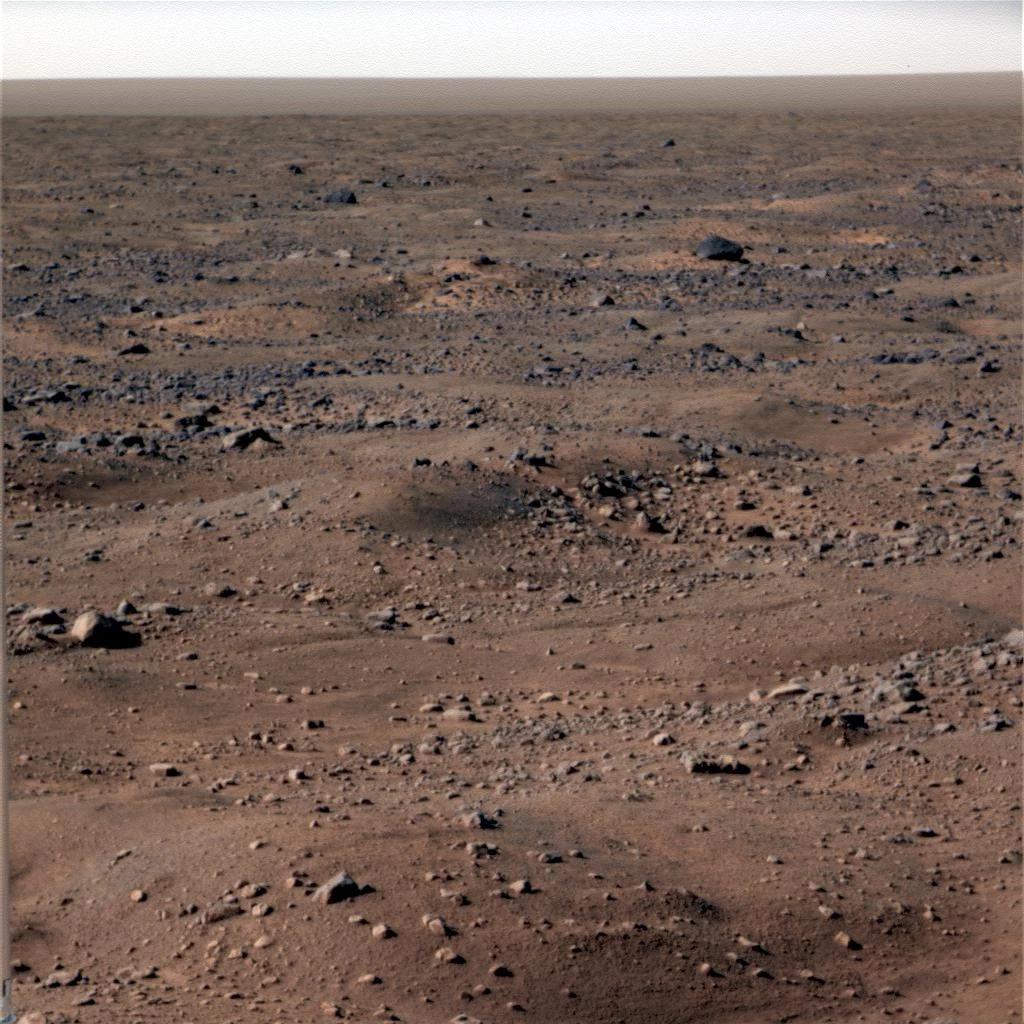
Observed, measured, modelled, open. Mars’s temperatures are measured by landers, rovers and orbiters. Its average temperature is a measured global estimate. Its frost and polar caps are observed. How warm Mars was billions of years ago, when water flowed, is still open.
Quick Answer: How Cold Is Mars?
NASA’s fact sheet gives Mars an average temperature of about −59 °C (−74 °F) (NASA NSSDC). But averages hide huge swings. NASA says temperatures can reach about 20 °C (70 °F) and fall to about −153 °C (−225 °F) (NASA). At the Viking 1 landing site, NASA’s fact sheet lists a daily range from about −89 °C to −31 °C, a swing of nearly 60 degrees in a single day (NASA NSSDC). Mars is cold because it’s farther from the Sun than Earth and because its air is so thin, about 0.6 percent of Earth’s surface pressure, that it can’t hold heat.
What this article can and cannot establish. It can give you Mars’s measured average temperature, its measured highs, lows and daily swings, and the reasons behind them. It cannot give you one temperature for “Mars,” because it varies enormously with place, season and time of day. And it can’t settle how warm ancient Mars was, a question scientists are still working on.
Table of Contents
The DCI Evidence Map: Mars’s Temperature
| Question | What we know | Status | Key source |
|---|---|---|---|
| What’s the average temperature? | About −59 °C (214 K) | Measured | NASA NSSDC |
| How warm can it get? | About 20 °C (70 °F) | Measured | NASA |
| How cold can it get? | About −153 °C (−225 °F) | Measured | NASA |
| How big are daily swings? | About −89 °C to −31 °C at Viking 1 | Measured | NASA NSSDC |
| How thin is the air? | About 6.36 millibars, about 0.6% of Earth’s | Measured | NASA NSSDC |
| Does carbon dioxide freeze out? | Yes, as frost and seasonal polar ice | Observed | NASA, PIA20758 |
| How warm was ancient Mars? | Not settled | Open | Astronomy Now, on Grotzinger et al. 2015 |
Status key: Observed = seen directly. Measured = a number with a stated uncertainty or a direct measurement. Modelled = inferred from measurements through a physical model, dependent on assumptions. Open = unresolved; the evidence is incomplete or points different ways. Not supported = the evidence goes against the claim, or there is none for it.
Cite this framework: “DCI Evidence Map: Mars’s Temperature,” Dark Cosmic Insights, November 2026, darkcosmicinsights.com/how-cold-is-mars/.
How Cold Is Mars on Average?
About −59 °C
NASA’s Mars fact sheet lists an average temperature of about 214 K, or −59 °C (NASA NSSDC). That’s about −74 °F (DCI conversion). Earth’s average, for comparison, is about 15 °C on NASA’s planetary comparison table (NASA NSSDC).
An average of extremes
An average is a useful way to compare planets, but no one on Mars would feel it for long. Mars has a solid surface, unlike the giant planets, so these are real ground-level and near-surface temperatures. They change dramatically from day to night, from season to season, and from the equator to the poles.
How Hot and How Cold Does Mars Get?
The warmest: about 20 °C
NASA says the temperature on Mars “can be as high as 70 degrees Fahrenheit (20 degrees Celsius)” (NASA). That happens near the equator, on summer afternoons, at the ground. Even then, the air a little above the ground is much colder.
The coldest: about −153 °C
At the other extreme, NASA says Mars can get “as low as about -225 degrees Fahrenheit (-153 degrees Celsius)” (NASA). Those lows happen near the poles in winter, during the long polar night.
The daily swing
The most striking thing about Mars’s temperature is how fast it changes. At NASA’s Viking 1 landing site, the fact sheet lists a daily range from about 184 K to 242 K, or −89 °C to −31 °C (NASA NSSDC). That’s a 58-degree change between night and day (DCI calculation). On Earth, a daily swing of 20 degrees is considered large.

Why Is Mars So Cold?
It’s farther from the Sun
Mars orbits about 1.5 times farther from the Sun than Earth (NASA). Sunlight spreads out with distance, so Mars gets less of it. NASA’s fact sheet lists 586.2 watts per square meter at Mars, about 43 percent of what Earth receives (NASA NSSDC). We cover the distance in How Far Is Mars?
Its air is too thin to hold heat
This is another major reason, and it’s behind Mars’s huge day–night swings. Mars’s average surface pressure is about 6.36 millibars, varying seasonally from about 4.0 to 8.7 (NASA NSSDC). Earth’s sea-level pressure is about 1,013 millibars, so Mars’s average surface pressure is about 0.6 percent of Earth’s sea-level pressure (DCI calculation). NASA describes Mars’s atmosphere as “thin” and made “mostly of carbon dioxide, nitrogen, and argon gases” (NASA).
Thin air works like a threadbare blanket. Earth’s thick atmosphere traps heat and spreads it around, keeping nights from getting too cold. On Mars, heat absorbed by the ground in the day radiates straight back to space at night.
Carbon dioxide alone isn’t enough
Mars’s air is about 95 percent carbon dioxide by volume (NASA NSSDC), a greenhouse gas. But there’s so little air overall that the greenhouse warming is weak. Compare Venus, where a thick carbon dioxide atmosphere drives surface temperatures to about 464 °C, in our guide to the hottest planet.
Its sunlight-only temperature
NASA’s fact sheet gives Mars a black-body temperature of 209.8 K (about −63 °C), the temperature it would have from sunlight alone, with its reflectivity but no atmosphere (NASA NSSDC; NASA NSSDC notes). Mars’s actual average, about 214 K, is only a little warmer, a sign of how little its atmosphere adds.

Frost, Ice and Seasons
The air itself freezes
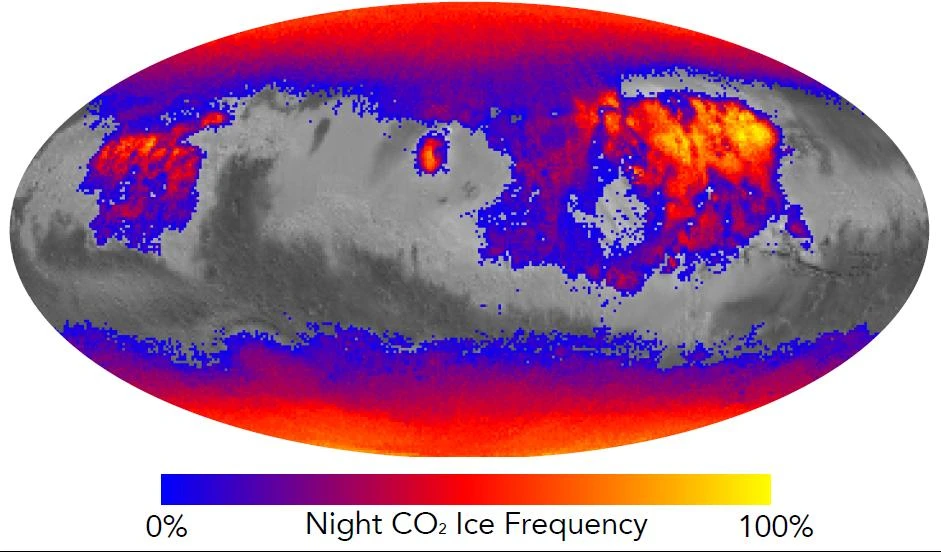
Mars gets so cold that part of its atmosphere freezes. Carbon dioxide frost forms on the ground at night in many regions. NASA’s Mars Reconnaissance Orbiter mapped where it appears, finding that carbon dioxide ice “more often covers the ground at night in some mid-latitude regions than in polar regions” (NASA, PIA20758).
Polar caps that grow and shrink
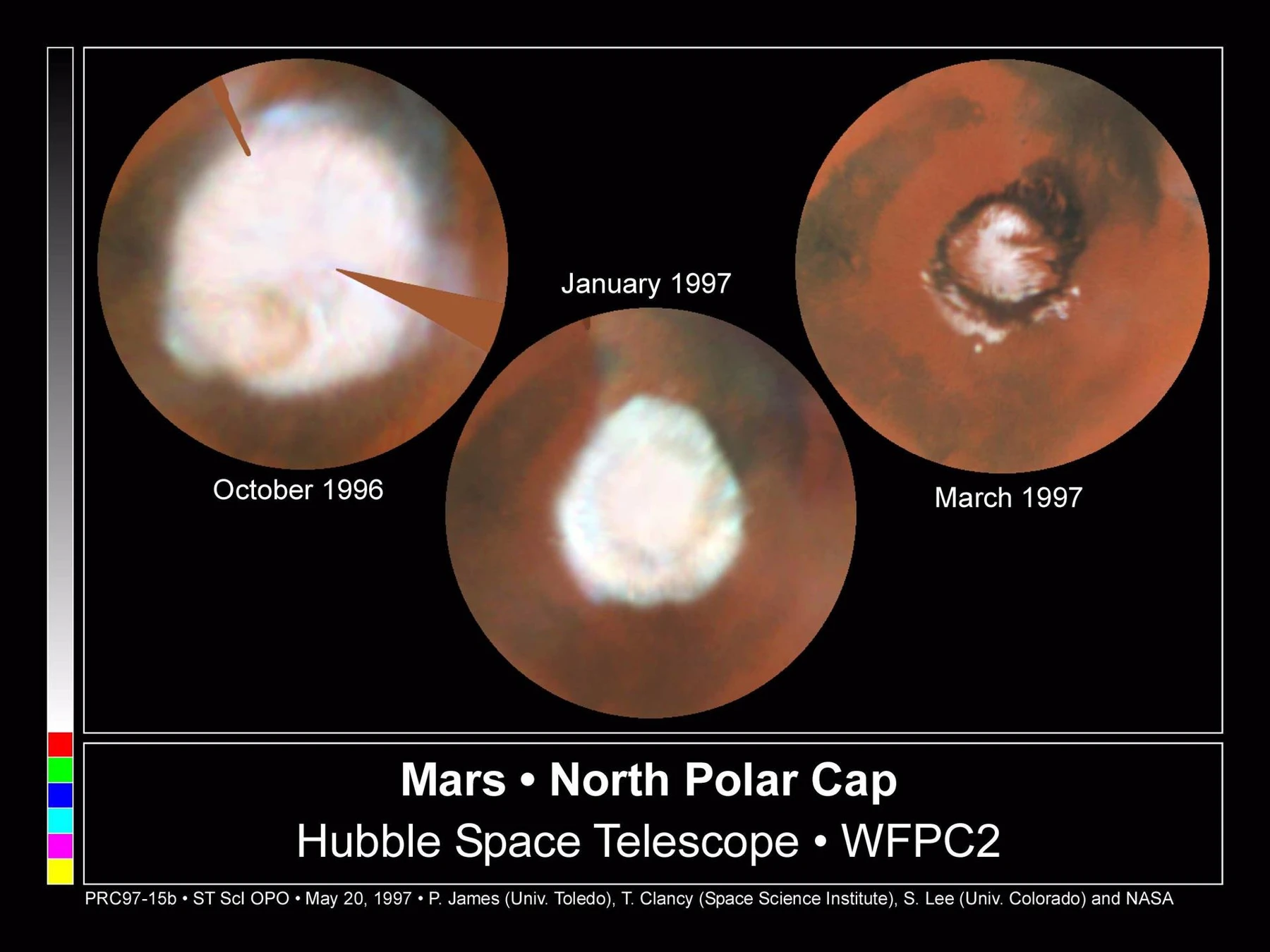
Mars has seasons because its axis is tilted about 25 degrees, close to Earth’s (NASA NSSDC). Its polar caps change with them. Hubble watched the north polar cap change with the seasons (NASA, PIA01247). Each Mars year lasts about 687 Earth days, so each season lasts roughly twice as long as ours.
Dust storms change the temperature
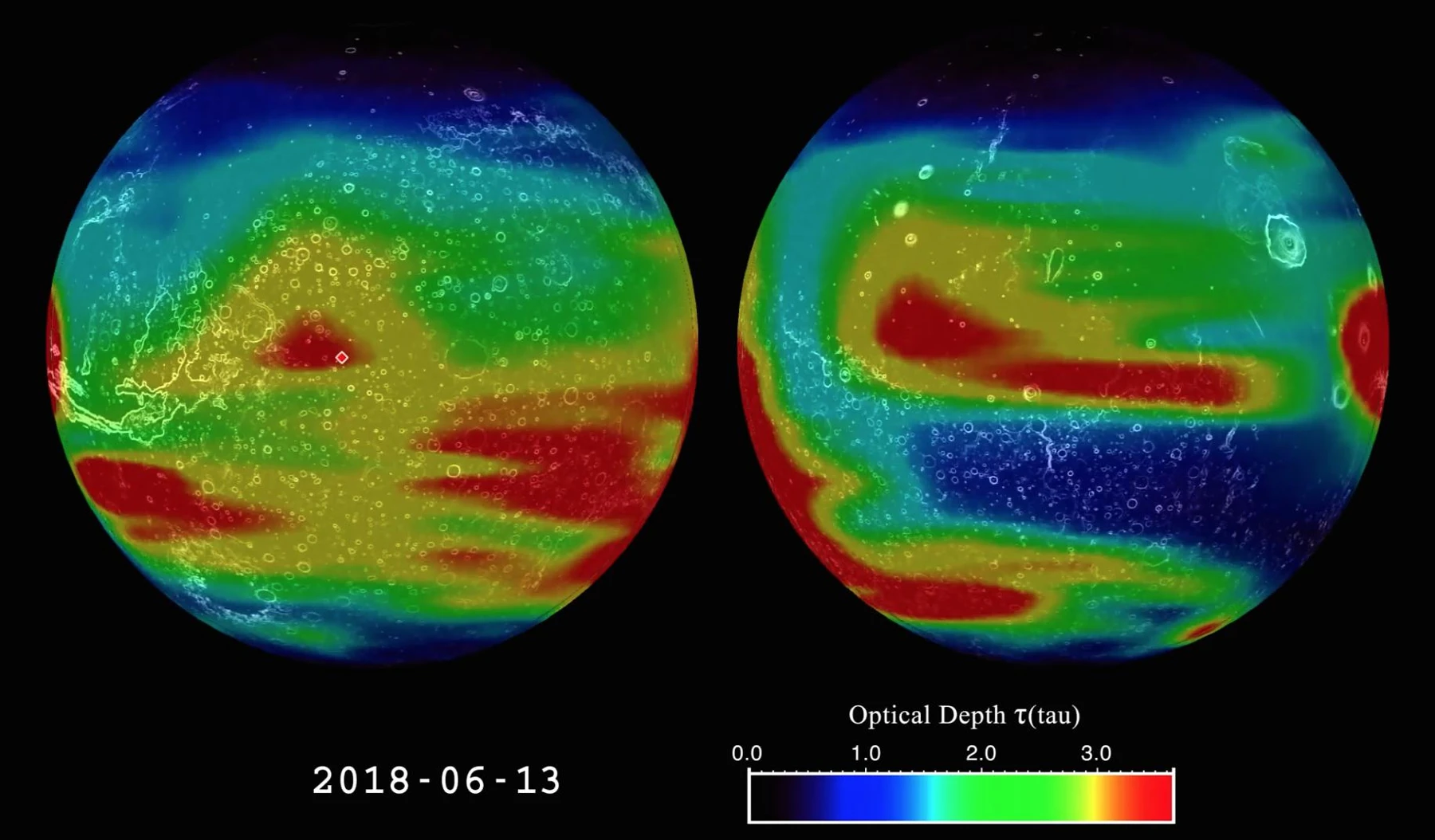
Dust storms can also reshape Mars’s weather. NASA notes that winds can create “dust storms that cover much of the planet” (NASA). Dust in the air absorbs sunlight, warming the atmosphere while shading the ground. During the planet-wide storm of 2018, NASA’s Mars Reconnaissance Orbiter tracked the dust spreading across Mars (NASA, PIA22737).
Could Humans Survive the Cold on Mars?
Not without help
The cold alone would be dangerous, but it isn’t the only problem. Mars’s thin air means astronauts would need a pressurized suit that supplies breathable oxygen and protects them from the cold. NASA notes the atmosphere is “too thin for liquid water to exist for long on the surface” (NASA).
Heat for rovers too
Robots need protection as well. Rovers carry heaters and insulated “warm boxes” for their electronics. Curiosity and Perseverance use nuclear power sources that also give off heat, which helps them through freezing nights. When the 2018 dust storm blocked sunlight at Opportunity’s site, the solar-powered rover went silent. A dust storm covered Opportunity in June 2018 (NASA, PIA22329).
Was Mars Ever Warm?
Evidence of a wetter past
There’s strong evidence Mars once had flowing water: NASA says it “appears to have had a watery past, with ancient river valley networks, deltas, and lakebeds” (NASA). Liquid water on the surface would suggest warmer conditions, a thicker atmosphere, or both.
The puzzle
How Mars stayed warm enough is still debated. When Curiosity’s team reported long-lived lakes in Gale Crater in 2015, they noted that for flowing water to have existed, “Mars must have had a thicker atmosphere and warmer climate,” yet paleoclimate models at the time had “literally, come up dry” (Astronomy Now, 2015). That question is open. We follow the evidence in Was There Water on Mars?

Myth vs. Fact: Mars’s Temperature
| Myth | Fact | Status |
|---|---|---|
| “Mars is a hot desert because it’s red.” | It averages about −59 °C; the red is rusted iron. | Measured |
| “Mars is always freezing.” | It can reach about 20 °C on summer afternoons near the equator. | Measured |
| “Its carbon dioxide air should keep it warm.” | Its surface pressure is only about 0.6% of Earth’s, so the warming is weak. | Measured |
| “Mars’s temperature is steady.” | At Viking 1 it swung about 58 °C between day and night. | Measured |
| “Only water freezes on Mars.” | Carbon dioxide from the air freezes into frost and polar ice. | Observed |
| “We know exactly how warm ancient Mars was.” | Scientists still debate it. | Open |
How Can You Explore Mars’s Weather Yourself?
Check the daily Mars weather
NASA’s rover teams share weather readings from the surface. Searching for Curiosity or Perseverance weather reports will show you real highs and lows from Gale and Jezero craters.
Watch the polar caps
Around opposition, a telescope can show Mars’s white polar cap. Over weeks and months, you may see it shrink as spring comes to that hemisphere. Mars’s next opposition is February 19, 2027 (Royal Observatory Greenwich).
Compare the planets
Our Solar System Explorer compares temperatures across all eight planets, from Venus’s 464 °C to Neptune’s −200 °C.
Mars’s Temperature by the Numbers
| Measure | Value | Source |
|---|---|---|
| Average temperature | about −59 °C (214 K) | NASA NSSDC |
| Highest | about 20 °C (70 °F) | NASA |
| Lowest | about −153 °C (−225 °F) | NASA |
| Daily range at Viking 1 | about −89 °C to −31 °C | NASA NSSDC |
| Black-body temperature | 209.8 K | NASA NSSDC |
| Surface pressure | about 6.36 mb (4.0–8.7) | NASA NSSDC |
| Carbon dioxide in the air | about 95.1% | NASA NSSDC |
| Sunlight received | 586.2 W/m², about 43% of Earth’s | NASA NSSDC |
| Axial tilt | 25.19° | NASA NSSDC |
Sources checked November 2026.
Mars Temperature FAQ
What is the average temperature on Mars?
About −59 °C, or −74 °F, according to NASA’s Mars fact sheet. But temperatures swing widely with place, season and time of day.
How hot does Mars get?
NASA says it can reach about 20 °C (70 °F), on summer afternoons near the equator, measured at the ground.
How cold does Mars get?
As low as about −153 °C (−225 °F), NASA says, near the poles in winter.
Why does Mars’s temperature change so much between day and night?
Its air is very thin, with a surface pressure about 0.6 percent of Earth’s, so it can’t hold much heat. At the Viking 1 site, temperatures swung from about −89 °C at night to about −31 °C in the day.
Is Mars colder than Earth?
Much colder. Mars averages about −59 °C; Earth averages about 15 °C on NASA’s planetary comparison table.
Does it snow on Mars?
Mars gets frost, including carbon dioxide frost that forms on the ground at night in many regions, and its polar caps grow and shrink with the seasons. The atmosphere also forms clouds of ice.
Could a person survive Mars’s temperatures?
Not without a pressurized, heated suit or habitat. The cold is only part of the problem: the air is too thin to breathe and too thin for liquid water to last on the surface.
Was Mars warmer in the past?
Probably, at least at times. River valleys, deltas and lakebeds show water once flowed. How Mars stayed warm enough is still debated.
Your next step: next time you see Mars’s steady orange glow, remember that its ground may have dropped below −80 °C last night and could warm by 50 degrees or more by its afternoon.

Sources and Further Reading
- NASA Science, Mars: Facts.
- NASA Space Science Data Coordinated Archive, Mars Fact Sheet; Planetary Fact Sheet; Fact Sheet Notes.
- Astronomy Now (October 8, 2015), NASA’s Curiosity rover team confirms ancient lakes on Mars, on Grotzinger et al., Science.
- Royal Observatory Greenwich, What is a planet in opposition?
- NASA images: PIA01247, PIA20758, PIA22737, PIA22329, PIA11132, PIA24935.
Explore Next
- What Mars’s thin air sounds like: Can Sound Travel Through Space?
- Mars’s two small moons: How Many Moons Does Mars Have?
- How rovers survive and find their way: How Do Mars Rovers Navigate?
- The opposite extreme: What Is the Hottest Planet?
- The temperatures of space itself: How Cold Is Space?
- Every planet in one place: Solar System Explorer
- How a claim earns its label: How We Know
How This Explainer Was Checked
Every number and quote in this article was checked in November 2026 against the source linked beside it: NASA’s Mars facts, NASA’s Mars and planetary fact sheets and notes, Astronomy Now’s 2015 report on the Curiosity lake study, the Royal Observatory Greenwich opposition table, and NASA’s image pages. Temperatures, pressure and composition are labelled Measured. Frost and polar-cap changes are labelled Observed. How warm ancient Mars was is labelled Open. Fahrenheit conversions, the pressure and sunlight percentages, and the daily swing are DCI calculations. Images are labelled: real spacecraft and telescope images as OBSERVATION, our charts and data maps as DATA GRAPHIC. Nothing AI-generated is presented as a real image.
Final Thought: A Planet Without a Blanket
Mars is cold for two big reasons: it gets less than half the sunlight Earth does, and it has lost most of its atmosphere. With only a wisp of air left, it warms quickly in sunlight and loses that warmth just as fast after dark. Somewhere in its past, rivers ran and lakes filled, which means Mars once had a better blanket. Working out what happened to it is one of the big stories in planetary science.
About the Author
Author: King | Founder of Dark Cosmic Insights