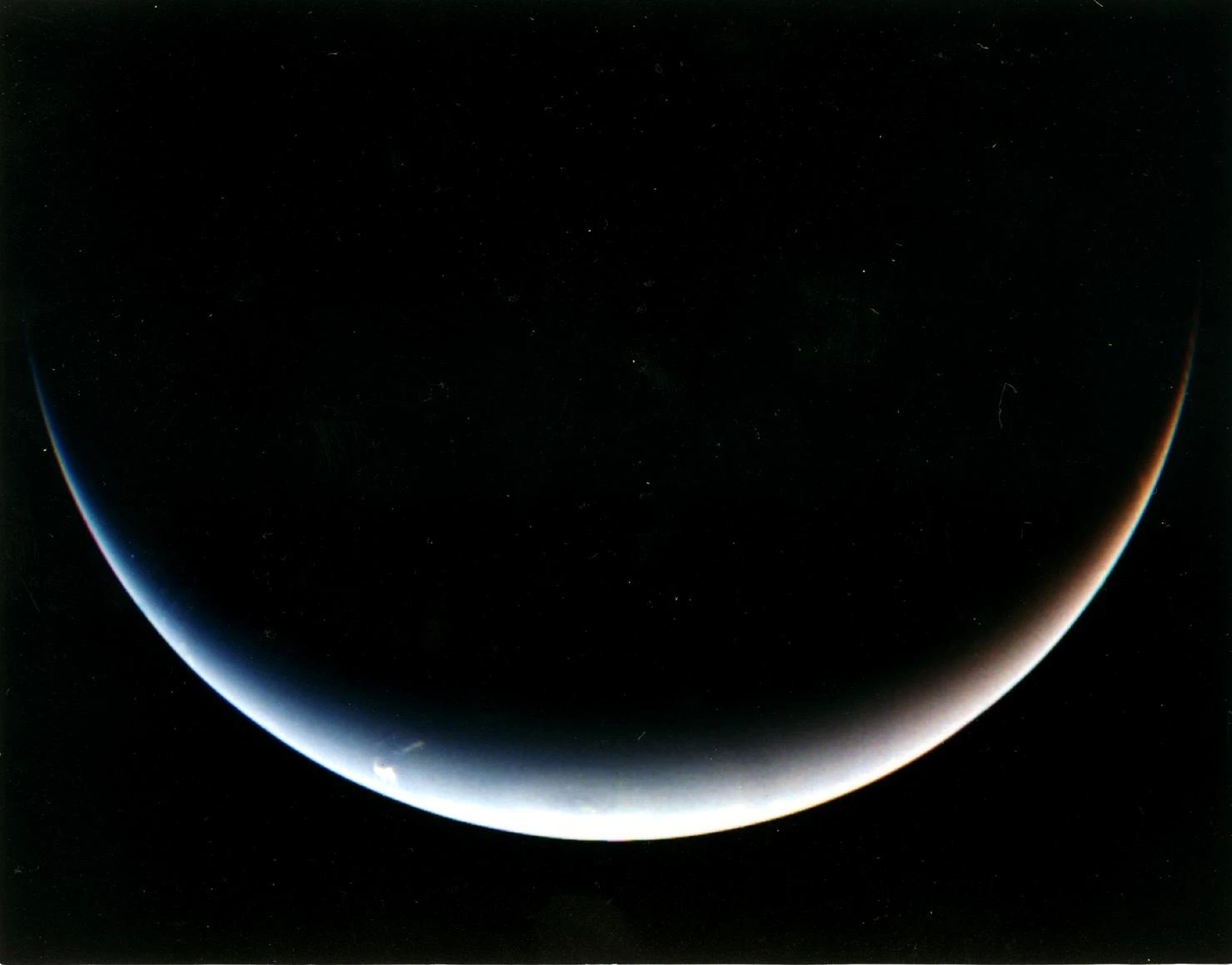
On August 25, 1989, NASA’s Voyager 2 skimmed about 4,800 km above Neptune’s cloud tops (NASA, Voyager 2). It had left Earth 12 years earlier. Its radio signals, traveling at the speed of light, took about four hours to get home. And when its cameras turned back for a last look, Neptune was a thin blue crescent fading into the dark.
No spacecraft has been back since. NASA notes that Voyager 2 “is the only spacecraft to visit Uranus and Neptune” (NASA, Voyager 2). That’s what distance means at the edge of the planets.
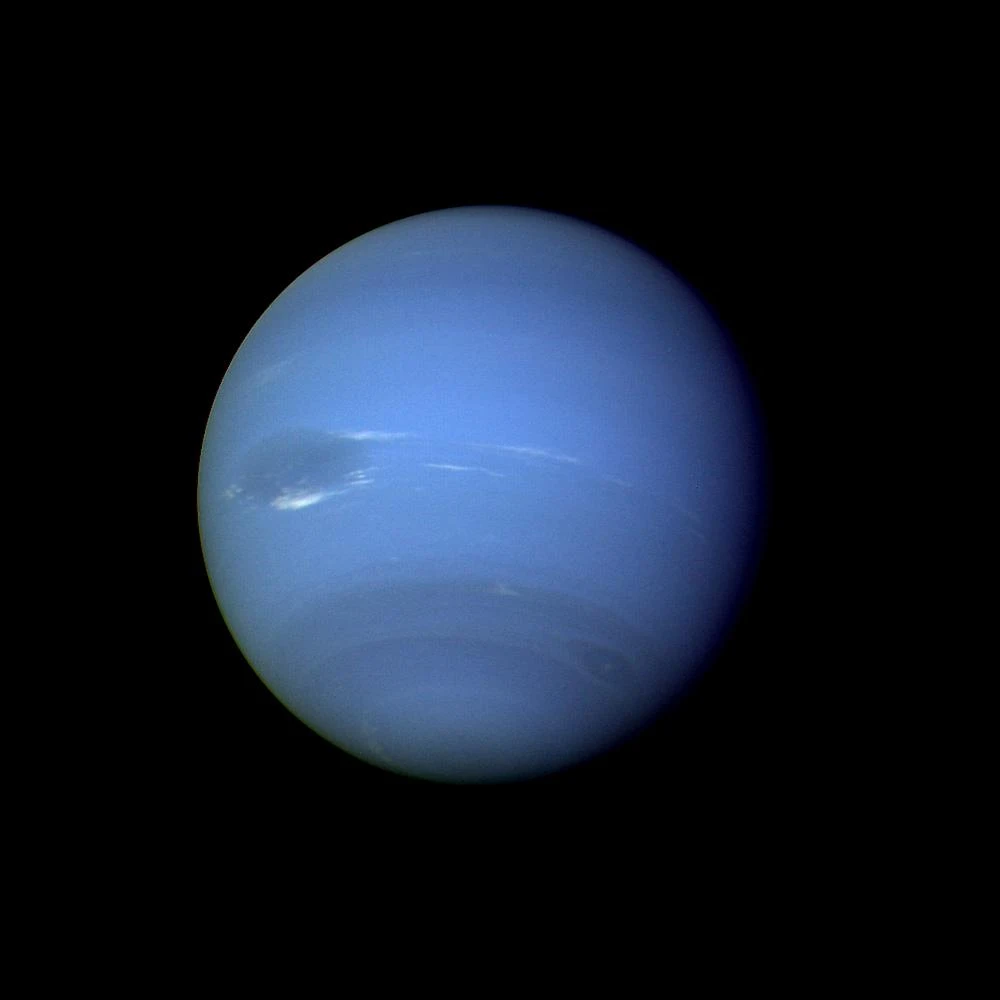
Observed, measured, modelled, open. Neptune’s distances and orbit are measured to high precision. Voyager 2’s journey is an observed fact. Light-travel times and comparisons here are DCI calculations from NASA’s measured distances, labelled as such.
Quick Answer: How Far Is Neptune?
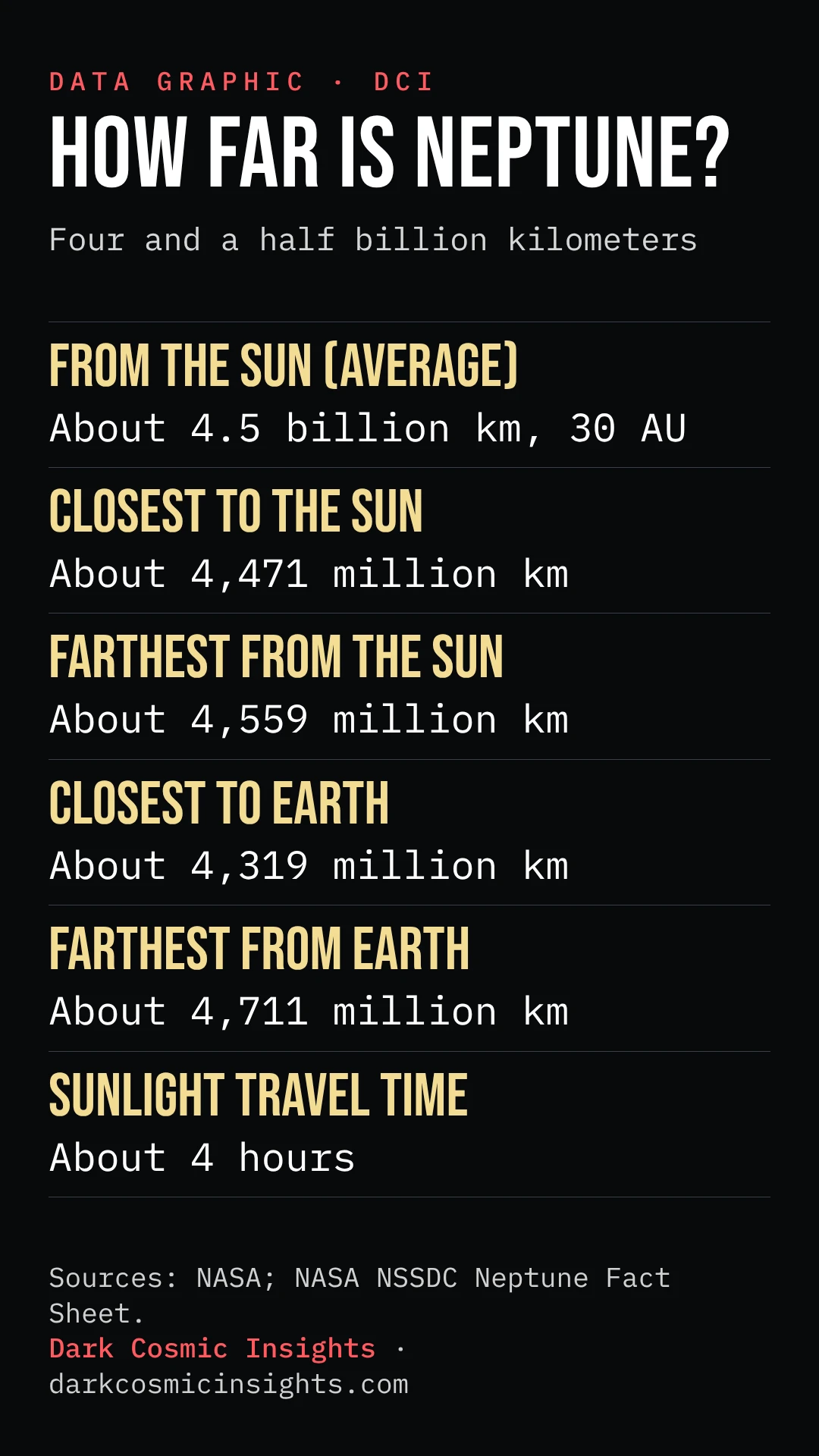
Neptune is about 4.5 billion km (2.8 billion miles) from the Sun on average, or about 30 astronomical units (AU), meaning 30 times Earth’s distance from the Sun (NASA). From Earth, it ranges from about 4,319 million km at its closest to about 4,711 million km at its farthest (NASA NSSDC). Sunlight takes about 4 hours to reach it (NASA). The only spacecraft to get there, Voyager 2, took 12 years. And one Neptune year lasts about 165 Earth years.
What this article can and cannot establish. It can give you Neptune’s measured distances from the Sun and from Earth, the light-travel times that follow from them, Voyager 2’s real journey and the length of a Neptune year. It cannot give one fixed Earth-to-Neptune distance, because both planets keep moving, and it can’t give a launch date for a next mission, because none is approved and scheduled.
Table of Contents
The DCI Evidence Map: Neptune’s Distance
| Question | What we know | Status | Key source |
|---|---|---|---|
| How far from the Sun, on average? | About 4.5 billion km (30 AU) | Measured | NASA |
| Closest and farthest from the Sun? | About 4,471 and 4,559 million km | Measured | NASA NSSDC |
| How far from Earth? | About 4,319 to 4,711 million km | Measured | NASA NSSDC |
| How long does sunlight take? | About 4 hours | Measured | NASA |
| How long did Voyager 2 take? | About 12 years (1977 to 1989) | Observed | NASA, Voyager 2 |
| How long is a Neptune year? | About 165 Earth years | Measured | NASA |
| Can you see it with the naked eye? | No; it’s too faint | Measured | NASA NSSDC |
Status key: Observed = seen directly. Measured = a number with a stated uncertainty or a direct measurement. Modelled = inferred from measurements through a physical model, dependent on assumptions. Open = unresolved; the evidence is incomplete or points different ways. Not supported = the evidence goes against the claim, or there is none for it.
Cite this framework: “DCI Evidence Map: Neptune’s Distance,” Dark Cosmic Insights, November 2026, darkcosmicinsights.com/how-far-is-neptune/.
How Far Is Neptune From the Sun?
The average distance
NASA says that “from an average distance of 2.8 billion miles (4.5 billion kilometers), Neptune is 30 astronomical units away from the Sun” (NASA). NASA also describes it as “more than 30 times as far from the Sun as Earth.” One astronomical unit is the average Earth–Sun distance, 149,597,870.7 km (NASA NSSDC notes).
An almost circular orbit
Neptune’s orbit is close to a circle. NASA’s fact sheet gives an eccentricity of just 0.0097, the second-lowest of any planet after Venus (NASA NSSDC; NASA NSSDC, planets). So its distance from the Sun barely changes:
- Perihelion (closest to the Sun): about 4,471 million km, roughly 29.9 AU.
- Aphelion (farthest from the Sun): about 4,559 million km, roughly 30.5 AU.
- Semimajor axis (average): about 4,515 million km, roughly 30.2 AU.
(AU values are DCI calculations from NASA’s kilometer figures.)
How much sunlight reaches it
At that distance, sunlight is faint. NASA’s fact sheet lists the solar irradiance at Neptune as 1.508 watts per square meter, compared with 1,361 at Earth (NASA NSSDC). That’s about 0.11 percent of Earth’s sunlight (DCI calculation). From Neptune, the Sun would look like an extremely bright star rather than a disk.
How Far Is Neptune From Earth?
It changes, but not by much
Because Earth’s orbit is small compared with Neptune’s, the distance between the two only swings by about the width of Earth’s orbit. NASA’s fact sheet gives a minimum distance from Earth of about 4,319 million km and a maximum of about 4,711 million km (NASA NSSDC). In miles, that’s roughly 2.68 to 2.93 billion miles (DCI conversion).
When is it closest?
Neptune is closest to us around opposition, when Earth passes between Neptune and the Sun and Neptune sits opposite the Sun in our sky. Because Neptune moves so slowly, oppositions come only a little more than a year apart: every 367.49 days, according to NASA’s fact sheet (NASA NSSDC). That’s just two days longer than Earth’s year (DCI calculation), so Neptune’s best viewing season shifts by only about two days each year.
How long does light take from Earth?
Light travels about 299,792 km every second. At Neptune’s closest, a radio signal from Earth takes about 4.0 hours to arrive. At its farthest, about 4.4 hours (DCI calculations from NASA’s distances). That’s why Voyager 2 couldn’t be steered in real time at Neptune: every command had to be sent hours ahead.
How Far Is That, Really?
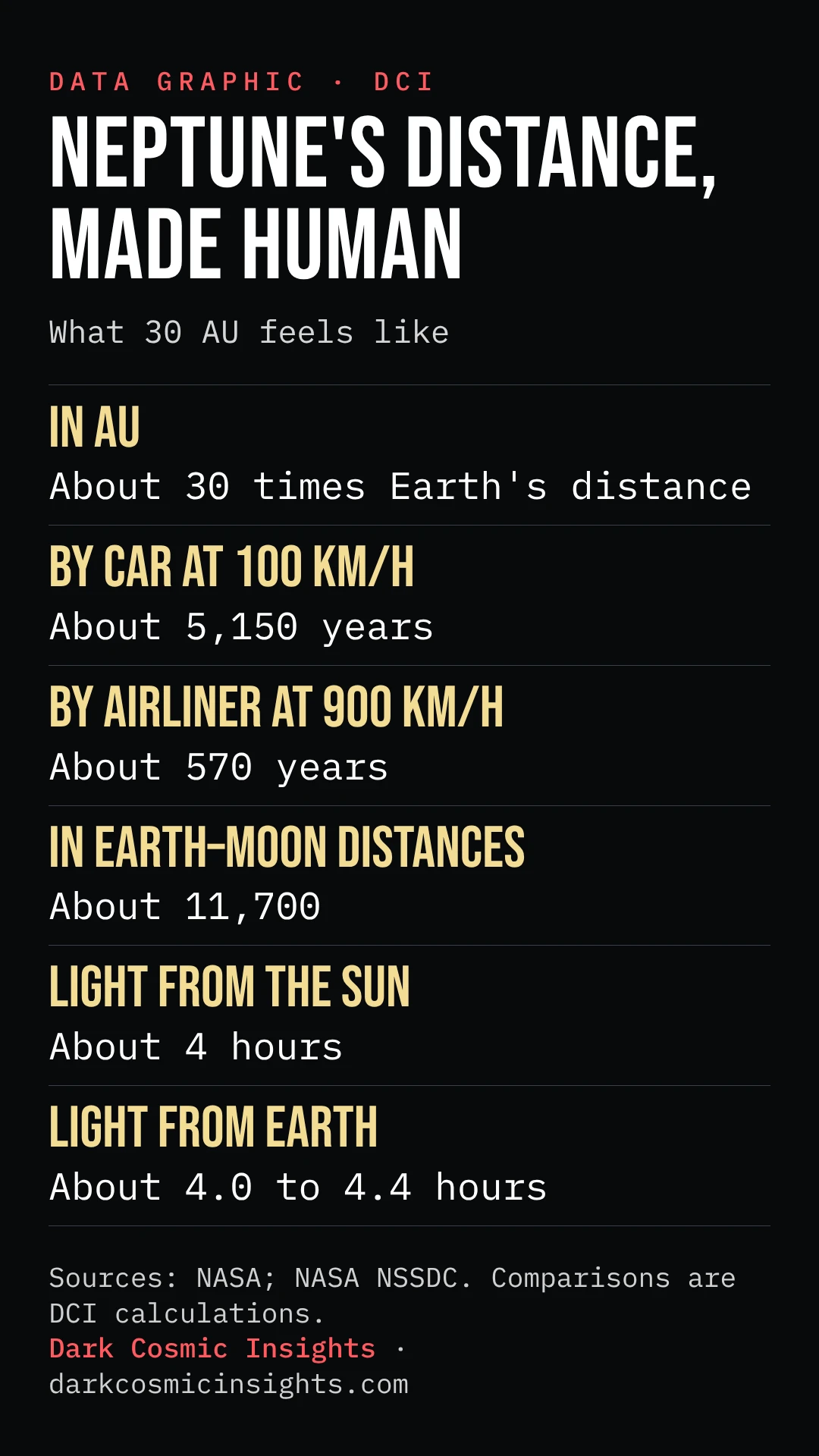
Numbers in the billions are hard to feel. Here are a few comparisons, all DCI calculations from NASA’s average distance of 4,515 million km:
- By car: driving nonstop at 100 km/h, you’d need about 5,150 years to cover the distance from the Sun to Neptune.
- By airliner: at a cruising speed of about 900 km/h, about 570 years.
- In Moon distances: about 11,700 trips between Earth and the Moon.
- Compared with Uranus: Neptune is about 1.6 times as far from the Sun as Uranus, its neighbor.
How Long Does It Take to Get to Neptune?
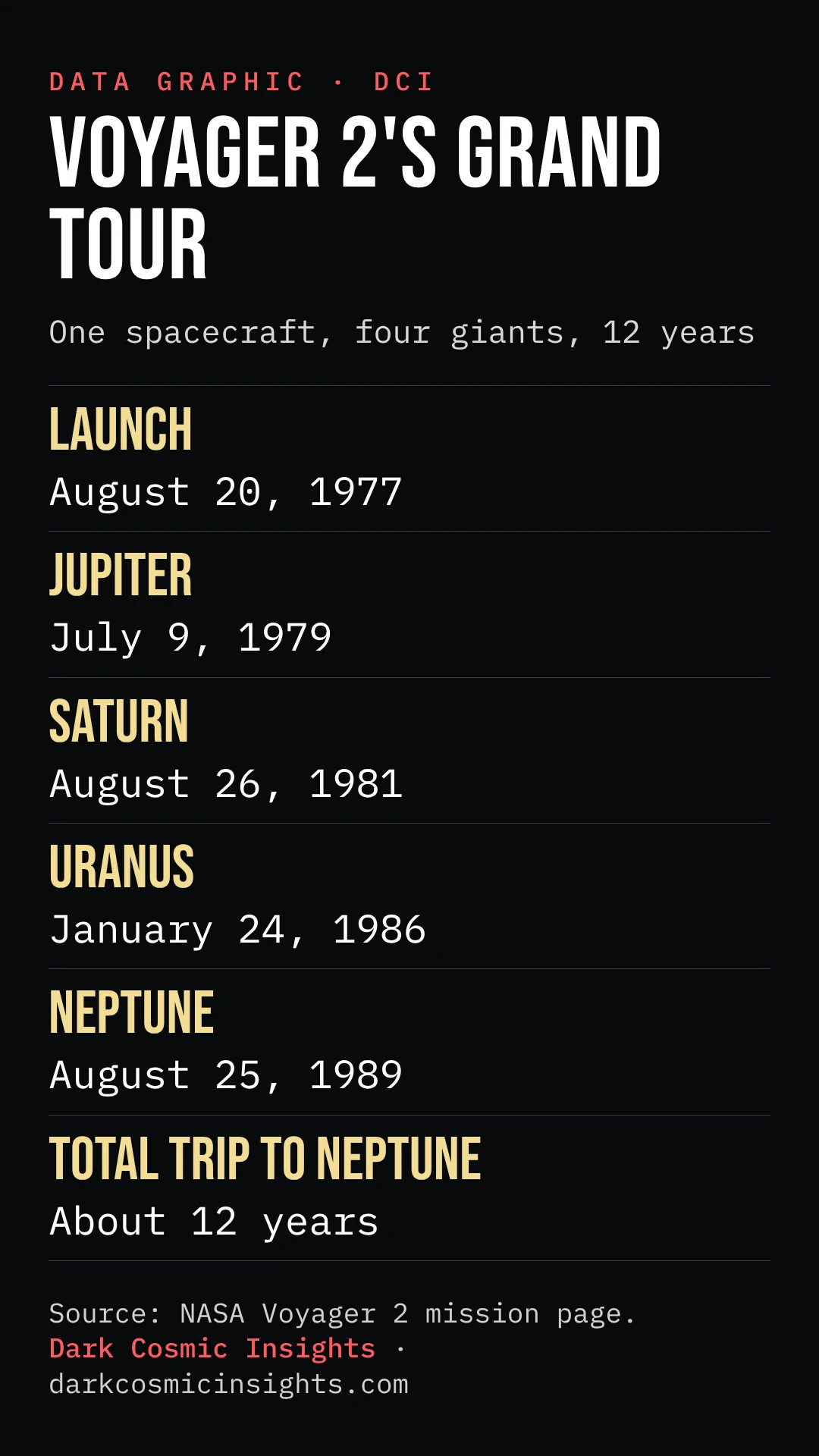
Voyager 2: 12 years
Only one spacecraft has ever reached Neptune. NASA’s Voyager 2 launched on August 20, 1977, and made its closest approach to Neptune on August 25, 1989, passing roughly 4,800 km above the cloud tops (NASA, Voyager 2). That’s a journey of 12 years and 5 days (DCI calculation).
It had help along the way
Voyager 2 didn’t fly straight to Neptune. It flew past Jupiter, Saturn and Uranus first, using each one’s gravity to bend its path and speed it toward the next planet, and reached Neptune last (NASA, Voyager 2):
- Jupiter: closest approach July 9, 1979.
- Saturn: closest approach August 26, 1981.
- Uranus: closest approach January 24, 1986.
- Neptune: closest approach August 25, 1989, Voyager 2’s final planetary encounter.
Gravity assists at Jupiter, Saturn and Uranus each helped send Voyager 2 onward. Neptune was its final planetary encounter, completing a tour of all four giants.
Why nobody has gone back
Getting to Neptune takes many years of travel, and an orbiter, unlike a flyby, would also need to brake hard on arrival to be captured. So far, no mission to orbit Neptune has been approved and scheduled. Everything we’ve learned since 1989 has come from telescopes like Hubble and the James Webb Space Telescope.
How Long Is a Year on Neptune?
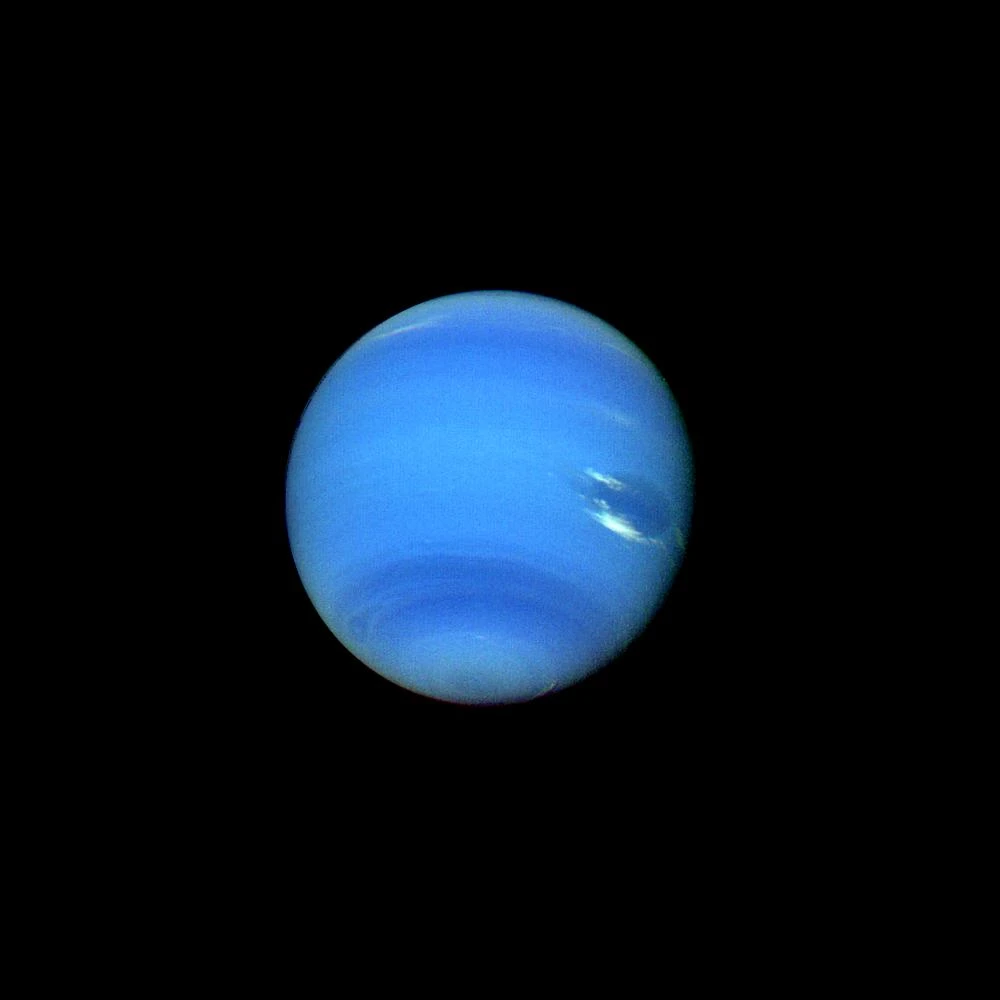
About 165 Earth years
NASA says Neptune “makes a complete orbit around the Sun (a year in Neptunian time) in about 165 Earth years (60,190 Earth days)” (NASA). NASA’s fact sheet lists the sidereal orbit period as about 60,189 days (NASA NSSDC).
One orbit since it was discovered
Neptune was discovered on the night of September 23 to 24, 1846. It didn’t complete its first full orbit since that night until July 11, 2011, according to ESA/Hubble (ESA/Hubble, 2011). Nobody alive at its discovery could have seen it come back around.
Why it’s so slow
Neptune moves at an average orbital speed of about 5.45 km/s, compared with Earth’s 29.78 (NASA NSSDC). It has a much longer path to cover and moves less than a fifth as fast. NASA notes that Neptune’s tilt of 28 degrees gives it seasons like Earth’s, but “each of the four seasons lasts for over 40 years” (NASA).
How it was found
Neptune was predicted on paper before anyone recognized it as a planet. Galileo had actually recorded it in 1612 and 1613, but took it for a star (NASA). NASA says it “became the first planet located through mathematical predictions”: French mathematician Urbain Le Verrier predicted its position from the way Uranus was being tugged off course, and Johann Gottfried Galle found it at the Berlin Observatory “on his first night of searching in 1846” (NASA).
Myth vs. Fact: Neptune’s Distance
| Myth | Fact | Status |
|---|---|---|
| “Pluto is always farther from the Sun than Neptune.” | Pluto’s stretched orbit sometimes brings it closer to the Sun than Neptune. | Measured |
| “You can see Neptune with your naked eye.” | At magnitude 7.67 at best, it’s too faint; you need binoculars or a telescope. | Measured |
| “Lots of spacecraft have visited Neptune.” | Only Voyager 2, in 1989. | Observed |
| “Neptune’s distance from Earth swings wildly.” | It varies by only about 9%, from about 4,319 to 4,711 million km. | Measured |
| “Light from Neptune reaches us in minutes.” | It takes about 4 hours. | DCI calculation |
| “A Neptune year is about 16 hours.” | That’s a day; a year is about 165 Earth years. | Measured |
How Can You Find Neptune Yourself?
You’ll need optics
Neptune never gets brighter than about magnitude 7.67, NASA’s fact sheet says (NASA NSSDC). The faintest stars the naked eye can see under dark skies are around magnitude 6, so Neptune is out of reach without help.
Binoculars and a chart
With good binoculars, a dark sky and a star chart or planetarium app, you can spot Neptune as a faint point that slowly shifts against the stars over weeks.
A telescope shows a tiny blue disk
At high magnification, a telescope shows Neptune as a tiny blue disk, only about 2.2 to 2.4 arcseconds across (NASA NSSDC), roughly 1/800 the width of the full Moon (DCI estimate). The light you see left the Sun about four hours before it bounced off Neptune’s clouds, then spent about four more hours reaching you.
Neptune’s Distance by the Numbers
| Measure | Value | Source |
|---|---|---|
| Average distance from the Sun | about 4.5 billion km (2.8 billion mi), 30 AU | NASA |
| Perihelion / aphelion | about 4,471 / 4,559 million km | NASA NSSDC |
| Closest / farthest from Earth | about 4,319 / 4,711 million km | NASA NSSDC |
| Sunlight travel time | about 4 hours | NASA |
| Light from Earth | about 4.0 to 4.4 hours (DCI calculation) | NASA NSSDC |
| Voyager 2 travel time | about 12 years (1977 to 1989) | NASA |
| One Neptune year | about 165 Earth years | NASA |
| Time between oppositions | about 367.5 days | NASA NSSDC |
| Brightest magnitude | 7.67 (not naked-eye) | NASA NSSDC |
Sources checked November 2026.
Neptune Distance FAQ
How far is Neptune from the Sun in miles?
About 2.8 billion miles, or 4.5 billion kilometers, on average, according to NASA. Its orbit is nearly circular, so it stays between about 4,471 and 4,559 million km from the Sun.
How far is Neptune from Earth?
Between about 4,319 million km and 4,711 million km, depending on where both planets are in their orbits. It’s closest around opposition, which comes about once every 367.5 days.
How long does it take to get to Neptune?
The only spacecraft to make the trip, NASA’s Voyager 2, took about 12 years, launching on August 20, 1977, and passing Neptune on August 25, 1989. It used gravity assists from Jupiter, Saturn and Uranus along the way.
How long does light take to reach Neptune?
NASA says sunlight takes about 4 hours to reach Neptune. A radio signal from Earth takes about 4.0 to 4.4 hours, depending on the two planets’ positions.
How many AU is Neptune from the Sun?
About 30 AU on average, NASA says. At its closest it’s about 29.9 AU, and at its farthest about 30.5 AU.
How long is a year on Neptune?
About 165 Earth years, or 60,190 Earth days, according to NASA. Neptune completed its first full orbit since its 1846 discovery in July 2011.
Can you see Neptune with the naked eye?
No. Neptune never gets brighter than about magnitude 7.67, too faint for the naked eye. Binoculars, a dark sky and a star chart will show it as a faint point; a telescope shows a tiny blue disk.
Is Neptune the farthest planet from the Sun?
Yes. Since Pluto was reclassified as a dwarf planet in 2006, Neptune has been the outermost of the eight planets, about 30 AU from the Sun.
Your next step: look up where Neptune is tonight in a planetarium app, then find it with binoculars or a telescope. The faint point you’re seeing is light that has traveled for about eight hours, from the Sun to Neptune and back to you.
Sources and Further Reading
- NASA Science, Neptune: Facts.
- NASA Space Science Data Coordinated Archive, Neptune Fact Sheet; Planetary Fact Sheet; Fact Sheet Notes.
- NASA Science, Voyager 2.
- ESA/Hubble (July 12, 2011), Happy birthday Neptune.
- NASA images: PIA00046, PIA02210, PIA01539, PIA02214, PIA01493.
Explore Next
- The ruler for star distances: What Is a Light-Year?
- Why Neptune looks so blue: Why Is Neptune Blue?
- Triton and Neptune’s other moons: How Many Moons Does Neptune Have?
- Saturn’s distance, for comparison: How Far Is Saturn?
- Why Pluto isn’t the ninth planet: Why Is Pluto Not a Planet?
- Every planet in one place: Solar System Explorer
- How a claim earns its label: How We Know
How This Explainer Was Checked
Every number and quote in this article was checked in November 2026 against the source linked beside it: NASA’s Neptune facts, NASA’s Neptune and planetary fact sheets and their notes, NASA’s Voyager 2 mission page, ESA/Hubble’s 2011 announcement of Neptune’s first orbit since discovery, and NASA’s image pages. Distances, orbit and brightness are labelled Measured. Voyager 2’s journey is labelled Observed. Light-travel times, mile conversions, AU values, the sunlight percentage, the driving, airliner and Moon comparisons, and Voyager 2’s total trip time are DCI calculations. Images are labelled: real spacecraft images as OBSERVATION, our charts as DATA GRAPHIC. Nothing AI-generated is presented as a real image.
Final Thought: The Edge of the Planets
Neptune is so far away that it took a mathematician to find it, 12 years for a spacecraft to reach it, and 165 years for it to circle the Sun once since we first saw it. Every photo we have from up close came from a single fast flyby in 1989. Until we go back, Neptune stays what it has always been: a blue dot at the edge of the planets, four light-hours from home.
About the Author
Author: King | Founder of Dark Cosmic Insights