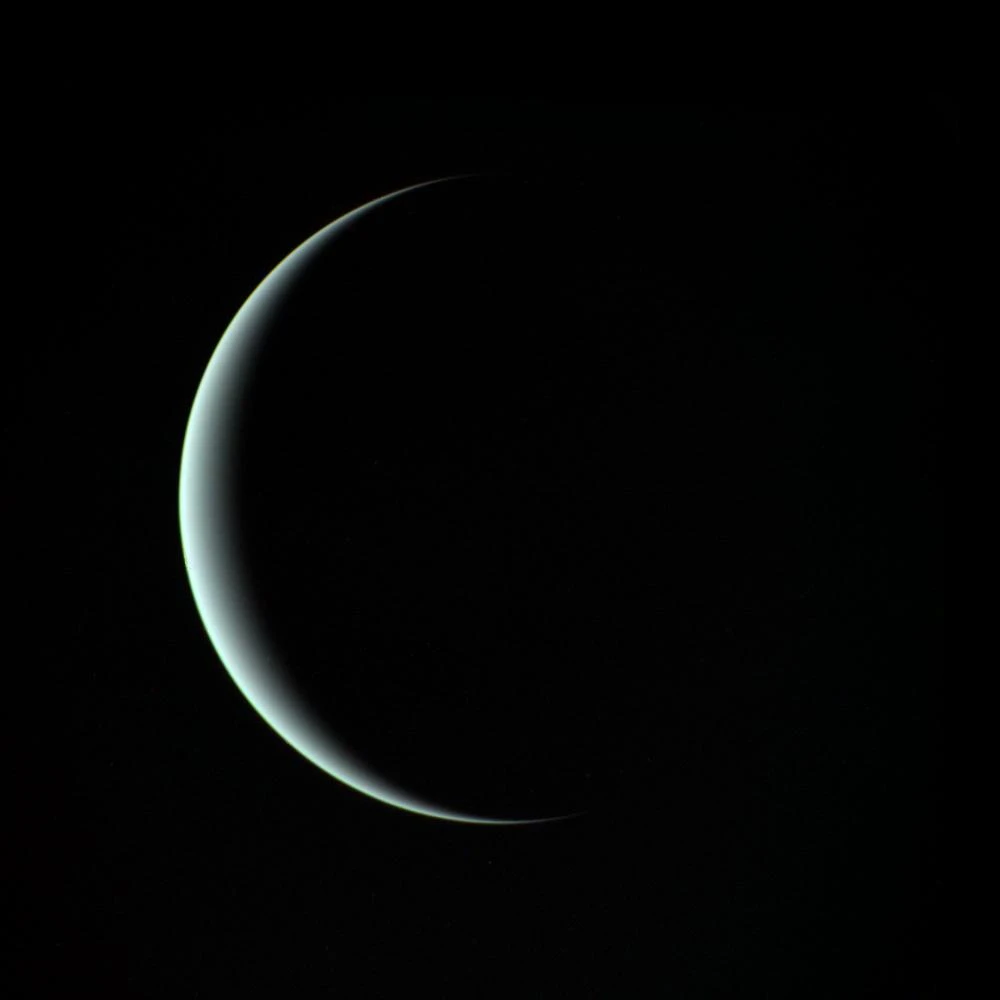
When Voyager 2 flew past Uranus in January 1986, it found a planet that seemed almost dead inside. The pale blue-green globe barely showed a cloud, and the spacecraft’s measurements suggested Uranus gave off little or no heat of its own. For almost 40 years, Uranus carried a reputation as the solar system’s cold, quiet oddball.
Then, in 2025, NASA reported that the old picture was off. Uranus does make some of its own heat after all (NASA, 2025). It’s still brutally cold. NASA’s facts page lists a minimum atmospheric temperature of 49 K, or −224.2 °C (NASA). But “how cold is Uranus?” turns out to have more than one answer.

Observed, measured, modelled, open. Uranus’s atmospheric temperatures are measured by Voyager 2 and telescopes. Its energy balance, how much heat it gives off compared with what it absorbs from the Sun, was estimated again in 2025 by a model built on decades of observations. Its core temperature is modelled. Why Uranus gives off so much less internal heat than Neptune is still open.
Quick Answer: How Cold Is Uranus?
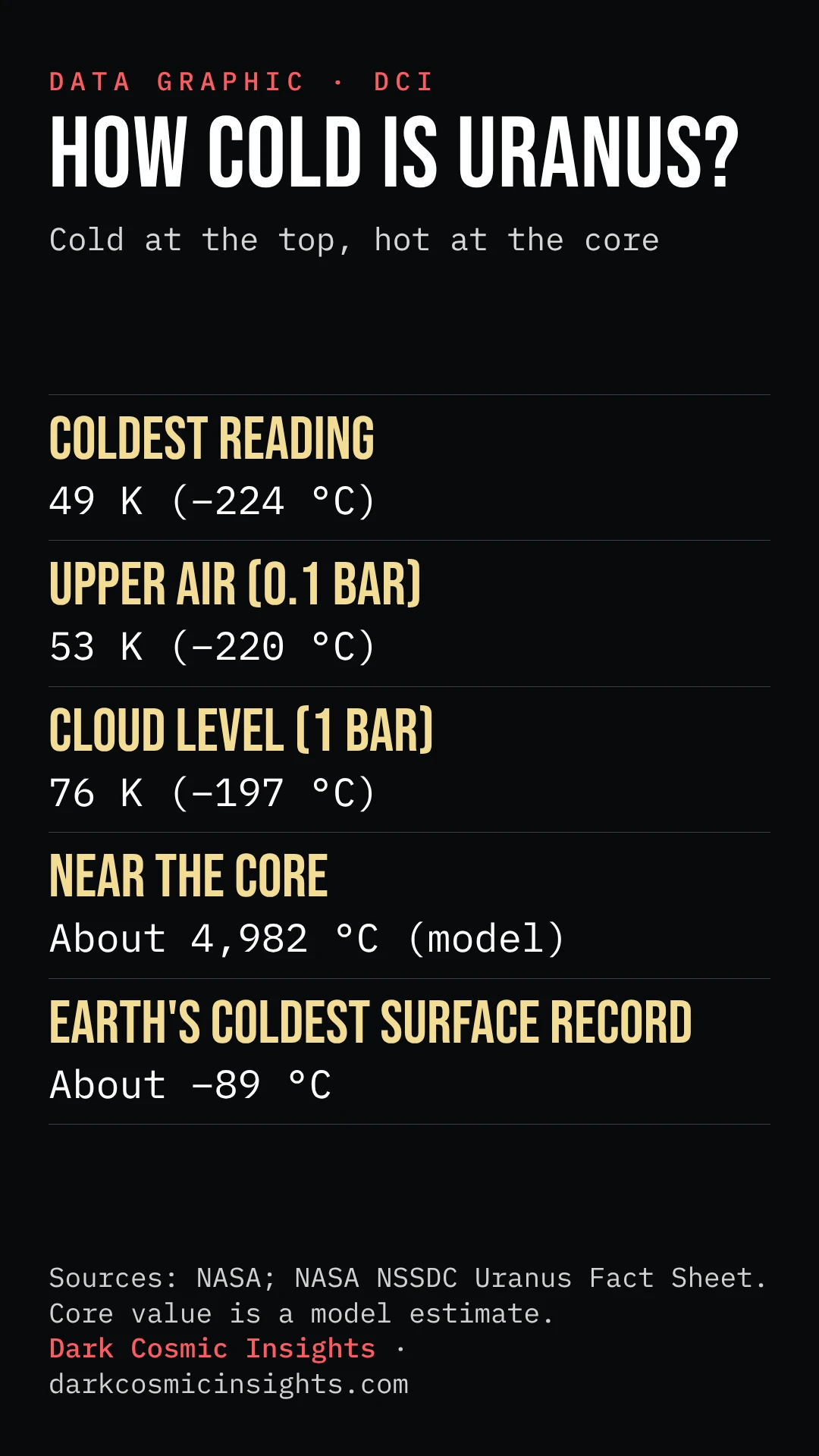
At the 1-bar level, about Earth’s sea-level air pressure, NASA’s fact sheet lists Uranus at 76 K (−197 °C, about −323 °F). Higher up, at 0.1 bar, it’s 53 K (−220 °C) (NASA NSSDC). Its coldest measured air reaches 49 K (−224.2 °C), which NASA says makes parts of Uranus colder than Neptune (NASA). Yet on average at the 1-bar level, Neptune is slightly colder, at 72 K. Deep inside, NASA says Uranus heats up to about 4,982 °C (9,000 °F) near its core, a modelled figure. And a 2025 model-based study estimated that Uranus gives off about 15% more energy in total than it absorbs from sunlight, evidence of some internal heat (NASA, 2025; Irwin et al. 2025, MNRAS).
What this article can and cannot establish. It can give you Uranus’s measured temperatures at different levels of its atmosphere, its measured heat output, and an honest comparison with Neptune. It cannot give you a measured core temperature, because no probe has gone inside Uranus. And there is no single “temperature of Uranus”: the number depends on where, and how deep, you look.
Table of Contents
The DCI Evidence Map: Uranus’s Temperature
| Question | What we know | Status | Key source |
|---|---|---|---|
| How cold is it at the 1-bar level? | 76 K (−197 °C) | Measured | NASA NSSDC |
| How cold is the upper air? | 53 K (−220 °C) at 0.1 bar | Measured | NASA NSSDC |
| What’s its coldest reading? | 49 K (−224.2 °C) | Measured | NASA |
| Is it colder than Neptune? | Parts of it, NASA says; at 1 bar, Neptune is colder | Measured | NASA; NASA NSSDC |
| Does it make its own heat? | Some: total output about 15% above absorbed sunlight | Modelled | NASA, 2025 |
| How hot is the core? | About 4,982 °C | Modelled | NASA |
| Why so much less heat than Neptune? | Not settled | Open | NASA, 2025 |
Status key: Observed = seen directly. Measured = a number with a stated uncertainty or a direct measurement. Modelled = inferred from measurements through a physical model, dependent on assumptions. Open = unresolved; the evidence is incomplete or points different ways. Not supported = the evidence goes against the claim, or there is none for it.
Cite this framework: “DCI Evidence Map: Uranus’s Temperature,” Dark Cosmic Insights, November 2026, darkcosmicinsights.com/how-cold-is-uranus/.
How Cold Is Uranus’s Atmosphere?
No surface, so we measure by pressure
Uranus has no solid ground. NASA says that “as an ice giant, Uranus doesn’t have a true surface” (NASA). So scientists quote temperatures at set pressure levels. The standard reference is the 1-bar level, where the pressure matches the air at sea level on Earth.
At the 1-bar level: −197 °C
NASA’s fact sheet lists Uranus at 76 K at 1 bar (NASA NSSDC). That’s −197 °C, or about −323 °F (DCI conversion). For comparison, the coldest air temperature ever directly measured on Earth is about −89 °C, at Vostok Station in Antarctica.
Higher up: −220 °C
Climb to the 0.1-bar level, where the pressure is one-tenth as high, and the fact sheet lists 53 K (−220 °C) (NASA NSSDC). That’s about −364 °F.
The coldest reading: −224 °C
NASA’s facts page gives Uranus’s minimum atmospheric temperature as 49 K (−224.2 °C), adding that this makes parts of Uranus colder than Neptune (NASA). That’s about −372 °F (DCI conversion), only about 49 degrees above absolute zero, the coldest temperature physics allows.
Why Is Uranus So Cold?
It’s very far from the Sun
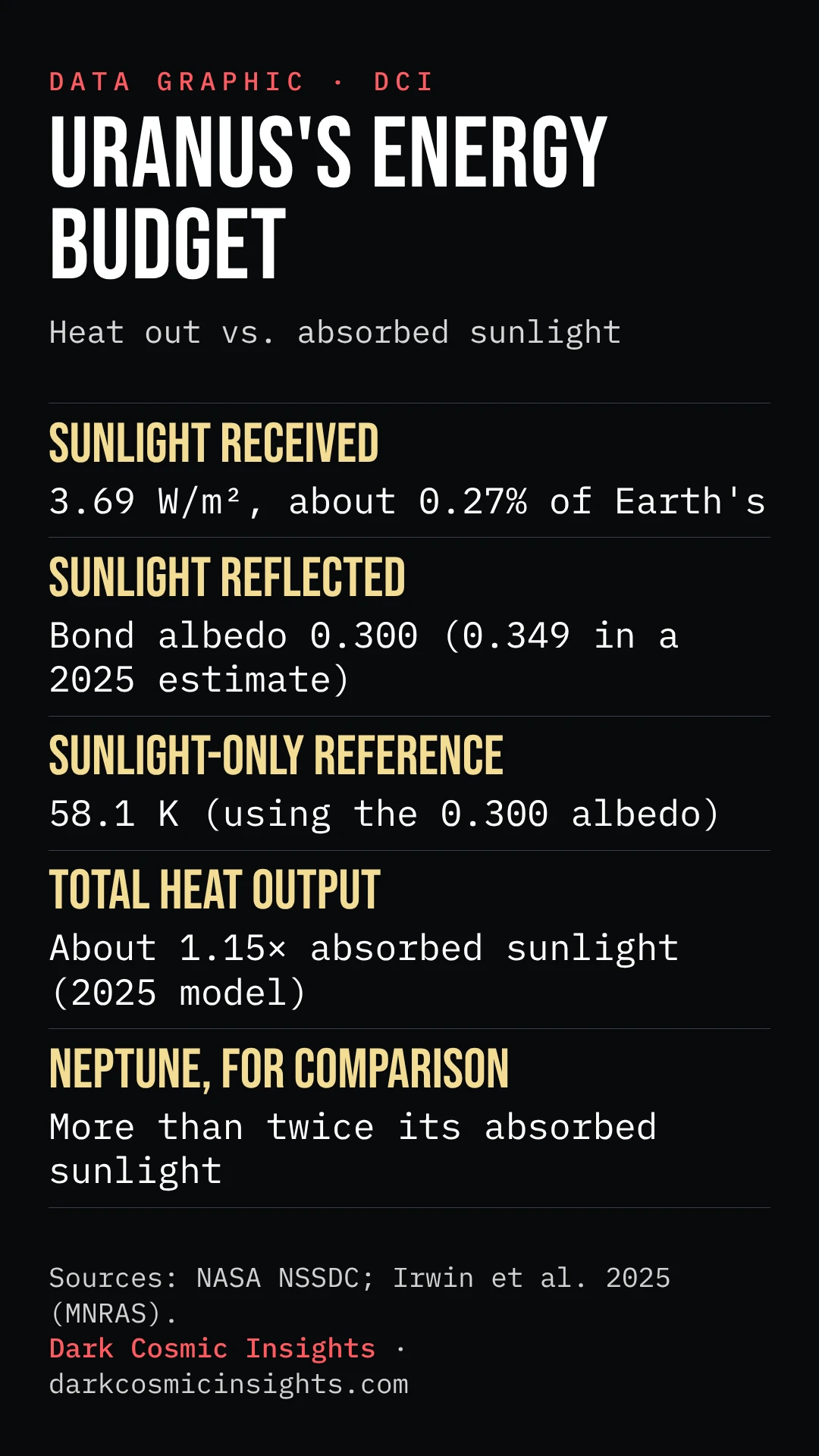
Uranus orbits about 19 astronomical units from the Sun, about 19 times Earth’s distance (NASA). Sunlight weakens with the square of distance, so Uranus gets very little. NASA’s fact sheet lists the sunlight reaching it at 3.69 watts per square meter, compared with 1,361 at Earth (NASA NSSDC). That’s about 0.27 percent of what Earth receives (DCI calculation).
It reflects some of what it gets
NASA’s fact sheet lists Uranus’s Bond albedo, the share of incoming sunlight it reflects, as 0.300, close to Earth’s 0.294 (NASA NSSDC). The 2025 study revised that upward: averaged over Uranus’s orbit, it estimated 0.349 ± 0.016, meaning Uranus reflects a little more sunlight, and absorbs a little less, than the older figure suggests (Irwin et al. 2025, MNRAS).
Its sunlight-only reference temperature
Using its older albedo value of 0.300, NASA’s fact sheet gives Uranus a black-body temperature of 58.1 K (NASA NSSDC). NASA’s notes define this as the temperature a body would have from sunlight alone, with the same albedo but no atmosphere (NASA NSSDC notes). It’s a reference number for comparison, not a layer of Uranus’s air. We explain the difference between these kinds of temperature in our Space Glossary.
Does Uranus Make Its Own Heat?
What Voyager 2 suggested in 1986
The giant planets don’t just soak up sunlight; most of them also leak heat left over from their formation. Jupiter, Saturn and Neptune all give off clearly more energy than they absorb. Uranus seemed to be the exception. NASA notes that “data from NASA’s Voyager 2 Uranus flyby in 1986 also suggested the planet is unusually cold inside” (NASA, 2025). The catch: that conclusion rested on “only one up-close measurement” of the heat Uranus gives off.
What changed in 2025
In 2025, a team led by Patrick Irwin, a professor of planetary physics at the University of Oxford, revisited the question with decades of observations. They built a model of how Uranus reflects sunlight and lets heat escape that accounts for its extreme, decades-long seasons. Their result, reported in the Monthly Notices of the Royal Astronomical Society in May 2025, is a model-based estimate, not a new direct measurement. Averaged over Uranus’s orbit, the planet gives off about 1.15 times as much thermal energy as it absorbs from sunlight, with an uncertainty of about ±0.06 (Irwin et al. 2025, MNRAS). NASA summarized it as Uranus releasing “about 15% more energy than it receives from the Sun” (NASA, 2025). That 15% excess compares total thermal output with absorbed sunlight; the difference is what points to heat from inside. A separate study, partly funded by NASA and published in Geophysical Research Letters in July 2025, reached a similar conclusion.
The researchers concluded that “Uranus does in fact generate some heat,” though much less than Neptune (NASA, 2025).
Why that matters
A planet’s leftover heat is a clue to its history and its interior. If Uranus gives off some heat but far less than Neptune, its insides may be layered in a way that traps heat, or something in its past, possibly whatever knocked it onto its side, changed how it cools. Those explanations are open. We explore the tilt in our guide to why Uranus is tilted.
How Hot Is Uranus Inside?
Hot, dense and fluid
Below its hydrogen and helium atmosphere, Uranus is mostly made of heavier materials. NASA describes most of its mass as a hot, dense fluid of “icy” materials, water, methane and ammonia, above a small rocky core (NASA). “Icy” here describes what those substances are, not their state: deep inside Uranus, they’re hot and squeezed.
Near the core: about 5,000 °C
NASA says that “near the core, it heats up to 9,000 degrees Fahrenheit (4,982 degrees Celsius)” (NASA). No instrument has measured that. It comes from models of Uranus’s interior built to match its mass, size, gravity and heat output. NASA adds that the extreme pressures and temperatures inside “would destroy a metal spacecraft.” The core temperature is modelled.
We cover what’s inside both ice giants in more depth in our guide to what Uranus and Neptune are made of.
Is Uranus the Coldest Planet?
It depends what you’re comparing
This is where headlines often go wrong. “Coldest planet” can mean the coldest single measurement or the coldest average, and the answer differs.
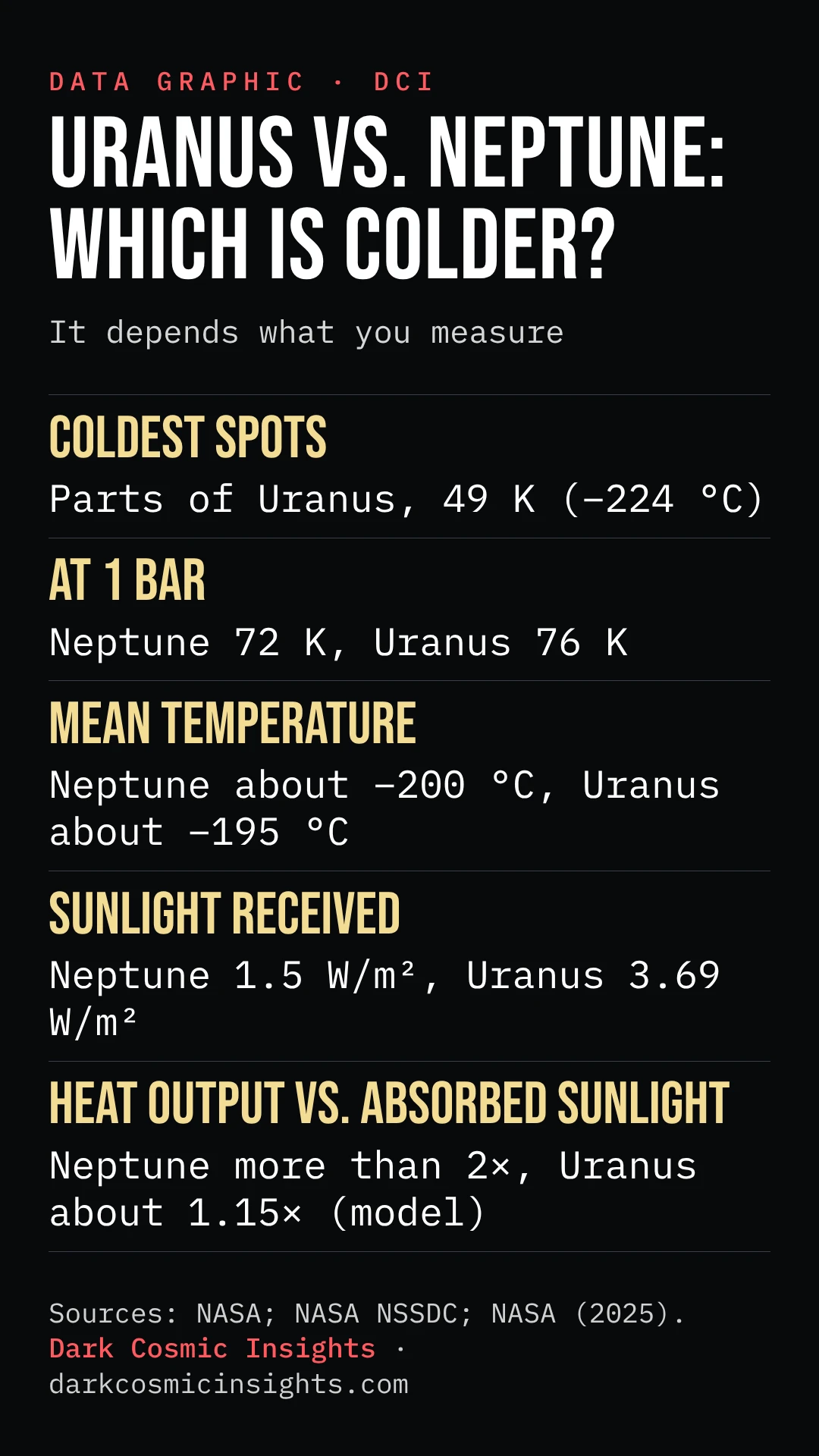
- Coldest spots: NASA lists Uranus’s minimum atmospheric temperature as 49 K (−224.2 °C) and says that makes parts of Uranus colder than Neptune (NASA).
- Colder at the 1-bar level: Neptune. NASA’s fact sheets list Neptune at 72 K at 1 bar and Uranus at 76 K (NASA NSSDC, Neptune; NASA NSSDC, Uranus).
- Colder mean temperature: Neptune. NASA’s planetary comparison table lists Neptune at about −200 °C and Uranus at about −195 °C (NASA NSSDC).
Why Uranus can be colder despite being closer
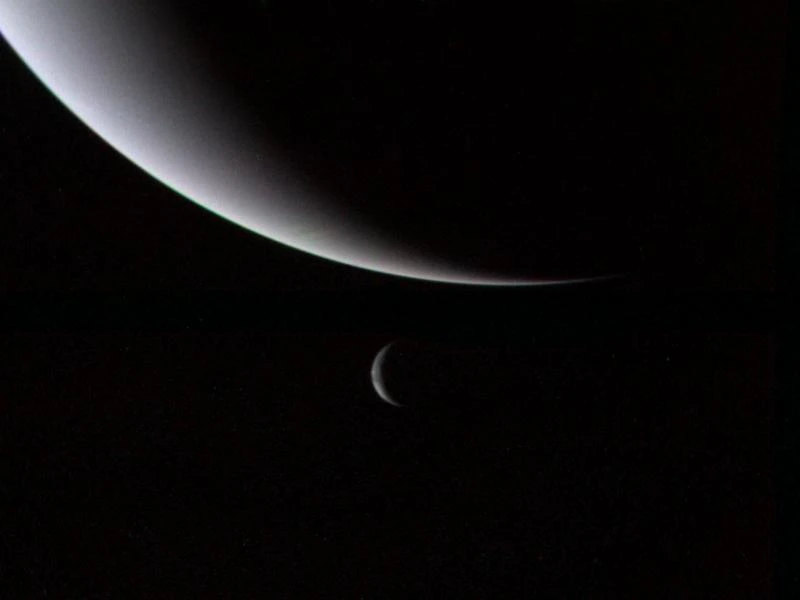
Neptune is about 1.6 times farther from the Sun than Uranus (DCI calculation from NASA’s fact sheets) and gets less than half as much sunlight. Yet Neptune “emits more than twice the energy it receives,” while Uranus’s total output is only about 15 percent above the sunlight it absorbs (NASA, 2025). Neptune’s stronger internal heat helps it stay about as warm as Uranus in its upper atmosphere, even though it’s much farther away.
So the fair summary is: parts of Uranus get colder than Neptune, but at the standard 1-bar level and on average, Neptune is the colder planet. You can compare all eight in our Solar System Explorer.
Does Uranus Have Seasons?
Extreme ones
Uranus is tilted about 98 degrees, so it rolls around the Sun on its side. Each pole gets roughly 42 years of daylight, then roughly 42 years of darkness, and each of the four seasons lasts about 21 years (DCI calculation from the 84-year orbit; NASA, 2025).
Seasons change the heat balance
That’s one reason measuring Uranus’s heat was so tricky. A single snapshot, like Voyager 2’s in 1986, catches one moment in a cycle that takes 84 years. The 2025 study succeeded partly because its model accounted for the way the seasons change how sunlight is reflected and how heat escapes (NASA, 2025).
Myth vs. Fact: Uranus’s Temperature
| Myth | Fact | Status |
|---|---|---|
| “Uranus has no internal heat.” | A 2025 model estimates its total output at about 15% above absorbed sunlight, so it has some. | Modelled |
| “Uranus is the coldest planet, full stop.” | Parts of it are colder, but Neptune is colder at 1 bar. | Measured |
| “Uranus is frozen solid.” | Its interior is a hot, dense fluid, near 5,000 °C at the core in models. | Modelled |
| “Scientists measured the core temperature.” | Core values come from models, not probes. | Modelled |
| “Uranus’s temperature is one number.” | It changes with depth and pressure. | Measured |
| “It’s cold because it’s ice.” | It’s cold mostly because it gets 0.27% of Earth’s sunlight. | Measured |
How Can You Explore Uranus’s Temperature Yourself?
Look at infrared images
The James Webb Space Telescope has taken striking near-infrared images of Uranus (NASA). They aren’t temperature maps: the bright and dark patches show features such as clouds, haze and rings, not simply warmer and colder regions.
Find Uranus in the sky
Uranus is just at the limit of naked-eye visibility under very dark skies, and easy in binoculars with a star chart or app. It looks like a tiny, pale blue-green point. Its light left the Sun, bounced off clouds colder than −190 °C, and traveled about 2.6 hours more to reach you (DCI estimate from Uranus’s distance).
Follow the next mission idea
Only Voyager 2 has ever visited Uranus. Every new mission proposal starts with the questions in this article: how hot is it inside, and why so much less than Neptune?
Uranus’s Temperature by the Numbers
| Measure | Value | Source |
|---|---|---|
| Temperature at 1 bar | 76 K (−197 °C) | NASA NSSDC |
| Temperature at 0.1 bar | 53 K (−220 °C) | NASA NSSDC |
| Minimum atmospheric temperature | 49 K (−224.2 °C) | NASA |
| Black-body (sunlight-only) temperature | 58.1 K (fact sheet, using albedo 0.300) | NASA NSSDC |
| Sunlight received | 3.69 W/m² (Earth: 1,361) | NASA NSSDC |
| Bond albedo | 0.300 (fact sheet); 0.349 ± 0.016 (2025 orbit-average estimate) | NASA NSSDC; Irwin et al. 2025, MNRAS |
| Thermal output vs. absorbed sunlight | about 1.15 ± 0.06 (model estimate) | Irwin et al. 2025, MNRAS |
| Near the core (model) | about 4,982 °C (9,000 °F) | NASA |
| Neptune at 1 bar, for comparison | 72 K | NASA NSSDC |
Sources checked November 2026.

Uranus Temperature FAQ
What is the temperature on Uranus?
There isn’t one temperature. At the 1-bar level, about Earth’s sea-level pressure, NASA lists 76 K, or −197 °C. Higher up it drops to 53 K (−220 °C), and its coldest measured air reaches 49 K (−224.2 °C). Deep inside, models put the region near the core at about 4,982 °C.
Is Uranus the coldest planet?
It depends on the measure. NASA lists Uranus’s minimum atmospheric temperature as 49 K and says that makes parts of it colder than Neptune. But Neptune is colder at the 1-bar level, 72 K versus 76 K, and has the lower mean temperature in NASA’s comparison table.
How cold is Uranus in Fahrenheit?
About −323 °F at the 1-bar level, about −364 °F at 0.1 bar, and about −372 °F at its coldest measured point. Near the core, NASA’s model gives about 9,000 °F.
Why is Uranus so cold?
Mostly distance. Uranus orbits about 19 times farther from the Sun than Earth, so it gets about 0.27 percent of the sunlight Earth does. It also gives off much less internal heat than Neptune.
Does Uranus have internal heat?
Some. A 2025 model-based study estimated that Uranus gives off about 15 percent more thermal energy in total than it absorbs from sunlight, which points to heat from inside. Voyager 2’s single 1986 measurement had suggested it was unusually cold inside.
Is Uranus hotter or colder than Neptune?
At the 1-bar level, NASA lists Neptune at 72 K and Uranus at 76 K, so Neptune is slightly colder there, even though it gives off far more internal heat. NASA also says parts of Uranus’s atmosphere get colder than Neptune. Neptune’s strong inner heat helps keep it about as warm as Uranus despite being much farther from the Sun.
How hot is Uranus’s core?
NASA says it heats up to about 4,982 °C (9,000 °F) near the core. That figure comes from models of Uranus’s interior; no spacecraft has measured it.
Could anything survive the cold on Uranus?
Not as far as we know. NASA says Uranus’s temperatures, pressures and materials are likely too extreme and volatile for life as we know it to adapt to.
Your next step: next time you find Uranus in binoculars, remember that the faint blue-green point you’re seeing has clouds colder than −190 °C, wrapped around an interior close to 5,000 °C.
Sources and Further Reading
- NASA Science, Uranus: Facts.
- NASA Space Science Data Coordinated Archive, Uranus Fact Sheet; Neptune Fact Sheet; Planetary Fact Sheet; Fact Sheet Notes.
- NASA (July 17, 2025), NASA, Oxford Discover Warmer Uranus Than Once Thought.
- NASA Science, Neptune: Facts.
- NASA images: PIA18182, PIA01535, PIA00346, PIA01391, PIA02215.
Explore Next
- Uranus’s sideways family: How Many Moons Does Uranus Have?
- Its near twin, and its color: Why Is Neptune Blue?
- Another giant that makes its own heat: How Cold Is Saturn?
- The temperatures of space itself: How Cold Is Space?
- Every planet in one place: Solar System Explorer
- How a claim earns its label: How We Know
How This Explainer Was Checked
Every number and quote in this article was checked in November 2026 against the source linked beside it: NASA’s Uranus and Neptune facts pages, NASA’s Uranus, Neptune and planetary fact sheets and their notes, NASA’s July 2025 release on Uranus’s heat, and NASA’s image pages. Atmospheric temperatures are labelled Measured; the 2025 energy balance is a model-based estimate and labelled Modelled. The core temperature is labelled Modelled. Why Uranus gives off so much less heat than Neptune is labelled Open. Fahrenheit conversions, the sunlight percentage, distance ratios and the light-travel estimate are DCI calculations. Where Uranus and Neptune each win a different “coldest” comparison, we show both rather than pick one. Images are labelled: real spacecraft images as OBSERVATION, our charts as DATA GRAPHIC. Nothing AI-generated is presented as a real image.
Final Thought: Cold, but Not Dead
For almost 40 years, Uranus was the giant planet that seemed to have gone cold inside. It turned out we’d been judging it on one quick look during one season of an 84-year year. Uranus is still one of the coldest places we know, with air colder than −220 °C. But it’s warmer inside than we thought, and that small surprise is a big clue about how this sideways world was built.
About the Author
Author: King | Founder of Dark Cosmic Insights