On March 23, 2025, Saturn’s rings disappeared. Not really, but from Earth they turned exactly edge-on, and rings that are thousands of times wider than they are thick simply vanished from view (Abrams Planetarium, Michigan State University). Headlines everywhere announced that Saturn was “losing its rings.”
Here’s the twist: that headline is wrong about 2025 and right about the long run. The 2025 vanishing act was pure geometry, and the rings are already tilting back into view. But Saturn really is losing its rings. NASA research estimates that ice from the rings rains into the planet fast enough to fill an Olympic swimming pool every half hour (NASA, 2018). And scientists are still arguing about a deeper question: are the rings a recent addition, or as old as Saturn itself?
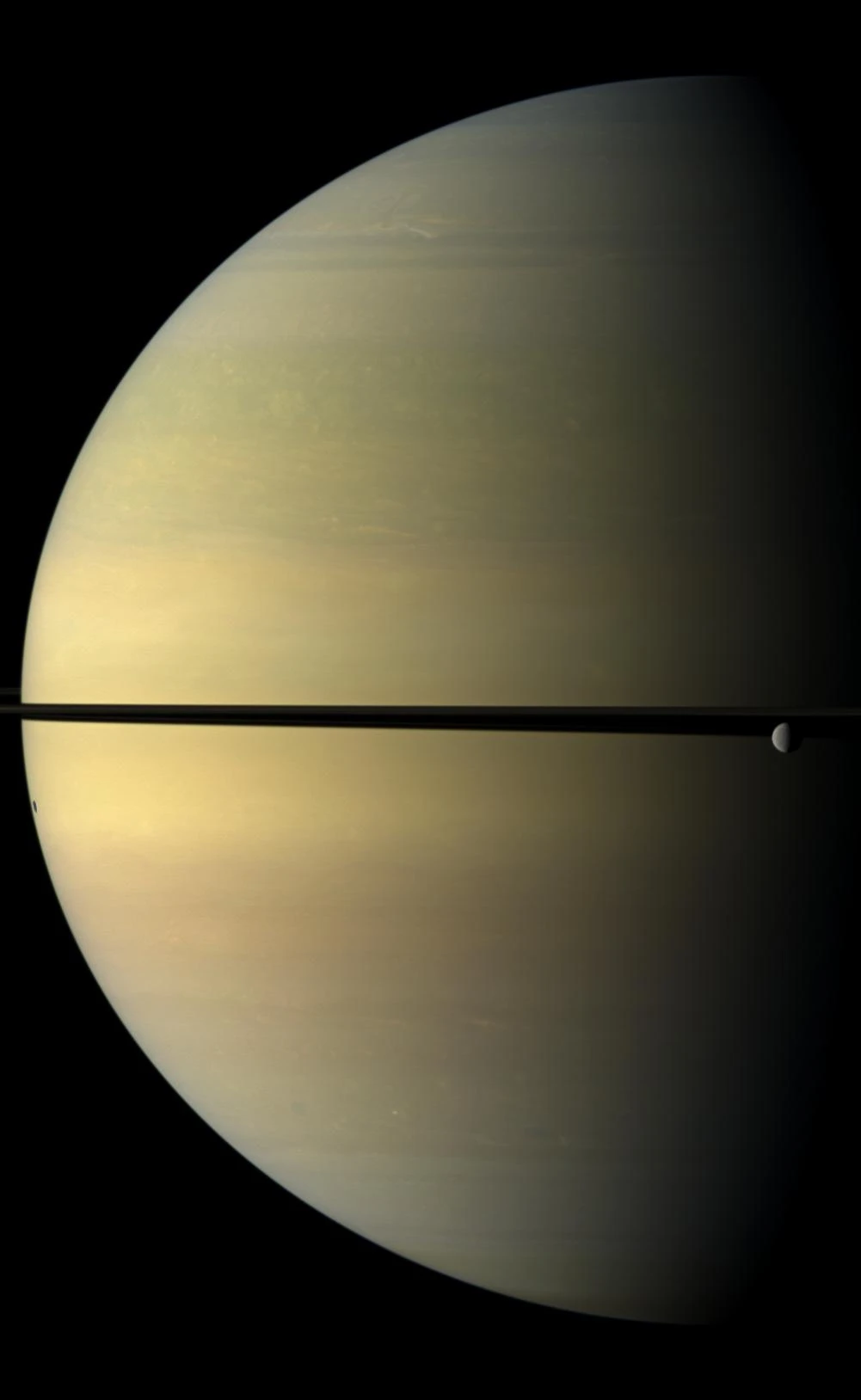
Observed, measured, modelled, open. The 2025 edge-on view is observed geometry. The rings’ mass and the rain of ring material into Saturn are measured by Cassini and telescopes. How long the rings will last is modelled from those rates. How old the rings are is still open.
Quick Answer: Are Saturn’s Rings Disappearing?
Yes and no. In 2025, Saturn’s rings seemed to disappear because Earth passed through the plane of the rings, so we saw them edge-on. That happens about every 13 to 15 years, and the rings come back into view afterward (NASA Science). But the rings are also slowly being lost for real: ring particles fall into Saturn as “ring rain.” NASA estimates the rings could be gone in about 300 million years from ring rain alone at the estimated rate, and in less than 100 million years if material falling into Saturn’s equator is included (NASA, 2018). How old they are is debated: Cassini data point to roughly 100 to 400 million years, while a 2024 study argues they could be far older.
What this article can and cannot establish. It can show you why the rings vanished from view in 2025, what Cassini measured about their mass and the material raining off them, and the evidence on each side of the age debate. It cannot give you a single settled age for the rings, because the leading studies disagree. And the “how long will they last” numbers are estimates based on current loss rates, which may not stay constant.
Table of Contents
The DCI Evidence Map: Saturn’s Rings
| Question | What we know | Status | Key source |
|---|---|---|---|
| Did the rings vanish in 2025? | From Earth they turned edge-on on March 23, 2025; they didn’t go anywhere | Observed | Abrams Planetarium, MSU |
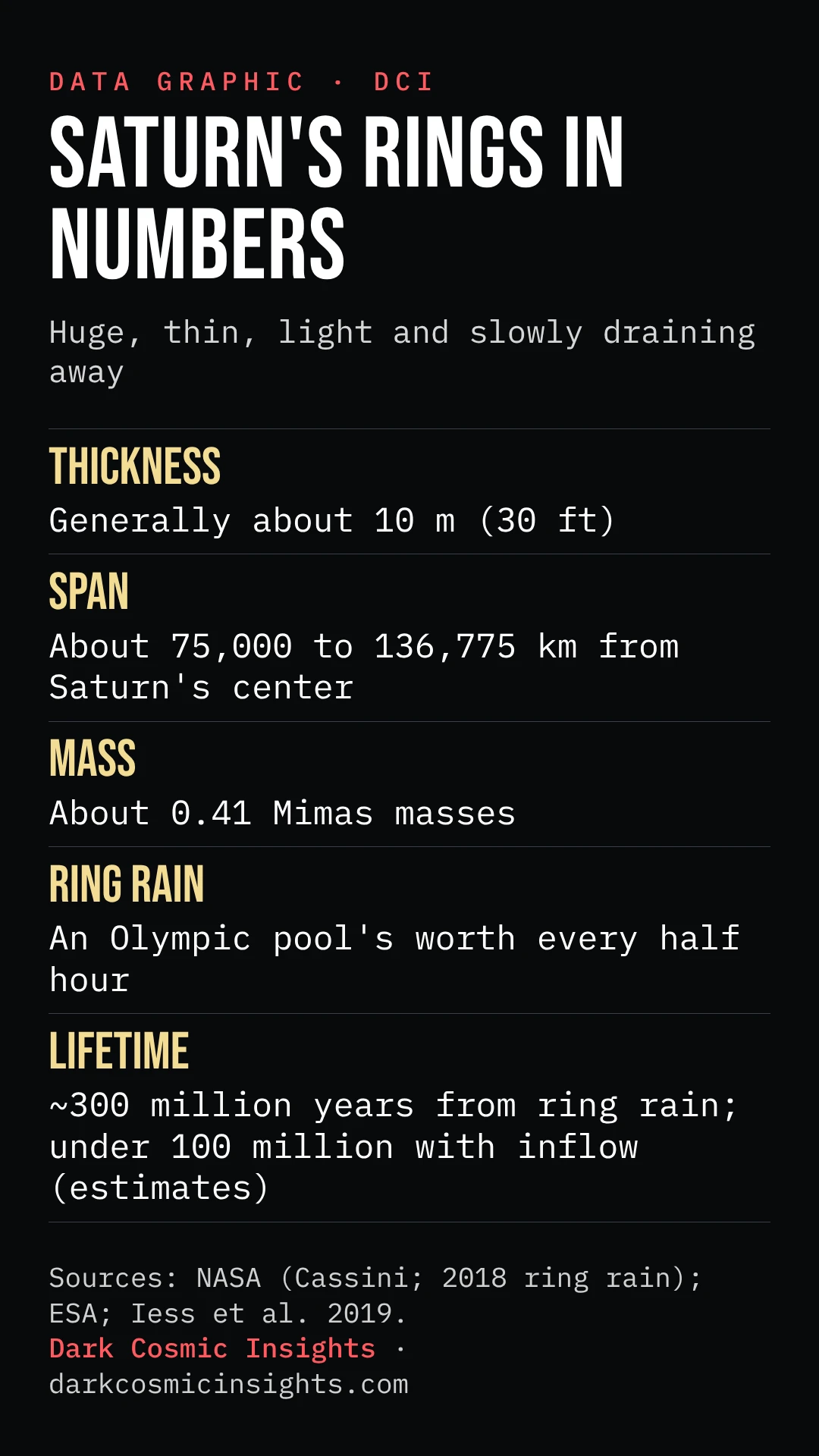
| How thick are the rings? | Generally about 10 meters (30 feet) | Measured | NASA, Cassini rings |
| How much do they weigh? | (1.54 ± 0.49) × 10¹⁹ kg, about 0.41 times the mass of the moon Mimas | Measured | Iess et al. 2019, Science |
| Are the rings losing material? | Yes: ring rain into Saturn, plus inflow at the equator seen by Cassini | Measured | NASA, 2018 |
| How long will they last? | About 300 million years from ring rain at the estimated rate; under 100 million with equatorial inflow | Modelled | NASA, 2018 |
| Are the rings young? | Mass and cleanliness suggest roughly 10–400 million years | Modelled | Iess et al. 2019 · Kempf et al. 2023 |
| Could they be as old as Saturn? | A 2024 study says they could only look young | Open | Hyodo et al. 2024, Nature Geoscience |
| Are the rings disappearing in 2025 for good? | No: they reappear as Earth’s view tilts | Not supported | NASA Science |
Status key: Observed = seen directly. Measured = a number with a stated uncertainty or a direct measurement. Modelled = inferred from measurements through a physical model, dependent on assumptions. Open = unresolved; the evidence is incomplete or points different ways. Not supported = the evidence goes against the claim, or there is none for it.
Cite this framework: “DCI Evidence Map: Saturn’s Rings,” Dark Cosmic Insights, November 2026, darkcosmicinsights.com/are-saturns-rings-disappearing/.
Why Did Saturn’s Rings “Disappear” in 2025?
A tilted planet, a tilted view
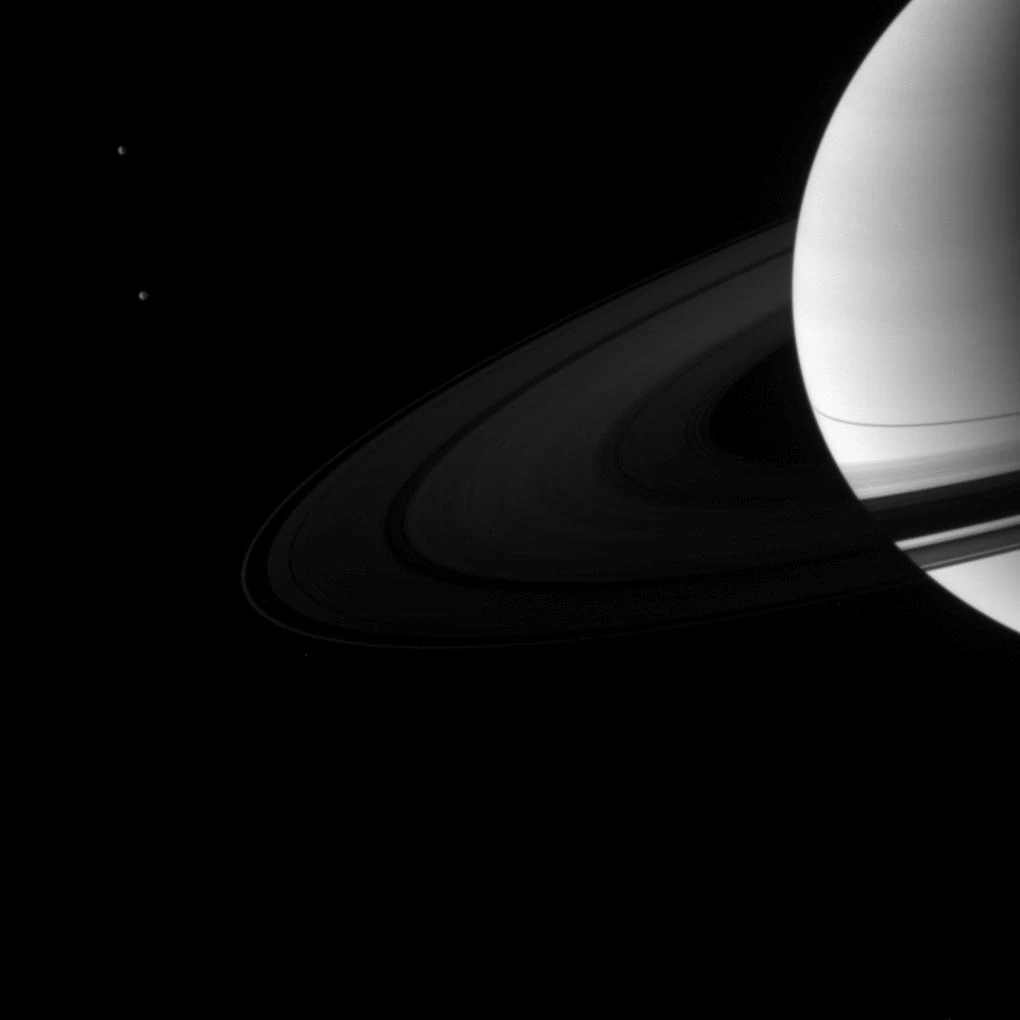
Saturn is tilted on its axis, so as it travels its 29.4-year orbit around the Sun, we see its rings from different angles. For half of a Saturn year we look down on the top of the rings; for the other half we look up at their underside (NASA, Cassini rings). In between, there’s a moment when Earth lines up exactly with the plane of the rings. Astronomers call this a ring plane crossing.
Why edge-on means invisible
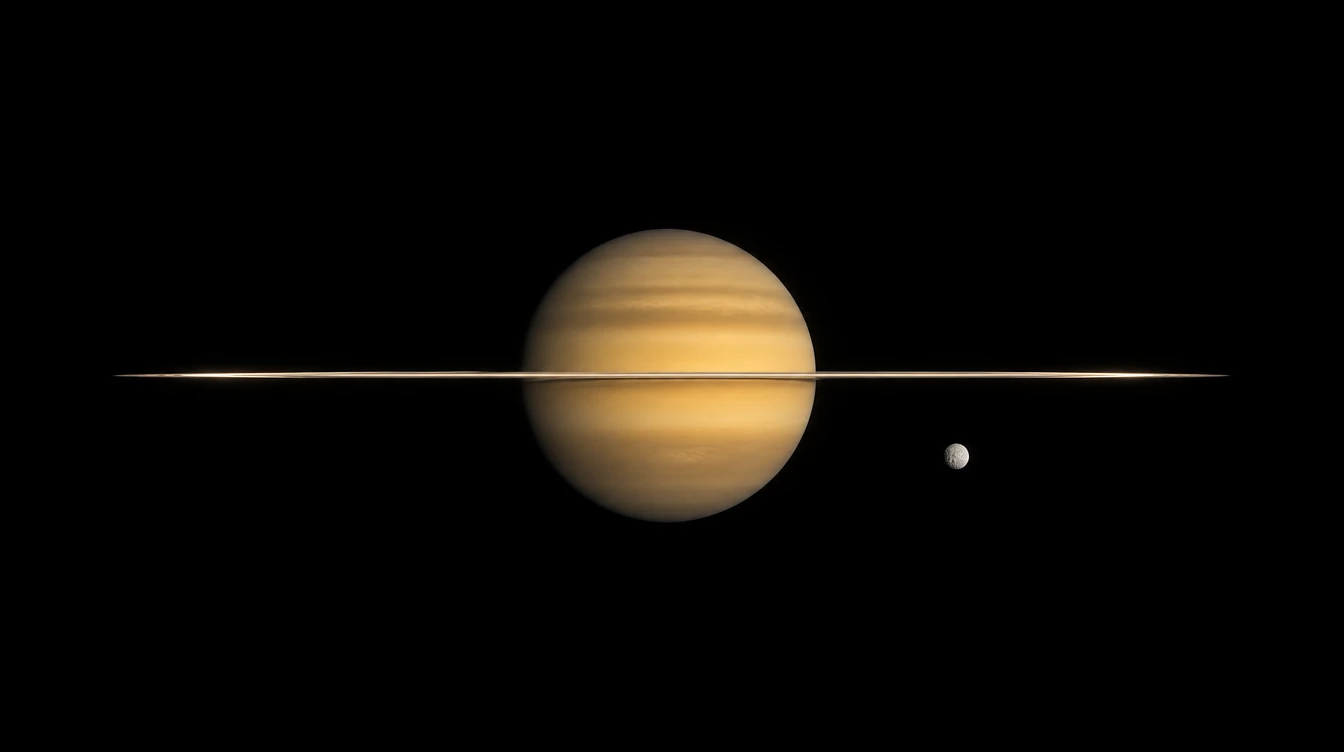
The rings are enormous across but astonishingly thin. NASA says they’re “generally about 30 feet (10 meters) thick or so” (NASA, Cassini rings). Meanwhile, ESA says the main rings stretch from about 75,000 to 136,775 km from Saturn’s center (ESA). Seen edge-on from more than a billion kilometers away, a sheet that thin almost vanishes. Through a small telescope, Saturn looks like a plain ball.
The 2025 dates
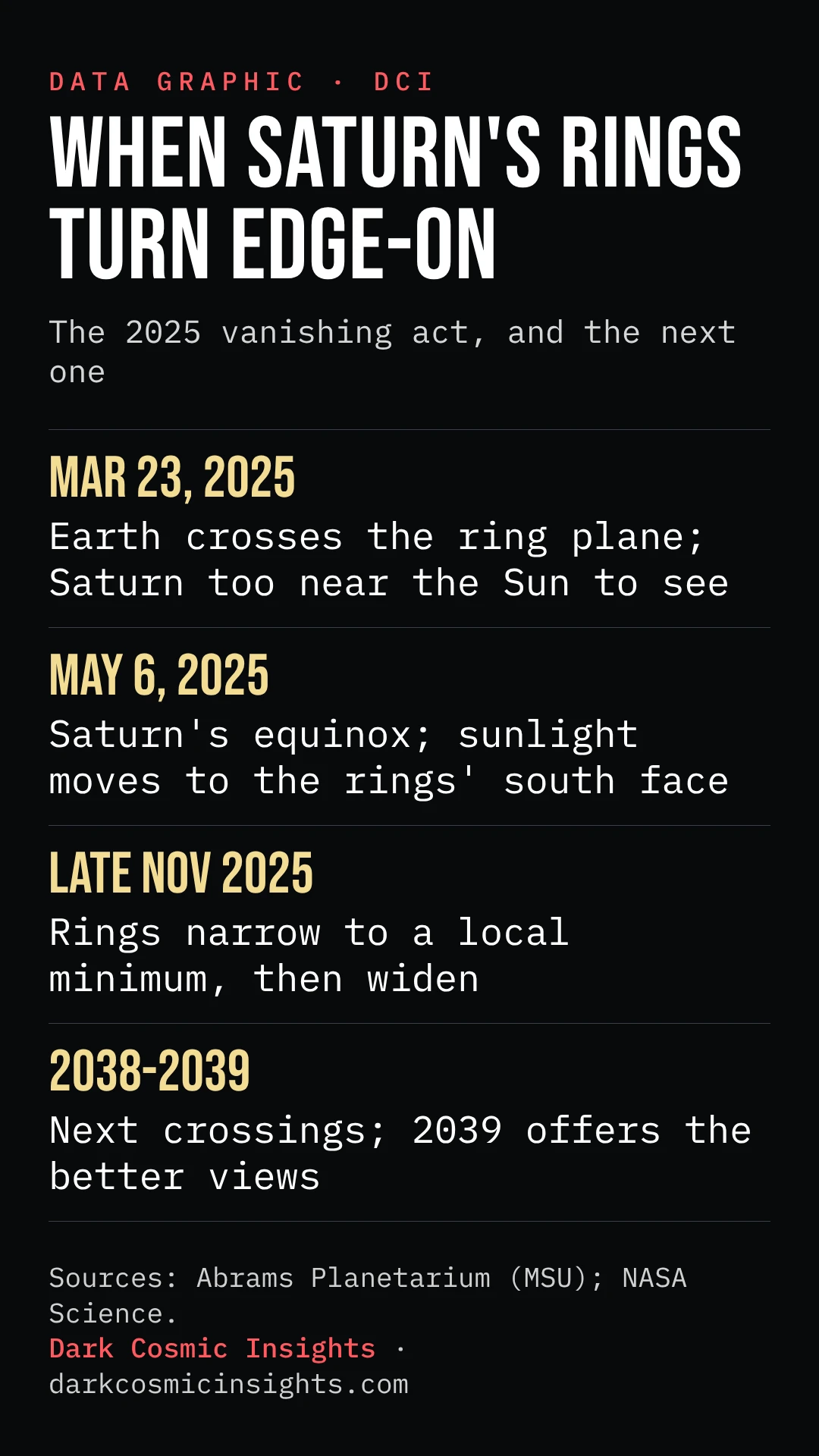
- March 23, 2025: Earth crossed the ring plane and the rings were exactly edge-on to us. Saturn was then only about 10° from the Sun in our sky, so almost nobody could see it (NASA Science).
- May 6, 2025: Saturn’s equinox, when the rings were edge-on to the Sun, and sunlight switched from the north face of the rings to the south face (Abrams Planetarium, MSU).
- Late November 2025: the rings narrowed to a local minimum (November 24, UT), without quite reaching edge-on, before widening again (Abrams Planetarium, MSU).
When will it happen again?
The next ring plane crossings come in 2038 and 2039, when Earth passes through the ring plane three times: October 15, 2038, April 1, 2039 and July 9, 2039. Saturn will be only about 28° from the Sun at the October 2038 crossing, so the 2039 crossings offer better opportunities, especially April, when Saturn is far from the Sun in our sky (NASA Science).
So the 2025 “disappearance” claim: not supported. The rings were right where they always are.
Is Saturn Really Losing Its Rings?
Yes, slowly. This part of the headline is real.
Ring rain
In 2018, a team led by James O’Donoghue of NASA’s Goddard Space Flight Center measured what’s called ring rain: icy particles from the rings that get electrically charged and are pulled into Saturn along its magnetic field lines. Using the Keck telescope in Hawaiʻi, they saw glowing bands in Saturn’s upper atmosphere where those field lines meet the planet (NASA, 2018).
O’Donoghue put the rate in everyday terms: ring rain drains enough water products “to fill an Olympic-sized swimming pool” from the rings “in half an hour.”
How long do the rings have?
From that rate alone, NASA says, “the entire ring system will be gone in 300 million years.” Cassini also detected ring material falling directly into Saturn’s equator during its final orbits. Add that, and “the rings have less than 100 million years to live” (NASA, 2018).
Those are estimates that assume today’s loss rates continue. A 2025 review of the rings’ age and origin notes that Cassini’s Grand Finale measurements indicate the rings are losing mass to the planet, but how fast that loss runs over long periods is still being worked out (Crida et al. 2025, Space Science Reviews).
The inner rings go first
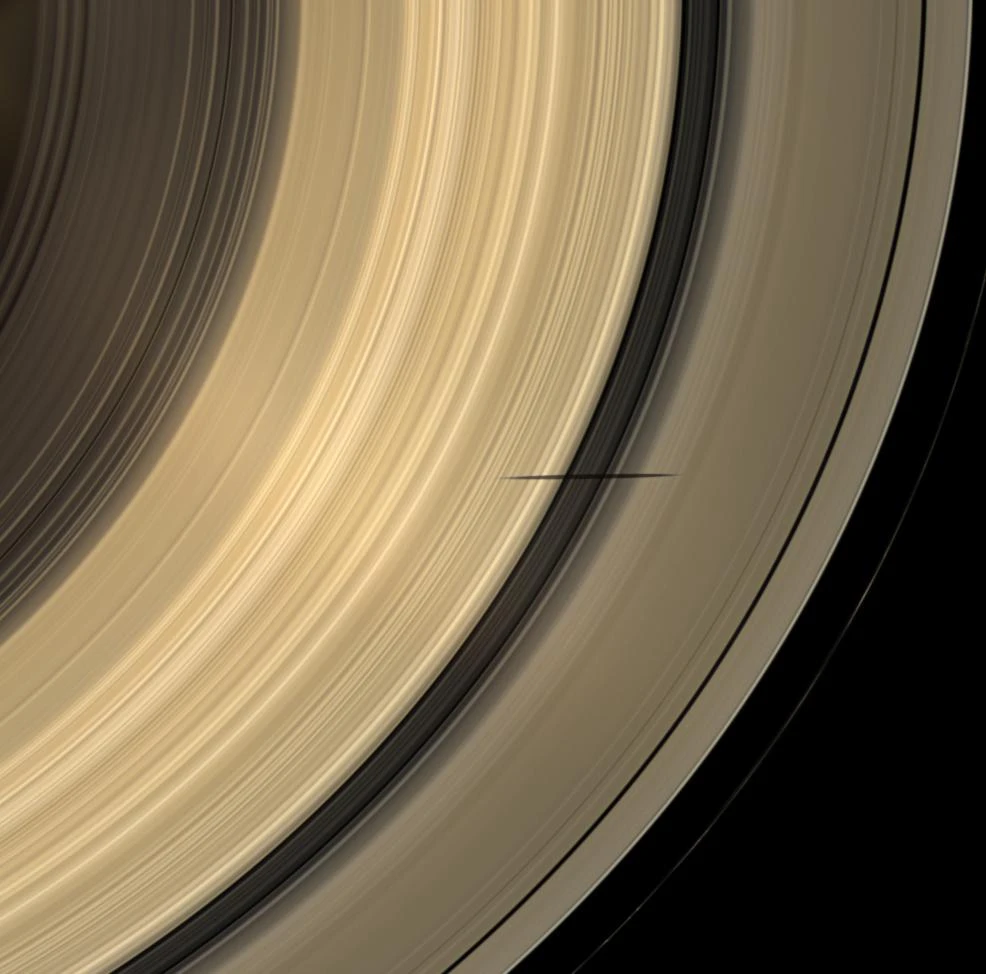
NASA’s visualization of the future shows the innermost rings disappearing first as they rain onto the planet, followed very slowly by the outer rings (NASA, 2018).
How Old Are Saturn’s Rings?
This is the big open question, and the evidence genuinely pulls in two directions.
Clue 1: The rings are light
During its 2017 Grand Finale, Cassini dived between Saturn and its innermost ring. By tracking how the rings’ gravity tugged on the spacecraft, scientists weighed them: (1.54 ± 0.49) × 10¹⁹ kilograms, about 0.41 times the mass of Saturn’s small moon Mimas (Iess et al. 2019, Science).
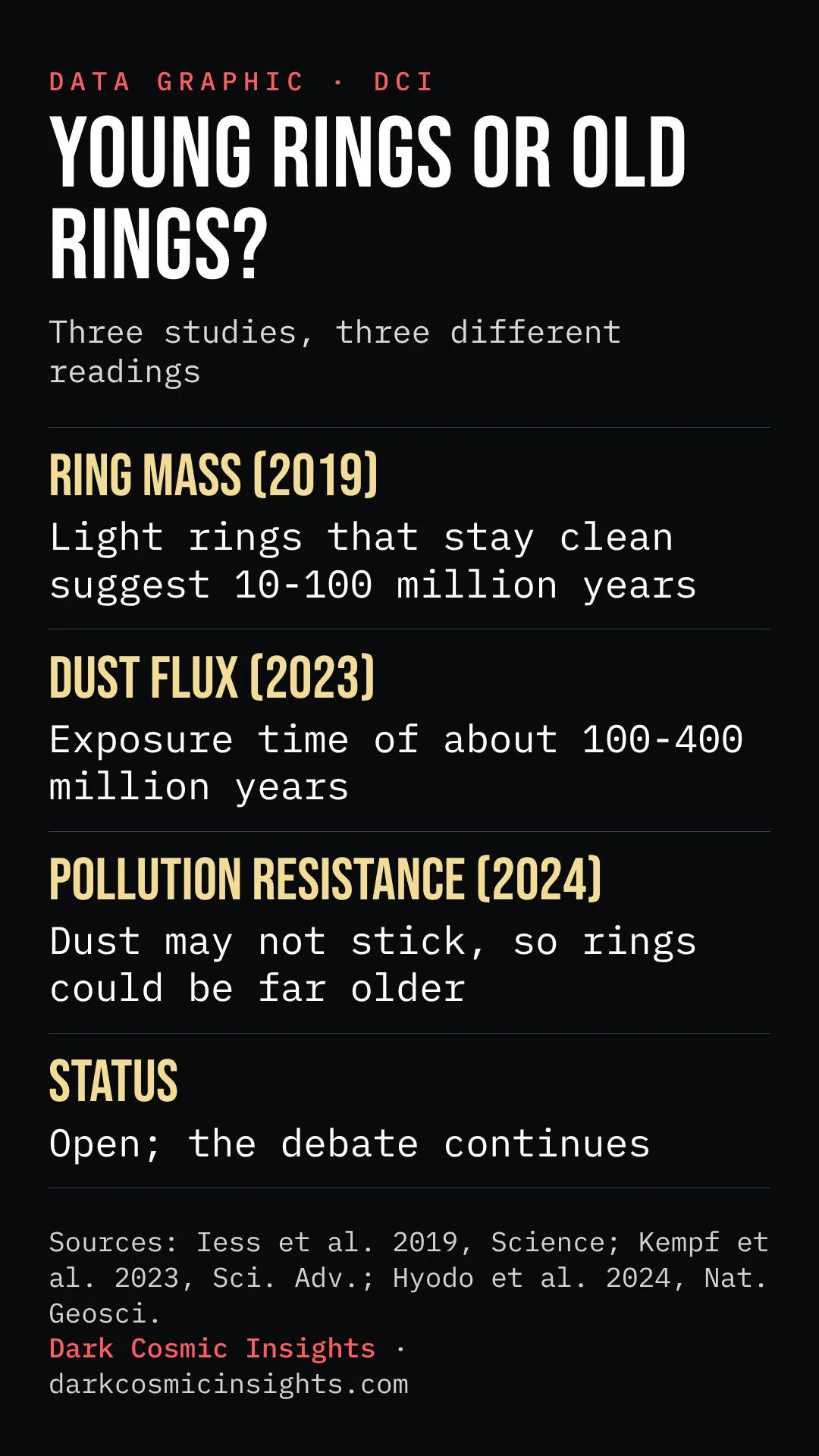
That’s lighter than older estimates. Lighter rings would get dirty faster from the dust constantly falling in from space, yet the rings are bright and icy. The team concluded the rings “may have formed 10⁷ to 10⁸ years ago,” meaning 10 to 100 million years (Iess et al. 2019). NASA summed it up: the rings may have formed “during the age of dinosaurs” (NASA, 2019).
Clue 2: The rings are clean
Space dust is mostly dark, rocky material. Over time, it should darken icy rings, like soot on snow. Cassini’s Cosmic Dust Analyzer measured how much of that dust is falling into the Saturn system. In 2023, Sascha Kempf and colleagues used that measurement to estimate the rings’ “exposure time” at about 100 to 400 million years (Kempf et al. 2023, Science Advances). Kempf told Physics magazine, “Saturn’s rings are incredibly clean,” which indicates they’re much younger than the planet (Physics, 2023).
Clue 3: Maybe the dust doesn’t stick
In December 2024, Ryuki Hyodo, Hidenori Genda and Gustavo Madeira challenged the “clean means young” logic in Nature Geoscience (Hyodo et al. 2024). Their simulations of tiny meteoroids slamming into ring particles at very high speed found that the impactor material vaporizes, becomes charged, and is swept out of the rings, into Saturn or away into space, rather than sticking.
If very little of the dust stays (they estimate an accretion efficiency of about 1% or less), the rings could stay clean for much longer. The authors suggest “the apparent youth of Saturn’s rings could be due to pollution resistance, rather than indicative of young formation age.” They also note their models don’t include particle porosity, strength or granularity, which adds uncertainty.
Where that leaves us
A 2025 review in Space Science Reviews by Aurélien Crida and colleagues lays out the problem: if the rings’ lifetime is on the order of a hundred million years, seeing them now is “very fortunate,” because that span is only about 2% of the solar system’s age (Crida et al. 2025). Young rings need a recent, dramatic origin; old rings need a way to stay clean and survive. Status: open.
Where Would Young Rings Come From?
If the rings are young, something had to make them recently. NASA notes the leading ideas: a comet that wandered too close and was torn apart by Saturn’s gravity, or an event that broke up an earlier generation of icy moons (NASA, 2019). NASA’s 2018 release adds that small icy moons could have collided, perhaps after a passing asteroid or comet nudged their orbits (NASA, 2018).
None of these has been confirmed. They’re modelled scenarios that would fit young rings.
The case for old rings, then and now
The old-rings side isn’t new. Back in 2007, University of Colorado researcher Larry Esposito argued from Cassini data that the rings “probably were always around but continually changing,” recycling material so pollution gets diluted (NASA, 2007). After the Grand Finale results, Science reported in 2017 that Esposito, who had “long believed the rings to be old,” said the new Cassini data “really argue strongly that the rings are young” (Science, 2017). The 2024 pollution-resistance study reopened the door.
What Else Changes in Saturn’s Rings?
The rings aren’t a frozen sculpture. Even on human timescales, they change.
Spokes that come and go
Cassini watched dark, ghostly spokes sweep across the rings. NASA says spokes can be longer than 10,000 miles (16,000 km), and can form “in the time it takes you to eat breakfast” and vanish by lunch. They went unseen from 1998 until 2005 and appeared in full again in 2008, behaving like a seasonal feature (NASA, Cassini rings).
Giant shadows at equinox
Around Saturn’s 2009 equinox, sunlight hit the rings edge-on and stretched the shadows of anything sticking up from them. Cassini saw shadows that revealed “unexpectedly immense ring chunks” (NASA, Cassini rings).
A gap that may be young too
The 2025 review notes that recent work suggests the Cassini Division, the dark gap between the A and B rings, could have formed as recently as about 4 million years ago, and may disappear within roughly 40 million years, linked to the movement of the moon Mimas (Crida et al. 2025). That’s a model-based suggestion, but it’s a reminder that the rings’ structure has a history of its own.
Myth vs. Fact: Saturn’s Rings
| Myth | Fact | Status |
|---|---|---|
| “Saturn’s rings disappeared in 2025.” | They turned edge-on to Earth on March 23, 2025, and are tilting back into view. | Observed |
| “The rings will be gone in our lifetime.” | Estimates give them about 300 million years from ring rain, or under 100 million with equatorial inflow. | Modelled |
| “The rings are as old as Saturn, everyone knows that.” | Cassini data point to young rings; a 2024 study says they could be old. | Open |
| “Saturn’s rings are thick and solid.” | They’re billions of separate icy pieces, generally about 10 m thick. | Measured |
| “Saturn is the only planet with rings.” | Jupiter, Uranus and Neptune have rings too; Saturn’s are by far the brightest. | Observed |
| “Nothing about the rings ever changes.” | Spokes come and go, and features like the Cassini Division may be geologically young. | Observed |
How Can You See Saturn’s Rings Yourself?
With a small telescope
Saturn’s rings are invisible to the naked eye, but even a modest telescope shows them. Right now, after the 2025 crossing, the rings are tilting open again, so they’ll look wider each year for the next several years.
Watch for 2038–2039
If you want to see the rings “vanish” yourself, mark 2038 and 2039, especially April 1, 2039, when Saturn is far from the Sun in our sky. Astronomers historically use them to hunt for faint moons and study the rings’ thin edge. The Hubble Space Telescope observed the 1995 crossing from space (NASA Science).
Explore the data
- Seven, eight or thousands: How Many Rings Does Saturn Have?
- Size, mass and the bathtub question: How Big Is Saturn?
- Distance, travel time and the 29-year Saturn year: How Far Is Saturn?
- Why Saturn looks pale gold, and why its poles turn blue: What Color Is Saturn?
- Browse Cassini ring images in NASA’s Photojournal.
- Read NASA’s 2018 ring rain release, which includes a visualization of Saturn’s future.
Saturn’s Rings by the Numbers
| Measure | Value | Source |
|---|---|---|
| Last ring plane crossing (Earth) | March 23, 2025 | Abrams Planetarium, MSU |
| Saturn’s equinox | May 6, 2025 | Abrams Planetarium, MSU |
| Next crossings | Oct 15, 2038; Apr 1, 2039; Jul 9, 2039 | NASA Science |
| Typical thickness | about 10 m (30 ft) | NASA |
| Main rings’ span | about 75,000–136,775 km from Saturn’s center | ESA |
| Ring mass | (1.54 ± 0.49) × 10¹⁹ kg, about 0.41 Mimas | Iess et al. 2019 |
| Ring rain rate | an Olympic pool every half hour | NASA, 2018 |
| Lifetime estimate | about 300 million years (ring rain, at the estimated rate); under 100 million (with equatorial inflow) | NASA, 2018 |
| Age from ring mass | 10–100 million years | Iess et al. 2019 |
| Age from dust exposure | about 100–400 million years | Kempf et al. 2023 |
Values are as of November 2026.
Saturn’s Rings FAQ
Are Saturn’s rings really disappearing?
Over hundreds of millions of years, yes. Ice from the rings rains into Saturn, and NASA estimates the rings could be gone in about 300 million years at the estimated ring-rain rate, or under 100 million counting material falling into Saturn’s equator. The 2025 “disappearance” was different: just an edge-on view.
Why couldn’t we see Saturn’s rings in 2025?
Earth passed through the plane of the rings on March 23, 2025, so we saw them exactly edge-on. Because the rings are only about 10 meters thick, they almost vanish when seen that way. Saturn was also close to the Sun in the sky at the time, which made it hard to observe.
How old are Saturn’s rings?
Nobody knows for sure. Cassini’s measurements of ring mass point to 10 to 100 million years, and its dust measurements to about 100 to 400 million years. A 2024 study argues the rings only look young because space dust doesn’t stick to them well, so they could be much older.
What is ring rain?
Ring rain is the steady fall of icy particles from Saturn’s rings into the planet. The particles become electrically charged and are pulled in along Saturn’s magnetic field lines. NASA estimates it drains enough water to fill an Olympic swimming pool every half hour.
How thick are Saturn’s rings?
Very thin for their size. NASA says the rings are generally about 10 meters, or 30 feet, thick, even though the main rings stretch about 60,000 kilometers across from inner to outer edge. They’re made of countless separate pieces of ice and some rock.
What are Saturn’s rings made of?
Mostly water ice, in pieces ranging from tiny grains to large chunks, plus a small amount of rocky material. That cleanness, with so little dark dust mixed in, is one of the main clues in the debate over the rings’ age.
When will Saturn’s rings be edge-on again?
Earth will pass through the ring plane three times: on October 15, 2038, April 1, 2039 and July 9, 2039. The 2039 crossings offer the better views, especially April 1, when Saturn sits far from the Sun in our sky. The October 2038 one, like March 2025, comes with Saturn fairly close to the Sun.
Will Saturn lose its rings in our lifetime?
No. Even the fastest NASA estimate gives the rings tens of millions of years, so they are not expected to disappear within a human lifetime. What you will notice is their changing tilt as seen from Earth.
Your next step: look up when Saturn is visible from your location this season and find a telescope, even a small one. The rings are opening up again after the 2025 crossing, and each year they’ll look a little wider.

Sources and Further Reading
- Iess, L., et al. (2019). Measurement and implications of Saturn’s gravity field and ring mass. Science, 364, eaat2965. doi:10.1126/science.aat2965
- Kempf, S., et al. (2023). Micrometeoroid infall onto Saturn’s rings constrains their age to no more than a few hundred million years. Science Advances, 9, eadf8537. doi:10.1126/sciadv.adf8537
- Hyodo, R., Genda, H., & Madeira, G. (2024). Pollution resistance of Saturn’s ring particles during micrometeoroid impact. Nature Geoscience, 18, 44–49 (2025). doi:10.1038/s41561-024-01598-9
- Crida, A., Estrada, P. R., Nicholson, P. D., & Murray, C. D. (2025). The Age and Origin of Saturn’s Rings. Space Science Reviews, 221, 66. doi:10.1007/s11214-025-01189-z
- NASA Science (December 17, 2018), NASA Research Reveals Saturn is Losing Its Rings at Worst-Case-Scenario Rate.
- NASA Science (January 17, 2019), NASA’s Cassini Data Show Saturn’s Rings Relatively New.
- NASA Science, Cassini: Saturn Rings; Hubble Views Saturn Ring-Plane Crossing; Saturn’s Rings May Be Old Timers (2007).
- ESA Science & Technology, Saturn (Cassini-Huygens).
- Abrams Planetarium, Michigan State University, Appearance of Saturn’s Rings, 2025–2039 and beyond.
- Physics (May 15, 2023), Space Dirt Reveals Age of Saturn’s Rings; Science (December 12, 2017), Saturn’s rings are a recent addition to the solar system.
Explore Next
- The full Saturn guide: Saturn: Facts, Rings, Moons and Your Questions
- The new ten-sided wave at Saturn’s south pole: Saturn’s Decagon
- Saturn’s huge family of moons, including ring shepherds: How Many Moons Does Saturn Have?
- Saturn’s north pole next to Jupiter’s: Jupiter’s Polar Cyclones vs. Saturn’s Hexagon
- NASA’s helicopter for Saturn’s biggest moon: Titan and Dragonfly
- Every planet, its moons and our guides: Solar System Explorer
- How a claim earns its label: How We Know
How This Explainer Was Checked
Every number in this article was checked in November 2026 against the source linked beside it: the peer-reviewed studies by Iess and colleagues (Science, 2019), Kempf and colleagues (Science Advances, 2023) and Hyodo and colleagues (Nature Geoscience, 2024), the 2025 review by Crida and colleagues in Space Science Reviews, NASA’s ring rain, ring age and Cassini ring pages, ESA’s Saturn page, and Michigan State University’s Abrams Planetarium for ring-plane crossing dates. The 2025 edge-on view is labelled Observed; ring mass, thickness and ring rain are labelled Measured; lifetime estimates and young-ring formation scenarios are labelled Modelled; the rings’ age is labelled Open. Different age estimates come from different methods and are shown side by side, not averaged. Images are labelled: real spacecraft images as OBSERVATION, illustrations as ILLUSTRATION, and our charts as DATA GRAPHIC. Nothing AI-generated is presented as a real image.
Final Thought: Lucky to Be Here Now
Saturn’s rings look permanent, the most famous decoration in the solar system. They aren’t. They’re raining away, and they may have shown up only after the dinosaurs did, or they may have been quietly cleaning themselves for billions of years. Either way, we happen to live in a moment when they’re bright, wide and easy to see. In 2025 they turned edge-on and seemed to vanish. They’ll be back in full view for a long, long time, but not forever.
About the Author
Author: King | Founder of Dark Cosmic Insights
King is the founder of Dark Cosmic Insights, a science storytelling platform exploring the strangest true stories hiding in space, science and AI. He digs into NASA, ESA and peer-reviewed research, separates what has been measured from what is still a mystery, and turns it into articles, data graphics and Shorts.
Follow the anomaly. Trace the source.