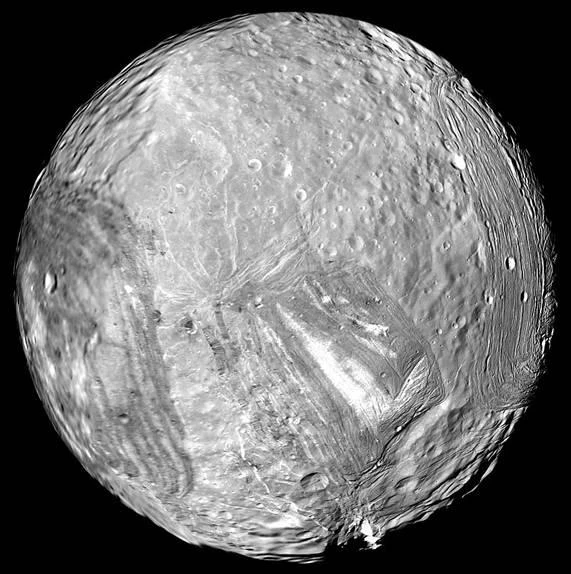
On January 24, 1986, NASA’s Voyager 2 flew past a small moon of Uranus at only 28,260 km (17,560 miles), closer than it had come to any object up to then (NASA Science, Voyager 2). The moon was Miranda, about 500 km across, and its surface looked stitched together from mismatched parts. NASA says its canyons run as much as 12 times as deep as the Grand Canyon (NASA Science, Miranda).
Miranda raises a simple question: how many moons does Uranus have, and what are they like? The short answer is 29 known moons, most of them named for Shakespeare and Alexander Pope characters, circling a planet that spins on its side.
Observed, modelled, open. The moons’ sizes, orbits and Voyager-era surfaces are observed or measured, and so is the fact that the big moons orbit around Uranus’s tilted equator. Hidden oceans inside the major moons, and how the moons ended up on that tilted equator, are modelled in published studies but still open. What tipped Uranus over in the first place is also open.
Quick Answer: How Many Moons Does Uranus Have?
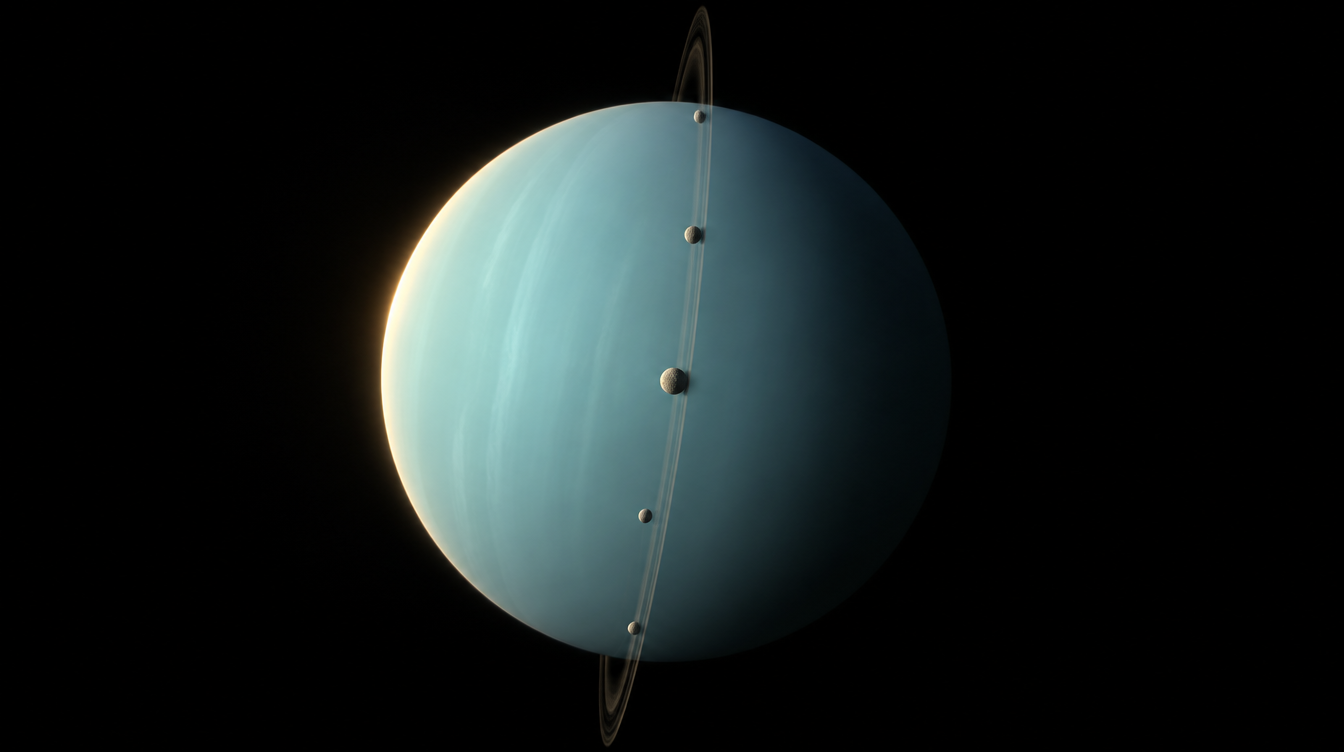
Uranus has 29 known moons, as of November 2026, according to NASA JPL’s live satellite list (JPL Solar System Dynamics); NASA’s Uranus Moons page gives the same figure (NASA Science). Five are large and round: Miranda, Ariel, Umbriel, Titania and Oberon. Fourteen small moons orbit close in, among and near the rings, and ten small irregular moons orbit far out, most of them backwards. Twenty-seven have names, almost all of them characters from Shakespeare, with a few from Alexander Pope; the two newest are still unnamed.
What this article can and cannot establish. It can give you a dated count, introduce the notable moons, and show which claims rest on Voyager 2 images, telescope data or models. It cannot tell you whether any Uranian moon has an ocean today, because none has been measured, or what tipped Uranus over, because the models disagree. Only one spacecraft has visited, in 1986.
Table of Contents
The DCI Evidence Map: Uranus’s Moons
| Question | What we know | Status | Key source |
|---|---|---|---|
| How many moons does Uranus have? | 29 known, as of November 2026 | Measured | JPL SSD |
| Do the big moons orbit around Uranus’s tilted equator? | Yes: inclinations of 0.0° to 0.1° for four, 4.4° for Miranda | Measured | JPL SSD, mean elements |
| What tipped Uranus onto its side? | Giant impact, spin-orbit resonance plus impact, or a lost migrating moon: all proposed | Open | NASA · Rogoszinski & Hamilton 2020 · Saillenfest et al. 2022 |
| How did the moons end up on the tilted equator? | One proposed scenario: a disk re-formed on the new equator after the tilt | Open | Morbidelli et al. 2012 |
| Is Miranda’s surface jumbled? | Three large coronae and deep fault canyons in Voyager 2 images | Observed | Smith et al. 1986 · NASA |
| How did Miranda’s terrain form? | Shattering and reassembly, or rising slushy ice; a 2024 model adds a past ocean | Open | NASA · Strom et al. 2024 |
| Do Ariel, Umbriel, Titania and Oberon have oceans today? | Interior models say they may; nothing has measured one | Open | Castillo-Rogez et al. 2023 |
| Is there CO₂ and CO ice on Ariel? | Yes, in Webb spectra; an interior source is unconfirmed | Observed | Cartwright et al. 2024 |
| Are the irregular moons captured? | Distant, tilted, mostly backwards orbits point to capture | Modelled | Gladman et al. 1998 |
| Is a Uranus orbiter on its way? | Recommended in 2022 and given up to $10 million for early planning in FY2026, but not approved to build; the FY2027 request proposed no dedicated funding | Not supported | Congressional Record, January 8, 2026; AAS, April 2026 |
Status key: Observed = seen directly in images or data. Measured = a number or detection with stated uncertainty. Modelled = inferred from measurements through a physical model, dependent on assumptions. Open = unresolved; the evidence is incomplete or points different ways. Not supported = no evidence for the claim.
Cite this framework: “DCI Evidence Map: Uranus’s Moons,” Dark Cosmic Insights, November 2026, darkcosmicinsights.com/how-many-moons-does-uranus-have/.
How Many Moons of Uranus Are Known, and Who Keeps the Count?
When we checked NASA JPL’s satellite discovery list in November 2026, it listed 29 moons of Uranus (JPL SSD). Of those, 28 carry a permanent Roman numeral and 27 have names. The newest two are the exceptions:
- S/2025 U1 has a number, Uranus XXVIII, but no name yet.
- S/2023 U1 has neither, only its provisional label.
NASA’s Uranus Moons page, updated September 22, 2026, agrees, listing 29 officially recognized moons as of August 2026 (NASA Science, Uranus Moons).
Not every NASA page has caught up. NASA’s Uranus facts page, updated October 15, 2026, still says 28 (NASA Science, Uranus Facts), and the main Uranus page mentions both 28 and the 27 in older Webb captions (NASA Science, Uranus). Those are earlier counts: the total rose to 28 in February 2024 and to 29 in August 2025. JPL’s page also still carries a 2023 date stamp, though its table cites 2024 and 2025 announcements.
For the dated comparison with Saturn, Jupiter and every other planet, see which planet has the most moons. Here, we focus on the moons themselves.

Why Are Uranus’s Moons Named After Shakespeare Characters?
Most planets’ moons take names from Greek and Roman myth. Uranus broke the pattern. NASA notes the moons are sometimes called the “literary moons,” because they are named for Shakespeare characters, with a couple from the works of Alexander Pope (NASA Science, Uranus Moons).
Three steps need keeping apart: discovery, naming and the date.
- Discovery. William Herschel found Titania and Oberon on January 11, 1787 (NASA Science, Titania). William Lassell, an English amateur astronomer, found Ariel and Umbriel on October 24, 1851 (NASA Science, Ariel).
- Names. NASA says Sir John Herschel, the discoverer’s son, named Ariel at Lassell’s request (NASA Science, Ariel). Wikipedia’s summary, citing Lassell’s 1852 paper in Astronomische Nachrichten, dates the naming of all four to 1852, and notes it is uncertain whether Herschel originated the names or Lassell chose them and asked permission (Wikipedia, Moons of Uranus).
- A date conflict. NASA’s Oberon page says John Herschel named it “in the early 19th century” (NASA Science, Oberon), which doesn’t fit 1852. We flag it rather than pick a side.
Where the names come from. Titania and Oberon are the fairy queen and king of A Midsummer Night’s Dream; Umbriel is a “malevolent spirit” in Pope’s The Rape of the Lock (NASA Science, Umbriel); Ariel is both a spirit in The Tempest and a sylph in Pope’s poem (NASA Science, Ariel).
Miranda came later. Gerard Kuiper found it on February 16, 1948, at McDonald Observatory in West Texas, and it is named for Prospero’s daughter in The Tempest (NASA Science, Miranda). Kuiper’s announcement appeared in 1949 (Kuiper 1949).
Naming today. Under IAU rules, a moon is named only once its orbit is “reasonably well known” and it has a permanent Roman numeral; IAU working groups then develop the name (USGS Gazetteer, IAU rules). So S/2025 U1 has a number but no name yet.
Why Does Miranda Look So Jumbled?
Miranda is the innermost and smallest of the five major moons (NASA Science, Uranus Moons). JPL gives its mean radius as 235.8 ± 0.7 km, so it is about 472 km (293 miles) across (JPL SSD, physical parameters); NASA rounds that to about 500 km. It orbits about 129,800 km (80,700 miles) from Uranus every 1.41 days (JPL SSD, mean elements).
What Voyager 2 saw
The Voyager imaging team reported that about half of Miranda’s surface is old, bland, cratered terrain. The rest is three large, younger regions crossed by intersecting scarps and ridges, with outcrops of bright and dark material (Smith et al. 1986). Those regions are now called coronae, and NASA describes them as unique among known objects in the solar system (NASA Science, Miranda).
NASA says Miranda “looks like it was pieced together from parts that didn’t quite merge properly.” In its weak gravity, a rock dropped from the highest cliff would take about 10 minutes to reach the bottom (NASA Science, Miranda).
How tall is Verona Rupes?
The most famous cliff is Verona Rupes, and estimates vary. NASA’s Astronomy Picture of the Day gives an estimated 20 km (12 miles) (NASA APOD, November 29, 2020). Studies from 1988 and 1991, summarized on Wikipedia, give about 5 to 10 km and 5 to 15 km (Wikipedia, Verona Rupes), and one Voyager image caption says the largest fault scarp in its frame “may be 5 km (3 mi) high” (NASA, PIA00044). So “tallest known cliff in the solar system” is one estimate, not a settled ranking.
Two ideas for how it happened
Both are open:
- Smashed and reassembled. Miranda may have been shattered by a huge collision, its pieces falling back together haphazardly.
- Heated from below. Large impacts could have partly melted the icy interior, letting slushy water rise and refreeze again and again. NASA suggests this one may be the likelier of the two (NASA Science, Miranda).
A 2024 study added a twist. Matching modelled stresses to Miranda’s mapped ridges and faults, Strom and colleagues found a past ocean at least 100 km (62 miles) deep under a thin crust of 30 km (19 miles) or less plausible, within the last 100 to 500 million years (Strom et al. 2024). That is a model fitted to 1986 images, not a detection.
What Are Ariel, Umbriel, Titania and Oberon Like?
The other four are bigger, and oddly different from one another. Like Miranda, they are thought to be roughly half water ice and half rock (NASA Science, Oberon). JPL’s mean densities run from about 1.18 g/cm³ for Miranda to about 1.66 g/cm³ for Oberon (JPL SSD, physical parameters); liquid water is 1.0.
Titania: the largest
Titania is Uranus’s largest moon (NASA Science, Titania). JPL’s mean radius of 788.9 ± 1.8 km makes it about 1,578 km (980 miles) across; NASA rounds it to about 1,600 km (1,000 miles). Voyager 2 showed fault valleys, some nearly 1,609 km (1,000 miles) long, a sign the crust was once stretched (NASA Science, Titania).
Oberon: the outermost major moon
Oberon is the second largest, about 1,523 km (946 miles) across, from JPL’s radius of 761.4 ± 2.6 km (JPL SSD). It is the farthest of the five, about 583,500 km (362,600 miles) from Uranus, with a 13.46-day orbit (JPL SSD, mean elements). It is heavily cratered and has at least one large mountain about 6 km (3.7 miles) high (NASA Science, Oberon).
Umbriel: the dark one
Umbriel is about 1,169 km (727 miles) across by JPL’s radius (JPL SSD), which NASA rounds to 1,200 km (750 miles). It is the darkest of the big five, reflecting only 16 percent of the light that hits it, and NASA says how its ancient, cratered surface got so dark is still unexplained (NASA Science, Umbriel). Voyager 2 also caught a bright ring about 140 km (90 miles) across on it, possibly frost tied to an impact crater.
Ariel: the young, bright one
Ariel, about 1,158 km (719 miles) across (JPL SSD), is Umbriel’s near-twin in size but looks nothing like it. It has the brightest surface of the five, the youngest surface of Uranus’s moons, and is crossed by grabens, valleys that drop between parallel faults (NASA Science, Ariel). The Voyager team saw strong evidence of material that once flowed onto its surface (Smith et al. 1986).
Why Do Uranus’s Moons Orbit Sideways?
The strangest thing about the moons of Uranus is that they orbit on edge, because Uranus itself is tipped over.
The tilt is measured
Uranus’s equator is tilted 97.77° to its orbit, the only planet whose equator is nearly at a right angle to its orbit, according to NASA. For nearly a quarter of each Uranian year, the Sun sits almost over one pole (NASA Science, Uranus Facts).
The major moons follow that tilt. JPL measures their orbits against Uranus’s equator, and the inclinations are tiny: 0.0° for Ariel and 0.1° for Umbriel, Titania and Oberon. Miranda is the outlier at 4.4° (JPL SSD, mean elements). So their orbits are tipped along with the planet, standing nearly on end relative to Uranus’s path around the Sun.
Why close moons hug the equator
Orbital dynamics explains why the alignment lasts. A moon’s orbit slowly wobbles around a reference plane called the Laplace surface. For circular orbits, that surface matches the planet’s equator close to the planet and the planet’s orbital plane far away (Tremaine et al. 2009).
JPL’s tables reflect the split: major and inner moons are measured against Uranus’s equator or local Laplace plane, distant irregulars against the ecliptic, the plane of Earth’s orbit (JPL SSD, mean elements). Close moons ride with the tilt; far moons don’t.
How the moons got there is open
The harder question is history: if something knocked Uranus over, why weren’t its moons left on tilted, messy orbits?
- What tipped Uranus? NASA says the tilt “may be the result of a collision with an Earth-sized object long ago” (NASA Science, Uranus Facts). Rogoszinski and Hamilton proposed a slower route: a resonance between Uranus’s spin and its orbit could tilt it to about 70°, with a smaller impact of about half an Earth mass finishing the job (Rogoszinski & Hamilton 2020). Saillenfest and colleagues modelled another option, an ancient moon, now gone, whose migration tilted the planet (Saillenfest et al. 2022). These are competing models.
- How did the moons end up equatorial? In one proposed scenario, a disk of material around Uranus at the time of a tilting collision was scrambled, then collapsed into a thin disk around the new equator, and the moons formed from it. The same paper says this needs Uranus to have had a noticeable tilt before the impact (Morbidelli et al. 2012).
Both stay open: we can measure where the moons are, not yet how they got there.

What Are the Inner Moons and Rings of Uranus?
Inside Miranda’s orbit lie 14 small moons and 13 known rings (JPL SSD; NASA Science, Uranus Facts).
The rings came first. Nine were found in 1977 by a stellar occultation: watching a star flicker as the rings passed in front of it (NASA Science, Hubble). Voyager 2 added two more in 1986, and Hubble two more in images from 2003 to 2005.
Most inner moons came from Voyager 2. The flyby found 10 new moons (NASA Science, Voyager 2), Cordelia through Puck in JPL’s list (JPL SSD), nine of them about 40 to 165 km across (Smith et al. 1986).
- Puck is the largest of Uranus’s lesser moons, about 150 km (90 miles) across, named for the sprite in A Midsummer Night’s Dream (NASA Science, Puck).
- Cordelia and Ophelia are shepherd moons: their gravity keeps the particles of the bright Epsilon ring from spreading out (NASA Science, Cordelia).
- Perdita, from the same 1986 data, is credited by JPL to Erich Karkoschka rather than the Voyager team (JPL SSD).
Hubble added two more. Mark Showalter and Jack Lissauer found Mab and Cupid (JPL SSD; Showalter & Lissauer 2006). Mab, about 12 miles (19 km) wide, shares its orbit with one of the new rings, and the team proposes that dust knocked off Mab by meteoroid impacts feeds that ring (NASA Science, Hubble).
A system in motion. Hubble also found the inner moons’ orbits had shifted since 1994. Showalter called it a “youthful and dynamic system of rings and moons,” and the team suggested some moons may collide within a few million years (NASA Science, Hubble). The orbit changes are measured; the collision timescale is modelled.
What Are Uranus’s Irregular Moons?
Irregular moons are small moons on distant, tilted, often backwards orbits, usually thought to be captured objects. Until 1997, Uranus was the only giant planet with none known (Gladman et al. 1998).
In September 1997, Brett Gladman, Philip Nicholson, Joseph Burns and J. J. Kavelaars used Palomar’s 5-meter Hale telescope to find two faint moons more than 6 and 8 million km from Uranus, confirmed on October 31 (Cornell Chronicle, October 31, 1997). Burns called them “enormous, irregular lumps of dark ice and gunk.” They became Caliban and Sycorax. The Nature paper gave radii of about 60 km and 30 km, found both orbits retrograde, and suggested capture early in the solar system’s history (Gladman et al. 1998). Capture is modelled: no one saw it happen.
Uranus now has 10 irregular moons, from Caliban to S/2023 U1 in JPL’s list (JPL SSD). From JPL’s mean elements:
- Nine orbit backwards. JPL lists inclinations above 90° for all of them except Margaret (JPL SSD, mean elements).
- Margaret goes forward. Its inclination is 60.5° to the ecliptic, and its eccentricity of 0.642 is the highest in JPL’s Uranus table. Its discoverers, who found it as S/2003 U3, called it Uranus’s first known prograde irregular moon (Sheppard et al. 2005).
- Ferdinand is the farthest out on average, at about 20.4 million km (12.7 million miles), taking about 2,788 days (7.6 years) per orbit (JPL SSD, mean elements).
The eight named backwards-orbiting moons all take their names from The Tempest (Wikipedia, Moons of Uranus); the ninth, S/2023 U1, has no name yet (JPL SSD).
How complete is the census?
Probably not. The 2005 Subaru survey reached 50 percent detection efficiency at red magnitude 26.1, about 7 km in radius for dark surfaces (albedo 0.04) (Sheppard et al. 2005). Fainter moons could still be out there; not seeing them isn’t proof they’re absent.
What Are the Newest Moons of Uranus?
S/2023 U1 (announced February 23, 2024). Scott Sheppard’s team first detected it in 2023 with the Magellan Telescope in Chile, then found it in 2021 Subaru and Magellan images. It is about 8 km (5 miles) across, takes about 680 days to orbit, and brought Uranus’s total to 28 (Subaru Telescope, March 5, 2024). JPL credits S. S. Sheppard, citing circular MPEC 2024-D113 (JPL SSD); its 143.9° inclination to the ecliptic makes it retrograde (JPL SSD, mean elements).
S/2025 U1 (announced August 19, 2025). This one came from space. A team led by Maryame El Moutamid of the Southwest Research Institute found it in a series of 10 long exposures taken by Webb’s Near-Infrared Camera on February 2, 2025 (SwRI, August 19, 2025).
- Size: about 10 km (6 miles) across, assuming a surface as reflective as nearby moons.
- Orbit: in Uranus’s equatorial plane, between Ophelia and Bianca. SwRI gives about 56,250 km (35,000 miles) from Uranus’s center; JPL’s mean semi-major axis is 57,844 km (35,900 miles) (JPL SSD, mean elements). We show both.
- Why it was missed: it is well below what Voyager 2’s cameras could detect. It took the count from 28 to 29.
El Moutamid called it “by far the smallest object discovered to date” in her team’s survey (SwRI). Astronomy reports it is the 14th moon found in Uranus’s inner system (Astronomy, August 19, 2025).
Do Uranus’s Moons Have Hidden Oceans?
Nobody knows. This is the most-hyped, least-settled part of the story.
What the models say
In 2023, a team led by Julie Castillo-Rogez of NASA JPL modelled the interiors of the five major moons, informed by a re-analysis of Voyager data (Castillo-Rogez et al. 2023; NASA, PIA25500). In JPL’s summary, Ariel, Umbriel, Titania and Oberon may hold salty oceans beneath their ice, possibly dozens of miles deep, kept liquid partly by salts and ammonia acting as antifreeze. Miranda is probably frozen now, too small to keep enough heat, though it may once have had an ocean.
Castillo-Rogez was careful: “We need to develop new models for different assumptions on the origin of the moons” (NASA JPL, May 4, 2023). Status: modelled, and the existence of any ocean is open.
What Webb saw on Ariel
In 2024, Webb’s NIRSpec instrument found carbon dioxide ice and the first clear signs of carbon monoxide ice on Ariel, with CO₂-rich deposits estimated at 10 mm (0.4 inches) or more on its trailing hemisphere (Cartwright et al. 2024; Phys.org, July 2024).
Carbon monoxide ice is normally stable only near 30 K (about −243 °C, −406 °F), far colder than Ariel’s surface (see how cold space is), so lead author Richard Cartwright said it must be actively replenished (Phys.org). The team suggests some carbon oxides could come from Ariel’s interior, perhaps a subsurface ocean, and sees possible carbonate minerals, but says this needs confirming. The ice is observed; an ocean source is open.
Checking would take a spacecraft, and even that may be tricky: JPL notes that the magnetic method used at Jupiter’s moon Europa could be harder here, because cold oceans in Ariel and Umbriel might carry electrical currents less well (NASA JPL). For Europa’s case, see how many moons Jupiter has.

How Do We Know? Voyager 2, Hubble, Webb and Ground-Based Telescopes
Everything above rests on four kinds of evidence, the how we know question at the heart of DCI.
- Voyager 2 (1986): the only close look. Closest approach came at 17:59 UT on January 24, 1986, about 81,500 km (50,640 miles) from Uranus (NASA Science, Voyager 2). Its images are still the only close-ups of the major moons.
- Hubble: tracking over time. Hubble found Mab, Cupid and two faint rings, and showed the inner moons’ orbits shifting (NASA Science, Hubble).
- Ground-based telescopes: the distant moons. Telescopes including Palomar’s Hale, Subaru and Magellan found the irregular moons with deep, repeated exposures (Cornell Chronicle; Subaru Telescope).
- Webb: infrared eyes. Webb found S/2025 U1 and read Ariel’s surface ices from its spectrum.
Webb’s Uranus images blend several processing treatments to show a bright planet and faint moons together (NASA Science, Webb asset); see are space photos real?
Myth vs. Fact: Uranus’s Moons
| Myth | Fact |
|---|---|
| “Uranus has 27 (or 28) moons.” | Those were older counts. JPL lists 29, as of November 2026. |
| “All of Uranus’s moons are named after Shakespeare.” | Most are, but a few, including Umbriel, come from Alexander Pope. |
| “Miranda was smashed apart and put back together.” | That’s one idea. NASA suggests heating from below may be likelier. Open. |
| “Uranus’s moons have confirmed oceans.” | Models say four may. No measurement has tested it. Open. |
| “The moons were knocked sideways along with Uranus.” | They orbit Uranus’s tilted equator; how they got there is open. |
| “A Uranus mission is on its way.” | It was recommended in 2022 and has early planning money, but it is not approved to build and launch. |
How Can You See the Uranus Moons Yourself?
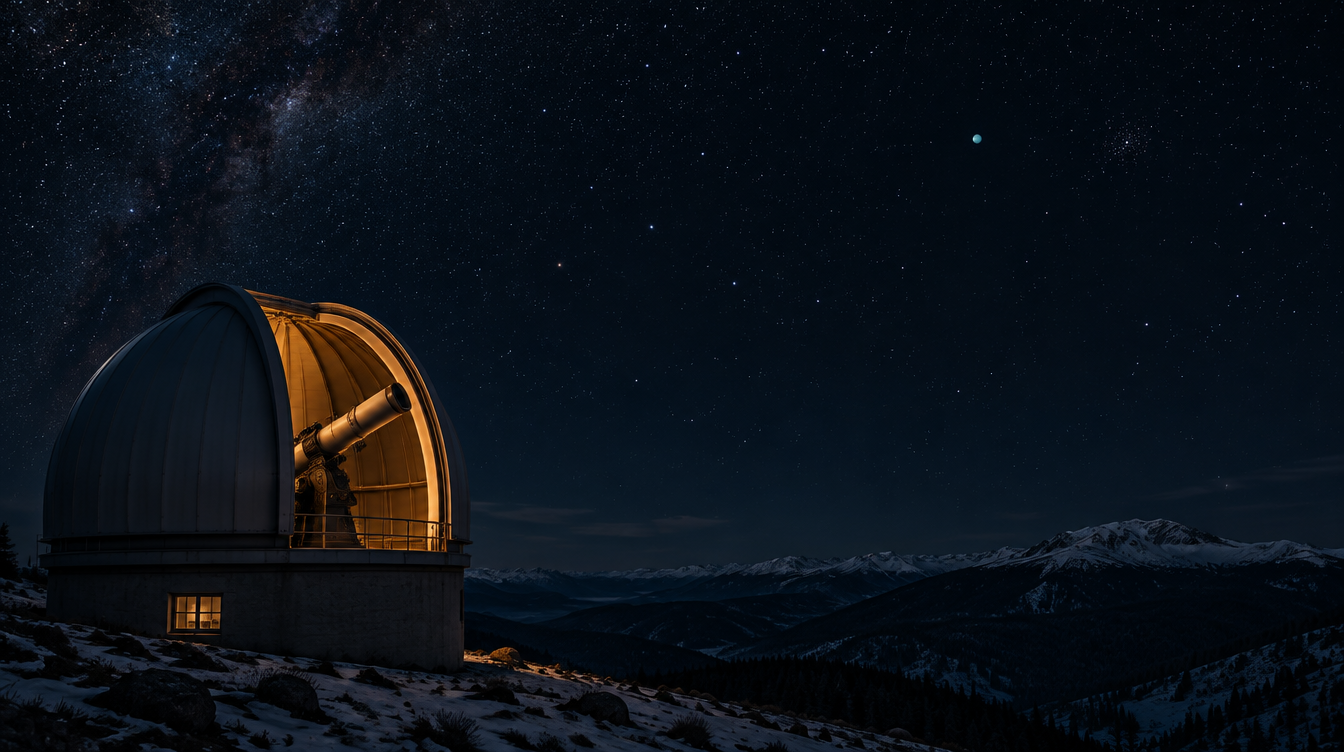
Good timing: Uranus reaches opposition, when it sits opposite the Sun in our sky and is best placed for viewing, on November 25, 2026, at magnitude +5.6 in Taurus (BBC Sky at Night Magazine, November 3, 2026). For UK observers, the magazine’s Pete Lawrence suggests November 22 around 00:15 UT, with the Moon farther away. Elsewhere, check a local sky chart or planetarium app for when Uranus is highest where you live.
A small telescope shows a tiny green-tinged disc. The moons are harder. Sky at Night‘s aperture guide:
- Titania and Oberon: a 200 to 250 mm (8 to 10 inch) telescope.
- Ariel and Umbriel: 300 mm (12 inches) or larger.
- Miranda: at least 400 mm (16 inches).
Tip: note the faint dots near the planet, then look again a night or two later. A moon keeps pace with Uranus; a background star doesn’t.
What Comes Next for Uranus’s Moons?
The state of play, as of November 2026:
- A recommended mission, not an approved one. In April 2022, the planetary science decadal survey named the Uranus Orbiter and Probe its top-ranking flagship concept, at an estimated $4.2 billion, able to launch as soon as 2031 with a Jupiter gravity assist (SpaceNews, April 2022). NASA’s 2021 concept study planned 25 flybys of the major moons, with a magnetometer to hunt for oceans (Simon et al. 2021).
- Schedule pressure. In May 2023, SpaceNews reported a NASA official saying a 2031 or 2032 launch was “not achievable” under current plutonium production plans for its power supply (SpaceNews, 2023).
- Budget status. For FY2026, Congress provided up to $10 million for formulation of the Uranus Orbiter and Probe (Congressional Record, January 8, 2026). That is early planning money, not approval to build and launch a spacecraft. The FY2027 President’s Budget Request, released April 3, 2026, proposed no dedicated funding for the mission (AAS, April 2026), while the House Appropriations Committee’s FY2027 bill voiced support without naming an amount (AAS, May 2026). As of early November 2026, no full-year FY2027 NASA budget had been enacted; a continuing resolution signed September 2, 2026 keeps NASA at its FY2026 level (SpacePolicyOnline, September 2026).
- Launch window and timing. A 2026 mission study in The Planetary Science Journal looked at launch dates from 2035 to 2040, reflecting a project start no earlier than 2027. It calls arriving before or close to Uranus’s early-2050 equinox “a clear desire among the science community, but not a firm requirement” (Simon et al. 2026). Scientific American explains that near equinox, sunlight reaches both hemispheres of the planet and its moons, so a spacecraft would get a better view of both, including moon regions Voyager 2 could not see in 1986 (Scientific American).
- Names. S/2023 U1 and S/2025 U1 are expected to receive literary names in time (NASA Science, Uranus Moons).
Uranus’s Moons by the Numbers
- 29: known moons of Uranus, as of November 2026 (JPL SSD)
- 97.77°: Uranus’s axial tilt (NASA)
- 1,578 km (980 miles): Titania’s mean diameter, the largest moon, twice JPL’s 788.9 km radius (JPL SSD)
- 472 km (293 miles): Miranda’s mean diameter, twice JPL’s 235.8 km radius (JPL SSD)
- 28,260 km (17,560 miles): Voyager 2’s closest distance to Miranda, January 24, 1986 (NASA)
- About 5 to 20 km (3 to 12 miles): published height estimates for Miranda’s Verona Rupes cliff (NASA APOD; Wikipedia)
- About 10 km (6 miles): the diameter of S/2025 U1, the newest moon, found by Webb (SwRI)
- 9 of 10: irregular moons on backwards orbits; Margaret is the exception (JPL SSD)
- About 20.4 million km (12.7 million miles): Ferdinand’s average distance from Uranus (JPL SSD)
Uranus’s Moons: FAQ
How many moons orbit Uranus right now?
Uranus has 29 known moons as of November 2026, according to NASA JPL’s satellite list and NASA’s Uranus Moons page. Twenty-seven have names. The two newest, S/2023 U1 and S/2025 U1, were announced in 2024 and 2025 and are still waiting for names.
What is the largest moon of Uranus?
Titania, at about 1,578 km (980 miles) across, based on JPL’s mean radius. Oberon is close behind at about 1,523 km (946 miles). Both were discovered by William Herschel in 1787.
Who chose the Shakespeare names for Uranus’s moons?
John Herschel, son of Uranus’s discoverer, named the first four moons; NASA says he did so at William Lassell’s request, and the names are usually dated to 1852. Gerard Kuiper found Miranda in 1948 and gave it its Tempest name. Later moons kept the theme of Shakespeare and Alexander Pope characters.
What happened to Miranda’s surface?
Voyager 2 images in 1986 showed old cratered ground beside three younger, ridged regions called coronae, plus canyons far deeper than the Grand Canyon. One idea is that Miranda was shattered and reassembled; another, which NASA suggests may be likelier, is that heat from impacts let slushy ice rise and refreeze. Neither is confirmed.
Do any of Uranus’s moons have water?
The five major moons are thought to be roughly half water ice and half rock; the small moons are too poorly known to say. A 2023 modelling study suggests Ariel, Umbriel, Titania and Oberon may also hide salty liquid oceans, but no measurement has confirmed one. Webb’s detection of carbon oxides on Ariel is a hint that some scientists link to its interior, still unconfirmed.
Why do the moons of Uranus orbit on their side?
Uranus is tilted about 98°, and its large moons orbit close to its equator, so their orbits are tilted too. Close to a planet, orbits stay aligned with the planet’s equator. How the moons ended up there after Uranus was tipped over is still an open question.
When was the newest moon of Uranus found?
S/2025 U1 was found in Webb images taken on February 2, 2025, and announced on August 19, 2025. It is about 10 km across and orbits between the inner moons Ophelia and Bianca. Before that, S/2023 U1 was announced in February 2024.
Is NASA sending a spacecraft to Uranus?
Not yet. The Uranus Orbiter and Probe was the top-recommended new flagship mission in 2022, and Congress gave it up to $10 million for early planning in FY2026, but it is not approved to build and launch, and the FY2027 request proposed no dedicated funding. A 2026 study looked at launches from 2035 to 2040; Voyager 2’s 1986 flyby remains the only visit.
Your next step: Uranus is at opposition on November 25, 2026. Find it in Taurus with a sky app, then look with binoculars or a telescope. If you have an 8-inch or larger scope, try for Titania and Oberon, two faint dots that share the planet’s motion from night to night.
Sources and Further Reading
- NASA JPL Solar System Dynamics (checked November 8, 2026), Planetary Satellite Discovery Circumstances; Planetary Satellite Physical Parameters; Planetary Satellite Mean Elements.
- NASA Science, Uranus Moons (updated September 22, 2026); Miranda (updated September 21, 2026); Ariel (updated November 3, 2024); Umbriel (updated November 3, 2024); Titania (updated September 21, 2026); Oberon (updated September 21, 2026); Puck and Cordelia (updated November 3, 2024).
- NASA Science, Uranus Facts (updated October 15, 2026); Uranus (updated October 26, 2026); Voyager 2 (updated September 28, 2026).
- Smith, B. A., Soderblom, L. A., Beebe, R., et al. (1986). Voyager 2 in the Uranian system: Imaging science results. Science, 233(4759), 43–64. doi:10.1126/science.233.4759.43 (Zenodo record)
- Castillo-Rogez, J., Weiss, B., Beddingfield, C., Biersteker, J., Cartwright, R., Goode, A., Melwani Daswani, M., & Neveu, M. (2023). Compositions and interior structures of the large moons of Uranus and implications for future spacecraft observations. Journal of Geophysical Research: Planets, 128(1), e2022JE007432. doi:10.1029/2022JE007432; NASA JPL (May 4, 2023), New Study of Uranus’ Large Moons Shows 4 May Hold Water; NASA Image Library, Major Moons of Uranus (PIA25500).
- Strom, C., Nordheim, T. A., Patthoff, D. A., & Fieber-Beyer, S. K. (2024). Constraining ocean and ice shell thickness on Miranda from surface geological structures and stress modeling. The Planetary Science Journal, 5(10), 226. doi:10.3847/PSJ/ad77d7 (DOAJ record)
- Cartwright, R. J., Holler, B. J., Grundy, W. M., et al. (2024). JWST reveals CO ice, concentrated CO₂ deposits, and evidence for carbonates potentially sourced from Ariel’s interior. The Astrophysical Journal Letters, 970(2), L29. doi:10.3847/2041-8213/ad566a; Phys.org (July 2024), Carbon oxides on Uranus moon Ariel.
- Gladman, B. J., Nicholson, P. D., Burns, J. A., Kavelaars, J. J., Marsden, B. G., Williams, G. V., & Offutt, W. B. (1998). Discovery of two distant irregular moons of Uranus. Nature, 392(6679), 897–899. doi:10.1038/31890 (RePEc record); Cornell Chronicle (October 31, 1997), ‘Irregular’ satellites S/1997 U1 and S/1997 U2 discovered.
- Sheppard, S. S., Jewitt, D., & Kleyna, J. (2005). An ultradeep survey for irregular satellites of Uranus: Limits to completeness. The Astronomical Journal, 129(1), 518–525. doi:10.1086/426329 (arXiv:astro-ph/0410059)
- Showalter, M. R., & Lissauer, J. J. (2006). The second ring-moon system of Uranus: Discovery and dynamics. Science, 311(5763), 973–977. doi:10.1126/science.1122882; NASA Science (December 22, 2005; updated March 20, 2025), NASA’s Hubble Discovers New Rings and Moons Around Uranus.
- Tremaine, S., Touma, J., & Namouni, F. (2009). Satellite dynamics on the Laplace surface. The Astronomical Journal, 137(3), 3706–3717. doi:10.1088/0004-6256/137/3/3706 (arXiv:0809.0237)
- Morbidelli, A., Tsiganis, K., Batygin, K., Crida, A., & Gomes, R. (2012). Explaining why the uranian satellites have equatorial prograde orbits despite the large planetary obliquity. Icarus, 219(2), 737–740. doi:10.1016/j.icarus.2012.03.025 (arXiv:1208.4685)
- Rogoszinski, Z., & Hamilton, D. P. (2020). Tilting ice giants with a spin–orbit resonance. The Astrophysical Journal, 888(2), 60. doi:10.3847/1538-4357/ab5d35 (arXiv:1908.10969)
- Saillenfest, M., Rogoszinski, Z., Lari, G., Baillié, K., Boué, G., Crida, A., & Lainey, V. (2022). Tilting Uranus via the migration of an ancient satellite. Astronomy & Astrophysics, 668, A108. doi:10.1051/0004-6361/202243953 (arXiv:2209.10590)
- Kuiper, G. P. (1949). The fifth satellite of Uranus. Publications of the Astronomical Society of the Pacific, 61(360), 129. doi:10.1086/126146
- Subaru Telescope (March 5, 2024), New moons of Uranus and Neptune.
- Southwest Research Institute (August 19, 2025), SwRI-led Webb Telescope survey discovers new moon orbiting Uranus; ESA/Webb (August 19, 2025), Uranus and its new moon S/2025 U1; NASA Science, Uranus new moon, annotated (Webb); Astronomy (August 19, 2025), Webb spots a new, tiny moon orbiting Uranus.
- USGS Gazetteer of Planetary Nomenclature, IAU rules and conventions.
- Simon, A., Nimmo, F., & Anderson, R. C. (2021). Uranus Orbiter & Probe Mission Concept Design Study Final Report. NASA Planetary Mission Concept Study for the 2023–2032 Decadal Survey.
- National Academies of Sciences, Engineering, and Medicine (2023). Origins, Worlds, and Life: A Decadal Strategy for Planetary Science and Astrobiology 2023–2032. National Academies Press. doi:10.17226/26522
- SpaceNews (April 2022), Planetary science decadal endorses Mars Sample Return, outer planets missions; SpaceNews (May 2023), Plutonium availability constrains plans for future planetary missions; American Astronomical Society (April 2026, updated May 7, 2026), The FY27 President’s Budget Request: NASA, NSF, and DOE Details; Scientific American, NASA’s Uranus Mission Is Running Out of Time.
- Congressional Record (January 8, 2026), Explanatory statement for H.R. 6938, Commerce, Justice, Science; Energy and Water Development; and Interior and Environment Appropriations Act, 2026, NASA Science section (Uranus Orbiter and Probe formulation).
- Simon, A. A., Anderson, R. C., Gallagher, D. T., et al. (2026). Uranus Orbiter and Probe: Mission Challenges and Concept Updates Since the Origins, Worlds, and Life Decadal Survey. The Planetary Science Journal, 7(6). doi:10.3847/PSJ/ae680c
- American Astronomical Society (May 2026), House FY27 CJS Report: NASA, NSF, and DOE Details; SpacePolicyOnline (September 1, 2026, updated September 3), House Clears FY2027 CR, Now to the President.
- NASA APOD (November 29, 2020), Verona Rupes: Tallest Known Cliff in the Solar System.
- BBC Sky at Night Magazine (Pete Lawrence, November 3, 2026), How to see Uranus at its best in November 2026.
- NASA Photojournal, Uranus: Montage of Uranus’ Five Largest Satellites (PIA01361); Miranda’s Icy Face (PIA18185); Miranda: High Resolution of Large Fault (PIA00044).
- Wikipedia, Moons of Uranus and Verona Rupes. Used only for the 1852 naming date, the naming-origin uncertainty, Tempest names and lower cliff-height estimates, as noted in place.
Explore Next
- The full, dated moon count for every planet: Which Planet Has the Most Moons?
- Uranus’s ice-giant twin and its backwards moon: How Many Moons Does Neptune Have?
- Volcano moons and a measured ocean world: How Many Moons Does Jupiter Have?
- Titan, Enceladus and the planet with the most moons: How Many Moons Does Saturn Have?
- How to read spacecraft and telescope images: Are Space Photos Real?
- How a claim earns its label: How We Know
- More from the planets: Planets & Moons
- Read next: What Is the Biggest Planet? Jupiter, Tiny Mercury and the Limits of Size
- Read next: What Is a Nebula? Star Nurseries, Stellar Ghosts and the Clouds Between the Stars
How This Explainer Was Checked
Every number in this article was checked in November 2026 against the source linked beside it: NASA JPL’s satellite tables, NASA Science and Photojournal pages, JPL, Hubble and Webb releases, observatory and institute news, and peer-reviewed papers, with DOIs given where they exist (paper details confirmed through Crossref and publisher or archive records). The moon count is JPL’s, dated; some NASA pages still show older counts of 27 or 28, and we say so. Diameters are DCI’s doubling of JPL’s mean radii, which is why they differ slightly from NASA’s rounded figures; mile conversions, the moon-family tallies, the 7.6-year period and the 30 K temperature conversions are DCI’s arithmetic. Where sources differ, as for S/2025 U1’s distance from Uranus, the height of Verona Rupes and the date of the moons’ naming, we show both. The tilt’s cause and how the moons came to orbit the tilted equator are labelled Open; hidden oceans are labelled Open, with the interior studies described as models; Ariel’s carbon oxide ices are labelled Observed, and their possible interior source Open. Wikipedia was used only where noted. Images are labelled: real spacecraft or telescope images as OBSERVATION, illustrations as ILLUSTRATION, and our charts as DATA GRAPHIC. Nothing AI-generated is presented as a real image.
Final Thought: A Literary Family on a Toppled World
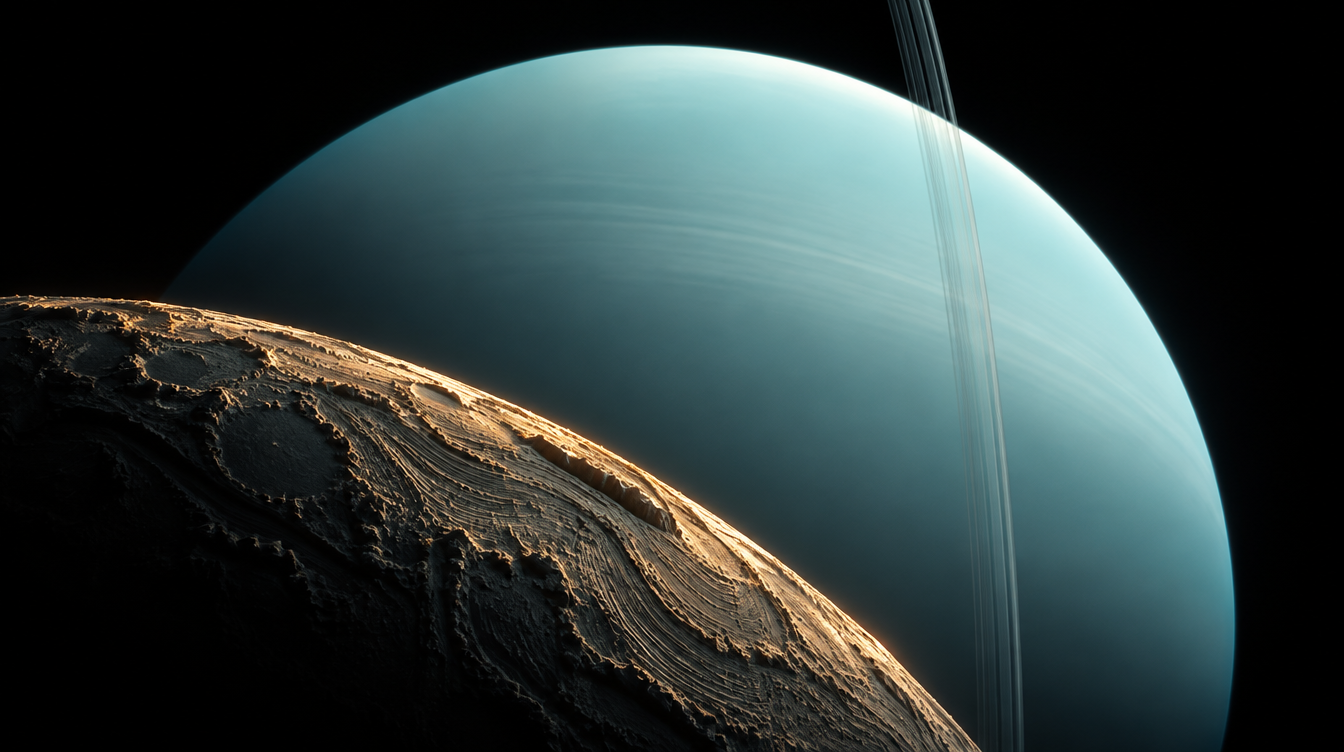
Uranus’s moon count will keep creeping up as Webb and big telescopes find fainter specks, and that number will always need a date. The lasting story is the family itself: a stitched-together Miranda, a dark Umbriel, a young and bright Ariel, two big fairy royals, and a swarm of captured strays, all riding a planet that lies on its side. Almost everything we know about their surfaces comes from a few hours in January 1986. The oceans, the tilt and the jumbled terrain are all questions waiting for someone to go back.
About the Author
Author: King | Founder of Dark Cosmic Insights
King is the founder of Dark Cosmic Insights, a science storytelling platform exploring the strangest true stories hiding in space, science and AI. He digs into NASA, ESA and peer-reviewed research, separates what has been measured from what is still a mystery, and turns it into articles, data graphics and Shorts.
Follow the anomaly. Trace the source.