On August 25, 1989, NASA’s Voyager 2 swept past a moon so cold that its surface sat near 38 kelvin (about −235 °C, −391 °F). Yet its cameras caught dark plumes rising about 8 km (5 miles) into a thin atmosphere, with trails drifting more than 100 km (62 miles) downwind (Soderblom et al. 1990).
That moon is Triton, and it raises a bigger question: how many moons does Neptune have, and why is its largest one so odd? Triton is a moon that orbits backwards, is larger than Pluto, and may have been born somewhere else entirely.
Observed, modelled, open. Triton’s backwards orbit, its plumes, and the sizes and orbits of Neptune’s moons are observed or measured. That Triton is a captured Kuiper Belt object and that it will one day be torn apart are modelled. How its plumes are powered, and whether Triton hides an ocean, are still open.
Quick Answer: How Many Moons Does Neptune Have?
Neptune has 16 known moons, as of November 2026, according to NASA JPL’s live satellite list (JPL Solar System Dynamics); NASA’s Neptune Moons page gives the same figure (NASA Science). The largest by far is Triton, which orbits backwards and is thought to be a captured Kuiper Belt object. Seven small moons orbit close in, the stretched-orbit moon Nereid sits far out, and seven more small, distant moons were found by ground-based telescopes since 2002.
What this article can and cannot establish. It can give you a dated count, explain what each kind of Neptunian moon is like, and show which claims rest on Voyager 2 images and which rest on models. It cannot tell you whether Triton has an ocean, because no spacecraft has measured that, or exactly when Triton will meet its end, because that depends on modelled tides. Only one spacecraft has ever visited, so much of what we know is a single 1989 snapshot.
Table of Contents
The DCI Evidence Map: Neptune’s Moons
| Question | What we know | Status | Key source |
|---|---|---|---|
| How many moons does Neptune have? | 16 known, as of November 2026 | Measured | JPL SSD |
| Does Triton orbit backwards? | Yes: inclination 157.3° to Neptune’s equator, so retrograde | Measured | JPL SSD, mean elements |
| Did Voyager 2 see plumes on Triton? | At least four active plumes; two rose about 8 km | Observed | Soderblom et al. 1990 |
| What powers the plumes? | Sunlight heating nitrogen ice is one proposed mechanism; heat from inside Triton is another, and a later review says several should still be considered | Open | Soderblom et al. 1990 · Hofgartner et al., Icarus |
| Is Triton a captured Kuiper Belt object? | Its retrograde orbit strongly suggests capture; how it happened is debated | Modelled | Agnor & Hamilton 2006 |
| Will Triton be torn apart? | Tidal models predict it will reach Neptune’s Roche limit, but estimates range from about 1.4 to 3.6 billion years (1989) to about 28 billion years (2025), depending on assumptions | Modelled | Chyba et al. 1989 · Wang et al. 2025 |
| Does Triton have an ocean? | No measurement either way | Open | Phys.org, 2021 |
| Is Nereid’s orbit extremely stretched? | Eccentricity 0.751 | Measured | JPL SSD, mean elements |
| Is Hippocamp a piece of Proteus? | Best explanation for its orbit beside Proteus; not proven | Modelled | Showalter et al. 2019 |
| Is Triton bigger than Pluto? | Yes: about 2,705 km across vs. Pluto’s 2,377 km | Measured | JPL SSD · NASA |
Status key: Observed = seen directly in images or data. Measured = a number or detection with stated uncertainty. Modelled = inferred from measurements through a physical model, dependent on assumptions. Open = unresolved; the evidence is incomplete or points different ways. Not supported = no evidence for the claim.
Cite this framework: “DCI Evidence Map: Neptune’s Moons,” Dark Cosmic Insights, November 2026, darkcosmicinsights.com/how-many-moons-does-neptune-have/.
How Many Moons Does Neptune Have, and Where Does That Number Come From?
When we checked NASA JPL’s satellite discovery list in November 2026, it listed 16 moons of Neptune: 14 numbered and named, plus two newer moons still known only by provisional labels, S/2002 N5 and S/2021 N1 (JPL SSD). NASA’s Neptune Moons page, updated September 21, 2026, agrees: “Neptune has 16 officially recognized moons” (NASA Science, Neptune Moons).
Not every NASA page has caught up. NASA’s Triton page, last updated in November 2024, still calls Triton the largest of Neptune’s 13 moons (NASA Science, Triton), and Webb’s 2022 image release refers to 14 known moons (NASA Science, Webb). Those were earlier counts, not errors. The count rose to 14 with Hippocamp and to 16 when the Minor Planet Center announced the two newest moons in February 2024 (Subaru Telescope, March 5, 2024).
For the dated comparison with Saturn, Jupiter and every other planet, see which planet has the most moons. Here, we focus on the moons themselves.
What Are the Moons of Neptune?
The moons of Neptune fall into three very different groups, and one giant that fits none of them.
- The seven inner moons. Naiad, Thalassa, Despina, Galatea, Larissa, Hippocamp and Proteus orbit close to Neptune, on nearly circular paths near its equator. JPL lists eccentricities of about 0.001 for all seven, where 0 is a perfect circle (JPL SSD, mean elements). Six were found by Voyager 2 in 1989; Hippocamp was found in Hubble images in 2013.
- Triton. One huge moon on a circular but backwards orbit, about 354,800 km (220,500 miles) from Neptune (JPL SSD).
- The outer irregular moons. Nereid plus seven small moons far beyond it. Irregular moons are moons on distant, tilted or stretched orbits, usually thought to be captured objects. Four of the seven beyond Nereid orbit backwards: JPL gives Halimede, Psamathe, Neso and S/2021 N1 inclinations above 90°, which means retrograde motion (JPL SSD).
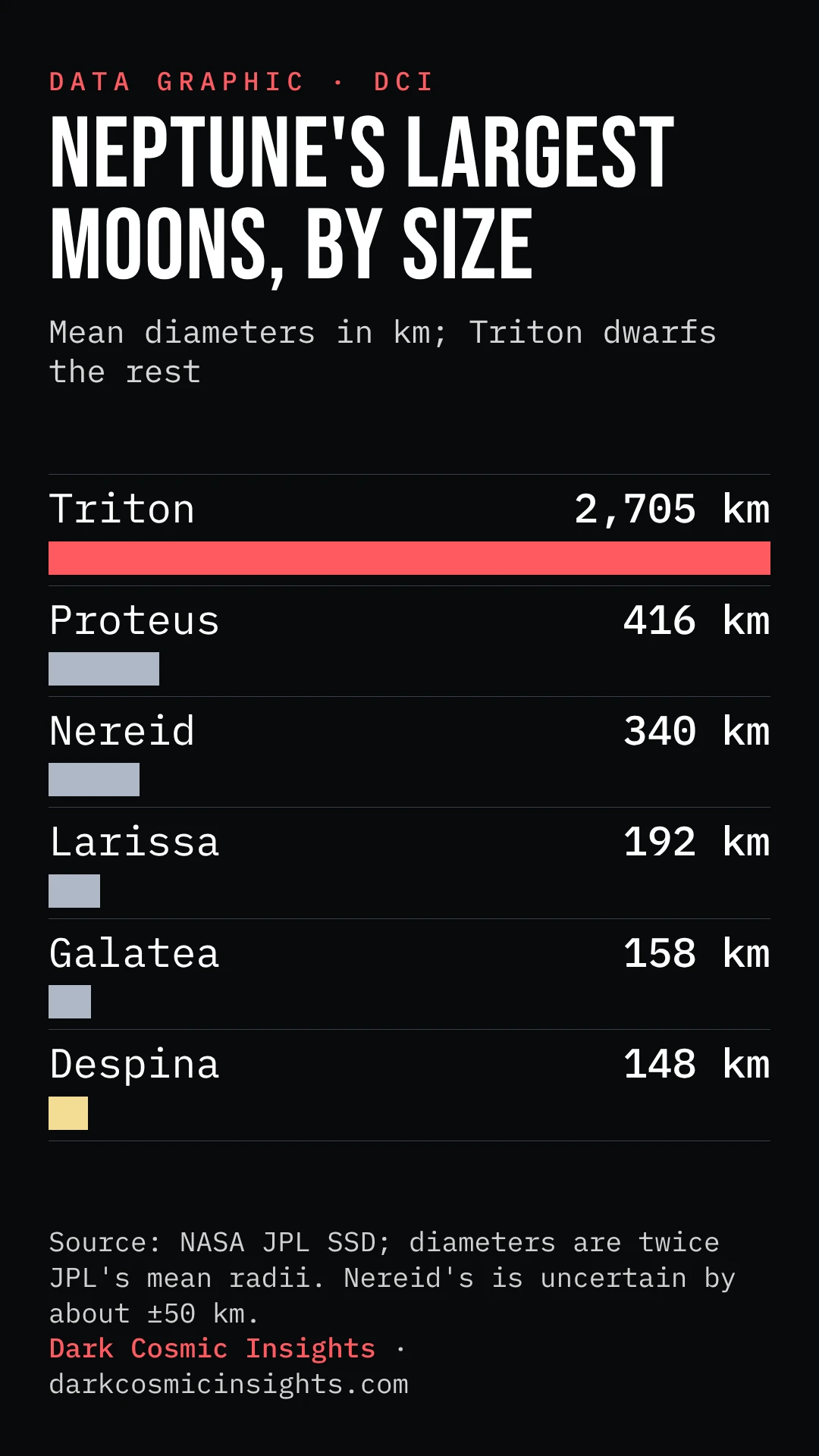
Triton dominates by size: JPL’s mean radius of 1,352.6 km makes it about 2,705 km (1,681 miles) across (JPL SSD, physical parameters), which NASA rounds to 2,700 km (NASA Science, Triton). That’s larger than Pluto, which NASA puts at about 2,377 km (1,477 miles) across (NASA Science, Pluto Facts). NASA says Neptune’s moons are named for “various lesser sea gods and nymphs” (NASA Science, Neptune Moons).
Why Does Triton Orbit Backwards?
This is a measured fact, not a theory: Triton circles Neptune in the opposite direction to the planet’s rotation. JPL lists its inclination as 157.3° relative to Neptune’s equator; anything above 90° counts as retrograde (JPL SSD, mean elements). NASA calls Triton “the only large moon in our solar system” that orbits against its planet’s rotation (NASA Science, Triton).
That matters because of how big moons are usually thought to form: from a disk of material spinning around the young planet, so they share the planet’s direction of spin. A large moon going the other way is hard to explain like that, which is why Triton is thought to have been captured (UC Santa Cruz, May 2006).
Apart from its direction, Triton’s orbit is tidy: JPL lists its eccentricity as 0.000, a near-perfect circle, and its period as 5.8792 days (JPL SSD). Like our Moon, it keeps one face toward its planet (NASA Science, Triton).
Is Triton a captured Kuiper Belt object?
Probably, but this is a model, not an observation. The Kuiper Belt is the zone of icy bodies beyond Neptune, home to Pluto. NASA’s summary is: “Scientists think Triton is a Kuiper Belt Object captured by Neptune’s gravity” (NASA Science, Triton). Nobody watched it happen; the evidence is the backwards orbit and Triton’s resemblance to Pluto.
How do you catch a moon?
An object falling toward Neptune from orbit around the Sun has too much energy to stay; something must remove it. Two proposals:
- A collision. In 1989, Peter Goldreich and colleagues proposed that Triton was captured after colliding with one of Neptune’s original regular moons, then spent less than about a billion years with its orbit being shaped by tides (Goldreich et al. 1989).
- A broken partnership. In 2006, Craig Agnor and Douglas Hamilton proposed that Triton was once half of a binary, a pair of bodies orbiting each other, perhaps like Pluto and Charon. During a close pass, Neptune kept Triton and flung its partner away, a process called an exchange reaction (Agnor & Hamilton 2006; UC Santa Cruz, May 2006).
Both are modelled. As Hamilton put it, “Binaries appear to be a ubiquitous feature of small-body populations” (UC Santa Cruz).
A violent aftermath
Models also suggest the capture was hard on the rest of Neptune’s family. Goldreich’s team argued Triton “cannibalized most of the regular satellites of Neptune” (Goldreich et al. 1989). ESA’s Hubble team describes the same scenario: Triton’s arrival tore apart the moons then in orbit, and the debris re-formed into the inner moons we see today (ESA/Hubble, heic1904). It fits the evidence, but it is a reconstruction.
Capture would also have heated Triton. A 2024 preprint, not yet peer reviewed, suggests post-capture tidal heating could have exceeded Io’s present-day heating many times over (van Woerkom 2024, arXiv).
For the story of Pluto, the Kuiper Belt world Triton most resembles, see why Pluto is not a planet.
What Did Voyager 2 See on Triton?
Voyager 2, the only spacecraft to visit Neptune (NASA Science, Voyager 2), made its closest pass by Triton about five hours after passing Neptune, at about 40,000 km (25,000 miles), according to an archived JPL Voyager page (JPL, archived 2008). Here is what it recorded, then what scientists concluded.
What the cameras and instruments recorded
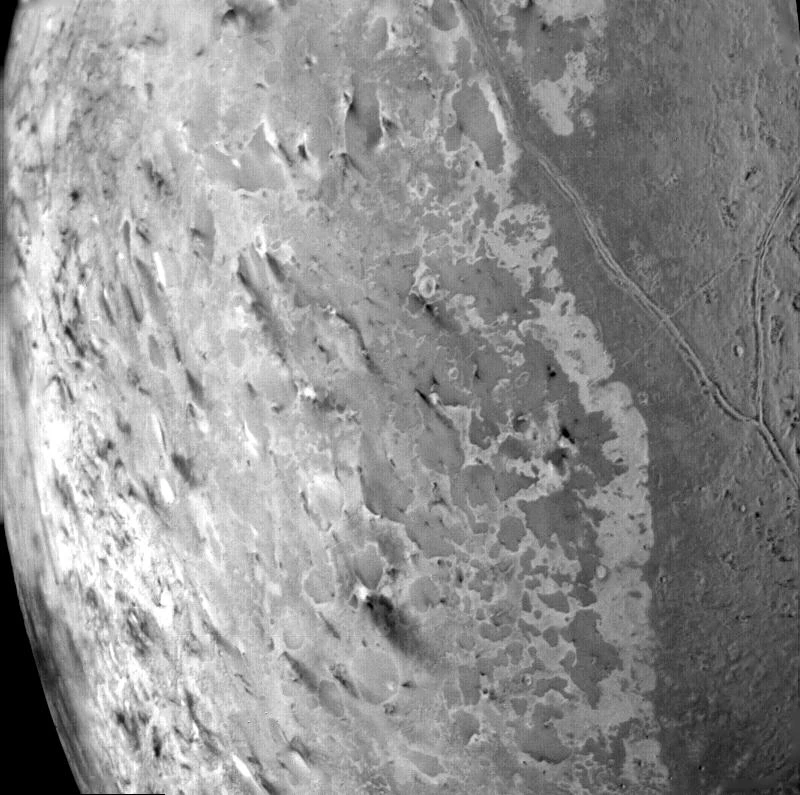
- Plumes. Soderblom and colleagues found at least four active, geyser-like eruptions in Voyager images. The two best documented rose as dark columns about 8 km (5 miles) high, then fed dark clouds that drifted more than 100 km (62 miles) downwind (Soderblom et al. 1990).
- Dark streaks. Triton’s south polar region is covered in dark streaks. NASA’s caption for one Voyager image counts about fifty of them, describing them as plumes or wind streaks (NASA, PIA00059).
- Cold. Voyager measured a surface temperature of about 38 ± 3 K (Soderblom et al. 1990). NASA gives the equivalent −235 °C (−391 °F) (NASA Science, Triton).
- A bright, frosty world. NASA says Triton reflects about 70 percent of the sunlight that hits it, because most of its nitrogen is frozen as frost (NASA Science, Triton).
- Few craters. Images show “a sparsely cratered surface with smooth volcanic plains,” plus mounds and pits that NASA links to icy lava flows (NASA Science, Triton). One region is wrinkled like the skin of a melon; NASA’s image archive calls it “cantaloupe terrain” (NASA, PIA00060).
What scientists concluded from it
- How the plumes work (open). One proposed mechanism, from the same 1990 paper, is a solar-powered greenhouse: sunlight passes into clear nitrogen ice, warms darker material underneath, and pressurised nitrogen gas eventually vents, carrying dark dust upward. The authors calculated that less than 4 K of extra warming would suffice for an 8 km plume (Soderblom et al. 1990). It was long treated as the leading idea, but a later review in Icarus found the plume locations don’t strongly favour it and concluded that all three eruption hypotheses, including two driven by heat from inside Triton, “should be considered further” (Hofgartner et al., Icarus). Voyager could not test any of them directly.
- A young surface (modelled). Craters build up over time, so few craters means a young surface. Schenk and Zahnle estimated Triton’s surface is “younger than 100 million years,” possibly only a few million, as Universe Today reported (Schenk & Zahnle 2007; Universe Today, 2007).
- Interior (modelled). NASA describes a crust of frozen nitrogen over an icy mantle, “believed to cover a core of rock and metal” (NASA Science, Triton). JPL lists a mean density of 2.065 g/cm³, about twice that of water (JPL SSD, physical parameters), and NASA notes Triton has more interior rock than the icy moons of Saturn and Uranus (NASA Science, Triton).
NASA’s image caption calls Triton “the coldest surface known anywhere in the solar system” (NASA, PIA00317). We treat that as a Voyager-era statement, not a settled ranking. For context, see how cold space is.
Does Triton Have an Ocean?
Nobody knows. This is genuinely open.
The case for asking: Triton has a young surface, active plumes and plenty of rock, and was probably heated strongly when captured. Some researchers have proposed ways to keep it warm today: one 2015 paper is titled “Powering Triton’s recent geological activity by obliquity tides” (Nimmo & Spencer 2015). Obliquity tides are tides caused by a moon’s spin axis being tilted relative to its orbit.
The case for caution: no measurement has tested it. The proposed Trident mission would have measured Triton’s magnetic field to test for a subsurface ocean, but NASA did not select it: in June 2021 it chose two Venus missions instead (Phys.org, June 7, 2021; NASA, June 2, 2021).
Unlike Jupiter’s Europa, where magnetometer data point to an ocean (see how many moons Jupiter has), Triton has no such measurement.
What Will Happen to Triton?
This part often gets told as fact, and isn’t. Triton’s backwards orbit means the tides it raises on Neptune act as a brake rather than a boost, so models predict it is slowly spiralling inward. Chyba, Jankowski and Nicholson described Triton as “currently spiralling toward Neptune due to tides raised on both bodies” (Chyba et al. 1989).
Their nominal model has Triton reaching Neptune’s Roche limit in “about 3.6 Gyr,” that is, about 3.6 billion years; in an alternative case for Triton’s spin, about 1.4 billion years (Chyba et al. 1989). A 2025 study that estimated how strongly Neptune dissipates tidal energy from Triton’s observed positions got a very different answer: about 28 billion years (Wang et al. 2025). Both are model results resting on different assumptions about Neptune’s interior. The Roche limit is the distance inside which a planet’s tides would pull a moon apart. NASA describes the same fate for the small inner moon Larissa, which “may eventually impact Neptune’s atmosphere” or be torn apart to form a ring (NASA Science, Larissa).
Three cautions:
- The inward spiral is predicted, not measured. It follows from tidal physics; no one has clocked Triton’s orbit shrinking.
- The timescale depends on assumptions about how much energy tides dissipate, which is why published estimates run from about 1.4 billion to about 28 billion years.
- “Triton will become a ring” is a common extrapolation. It’s a plausible outcome of crossing the Roche limit, but the paper’s abstract gives the time to reach the limit, not what happens next.

Why Is Nereid’s Orbit So Stretched?
Nereid was the second Neptunian moon found, discovered on May 1, 1949 by Gerard Kuiper with a ground-based telescope (NASA Science, Nereid).
JPL lists Nereid’s eccentricity as 0.751 and its average distance from Neptune as 5,513,900 km (JPL SSD, mean elements). Working from those two numbers, Nereid swings from about 1.4 million km (0.85 million miles) from Neptune at its closest to about 9.7 million km (6.0 million miles) at its farthest: its farthest distance is about seven times its nearest. One orbit takes about 360 days (NASA Science, Nereid). NASA calls it “one of the most eccentric orbits of any moon in our solar system.”
How did it get that way? NASA gives two possibilities: Nereid may be a captured asteroid or Kuiper Belt object, or it may have been heavily disturbed when Neptune captured Triton (NASA Science, Nereid). Goldreich’s team argued for the second: Triton’s evolving orbit perturbed Nereid, explaining its eccentric, inclined path (Goldreich et al. 1989). Both remain models.
Its size is uncertain: JPL’s mean radius of 170 ± 25 km makes it roughly 340 km (210 miles) across (JPL SSD).
What Is Proteus, and Why Is It Box-Shaped?
Proteus is Neptune’s second-largest moon and the outermost of the seven inner moons. JPL gives its mean radius as 208 ± 8 km, about 416 km (259 miles) across (JPL SSD); NASA’s Hippocamp page rounds it to about 418 km (NASA Science, Hippocamp).
Though larger than Nereid, Proteus wasn’t found until Voyager 2 arrived in 1989; NASA says it was “most likely overlooked because it is so dark” and so far from Earth (NASA Science, Proteus). Its orbit sits about 117,700 km (73,100 miles) from Neptune, with a period of about 27 hours (JPL SSD).
Proteus is “irregularly shaped and heavily cratered,” with “an odd box-like shape,” and NASA notes that with a little more mass it could have pulled itself into a sphere (NASA Science, Proteus). Voyager 2 images showed one impact crater “almost large enough to have shattered the moon” (ESA/Hubble, heic1904). Keep that crater in mind.
What Are Neptune’s Small Inner Moons?
Inside Proteus orbit five small moons found by Voyager 2: Naiad, Thalassa, Despina, Galatea and Larissa. JPL’s mean radii make them roughly 58 to 192 km (36 to 119 miles) across: Larissa is the largest at about 192 km, followed by Galatea at about 158 km and Despina at about 148 km (JPL SSD).
Larissa had actually been glimpsed from the ground in 1981, but NASA says it was “officially discovered in July 1989 by the Voyager 2 science team” (NASA Science, Larissa).
The dance of Naiad and Thalassa
The two innermost moons are locked in what NASA JPL calls a dance of avoidance. Their orbits are only about 1,850 km (1,150 miles) apart, yet when Naiad, on the inside track, passes Thalassa, the two are about 3,540 km (2,200 miles) apart (NASA JPL, November 14, 2019).
The trick is Naiad’s tilted orbit: it weaves above and below Thalassa in a repeating pattern, a resonance that repeats each time Naiad gains four laps. Naiad takes about 7 hours per orbit, Thalassa about 7.5. “They maintain the peace by never getting too close,” said the SETI Institute’s Mark Showalter (NASA JPL). The orbits are measured from Hubble observations; the resonance explanation comes from fitting those orbits (Brozović et al. 2020).
How Was Hippocamp Discovered?
Hippocamp is the smallest of Neptune’s seven inner moons, about 34 km (20 miles) across (NASA Science, Hippocamp). Voyager 2 flew right past it in 1989 without detecting it: NASA says it was too faint for the spacecraft’s cameras.
Mark Showalter found it on July 1, 2013, analysing more than 150 archival Hubble photographs in which “the same white dot appeared over and over again” (NASA Science, Hippocamp). First labelled S/2004 N1, it is named for a sea creature of Greek myth; the discovery paper appeared in Nature in 2019 (Showalter et al. 2019).
A chip off Proteus?
The puzzle is where Hippocamp orbits. Its average distance from Neptune is about 105,300 km, against Proteus’s 117,700 km (JPL SSD): their orbits differ by only about 10 percent. ESA puts them “only 12 000 km apart” (ESA/Hubble). NASA notes that a larger moon would normally clear such a neighbour from its path (NASA Science, Hippocamp).
The team’s explanation is modelled, not observed: a comet impact billions of years ago blasted a fragment off Proteus, perhaps the impact that made Proteus’s giant crater, and that fragment is Hippocamp. The paper adds that tides have pushed Proteus outward over time (Showalter et al. 2019). “In 1989, we thought the crater was the end of the story,” Showalter said (ESA/Hubble).
If the Triton story is right too, ESA notes, Hippocamp is a third-generation moon, chipped from a moon that itself re-formed from Triton’s wreckage (ESA/Hubble).

What Are the Newest Moons of Neptune?
After Voyager, the next moons came from the ground. In 2002 and 2003, astronomers found five small, distant irregular moons. JPL credits Halimede, Sao, Laomedeia and Neso to Matthew Holman, J. J. Kavelaars and colleagues (2002), and Psamathe to S. S. Sheppard, D. C. Jewitt and J. Kleyna (2003) (JPL SSD). Holman’s team described them in Nature in 2004 (Holman et al. 2004).
Then, in February 2024, the Minor Planet Center announced two more (Subaru Telescope, March 5, 2024):
- S/2021 N1, about 14 km (9 miles) across, first imaged by the Subaru Telescope on September 7, 2021, with its orbit confirmed using the Very Large Telescope in Chile and Gemini in Hawaiʻi. The Subaru team says its image shows the faintest moon ever discovered by ground-based telescopes, at about magnitude 27.
- S/2002 N5, about 23 km (14 miles) across, traced back to an object seen near Neptune in 2002 “but lost before it could be confirmed,” as Sheppard put it, then pinned down with the Magellan telescopes in 2022 and 2023.
JPL’s mean elements put S/2002 N5 on an orbit of about 3,151 days (8.6 years) and S/2021 N1 at about 10,043 days (27.5 years), at an average distance of about 50.7 million km (31.5 million miles), the largest in JPL’s Neptune table (JPL SSD). Subaru rounds the periods to “almost 9 years” and “almost 27 years.”
“It took special image processing to reveal such faint objects,” Sheppard said, as reported by Astronomy, which adds that the new moons are expected to take names from Greek sea mythology, like Neptune’s other outer moons (Astronomy, March 4, 2024). Sheppard places S/2021 N1 in the retrograde Neso group and S/2002 N5 in the prograde Sao group (Scott Sheppard, Carnegie Science).
Could there be more? Saturn moon-hunter Edward Ashton told UBC: “With current technology I don’t think we can do much better” for Saturn, Uranus and Neptune (UBC, March 2025).
How Do We Know? Voyager 2, Hubble and Ground-Based Telescopes
Almost everything about Neptune’s moons comes from three kinds of evidence, the how we know question at the heart of DCI.
- Voyager 2 (1989): the only close look. Voyager 2 made its closest approach to Neptune on August 25, 1989. NASA’s current Voyager 2 page puts that pass about 4,800 km (2,980 miles) above the cloud tops (NASA Science, Voyager 2); an archived JPL page gives about 4,950 km (3,000 miles) above the north pole (JPL, archived). Voyager imaged about two-thirds of Triton and found six moons (NASA Science, Voyager 2).
- Hubble: the archive that keeps giving. Hubble tracks the small inner moons from Earth orbit. Its archival images revealed Hippocamp, re-observed Naiad for the first time since 1989, and refined all the inner moons’ orbits and sizes (Showalter et al. 2019).
- Big ground-based telescopes: the outer moons. Every outer moon found since 2002 came from the ground, using deep, repeated exposures from telescopes such as Subaru, Magellan, Gemini and the VLT (Subaru Telescope). Astronomers stack many exposures so faint moons stand out against the background (Live Science, February 27, 2024).
Webb has joined in. Its 2022 near-infrared image caught seven of Neptune’s moons, with Triton as the brightest point, outshining Neptune because methane in the planet’s atmosphere absorbs near-infrared light (NASA Science, Webb, September 21, 2022). Brightness depends on wavelength; see are space photos real?
Myth vs. Fact: Neptune’s Moons
| Myth | Fact |
|---|---|
| “Neptune has 13 (or 14) moons.” | Those were older counts. JPL lists 16, as of November 2026. |
| “Triton erupts lava like a volcano.” | Voyager saw dark plumes of gas and dust about 8 km high, likely driven by nitrogen, not molten rock. |
| “We watched Neptune capture Triton.” | Capture is a model, based mainly on Triton’s backwards orbit. |
| “Triton will crash into Neptune soon.” | Models give anywhere from about 1.4 to about 28 billion years to reach the Roche limit. |
| “Triton has an underground ocean.” | Unknown. No mission has measured it. |
How Can You See Triton Yourself?
At about magnitude +7.8, Neptune is too faint for the naked eye and needs binoculars or a telescope; BBC Sky at Night Magazine gave Neptune’s 2026 opposition as 26 September 2026, in Pisces (Sky at Night, 2026). Opposition is when a planet is opposite the Sun in our sky, closest and best placed for viewing.
Triton is the Neptunian moon backyard observers go after. Sky & Telescope gives its brightness as magnitude 13.5 and suggests an 8-inch (200 mm) telescope or larger under dark skies, at high magnification (Sky & Telescope). Tips:
- Use 150× or more, on a night of steady air.
- Try near greatest elongation, when Triton is farthest from Neptune; Sky & Telescope’s Triton Tracker shows when.
- Use averted vision: look slightly to one side of a faint object.
If you see a faint dot that keeps pace with Neptune over a few nights, you’re looking at a world first spotted by William Lassell on October 10, 1846, just 17 days after Neptune’s own discovery (NASA Science, Neptune Moons).
What Comes Next for Neptune’s Moons?
The state of play, as of November 2026:
- No mission is on its way. Voyager 2’s 1989 flyby remains the only visit (NASA Science, Voyager 2). The proposed Trident flyby of Triton was a finalist for NASA’s Discovery program but was not selected in June 2021 (Phys.org). We found no approved NASA or ESA mission to Neptune.
- More faint moons, maybe. Sheppard told Astronomy that he doesn’t expect other moons at Uranus or Neptune as large as or larger than the new ones, but that better technology or a spacecraft could reveal smaller ones (Astronomy, March 2024).
- Names. The two newest moons are expected to receive names in the coming years (Live Science).
Neptune’s Moons by the Numbers
- 16: known moons of Neptune, as of November 2026 (JPL SSD)
- 2,705 km (1,681 miles): Triton’s mean diameter, twice JPL’s 1,352.6 km radius (JPL SSD); NASA rounds it to 2,700 km (1,680 miles)
- 157.3°: Triton’s orbital inclination to Neptune’s equator; above 90° means retrograde (JPL SSD)
- 38 ± 3 K (about −235 °C; −391 °F): Triton’s surface temperature measured by Voyager 2 (Soderblom et al. 1990)
- About 8 km (5 miles): height of Triton’s two best-documented plumes (Soderblom et al. 1990)
- About 40,000 km (25,000 miles): Voyager 2’s closest distance to Triton (JPL, archived)
- 0.751: Nereid’s orbital eccentricity, carrying it from about 1.4 to 9.7 million km (0.85 to 6.0 million miles) from Neptune (JPL SSD; DCI arithmetic)
- About 34 km (20 miles): Hippocamp’s diameter, the smallest of the seven inner moons (NASA)
- About 1.4 to 28 billion years: modelled time for Triton to reach Neptune’s Roche limit, depending on the model (Chyba et al. 1989; Wang et al. 2025)
- 1846: the year William Lassell discovered Triton, 17 days after Neptune was found (NASA)

Neptune’s Moons: FAQ
What is Neptune’s current moon count?
Neptune has 16 known moons as of November 2026, according to NASA JPL’s satellite list and NASA’s Neptune Moons page. Fourteen have names and numbers. The two newest, S/2002 N5 and S/2021 N1, were announced in February 2024 and still carry provisional labels.
What is Neptune’s biggest moon?
Triton, at about 2,705 km (1,681 miles) across. It’s larger than Pluto and far larger than any other moon of Neptune; the next biggest, Proteus, is only about 416 km (259 miles) across.
Why does Triton go around Neptune the wrong way?
Triton’s orbit is retrograde: it travels opposite to Neptune’s rotation, at an inclination of 157.3°. Moons that form around a planet normally share its direction of spin, so scientists think Triton formed elsewhere and was captured, probably from the Kuiper Belt. The capture itself is a model, not an observation.
Are Triton’s geysers made of water?
Not as far as we know. The plumes Voyager 2 saw in 1989 were dark columns about 8 km high, which one proposed model attributes to nitrogen gas venting after sunlight warms the ice from below; others point to heat from inside Triton. They carried dark dust, not lava. The exact mechanism hasn’t been confirmed, because no spacecraft has returned since.
Will Triton crash into Neptune?
Tidal models predict Triton is spiralling slowly inward and will reach Neptune’s Roche limit, in anywhere from about 1.4 to about 28 billion years depending on the model. Inside that distance, tides would be expected to pull it apart. This is a prediction from models; the inward drift has not been measured.
What makes Nereid unusual?
Nereid has one of the most stretched orbits of any known moon, with an eccentricity of 0.751. It swings from about 1.4 million km to about 9.7 million km from Neptune over a roughly 360-day orbit. It may be a captured object or a moon thrown off course by Triton’s arrival.
Where did Hippocamp come from?
Hippocamp, about 34 km across, orbits close to the much bigger moon Proteus. Its discoverers think it is a fragment knocked off Proteus by a comet impact billions of years ago. It was found in archival Hubble images in 2013.
Has any spacecraft orbited Neptune?
No. Voyager 2 flew past Neptune and Triton in August 1989 and remains the only spacecraft to visit. A proposed Triton flyby mission called Trident was not selected by NASA in 2021, and as of November 2026 we found no approved mission to Neptune.
Your next step: check when Neptune is next well placed in your sky, then look at it through binoculars or a small telescope. It will be a faint blue-grey dot. Knowing that a backwards-orbiting, geyser-streaked moon is circling right beside it changes how that dot looks.

Sources and Further Reading
- NASA JPL Solar System Dynamics (checked November 8, 2026), Planetary Satellite Discovery Circumstances; Planetary Satellite Physical Parameters; Planetary Satellite Mean Elements.
- NASA Science, Neptune Moons (updated September 21, 2026); Triton (updated November 3, 2024); Nereid (updated November 3, 2024); Proteus (updated November 3, 2024); Larissa (updated November 3, 2024); Hippocamp (updated November 5, 2024); Pluto Facts.
- NASA Science, Voyager 2 (updated September 28, 2026); NASA JPL, Voyager: Neptune (archived copy, 2008).
- Hofgartner, J. D., Birch, S. P. D., Castillo, J., Grundy, W. M., et al. Hypotheses for Triton’s plumes: New analyses and future remote sensing tests. Icarus, 114835 (accepted December 2021). doi:10.1016/j.icarus.2021.114835; arXiv:2112.04627
- Wang, B., Lu, X., Yan, J., et al. (2025). A plausible minimum value of the Neptunian tidal dissipation factor estimated from Triton’s astrometric observations. Solar System Research, 59, 6. doi:10.1134/S0038094624601440
- Soderblom, L. A., Kieffer, S. W., Becker, T. L., Brown, R. H., Cook, A. F., Hansen, C. J., Johnson, T. V., Kirk, R. L., & Shoemaker, E. M. (1990). Triton’s geyser-like plumes: Discovery and basic characterization. Science, 250(4979), 410–415. doi:10.1126/science.250.4979.410 (USGS record)
- Agnor, C. B., & Hamilton, D. P. (2006). Neptune’s capture of its moon Triton in a binary–planet gravitational encounter. Nature, 441(7090), 192–194. doi:10.1038/nature04792; UC Santa Cruz News (May 10, 2006), New capture scenario explains origin of Neptune’s oddball moon Triton.
- Goldreich, P., Murray, N., Longaretti, P. Y., & Banfield, D. (1989). Neptune’s story. Science, 245(4917), 500–504. doi:10.1126/science.245.4917.500 (Caltech record)
- Chyba, C. F., Jankowski, D. G., & Nicholson, P. D. (1989). Tidal evolution in the Neptune-Triton system. Astronomy and Astrophysics, 219, L23. ADS: 1989A&A…219L..23C
- van Woerkom, Q. B. (2024). The trans- and post-capture orbital evolution of Triton. arXiv preprint, arXiv:2409.16983 (not peer reviewed at the time of checking).
- Schenk, P. M., & Zahnle, K. (2007). On the negligible surface age of Triton. Icarus, 192(1), 135–149. doi:10.1016/j.icarus.2007.07.004; Universe Today (November 27, 2007), How Old Is Triton’s Surface?
- Nimmo, F., & Spencer, J. R. (2015). Powering Triton’s recent geological activity by obliquity tides: Implications for Pluto geology. Icarus, 246, 2–10. doi:10.1016/j.icarus.2014.01.044
- Showalter, M. R., de Pater, I., Lissauer, J. J., & French, R. S. (2019). The seventh inner moon of Neptune. Nature, 566, 350–353. doi:10.1038/s41586-019-0909-9; ESA/Hubble (February 20, 2019), Hubble uncovers origin of Neptune’s smallest moon Hippocamp (heic1904).
- Brozović, M., Showalter, M. R., Jacobson, R. A., French, R. S., Lissauer, J. J., & de Pater, I. (2020). Orbits and resonances of the regular moons of Neptune. Icarus, 338, 113462. doi:10.1016/j.icarus.2019.113462; NASA JPL (November 14, 2019), NASA Finds Neptune Moons Locked in “Dance of Avoidance”.
- Holman, M. J., Kavelaars, J. J., Grav, T., Gladman, B. J., Fraser, W. C., Milisavljevic, D., Nicholson, P. D., Burns, J. A., Carruba, V., Petit, J.-M., Rousselot, P., Mousis, O., Marsden, B. G., & Jacobson, R. A. (2004). Discovery of five irregular moons of Neptune. Nature, 430(7002), 865–867. doi:10.1038/nature02832
- Subaru Telescope (March 5, 2024), New moons of Uranus and Neptune; Scott Sheppard, Carnegie Science, Neptune moons page; Astronomy (March 4, 2024), New moons of Uranus and Neptune discovered; Live Science (February 27, 2024), 3 new moons discovered around Uranus and Neptune.
- University of British Columbia (March 2025), Saturn still reigns supreme as moon king with 128 new moons.
- NASA Science (September 21, 2022), New Webb Image Captures Clearest View of Neptune’s Rings in Decades.
- NASA (June 2, 2021), NASA Selects 2 Missions to Study ‘Lost Habitable’ World of Venus; Phys.org (June 7, 2021), NASA rejected missions to the moons of Jupiter and Neptune.
- Sky & Telescope, Neptune and Its Maverick Moon, Triton; BBC Sky at Night Magazine (2026), Neptune is at its best this month.
- NASA Photojournal, Global Color Mosaic of Triton (PIA00317); Triton South Polar Terrain (PIA00059); NASA Image Library, Triton: False Color of Cantaloupe Terrain (PIA00060).
Explore Next
- The full, dated moon count for every planet: Which Planet Has the Most Moons?
- Volcano moons and ocean worlds: How Many Moons Does Jupiter Have?
- Triton’s Kuiper Belt cousin: Why Is Pluto Not a Planet?
- Just how cold it gets out there: How Cold Is Space?
- How to read spacecraft images: Are Space Photos Real?
- How a claim earns its label: How We Know
- More from the planets: Planets & Moons
- Titan, Enceladus and Saturn’s crowd of moons: How Many Moons Does Saturn Have?
- The two planets with no known moons: Why Don’t Mercury and Venus Have Moons?
How This Explainer Was Checked
Every number in this article was checked in November 2026 against the source linked beside it: NASA JPL’s satellite tables, NASA Science and Photojournal pages, JPL and ESA/Hubble releases, observatory news, and peer-reviewed papers, with DOIs given where they exist (paper details confirmed through Crossref and publisher or archive records; the 1989 Chyba paper predates DOIs, so we link its ADS record). The moon count is JPL’s, dated; some NASA pages still show older counts of 13 or 14, and we say so. Diameters are DCI’s doubling of JPL’s mean radii, which is why they differ slightly from NASA’s rounded figures; mile, Celsius and Fahrenheit conversions, Nereid’s nearest and farthest distances, the 27.5-year period and the moon-family counts are DCI’s arithmetic from JPL tables. Where sources differ, as for Voyager 2’s closest distance to Neptune (4,800 km on NASA’s current page, 4,950 km on an archived JPL page) and the new moons’ periods, we show both. Triton’s capture and its future are labelled Modelled; its plume mechanism and the ocean question are labelled Open. The 40,000 km Triton distance comes from an archived JPL page, marked as archived. Images are labelled: real spacecraft or telescope images as OBSERVATION, illustrations as ILLUSTRATION, and our charts as DATA GRAPHIC. Nothing AI-generated is presented as a real image.

Final Thought: A Moon That Came From Somewhere Else
Neptune’s moon count will keep inching up as telescopes find fainter specks, and that number will always need a date. Triton is the lasting story. A world bigger than Pluto, orbiting the wrong way, puffing dark plumes from a surface at 38 kelvin: everything about it says it didn’t start here. We know that much from one spacecraft and a few hours of pictures in 1989. Capture, the plumes’ engine, a hidden ocean and a far-future break-up are all still models waiting for someone to go back and check.
About the Author
Author: King | Founder of Dark Cosmic Insights
King is the founder of Dark Cosmic Insights, a science storytelling platform exploring the strangest true stories hiding in space, science and AI. He digs into NASA, ESA and peer-reviewed research, separates what has been measured from what is still a mystery, and turns it into articles, data graphics and Shorts.
Follow the anomaly. Trace the source.