In 2021, scientists published an answer to a question people have asked for centuries: how dark is space? Using images NASA’s New Horizons took in 2018 and 2019, more than 4 billion miles from the Sun out past Pluto, far from the glare of the inner solar system, they measured the sky between the stars and found it about 10 times darker than the darkest sky the Hubble Space Telescope can see (NASA, 2021).
But not perfectly black. Even there, NASA said, “space isn’t absolutely black.” A faint glow remains. Explaining both the darkness and that glow takes us to the age of the universe, the speed of light and the stretching of space itself.
Observed, measured, modelled, open. That the sky between the stars looks black is observed by anyone. How dark it is beyond Pluto has been measured by New Horizons. Why it’s dark, the finite age of the universe and its expansion, is modelled in standard cosmology and backed by the cosmic microwave background. Exactly what makes the faint leftover glow is close to settled but still being refined, so we mark the last details open.
Quick Answer: Why Is Space Black?
Space looks black because the universe has a finite age, so starlight has had only so much time to fill the sky, and because the oldest light has been stretched out of the range our eyes can see. The universe is about 13.8 billion years old (NASA), light travels at a finite speed, and the expansion of the universe shifts the light of the most distant galaxies to longer wavelengths (NASA, 2023). Earth’s daytime sky is blue only because our air scatters sunlight (NASA Space Place). Above the atmosphere, there’s no air to do that, so the sky between the stars stays dark even in full sunshine. And space isn’t perfectly black: it glows faintly with the light of all the galaxies that have ever shone, and brightly in microwaves we can’t see.
What this article can and cannot establish. It can explain why the night sky is dark, the puzzle known as Olbers’ paradox, and what spacecraft have measured about how dark space is. It can’t give an exact final number for the faint background glow, which researchers are still refining, and it doesn’t settle deeper questions such as whether the universe is infinite.
Table of Contents
The DCI Evidence Map: Why Space Is Black
| Question | What we know | Status | Key source |
|---|---|---|---|
| Is the sky between the stars dark? | Yes, and even darker above Earth’s air | Observed | NASA, 2021 |
| Why is Earth’s daytime sky blue? | Air scatters blue sunlight the most | Observed | NASA Space Place |
| Why isn’t the night sky blazing with starlight? | The universe has a finite age, and light a finite speed | Modelled | NASA, 2023 |
| Does expansion help? | Yes, it stretches distant light to longer wavelengths | Modelled | NASA, 2023 |
| Is space completely black? | No; it has a faint optical glow | Measured | Lauer et al., 2021 |
| What makes that glow? | Simplest reading: galaxies | Modelled | Postman et al., 2024 |
| Is the universe infinite? | Unknown; not needed to explain the dark sky | Open | ESA |
Status key: Observed = seen directly. Measured = a number with a stated uncertainty or a direct measurement. Modelled = inferred from measurements through a physical model, dependent on assumptions. Calculated = worked out from measured values. Open = unresolved; the evidence is incomplete or points different ways. Not supported = the evidence goes against the claim.
Cite this framework: “DCI Evidence Map: Why Space Is Black,” Dark Cosmic Insights, November 2026, darkcosmicinsights.com/why-is-space-black/.
Why Does Space Look Black?
What astronauts see
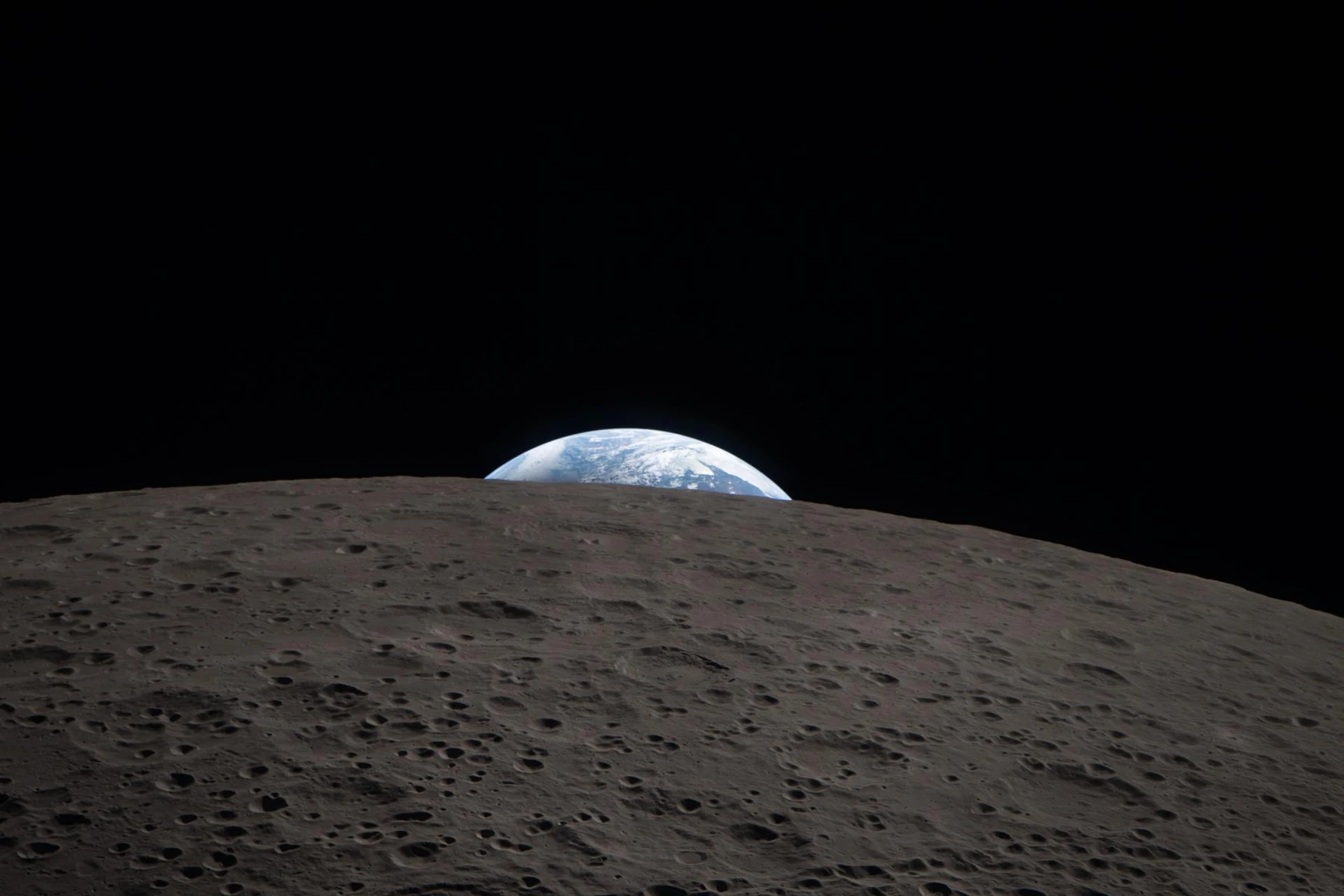
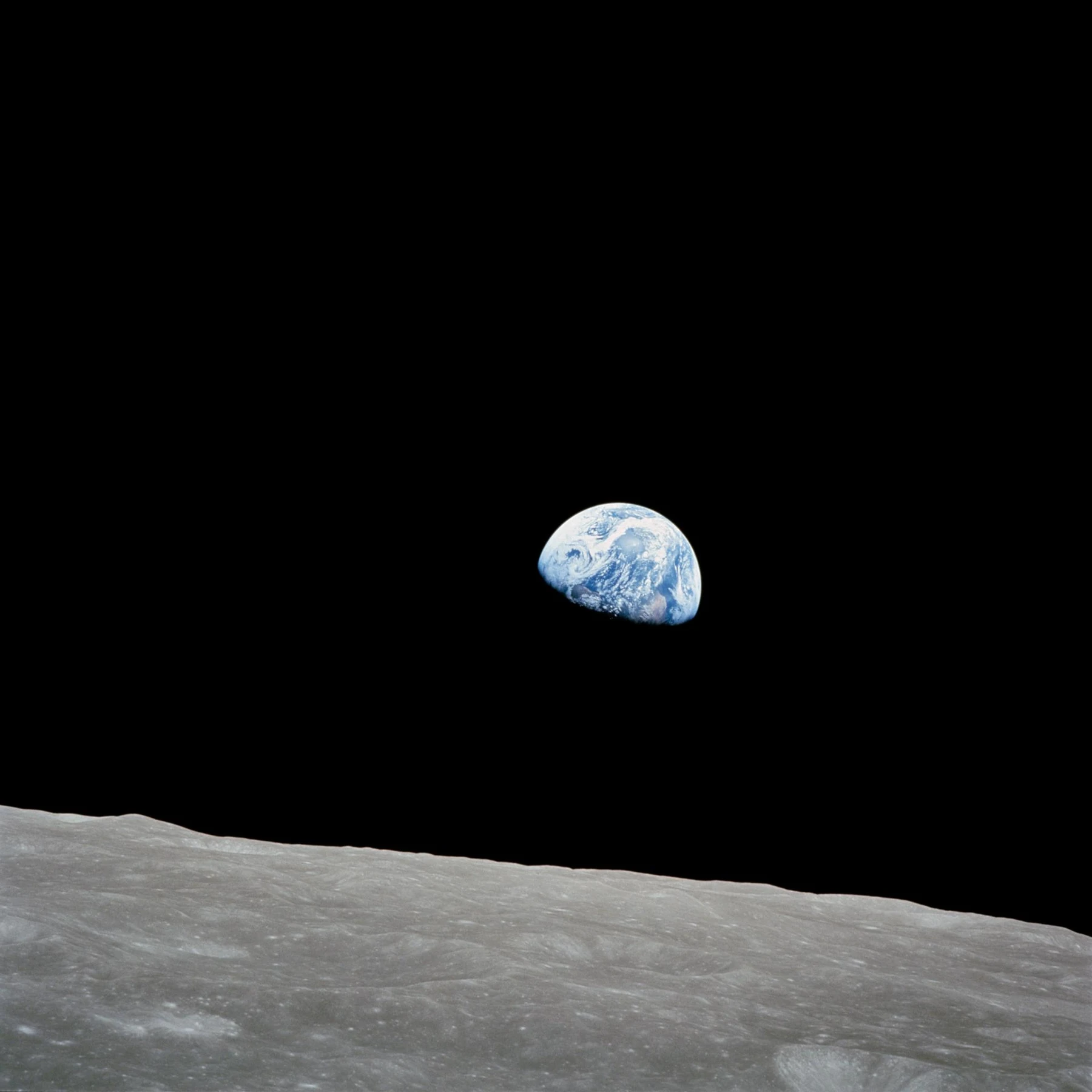
From orbit or the Moon, the sky looks black even when the Sun is up. The featured image, taken by the Artemis II crew in April 2026, shows Earth setting behind a sunlit Moon against a sky with no blue at all. The same black sky appears in Apollo 8’s famous Earthrise photo from December 24, 1968.
Why our sky is blue instead
On Earth, sunlight hits our atmosphere and “is scattered in all directions by all the gases and particles in the air,” NASA explains. Blue light is scattered more than other colors because it travels as shorter, smaller waves (NASA Space Place). That scattered light reaches our eyes from every direction, so the whole sky glows blue.
No air, no glow
Above the atmosphere, there’s almost nothing to scatter sunlight toward your eyes. Light still streams past you, but unless it hits something, you don’t see it. That’s why the space around a sunlit spacecraft looks black. NASA put it this way: above Earth’s atmosphere, space dims “to an inky pitch-black” (NASA, 2021).
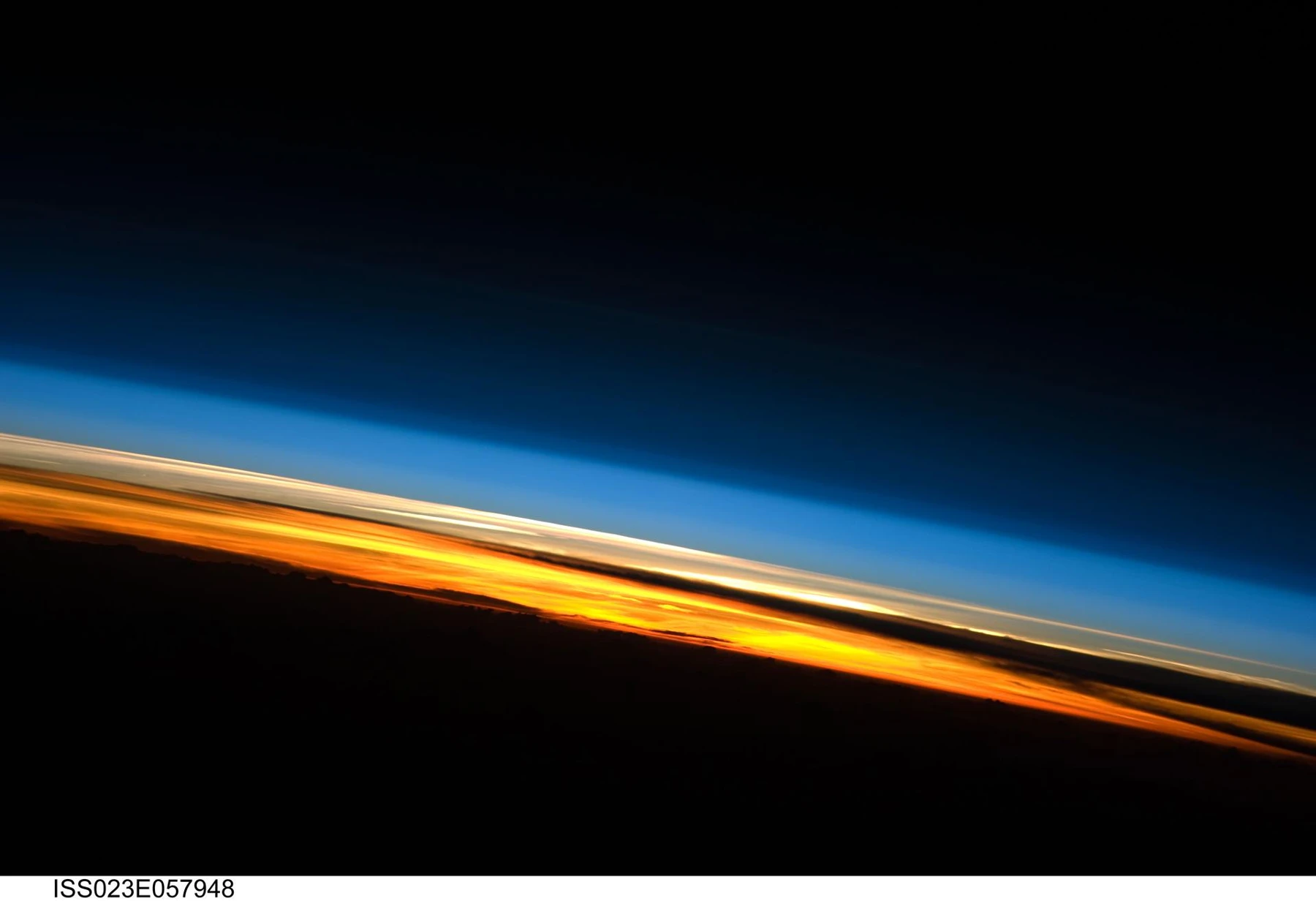
But that only explains why space looks dark near the Sun. The deeper question is why the night sky, which faces out toward billions of galaxies, isn’t bright.
What Is Olbers’ Paradox?
The puzzle
Imagine a universe that goes on forever, has existed forever without changing, and is filled evenly with stars that shine forever, with no expansion stretching their light. ESA describes the problem: in that universe, “if you were, therefore, to look in any direction in the sky, your line of sight would eventually hit on a star’s surface.” Every direction would end on a star, and the night sky would be blindingly bright (ESA).
Why distance doesn’t save us
You might think distant stars are too faint to matter. But in that imaginary universe, the number of stars grows with distance as fast as each one dims. A star twice as far away looks a quarter as bright, but it also takes up a quarter of the area on the sky, so a patch of sky covered by stars looks just as bright, near or far (Berkeley Lab). Fill every direction and the whole sky shines like the surface of a star.
Who asked first
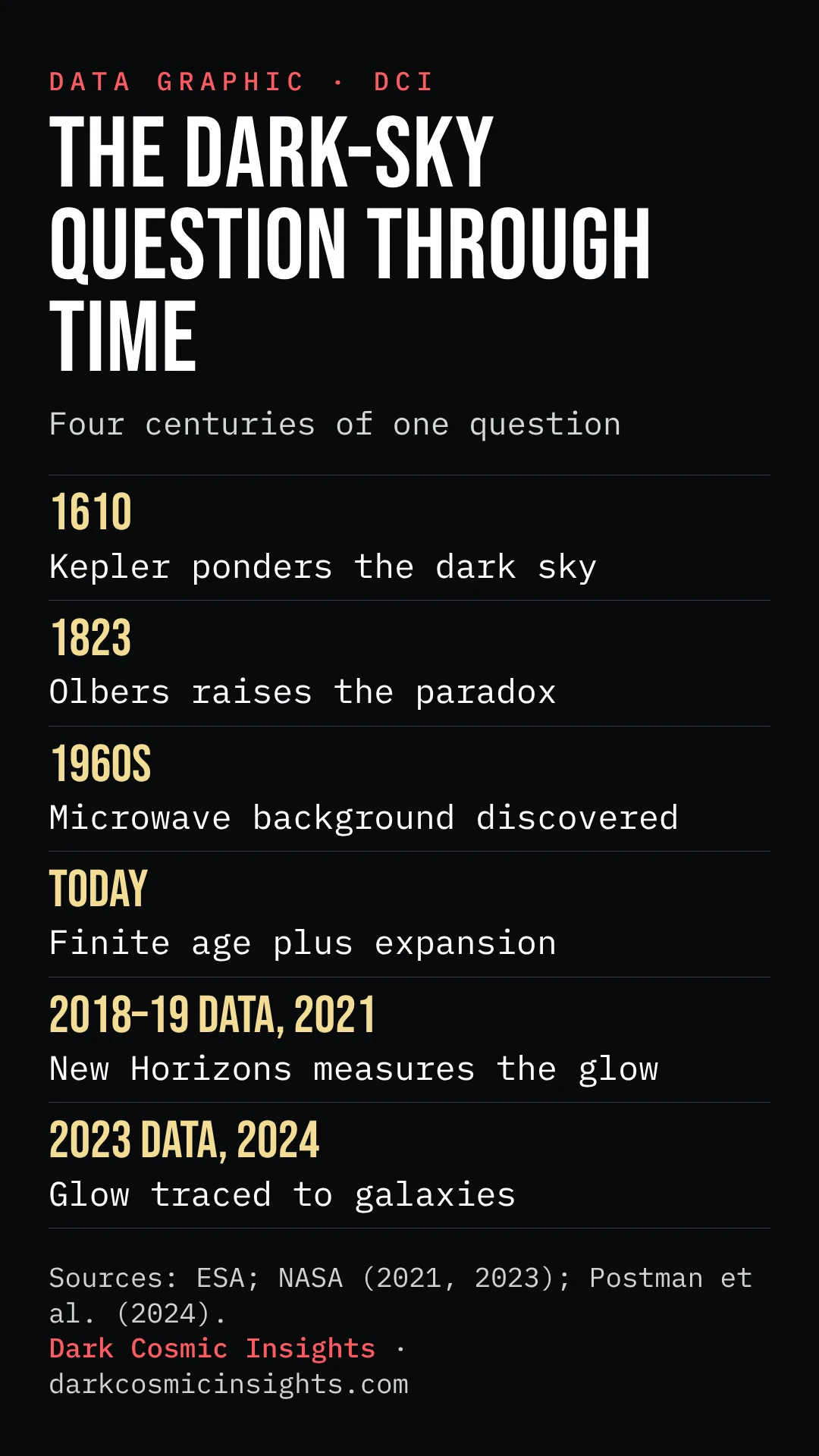
The puzzle is named after Heinrich Olbers, a German astronomer who raised it in 1823, but he wasn’t the first. Johannes Kepler had pondered the dark night sky in 1610 (ESA). For two centuries, nobody had a fully satisfying answer.
Why Is the Night Sky Dark? The Answer
Reason 1: the universe has a finite age
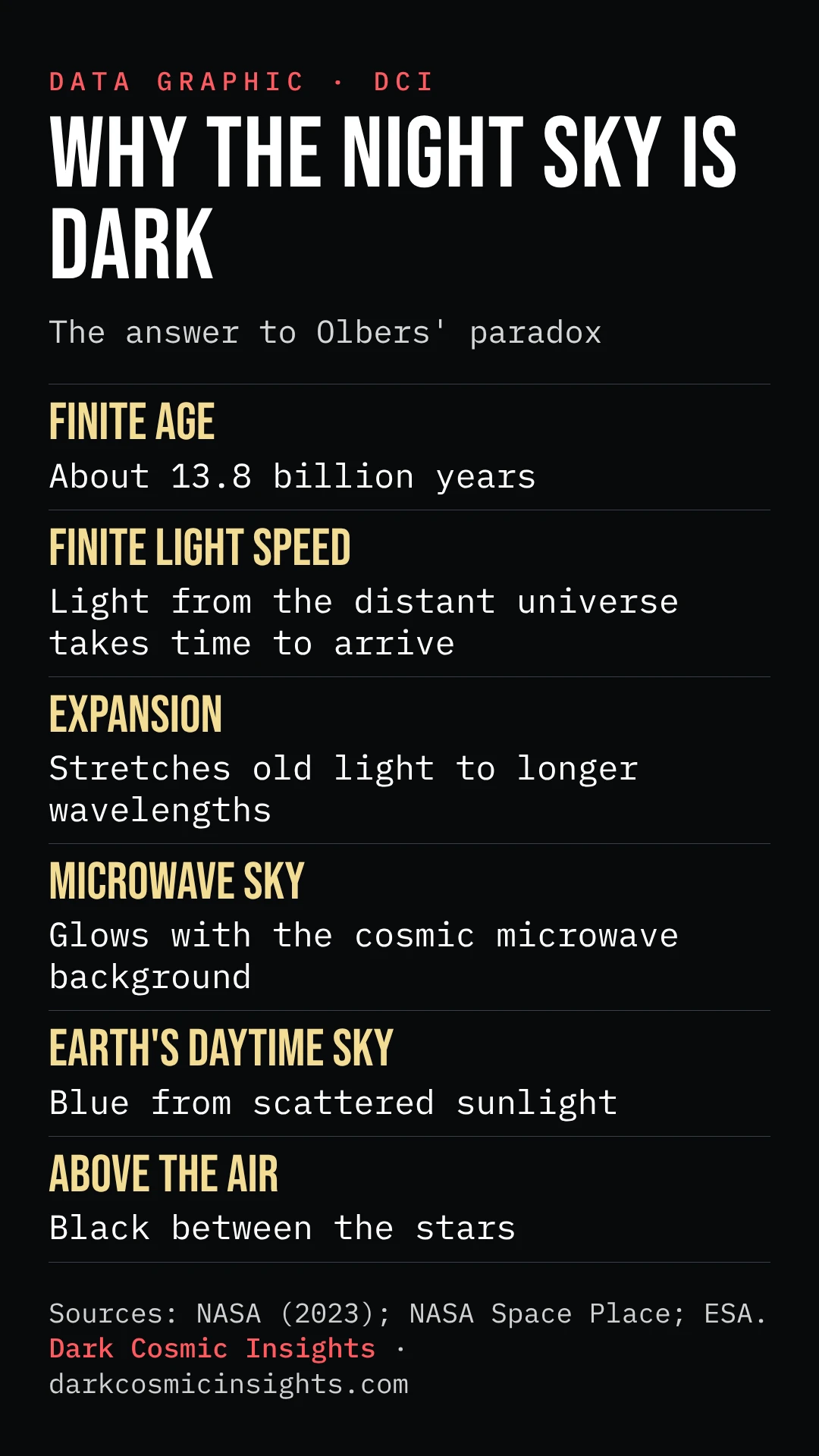
NASA’s explanation is direct: “the Universe has a finite age and size, with the speed of light having a definite value” (NASA, 2023). The size that matters here is the observable universe, the region whose light has had time to reach us. Whether the whole universe is finite or infinite is unknown, and the argument doesn’t need to know. The universe is about 13.8 billion years old (NASA), so we can only see light that has had time to reach us. Looking back far enough, our lines of sight reach the time before stars and galaxies formed, so they don’t end on a star at all. We explain the age in How Old Is the Universe?
Reason 2: expansion stretches old light
The universe is expanding, and as light crosses expanding space, its wavelength stretches. NASA notes that this shifts the light of the oldest, most distant galaxies “towards the longer wavelengths of the electromagnetic spectrum” (NASA, 2023). Light that left those galaxies as visible or ultraviolet light can arrive as infrared, which our eyes can’t see.
Which matters more?
Both effects help, but a Lawrence Berkeley National Laboratory explainer concludes that “the finite age of the Universe is the most important effect,” with expansion contributing too (Berkeley Lab).
How it was settled
NASA says the debate wasn’t truly settled until the 1960s, when scientists discovered the cosmic microwave background, the afterglow of the young universe (NASA, 2023). That discovery showed the universe had a hot beginning and has been changing ever since. A universe that’s infinitely old and unchanging, the kind that would produce a bright sky, doesn’t match what we observe.
Is Space Completely Black?
Bright in microwaves
No. If your eyes could see microwaves, NASA says, “we would behold a sky blazing with the light of the hot, young Universe” (NASA, 2023). That’s the cosmic microwave background, light from when the universe was under 400,000 years old, stretched by the expansion of the universe into microwaves. In a sense, Olbers was right that the whole sky glows. It just glows in a color we can’t see.
A faint visible glow
In visible light, space also isn’t perfectly dark. All the galaxies that have ever shone add up to a feeble background called the cosmic optical background. NASA describes it as “the visible-light equivalent of the more well-known cosmic microwave background” (NASA, 2021).
Why it’s hard to measure
From near Earth, that glow is swamped by sunlight scattered off dust in the solar system, called zodiacal light. Measuring the true darkness of space means getting far from that dust.
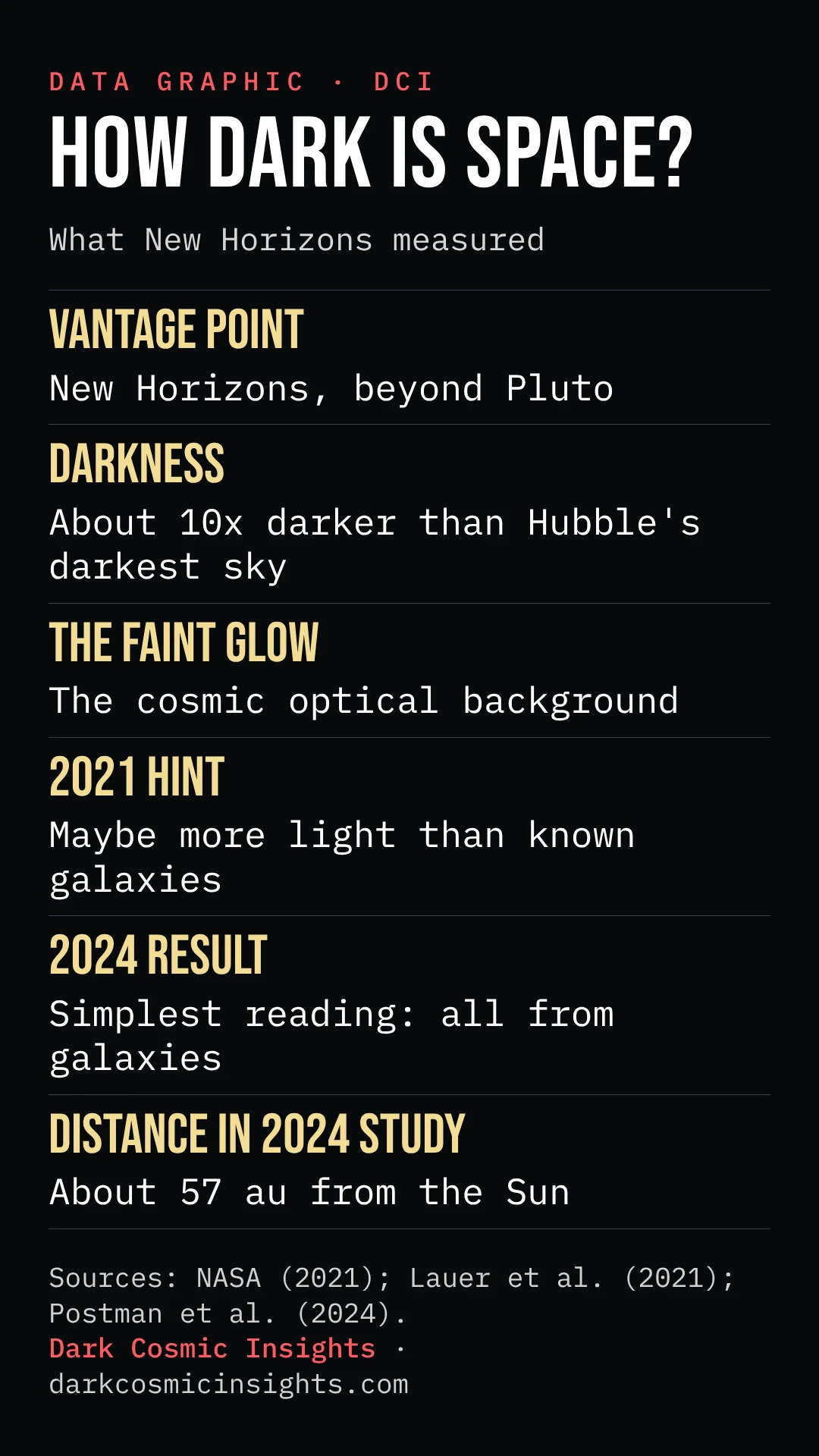
How Dark Is Space? What New Horizons Found
A camera beyond Pluto
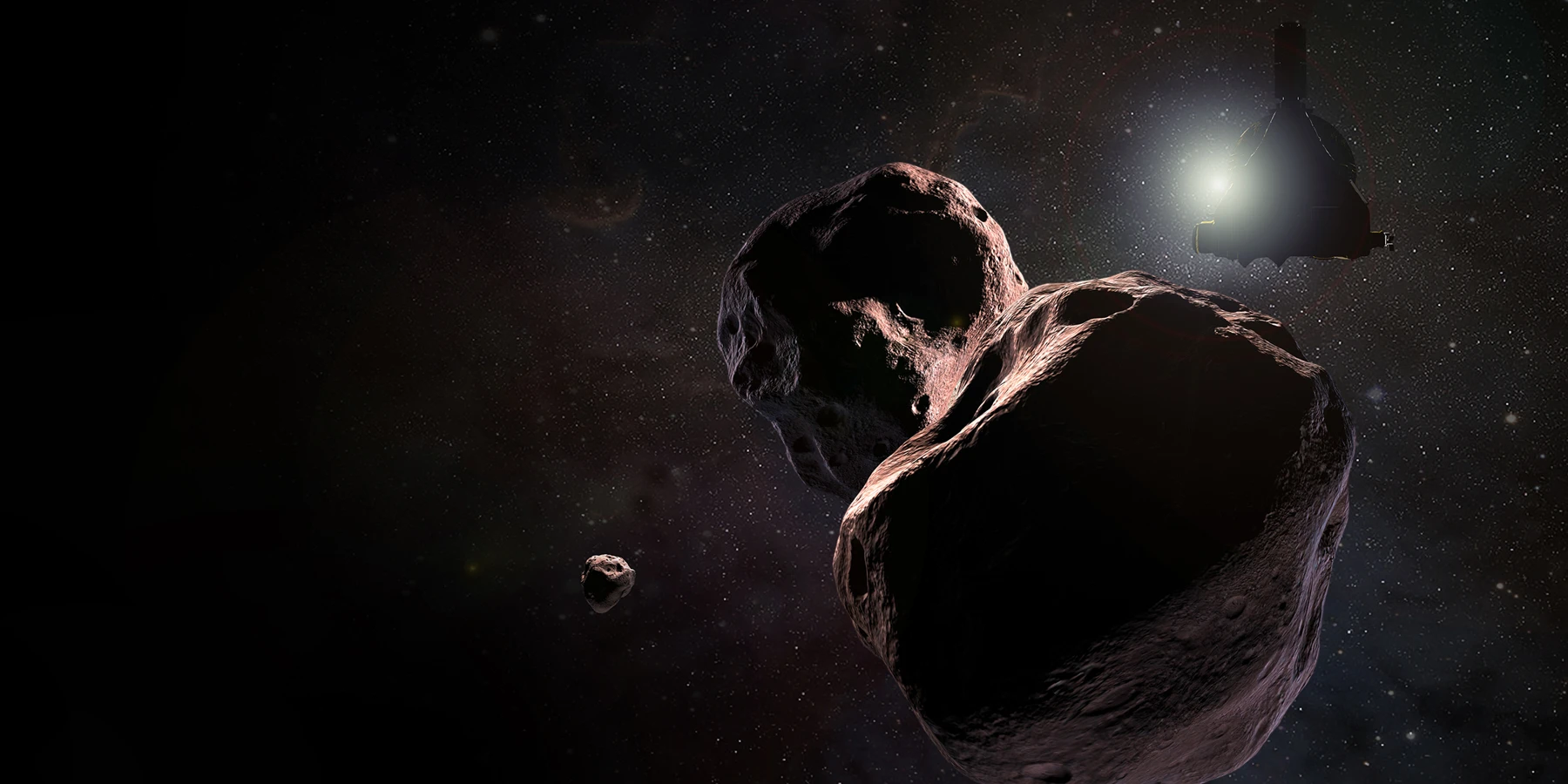
NASA’s New Horizons spacecraft, which flew past Pluto in 2015, carries a camera called LORRI. For a study published in 2021, its team analyzed archived images taken in 2018 and 2019, when the spacecraft was 42 to 45 astronomical units from the Sun, where the sky is about 10 times darker than the darkest sky available to Hubble (Lauer et al., 2021).
The refrigerator test
The leftover glow was extremely faint but measurable. Co-author Marc Postman compared it to lying in a dark bedroom in the countryside, curtains open, when a neighbor a mile away opens a refrigerator and its light reflects off your walls (NASA, 2021). That’s how bright the background New Horizons detected would look.
A surprise, then an answer
The 2021 analysis suggested the background might hold more light than known galaxies could explain, raising the possibility of faint galaxies just beyond detection (NASA, 2021). In 2024, the team published results based mainly on new observations made in 2023 for this measurement, taken as New Horizons was about 57 au from the Sun, which the team calls the most remote camera ever deployed. Their conclusion: “The simplest interpretation is that the COB is completely due to galaxies” (Postman et al., 2024).
What that means
So the faint glow of space appears to come from ordinary galaxies, near and far, adding up over cosmic history. The measurement is measured; tying it entirely to galaxies is the team’s simplest interpretation, and future studies will keep testing it.
Why Do Deep Images Show So Many Galaxies Then?
Long exposures collect faint light
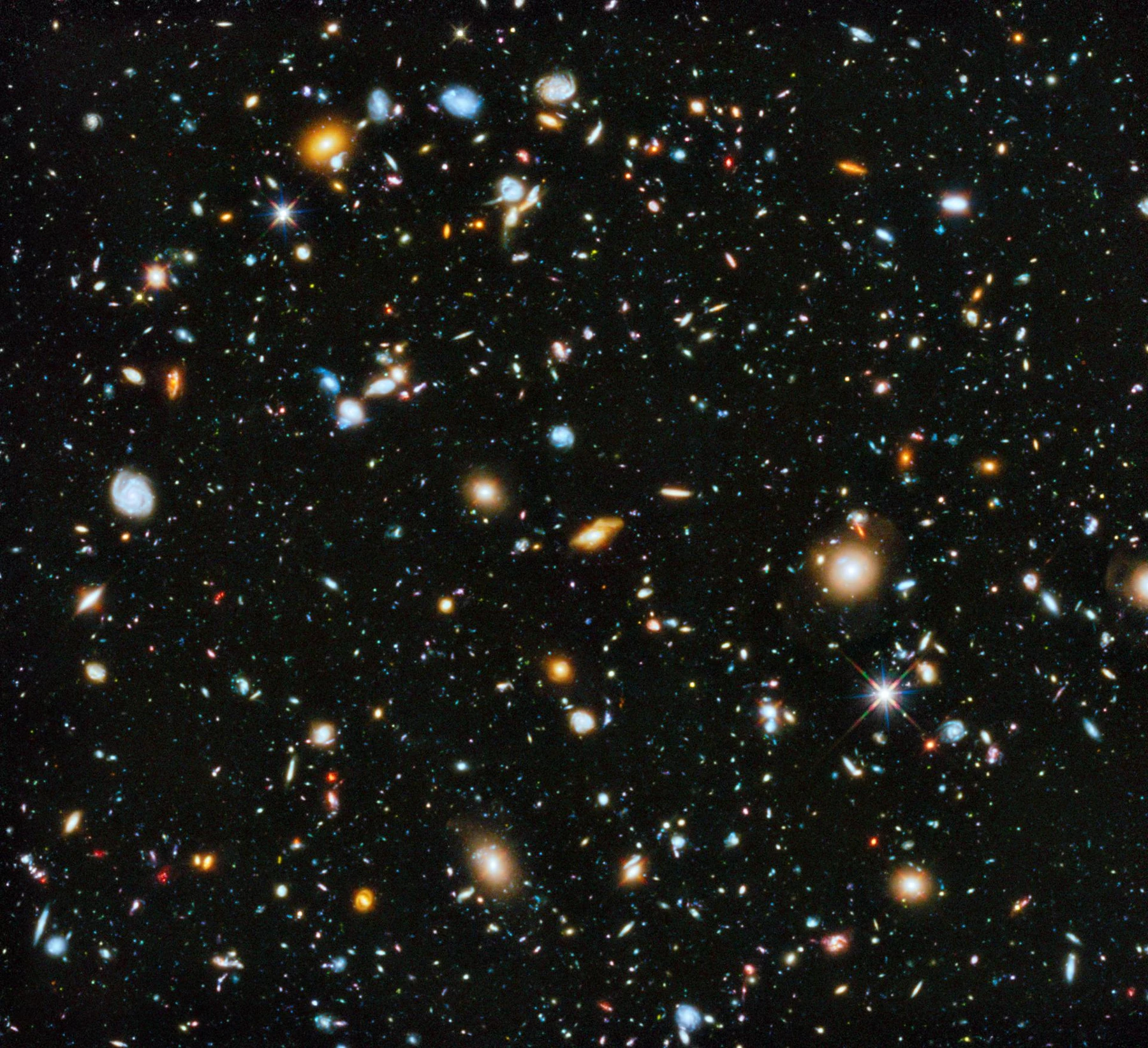
Hubble’s and Webb’s deep fields seem to contradict the dark sky: a tiny patch looks crowded with galaxies. NASA notes that what appears as a dark background “is populated with” a huge number of galaxies once you collect enough light (NASA, 2023). Telescopes stare for hours or days to gather light far too faint for eyes.
Still mostly dark
Even in the deepest images, galaxies cover only part of the frame. The black between them isn’t empty. Those dark pixels are simply below the image’s detection limit: light too faint or too stretched for the telescope to record in that exposure. They don’t mark the edge of the observable universe. But the fact that even the deepest images don’t fill in completely echoes Olbers’ paradox in a single picture.
See it for yourself
We explain how big the observable universe is in How Big Is the Universe?, and how its light travels in What Is a Light-Year?
A Timeline of the Dark-Sky Question
Each step built on the one before:
- 1610: Johannes Kepler ponders the dark night sky and suggests stars extend only so far (ESA).
- 1823: Heinrich Olbers raises the paradox that now bears his name (ESA).
- 1960s: The cosmic microwave background is discovered, settling the debate in favor of an evolving universe (NASA, 2023).
- 2018 to 2019, published 2021: New Horizons images from beyond Pluto measure the faint visible glow (NASA, 2021).
- 2023, published 2024: New observations point to galaxies as the simplest source of that glow (Postman et al., 2024).
Myth vs. Fact: Why Space Is Black
| Myth | Fact | Status |
|---|---|---|
| “Space is black because it’s cold.” | Darkness is about light reaching your eyes, not temperature. | Not supported |
| “There aren’t enough stars to light the sky.” | The key limit is time: we only see light from the observable universe, and lines of sight reach back before stars formed. | Modelled |
| “Dust blocks the starlight.” | Given enough time, dust would heat up and glow like a star. | Not supported |
| “Space is perfectly black.” | It glows faintly in visible light and brightly in microwaves. | Measured |
| “The sky is black on the Moon because it’s night.” | It’s black in daytime too, with no air to scatter light. | Observed |
| “The universe must be infinite.” | Unknown; the dark sky doesn’t depend on it. | Open |
The dust row follows the Berkeley Lab explainer, which notes that “in an infinite time the dust will heat up so that it radiates like a star” (Berkeley Lab).
How Can You See the Darkness Yourself?
Find a dark sky
Get away from city lights on a moonless night and let your eyes adjust for 20 minutes or more. The sky between the stars still won’t be perfectly black, because Earth’s air scatters light from towns and from the Moon. That’s the darkness Olbers wondered about.
Look between the stars
Pick a patch of sky with few visible stars. With binoculars, more stars appear in it. With a big telescope, galaxies appear. With Hubble or Webb, thousands do. Each step reveals light that was too faint before, but the sky never fills in completely.
Remember the microwave glow
The black you see is only black to your eyes. The same patch of sky is glowing in microwaves with light from the young universe. Our article How Cold Is Space? explains how that glow sets the temperature of empty space.
Why Space Is Black: By the Numbers
| Measure | Value | Source |
|---|---|---|
| Age of the universe | about 13.8 billion years | NASA |
| Olbers raises the paradox | 1823 | ESA |
| Kepler’s first musings | 1610 | ESA |
| Microwave background discovered | 1960s | NASA, 2023 |
| New Horizons’ sky vs. Hubble’s darkest | about 10x darker | NASA, 2021 |
| New Horizons distance, 2018 to 2019 images | 42 to 45 au | Lauer et al., 2021 |
| New Horizons distance, 2023 images | about 57 au | Postman et al., 2024 |
Sources checked November 2026.
Why Is Space Black? FAQ
Why is space black if the Sun is shining?
Because there’s no air to scatter sunlight toward your eyes. On Earth, air scatters blue light across the whole sky. In space, sunlight streams past you unseen unless it hits something, so the background looks black.
What is Olbers’ paradox?
It’s the question of why the night sky is dark. In a universe that is infinite, unchanging and infinitely old, filled with stars that shine forever, every line of sight would end on a star, and the sky would blaze. Olbers raised it in 1823, though Kepler had wondered about it in 1610.
What is the answer to Olbers’ paradox?
The universe has a finite age, about 13.8 billion years, and light travels at a finite speed, so we only see light from the observable universe, and looking far enough back takes us to a time before stars formed. Expansion also stretches the oldest light to wavelengths our eyes can’t see.
Is space completely black?
No. It glows faintly in visible light with the combined light of all galaxies, called the cosmic optical background, and brightly in microwaves with the cosmic microwave background.
How dark is space?
From beyond Pluto, New Horizons measured a sky about 10 times darker than the darkest sky available to the Hubble Space Telescope. Even there, a faint glow remained.
What makes the faint glow of space?
A 2024 New Horizons study concluded that the simplest interpretation is that it comes entirely from galaxies. Earlier data had hinted at extra light, so researchers continue to test the result.
Why is the sky blue on Earth but black in space?
Earth’s air scatters sunlight, and it scatters blue light the most, so the sky glows blue. Above the atmosphere there’s almost no air to scatter light, so the sky looks black.
Does a dark sky mean the universe is finite in size?
Not necessarily. The darkness is explained by the universe’s finite age and its expansion. Whether space goes on forever is still an open question.
Your next step: on the next clear, moonless night, find the darkest patch of sky you can and look between the stars. The darkness you see is part of the evidence that the universe has a finite age.
Sources and Further Reading
- NASA (January 13, 2021), New Horizons Spacecraft Answers Question: How Dark Is Space?
- Lauer et al. (2021), New Horizons Observations of the Cosmic Optical Background, The Astrophysical Journal.
- Postman et al. (August 28, 2024), New Synoptic Observations of the Cosmic Optical Background with New Horizons, The Astrophysical Journal.
- NASA Night Sky Network (August 29, 2023), Looking Beyond the Stars: September’s Night Sky Notes.
- NASA Science, Universe Overview.
- NASA Space Place, Why Is the Sky Blue?
- ESA Science & Technology, Cosmology: Olbers’ paradox.
- Lawrence Berkeley National Laboratory, Olbers’ Paradox.
- NASA images: art002e021278, iss023e057948, PIA22190, Hubble Ultra Deep Field 2014, AS08-14-2383.
Explore Next
- The age that makes the sky dark: How Old Is the Universe?
- How far the light has traveled: How Big Is the Universe?
- The unit behind cosmic distances: What Is a Light-Year?
- The temperature of the dark: How Cold Is Space?
- Are those colorful pictures real?: Are Space Photos Real?
- What “redshift” and “cosmic microwave background” mean: Space Glossary
- How a claim earns its label: How We Know
How This Explainer Was Checked
Every number and quote in this article was checked in November 2026 against the source linked beside it: NASA’s Universe overview, NASA’s 2021 New Horizons release, the 2021 and 2024 New Horizons papers in The Astrophysical Journal, NASA’s 2023 Night Sky Notes, NASA Space Place, ESA’s cosmology pages and Berkeley Lab’s Olbers’ paradox explainer. The dark sky and blue daytime sky are labelled Observed; New Horizons’ sky brightness Measured; the finite-age and expansion explanation, and the galaxy origin of the faint glow, Modelled; whether the universe is infinite Open; common myths Not supported. Images are labelled: real photos and telescope images as OBSERVATION, illustrations as ARTIST’S CONCEPT, our charts as DATA GRAPHIC. Nothing AI-generated is presented as a real image.
Final Thought: The Dark Is a Clock
The black between the stars isn’t empty. It’s a message about time. If the universe were infinitely old, unchanging and filled with stars that shine forever, light from every direction would have reached us long ago, and night would never fall. Instead, we see darkness, because the universe has a finite age and its oldest light, reaching us right now, has been stretched into colors we can’t see. Every clear night, you’re looking at the evidence.