Today, Mars is a frozen desert. NASA says its air is “too thin for liquid water to exist for long on the surface” (NASA). Yet everywhere rovers and orbiters look, Mars is covered in the marks of water: dried-up river channels, fan-shaped deltas, layered lakebed mud, and cracks that look like mud drying in the sun.
So yes, there was water on Mars. NASA puts it plainly: Mars “appears to have had a watery past, with ancient river valley networks, deltas, and lakebeds” (NASA). The harder questions are how much, for how long, and where it went. Here’s the evidence, one rung at a time.
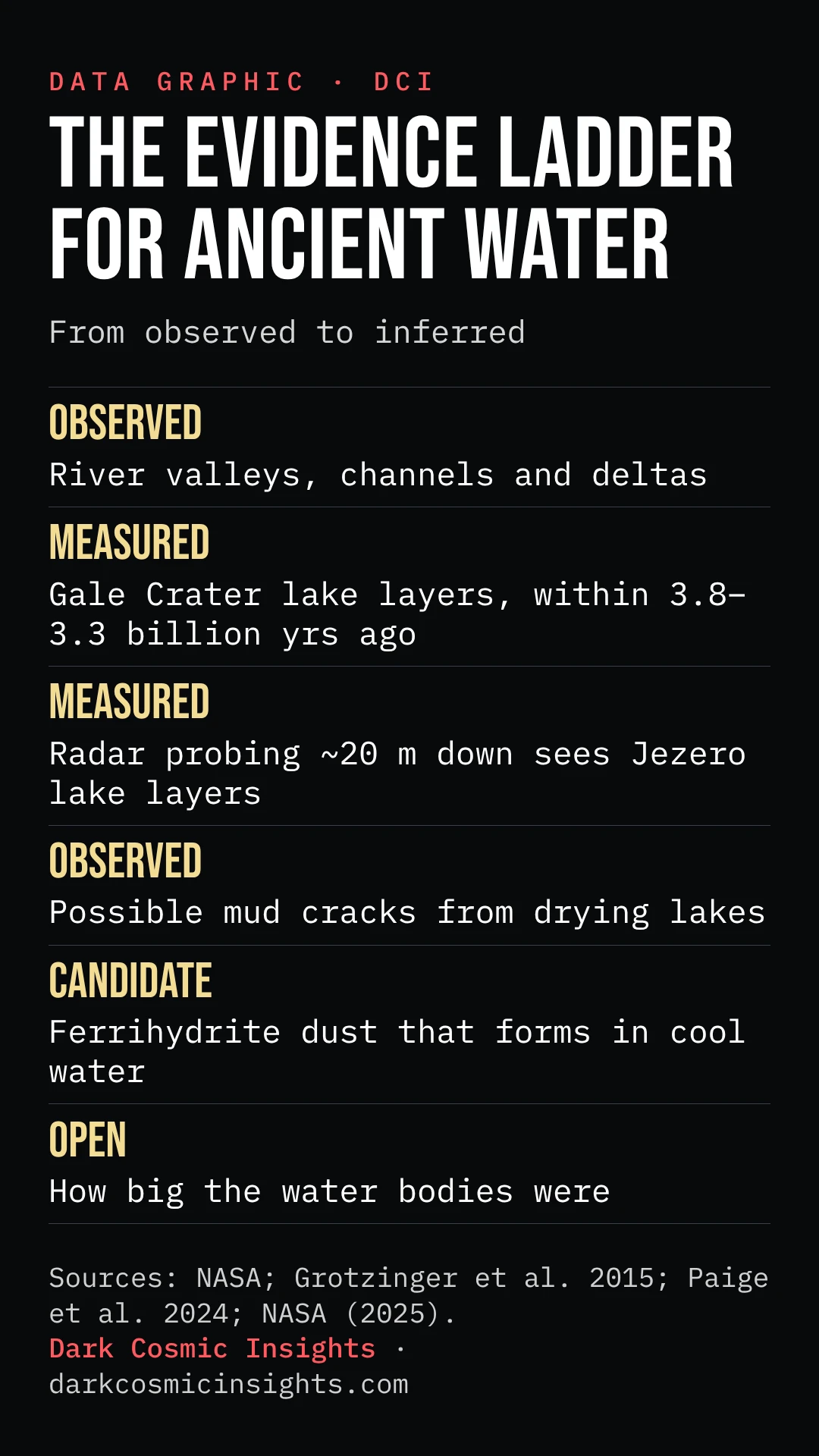
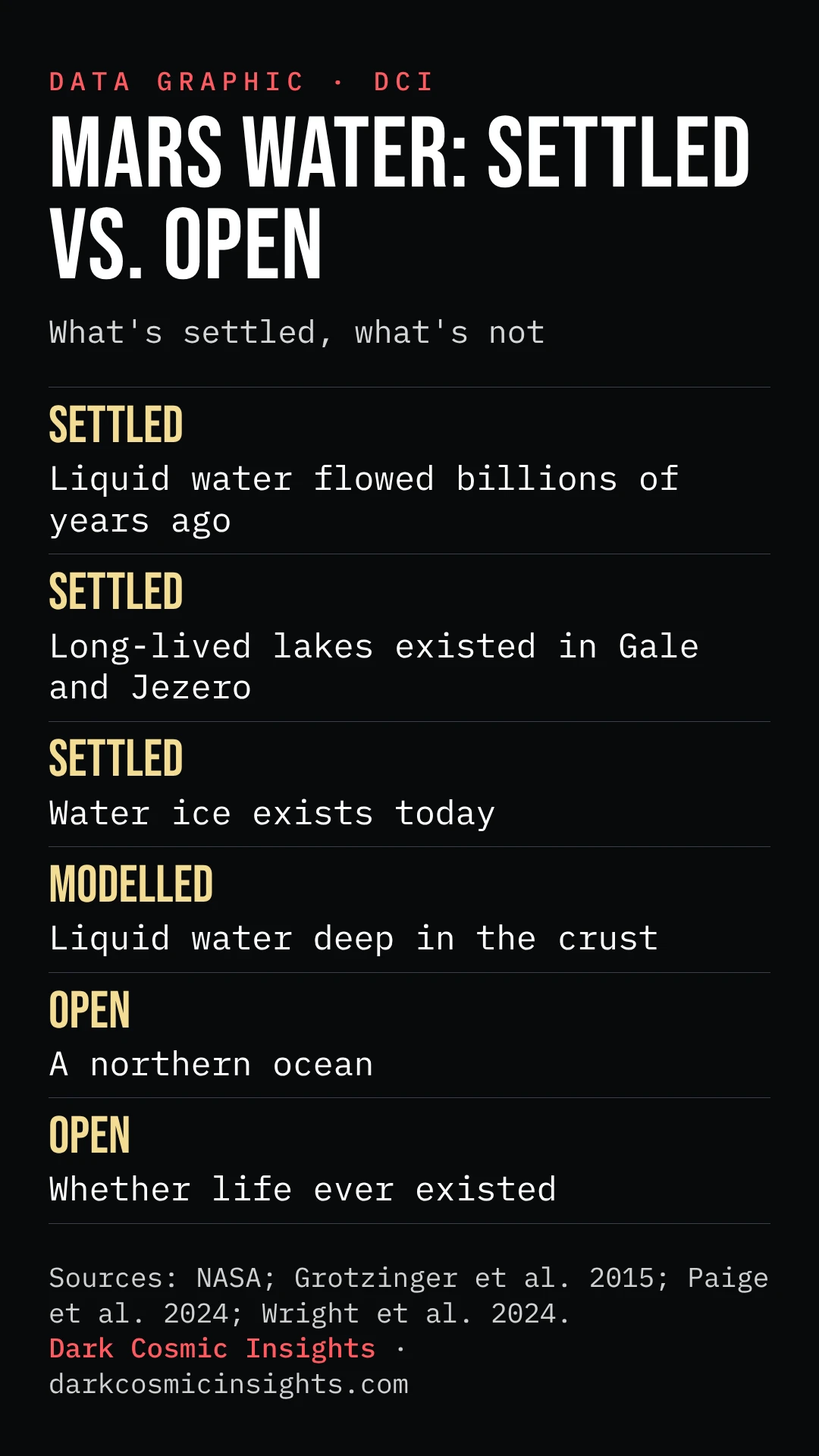
Observed, measured, modelled, open. River valleys, deltas and lakebed layers are observed from orbit and on the ground. Water-formed minerals and water ice are measured. Deep liquid groundwater is modelled from seismic data. Whether Mars had a large ocean, and whether it ever had life, are still open.
Quick Answer: Was There Water on Mars?
Yes. Billions of years ago, liquid water flowed on Mars. NASA’s Curiosity rover found evidence that long-lived streams and lakes existed in Gale Crater at some point between about 3.8 and 3.3 billion years ago (Astronomy Now, on Grotzinger et al. 2015). Perseverance’s ground-penetrating radar, probing about 20 meters (65 feet) below the surface, found layers of water-laid lake sediments in Jezero Crater, thought to be about 3 billion years old (UCLA, 2024). Today, Mars still has water, but mostly as ice at its poles and under its surface, plus a trace of vapor in the air. A 2024 study suggests liquid water may sit deep in the crust, 11.5 to 20 km down, but that’s modelled from seismic data, not observed.
What this article can and cannot establish. It can lay out the evidence for water on Mars, from what has been seen directly to what has been inferred. It cannot tell you how big Mars’s ancient water bodies were, whether a large ocean ever covered its northern plains, or whether life ever existed there. Those questions are still open.
Table of Contents
The DCI Evidence Map: Water on Mars
| Question | What we know | Status | Key source |
|---|---|---|---|
| Did water once flow on Mars? | Yes: river valleys, deltas and lakebeds | Observed | NASA |
| Were there long-lived lakes? | Yes, in Gale Crater, at times within about 3.8 to 3.3 billion years ago | Measured | Astronomy Now, 2015 |
| Was Jezero Crater a lake? | Radar probing about 20 m down shows water-laid sediments | Measured | UCLA, 2024 |
| Is there water ice today? | Yes, at the poles and under the surface | Observed | NASA, Phoenix |
| Is there liquid water deep underground? | Possibly, 11.5 to 20 km down | Modelled | ScienceDaily, on Wright et al. 2024 |
| Did Mars have a northern ocean? | Debated; scientists disagree | Open | See below |
| Did Mars have life? | No confirmed evidence | Open | NASA, 2025 |
Status key: Observed = seen directly. Measured = a number with a stated uncertainty or a direct measurement. Modelled = inferred from measurements through a physical model, dependent on assumptions. Open = unresolved; the evidence is incomplete or points different ways. Not supported = the evidence goes against the claim, or there is none for it.
Cite this framework: “DCI Evidence Map: Water on Mars,” Dark Cosmic Insights, November 2026, darkcosmicinsights.com/was-there-water-on-mars/.
The Evidence Ladder: How We Know Mars Was Wet
Evidence for water on Mars comes in different strengths. Here it is, from the most direct to the most inferred.
Rung 1: shapes carved by water (observed)
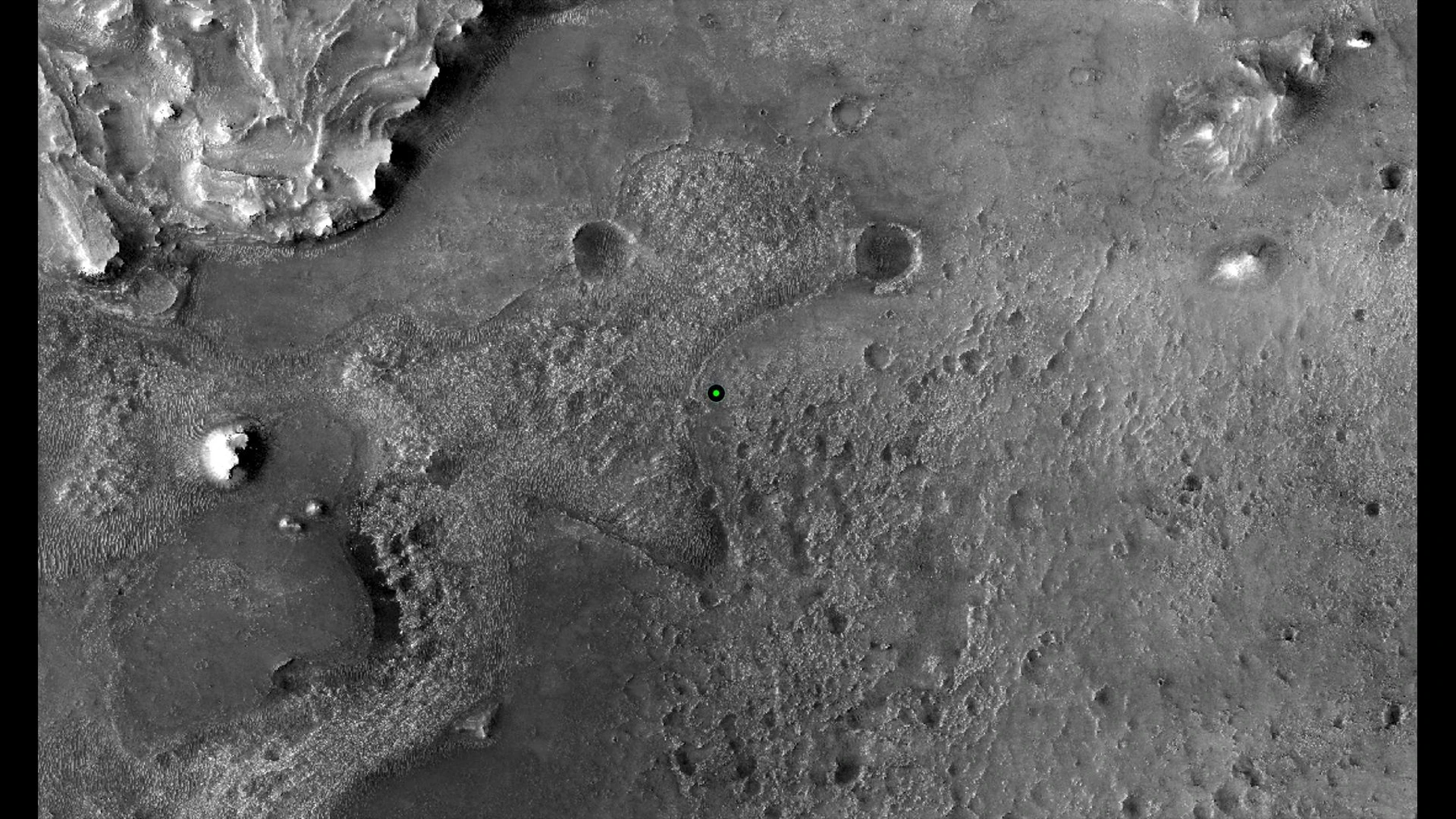
From orbit, Mars shows features that, on Earth, only flowing water makes: branching river valleys, channels and fan-shaped deltas. NASA lists “ancient river valley networks, deltas, and lakebeds” among Mars’s features (NASA). The delta in Jezero Crater, Perseverance’s landing site, is one of the clearest. NASA explains that deltas form “when sediments settle out due to a decrease in speed of a river system,” often where rivers flow into lakes (NASA, PIA26252).
Rung 2: layers laid down in lakes (measured)
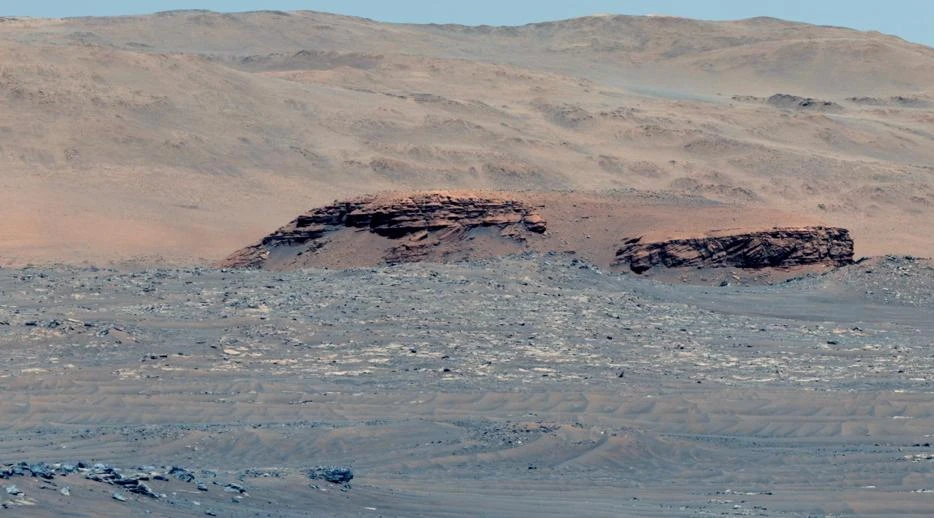
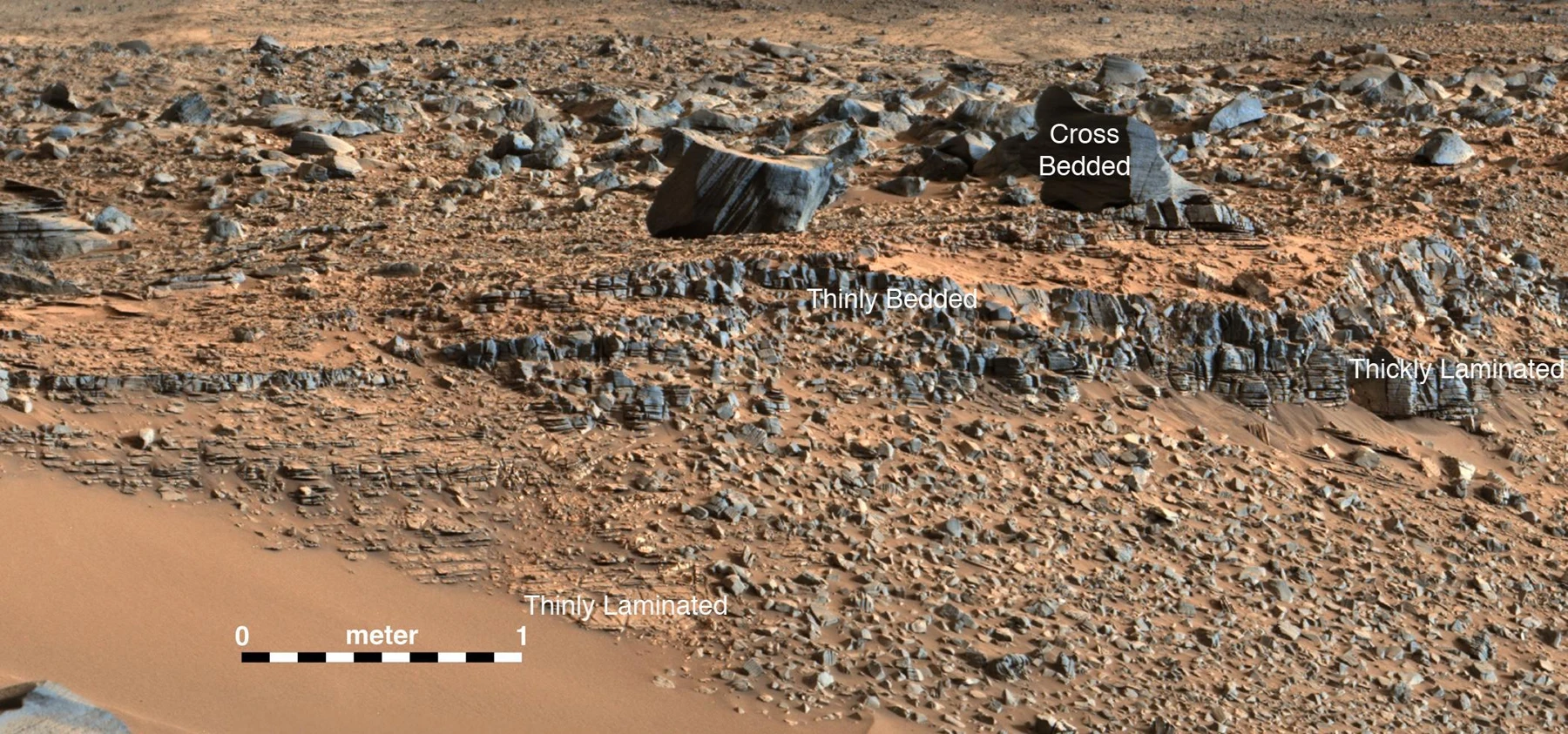
Curiosity has spent years climbing Mount Sharp in Gale Crater. Its team found “finely laminated mudstones in abundance that look like lake deposits” (Astronomy Now, 2015). In a 2015 paper in Science, they concluded that “a series of long-lived streams and lakes existed at some point between about 3.8 to 3.3 billion years ago,” with lakes possibly expanding and contracting over hundreds to millions of years. Lead author John Grotzinger put it memorably: “Paradoxically, where there is a mountain today there was once a basin, and it was sometimes filled with water.”
Rung 3: lake sediments under Jezero (measured)
In January 2024, a team led by David Paige of UCLA reported results from Perseverance’s RIMFAX ground-penetrating radar in Science Advances. The radar measured reflections from depths of about 20 meters (65 feet) below the surface, how deep it probed, and revealed rock layers that “provide unmistakable evidence that soil sediments carried by water were deposited at Jezero Crater and its delta,” matching lake sediments on Earth and thought to be about 3 billion years old (UCLA, 2024; CNBC/Reuters, 2024).
Rung 4: mud cracks (observed)
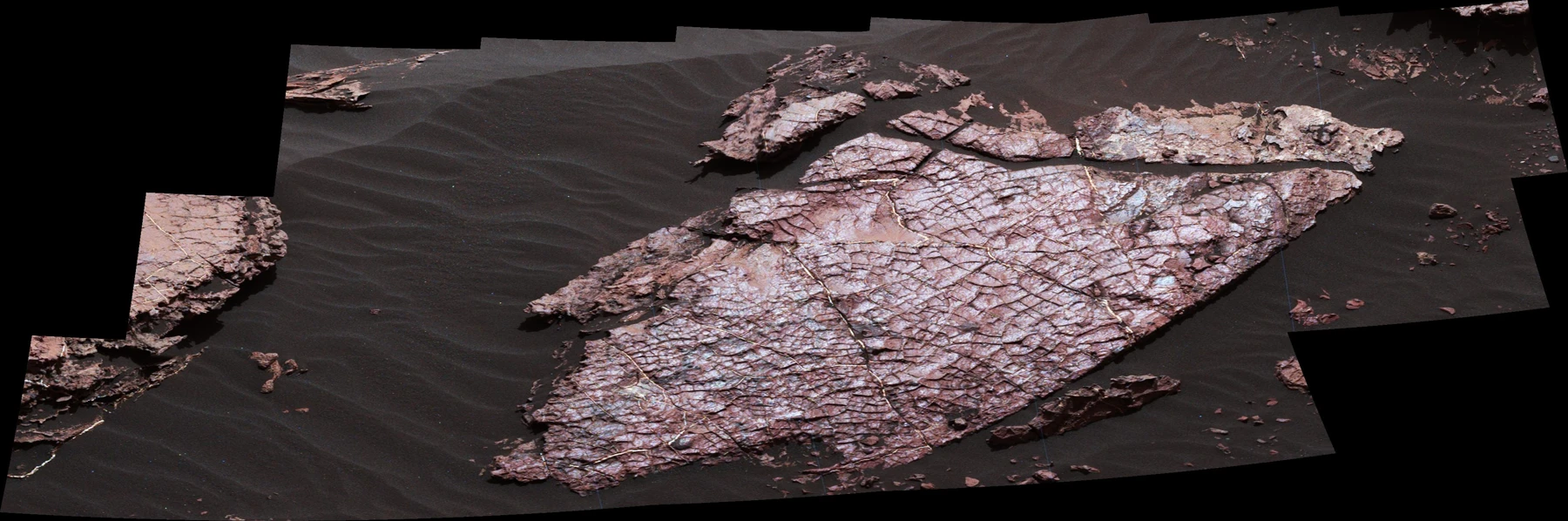
Curiosity also photographed a rock slab called “Old Soaker” with a network of cracks that “may have originated in drying mud.” NASA says mud cracks would be evidence of a time “more than 3 billion years ago” when dry spells interrupted wetter periods that supported lakes (NASA, PIA21262). They suggest Mars’s lakes came and went.
Rung 5: minerals that form in water (modelled link)
Some minerals only form with water. A 2025 study suggests Mars’s red dust may be dominated by ferrihydrite, an iron oxide that forms in cool water, though that’s not yet confirmed (NASA, 2025). We cover that in Why Is Mars Red?
Is There Water on Mars Today?
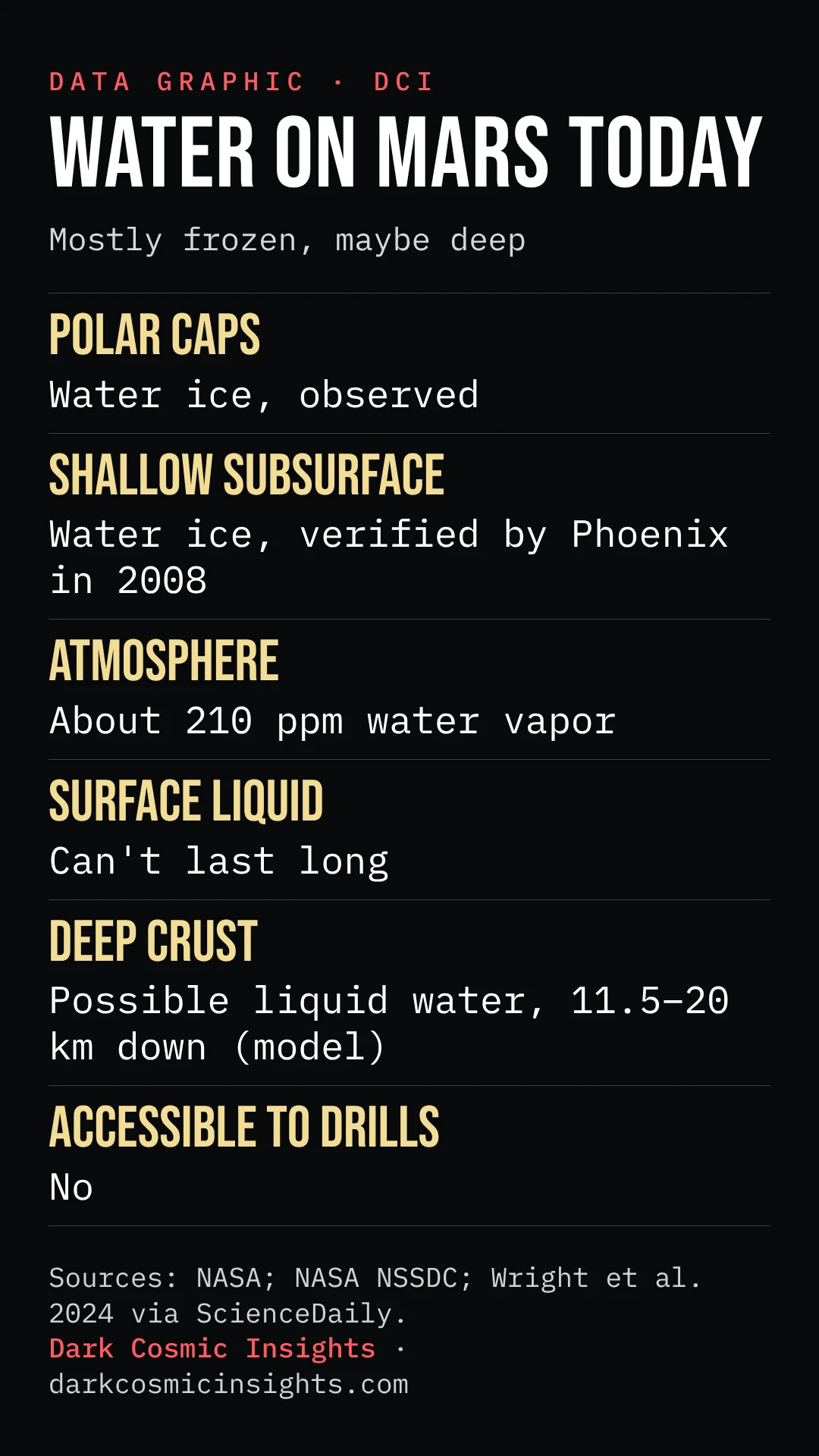
Yes, but mostly frozen
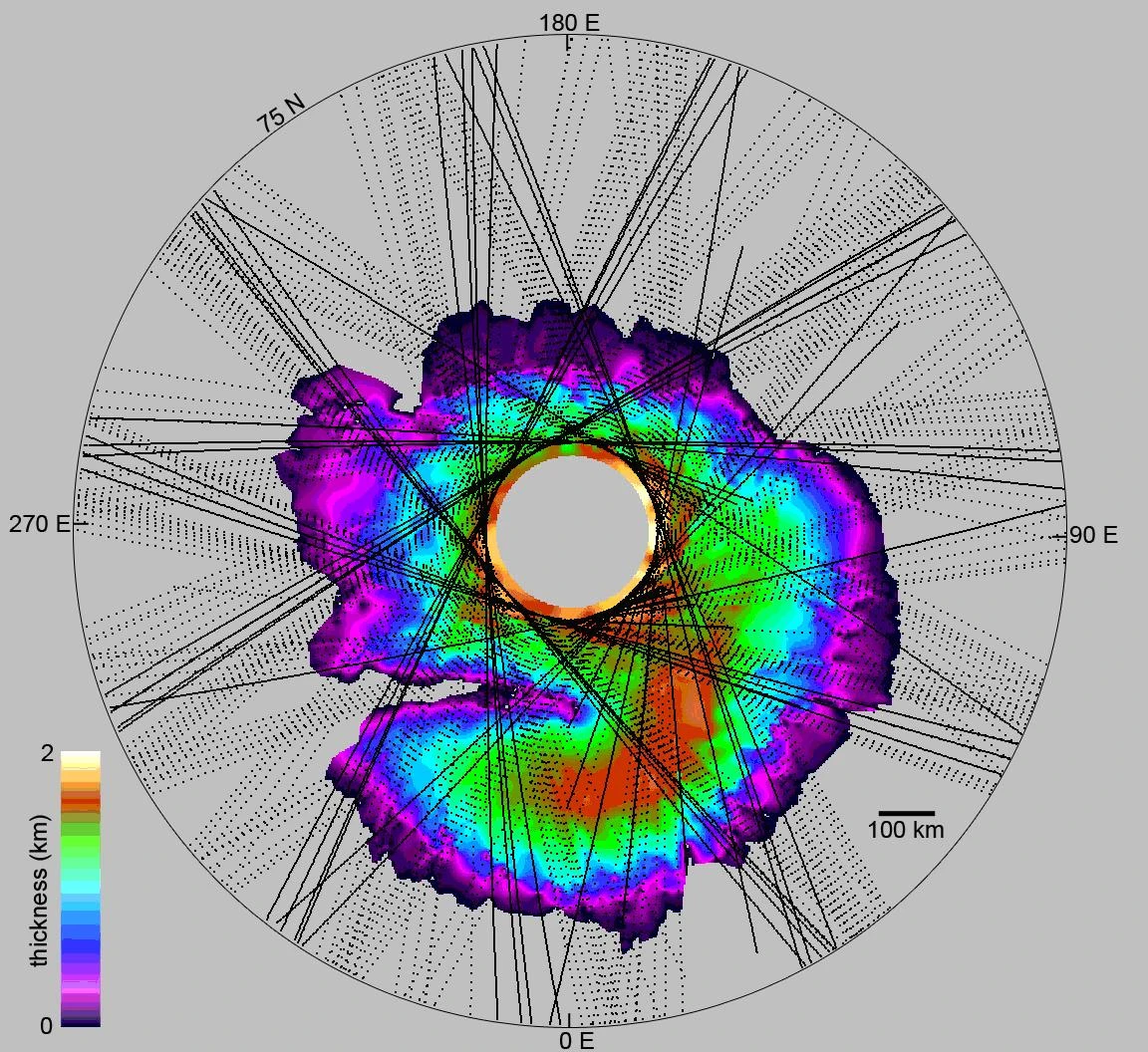
Mars still has water, just not much liquid on the surface. NASA notes it has “polar ice caps” (NASA), and NASA’s Phoenix lander, which touched down on May 25, 2008, contributed to “verifying the existence of water-ice in the Martian subsurface” (NASA, Phoenix).
A trace in the air
The air holds a little water vapor too. NASA’s Mars fact sheet lists water vapor at about 210 parts per million of the atmosphere by volume (NASA NSSDC).
Why no lakes now
Liquid water can’t last on Mars’s surface today. The air is so thin, about 0.6 percent of Earth’s pressure at the surface, and so cold, averaging about −59 °C, that water either freezes or evaporates (NASA; NASA NSSDC). We cover the cold in How Cold Is Mars?
Is There Liquid Water Deep Underground?
What InSight’s marsquakes suggested
NASA’s InSight lander recorded marsquakes during its mission. In August 2024, a team led by Vashan Wright, with Matthias Morzfeld and Michael Manga, published an analysis in the Proceedings of the National Academy of Sciences. They found the seismic data are “best explained by a water-saturated mid-crust” beneath InSight, with water filling “tiny cracks and pores in rock” between about 11.5 and 20 kilometers below the surface (ScienceDaily, 2024).
How much
If the crust is similar everywhere, that groundwater “could cover the entire planet to a depth of between 1 and 2 kilometers,” the researchers said (ScienceDaily, 2024).
Big caveats
This is modelled, not observed. The water hasn’t been seen or sampled; it’s the best fit to seismic data under one lander, using rock-physics models. And it’s far too deep to reach: as the release notes, “Even on Earth, drilling a hole a kilometer deep is a challenge” (ScienceDaily, 2024).
Where Did Mars’s Water Go?
Mars needed a thicker atmosphere
For liquid water to flow on the surface, the Curiosity team noted, “Mars must have had a thicker atmosphere and warmer climate” (Astronomy Now, 2015). Today that atmosphere is mostly gone.
Some froze, some may be locked in rock, some escaped
Water that once flowed on Mars could have gone several places: into the polar caps and buried ice, into minerals that trap water in their structure, deep into the crust, or out to space as the atmosphere thinned. The InSight study suggests a large share may have soaked into the crust (ScienceDaily, 2024). How the water was divided among these places is still open.
The climate puzzle
Even how Mars stayed warm enough for lakes is unresolved. When the Gale Crater results came out, the team noted that paleoclimate models “have, literally, come up dry” in explaining it (Astronomy Now, 2015).
Did Mars Have an Ocean?
Some scientists have argued that a large ocean once covered Mars’s low northern plains. Others think the evidence fits lakes, groundwater and ice better. For now, a Martian ocean is labelled open.
Water and the Search for Life
Water isn’t life
Liquid water is one of the things life as we know it needs, so an ancient wet Mars was potentially habitable. NASA’s Geronimo Villanueva said the 2025 ferrihydrite findings “point to a potentially habitable past for Mars” (NASA, 2025). But habitable means conditions life could have used. No evidence of past life on Mars has been confirmed.
Why Perseverance went to a lake
That’s exactly why Perseverance landed in Jezero Crater on February 18, 2021: an ancient lake with a delta is a good place to look for signs of ancient microbial life. NASA says a key objective is astrobiology, “including the search for signs of ancient microbial life” (NASA, PIA24331). The rover is collecting rock samples that a future mission could bring to Earth for study (NASA, Perseverance).
Myth vs. Fact: Water on Mars
| Myth | Fact | Status |
|---|---|---|
| “Mars has always been a dry desert.” | Rivers and long-lived lakes existed billions of years ago. | Measured |
| “There’s no water on Mars now.” | There’s water ice at the poles and underground, and vapor in the air. | Observed |
| “Scientists found an underground ocean we could drink.” | A model suggests water 11.5–20 km deep, far too deep to reach. | Modelled |
| “Mars definitely had a giant ocean.” | It’s debated. | Open |
| “Water on Mars means there was life.” | Water makes life possible, not certain; none has been confirmed. | Open |
| “Liquid water flows on Mars’s surface today.” | It can’t last long in the thin, cold air. | Measured |
How Can You Explore Mars’s Water Yourself?
See the Jezero delta
NASA’s image library has orbital views of Jezero’s delta and Perseverance’s close-ups from the ground. Look for the fan-shaped deposit where an ancient river entered the crater.
Follow Perseverance’s samples
NASA posts updates on the rock cores Perseverance collects. Some come from the delta and lakebed, the kind of samples scientists hope to study on Earth.
Watch the polar caps
Around Mars’s next opposition, February 19, 2027, a small telescope can show a white polar cap (Royal Observatory Greenwich).
Water on Mars by the Numbers
| Measure | Value | Source |
|---|---|---|
| Gale Crater lakes | at times within about 3.8 to 3.3 billion years ago | Astronomy Now, 2015 |
| Jezero radar survey | probed about 20 m (65 ft) down; sediments about 3 billion years old | UCLA, 2024 |
| Phoenix landing (subsurface ice) | May 25, 2008 | NASA |
| Water vapor in the air | about 210 ppm | NASA NSSDC |
| Possible deep groundwater | 11.5–20 km down (model) | ScienceDaily, 2024 |
| If spread over Mars | 1–2 km deep (model) | ScienceDaily, 2024 |
| Surface pressure today | about 6.36 mb | NASA NSSDC |
| Perseverance landing (lake crater) | February 18, 2021 | NASA |
Sources checked November 2026.
Water on Mars FAQ
Was there water on Mars?
Yes. River valleys, deltas, lakebed layers and possible mud cracks show liquid water flowed on Mars billions of years ago. Curiosity’s team found long-lived lakes existed in Gale Crater at some point within about 3.8 to 3.3 billion years ago.
Is there water on Mars now?
Yes, mostly as ice. Mars has water ice at its poles and in the ground; NASA’s Phoenix lander helped verify subsurface ice in 2008. There’s also a trace of water vapor in the air, about 210 parts per million.
Is there liquid water on Mars?
Not on the surface; it can’t last there today. A 2024 study of InSight’s marsquake data suggests liquid water may fill cracks in rock 11.5 to 20 km below the surface, but that’s a model, not a direct detection.
Did Mars have oceans?
That’s debated. Some researchers argue a large ocean once covered the northern lowlands; others think lakes, groundwater and ice explain the evidence. It’s an open question.
Where did Mars’s water go?
Some is frozen in the polar caps and underground, some may be locked in minerals or deep in the crust, and some escaped to space as Mars lost most of its atmosphere. How much went where is still being worked out.
When did Mars have water?
Mostly billions of years ago. The Gale Crater lakes existed at some point within about 3.8 to 3.3 billion years ago, and the Jezero lake sediments to about 3 billion years ago.
Did Mars have life?
There’s no confirmed evidence. Ancient Mars had liquid water, so it was potentially habitable, but that’s not the same as inhabited. Perseverance is collecting samples to help answer the question.
Why did Perseverance land in Jezero Crater?
Because it was once a lake with a river delta, a promising place to find preserved signs of ancient microbial life, if any existed. NASA lists the search for those signs as a key objective.
Your next step: look up a NASA orbital image of the Jezero delta, then find the dot where Perseverance landed. You’ll be looking at the shore of a lake that dried up about 3 billion years ago.
Sources and Further Reading
- NASA Science, Mars: Facts.
- Astronomy Now (October 8, 2015), NASA’s Curiosity rover team confirms ancient lakes on Mars, on Grotzinger et al., Science.
- CNBC/Reuters (January 27, 2024), Mars rover data confirms ancient lake sediments on red planet, on Paige et al., Science Advances.
- ScienceDaily (August 12, 2024), Liquid water in the Martian mid-crust, on Wright, Morzfeld & Manga, PNAS.
- NASA Science, Phoenix; Mars 2020: Perseverance.
- NASA (February 2025), NASA New Study on Why Mars Is Red Supports Potentially Habitable Past.
- NASA Space Science Data Coordinated Archive, Mars Fact Sheet.
- NASA images: PIA25022, PIA26252, PIA21262, PIA19840, PIA24331, PIA10651.
Explore Next
- Water beyond Mars: Does Europa Have an Ocean?
- An ocean you can sample from orbit: Enceladus’s Geysers
- How rovers explore these ancient lakebeds: How Do Mars Rovers Navigate?
- Mars’s two small moons: How Many Moons Does Mars Have?
- How scientists date old material on Earth: Radiocarbon Dating Peatlands
- How a claim earns its label: How We Know
- Every planet in one place: Solar System Explorer
- Space terms in plain English: Space Glossary
How This Explainer Was Checked
Every number and quote in this article was checked in November 2026 against the source linked beside it: NASA’s Mars facts, NASA’s Phoenix and Perseverance mission pages, NASA’s 2025 ferrihydrite release, NASA’s Mars fact sheet, Astronomy Now’s report on the 2015 Gale Crater study in Science, the CNBC/Reuters report on the 2024 RIMFAX study in Science Advances, ScienceDaily’s release on the 2024 InSight study in PNAS, and NASA’s image pages. River valleys, deltas and mud cracks are labelled Observed. Lake ages, sediment depths and ice are labelled Measured or Observed. Deep groundwater is labelled Modelled. A northern ocean and past life are labelled Open. Images are labelled: real spacecraft images as OBSERVATION, our charts as DATA GRAPHIC. Nothing AI-generated is presented as a real image.
Final Thought: A Wet World That Dried Out
Mars wasn’t always the dry, frozen planet we see now. Its rocks remember rivers that carved valleys, deltas that spread into lakes, and lakes that filled and dried and filled again. Much of that water is still there, frozen at the poles, buried in the ground, maybe deep in the crust. What we still don’t know is whether anything ever lived in it. The answer may be sitting in a sample tube in Jezero Crater.
About the Author
Author: King | Founder of Dark Cosmic Insights