Call a planet an “ice giant” and most people picture a frozen ball, a giant snowball drifting at the edge of the solar system. Uranus and Neptune are nothing like that. Deep down, they’re hot. NASA says that near Uranus’s core, temperatures reach about 4,982 °C (NASA), and scientists think there might be “an ocean of super hot water under Neptune’s cold clouds” (NASA).
So why “ice”? The answer is about what these planets are made of, not how cold they are. And because only one spacecraft has ever flown past them, it’s also a story about how much we can, and can’t, know about what’s inside.
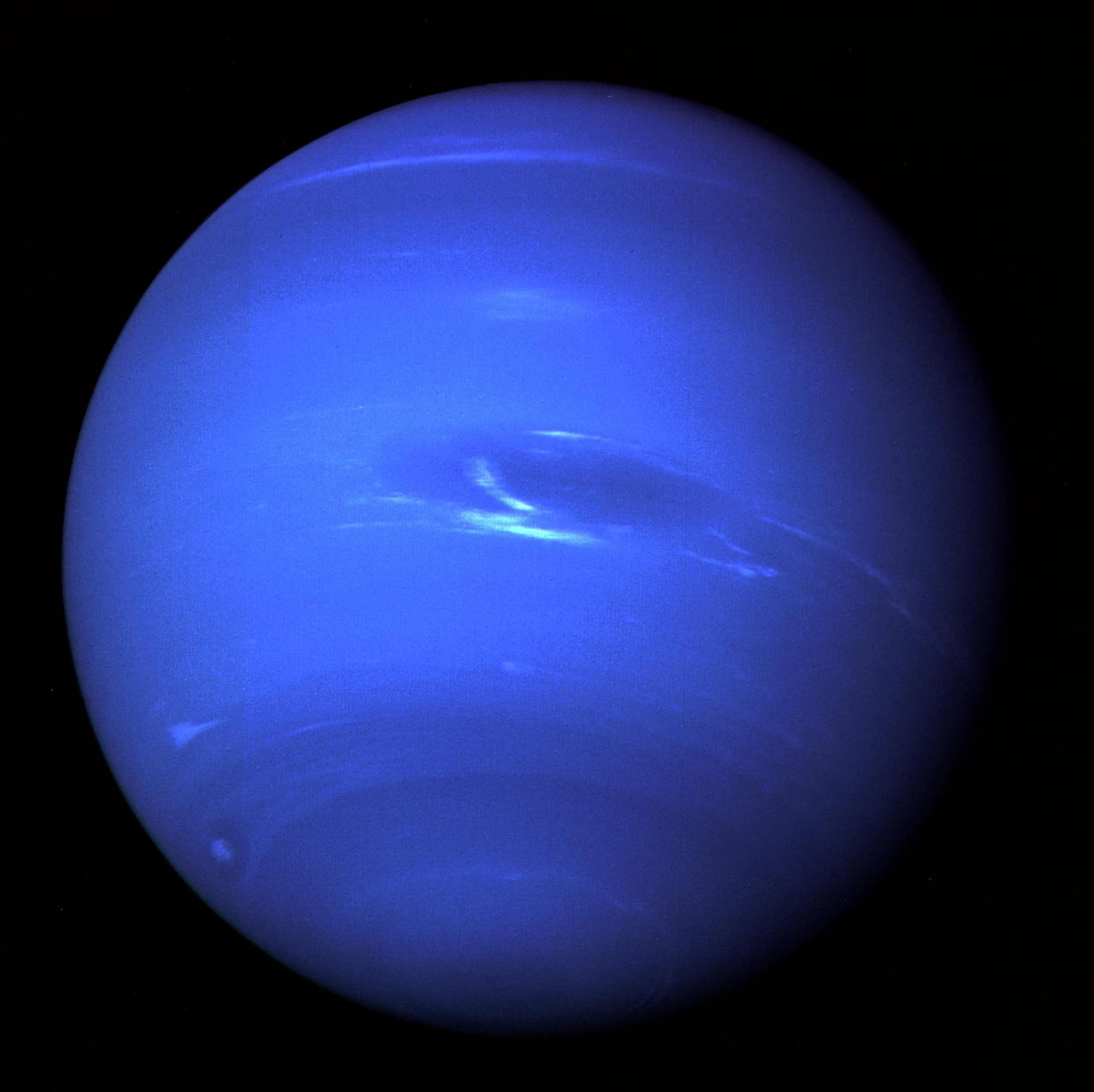
Observed, measured, modelled, open. What’s in the upper atmospheres of Uranus and Neptune is measured by spectroscopy. Their masses, sizes and densities are measured. Everything about their deep interiors, the hot fluid layers and small cores, is modelled from those measurements. Diamond rain is a hypothesis backed by lab experiments but never observed on either planet. How their strange magnetic fields form is still open.
Quick Answer: What Are Uranus and Neptune Made Of?
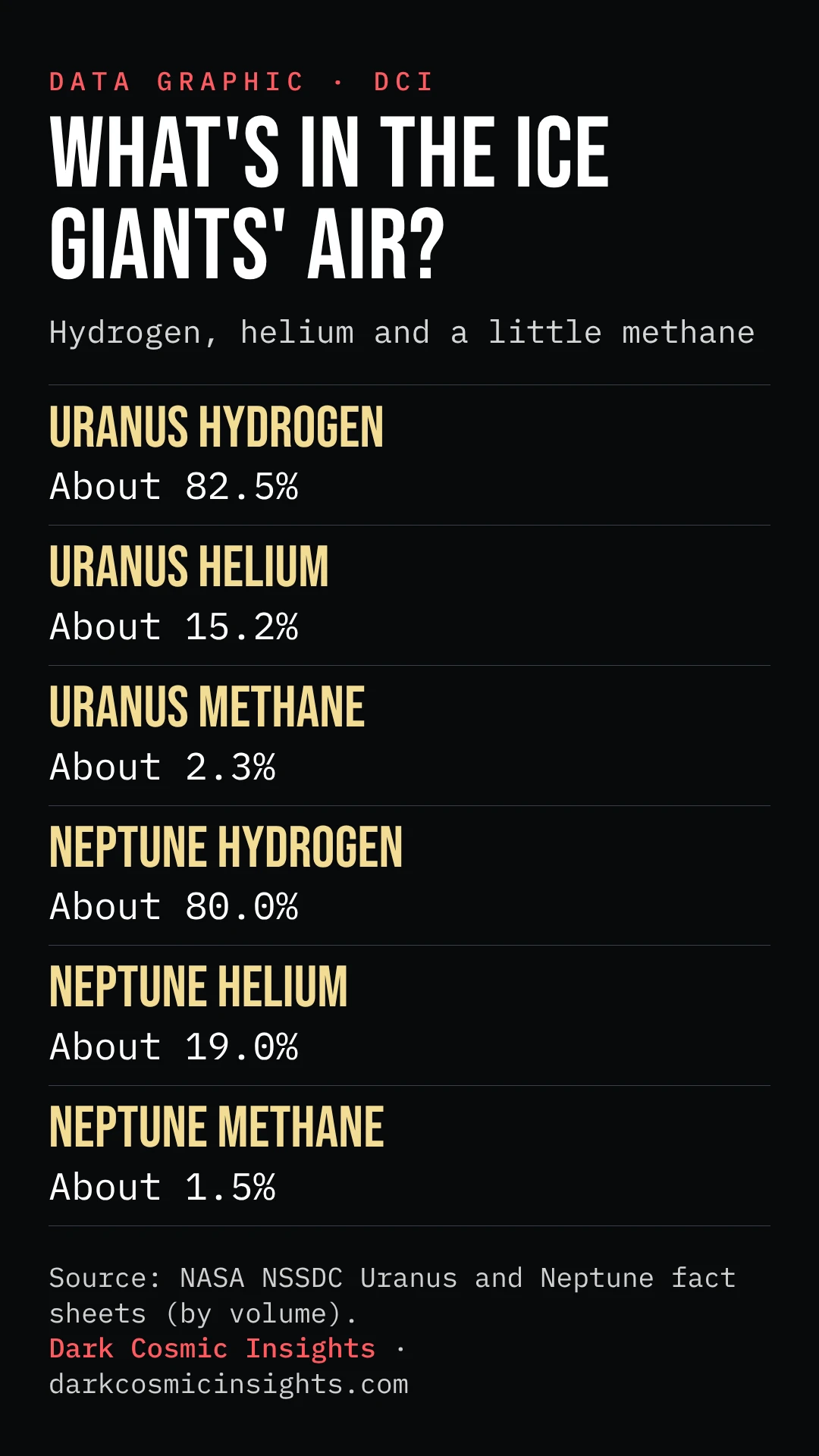
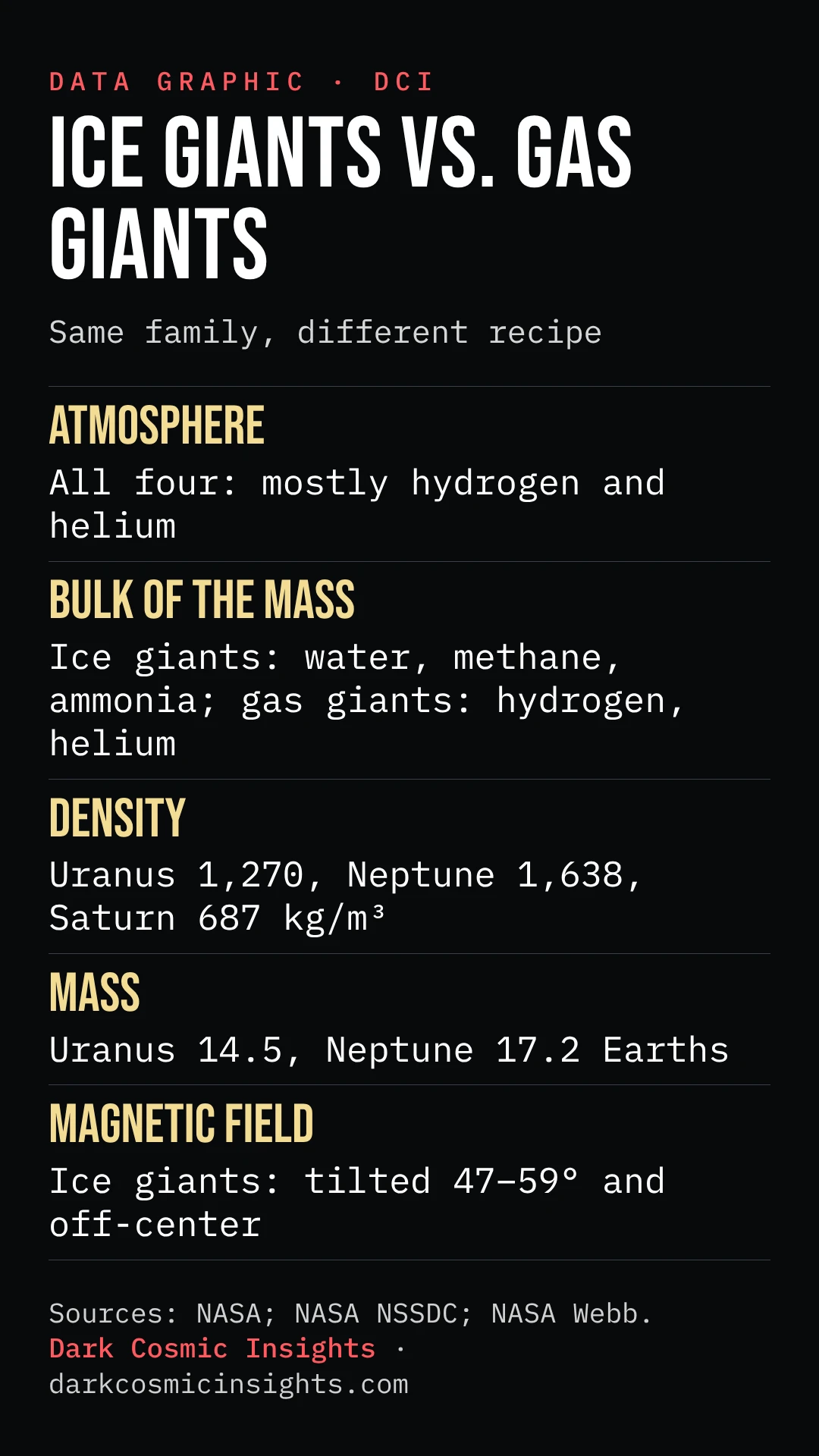
Their atmospheres are mostly hydrogen and helium with a little methane. NASA’s fact sheets list Uranus’s as about 82.5% hydrogen, 15.2% helium and 2.3% methane, and Neptune’s as about 80.0% hydrogen, 19.0% helium and 1.5% methane by volume (NASA NSSDC, Uranus; NASA NSSDC, Neptune). But that’s only the outer layer. NASA says 80 percent or more of each planet’s mass is “a hot dense fluid of ‘icy’ materials”, water, methane and ammonia, above a small rocky core (NASA; NASA). That’s why they’re called ice giants: they’re made largely of substances astronomers call “ices,” even though inside the planets those substances are hot and fluid.
What this article can and cannot establish. It can give you the measured makeup of Uranus’s and Neptune’s atmospheres, their measured masses and densities, and what scientists infer about their interiors. It cannot show you a picture of their insides. No probe has gone below the clouds of either planet. Any cutaway diagram of an ice giant, including ours, is a model, not a photograph.
Table of Contents
The DCI Evidence Map: Inside the Ice Giants
| Question | What we know | Status | Key source |
|---|---|---|---|
| What’s in their atmospheres? | Mostly hydrogen and helium, with 1.5–2.3% methane | Measured | NASA NSSDC |
| How dense are they? | 1,270 (Uranus) and 1,638 (Neptune) kg/m³ | Measured | NASA NSSDC |
| What makes up most of their mass? | A hot, dense fluid of water, methane and ammonia | Modelled | NASA |
| Do they have a solid core? | Probably a small rocky one | Modelled | NASA |
| Why are they blue? | Methane absorbs red light | Measured | NASA |
| Does it rain diamonds inside? | Lab experiments make diamonds; not seen on the planets | Modelled | SLAC, 2022 |
| How do their odd magnetic fields form? | Not settled | Open | NASA NSSDC |
Status key: Observed = seen directly. Measured = a number with a stated uncertainty or a direct measurement. Modelled = inferred from measurements through a physical model, dependent on assumptions. Open = unresolved; the evidence is incomplete or points different ways. Not supported = the evidence goes against the claim, or there is none for it.
Cite this framework: “DCI Evidence Map: Inside the Ice Giants,” Dark Cosmic Insights, November 2026, darkcosmicinsights.com/what-are-uranus-and-neptune-made-of/.
Why Are They Called Ice Giants?
Not because they’re frozen
In planetary science, “ices” means substances like water, methane and ammonia. They have much higher melting and boiling points than hydrogen and helium, so they freeze solid in the cold outer solar system where these planets formed. The name describes the ingredients, not their state today. Inside Uranus and Neptune, those “ices” are crushed under enormous pressure and heated to thousands of degrees.
Different from Jupiter and Saturn
NASA’s Webb team puts it simply: Uranus and Neptune are “nicknamed the ‘ice giants’ because their interiors are compositionally different from Jupiter and Saturn, which are richer in hydrogen and helium” (NASA Webb). Jupiter and Saturn are dominated by hydrogen and helium overall. Uranus and Neptune have a hydrogen-and-helium envelope wrapped around a much larger share of heavier material. We cover the gas giants in What Is Jupiter Made Of? and What Is Saturn Made Of?.
The least-explored kind of planet
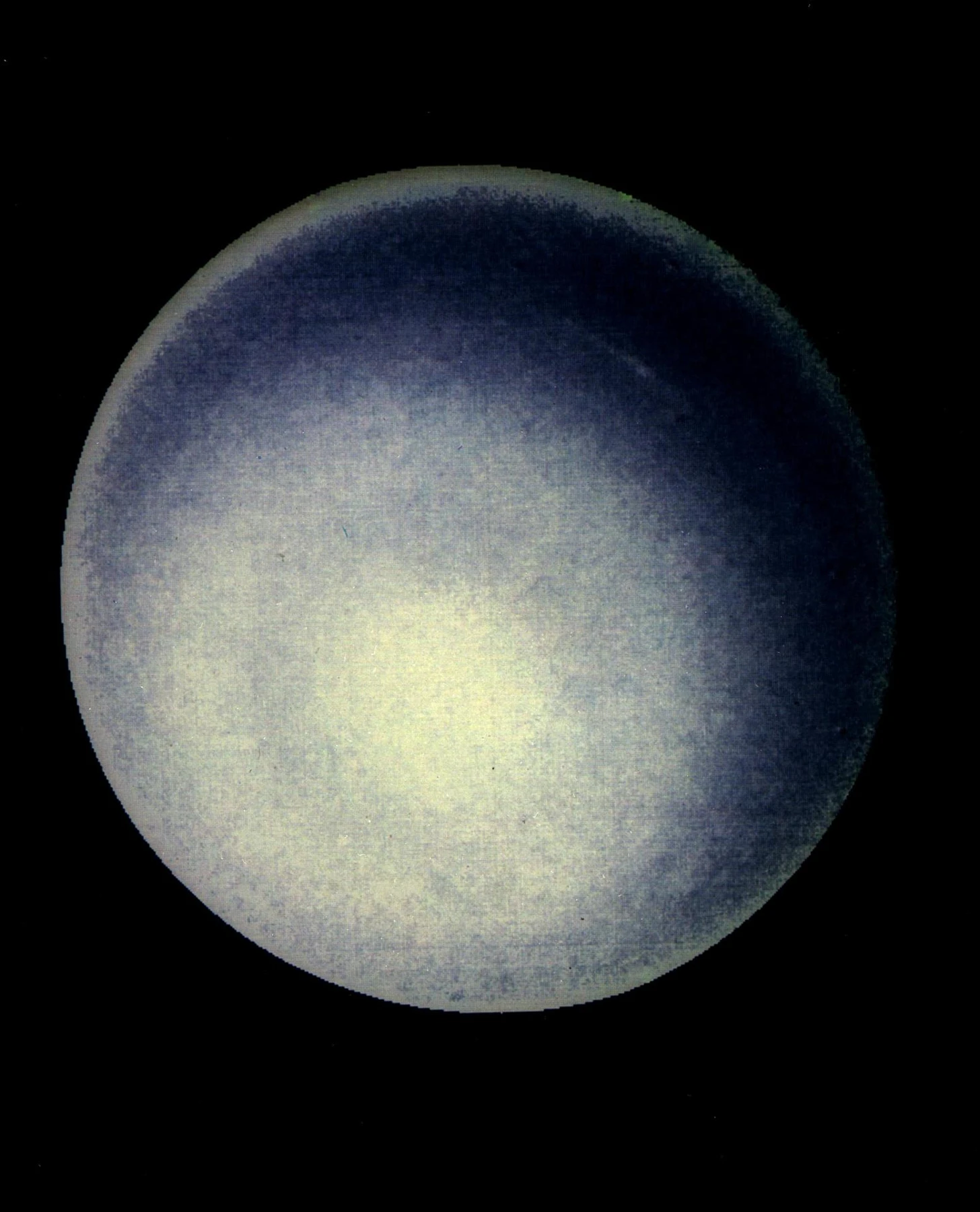
NASA calls the ice giants “the least-explored category of planet in our solar system” (NASA Webb). Voyager 2 flew past Uranus in 1986 and Neptune in 1989. No spacecraft has returned to either.
What’s in Their Atmospheres?
Mostly hydrogen and helium
The parts we can measure directly are the upper atmospheres, by splitting their light into a spectrum and reading which gases absorb which colors. NASA’s fact sheets give these compositions by volume (NASA NSSDC, Uranus; NASA NSSDC, Neptune):
- Uranus: molecular hydrogen about 82.5%, helium about 15.2%, methane about 2.3%, plus traces such as hydrogen deuteride.
- Neptune: molecular hydrogen about 80.0%, helium about 19.0%, methane about 1.5%, plus traces such as hydrogen deuteride and ethane.
The hydrogen and helium figures carry uncertainties of about 3 percentage points, so the two atmospheres are closer than the numbers might suggest.
Methane makes them blue
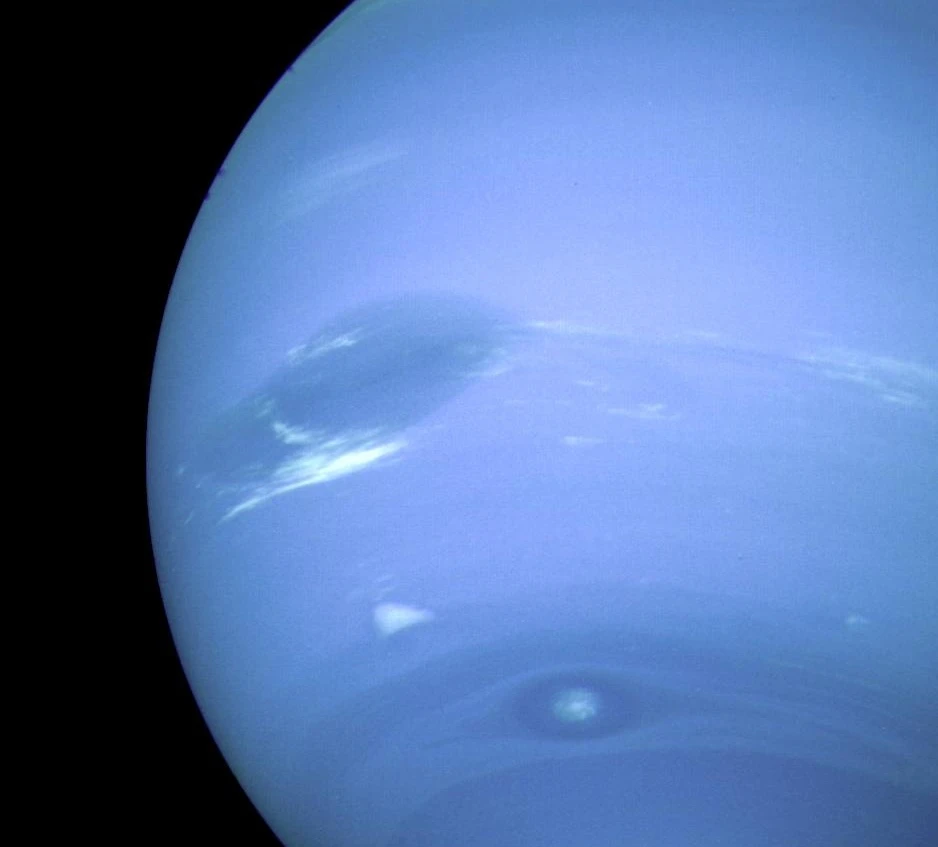
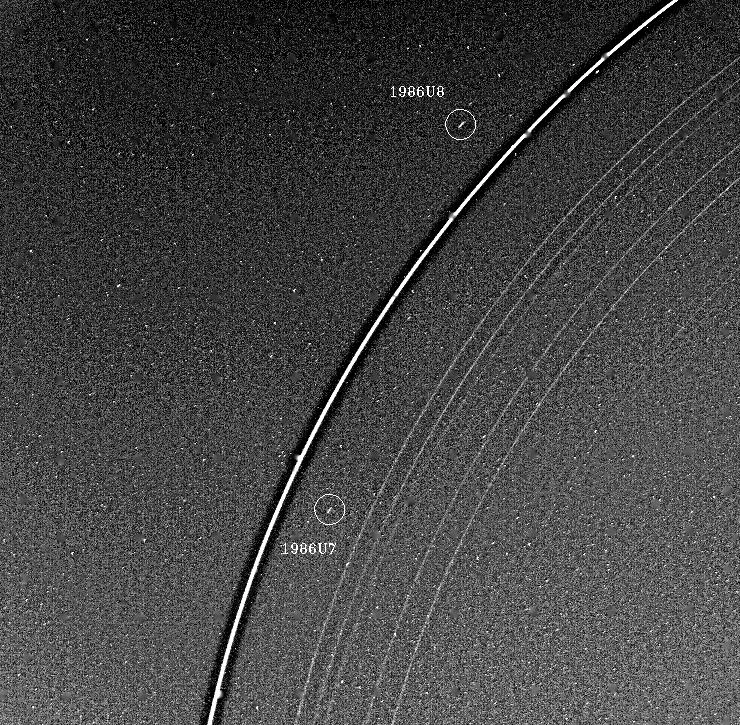
That small amount of methane matters a lot. NASA explains that methane gas “absorbs the red portion of the light, resulting in a blue-green color” (NASA). Both planets get their color this way. Why Neptune long looked so much bluer than Uranus is a story in itself, told in Why Is Neptune Blue?
A deeper soup
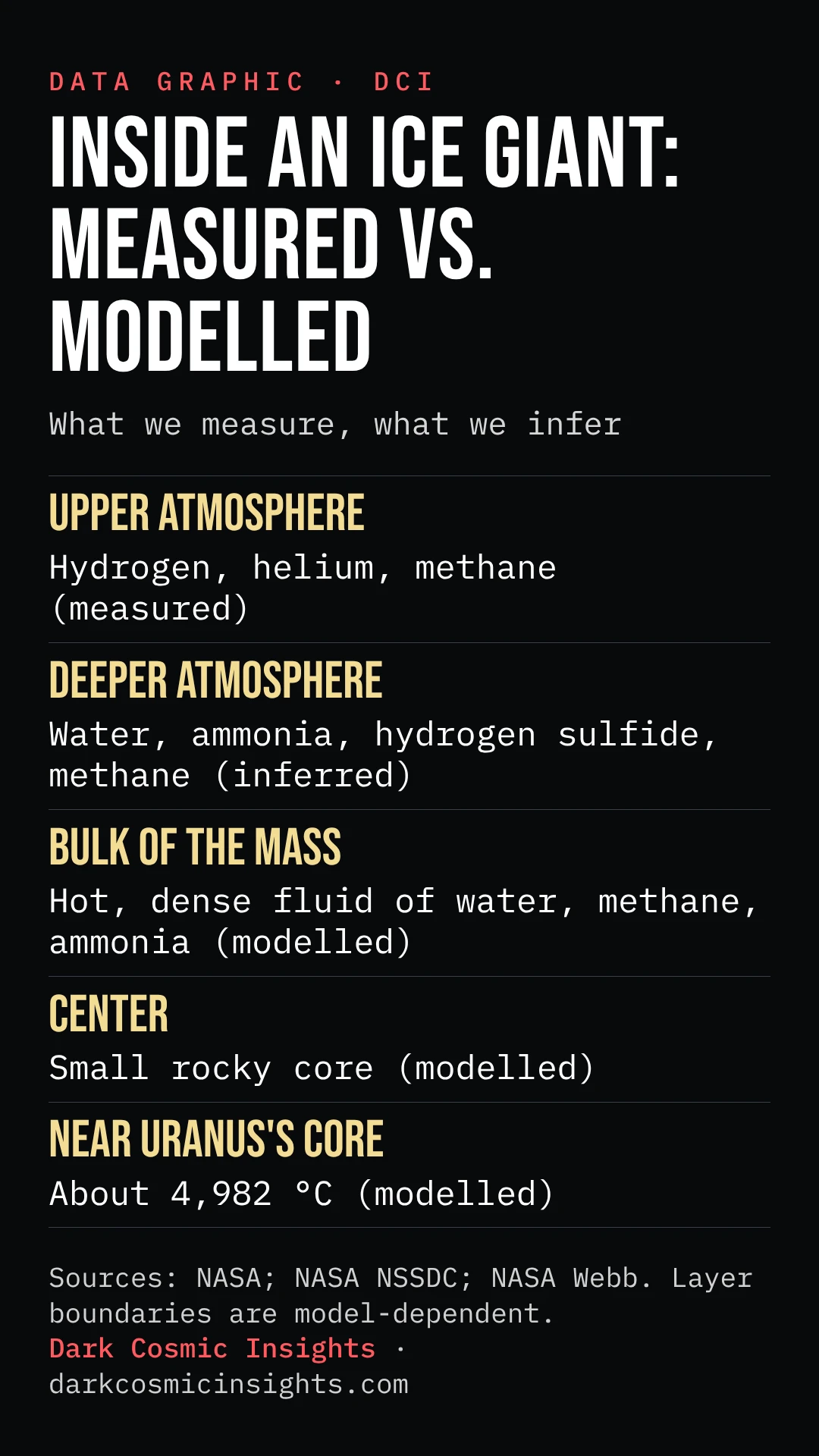
Below the visible clouds, the mix changes. NASA’s Webb team describes Neptune’s deep atmosphere as “a thick soup of water, ammonia, hydrogen sulfide and methane over an unknown and inaccessible interior” (NASA Webb). That “unknown and inaccessible” is worth keeping in mind for the rest of this article.
What’s Inside? What Scientists Infer
How you study an interior you can’t see
No probe has gone deep inside Uranus or Neptune. Scientists work backward from what they can measure: each planet’s mass, size, shape, spin, gravity field and heat output. They then build computer models of possible interiors and keep the ones that match. Everything in this section is modelled that way.
Density is the first clue
Density tells you a lot. NASA’s fact sheets give Uranus a mean density of 1,270 kg/m³ and Neptune 1,638 kg/m³ (NASA NSSDC, Uranus; NASA NSSDC, Neptune). Saturn, made mostly of hydrogen and helium, is only 687. Uranus and Neptune are smaller than Saturn, so their own weight squeezes them less, yet they’re denser. That means they must contain a lot of material heavier than hydrogen and helium.
Neptune is the denser of the two, and also slightly more massive: about 17.15 Earth masses, versus 14.54 for Uranus, even though it’s a little smaller (NASA NSSDC).
The middle layer: hot, dense, fluid “ices”
From models that match those numbers, NASA describes the bulk of each planet, 80 percent or more of its mass, as a hot, dense fluid of water, methane and ammonia (NASA; NASA). It isn’t a liquid ocean like Earth’s, and it isn’t ordinary ice. Under those pressures and temperatures, the mixture behaves in ways that don’t happen naturally on Earth, and some models include exotic high-pressure phases, such as possible superionic water, that are partly solid (SLAC, 2022). When NASA says there “might be an ocean of super hot water under Neptune’s cold clouds” (NASA), “ocean” is a loose word for this deep, hot fluid.
A small rocky core
At the center, models point to a small core of rock and metal. NASA’s facts pages describe the icy fluid sitting above a small rocky core in Uranus, and a solid core of roughly Earth’s mass in Neptune (NASA; NASA). NASA says it heats up to about 4,982 °C near Uranus’s core (NASA).
Why the layer boundaries are fuzzy
Diagrams usually show neat rings: gas, then “ice,” then rock. Real interiors probably blend gradually. Different models put the boundaries in different places, and some suggest the layers mix. Treat any ice giant cutaway as a simplified sketch of one model, not a map.
Does It Really Rain Diamonds on Uranus and Neptune?
The idea
You may have read that it “rains diamonds” inside the ice giants. Here’s where that comes from, and how sure anyone is. The idea is that deep inside, under crushing pressure, carbon from methane separates out and forms diamond, which then sinks through the hot fluid layers. SLAC National Accelerator Laboratory describes diamond rain as “a long-hypothesized exotic type of precipitation on ice giant planets” (SLAC, 2022).
What the lab showed
Scientists can’t visit, so they recreate the conditions on Earth. In an earlier experiment, a team used powerful lasers to shock a plastic made of hydrogen and carbon. One researcher said, “The earlier paper was the first time that we directly saw diamond formation from any mixtures” (SLAC, 2022).
In 2022, a team led by researchers at Helmholtz-Zentrum Dresden-Rossendorf and the University of Rostock, working with SLAC, repeated the test with PET plastic, which contains oxygen as well. They reported in Science Advances that tiny nanodiamonds formed, and that oxygen helped them form at lower pressures and temperatures than before (SLAC, 2022).
What hasn’t been shown
No one has seen diamonds inside Uranus or Neptune. The experiments recreate ice-giant conditions only briefly, in tiny samples. The researchers “predict” that diamonds on Neptune and Uranus would grow much larger (SLAC, 2022). That’s a prediction, not an observation. The honest label for diamond rain on the ice giants is hypothesis, supported by experiments.
Why Are Their Magnetic Fields So Strange?
Tilted and off-center
Voyager 2 found that both planets have lopsided magnetic fields. NASA’s fact sheets list Uranus’s magnetic field as tilted 58.6 degrees from its spin axis and offset from the planet’s center by about 35 percent of its radius; Neptune’s is tilted 46.9 degrees and offset by about 49 percent (NASA NSSDC, Uranus; NASA NSSDC, Neptune). Earth’s field, by contrast, is nearly centered and close to the spin axis.
A clue to the interior
One leading idea is that, because the fields are so off-center, they’re generated not deep in the core but in a shallower, electrically conducting layer within the hot, fluid “ices.” The 2022 SLAC study also reported tentative evidence that superionic water, a strange hot form of water that conducts electricity, might form under such conditions, which “could explain” the planets’ magnetic fields (SLAC, 2022). Exactly how the fields form is open.
Uranus vs. Neptune: Twins, Not Clones
The two ice giants are similar in size: NASA describes each as about four times wider than Earth (NASA; NASA). But they differ in ways that hint at different histories:
- Mass and density: Neptune is heavier and denser, packing more mass into a slightly smaller ball.
- Heat: Neptune “emits more than twice the energy it receives,” while a 2025 model-based study estimated Uranus’s total thermal output at only about 15 percent above the sunlight it absorbs (NASA, 2025; Irwin et al. 2025, MNRAS). We explore that in How Cold Is Uranus?
- Tilt: Uranus lies on its side at about 98 degrees; Neptune is tilted about 28. See Why Is Uranus Tilted?
Whether those differences come from how the planets formed, what hit them, or how their interiors are layered is still open.
Myth vs. Fact: What the Ice Giants Are Made Of
| Myth | Fact | Status |
|---|---|---|
| “Ice giants are giant balls of ice.” | Most of their mass is a hot, dense fluid; “ice” names the ingredients. | Modelled |
| “Uranus and Neptune are gas giants like Jupiter.” | They’re compositionally different: far more water, methane and ammonia. | Modelled |
| “It definitely rains diamonds on Neptune.” | Lab experiments make diamonds; it hasn’t been observed on the planets. | Modelled |
| “We’ve seen inside these planets.” | No probe has gone below their clouds; interiors are modelled. | Modelled |
| “They’re blue because of water.” | Methane absorbs red light, leaving blue-green. | Measured |
| “Their magnetic fields are like Earth’s.” | Both are steeply tilted and off-center. | Measured |
How Can You Explore the Ice Giants Yourself?
See their colors
Uranus is just visible to the naked eye under very dark skies and easy in binoculars with a sky app. Neptune needs binoculars or a telescope. Both show the blue-green tint of methane.
Compare the planets
Our Solar System Explorer puts all eight planets side by side, so you can see how the ice giants’ sizes, densities and distances compare with Jupiter and Saturn.
Learn the words
Terms like “ice giant,” “black-body temperature” and “albedo” are defined in plain English in our Space Glossary.
The Ice Giants by the Numbers
| Measure | Uranus | Neptune | Source |
|---|---|---|---|
| Atmosphere (H₂ / He / CH₄) | 82.5% / 15.2% / 2.3% | 80.0% / 19.0% / 1.5% | NASA NSSDC |
| Mass | 14.54 Earths | 17.15 Earths | NASA NSSDC |
| Mean density | 1,270 kg/m³ | 1,638 kg/m³ | NASA NSSDC |
| Equatorial radius (1 bar) | 25,559 km | 24,764 km | NASA NSSDC |
| “Icy” share of mass | 80% or more | 80% or more | NASA |
| Magnetic field tilt | 58.6° | 46.9° | NASA NSSDC |
| Near the core (model) | about 4,982 °C | Not given by NASA | NASA |
| Spacecraft visits | 1 (Voyager 2, 1986) | 1 (Voyager 2, 1989) | NASA |
Sources checked November 2026.
Ice Giants FAQ
What is Uranus made of?
Its atmosphere is mostly hydrogen and helium, with about 2.3 percent methane. But NASA says 80 percent or more of its mass is a hot, dense fluid of water, methane and ammonia above a small rocky core.
What is Neptune made of?
Much the same: an atmosphere of about 80 percent hydrogen, 19 percent helium and 1.5 percent methane over a hot, dense fluid of water, methane and ammonia that makes up most of its mass, with a solid core of roughly Earth’s mass at the center.
Why are Uranus and Neptune called ice giants?
Because they’re made largely of “ices,” the planetary-science term for water, methane and ammonia, rather than mostly hydrogen and helium like Jupiter and Saturn. Inside the planets, those ices aren’t ordinary frozen ice; models describe them as hot, dense fluids, possibly with exotic high-pressure phases.
Is there ice on Uranus and Neptune?
Not ordinary ice. Models describe their deep “icy” layers mainly as hot, dense fluids, though some include exotic high-pressure phases such as possible superionic water. Methane does freeze into clouds high in their cold atmospheres.
Does it rain diamonds on Neptune and Uranus?
It might, but no one knows. Lab experiments have created tiny diamonds from carbon-rich plastics under ice-giant-like conditions, and researchers predict diamonds could form and sink inside both planets. It has never been observed on either one.
Do Uranus and Neptune have a solid core?
Models suggest each has a small rocky core at the center. NASA describes Neptune’s as a solid core of roughly Earth’s mass. No measurement has confirmed either directly.
Does Neptune have an ocean?
NASA says scientists think there “might be an ocean of super hot water” under Neptune’s clouds. That “ocean” means the deep, hot, dense fluid layer, not a liquid sea with a surface like Earth’s.
Why are Uranus and Neptune blue?
Methane in their atmospheres absorbs red light, so the light they reflect is blue-green. Neptune’s deeper blue in older images is partly a processing story, which we explain in our guide to why Neptune is blue.
Your next step: next time you see a cutaway diagram of an ice giant, look for the label that says it’s a model. Then picture what it really is: hot, crushed water, methane and ammonia, wrapped in a cold blue-green sky.
Sources and Further Reading
- NASA Science, Uranus: Facts; Neptune: Facts.
- NASA Space Science Data Coordinated Archive, Uranus Fact Sheet; Neptune Fact Sheet.
- NASA Webb Mission Team, Examining Ice Giants With NASA’s Webb Telescope.
- SLAC National Accelerator Laboratory (September 2, 2022), Diamond rain on giant icy planets could be more common than previously thought, on He et al., Science Advances.
- NASA (July 17, 2025), NASA, Oxford Discover Warmer Uranus Than Once Thought.
- NASA Science, Voyager 2.
- NASA images: PIA01492, PIA00049, PIA01488, PIA01976, PIA00370.
Explore Next
- Why Neptune looks so blue: Why Is Neptune Blue?
- The gas giants, for comparison: What Is Jupiter Made Of? and What Is Saturn Made Of?
- Uranus’s moons: How Many Moons Does Uranus Have?
- Neptune’s moons: How Many Moons Does Neptune Have?
- Every planet in one place: Solar System Explorer
- How a claim earns its label: How We Know
How This Explainer Was Checked
Every number and quote in this article was checked in November 2026 against the source linked beside it: NASA’s Uranus and Neptune facts pages, NASA’s Uranus and Neptune fact sheets, NASA’s Webb page on the ice giants, SLAC’s 2022 release on the diamond rain experiments, NASA’s 2025 release on Uranus’s heat, NASA’s Voyager 2 page and NASA’s image pages. Atmospheric composition, mass, density and magnetic-field geometry are labelled Measured. The interior layers, the core and the core temperature are labelled Modelled. Diamond rain is labelled a hypothesis supported by experiments, not an observation. How the magnetic fields form is labelled Open. Magnetic offsets as percentages of radius and Earth comparisons are DCI calculations from NASA’s fact sheets. Images are labelled: real spacecraft images as OBSERVATION, our charts as DATA GRAPHIC. No cutaway is presented as an observed view of an interior.
Final Thought: Hot Hearts, Cold Names
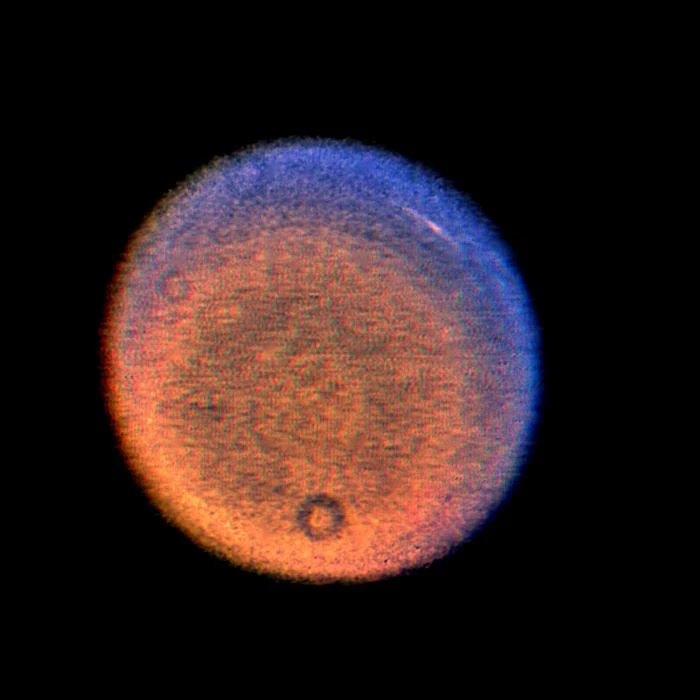
“Ice giant” is one of astronomy’s most misleading names. Uranus and Neptune aren’t frozen worlds; they’re hot, crushed mixtures of water, methane and ammonia hidden under cold blue skies. We know their atmospheres from their light and their bulk from their weight. Everything deeper is our best reconstruction, built from one flyby each, nearly 40 years ago. That’s exactly why these two planets are some of the most exciting places left to explore.
About the Author
Author: King | Founder of Dark Cosmic Insights