Some ancient statues look like plain, bare stone. Shine a red light on them, look through a camera that sees infrared, and tiny specks start to glow like stars on a night sky. That glow is the fingerprint of Egyptian blue, the oldest known synthetic pigment, and it’s showing scientists color that faded from human eyes centuries ago.
The Egyptian blue infrared glow is invisible to us, yet it’s strong enough to pick out single grains of pigment on a 2,400-year-old marble sculpture. It has revealed painted patterns on the Parthenon, mapped a luxury shrine in Pompeii, and even caught Raphael copying the ancients.
This guide explains what Egyptian blue is, how it was made, why it glows, and how researchers use that glow to find lost paint. As always at Dark Cosmic Insights, we keep three things separate: what has been observed on real objects, what has been measured in the lab, and what is still open or debated.
In this guide
- Quick Answer: Why Does Egyptian Blue Glow in Infrared?
- The DCI Egyptian Blue Evidence Map
- What Is Egyptian Blue?
- How Was Egyptian Blue Made?
- When Was Egyptian Blue Invented?
- Why Did the Recipe Disappear?
- Why Does Egyptian Blue Glow?
- Egyptian Blue Infrared Imaging: How VIL Works
- How Do Scientists Confirm It’s Really Egyptian Blue?
- Were Greek Statues Painted?
- Pompeii’s Blue Room: How Much Did the Color Cost?
- Raphael’s Secret Ancient Blue
- Myth vs Fact: Were Ancient Statues Meant to Be White?
- What the Glow Can and Can’t Prove
- Where Can You See Egyptian Blue?
- Egyptian Blue’s Modern Future
- What Comes Next
- Egyptian Blue by the Numbers
- FAQ
- Sources and Further Reading
- Keep Exploring
Quick Answer: Why Does Egyptian Blue Glow in Infrared?
Quick Answer: Egyptian blue is a man-made pigment, calcium copper silicate (CaCuSi₄O₁₀), first made in Egypt more than 5,000 years ago. When visible light hits it, especially red light, it re-emits some of that energy as near-infrared light peaking near 910 nanometres, which human eyes can’t see. A camera that blocks visible light and records infrared shows even microscopic grains as bright white spots. This method, called visible-induced luminescence (VIL) imaging, lets scientists find faded paint without touching the object.
What this article can and cannot establish: We can explain the chemistry and the imaging method, and show what they have found on real objects, with sources. We cannot tell you exactly how every ancient workshop made the pigment, because direct archaeological evidence of production is rare. And a glow alone is a strong clue, not final proof: researchers confirm it with other tests, as we explain below.
The DCI Egyptian Blue Evidence Map
Not every claim about Egyptian blue is equally solid. This map sorts the big questions by how well they’re supported.
| Question | What we know | Status | Key source |
|---|---|---|---|
| What is it made of? | Calcium copper silicate crystals (cuprorivaite) plus glass and leftover quartz | Measured | X-ray diffraction studies; Mazzi & Pabst 1962 |
| When was it first made? | Earliest known example about 3250 BCE | Observed | Corcoran 2016 (MFA Boston bowl) |
| How was it made? | Sand, lime, copper and an alkali fired at roughly 850–1000 °C | Measured · Modelled | Vitruvius; McCloy et al. 2025 |
| Why does it glow? | Copper ions in its layered crystal emit near-infrared light | Measured | Accorsi et al. 2009 |
| How strong is the glow? | 10.5% efficiency measured in 2009; near 100% in very thin layers | Measured | Berdahl et al. 2018 |
| Were the Parthenon sculptures painted? | Yes: Egyptian blue, white and purple traces found | Observed | Verri et al. 2023, Antiquity |
| Does a glow prove Egyptian blue? | No: Han blue and Han purple glow too | Not supported alone | Verri 2009 |
| Why did the recipe fade from use? | Cost, trade and taste are suggested; no single cause is proven | Open | Nicola et al. 2023 review |
Status key: Observed = seen directly on real objects; Measured = quantified in the lab; Modelled = reconstructed from experiments and assumptions; Open = still debated; Not supported alone = can’t be concluded from that evidence by itself.
Cite this framework: Dark Cosmic Insights, “Egyptian Blue Evidence Map,” darkcosmicinsights.com, 2026.
The paint faded from our eyes long ago. It never stopped glowing.
What Is Egyptian Blue?
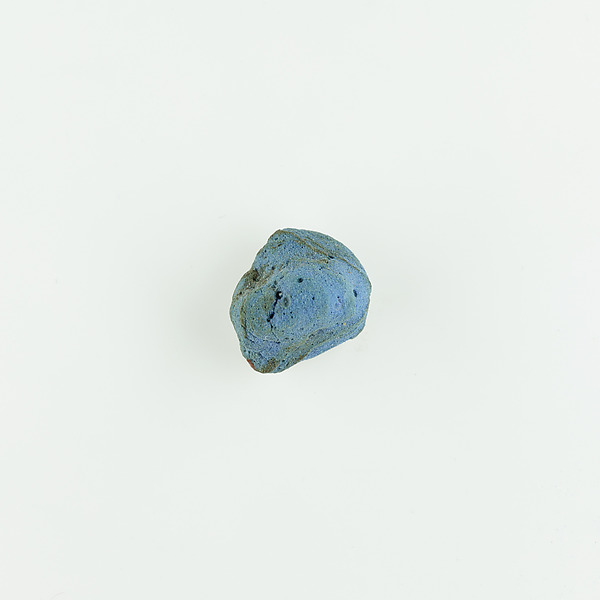
Most ancient pigments were dug out of the ground: red and yellow ochres, black from charcoal, green from crushed malachite. Egyptian blue was different. It was made. Craftspeople mixed common materials, fired them in a furnace and created a substance that barely exists in nature. That’s why it’s often called the world’s first synthetic pigment (The Met).
Chemically, its color comes from calcium copper silicate, CaCuSi₄O₁₀. There is a natural mineral with the same formula, called cuprorivaite, but it’s so rare and found in such tiny amounts, for example around Vesuvius in Italy, that it was never a practical source of paint. Ancient artists had to manufacture their blue.
Why go to the trouble? Blue was precious. The natural blue stones Egyptians loved, lapis lazuli and turquoise, were rare, imported and expensive. A manufactured blue gave artists a steady supply for wall paintings, statues, coffins, jewellery and small molded objects (WSU, 2025).
For the bigger story of how Egyptian artists used red, green, gold and black as well as blue, see our sister site’s guide to the colors of ancient Egypt. Here, we focus on the blue, and the hidden glow that makes it so useful to science.
How Was Egyptian Blue Made?
The basic recipe uses four ingredients, all available in ancient Egypt:
- Quartz sand, for silica
- Lime (calcium carbonate), often already present in the sand
- A copper source: copper ore, scrap metal or filings
- An alkali flux such as natron or plant ash, which helps the mix react
These were heated together for hours in a furnace. Inside, the copper, calcium and silica combine into blue crystals, surrounded by glassy material and grains of leftover quartz. The result was a hard blue “cake” or pellets, which were then ground into powder and mixed with a binder to make paint.

A narrow window
The process sounds simple, but it’s easy to get wrong. If the furnace is too cool, little blue forms. If it’s too hot, the blue crystals break down into glass. Most researchers think ancient makers worked at roughly 850–950 °C, which takes real skill with a wood or charcoal fire.
In 2025, a team led by Washington State University recreated 12 different recipes, firing them at about 1,000 °C for between 1 and 11 hours and cooling them at different rates. Small changes in ingredients and timing produced very different blues, and the bluest samples needed only about half of the material to be the blue compound itself (McCloy et al., npj Heritage Science, 2025). Ancient Egyptian blue, they found, is highly varied: different workshops produced different shades.
Grain size changes the color
How finely the cake was ground mattered too. Coarse grains look deep blue, while finely ground pigment looks paler. On the Parthenon and the Propylaea in Athens, a 2025 study found grains from about 15 to 110 micrometres across, most often around 50–80 micrometres, the size that gives a dark blue (Aggelakopoulou et al., Journal of Raman Spectroscopy, 2025).
The Roman recipe
The Roman architect Vitruvius, writing in the 1st century BCE, left the only detailed ancient description. He called the pigment caeruleum and wrote that the recipe was first discovered in Alexandria, and that a man named Vestorius later began making it at Puteoli, near Naples. His version: grind sand with copper filings and natron, roll the paste into balls, dry them and fire them in a furnace (RSC Education). He gives no quantities or temperatures, which is one reason modern experiments are still needed.
When Was Egyptian Blue Invented?
For a long time, textbooks dated Egyptian blue to Egypt’s Fourth Dynasty, the age of the great pyramids, around 2500 BCE. Then, in 2016, Egyptologist Lorelei H. Corcoran of the University of Memphis identified it on a small alabaster bowl in the Museum of Fine Arts, Boston. The bowl came from the early site of Hierakonpolis and is dated to about 3250 BCE. Its incised early hieroglyphs are filled with blue that the MFA’s lab confirmed as Egyptian blue (University of Memphis).
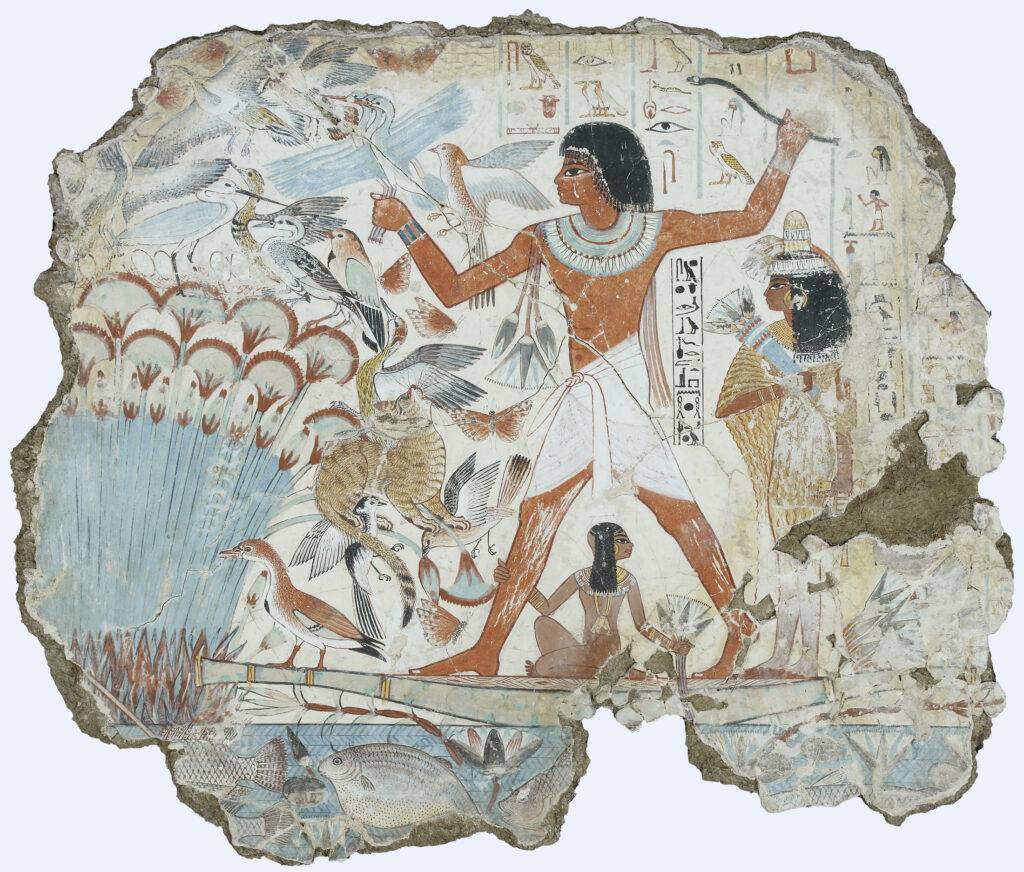
That pushed the invention back to the very dawn of Egyptian history, and made Egyptian blue the oldest known man-made pigment. From there, it spread. It appears across Egypt, Mesopotamia and Persia, and became the standard blue of the Greek and Roman world. In Egypt and Mesopotamia in the 2nd millennium BCE, it was essentially the only blue pigment in use.

Why Did the Recipe Disappear?
After the Roman era, Egyptian blue faded from common use. The scholar Isidore of Seville mentioned it in his encyclopedia, the Etymologiae, in the early 7th century, and after that written records go quiet (RSC Education). Medieval painters turned to other blues, such as costly ultramarine made from lapis lazuli, and plant-based indigo.
Why it declined is still an open question. Possible factors include the collapse of Roman trade networks and workshops, the skill needed to fire it correctly, and changing tastes. No single cause has been proven.
“Lost” is also too strong a word. Scientists keep finding Egyptian blue in places it “shouldn’t” be. It has turned up in early medieval paintings, and, most surprisingly, in Renaissance art. As one conservator told a Harvard workshop in 2026, the old idea of a firm end date for the pigment “is not true” (Harvard Gazette).
How chemists rediscovered it
Interest returned in the early 19th century. In 1815, the English chemist Sir Humphry Davy analyzed ancient pigments from Rome and Pompeii and described Egyptian blue’s ingredients (Davy, Philosophical Transactions, 1815). In 1889, the French chemist Ferdinand Fouqué worked out its composition, and in the 20th century X-ray studies confirmed it has the same crystal structure as the natural mineral cuprorivaite.
Why Does Egyptian Blue Glow?
Many materials absorb light. What makes Egyptian blue special is what happens next. Inside its crystals, each copper ion sits locked in a flat, square arrangement between layers of silicate. When visible light, especially red light, hits the crystal, the copper ions absorb some of that energy. Instead of losing it all as heat, they release part of it again as light, at longer wavelengths in the near-infrared.
This process is called luminescence. The emitted light peaks near 910 nanometres. Human vision stops at about 700 nm, so the glow is completely invisible to us, no matter how bright it is.

An unusually strong, long glow
In 2009, a team including the chemists Gianluca Accorsi and Nicola Armaroli and the conservation scientist Giovanni Verri measured the glow precisely. They found an emission efficiency of 10.5% and an excited-state lifetime of about 107 microseconds, meaning the glow lingers for about a ten-thousandth of a second after the light hits (Accorsi et al., Chem. Commun., 2009). For a pigment, both numbers are exceptional.
Later work showed the glow can be even stronger. In 2018, researchers at Lawrence Berkeley National Laboratory found that in very thin layers, Egyptian blue can emit nearly 100% as many infrared photons as it absorbs, about ten times more than previously thought. In thicker layers some light is reabsorbed, but the glow is still powerful (Berdahl et al., Journal of Applied Physics, 2018).
Just as important, very few other materials found on ancient objects glow this way. Most pigments, stone and plaster stay dark in the near-infrared. That contrast is what makes Egyptian blue so easy to spot.
Egyptian Blue Infrared Imaging: How VIL Works
The technique that turns this glow into a map is called visible-induced luminescence imaging, or VIL. It was developed by conservation scientist Giovanni Verri, then at the British Museum and now at the Art Institute of Chicago, and published in 2009 (Verri, Analytical and Bioanalytical Chemistry, 2009).

1. Light it
Shine visible light, often red light or LEDs that give off almost no infrared of their own, onto the object.
2. Block what you don’t want
Put a filter on the camera that blocks visible light and lets only near-infrared through.
3. Record the infrared
Use a camera that’s sensitive to near-infrared. Many ordinary digital camera sensors can see it once their built-in infrared-blocking filter is removed.
4. Read the image
Anything containing Egyptian blue shows up bright white against a dark gray or black background. A single grain, too small to see by eye, can appear as a clear dot of light.
The big advantage is that VIL is non-invasive. Nobody has to scrape a sample off a priceless object, and a whole statue or wall can be scanned in a few shots. That’s why it has become a standard first step in studying ancient color.
If this sounds familiar, it’s the same basic idea astronomers use with infrared telescopes: an invisible wavelength reveals what ordinary light hides. See Hubble vs. Webb for how that plays out in space, and Are Space Photos Real? for how scientists turn invisible light into images we can see.
Night-vision goggles join the toolkit
In 2024, a team led by Marco Nicola of the University of Turin showed that modified night-vision goggles, fitted with a filter that blocks visible light, can spot Egyptian blue in real time. They tested them at the Museo Egizio in Turin, in Nero’s Domus Aurea in Rome and on Raphael’s frescoes at the Villa Farnesina (Nicola et al., Rendiconti Lincei, 2024). A later study priced such goggles at about $90–100, which puts a first look within reach of almost any museum or dig (Quraishi et al., 2026).
How Do Scientists Confirm It’s Really Egyptian Blue?
A bright spot in a VIL image is a strong clue, but it isn’t proof by itself. Two related pigments made in ancient China, Han blue (BaCuSi₄O₁₀) and Han purple (BaCuSi₂O₆), glow in the near-infrared too, because they share a similar copper-silicate structure (Verri 2009). Stray infrared from sunlight or lamps can also confuse an image if it isn’t controlled.
So researchers back up VIL with other methods, usually on the spots VIL has flagged:
- Microscopy, to see the shape of the blue crystals
- X-ray fluorescence (XRF), to detect elements such as copper and calcium
- Raman spectroscopy, which identifies the crystal’s exact molecular “fingerprint”
- Electron microscopy (SEM-EDX), to map the chemistry of individual grains
Even then, care is needed. A copper signal on its own doesn’t prove Egyptian blue, since other copper pigments exist. Interestingly, Egyptian green, a related copper-bearing glass made from similar ingredients, does not show the same glow (McCloy et al. 2025). The glow is specific to the blue crystal.
Questions about when something was painted need different tools entirely, such as radiocarbon dating for organic material in a binder. We explain what that method can and can’t date in Old Carbon in New Water.
Were Greek Statues Painted?
The image of gleaming white marble is one of the most famous in art history. It’s also, in large part, a modern misunderstanding. Paint wears away over thousands of years of weather, burial and cleaning, leaving bare stone. VIL has become one of the best tools for proving the color was once there.
The Parthenon sculptures
The Parthenon’s sculptures were carved between about 447 and 432 BCE. Many are now in the British Museum, where scholars had studied them for centuries. As lead researcher Giovanni Verri put it, “no traces of colour have ever been found” on them (King’s College London).
Then a team from the British Museum, King’s College London and the Art Institute of Chicago scanned them with VIL. They found Egyptian blue, plus gypsum, probably bone white and a purple organic colorant (Verri et al., Antiquity, 2023). News reports on the study said paint traces turned up on 11 of the 17 figures examined, along with part of the frieze.
The blue wasn’t just splashed on. On one seated goddess, known as East Pediment figure L, it outlined a complex woven figural design on her mantle: a patterned textile, carved in stone and finished in paint. The researchers concluded that carving and color were planned together.
Work in Athens points the same way. A 2025 study of the Parthenon and the Propylaea found Egyptian blue used for whole painted areas and for ornamental patterns such as a double meander, much of it hidden under centuries of crusts and patina (Aggelakopoulou et al. 2025).
Pompeii’s Blue Room: How Much Did the Color Cost?
In 2024, archaeologists at Pompeii uncovered a small room whose walls were painted an intense blue, decorated with female figures representing the seasons, agriculture and sheep farming. The site interpreted it as a sacrarium, a shrine for rituals and sacred objects, buried by Vesuvius in 79 CE.
Researchers from MIT, the University of Turin and the Pompeii Archaeological Park confirmed the blue was Egyptian blue, using modified night-vision goggles. Because ambient daylight couldn’t be shut out on site, they took two images, one in natural light and one under LED light, and subtracted one from the other to isolate the pigment’s glow (Quraishi et al., npj Heritage Science, 2026).
Then they did something unusual: they estimated the price. They calculated that roughly 6 to 10 pounds of pigment covered about 20 square metres (about 215 square feet) of wall. Using prices recorded by Pliny the Elder, they put its cost at about 93 to 168 denarii, before paying for labor. Press coverage compared that to more than half a Roman foot soldier’s yearly pay. The team suggests the choice says less about cheap pigment and more about a very wealthy household.
Raphael’s Secret Ancient Blue
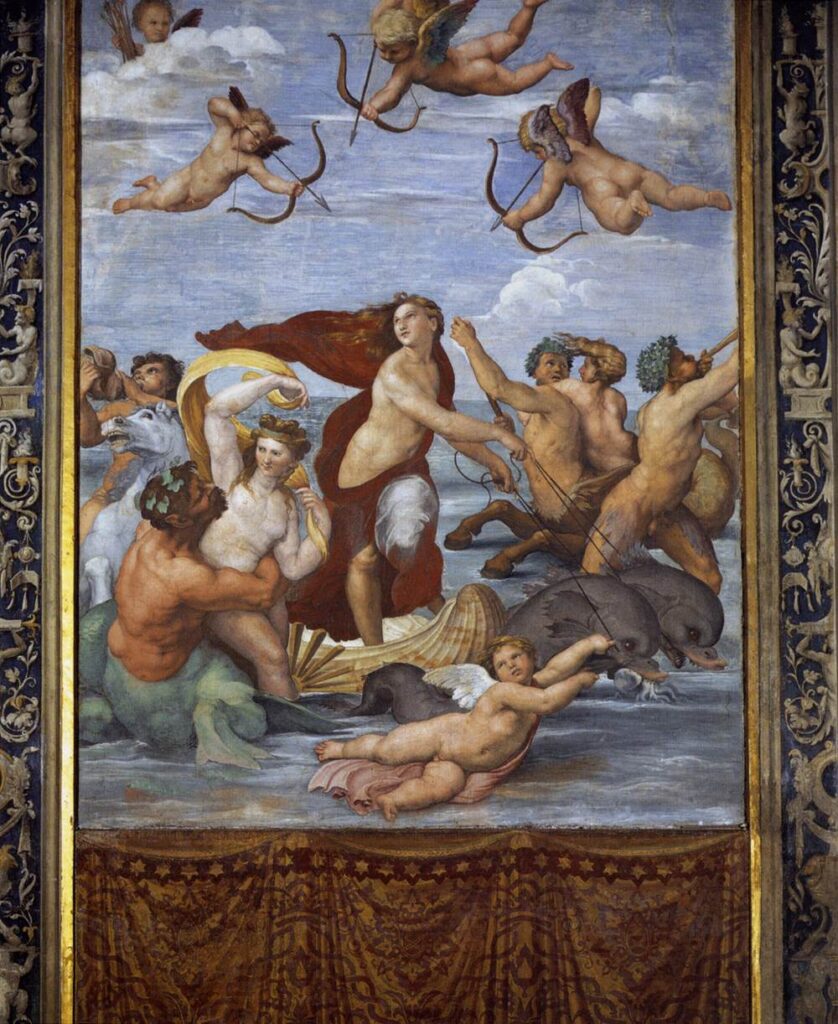
The most surprising find came from the Renaissance. In 2020, scientists studying Raphael’s fresco Triumph of Galatea (about 1512) at the Villa Farnesina in Rome found Egyptian blue in the sky, the sea and the eyes of the nymph Galatea, more than a thousand years after the pigment supposedly disappeared (Villa Farnesina).
Where did Raphael get it? That’s still open. The researchers see it as a sign of his passion for the ancient world and a wish to use its materials. In 2025, the same night-vision approach found Egyptian blue in works by Perugino, Raphael’s teacher, and by the painter known as “Lo Spagna” in the Louvre (Rendiconti Lincei, 2025).
Myth vs Fact: Were Ancient Statues Meant to Be White?
Myth: Classical sculptors preferred pure white marble
Fact: Many Greek and Roman sculptures were painted, sometimes richly. VIL has found Egyptian blue on the Parthenon sculptures and many others. The “white” look comes largely from paint that wore away, and from Renaissance and later artists who admired the bare stone they found.
Myth: Egyptian blue is a natural mineral
Fact: It was manufactured. Its natural twin, cuprorivaite, is far too rare to have supplied ancient painters.
Myth: If a statue doesn’t glow, it was never painted
Fact: VIL only finds Egyptian blue and a few related pigments. Reds, yellows, blacks and most other colors don’t glow, and paint may have been lost completely. No glow means no Egyptian blue was detected, not that the object was bare.
Myth: The recipe was lost for good after Rome
Fact: Its use declined sharply, but it appears in early medieval and Renaissance works, and chemists have been remaking it since the 19th century.
What the Glow Can and Can’t Prove
| The glow CAN tell you | The glow CAN’T tell you on its own |
|---|---|
| Where Egyptian blue is likely present, even in microscopic amounts | For certain that it’s Egyptian blue: Han blue and Han purple glow too |
| Hidden patterns or painted areas invisible to the eye | When the paint was applied, or whether it’s original or a later restoration |
| Where to take a sample, if one is needed | What other colors were there: most pigments don’t glow |
| That an object was painted at least in places | That an object without a glow was never painted |
Researchers treat VIL as a map that tells them where to look, then confirm with laboratory techniques. That combination is what makes the findings trustworthy.
Where Can You See Egyptian Blue?
You don’t need a lab to see Egyptian blue in person. Many major museums display objects painted with it:
- The British Museum, London: the Parthenon sculptures and the Nebamun tomb paintings
- The Metropolitan Museum of Art, New York: Egyptian galleries, including raw lumps of the pigment
- Museo Egizio, Turin: one of the world’s great Egyptian collections, studied with VIL goggles
- Villa Farnesina, Rome: Raphael’s Triumph of Galatea
- Pompeii Archaeological Park, Italy: Roman wall paintings in their original setting
Can you image it yourself?
In principle, yes. Hobbyists use cameras converted to see infrared, fitted with a filter that blocks visible light, and light the subject with LEDs that give off little infrared. Art suppliers sell modern Egyptian blue pigment, which makes a safe test target. Never shine lights on museum objects or touch them without permission: the professionals work with the museum’s approval and careful lighting.
Egyptian Blue’s Modern Future
The same glow that helps archaeologists is attracting engineers, doctors and forensic scientists:
- Fingerprints: in 2016, a team of forensic chemists showed that finely ground Egyptian blue works as a fingerprint dusting powder. The prints glow in infrared, which helps on patterned or shiny surfaces where ordinary powders fail (Errington et al., Dyes and Pigments, 2016).
- Cooler buildings: Berkeley Lab researchers say surfaces coated with Egyptian blue stay cooler in sunlight because they shed energy as infrared light, and that windows tinted with it could help produce solar power (Berkeley Lab, 2018).
- Medical and lab imaging: Egyptian blue can be split into sheets just a few nanometres thick that still glow in the near-infrared, a range where light passes well through tissue (Selvaggio et al., Nanoscale Advances, 2021).
- Security inks and physics: its glow suits anti-counterfeit inks, and its chemistry resembles that of some high-temperature superconductors (WSU, 2025).
What Comes Next
- Cheaper, faster surveys: low-cost VIL goggles mean many more museums and excavations can check objects for Egyptian blue on the spot, then send the best candidates for lab confirmation.
- More Renaissance surprises: after Raphael and Perugino, researchers are checking other Renaissance paintings for an ancient blue that wasn’t supposed to be there.
- Workshop detective work: studies like the 2025 WSU recipes help match ancient pigments to how they were made, which could reveal where and how workshops operated.
- Pompeii’s ongoing digs: new excavations keep uncovering painted rooms, now routinely checked with infrared tools.
Egyptian Blue by the Numbers
- Formula: CaCuSi₄O₁₀ (calcium copper silicate)
- Earliest known use: about 3250 BCE (Hierakonpolis bowl)
- Firing temperature: roughly 850–1,000 °C (about 1,560–1,830 °F)
- Peak infrared glow: about 910 nanometres
- Human vision ends at: about 700 nanometres
- Glow lifetime: about 107 microseconds (2009 measurement)
- Emission efficiency: 10.5% (2009); near 100% in very thin layers (2018)
- Parthenon sculptures carved: about 447–432 BCE
- Pompeii Blue Room pigment: about 6–10 pounds (2.7–4.5 kg) over about 20 m² (215 sq ft)
- Modified VIL goggles: about $90–100
FAQ
What is Egyptian blue made of?
Egyptian blue is calcium copper silicate, CaCuSi₄O₁₀. It was made by heating quartz sand, lime, a copper source and an alkali such as natron to roughly 850–1,000 °C. The finished pigment also contains glassy material and leftover quartz.
Why does Egyptian blue glow in infrared?
Copper ions locked inside its layered crystal absorb visible light, especially red light, and re-emit part of that energy as near-infrared light peaking near 910 nanometres. Our eyes can’t see past about 700 nanometres, so the glow is invisible to us but clear to an infrared camera.
What is visible-induced luminescence imaging?
Visible-induced luminescence (VIL) imaging lights an object with visible light and photographs it with a camera that records only near-infrared. Egyptian blue shows up as bright white spots on a dark background. Giovanni Verri published the method in 2009.
Were Greek statues painted?
Many were. VIL imaging found Egyptian blue, white and purple on the Parthenon sculptures in the British Museum, including a woven pattern on one goddess’s mantle. The white look of ancient marble today is largely the result of paint wearing away.
How old is Egyptian blue?
The earliest known example is on a bowl from Hierakonpolis, Egypt, dated to about 3250 BCE. That makes Egyptian blue more than 5,000 years old and the oldest known synthetic pigment.
Does the infrared glow prove a pigment is Egyptian blue?
Not on its own. Han blue and Han purple, ancient Chinese pigments, glow in the near-infrared too. Scientists confirm VIL results with methods such as Raman spectroscopy, X-ray fluorescence and microscopy.
Why did people stop using Egyptian blue?
Its use declined sharply after the Roman era, and written mentions end around the 7th century. The reasons are still debated: possible factors include lost trade networks, the skill needed to make it, and changing tastes. It still turns up in some medieval and Renaissance works.
Is Egyptian blue used today?
Yes. Artists can buy it, and scientists are testing it as a fingerprint powder, a cooling coating for buildings, a material for solar windows, and as glowing nanosheets for imaging.
Sources and Further Reading
- G. Accorsi, G. Verri, M. Bolognesi, N. Armaroli, C. Clementi, C. Miliani, A. Romani (2009), “The exceptional near-infrared luminescence properties of cuprorivaite (Egyptian blue),” Chemical Communications, 3392–3394, doi:10.1039/b902563d
- G. Verri (2009), “The spatially resolved characterisation of Egyptian blue, Han blue and Han purple by photo-induced luminescence digital imaging,” Analytical and Bioanalytical Chemistry 394, 1011–1021, doi:10.1007/s00216-009-2693-0
- G. Verri, H. Granger Taylor, I. Jenkins, T. Sweek, K. Weglowska, W. Wootton (2023), “The goddess’ new clothes: the carving and polychromy of the Parthenon Sculptures,” Antiquity, doi:10.15184/aqy.2023.130
- King’s College London (October 11, 2023), Scientific analysis reveals the true colours of the Parthenon Sculptures
- J. S. McCloy, E. P. Vicenzi et al. (2025), “Assessment of process variability and color in synthesized and ancient Egyptian blue pigments,” npj Heritage Science 13, 202, Nature.com; and WSU press release
- P. Berdahl, S. K. Boocock, G. C.-Y. Chan, S. S. Chen, R. M. Levinson, M. A. Zalich (2018), “High quantum yield of the Egyptian blue family of infrared phosphors (MCuSi₄O₁₀, M = Ca, Sr, Ba),” Journal of Applied Physics 123, 193103, doi:10.1063/1.5019808; and Berkeley Lab news
- M. A. Quraishi, M. Nicola, J. C. Weaver, C. Grifa et al. (2026), “The Pompeiian ‘Blue Room’: in situ detection and economic estimation of Egyptian blue pigment in an ancient domestic sacrarium,” npj Heritage Science 14, 132, Nature.com
- M. Nicola, R. Gobetto, A. Bazzacco et al. (2024), “Real-time identification and visualization of Egyptian blue using modified night vision goggles,” Rendiconti Lincei. Scienze Fisiche e Naturali 35, 495–512, doi:10.1007/s12210-024-01245-w
- M. Nicola, R. Gobetto, A. Masic (2023), “Egyptian blue, Chinese blue, and related two-dimensional silicates: from antiquity to future technologies. Part A,” Rendiconti Lincei, Springer
- “Unexpected Egyptian blue in Renaissance paintings: identification in works by Perugino and ‘Lo Spagna’ in the Louvre collection” (2025), Rendiconti Lincei, Springer
- Villa Farnesina, Raphael in Villa Farnesina: Galatea and Psyche (Egyptian blue in the Triumph of Galatea)
- E. Aggelakopoulou et al. (2025), “Egyptian Blue in the Polychromy of the Acropolis Monuments: An Analytical Investigation,” Journal of Raman Spectroscopy 56, 1290–1301, doi:10.1002/jrs.70017
- University of Memphis (March 18, 2016), University of Memphis Egyptologist identifies earliest known example of Egyptian blue
- H. Davy (1815), “Some experiments and observations on the colours used in painting by the ancients,” Philosophical Transactions of the Royal Society of London 105, 97–124, doi:10.1098/rstl.1815.0009
- B. Errington, G. Lawson, S. W. Lewis, G. D. Smith (2016), “Micronised Egyptian blue pigment: A novel near-infrared luminescent fingerprint dusting powder,” Dyes and Pigments, ScienceDirect
- G. Selvaggio et al. (2021), “Photophysical properties and fluorescence lifetime imaging of exfoliated near-infrared fluorescent silicate nanosheets,” Nanoscale Advances 3, 4541–4553, doi:10.1039/d1na00238d
- Royal Society of Chemistry, Egyptian blue (RSC Education)
- The Metropolitan Museum of Art, Lump of Blue Paste (36.3.202)
- Harvard Gazette (April 13, 2026), When Egyptians made blue
Keep Exploring
See why infrared changes everything in astronomy in Hubble vs. Webb, learn how scientists turn invisible light into real images in Are Space Photos Real?, or find out what radiocarbon can and can’t date in Old Carbon in New Water. For the wider story of ancient Egyptian color, read our sister site’s guide to the colors and pigments of ancient Egypt.
How this explainer was checked
This Dark Cosmic Insights article was built from peer-reviewed papers, museum and university releases, and the original historical publications. Observed, measured, modelled and open claims are labelled separately. Museum photos are real objects; DCI diagrams and timelines are marked as illustrations, and the spectrum chart is drawn from published values.
About The Author
Author: King | Founder of Dark Cosmic Insights
King is the founder of Dark Cosmic Insights, a science storytelling platform exploring the strangest true stories hiding in space, science and AI. Through Dark Cosmic Insights, King digs into NASA, ESA and peer-reviewed research, separates what has been measured from what is still a mystery, and turns real discoveries into clear articles, original data graphics and Shorts that help curious people see the universe more clearly.
Follow the anomaly. Trace the source. 🔭
November 5, 2026