Right now, you are moving at roughly 600 kilometers per second. Not because of Earth’s spin or its orbit around the Sun, but because our whole neighborhood of galaxies, the Local Group, is drifting through space relative to the afterglow of the Big Bang (Dressler & Monson 2026). That works out to more than two million kilometers an hour. Something out there is pulling us, and for almost 40 years astronomers have called the main suspect the Great Attractor.
The catch is that it sits in the worst possible spot. The direction of the pull lies near the plane of our own Milky Way, where dust and crowded stars block much of the view (NASA Science). And in 2026 two research teams reached very different conclusions about it. One says the Great Attractor is the main source of our motion. The other calls the classical Great Attractor “an artefact of the instantaneous velocity field.”
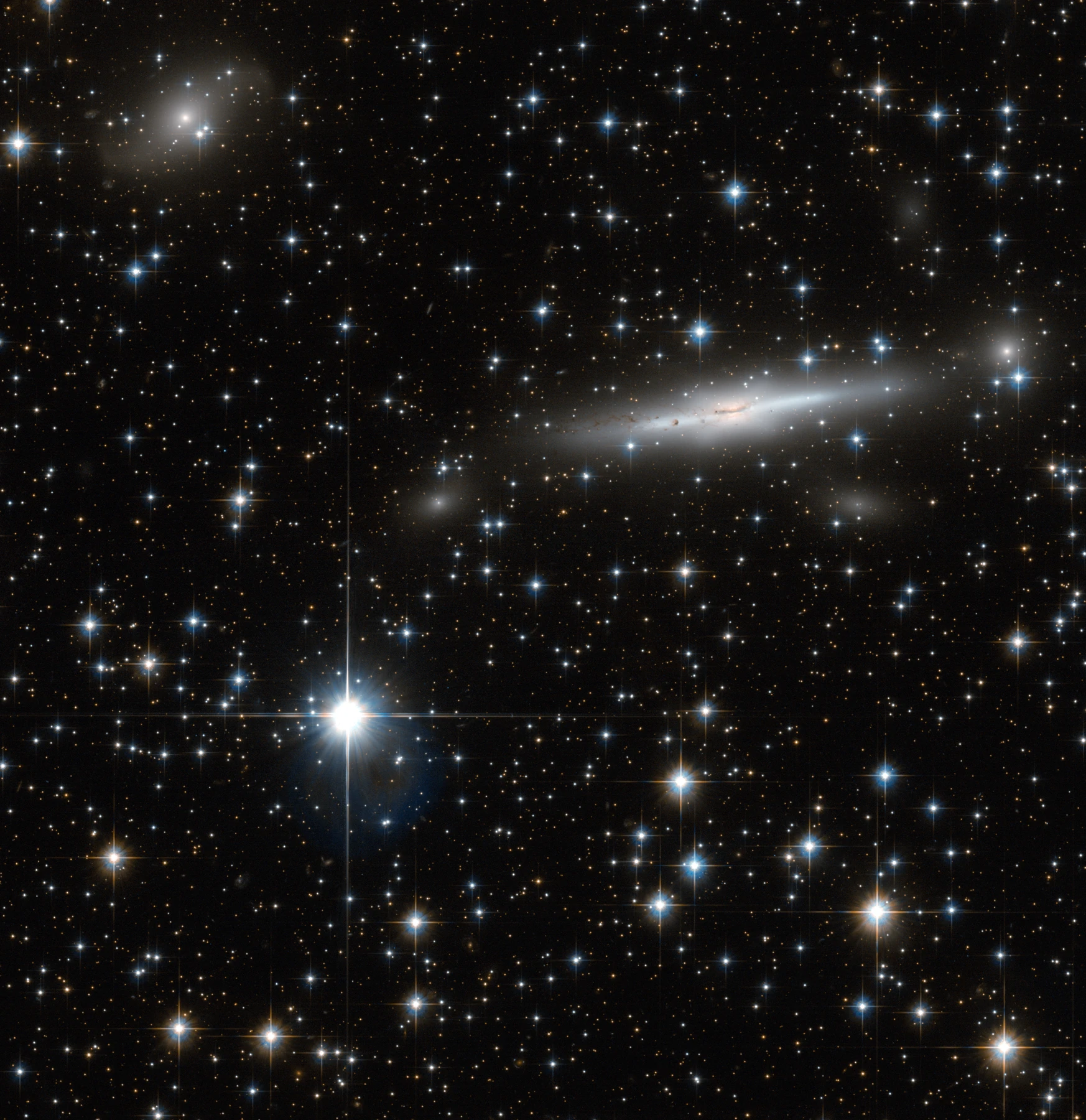
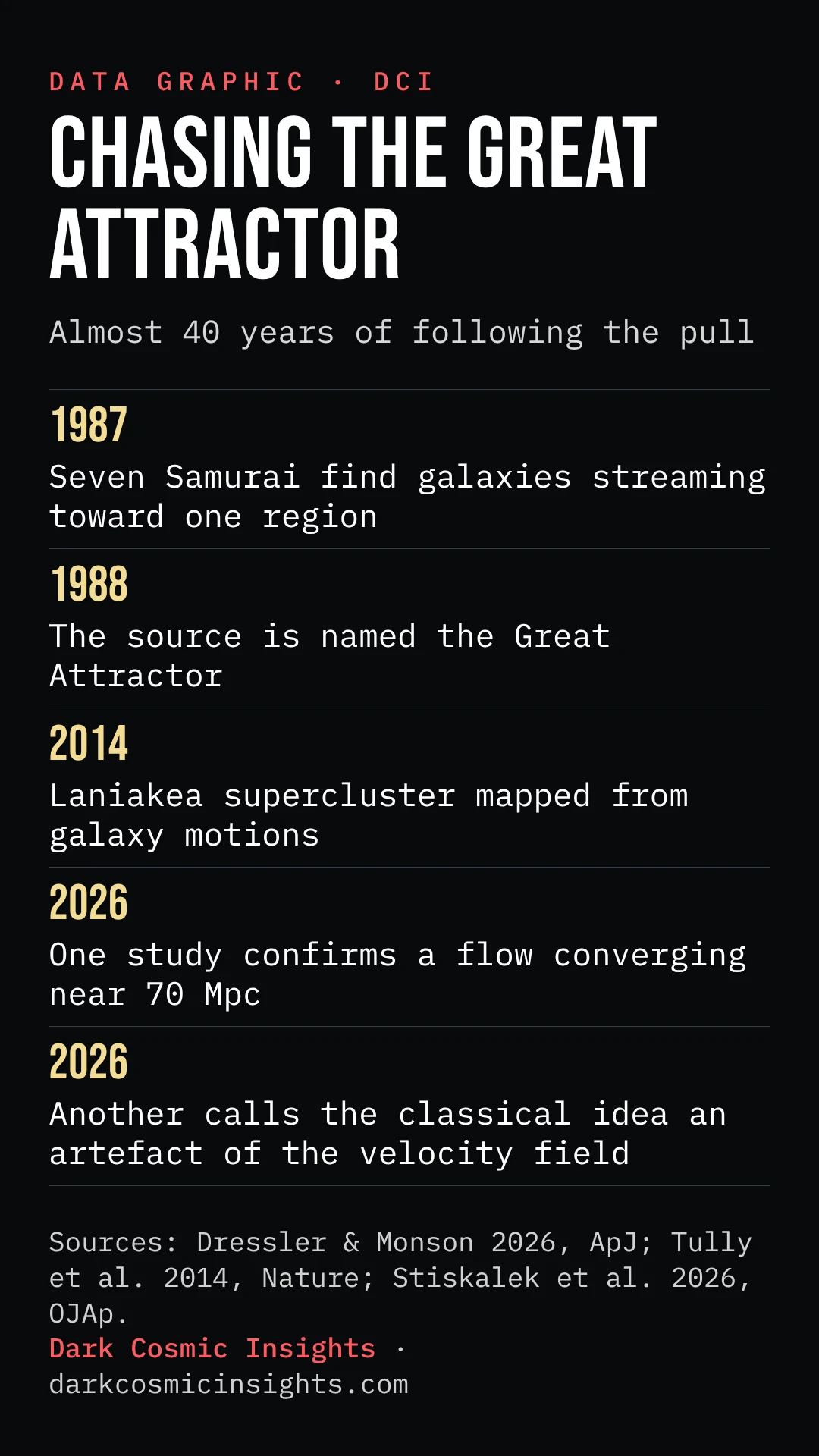
Observed, measured, modelled, open. Our motion relative to the cosmic microwave background is measured. Large flows of galaxies toward the Great Attractor region are measured. The Laniakea “basin” and computer reconstructions of where flows converge are modelled. How much of our motion the Great Attractor itself causes is still open.
Quick Answer: What Is the Great Attractor?
The Great Attractor is a huge concentration of galaxies and dark matter about 200 million light-years away, in the direction of the constellations Norma and Centaurus, whose gravity pulls on the Milky Way and thousands of other galaxies. It isn’t a single object or a black hole. It’s a region where galaxy clusters, including the Norma Cluster, crowd together. Astronomers inferred it in the 1980s from galaxies moving faster toward that direction than cosmic expansion alone would explain. Much of it is hidden behind the dust of our own galaxy. In 2026, one study confirmed a strong flow converging about 70 megaparsecs (about 230 million light-years) away (Dressler & Monson 2026), while another argued no single attractor explains our motion (Stiskalek et al. 2026).
What this article can and cannot establish. It can show you how astronomers measure the pull on our galaxy, what the Great Attractor region contains, and where the 2026 studies agree and disagree. It cannot tell you exactly how much of our motion comes from the Great Attractor versus more distant structures, because that is the open question. It also cannot give you a single, exact “mass of the Great Attractor”: the number depends on how its boundary is drawn.
Table of Contents
The DCI Evidence Map: The Great Attractor
| Question | What we know | Status | Key source |
|---|---|---|---|
| Is the Local Group moving relative to the cosmic microwave background? | Yes, at about 600 km/s (about 620 km/s in Planck’s analysis), toward galactic coordinates (272°, 30°) | Measured | Dressler & Monson 2026 · Stiskalek et al. 2026 |
| Do galaxies stream toward the Great Attractor region? | Yes: peculiar velocities of about 1,000 km/s, falling to near zero about 70 Mpc away | Measured | Dressler & Monson 2026 |
| What’s in the region? | The Norma, Centaurus and Hydra clusters, among others; Norma is about 220 million light-years away | Observed | NASA Science · Nature, 2014 |
| Why is it hard to see? | It lies near the Milky Way’s plane, behind dust and dense star fields | Observed | NASA Science |
| Is it part of a larger structure? | It sits within Laniakea, the supercluster mapped from galaxy motions in 2014 | Modelled | University of Hawaiʻi, 2014 |
| Does the Great Attractor cause most of our motion? | One 2026 study says yes; another says mass within a large volume explains only about 72% of it, with no single dominant attractor | Open | Dressler & Monson 2026 · Stiskalek et al. 2026 |
| Do farther structures like Shapley contribute? | Some studies say yes; how much is disputed | Open | Feindt et al. 2013 · ESA, Shapley |
| Is the Great Attractor a black hole or one object? | No: it’s a spread-out concentration of galaxies, gas and dark matter | Not supported | Nature, 2014 |
Status key: Observed = seen directly in images or data. Measured = a number with a stated uncertainty. Modelled = inferred from measurements through a physical model or simulation, dependent on assumptions. Open = unresolved; the evidence is incomplete or points different ways. Not supported = the evidence goes against the claim, or there is none for it.
Cite this framework: “DCI Evidence Map: The Great Attractor,” Dark Cosmic Insights, November 2026, darkcosmicinsights.com/great-attractor/.
How Do We Know the Milky Way Is Moving?
Start with the sky’s oldest light. The cosmic microwave background (CMB) is the afterglow of the hot early universe, and it fills every direction. For more on that early era, see How Old Is the Universe?
A warmer and a cooler side of the sky
When you move through a bath of light, the light ahead of you looks slightly bluer and warmer, and the light behind looks slightly redder and cooler. The CMB shows exactly that pattern, a slightly warmer side and a slightly cooler side. Astronomers call it the CMB dipole.
Correct for Earth’s orbit, the Sun’s path around the Milky Way and the Milky Way’s motion within the Local Group, and you’re left with the motion of the Local Group itself. It comes to roughly 600 km/s (Dressler & Monson 2026). The Planck satellite’s analysis, as cited in a 2026 study, gives about 620 km/s toward galactic longitude 272° and latitude 30° (Stiskalek et al. 2026). That’s about 2.2 million km/h, or 1.3 million mph (DCI’s arithmetic).
“Peculiar velocity,” the extra motion
The universe is expanding, so distant galaxies recede from us. A galaxy’s peculiar velocity is the part of its motion left over after removing that expansion. It’s the motion caused by gravity tugging on it locally. Our 600 km/s is the Local Group’s peculiar velocity. And a peculiar velocity that big needs a big cause.
Where Did the Idea of the Great Attractor Come From?
The “Seven Samurai”
In the 1980s, a team of seven astronomers, nicknamed the “Seven Samurai,” measured distances and velocities of galaxies across the sky. They found galaxies streaming toward one region of the southern sky, near the direction of the CMB dipole. The team, led by Alan Dressler, described it in 1987 as large-scale streaming, and in a 1988 paper led by Donald Lynden-Bell the source was named the “Great Attractor” (Dressler & Monson 2026).
The core idea was simple: a huge overdensity of matter, galaxies plus dark matter, sitting roughly in the direction of Centaurus, was pulling on everything around it, including us.
A target behind a wall of dust
There was one big problem. The Great Attractor’s direction lies close to the plane of the Milky Way. That band of sky is crowded with our own galaxy’s stars and blocked by its dust. NASA’s Hubble team puts it bluntly: the plane of the Milky Way “both outshines (with stars) and obscures (with dust)” what lies behind it (NASA Science).
Astronomers call this hidden strip of sky the Zone of Avoidance. A 2025 catalogue paper defines it as low galactic latitudes, within about 10° of the galactic plane, and lists the Great Attractor among the major structures it hides (Schröder 2025, A&A). Infrared and radio surveys can see through some of the dust. The region behind the Milky Way’s center, where the dust is thickest, is still almost a blank.
What Is Actually in the Great Attractor Region?
The Great Attractor isn’t one thing you could point a telescope at. It’s a region. Nature‘s summary of the 2014 Laniakea paper lists the Norma, Hydra and Centaurus clusters as “also known as the Great Attractor” (Nature, 2014).
The Norma Cluster
The Norma Cluster (Abell 3627) is the richest galaxy cluster in the region and has been proposed as the Great Attractor’s “core” (Mutabazi et al. 2014, MNRAS). NASA describes it as the closest massive galaxy cluster to the Milky Way, about 220 million light-years away (NASA Science). Its mass and richness are comparable to the famous Coma Cluster.
One telling result: when astronomers measured Norma’s own peculiar velocity, it came out small, −72 ± 170 km/s, essentially at rest relative to the CMB (Mutabazi et al. 2014). That’s what you’d expect if Norma sits near the bottom of the gravitational “valley,” rather than being swept along by something farther away.
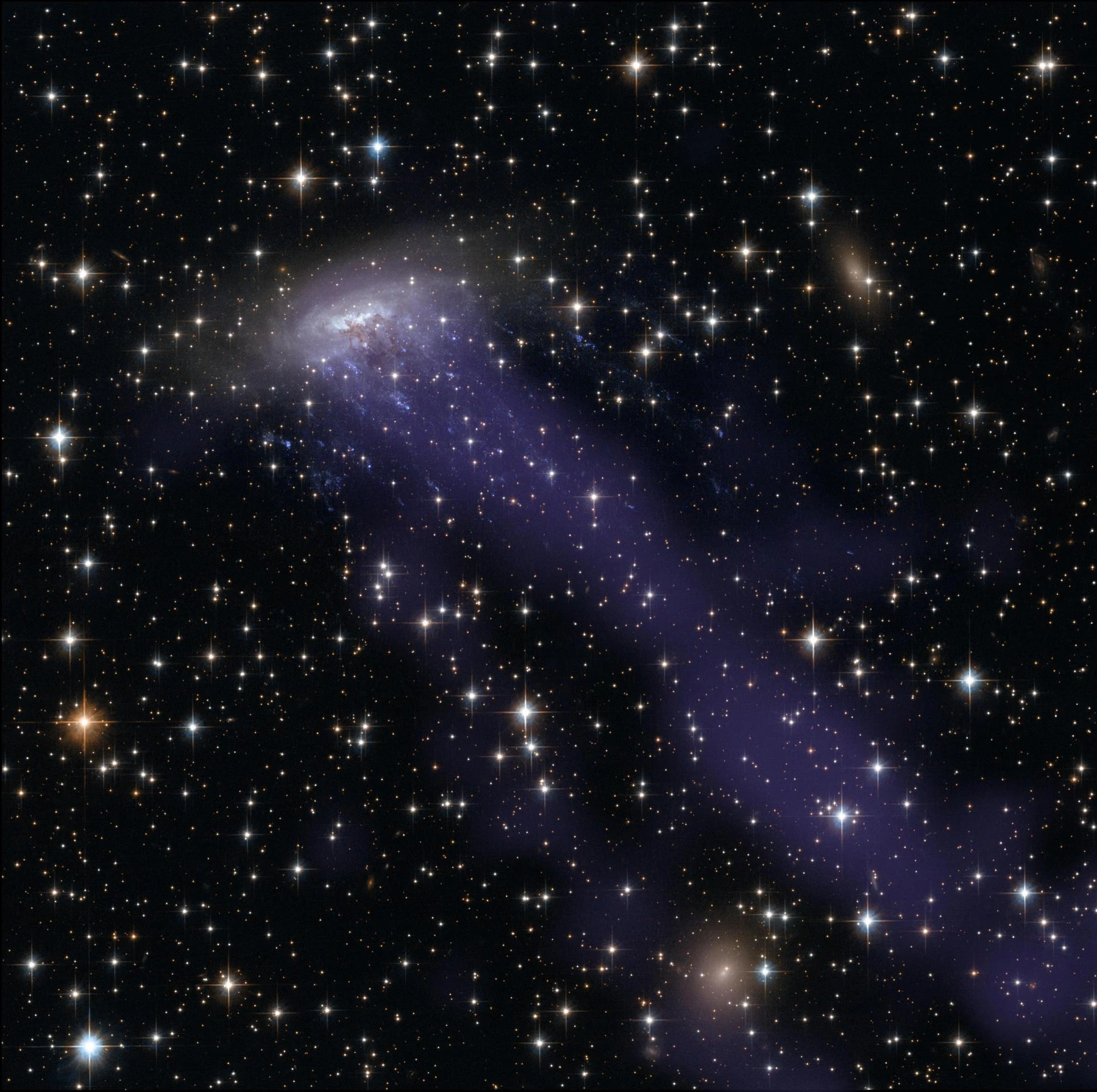
A galaxy losing its gas
The Norma Cluster is a harsh place. Its galaxies move through gas so hot it glows in X-rays. NASA says the spiral galaxy ESO 137-001 is plowing through that gas at nearly 4.5 million miles per hour, fast enough to strip away its own gas into glowing blue streamers (NASA, Hubble and Chandra image). It’s a vivid sign of just how much mass is concentrated here.
How Far Away Is the Great Attractor?
It depends on what you mean by “the Great Attractor,” and that’s not a dodge.
- The Norma Cluster is about 220 million light-years away (NASA Science).
- The convergence point of the flow in the 2026 Dressler and Monson study is about 70 megaparsecs, roughly 230 million light-years (DCI’s conversion), where galaxies come to rest relative to the CMB (Dressler & Monson 2026).
- The overall structure in the original model spans up to about 140 megaparsecs in diameter, roughly 460 million light-years (DCI’s conversion).
These figures describe different things: a single cluster, the point where a flow stops, and the size of a whole structure. They aren’t competing estimates of one distance.
The 2026 Showdown: Two Studies, Two Answers
This is where the story turns current. Two papers published in 2026 tackled the same question from opposite directions.
Study 1: “Strong evidence” for the Great Attractor
Alan Dressler, one of the original Seven Samurai, returned to the problem with Andrew Monson. Published in The Astrophysical Journal in 2026, their study used the FourStar near-infrared camera on the Magellan-Baade telescope to image 66 galaxies in the Great Attractor region (Dressler & Monson 2026).
Their key tool is surface brightness fluctuations (SBF). A galaxy’s starlight looks smoother the farther away it is, because more stars blend into each pixel. Measuring that graininess gives distances accurate to about 5%, far better than the roughly 20–25% of older methods the paper compares it with.
What they found:
- Galaxies in the region flow at peculiar velocities of up to about 1,000 km/s, rising from about 600 km/s at the Local Group.
- Beyond about 50 megaparsecs, those velocities fall, reaching about zero near 70 megaparsecs, where galaxies are essentially at rest relative to the CMB.
- The four most distant galaxies even hint at slightly negative velocities, which could be “backfall” toward the attractor from the far side. The authors flag this carefully: it “might be” backfall.
Their conclusion: this zero-crossing is “significant evidence” that the Great Attractor is the primary source of the CMB dipole. A large bulk flow driven by more distant structures, they argue, would make velocities stay level or rise, not fall.
Study 2: The Great Attractor as an “artefact”
Earlier in 2026, a team led by Richard Stiskalek published a very different take in The Open Journal of Astrophysics (Stiskalek et al. 2026). They didn’t take new pictures. They used Manticore-Local, a suite of “digital twins”: computer reconstructions of the nearby universe built to match its observed galaxies.
They split the Great Attractor idea into three questions, and got three answers:
- What causes our motion? Mass within about 155 h⁻¹ megaparsecs accounts for only about 72% of the Local Group’s speed, and its direction is about 38° off. No single structure would be expected to dominate.
- Where do galaxy flows converge? It depends on how much the map is smoothed: toward Virgo at small scales, the Hydra–Centaurus region at intermediate scales, and Shapley at large scales. At intermediate smoothing the convergence point lies near the cluster Abell 3565, in a basin of about 10^16.4 h⁻¹ solar masses that excludes Norma.
- Where are we headed? Running the twins far into the future, the dominant motion is toward Virgo, but even Virgo accounts for at most a third of the Local Group’s velocity.
Their bottom line: “the classical Great Attractor is not a dynamically dominant structure but an artefact of the instantaneous velocity field.”
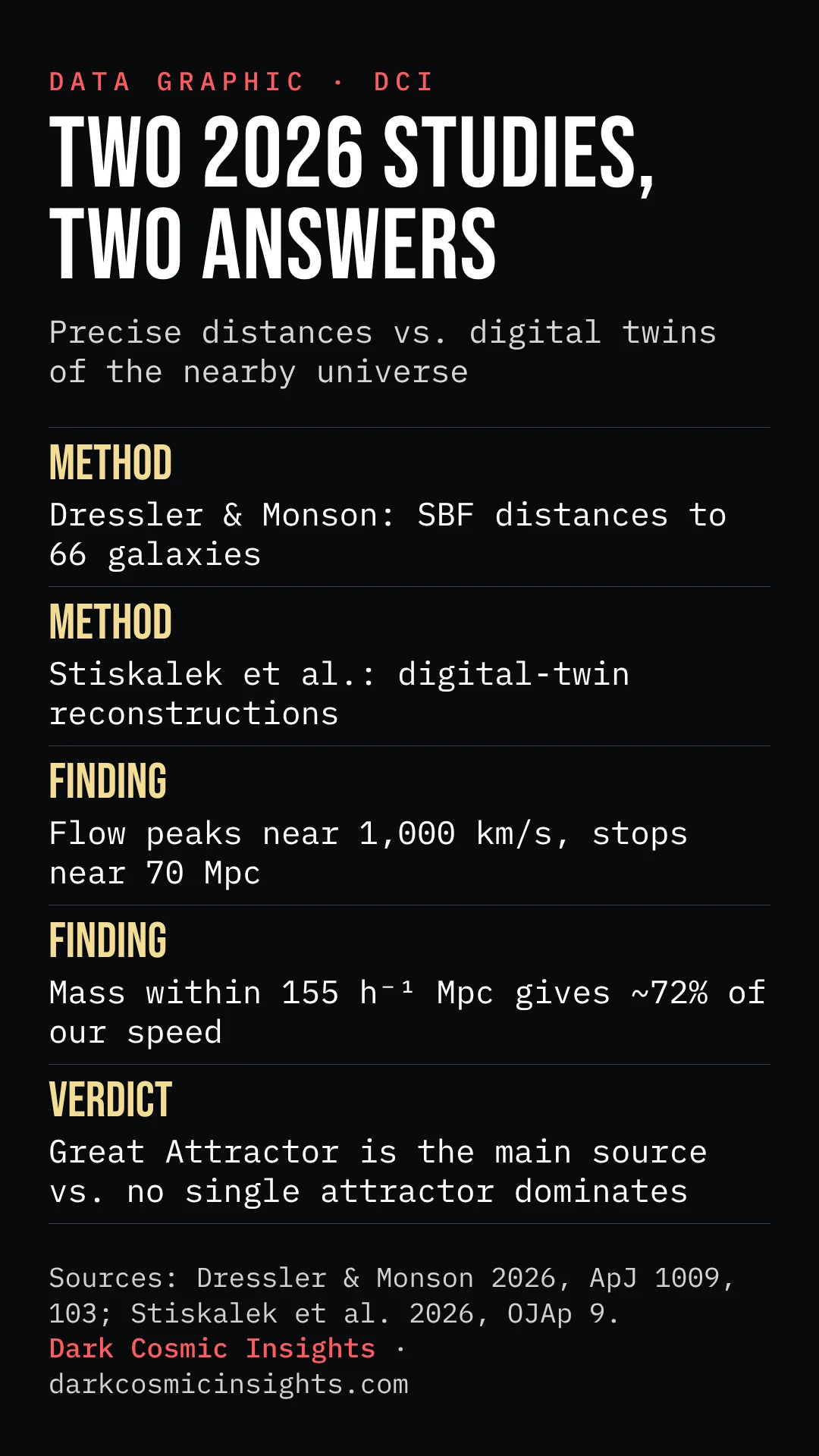
Who’s right?
Neither study settles it alone, and they don’t measure quite the same thing. Dressler and Monson measured real distances to real galaxies in one patch of sky, about a steradian. Stiskalek and colleagues modelled the whole nearby universe, with the assumptions any reconstruction carries. Dressler and Monson argue that only distance methods as accurate as SBF can settle the question, and suggest extending SBF to other directions with the James Webb Space Telescope. Status: open.
What Is Laniakea, and How Does the Great Attractor Fit In?
In 2014, a team led by R. Brent Tully of the University of Hawaiʻi mapped the motions of thousands of galaxies and drew a new boundary around our cosmic home. They named it Laniakea, from the Hawaiian words for “heaven” and “spacious” (Nature, 2014), a name suggested by Nawaʻa Napoleon (University of Hawaiʻi, 2014).
A gravitational watershed
The team defined Laniakea not by where galaxies are, but by where they’re flowing. Inside its boundary, galaxy motions point inward, “as water streams follow descending paths toward a valley.” Laniakea is about 500 million light-years across and contains the mass of about 10^17 Suns spread across 100,000 galaxies (University of Hawaiʻi, 2014). Nature‘s summary gives its size as 160 megaparsecs (Nature, 2014).
In that picture, the Great Attractor is “a large flat bottom gravitational valley” whose pull extends across Laniakea. The Milky Way sits out on Laniakea’s edge.
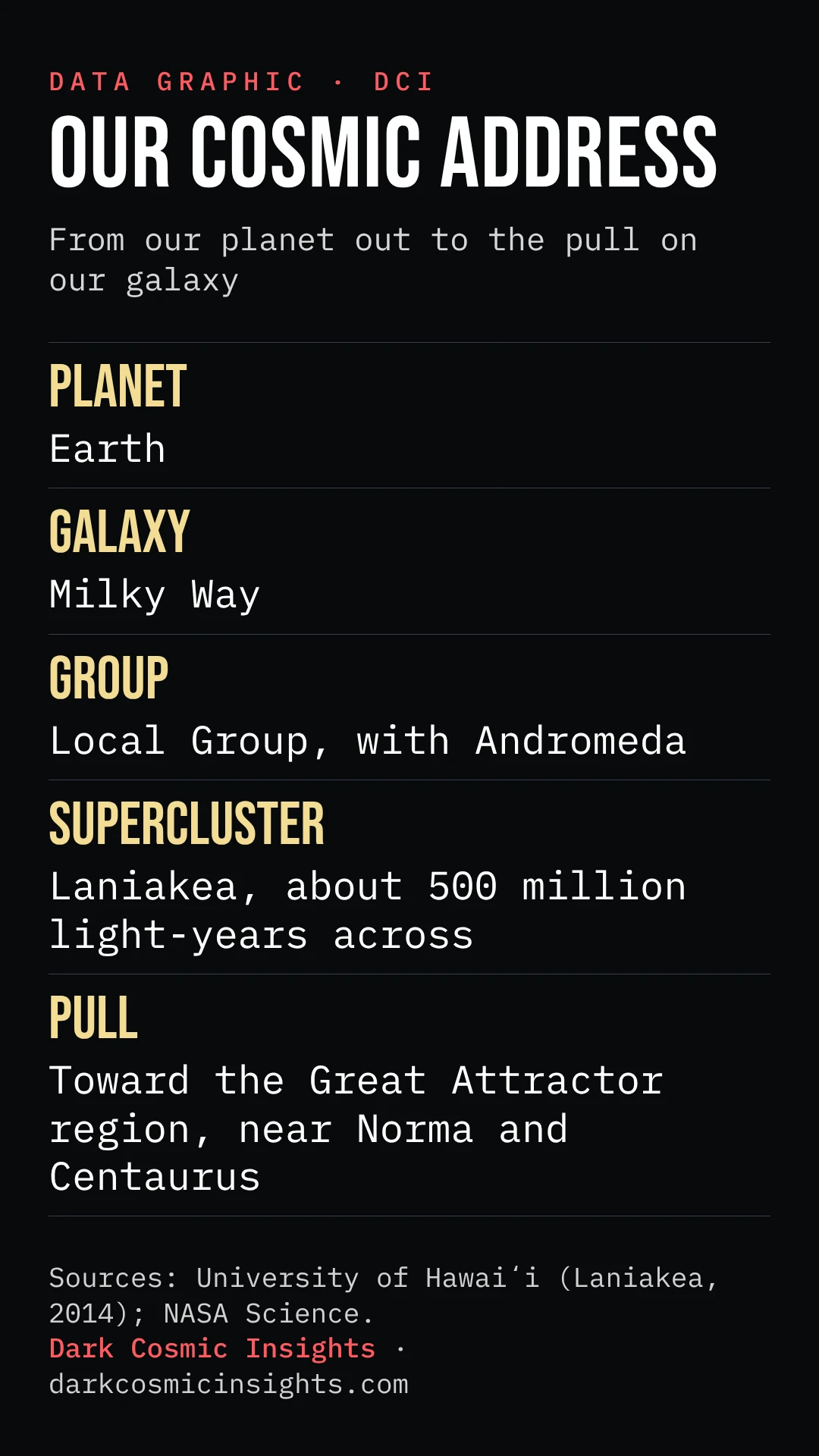
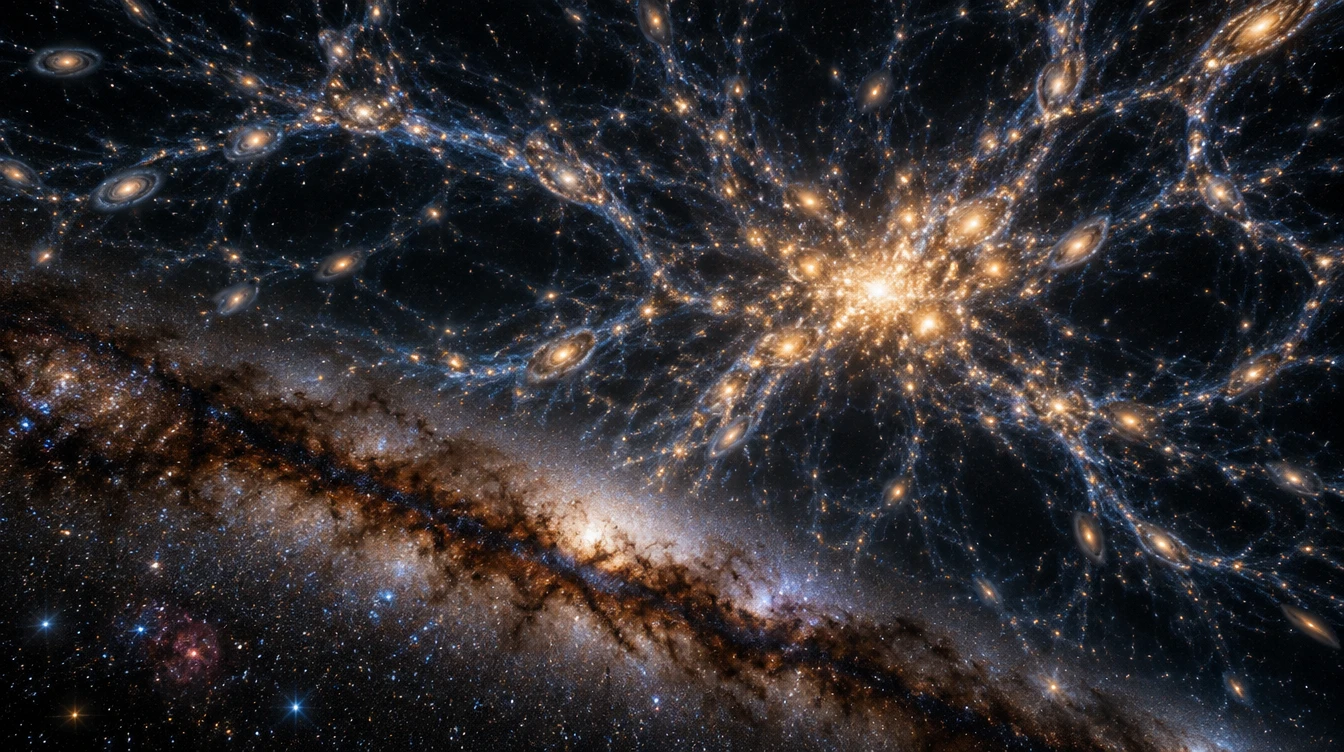
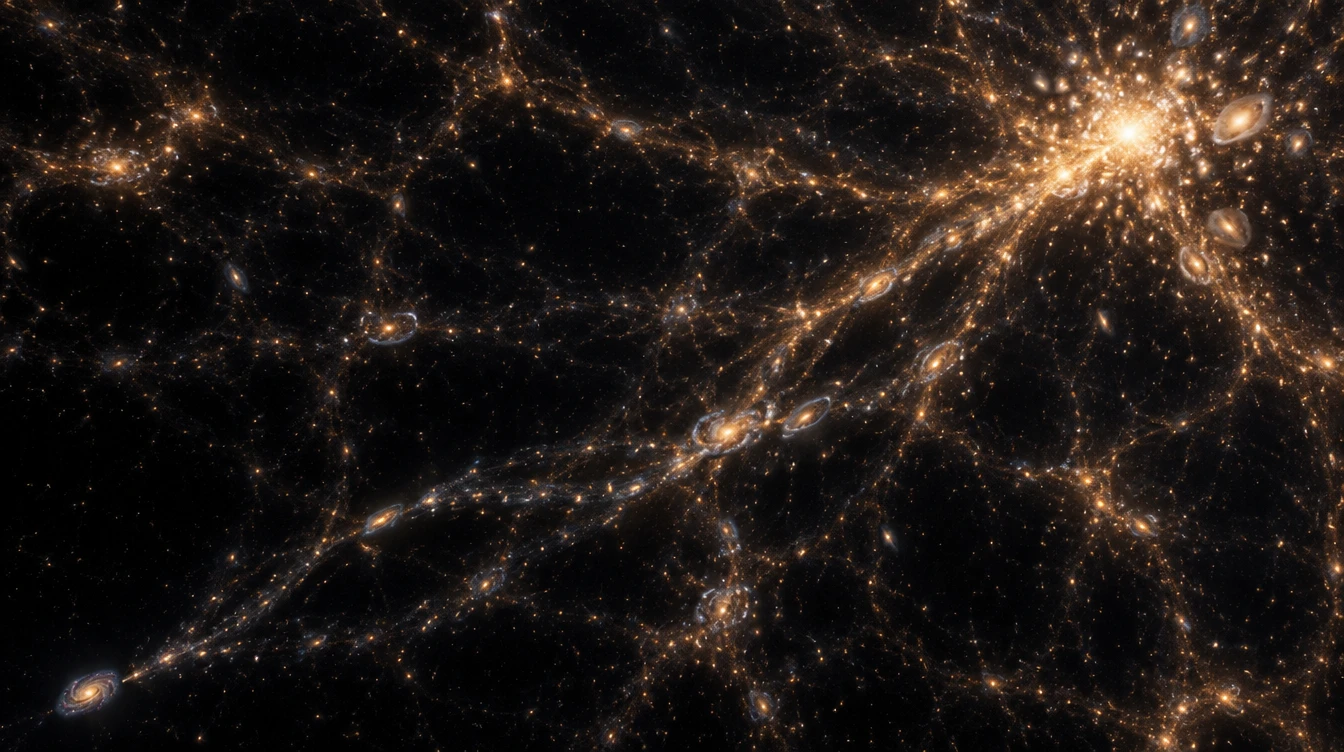
That’s a modelled boundary, built from measured velocities. The 2026 digital-twin study is a reminder that where the “valley floor” sits depends on how the map is smoothed.
Is Something Even Bigger Pulling Us?
Probably, to some degree. The question is how much.
The Shapley Supercluster
Beyond the Great Attractor, in roughly the same direction, lies the Shapley Supercluster. ESA calls it the most massive structure within about a billion light-years of the Milky Way, with more than 8,000 galaxies and a total mass of more than ten million billion Suns (ESA, Planck).
Some studies give Shapley a big role. One X-ray cluster analysis (Kocevski and Ebeling, 2006) found the Great Attractor accounted for only about 44% of the dipole in its sample, with the rest from more distant sources such as Shapley, as summarized by a 2013 supernova study (Feindt et al. 2013, A&A). Dressler and Monson’s 2026 result points the other way, arguing that the Great Attractor itself does most of the work.
The hidden Vela Supercluster
There may be more hiding in the Zone of Avoidance. In 2017, astronomers reported the Vela Supercluster, an extended structure behind the Milky Way at a recession velocity of about 18,000 km/s (Mutabazi 2021, ApJ). How much it pulls on us is still being worked out.
Myth vs. Fact: The Great Attractor
| Myth | Fact | Status |
|---|---|---|
| “The Great Attractor is a giant black hole.” | It’s a spread-out concentration of galaxy clusters, gas and dark matter. | Not supported |
| “It’s a total mystery that no one can see.” | We can see much of it, including the Norma Cluster; the Milky Way’s dust hides parts of it. | Observed |
| “Scientists agree it’s pulling us all in.” | Two 2026 studies disagree on how much of our motion it causes. | Open |
| “We’re about to crash into it.” | It’s a spread-out region, not a target; one 2026 simulation finds our dominant future motion is toward Virgo. | Modelled |
| “The Great Attractor is 150 million light-years away, exactly.” | “Distance” depends on what you measure: Norma (~220 million ly) or the flow’s stopping point (~70 Mpc). | Measured |
| “It’s the biggest structure near us.” | The Shapley Supercluster, farther away, is more massive. | Measured |
How Can You Explore the Great Attractor Yourself?
You can’t spot it with backyard binoculars. It’s a region of distant galaxies behind the Milky Way’s southern band. But you can explore it.
Look in the right direction
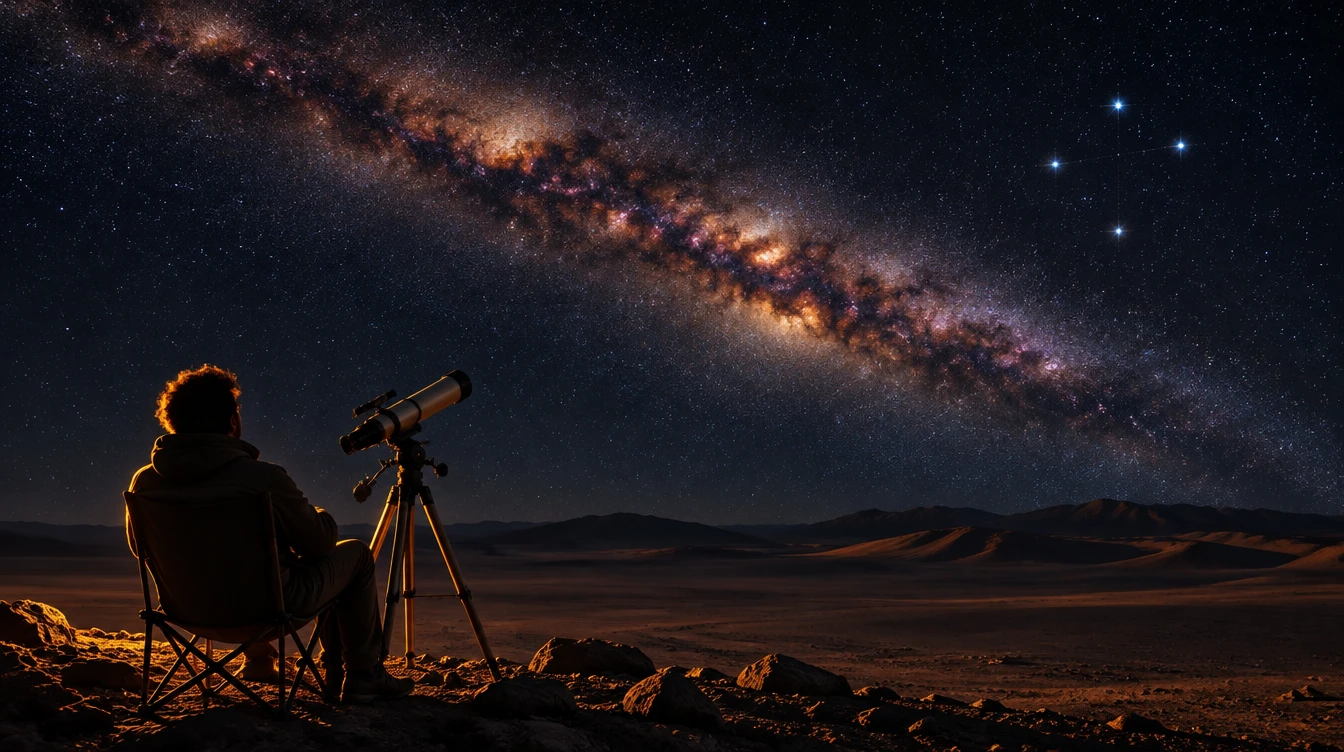
The Great Attractor lies toward the southern constellations Norma, Triangulum Australe and Centaurus (NASA Science). From mid-northern latitudes those are low or below the horizon. From the Southern Hemisphere, look toward the Milky Way near the Southern Cross: the pull on our galaxy comes from behind that band of stars.
Explore real data
- Browse Hubble’s view of the Norma Cluster field and its credit at ESA/Hubble.
- Read the 2026 papers: Dressler & Monson and Stiskalek et al. (both free on arXiv).
- Look up how astronomers measure distances in our guide How Astronomers Measure Stars.
The Great Attractor by the Numbers
| Measure | Value | Source |
|---|---|---|
| Local Group speed relative to the CMB | about 600 km/s (about 620 km/s in Planck’s analysis) | Dressler & Monson 2026 · Stiskalek et al. 2026 |
| Direction of that motion | galactic (272°, 30°) | Stiskalek et al. 2026 |
| Peak flow toward the region | about 1,000 km/s | Dressler & Monson 2026 |
| Where the flow stops | about 70 Mpc (about 230 million ly) | Dressler & Monson 2026 |
| Galaxies measured with SBF | 66 | Dressler & Monson 2026 |
| SBF distance accuracy | about 5% | Dressler & Monson 2026 |
| Norma Cluster distance | about 220 million ly | NASA Science |
| Laniakea size | about 500 million ly across | University of Hawaiʻi |
| Laniakea mass | about 10^17 Suns, 100,000 galaxies | University of Hawaiʻi |
| Share of our speed from mass within 155 h⁻¹ Mpc (model) | about 72%, 38° off | Stiskalek et al. 2026 |
| Shapley Supercluster | 8,000+ galaxies, over 10^16 Suns | ESA |
Values are as of November 2026. Light-year and km/h conversions are DCI’s arithmetic.
Great Attractor FAQ
Is the Great Attractor a black hole?
No. It’s a large region where galaxy clusters, hot gas and dark matter are concentrated, in the direction of Norma and Centaurus. Its pull comes from the combined mass of all that material spread over tens of millions of light-years, not from a single compact object.
How fast is the Milky Way moving toward it?
Our Local Group moves at about 600 km/s relative to the cosmic microwave background, more than two million kilometers an hour. How much of that speed the Great Attractor causes is disputed. One 2026 study says most of it; another says no single structure dominates.
Why can’t telescopes see the Great Attractor clearly?
It lies near the plane of the Milky Way, where our galaxy’s stars outshine and its dust blocks much of what’s behind. Astronomers call this strip the Zone of Avoidance. Infrared and radio telescopes can see through some of the dust, which is how much of the region has been mapped.
Who discovered the Great Attractor?
A team of seven astronomers nicknamed the Seven Samurai, led by Alan Dressler, found galaxies streaming toward one region of the southern sky and described it in 1987. A 1988 paper led by Donald Lynden-Bell named the source the Great Attractor.
What is Laniakea?
Laniakea is the supercluster of galaxies that contains the Milky Way, mapped in 2014 by a team led by R. Brent Tully. It’s about 500 million light-years across, holds about 100,000 galaxies, and was defined by where galaxies flow. The Great Attractor region sits near the bottom of its gravitational “valley.”
Will the Milky Way crash into the Great Attractor?
There’s no sign of a collision. The Great Attractor is a spread-out region, not a target, and one 2026 simulation found the Local Group’s dominant future motion is toward the Virgo Cluster rather than the Great Attractor.
Is the Shapley Supercluster pulling us too?
Possibly. Shapley lies farther away in roughly the same direction and is more massive, with more than 8,000 galaxies. Some studies credit it with a large share of our motion. A 2026 study using precise distances argues the nearer Great Attractor does most of the work.
Where in the sky should I look?
Toward the southern constellations Norma, Triangulum Australe and Centaurus, along the Milky Way near the Southern Cross. The galaxies themselves are far too faint to see without large telescopes, but you’ll be facing the direction of the pull.
Your next step: open Hubble’s Norma Cluster image and notice how many of the bright points are Milky Way stars sitting in front of the galaxies. That crowding is the whole reason the Great Attractor stayed hidden for so long.
Sources and Further Reading
- Dressler, A., & Monson, A. (2026). Return to the Great Attractor: Strong Evidence for a Steradian-sized Flow Converging at ~70 Mpc within the GA Supercluster and Aligned with the CMB Dipole. The Astrophysical Journal, 1009(2), 103. doi:10.3847/1538-4357/ae677f · arXiv:2604.02470
- Stiskalek, R., Desmond, H., McAlpine, S., Lavaux, G., Jasche, J., & Hudson, M. J. (2026). Revisiting the Great Attractor: The Local Group’s streamline trajectory, cosmic velocity and dynamical fate. The Open Journal of Astrophysics, 9. doi:10.33232/001c.157824 · arXiv:2601.08524
- Tully, R. B., Courtois, H., Hoffman, Y., & Pomarède, D. (2014). The Laniakea supercluster of galaxies. Nature, 513, 71–73. doi:10.1038/nature13674
- University of Hawaiʻi at Mānoa (September 3, 2014), Hawaii scientist maps and names Laniakea, our home supercluster of galaxies.
- Mutabazi, T., Blyth, S. L., Woudt, P. A., Lucey, J. R., Jarrett, T. H., Bilicki, M., Schröder, A. C., & Moore, S. A. W. (2014). The Norma cluster (ACO 3627) – III. The distance and peculiar velocity via the near-infrared Ks-band Fundamental Plane. Monthly Notices of the Royal Astronomical Society, 439(4), 3666–3682. Oxford Academic
- Mutabazi, T. (2021). The Distance and Peculiar Velocity of the Norma Cluster. The Astrophysical Journal. IOPscience
- Feindt, U., et al. (2013). Measuring cosmic bulk flows with Type Ia supernovae from the Nearby Supernova Factory. Astronomy & Astrophysics, 560, A90. A&A
- Schröder, A. C. (2025). Supplementing the 2MRS survey: The 2MZoA catalogue. Astronomy & Astrophysics, 704, A252. A&A
- NASA Science (January 18, 2013), Hubble Focuses on “the Great Attractor”; ESA/Hubble, A busy patch of the Great Attractor (potw1302a), CC BY 4.0.
- NASA Image Library, ESO 137-001 in the Norma Cluster (Hubble and Chandra).
- ESA Science & Technology, Shapley Supercluster (Planck).
Explore Next
- From here to the horizon: How Big Is the Universe?
- The invisible mass behind every galaxy cluster: What Is Dark Matter?
- Where the CMB comes from: How Old Is the Universe?
- Spirals, ellipticals and the galaxies in these clusters: Types of Galaxies
- How distances in space are measured: How Astronomers Measure Stars
- How enhanced and processed images work: Are Space Photos Real?
- How a claim earns its label: How We Know
How This Explainer Was Checked
Every number in this article was checked in November 2026 against the source linked beside it: the two 2026 papers by Dressler and Monson (ApJ) and Stiskalek and colleagues (OJAp), the 2014 Laniakea paper in Nature and the University of Hawaiʻi release, peer-reviewed studies of the Norma Cluster and of bulk flows, NASA’s Hubble pages and ESA’s Planck page on Shapley. The Local Group’s motion, the flows toward the region and Norma’s distance are labelled Measured; Laniakea’s boundary and the digital-twin results are labelled Modelled; how much of our motion the Great Attractor causes is labelled Open. Different distances (a cluster, a flow’s stopping point, a structure’s size) are kept separate rather than presented as competing estimates. Light-year, km/h and mph conversions are DCI’s arithmetic, using 1 megaparsec ≈ 3.26 million light-years. The featured Hubble image is used under CC BY 4.0 with its full credit line. Images are labelled: real telescope images as OBSERVATION, illustrations as ILLUSTRATION, and our charts as DATA GRAPHIC. Nothing AI-generated is presented as a real image.
Final Thought: Pulled by Something We Can Barely See
For almost 40 years, astronomers have known we’re moving and have argued about why. The Great Attractor began as a bold idea, a hidden mass behind our own galaxy’s dust. In 2026 it’s both stronger and shakier than ever: confirmed by precise new distances, and called an artefact by detailed reconstructions. That isn’t a failure. It’s what science looks like when the question is hard and the target sits behind a wall. Somewhere behind the Milky Way’s glow, the answer is waiting.
About the Author
Author: King | Founder of Dark Cosmic Insights
King is the founder of Dark Cosmic Insights, a science storytelling platform exploring the strangest true stories hiding in space, science and AI. He digs into NASA, ESA and peer-reviewed research, separates what has been measured from what is still a mystery, and turns it into articles, data graphics and Shorts.
Follow the anomaly. Trace the source.