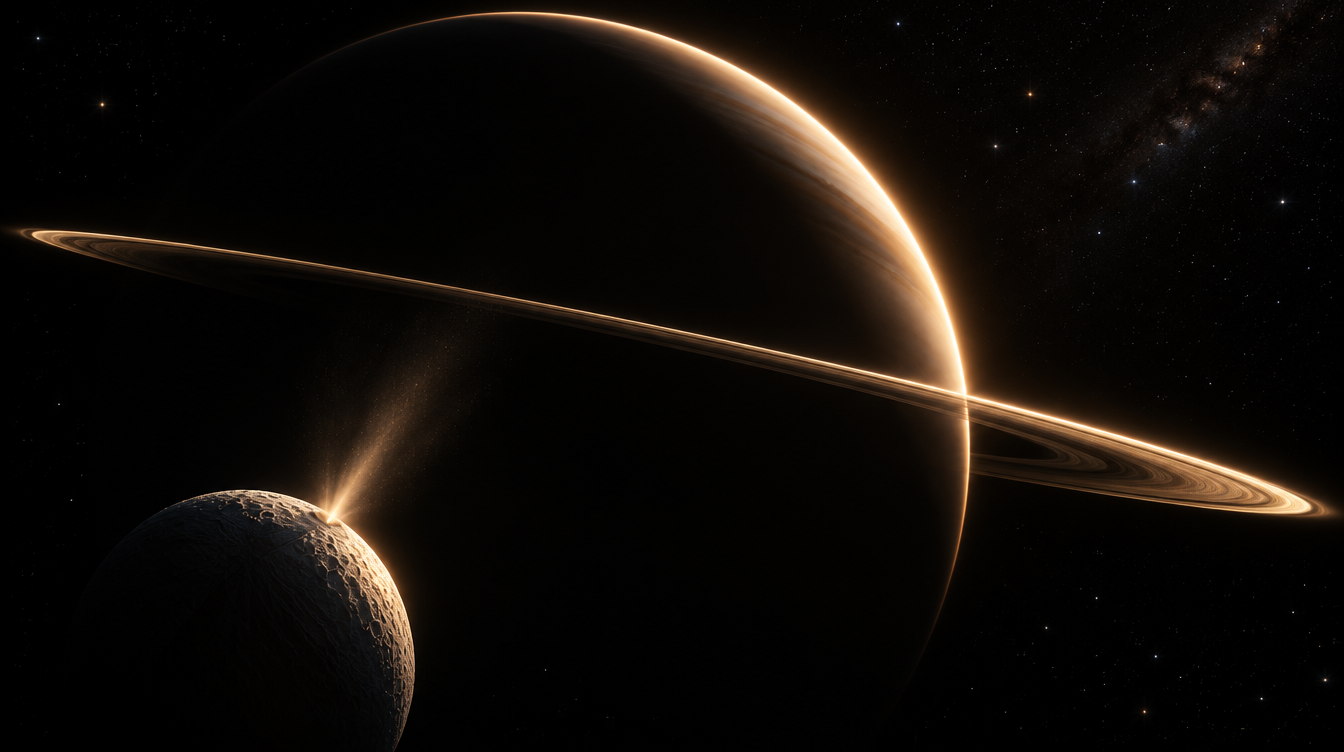
A moon about 500 km (310 miles) across is spraying its own interior into space. Cassini found the jets in 2005: icy particles and gas leaving the south pole of Enceladus at about 400 m/s (about 900 mph; our conversion), feeding one of Saturn’s rings (NASA Science, Enceladus). Later measurements pointed to its source: a global ocean under the ice, inferred from how the moon wobbles.
That’s the real answer hiding inside a simple search: how many moons does Saturn have, and what are they actually like? The count is huge and keeps changing. The better story is the variety: a moon with seas, a cratered moon that may hide a young ocean, a moon with one coal-black face, a spongy tumbler, and a swarm of captured rocks.
Observed, modelled, open. The jets of Enceladus, the two-tone face of Iapetus and the moons’ orbits are observed or measured. The oceans inside Enceladus and Mimas, and the capture of the outer moons, are modelled: inferred from measurements through physical models. Whether Enceladus is habitable in practice, and how old Saturn’s rings really are, is still open.
Quick Answer: How Many Moons Does Saturn Have?
Saturn has 293 known moons, as of November 2026, according to NASA JPL’s live satellite list (JPL Solar System Dynamics); NASA’s Saturn page gives the same figure “as of August 2026” (NASA Science, Saturn Moons). The largest, Titan, is bigger than the planet Mercury. Enceladus vents water from what is very likely a global ocean, and Iapetus has one dark and one bright hemisphere. Most of the rest are small, distant irregular moons, probably captured long ago. The count rises as surveys confirm fainter moons.
What this article can and cannot establish. It can give you a dated count, explain what makes Saturn’s notable moons distinct, and show the evidence behind each claim, including where that evidence is indirect. It cannot tell you whether anything lives in the ocean of Enceladus, because no mission has measured that, or what Saturn’s “final” moon count will be, because nobody knows how many faint moons remain undiscovered.
Table of Contents
The DCI Evidence Map: Saturn’s Moons
| Question | What we know | Status | Key source |
|---|---|---|---|
| How many moons does Saturn have? | 293 known, as of November 2026 | Measured | JPL SSD |
| Does Enceladus vent water into space? | Jets of ice particles and gas seen by Cassini from 2005 | Observed | Porco et al. 2006 |
| Is there a global ocean under Enceladus’s ice? | Its measured wobble is too large for a shell frozen to the core | Modelled | Thomas et al. 2016 |
| Is there hydrothermal activity on Enceladus’s seafloor? | Hydrogen in the plume points to water-rock reactions | Modelled | Waite et al. 2017 |
| Has life been found on Enceladus? | No; Cassini found ingredients and a possible energy source, not life | Not supported | NASA, Apr 2017 |
| Does Mimas have a hidden ocean? | Its orbital drift fits a young ocean 20 to 30 km down | Modelled | Lainey et al. 2024 |
| Why is Iapetus two-toned? | Dark dust plus ice migrating to colder areas, per Cassini-era models | Modelled | Spencer & Denk 2010 |
| Are the small outer moons captured? | Distant, tilted, often backward orbits and family groupings point to capture and collisions | Modelled | UBC, Mar 2025 |
| Are Saturn’s rings young? | One Cassini-based study says 100 to 400 million years; another says they could be about as old as Saturn | Open | Kempf et al. 2023 · Hyodo et al. 2024 |
Status key: Observed = seen directly in images or data. Measured = a number or detection with stated uncertainty. Modelled = inferred from measurements through a physical model, dependent on assumptions. Open = unresolved; the evidence is incomplete or points different ways. Not supported = no evidence for the claim.
Cite this framework: “DCI Evidence Map: Saturn’s Moons,” Dark Cosmic Insights, November 2026, darkcosmicinsights.com/how-many-moons-does-saturn-have/.
How Many Moons Does Saturn Have, and Why Won’t the Number Sit Still?
When we checked NASA JPL’s satellite discovery list in November 2026, it listed 293 moons of Saturn. The newest entries, such as S/2023 S63, were first seen in 2023 and announced in 2026 Minor Planet Center circulars (JPL SSD). That’s our count: 293, as of November 2026.
NASA’s Saturn Moons page agrees in its text, though its search summary still shows an older 274 (NASA Science).
The number rises as astronomers confirm faint moons that were always there. For the comparison with Jupiter and every other planet, see which planet has the most moons. Here, we focus on the moons themselves.
What Are Saturn’s Moons?
The moons of Saturn fall into three broad groups, from the planet outward.
- Ring moons. Small moons orbiting in or near the rings, such as Pan, Daphnis, Atlas, Prometheus and Pandora. Some are only a few kilometres across: NASA gives Daphnis a mean radius of about 3.8 km (2.4 miles) (NASA Science, Daphnis).
- The major moons. Seven moons are large enough to have pulled themselves into rounded shapes: Mimas, Enceladus, Tethys, Dione, Rhea, Titan and Iapetus (Wikipedia, Moons of Saturn). Potato-shaped Hyperion orbits among them.
- The outer swarm. Beyond Iapetus lie hundreds of small irregular moons on distant, steeply tilted and often retrograde orbits, meaning they travel opposite to Saturn’s spin. The largest is Phoebe, which travels a retrograde orbit taking about 550 days (JPL SSD, mean elements).
Moons that grew in orbit around their planet are called regular. Wikipedia’s tally from the JPL list counts 25 regular and 268 irregular moons as of mid-2026 (Wikipedia, Moons of Saturn): roughly nine in ten belong to the swarm.
How big are Saturn’s moons?
Diameters below are DCI’s doubling of JPL’s mean radii (JPL SSD, physical parameters); NASA’s moon pages give slightly rounded figures.
| Moon | Mean diameter |
|---|---|
| Titan | about 5,150 km (3,200 miles) |
| Rhea | about 1,527 km (949 miles) |
| Iapetus | about 1,469 km (913 miles) |
| Dione | about 1,123 km (698 miles) |
| Tethys | about 1,062 km (660 miles) |
| Enceladus | about 504 km (313 miles) |
| Mimas | about 396 km (246 miles) |
Tethys has a mean density of 0.984 g/cm³ in JPL’s table, just under that of liquid water, so it’s mostly ice.

What Makes Titan, Saturn’s Largest Moon, So Unusual?
Titan is Saturn’s largest moon, bigger than the planet Mercury (NASA Science, Saturn Moons). JPL lists its mean radius as 2,574.76 km, so it’s about 5,150 km (3,200 miles) across (JPL SSD).
What makes Titan special isn’t its size. NASA calls it “the only moon in our solar system known to have a substantial atmosphere,” and the only place besides Earth known to have liquids on its surface: rivers, lakes and seas of hydrocarbons such as methane and ethane (NASA Science, Titan).
ESA’s Huygens probe, carried by Cassini, began its descent through Titan’s atmosphere on January 14, 2005 (NASA JPL, Cassini-Huygens). ESA describes it as the first probe to land on a world in the outer Solar System (ESA, Cassini-Huygens).
For Titan’s atmosphere, weather and NASA’s plan to fly a rotorcraft there, read our Dragonfly mission explainer.
Does Enceladus Have an Ocean?
Enceladus is about 504 km (313 miles) across (JPL SSD); NASA calls it “the most reflective body in the solar system” (NASA Science, Enceladus). Its surface averages about −201°C (−330°F), or about 72 K (NASA; kelvin conversion ours).
The jets
In 2005, Cassini found icy particles and gas erupting from its south pole (NASA Science, Enceladus). The jets rise from relatively warm fractures informally called “tiger stripes” (NASA). The imaging team published its results in March 2006 (Porco et al. 2006).
Not all of it falls back. NASA says the plumes supply Saturn’s E ring, made mostly of ice droplets (NASA Science, Enceladus).
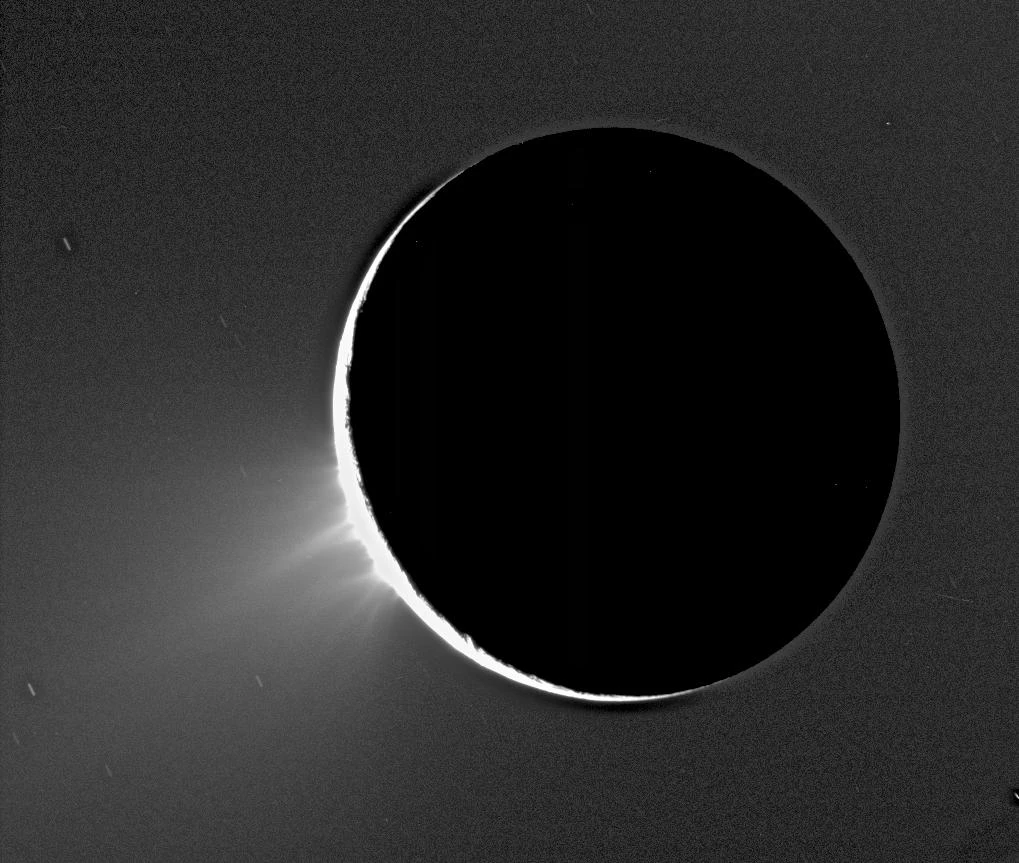
The wobble that revealed a global ocean
Jets prove there’s water below, not that there’s an ocean everywhere. That case came from a subtler measurement.
Over more than seven years, Cassini’s imaging team tracked craters across hundreds of images to measure Enceladus’s libration: a tiny back-and-forth rocking as it orbits Saturn (NASA JPL, Sept 15, 2015). The rocking was too large for an ice shell frozen solid to the rocky core. Co-author Matthew Tiscareno: there “must be a global layer of liquid separating the surface from the core” (JPL). The paper’s title says the libration “requires a global subsurface ocean” (Thomas et al. 2016).
Earlier data had pointed only to a regional sea under the south pole (JPL). Today NASA estimates the ice shell at about 1 to 5 km (0.5 to 3 miles) thick at the south pole and 20 to 25 km (12 to 16 miles) thick on average (NASA Science, Enceladus).
This is a modelled result: nobody has seen the ocean; it’s inferred from how the moon moves. Our How We Know hub explains how we label evidence like this.
Could There Be Life on Enceladus?
Habitability means having what life needs: liquid water, ingredients and energy. Cassini found evidence for all three, but not life.
An energy source: hydrogen
In October 2015, Cassini made its last and deepest dive through the plume (NASA, April 13, 2017). Its mass spectrometer found that the plume gas is nearly 98% water and about 1% hydrogen, with the rest a mix including carbon dioxide, methane and ammonia (NASA). The team interpreted the hydrogen as evidence of hydrothermal processes, reactions between hot water and rock on the seafloor (Waite et al. 2017).
Microbes could in principle use that hydrogen for energy. NASA’s framing was careful: “we can’t detect life,” but there is “a food source there for it” (NASA).
NASA adds that silica grains in the E ring need liquid water and rock interacting above about 90°C (200°F, about 363 K), and calls hydrothermal vents “likely” (NASA Science, Enceladus; kelvin ours).
An ingredient: phosphates
Life as we know it needs phosphorus, and in 2017 it hadn’t been shown in the ocean (NASA). That changed in June 2023. A team led by Frank Postberg matched ice grains caught by Cassini’s Cosmic Dust Analyzer with lab experiments (Postberg et al. 2023).
The University of Washington’s summary says phosphate levels in the ocean are at least 100 times higher than in Earth’s oceans, and possibly about 1,000 times higher (University of Washington, June 14, 2023).
What that does and doesn’t mean
So Enceladus has a modelled global ocean, modelled hydrothermal chemistry and measured ingredients in its spray: a compelling place to look for life, but not one known to be inhabited. No life has been detected, and the grains Cassini sampled were thrown out of cracks, not scooped from the ocean itself.
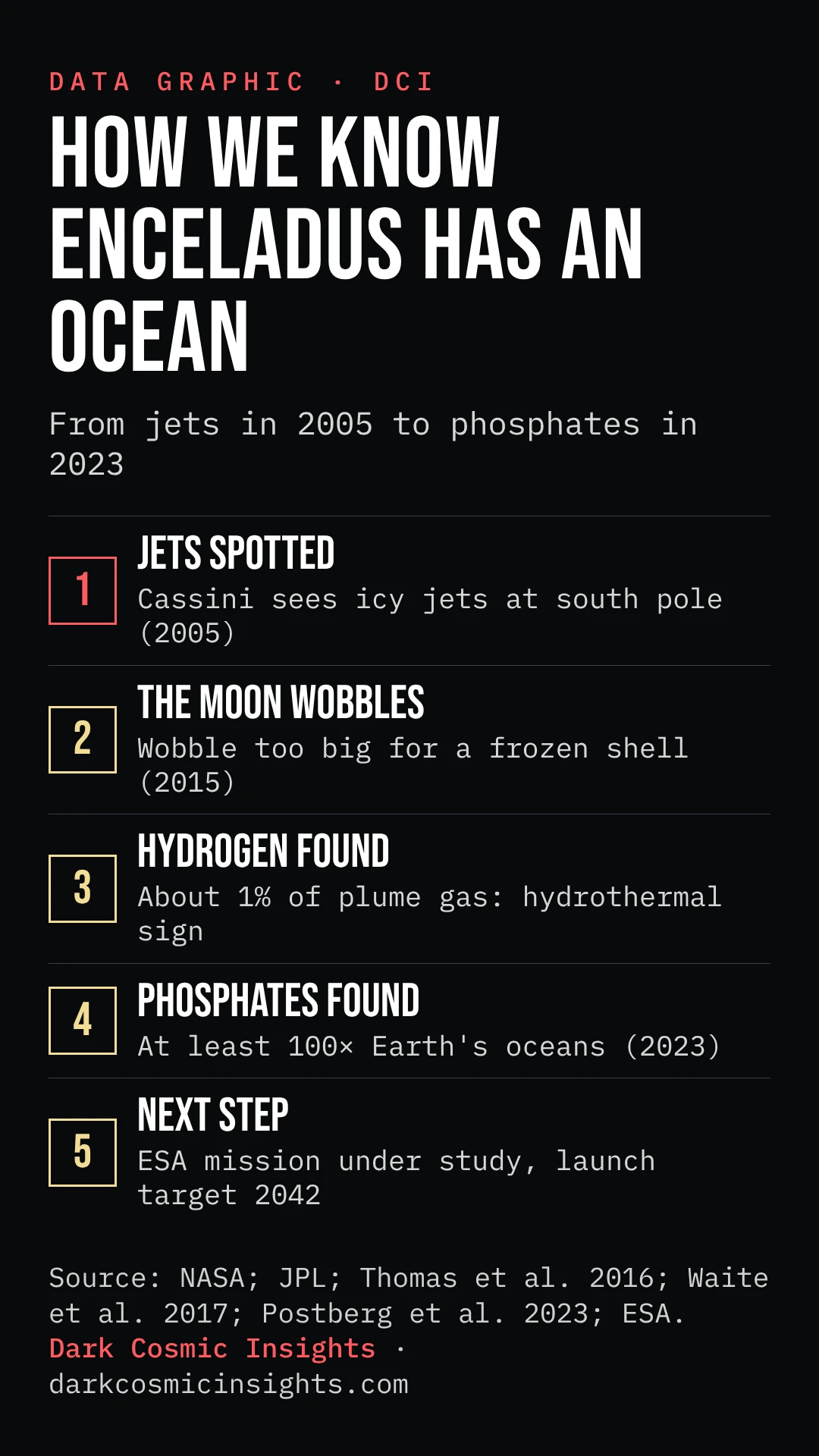
Does Mimas Have a Hidden Ocean?
Mimas is famous for its looks. NASA says its giant Herschel Crater, about 130 km (80 miles) across, roughly a third of the moon’s diameter, makes it resemble the Death Star from Star Wars (NASA Science, Mimas). The crater’s outer walls are about 5 km (3 miles) high.
NASA’s Mimas page still says it “appears to be frozen solid” (NASA). A 2024 study argues otherwise.
Clues in an orbit
Valéry Lainey and colleagues studied how Mimas’s orbit shifts over time using Cassini data, especially the slow drift of its closest point to Saturn (Lainey et al. 2024). Their conclusion, in the abstract’s words: Mimas’s “heavily cratered icy shell hides a global ocean, at a depth of 20–30 kilometres.” That’s about 12 to 19 miles down.
The team also argued the ocean is young. Because the orbit’s eccentricity (how oval it is) is still damping, they estimated the ocean is less than 25 million years old, and that it may have risen to within 30 km of the surface only in the last 2 to 3 million years, too recently to have cracked the surface (Lainey et al. 2024).
The ocean is inferred, not seen, and depends on an interior model; its youth would explain why the surface looks undisturbed. We list it as Modelled, and note that NASA’s Mimas page hasn’t yet caught up with the 2024 paper.
Why Does Iapetus Have Two Colors?
In 1671, Giovanni Cassini discovered Iapetus and noticed something odd: he could see it only when it was on Saturn’s west side (NASA Science, Iapetus).
Spacecraft images show why. Iapetus is tidally locked, always keeping the same face toward Saturn, and its two hemispheres are wildly different. NASA describes the leading hemisphere, the side facing forward in its orbit, as “as dark as coal,” with an albedo (the fraction of light reflected) of 0.03 to 0.05. The trailing hemisphere is far brighter, at 0.5 to 0.6 (NASA Science, Iapetus).
Where the dark side came from
NASA lists three ideas: dust from the distant moon Phoebe, ice volcanism, and thermal segregation, which Cassini’s September 2007 flyby suggested is most likely (NASA).
A 2010 model combines the first and third. John Spencer and Tilmann Denk proposed in 2010 that the process was “exogenically triggered”: dark dust from outside darkens the leading side, which then absorbs more sunlight and warms up (Spencer & Denk 2010). Ice in the warmer dark terrain evaporates and refreezes on colder, brighter areas, so dark gets darker and bright gets brighter. Iapetus’s slow spin, longer than 79 days, gives each patch of ground long days to heat up (NASA).
The ring that supplies the dust
In 2009, NASA’s Spitzer Space Telescope found a vast, faint dust ring far outside the main rings. JPL says its bulk starts about 6 million km (3.7 million miles) from Saturn and extends roughly another 12 million km (7.4 million miles) outward (NASA JPL, Oct 6, 2009). Phoebe orbits inside it and is the likely source, and dust drifting inward from it may strike Iapetus (Verbiscer, Skrutskie & Hamilton 2009).
Why Does Hyperion Look Like a Sponge?
NASA describes Hyperion as potato-shaped, about 410 × 260 × 220 km (255 × 163 × 137 miles), with deep craters that give it “a curiously punched-in look,” like a sponge or a wasp nest (NASA Science, Hyperion). William Lassell and, independently, William Cranch Bond and George Phillips Bond found it in 1848 (NASA).
The sponge look fits its density. JPL lists Hyperion at about 0.54 g/cm³ (JPL SSD). NASA says that could mean water ice with more than 40% porosity, so it’s partly empty space (NASA).
It also doesn’t spin steadily. NASA says Hyperion rotates chaotically, turning roughly every 13 days during its 21-day orbit (NASA). Hyperion’s orbit is also more oval than its big neighbours’: JPL gives it an eccentricity of 0.105, against 0.029 for Titan, where 0 is a perfect circle (JPL SSD, mean elements).
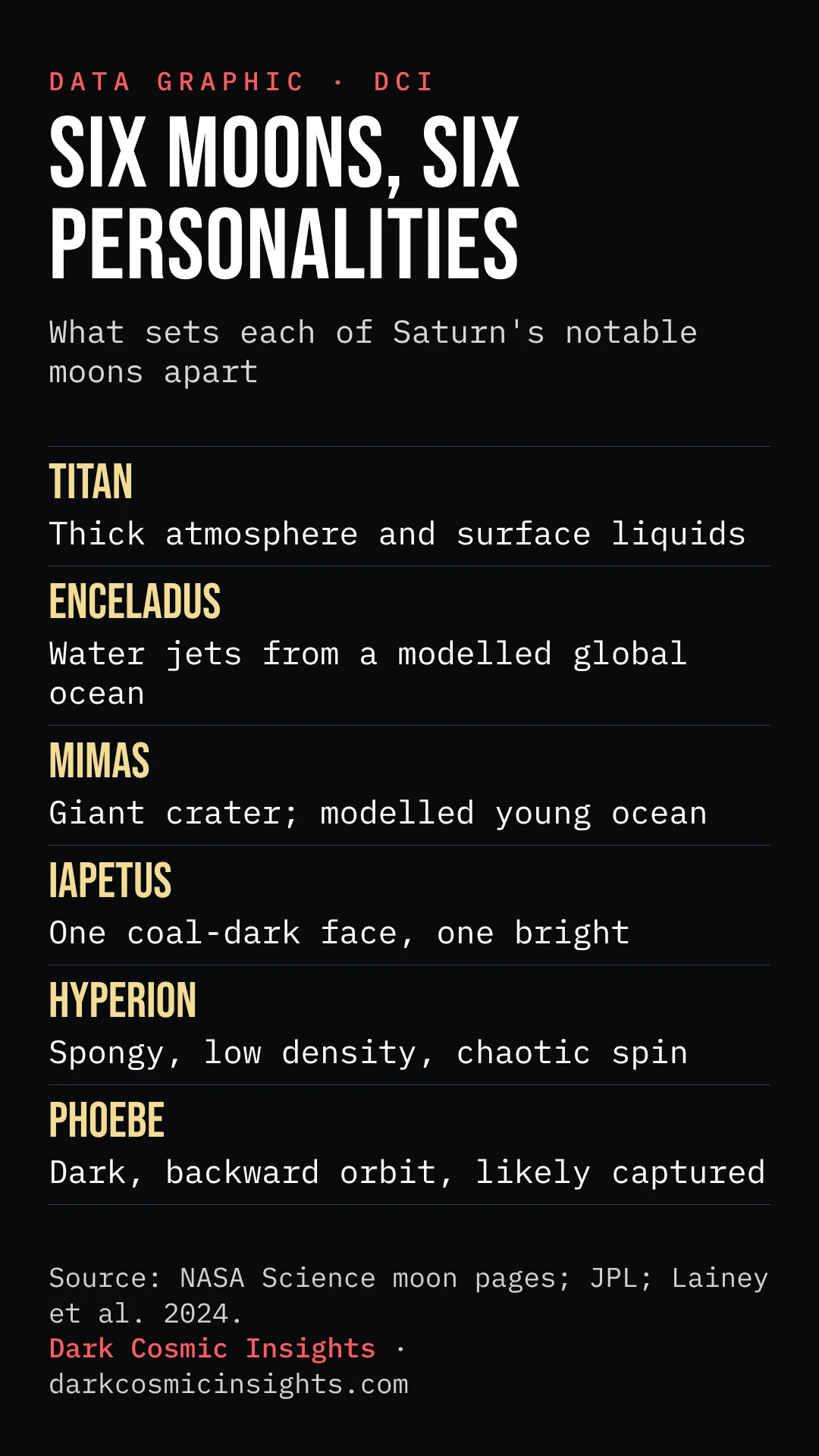
What Are Shepherd Moons?
Small moons that keep Saturn’s ring material in line are called shepherd moons.
Moons that hold gaps open
- Pan orbits inside the Encke Gap, a roughly 325 km (200 mile) opening in Saturn’s A ring, about 134,000 km (83,000 miles) from the planet. NASA says it acts as a shepherd, helping keep the gap open. An equatorial ridge gives it a “distinctive flying saucer shape” (NASA Science, Pan).
- Daphnis orbits in the Keeler Gap, near the A ring’s outer edge. Ripples along the gap’s edge predicted a moon there, and the Cassini team found it on May 1, 2005 (NASA Science, Daphnis). Its gravity raises waves in the gap’s edges.
Moons on either side of a ring
Saturn’s thin F ring has two moons beside it. Cassini’s “Four Moons” image shows Prometheus, about 86 km across, and Pandora, about 81 km across, “just inside and outside” the F ring, their gravity shaping it (NASA Photojournal, PIA17157). NASA’s Prometheus page says it constrains the ring’s inner edge, while its Pandora page says Pandora “tends to disrupt” the ring (NASA, Prometheus; NASA, Pandora).
Two moons that swap places
Just outside the main rings, Janus and Epimetheus share almost the same orbit, one about 50 km (31 miles) farther out than the other. Every four Earth years, the inner, faster moon catches up and their gravity makes them swap inner and outer orbits (NASA Science, Epimetheus).
Moonlets inside the rings
Wikipedia’s summary of the research says more than 150 moonlets embedded in the rings have been detected from the disturbances they cause, likely only a small sample (Wikipedia, Moons of Saturn). Most aren’t counted among the 293.
Where Did Saturn’s Irregular Moons Come From?
The University of British Columbia team behind the 128 moons announced in March 2025 describes them as small objects, a few kilometres across, that Saturn captured early in the solar system’s history (UBC, March 2025). They are likely fragments of a smaller number of original captured moons, broken apart by collisions with other Saturnian moons or passing comets.
Phoebe, the big one
Phoebe is the largest of them, about 213 km (132 miles) across (JPL SSD). William Pickering discovered it in August 1898 (NASA Science, Phoebe). It orbits backwards (a retrograde orbit), takes about 550 days, roughly 18 months, per orbit (JPL SSD), and reflects only about 6% of the sunlight that hits it. NASA says its darkness and retrograde orbit suggest it’s a captured object from the outer solar system, possibly a Centaur, a body thought to have migrated inward from the Kuiper Belt (NASA).
It was Cassini’s first target on arrival in June 2004 (NASA). Sources differ slightly on its distance: JPL’s mean elements give 12,929,400 km (about 8.03 million miles) (JPL SSD), NASA’s Phoebe page about 12,952,000 km (8,049,668 miles). Both round to about 13 million km.
Families with themes
The irregular moons cluster into families with similar orbits, a clue to shared parent bodies, and their names follow the families. The IAU says Saturn’s newest moons will take names from Gallic, Inuit and Norse mythologies (IAU, March 26, 2026). Scott Sheppard of Carnegie Science describes Inuit and Gallic groups on prograde orbits (Carnegie Science); the Norse group is retrograde (Wikipedia).
A recent smash-up?
The UBC team also suggests at least one collision happened in the Saturn system within the last 100 million years, likely in the Mundilfari subgroup (UBC). That’s modelled: it’s inferred from orbits clustering together, like debris from one broken rock.
Jupiter’s outer moons tell a similar story; see how many moons Jupiter has.
How Do We Know? Cassini, Huygens and the Telescope Surveys
Centuries of telescopes
The big moons were found from Earth, from Titan in 1655 to Phoebe in 1898, the discovery years given throughout this article (JPL SSD).
Cassini and Huygens
The Cassini-Huygens mission, a joint NASA, ESA and Italian Space Agency (ASI) project, launched on October 15, 1997, and arrived at Saturn on June 30, 2004 (NASA JPL; ESA). It ended on September 15, 2017, with a plunge into Saturn’s atmosphere.
NASA’s tally of the mission: 294 orbits, 162 targeted flybys of Saturn’s moons, 453,048 images, 635 GB of science data and 6 named moons discovered (NASA, Cassini-Huygens by the Numbers). Those flybys produced most of the close-up evidence in this article. Cassini studied Saturn itself, too, including the six-sided pattern around its north pole; see Jupiter’s polar cyclones vs. Saturn’s hexagon.
Many Cassini images online are processed or shown in false color; Are Space Photos Real? explains how to read the labels.
Modern telescope surveys
The small outer moons are a ground-based story. The 128 moons announced in March 2025 came from the Canada-France-Hawaii Telescope, with the team combining multiple images to strengthen each faint signal (UBC). The IAU’s Minor Planet Center then confirms each orbit before a moon counts (IAU, March 26, 2026).
What Is Still Unknown About Saturn’s Moons?
These are the big open questions.
How old are the rings?
Using the final measurements from Cassini’s Cosmic Dust Analyzer, Sascha Kempf and colleagues characterised the micrometeoroid dust falling into the Saturn system, the dust that slowly pollutes the rings. The measured flux implies the rings have been exposed for roughly 100 to 400 million years, supporting a recent origin (Kempf et al. 2023). In December 2024, Ryuki Hyodo and colleagues published computer simulations suggesting fast impacts vaporise much of that dust before it can stick, so the rings could look young yet be about as old as Saturn, roughly 4.5 billion years (Hyodo et al. 2024; Scimex summary). Neither paper settles it.
How thick is Enceladus’s ice, and how deep is its ocean?
NASA gives ranges for the shell, 1 to 5 km at the south pole and 20 to 25 km on average, but its Enceladus page gives no figure for the ocean’s depth (NASA Science, Enceladus). Those numbers are among the questions a future mission, such as the one ESA is studying, could address.
Is Mimas’s ocean real?
The ocean is still inferred rather than seen. The 2024 study is a strong line of evidence and other work also supports a young ocean, but its properties, such as depth and age, need further testing.
Myth vs. Fact: Saturn’s Moons
| Myth | Fact |
|---|---|
| “Saturn has a few dozen moons.” | It has 293 known moons, as of November 2026 (JPL). |
| “Enceladus has life.” | No life has been detected. Cassini found water, ingredients and a possible energy source. |
| “Scientists have seen the ocean on Enceladus.” | The global ocean is inferred from the moon’s wobble; the jets are what’s observed. |
| “Mimas is frozen solid.” | A 2024 study models a young ocean 20 to 30 km down. NASA’s page still says “frozen solid.” |
| “Iapetus is painted half black by Phoebe alone.” | Dust probably starts it; ice migration in sunlight makes the contrast extreme (modelled). |
How Can You See Saturn’s Moons Yourself?
- When to look. Saturn reached opposition, when it’s opposite the Sun in our sky and visible all night, on October 4, 2026, shining at about magnitude 0.3 in the constellation Cetus (EarthSky, Oct 4, 2026). EarthSky calls late August through October the best viewing period. The rings, edge-on in March 2025, are opening again.
- Titan with binoculars. Sky at Night gives Titan a brightness of about magnitude +8.4, within reach of binoculars (Sky at Night).
- Rhea, Tethys and Dione with a small telescope. The same guide lists Rhea at about +9.7, Tethys at +10.3 and Dione at +10.4 (on dark nights) for a 3-inch refractor.
- Watch Iapetus change. Iapetus varies from about +10.1 to +11.9 depending on which hemisphere faces us (Sky at Night); Astronomy gave about 11 to 12 in August 2026 (Astronomy). Track it for a few weeks and you’re repeating Cassini’s 1671 puzzle.
- Use free tools. EarthSky suggests Stellarium-Web or timeanddate.com for rise and set times (EarthSky).
What Comes Next: Dragonfly and an Enceladus Mission
- Dragonfly to Titan. NASA’s rotorcraft lander is planned to launch no earlier than July 2028 and arrive at Titan in late 2034, for a planned surface mission of 3.3 years, per NASA’s mission page dated October 29, 2026, which lists it as a “Future Mission” (NASA Science, Dragonfly).
- ESA’s Enceladus mission. ESA’s L4 mission to Enceladus is under study, with an orbiter and what ESA’s study team calls “the first landing attempt on Enceladus” (Helbert et al., EGU26-2724, 2026). ESA’s mission page lists its status as “Future” and a launch target of 2042, on two Ariane 6 rockets (ESA). Study is not approval.
- More moons. New Minor Planet Center circulars will keep adjusting the count.
Saturn’s Moons by the Numbers
- 293: known moons of Saturn, as of November 2026 (JPL SSD)
- About 5,150 km (3,200 miles): Titan’s mean diameter, twice JPL’s mean radius of 2,574.76 km (JPL)
- About 504 km (313 miles): Enceladus’s mean diameter (JPL)
- About 400 m/s (about 900 mph; our conversion): speed of the Enceladus jets (NASA)
- About −201°C (−330°F, about 72 K): Enceladus’s surface temperature (NASA; kelvin ours)
- 20 to 25 km (12 to 16 miles): average thickness of Enceladus’s ice shell (NASA)
- 20 to 30 km (12 to 19 miles): modelled depth to Mimas’s ocean (Lainey et al. 2024)
- 0.03 to 0.05 vs. 0.5 to 0.6: albedo of Iapetus’s dark vs. bright hemisphere (NASA)
- About 12.9 million km (8 million miles): Phoebe’s average distance from Saturn (JPL)
- 162: Cassini’s targeted flybys of Saturn’s moons (NASA)

Saturn’s Moons: FAQ
What is Saturn’s current moon count?
As of November 2026, NASA JPL lists 293 known moons of Saturn. The count changes as the Minor Planet Center confirms faint new moons, so check the date on any figure you see.
Which of Saturn’s moons is the largest?
Titan, about 5,150 km (3,200 miles) across, is Saturn’s largest moon and bigger than the planet Mercury. It is the only moon known to have a substantial atmosphere, and it has lakes and seas of liquid methane and ethane.
Is there really liquid water inside Enceladus?
Very probably. Cassini saw water-rich jets at its south pole, and the moon’s measured wobble requires a global liquid layer between the ice shell and the rocky core. The ocean itself hasn’t been seen, so it remains an inference.
Has anyone found life on Saturn’s moons?
No. Cassini found that Enceladus has liquid water, phosphates and hydrogen that microbes could in principle use for energy. Those are ingredients for habitability, not evidence of life.
Why is one side of Iapetus so dark?
Dark dust, probably from a vast faint ring fed by Phoebe, settles on the side of Iapetus facing forward in its orbit. The darkened ground warms, its ice moves to colder, brighter areas, and the contrast grows.
Why does Mimas look like the Death Star?
Mimas has a giant impact crater, Herschel, about 130 km (80 miles) wide, roughly a third of the moon’s own diameter. The crater’s high walls and central peak give it the famous look.
What do shepherd moons do?
They are small moons whose gravity shapes Saturn’s rings. Pan and Daphnis keep gaps open in the A ring, while Prometheus and Pandora orbit just inside and outside the narrow F ring.
Will a spacecraft go back to Saturn’s moons?
Yes, if plans hold. NASA’s Dragonfly rotorcraft is planned to launch no earlier than July 2028 and reach Titan in late 2034, and ESA is studying an Enceladus orbiter and lander with a launch target of 2042.
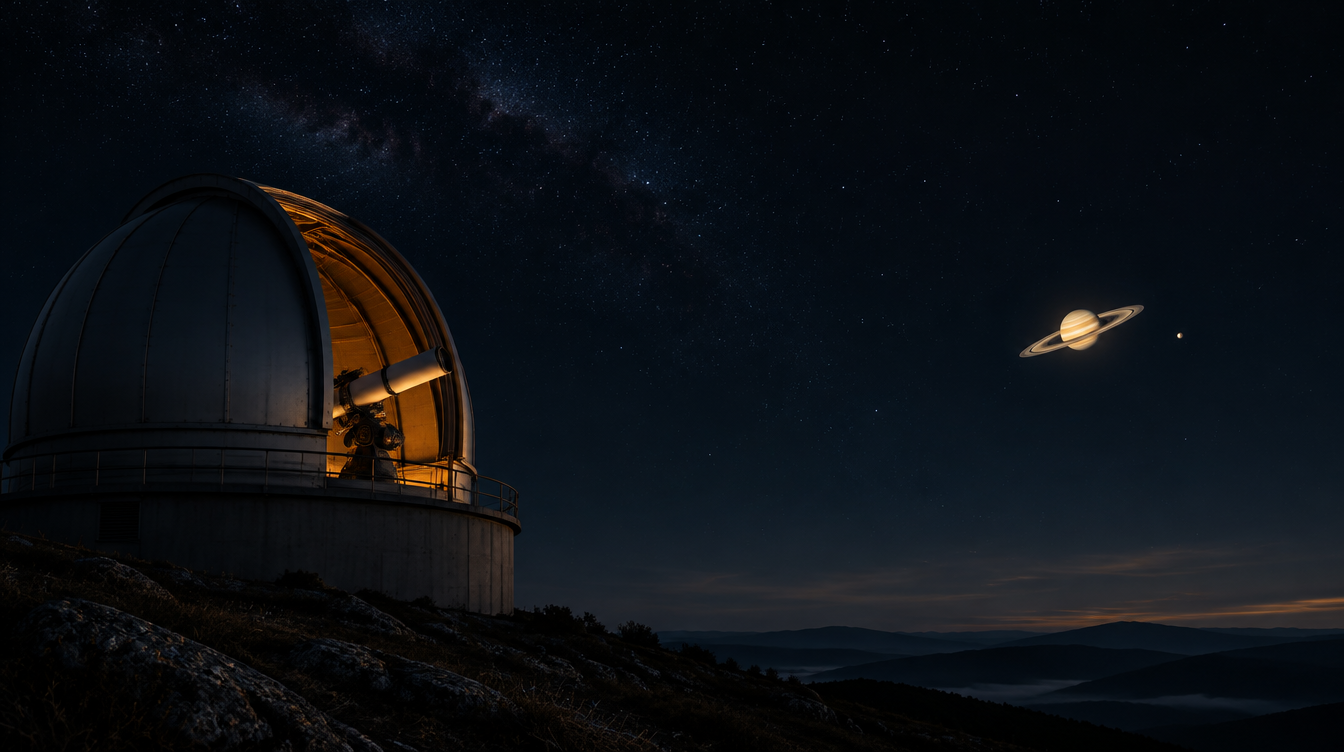
Your next step: on a clear night, find Saturn and look for the faint “star” beside it with binoculars. That may well be Titan. Then check JPL’s satellite discovery list to see whether the count has moved.
Sources and Further Reading
- NASA JPL Solar System Dynamics (checked November 2026), Planetary Satellite Discovery Circumstances; Planetary Satellite Physical Parameters; Planetary Satellite Mean Elements.
- NASA Science (updated September 22, 2026), Saturn Moons; NASA Science moon pages: Titan, Enceladus, Mimas, Iapetus, Hyperion, Phoebe, Pan, Daphnis, Prometheus, Pandora, Epimetheus.
- Porco, C. C., Helfenstein, P., Thomas, P. C., Ingersoll, A. P., et al. (2006). Cassini Observes the Active South Pole of Enceladus. Science, 311, 1393–1401. doi:10.1126/science.1123013
- Thomas, P. C., Tajeddine, R., Tiscareno, M. S., Burns, J. A., et al. (2016). Enceladus’s measured physical libration requires a global subsurface ocean. Icarus, 264, 37–47. doi:10.1016/j.icarus.2015.08.037; NASA JPL (September 15, 2015), Cassini Finds Global Ocean in Saturn’s Moon Enceladus.
- Waite, J. H., Glein, C. R., Perryman, R. S., Teolis, B. D., et al. (2017). Cassini finds molecular hydrogen in the Enceladus plume: Evidence for hydrothermal processes. Science, 356(6334), 155–159. doi:10.1126/science.aai8703; NASA (April 13, 2017), NASA Missions Provide New Insights into ‘Ocean Worlds’.
- Postberg, F., Sekine, Y., Klenner, F., Glein, C. R., et al. (2023). Detection of phosphates originating from Enceladus’s ocean. Nature, 618, 489–493. doi:10.1038/s41586-023-05987-9; University of Washington (June 14, 2023), Phosphate, a key building block of life, found on Saturn’s moon Enceladus.
- Lainey, V., Rambaux, N., Tobie, G., Cooper, N., et al. (2024). A recently formed ocean inside Saturn’s moon Mimas. Nature, 626, 280–282. doi:10.1038/s41586-023-06975-9
- Spencer, J. R., & Denk, T. (2010). Formation of Iapetus’ Extreme Albedo Dichotomy by Exogenically Triggered Thermal Ice Migration. Science, 327, 432–435. doi:10.1126/science.1177132
- Verbiscer, A. J., Skrutskie, M. F., & Hamilton, D. P. (2009). Saturn’s largest ring. Nature, 461, 1098–1100. doi:10.1038/nature08515; NASA JPL (October 6, 2009), NASA Space Telescope Discovers Largest Ring Around Saturn.
- Kempf, S., Altobelli, N., Schmidt, J., Cuzzi, J. N., Estrada, P. R., & Srama, R. (2023). Micrometeoroid infall onto Saturn’s rings constrains their age to no more than a few hundred million years. Science Advances, 9(19), eadf8537. doi:10.1126/sciadv.adf8537
- Hyodo, R., Genda, H., & Madeira, G. (2024). Pollution resistance of Saturn’s ring particles during micrometeoroid impact. Nature Geoscience, 18, 44–49. doi:10.1038/s41561-024-01598-9; Scimex, How Saturn’s rings might be keeping a youthful appearance.
- University of British Columbia (March 2025), Saturn still reigns supreme as moon king with 128 new moons.
- International Astronomical Union (March 26, 2026), MPC Announces New Moons of Saturn and Jupiter; Scott Sheppard, Carnegie Science, Saturn moons.
- NASA JPL, Cassini-Huygens mission page; NASA Science, Cassini-Huygens by the Numbers; ESA, Cassini-Huygens.
- NASA Science (page dated October 29, 2026), Dragonfly; ESA, L4 to Enceladus; Helbert, J., et al. (2026), The Mission to Enceladus: The ESA L4 mission, EGU General Assembly 2026, EGU26-2724.
- EarthSky (October 4, 2026), Saturn at opposition; BBC Sky at Night Magazine, How to observe Saturn’s moons; Klesman, A., Astronomy (August 5, 2026), The Sky Today: Iapetus at superior conjunction.
- NASA Photojournal, Worlds in Orbit (PIA08161); Fountains of Enceladus (PIA07758); Four Moons (PIA17157).
- Wikipedia, Moons of Saturn. Used only for the list of seven major moons, the regular/irregular split, the ring-moonlet tally and the Norse group’s retrograde motion.
Explore Next
- The full, dated moon count for every planet: Which Planet Has the Most Moons?
- Saturn’s biggest moon, up close: NASA’s Dragonfly Mission to Titan
- Weather at the top of the giants: Jupiter’s Polar Cyclones vs. Saturn’s Hexagon
- Another giant’s moon family: How Many Moons Does Jupiter Have?
- Mars’s two small, dark moons: How Many Moons Does Mars Have?
- How to read spacecraft images: Are Space Photos Real?
- How a claim earns its label: How We Know
- More from the planets: Planets & Moons
- Triton’s backwards orbit and Neptune’s moons: How Many Moons Does Neptune Have?
- The two planets with no known moons: Why Don’t Mercury and Venus Have Moons?
How This Explainer Was Checked
Every number in this article was checked in November 2026 against the source linked beside it: NASA JPL’s satellite tables, NASA Science moon and mission pages, JPL and NASA news releases, ESA mission pages, and peer-reviewed papers, with DOIs given (paper details confirmed through Crossref records). The moon count is JPL’s, dated; NASA’s Saturn Moons page shows the same count in its text but an older figure in its search summary, and we say so. Diameters are DCI’s doubling of JPL’s mean radii, which is why they differ slightly from NASA’s rounded figures (NASA gives Iapetus a 736 km radius against JPL’s 734.3 km, for example); mile and kelvin conversions are DCI’s arithmetic unless the source gave them. Where sources differ, as for Phoebe’s distance, we show both. Oceans inferred from wobbles or orbits are labelled Modelled, and the Mimas ocean is shown alongside NASA’s older “frozen solid” wording. The age of Saturn’s rings is labelled Open, with both competing studies cited. Mission dates are the agencies’ planned schedules, dated, and ESA’s Enceladus mission is described as under study. Wikipedia was used only for the few details listed in the sources, never as the only support for a key claim. Images are labelled: real spacecraft images as OBSERVATION, illustrations as ILLUSTRATION, and our charts as DATA GRAPHIC. Nothing AI-generated is presented as a real image.
Final Thought: A Planet of Many Worlds
Saturn’s moon count will keep climbing, and it will always need a date. The lasting story is in the handful of moons we’ve seen up close. A small moon sprays its ocean into space. A cratered moon may be hiding a sea less than 25 million years old. A two-faced moon puzzled the astronomer who found it for decades, and a spongy one never settles into a spin. Cassini turned dots in a telescope into places. The next step, Dragonfly at Titan and perhaps a lander on Enceladus, is to visit them again and test what we’ve inferred.
About the Author
Author: King | Founder of Dark Cosmic Insights
King is the founder of Dark Cosmic Insights, a science storytelling platform exploring the strangest true stories hiding in space, science and AI. He digs into NASA, ESA and peer-reviewed research, separates what has been measured from what is still a mystery, and turns it into articles, data graphics and Shorts.
Follow the anomaly. Trace the source.