Every 42.5 hours, a moon of Jupiter gets squeezed so hard that its surface rises and falls by as much as 100 metres (330 feet). That moon is Io, and the squeezing helps explain why it has hundreds of volcanoes (NASA Science, Io Facts). It’s a good way into a bigger question: how many moons does Jupiter have, and what are they actually like?
The count is large and keeps changing. The better story is that Jupiter’s four big moons could hardly be more different: a volcano world, a likely ocean world, a moon wider than Mercury with its own magnetic field, and an ancient, battered survivor. Around them circles a swarm of small, captured rocks that astronomers are still finding.
Observed, modelled, open. Io’s eruptions, Ganymede’s magnetic field and the moons’ orbits are observed or measured. The oceans inside Europa, Ganymede and Callisto are modelled: inferred from magnetic and auroral data, not seen. Whether Europa is habitable, and whether it vents water plumes, is still open.
Quick Answer: How Many Moons Does Jupiter Have?
Jupiter has 115 known moons, as of November 2026, according to NASA JPL’s live satellite list (JPL Solar System Dynamics); NASA Space Place gives the same figure, “as of April 2026” (NASA Space Place). The four largest, the Galilean moons Io, Europa, Ganymede and Callisto, were discovered by Galileo in January 1610. Eight moons orbit close in; most of the rest are small, distant irregular moons, probably captured long ago. The count rises as surveys confirm fainter moons.
What this article can and cannot establish. It can give you a dated count, explain what makes each big moon distinct, and show the evidence behind each claim, including where that evidence is indirect. It cannot tell you whether Europa or Ganymede hosts life, because no mission has measured that, or what Jupiter’s “final” moon count will be, because nobody knows how many faint moons remain undiscovered.
Table of Contents
The DCI Evidence Map: Jupiter’s Moons
| Question | What we know | Status | Key source |
|---|---|---|---|
| How many moons does Jupiter have? | 115 known, as of November 2026 | Measured | JPL SSD |
| Is Io volcanically active? | Eruptions seen by Voyager 1 in 1979 and by later missions | Observed | NASA JPL, PIA00379 |
| What powers Io’s volcanoes? | Tidal flexing on an oval orbit, kept up by orbital resonance | Modelled | JPL, Dec 2024 |
| Does Io have a shallow global magma ocean? | Juno’s measured tidal response rules one out | Measured | Park et al. 2025 |
| Does Europa have a subsurface ocean? | Induced magnetic field best explained by salty water under ice | Modelled | Kivelson et al. 2000 |
| Does Europa vent water plumes? | Possible Hubble detections, not confirmed | Open | NASA, Sep 2016 |
| Has life been found on Europa? | No; missions are assessing habitability, not detecting life | Not supported | NASA Europa Clipper |
| Does Ganymede have its own magnetic field? | Yes, detected by Galileo in 1996 | Measured | Kivelson et al. 1996 |
| Does Callisto have an ocean? | Reanalysed Galileo data strengthen the case; not settled | Open | Cochrane et al. 2025 |
| Are the small outer moons captured? | Their orbits and family groupings point to capture, then collisions | Modelled | Sheppard & Jewitt 2003 |
Status key: Observed = seen directly in images or data. Measured = a number or detection with stated uncertainty. Modelled = inferred from measurements through a physical model, dependent on assumptions. Open = unresolved; the evidence is incomplete or points different ways. Not supported = no evidence for the claim.
Cite this framework: “DCI Evidence Map: Jupiter’s Moons,” Dark Cosmic Insights, November 2026, darkcosmicinsights.com/how-many-moons-does-jupiter-have/.
How Many Moons Does Jupiter Have, and Why Does the Number Keep Moving?
When we checked NASA JPL’s satellite discovery list on November 8, 2026, it listed 115 moons of Jupiter, the most recent by discovery year being S/2024 J 1, credited to S. S. Sheppard and D. J. Tholen (JPL SSD). That’s our count: 115, as of November 2026.
Not every NASA page agrees yet. NASA’s main Jupiter Moons page still says 95 moons “officially recognized” by the IAU, a figure from before the 2025 and 2026 announcements (NASA Science, Jupiter Moons). The data moves faster than the web pages.
The number rises as astronomers confirm faint moons that were always there. For the dated comparison with Saturn and every other planet, see which planet has the most moons. Here, we focus on the moons themselves.
What Are the Moons of Jupiter?
The moons of Jupiter fall into three groups, from the planet outward.
- The inner moons. Metis, Adrastea, Amalthea and Thebe orbit inside Io’s orbit. They’re tiny: JPL lists Amalthea’s mean radius as 83.5 km (about 167 km or 104 miles across) and Adrastea’s as 8.2 km (JPL SSD, physical parameters).
- The four Galilean moons. Io, Europa, Ganymede and Callisto, on nearly circular orbits: JPL puts Io’s eccentricity at 0.004 and Ganymede’s at 0.001, where 0 is a perfect circle (JPL SSD, mean elements).
- The outer swarm. The other 107 moons, by DCI’s count (115 minus those eight), orbit far beyond Callisto. These irregular moons have distant, often steeply tilted and sometimes retrograde orbits, meaning they travel opposite to Jupiter’s spin. Carme, for example, is inclined 164.6° and takes about 719 days per orbit (JPL SSD, mean elements).
The split matters. Astronomers distinguish regular moons, which grew in orbit around their planet, from irregular ones, which probably didn’t (Sheppard & Jewitt 2003).
What Are the Galilean Moons?
The Galilean moons are Jupiter’s four largest, named for Galileo Galilei. NASA dates the discovery to January 7, 1610, when Galileo pointed a homemade telescope of about 20 power at Jupiter. By January 15 he had concluded that the shifting points of light were four moons, and he published the finding in March 1610 in Sidereus Nuncius (The Starry Messenger) (NASA, 415 Years Ago).
They were the first moons found beyond Earth (NASA Science, Jupiter Moons), and NASA calls the discovery strong evidence for the Copernican, Sun-centred view. The modern names came later. The German astronomer Simon Marius, who saw the moons at about the same time as Galileo, published Io, Europa, Ganymede and Callisto in his 1614 book Mundus Iovialis; he wrote that Johannes Kepler had suggested them (NASA, Galilean Moons lithograph). Astronomers mostly used Galileo’s Roman numerals instead, and the names didn’t catch on for more than 200 years (NASA, 415 Years Ago).
| Moon | Mean diameter | Distance from Jupiter | One orbit |
|---|---|---|---|
| Io | 3,643 km (2,264 mi) | 422,000 km (262,000 mi) | about 42.5 hours |
| Europa | 3,122 km (1,940 mi) | 671,000 km (417,000 mi) | about 3.5 days |
| Ganymede | 5,262 km (3,270 mi) | 1.07 million km (665,000 mi) | about 7.155 days |
| Callisto | 4,821 km (2,995 mi) | 1,883,000 km (1,170,000 mi) | about 16.689 days |
| Mercury, for scale | 4,879 km (3,032 mi) |
Diameters are DCI’s doubling of JPL’s mean radii (JPL SSD; Mercury from JPL). Distances and periods are NASA’s rounded figures (Io and JPL; Europa; Ganymede; Callisto). NASA rounds Europa to 3,100 km (1,940 miles) across, about 90% the size of Earth’s Moon.
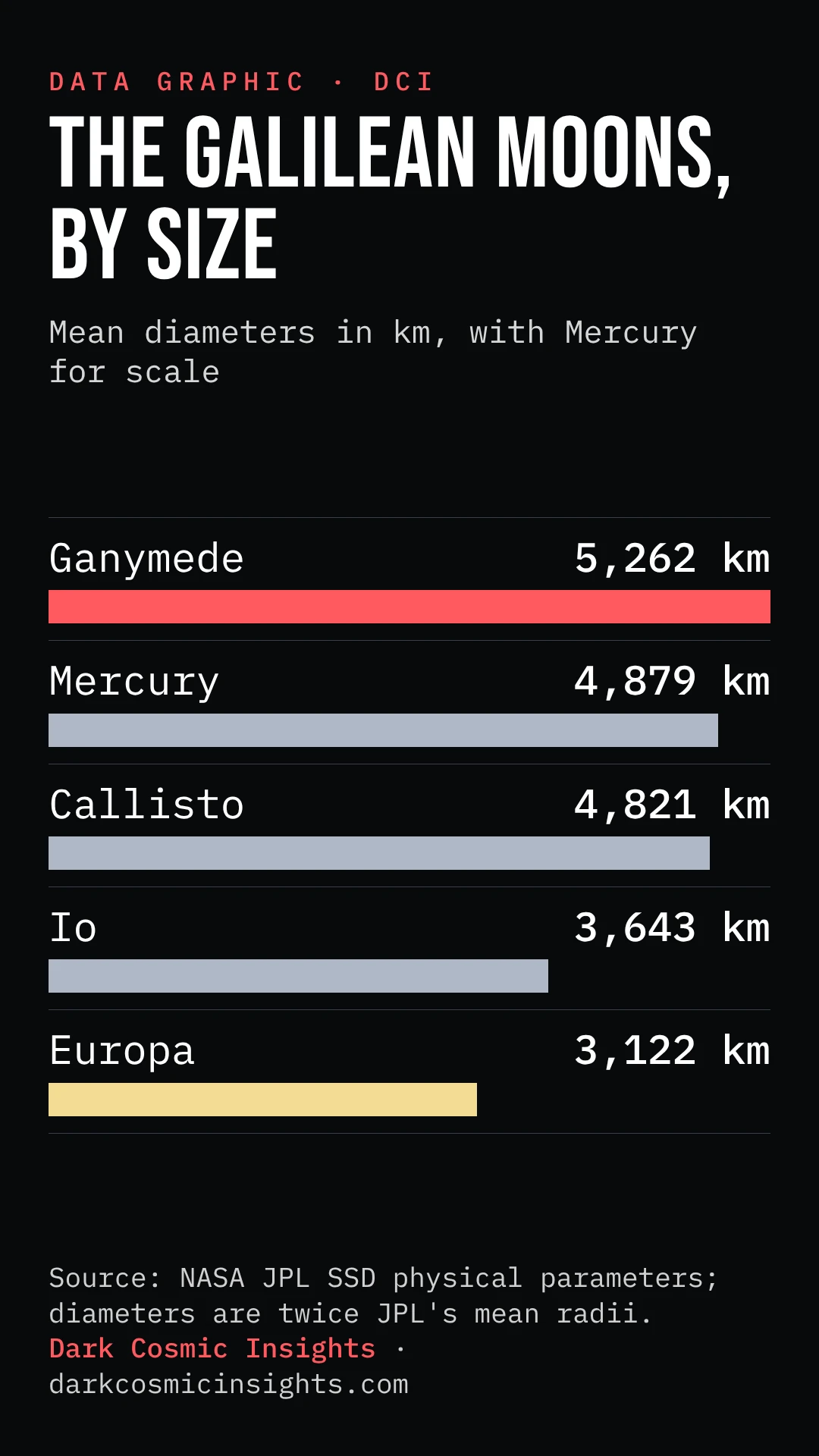
Ganymede is wider than the planet Mercury, and density falls with distance: JPL lists Io at 3.53 g/cm³ and Callisto at 1.83 g/cm³ (JPL SSD). Io is mostly rock; the outer two hold a lot of ice.
Why Does Io Have So Many Volcanoes?
JPL calls Io the most volcanic body in the solar system and credits it with “an estimated 400 volcanoes” (JPL, December 12, 2024; JPL, January 2025). Some of its lava fountains reach dozens of kilometres high, yet Io is only a bit larger than Earth’s Moon (NASA Io Facts). Where does the heat come from?
Tidal heating
The leading explanation is tidal heating: heat made inside a body by repeated stretching and squeezing. Io’s orbit isn’t a perfect circle, so its distance from Jupiter changes through each 42.5-hour lap, and Io flexes as Jupiter’s pull rises and falls. JPL describes the friction from that flexing as melting parts of the interior (JPL, December 2024). NASA puts the surface bulge at up to 100 m (330 ft), against about 18 m (60 ft) for Earth’s highest ocean tides (NASA Io Facts).
The Laplace resonance
The flexing only works because Io’s orbit stays slightly oval, and what keeps it that way is Io’s neighbours. NASA describes Io as caught in a tug-of-war between Jupiter and “precisely timed pulls” from Europa and Ganymede (NASA Science, Io).
That timing is an orbital resonance, a fixed ratio between orbital periods. Using NASA’s figures, Io orbits in about 1.77 days, Europa in about 3.5 and Ganymede in about 7.155. So the orbital periods of Io, Europa and Ganymede, in that order, run close to 1 : 2 : 4. For roughly every lap Ganymede makes, Europa makes two and Io four. Astronomers write it as the Laplace relation, n₁ − 3n₂ + 2n₃ = 0, where the n’s are the average orbital speeds of Io, Europa and Ganymede (Peale & Lee 2002, Science).
How the resonance formed is open. Peale and Lee proposed it could date from the moons’ birth, set up as they migrated through a disc of material around the young Jupiter, rather than later through Jupiter’s tides (arXiv version).
A prediction, then a discovery
Theory got there first. A paper titled “Melting of Io by Tidal Dissipation,” by S. J. Peale, P. Cassen and R. T. Reynolds, was published in Science on March 2, 1979 (Peale et al. 1979). Voyager 1 made its closest approach to Jupiter three days later, on March 5 (NASA Science, Voyager 1).
On an image taken March 8, 1979, JPL engineer Linda Morabito spotted a bright, curved cloud on Io’s edge: the first eruption seen beyond Earth, rising more than 260 km (150 miles) (NASA JPL, PIA00379). The discovery paper followed that June (Morabito et al. 1979).
What Juno found: no magma ocean
One model held that Io’s volcanoes drew on a shallow, global ocean of magma. NASA’s Juno tested it on flybys in December 2023 and February 2024, within about 1,500 km (930 miles) of the surface, by measuring how Io’s gravity flexes with the tides. The answer: Io’s tidal response rules out a shallow magma ocean (Park et al. 2025, Nature). JPL says each volcano is probably fed by its own chamber of hot magma (JPL, December 2024).
Juno also caught one well-measured outburst. On December 27, 2024, its JIRAM infrared camera recorded a hot spot covering about 100,000 sq km (40,000 sq mi), radiating more than 80 trillion watts; JPL quotes principal investigator Scott Bolton calling it “the most powerful volcanic event ever recorded” on Io (JPL, January 28, 2025). The team thinks it may be several hot spots erupting together.
Is There an Ocean on Europa?
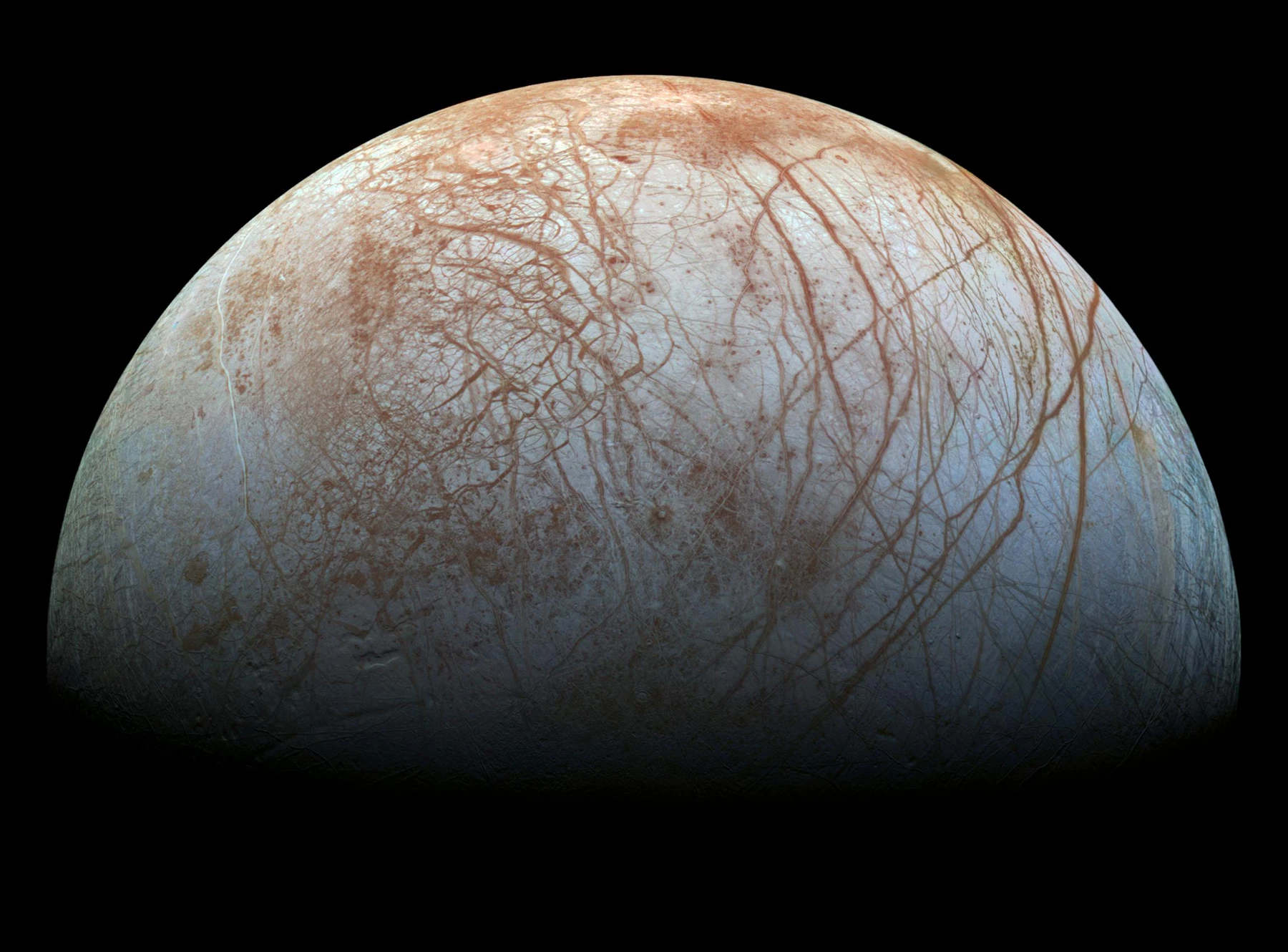
Europa is a bright ball of ice crossed by ridges and dark bands. NASA estimates the surface is no more than 40 to 90 million years old, and that the ice sits on an ocean that may hold about twice as much water as Earth’s global ocean (NASA Europa Facts). Nobody has seen that ocean. Here’s how it’s inferred.
The magnetic clue
From Europa’s point of view, Jupiter’s huge magnetic field keeps changing direction. If Europa holds a layer that conducts electricity, that changing field induces currents in it, which produce a secondary magnetic field.
NASA’s Galileo orbiter measured that kind of signature. A 1998 study argued that induced fields were evidence for oceans in Europa and Callisto (Khurana et al. 1998, Nature). Then, on a January 2000 flyby, Jupiter’s field at Europa pointed opposite to earlier passes, and Europa’s induced field flipped as an ocean model predicted (JPL, August 25, 2000; Kivelson et al. 2000, Science). Ice conducts poorly, so the best candidate is salty liquid water.
It’s indirect: Galileo project scientist Torrence Johnson noted that gravity and tidal measurements would be needed for a definitive answer (JPL, 2000). NASA still calls the magnetic result the best evidence for the ocean (NASA Europa Facts). Hence Modelled.
How thick is the ice?
Estimates differ, partly because they measure different things.
- NASA’s general estimate: a shell 15 to 25 km (10 to 15 miles) thick over an ocean 60 to 150 km (40 to 100 miles) deep (NASA Europa Facts).
- Juno’s microwave measurement: on a September 29, 2022 flyby at about 360 km (220 miles), Juno’s Microwave Radiometer found that the cold, heat-conducting outer layer averages 29 ± 10 km (about 18 ± 6 miles) thick in the region it observed, roughly half the surface. That figure assumes the shell is pure water ice (JPL, January 27, 2026; Levin et al., Nature Astronomy).
Juno’s figure has stated caveats. A warmer, convecting layer beneath could make the total shell thicker, and dissolved salt would cut the estimate by about 3 miles (about 5 km) (JPL, January 2026). So the ice thickness is still a range.
Does Europa vent plumes?
Possibly. In 2016, a Hubble team reported what may be water vapour plumes, seen as silhouettes when Europa crossed Jupiter’s face. They saw possible plumes in 3 of 10 transits over 15 months, rising an estimated 200 km (125 miles). NASA’s release noted that a second team using another method hadn’t detected them at the same time, and that any plumes could be highly variable (NASA, September 26, 2016). Status: Open.
Could There Be Life on Europa?
What’s known. NASA says scientists believe a saltwater ocean lies beneath Europa’s ice and that the moon may also have the chemical elements key to life (NASA Science, Europa).
What hasn’t been found. Life, or any direct sign of it. NASA’s Europa Clipper is built for a narrower question: its stated objective is to determine whether Europa has conditions suitable to support life (NASA Europa Clipper). That’s habitability, not life detection. A habitable ocean could still be empty.
What matters next. How surface chemicals reach the water: Juno’s ice team concluded that small cracks and pores near the surface are unlikely to be a major pathway for oxygen and nutrients (JPL, January 2026).
So the claim that life has been found on Europa is Not supported; the claim that Europa could be habitable is Open.
What Makes Ganymede Different From Every Other Moon?
Ganymede is the largest moon in the solar system, about 5,260 km (3,270 miles) across in NASA’s rounding, bigger than Mercury and Pluto (NASA Ganymede Facts). Its real distinction is magnetic.
A moon with its own magnetosphere
NASA calls Ganymede “the only moon known to have its own magnetic field” (NASA Science, Ganymede). Galileo found it on flybys on June 27 and September 6, 1996: its plasma wave instrument detected a magnetosphere (a bubble of space controlled by a body’s own field), and its magnetometer recorded a large jump in field strength (JPL, December 12, 1996; Kivelson et al. 1996, Nature). The field also gives Ganymede auroras circling its poles.
An ocean revealed by auroras
As Jupiter rotates, its tilted magnetic field sweeps back and forth, and Ganymede’s auroral ovals rock with it. A salty, conducting ocean would push back and damp the rocking. In 2015, a team led by Joachim Saur of the University of Cologne used Hubble to watch: the ovals rocked about 2 degrees, not the 6 degrees expected without an ocean (NASA, March 12, 2015; Saur et al. 2015).
NASA estimates the ocean is about 100 km (60 miles) thick under roughly 150 km (95 miles) of mostly ice crust (NASA Ganymede Facts). Those depths come from models, so: Modelled.
Ganymede up close
Daytime temperatures run 90 to 160 K (about −183 to −113 °C; NASA gives −297 to −171 °F) (NASA Ganymede Facts). Juno flew within 652 miles (about 1,049 km) of Ganymede on June 7, 2021 (NASA Science, Juno).
Why Is Callisto So Heavily Cratered?
Callisto is the outermost Galilean moon and the odd one out. NASA calls it “the most heavily cratered object in our solar system” (NASA Science, Callisto), with a surface about 4 billion years old (NASA Callisto Facts).
A surface stays cratered when nothing erases the scars. Callisto orbits about 1,883,000 km (1,170,000 miles) out, and it isn’t part of the Laplace relation, which links only Io, Europa and Ganymede (Peale & Lee 2002). Without a resonant partner forcing its orbit, it lacks the mechanism that keeps Io molten.
A buried ocean anyway?
Callisto may still hide water. The 1998 Galileo study that pointed to Europa’s ocean found an induced signal at Callisto too (Khurana et al. 1998), but its dense ionosphere (a layer of electrically charged gas) could mimic an ocean’s magnetic fingerprint. In 2025, Corey Cochrane’s team reanalysed data from all eight of Galileo’s close Callisto flybys; Eos reported their finding that the ionosphere alone “cannot explain all existing observations” (Eos, February 18, 2025; Cochrane et al. 2025). Their models suggest an ocean at least tens of kilometres thick. NASA’s fact page places it perhaps 250 km (155 miles) below the surface. Stronger, not closed: Open.

What Are Jupiter’s Small Inner Moons?
The four inner moons solve a mystery: where Jupiter’s rings come from. Amalthea was found in 1892 by E. E. Barnard; Thebe, Metis and Adrastea were found in 1979 by the Voyager science team (JPL SSD). That year, Voyager 1 also discovered Jupiter’s faint rings (NASA Science, Voyager 1).
Galileo explained them in 1998: the rings are dust knocked off these small moons by meteoroid impacts. The main ring is likely fed by Adrastea and Metis, and the fainter gossamer rings by Amalthea and Thebe, whose tilted orbits make those rings thicker (JPL, September 15, 1998; JPL, PIA01627).
Where Did Jupiter’s Small Outer Moons Come From?
Himalia, one of the outer swarm’s bigger members, has a mean radius of about 85 km (roughly 170 km or 106 miles across) (JPL SSD); the moons announced in March 2026 average about 3 km (1.9 miles) (Space.com, March 20, 2026). Far out in that swarm, S/2003 J 23 orbits at an average 23,824,000 km (about 14.8 million miles), on a retrograde orbit inclined 144.4°, taking about 751 days per lap (JPL SSD, mean elements).
Captured, then shattered
In 2003, Scott Sheppard and David Jewitt reported 23 new irregular moons of Jupiter in Nature, and summarised the standard view: such moons were probably captured early in the solar system’s history from orbits around the Sun, by a mechanism that’s still uncertain (Sheppard & Jewitt 2003).
They also found the moons cluster into groups, each dominated by one larger body, most likely pieces of a few captured objects shattered by collisions. Sheppard’s moon pages call these “obvious dynamical groupings” (Carnegie Science, Sheppard). One 2018 find, Valetudo, likely under 1 km across, orbits prograde while crossing the retrograde moons’ paths, an “unstable situation” in Sheppard’s words that makes head-on collisions likely (Carnegie Science, July 16, 2018). The collision history is Modelled: inferred from orbits, not from visiting a fragment.
Why Are Astronomers Finding So Many New Jupiter Moons Now?
Because the moons left to find are extremely faint.
- Deeper surveys. The moons announced in March 2026 shine at magnitude 25 to 27. They were found with the 6.5 m Magellan–Baade telescope in Chile and the 8 m Subaru telescope in Hawaii (Space.com, March 2026).
- Searches for other targets. The 12 moons announced in 2018 turned up in a hunt for a distant planet beyond Pluto, mostly spotted with the 4 m Blanco telescope in Chile (Carnegie Science, 2018).
- Patience. Old sightings get linked to new ones: one moon’s track, S/2003 J 10, was extended to 18 years (Sky & Telescope, 2023).
How a new moon gets confirmed and named
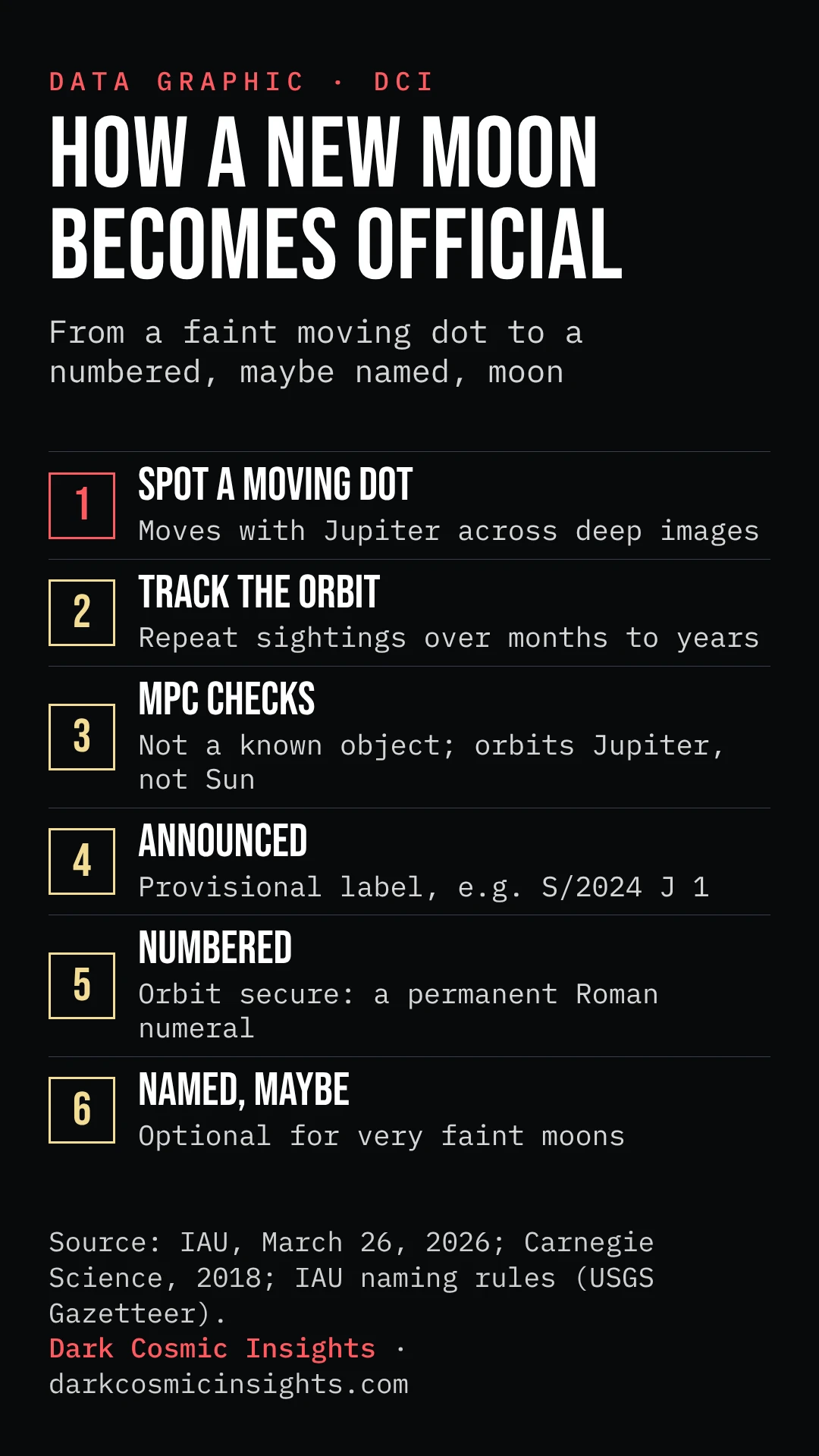
In 2018, the Minor Planet Center’s Gareth Williams explained that several observations are needed to confirm an object orbits Jupiter, and that the process took a year (Carnegie Science, 2018).
The Minor Planet Center (MPC), which works under the International Astronomical Union (IAU), checks that the observations don’t match a catalogued object, that an orbit around the planet is more likely than one around the Sun, and whether earlier sightings exist (IAU, March 26, 2026). The moon is announced with a provisional label such as S/2024 J 1 (satellite, discovery year, J for Jupiter, sequence number). Once the orbit is accurately determined, it gets a permanent Roman numeral, and the discoverer can propose a name (IAU). Names are optional for the faintest: IAU rules say a Jovian satellite fainter than absolute magnitude 16.5 should be named only if it’s of special scientific interest (USGS Gazetteer, IAU rules).
How Do We Know? From Galileo’s Telescope to Juno
Each claim above rests on a specific instrument; that chain of evidence is what our How We Know hub is about.
- 1610, a small telescope. Galileo sees four moving points of light.
- 1979, Voyager 1 and 2. Io’s volcanoes, faint rings and new inner moons.
- 1995 to 2003, the Galileo orbiter. Galileo arrived on December 7, 1995, orbited Jupiter 34 times, and found the magnetic evidence for oceans and Ganymede’s field. On September 21, 2003 it was deliberately sent into Jupiter to avoid any chance of hitting Europa (NASA Science, Galileo).
- Hubble. Ganymede’s auroras and Europa’s possible plumes.
- 2016 onward, Juno. Juno entered orbit on July 4, 2016; its extended mission flew past Ganymede, Europa and Io (NASA Science, Juno).
Juno’s status, as of November 2026: Juno’s first extended mission ran from August 2021 to September 2025. At a 2025 conference, principal investigator Scott Bolton described a proposed three-year second extended mission starting in October 2025; his abstract notes the proposal was still under review (Bolton, EPSC-DPS 2025). A 2026 abstract from the Juno team separately reports that extended operations were continuing (Levin & Juno Science Team, EGU 2026). NASA released Juno images of the small inner moon Thebe, taken on May 1, 2026 from about 5,000 km (3,100 miles) away (NASA Photojournal, May 5, 2026). These are the latest reports we found; we haven’t verified the spacecraft’s status on the day you read this.
Our guide to whether space photos are real explains how spacecraft images are processed.
Myth vs. Fact: Jupiter’s Moons
| Myth | Fact |
|---|---|
| “Jupiter has the most moons.” | Not now. Saturn’s count is far higher; see our moon count comparison. |
| “Jupiter has 79 (or 95) moons.” | Those are older counts. JPL lists 115, as of November 2026. |
| “Scientists found life on Europa.” | No. Missions are testing whether Europa is habitable. |
| “Europa’s ocean has been seen.” | It’s inferred from magnetic data, not imaged or sampled. |
| “Io’s volcanoes tap a global magma ocean.” | Juno’s gravity data rule out a shallow one. |
How Can You See Jupiter’s Moons Yourself?
NASA’s Night Sky Network says modest binoculars or a small telescope will show the Galilean moons as a line of small dots on one or both sides of Jupiter, and offers a mnemonic for their order outward: “I Eat Green Caterpillars” (NASA Night Sky Network).
- Repeat Galileo’s experiment. Sketch the dots on several nights in a row and watch them change places.
- Pick a good season. Jupiter is brightest around opposition, when Earth lies between it and the Sun. EarthSky lists the next as February 10, 2027 (0:21 UTC on February 11) and March 12, 2028 (EarthSky, July 10, 2026).
- Explore the real images. NASA’s Photojournal hosts the Galileo family portrait (PIA01299) and Europa in natural color (PIA19048).
The small outer moons are far beyond amateur gear, but the four you can see are the four that changed astronomy in 1610.
What Comes Next: Europa Clipper and JUICE
Dates below are the agencies’ planned schedules, as of November 2026.
NASA’s Europa Clipper launched on October 14, 2024 and is planned to reach Jupiter in April 2030, then make 49 close flybys of Europa. An Earth gravity-assist flyby is planned for December 3, 2026 (NASA Science, Europa Clipper, updated November 3, 2026).
ESA’s JUICE (JUpiter ICy moons Explorer) launched on 14 April 2023 and is planned to reach Jupiter in July 2031 (ESA, Juice factsheet), with 35 flybys of Jovian moons (ESA, Juice). ESA’s timeline shows Ganymede orbit insertion in December 2034 (ESA Cosmos, overview) and a nominal science phase ending 28 September 2035 (ESA Cosmos, calendar). In a 28 September 2026 news item, ESA reported a successful Earth flyby that refined Juice’s course to Jupiter (ESA, Juice).
ESA’s focus is the three likely ocean-bearing moons, Ganymede, Europa and Callisto (ESA Cosmos), and Eos noted that close-up magnetic data from both missions should help settle Callisto’s ocean question (Eos, 2025). For another ocean-world mission, see NASA’s Dragonfly rotorcraft for Titan.
Jupiter’s Moons by the Numbers
- 115: known moons of Jupiter, as of November 2026 (JPL SSD)
- 1610: the year Galileo discovered the four largest, starting January 7 (NASA)
- 5,262 km (3,270 miles): Ganymede’s mean diameter, versus Mercury’s 4,879 km (3,032 miles) (JPL SSD)
- About 400: volcanoes estimated on Io (JPL)
- 100 m (330 ft): how far Io’s surface can bulge with each tidal squeeze (NASA)
- About 1 : 2 : 4: the ratio of the orbital periods of Io, Europa and Ganymede, in that order
- 29 ± 10 km (about 18 ± 6 miles): Juno’s average for the cold, heat-conducting outer layer of Europa’s ice in the region it observed, assuming pure water ice (Levin et al. 2026)
- About 100 km (60 miles): NASA’s estimated thickness of Ganymede’s ocean (NASA)
- 90 to 160 K (about −183 to −113 °C; −297 to −171 °F): Ganymede’s daytime temperature range (NASA)
- 23,824,000 km (about 14.8 million miles): average orbital distance of S/2003 J 23, a small retrograde moon in Jupiter’s far outer swarm (JPL SSD)
Jupiter’s Moons: FAQ
What is Jupiter’s current moon count?
Jupiter has 115 known moons as of November 2026, according to NASA JPL’s satellite list. NASA Space Place gives the same number. Some older pages still show 79 or 95, which were earlier counts.
What are the names of Jupiter’s four biggest moons?
They are Io, Europa, Ganymede and Callisto, known together as the Galilean moons. Galileo discovered them in January 1610 with a small homemade telescope; Simon Marius published the four names in 1614, at Johannes Kepler’s suggestion. Ganymede is the largest moon in the solar system.
Does Europa really have liquid water?
Very likely, but it hasn’t been seen directly. Galileo’s magnetometer detected an induced magnetic field best explained by a salty ocean under the ice. NASA estimates that ocean may hold about twice as much water as Earth’s global ocean.
Has anyone found life on Jupiter’s moons?
No. Europa, Ganymede and Callisto may have oceans, but no mission has detected life. NASA’s Europa Clipper is designed to assess whether Europa has conditions suitable for life, not to detect life directly.
Why is Io so volcanic?
Io is heated from inside by tides. Its slightly oval orbit, kept that way by regular tugs from Europa and Ganymede, makes Jupiter’s gravity flex the moon, and the friction generates heat. Juno’s data suggest each volcano has its own magma chamber rather than a shared magma ocean.
Is Ganymede bigger than Mercury?
Yes, by diameter. Ganymede is about 5,262 km (3,270 miles) across, compared with about 4,879 km (3,032 miles) for Mercury. It still counts as a moon, because it orbits Jupiter rather than the Sun.
Why does Callisto look so old?
Callisto’s surface is about 4 billion years old, and NASA calls it the most heavily cratered object in the solar system. It orbits far from Jupiter and isn’t part of the resonance that keeps Io’s orbit stretched, so little has erased its impact scars.
When will spacecraft reach Jupiter’s moons?
NASA’s Europa Clipper is planned to reach Jupiter in April 2030 and make 49 close flybys of Europa. ESA’s JUICE is planned to arrive in July 2031 and to enter orbit around Ganymede in December 2034.
Your next step: on the next clear night when Jupiter is up, take binoculars outside and count the dots beside it. Then look again the following night and see which ones moved. That’s the observation that started all of this.

Sources and Further Reading
- NASA JPL Solar System Dynamics (checked November 8, 2026), Planetary Satellite Discovery Circumstances; Planetary Satellite Physical Parameters; Planetary Satellite Mean Elements; Planetary Physical Parameters.
- NASA Space Place (updated July 31, 2026), How Many Moons Are in Our Solar System?.
- NASA Science, Jupiter Moons; Io (updated June 25, 2025); Io Facts (updated April 21, 2025); Europa (updated September 24, 2026); Europa Facts; Ganymede; Ganymede Facts (updated April 25, 2025); Callisto (updated September 28, 2026); Callisto Facts (updated April 22, 2025).
- NASA (January 2025), 415 Years Ago: Astronomer Galileo Discovers Jupiter’s Moons.
- NASA Science mission pages: Voyager 1; Galileo; Juno (updated November 3, 2026); Europa Clipper (updated November 3, 2026).
- Peale, S. J., Cassen, P., & Reynolds, R. T. (1979). Melting of Io by tidal dissipation. Science, 203(4383), 892–894. doi:10.1126/science.203.4383.892
- Morabito, L. A., Synnott, S. P., Kupferman, P. N., & Collins, S. A. (1979). Discovery of currently active extraterrestrial volcanism. Science, 204(4396), 972. doi:10.1126/science.204.4396.972
- NASA JPL, Volcanic Eruptions on Io (PIA00379).
- Peale, S. J., & Lee, M. H. (2002). A primordial origin of the Laplace relation among the Galilean satellites. Science, 298(5593), 593–597. doi:10.1126/science.1076557 (arXiv)
- Park, R. S., Jacobson, R. A., Gomez Casajus, L., Nimmo, F., Ermakov, A. I., et al. (2025). Io’s tidal response precludes a shallow magma ocean. Nature, 638, 69–73. doi:10.1038/s41586-024-08442-5
- NASA JPL (December 12, 2024), NASA’s Juno Mission Uncovers Heart of Jovian Moon’s Volcanic Rage; (January 28, 2025), NASA Juno Mission Spots Most Powerful Volcanic Activity on Io to Date.
- Khurana, K. K., Kivelson, M. G., Stevenson, D. J., Schubert, G., Russell, C. T., Walker, R. J., & Polanskey, C. (1998). Induced magnetic fields as evidence for subsurface oceans in Europa and Callisto. Nature, 395, 777–780. doi:10.1038/27394
- Kivelson, M. G., Khurana, K. K., Russell, C. T., Volwerk, M., Walker, R. J., & Zimmer, C. (2000). Galileo magnetometer measurements: A stronger case for a subsurface ocean at Europa. Science, 289(5483), 1340–1343. doi:10.1126/science.289.5483.1340; NASA JPL release (August 25, 2000), Galileo Evidence Points to Possible Water World Under Europa’s Icy Crust.
- Levin, S. M., Zhang, Z., Bolton, S. J., Brown, S., Ermakov, A. I., et al. (2026). Europa’s ice thickness and subsurface structure characterized by the Juno microwave radiometer. Nature Astronomy, 10, 84–91 (published online December 17, 2025). doi:10.1038/s41550-025-02718-0; NASA JPL (January 27, 2026), NASA’s Juno Measures Thickness of Europa’s Ice Shell.
- NASA (September 26, 2016), NASA’s Hubble Spots Possible Water Plumes Erupting on Jupiter’s Moon Europa.
- Kivelson, M. G., Khurana, K. K., Russell, C. T., Walker, R. J., Warnecke, J., Coroniti, F. V., Polanskey, C., Southwood, D. J., & Schubert, G. (1996). Discovery of Ganymede’s magnetic field by the Galileo spacecraft. Nature, 384, 537–541. doi:10.1038/384537a0; NASA JPL release (December 12, 1996), Galileo Team Hears “Voice” of Ganymede.
- Saur, J., Duling, S., Roth, L., et al. (2015). The search for a subsurface ocean in Ganymede with Hubble Space Telescope observations of its auroral ovals. Journal of Geophysical Research: Space Physics, 120(3), 1715–1737. doi:10.1002/2014JA020778; NASA release (March 12, 2015), NASA’s Hubble Observations Suggest Underground Ocean on Jupiter’s Largest Moon.
- Cochrane, C. J., Vance, S. D., Castillo-Rogez, J. C., Styczinski, M. J., & Liuzzo, L. (2025). Stronger evidence of a subsurface ocean within Callisto from a multifrequency investigation of its induced magnetic field. AGU Advances, 6(1), e2024AV001237. doi:10.1029/2024AV001237; Eos (February 18, 2025), Jupiter’s Moon Callisto Is Very Likely an Ocean World.
- NASA JPL (September 15, 1998), Galileo Finds Jupiter’s Rings Formed by Dust Blasted Off Small Moons; Jupiter’s Inner Satellites and Ring Components (PIA01627).
- Sheppard, S. S., & Jewitt, D. C. (2003). An abundant population of small irregular satellites around Jupiter. Nature, 423, 261–263. doi:10.1038/nature01584
- Sheppard, S. S., Tholen, D. J., Alexandersen, M., & Trujillo, C. A. (2023). New Jupiter and Saturn satellites reveal new moon dynamical families. Research Notes of the AAS, 7(5), 100. doi:10.3847/2515-5172/acd766; Scott Sheppard, Carnegie Science, Jupiter moons page.
- Carnegie Science (July 16, 2018), A Dozen New Moons of Jupiter Discovered, Including One “Oddball”.
- Sky & Telescope (early 2023), Astronomers Find a Dozen More Moons for Jupiter.
- Space.com (March 20, 2026), Astronomers Keep Finding New Moons of Jupiter and Saturn.
- Bolton, S. (2025). The Juno 2nd Extended Mission. EPSC-DPS Joint Meeting 2025, EPSC-DPS2025-158. doi:10.5194/epsc-dps2025-158; Levin, S., & the Juno Science Team (2026). Science from Juno’s Continuing Extended Mission. EGU General Assembly 2026, EGU26-22848. doi:10.5194/egusphere-egu26-22848; NASA Photojournal (May 5, 2026), NASA’s Juno Mission Captures Jupiter Moon Thebe; NASA, Galilean Moons of Jupiter lithograph.
- International Astronomical Union (March 26, 2026), MPC Announces New Moons of Saturn and Jupiter; USGS Gazetteer of Planetary Nomenclature, IAU Rules and Conventions.
- ESA, Juice; Juice factsheet; ESA Cosmos, Juice overview and mission calendar (edited April 2025).
- NASA Night Sky Network, From Galileo to Clipper: Exploring Jupiter’s Moons; EarthSky (July 10, 2026), Jupiter at Opposition.
- NASA Photojournal, The Galilean Satellites (PIA01299); Europa’s Stunning Surface (PIA19048).
Explore Next
- The full, dated moon count for every planet: Which Planet Has the Most Moons?
- Weather at the top of the giants: Jupiter’s Polar Cyclones vs. Saturn’s Hexagon
- Another ocean-world mission: NASA’s Dragonfly Mission to Titan
- How to read spacecraft images: Are Space Photos Real?
- How a claim earns its label: How We Know
- More from the planets: Planets & Moons
- Start anywhere: Explore Dark Cosmic Insights
- Mars’s two small, dark moons: How Many Moons Does Mars Have?
- Spirals, ellipticals and the tuning fork: Types of Galaxies
How This Explainer Was Checked
Every number in this article was checked on November 8, 2026 against the source linked beside it: NASA JPL’s satellite tables, NASA Science and NASA Space Place pages, JPL and NASA news releases, ESA mission pages, and peer-reviewed papers, with DOIs given (paper details confirmed through Crossref and publisher records). The moon count is JPL’s, dated; NASA’s main Jupiter Moons page still shows an older figure, and we say so. Diameters in the table and bar chart are DCI’s doubling of JPL’s mean radii, which is why they differ slightly from NASA’s rounded figures; mile, Celsius and other conversions are DCI’s arithmetic unless the source gave them. The count of 107 outer moons and the 1 : 2 : 4 period ratio are DCI’s arithmetic from JPL and NASA figures. Where estimates differ, as for Europa’s ice thickness, we show each estimate with what it measures. NASA’s 2016 plume release gives about 200 km (125 miles) in its text and over 160 km (100 miles) in a photo caption; we use the text figure, and we keep plumes labelled Open even though NASA’s Europa fact page describes them in more definite terms. Oceans inferred from magnetic or auroral data are labelled Modelled, Juno’s status is given as the latest mission-team reports we found, dated, without claiming today’s live status. Moon names are credited to Simon Marius’s 1614 book, following Kepler’s suggestion, and Europa’s Juno ice figure is given with its stated uncertainty and pure-ice assumption. Mission dates are the agencies’ planned schedules. Images are labelled: real spacecraft or telescope images as OBSERVATION, illustrations as ILLUSTRATION, and our charts as DATA GRAPHIC. Nothing AI-generated is presented as a real image.

Final Thought: Four Worlds, One Gravity Well
Jupiter’s moon count will keep climbing as telescopes dig fainter, and that number will always need a date. The four big moons tell a more lasting story. They formed around the same planet, yet one is a furnace, two probably carry hidden oceans, and the outermost, which may hide one too, wears about four billion years of impacts. Much of that difference traces back to distance, resonance and tides. In the 2030s, Europa Clipper and JUICE are planned to test the ocean claims up close. Until then, the best evidence we have is a flipped magnetic field, a rocking aurora and four dots that moved in Galileo’s eyepiece.
About the Author
Author: King | Founder of Dark Cosmic Insights
King is the founder of Dark Cosmic Insights, a science storytelling platform exploring the strangest true stories hiding in space, science and AI. He digs into NASA, ESA and peer-reviewed research, separates what has been measured from what is still a mystery, and turns it into articles, data graphics and Shorts.
Follow the anomaly. Trace the source.