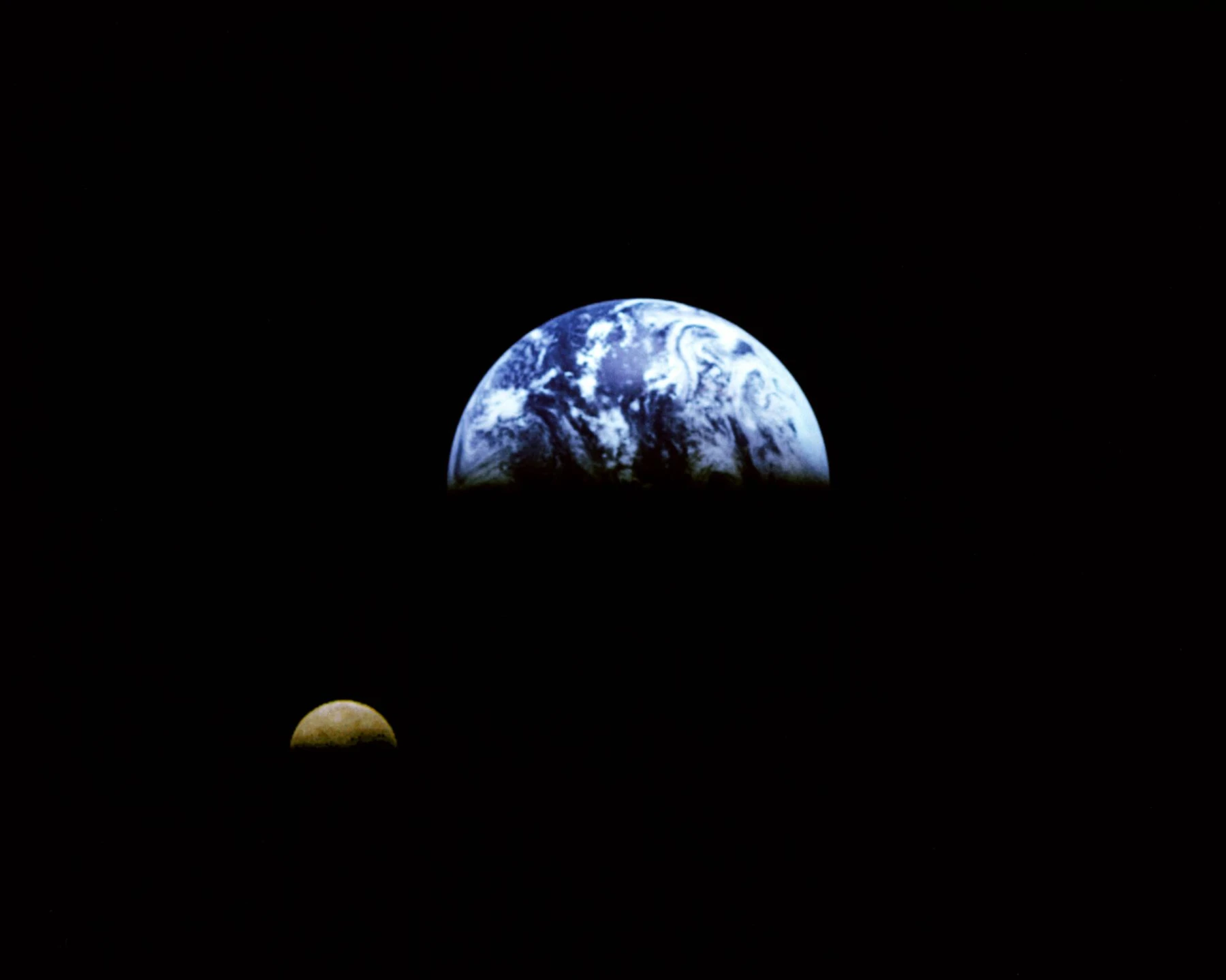
On April 6, 2026, four astronauts became the farthest-traveled humans in history. NASA’s Artemis II crew swung around the far side of the Moon and reached 252,756 miles (about 406,770 km) from Earth, breaking a record Apollo 13 had held since 1970 (NASA, 2026). From out there, Earth looked like a small blue-and-white marble setting behind the lunar horizon.
That record distance is only a little more than the Moon’s average distance from us. The Moon is our nearest neighbor in space, but “near” is relative: you could line up about 30 Earths in the gap between us. And that gap isn’t fixed. It changes every month, and it grows a little every year.

Observed, measured, modelled, open. The Moon’s distance is measured to within millimeters by bouncing lasers off mirrors left by Apollo astronauts. Its slow drift away from Earth is measured too. Travel times for Apollo 11, New Horizons and Artemis II are observed facts. Light-travel times, Earth-widths and car-trip comparisons are DCI calculations from NASA’s measured distances, labelled as such.
Quick Answer: How Far Is the Moon?
The Moon is an average of 384,400 km (238,855 miles) from Earth, NASA says (NASA). Because its orbit is slightly oval, that distance swings each month between perigee, its closest point, which averages about 363,300 km, and apogee, its farthest, which averages about 405,500 km; the exact values vary from orbit to orbit (NASA). Light crosses the gap in about 1.3 seconds. Apollo 11 reached lunar orbit about 76 hours after launch. And the Moon is drifting away from Earth by about 3.8 cm (1.5 inches) a year (NASA JPL).
What this article can and cannot establish. It can give you the Moon’s measured average, closest and farthest distances, how scientists measure them, how long light and spacecraft take to cross them, and why the Moon is slowly moving away. It can’t give one fixed Earth–Moon distance, because the Moon is always moving along its orbit, and it can’t predict exactly how long a future crewed trip will take, because each mission flies its own path.
Table of Contents
The DCI Evidence Map: The Moon’s Distance
| Question | What we know | Status | Key source |
|---|---|---|---|
| How far is the Moon, on average? | About 384,400 km (238,855 miles) | Measured | NASA |
| How close and how far does it get? | About 363,300 km (perigee) to 405,500 km (apogee), on average | Measured | NASA |
| How precisely is it measured? | To within a few millimeters, by laser | Measured | NASA JPL |
| Is the Moon moving away? | Yes, about 3.8 cm (1.5 inches) a year | Measured | NASA JPL |
| Why is it moving away? | Earth’s ocean tides affect its orbit | Modelled | NASA GSFC |
| How long did Apollo 11 take? | About 75 hours 50 minutes to lunar orbit | Observed | NASA |
| What’s the human distance record? | 252,756 miles from Earth, Artemis II, April 2026 | Observed | NASA |
| How long does light take? | About 1.3 seconds one way | Calculated | DCI, from NASA’s distance |
Status key: Observed = seen directly. Measured = a number with a stated uncertainty or a direct measurement. Modelled = inferred from measurements through a physical model, dependent on assumptions. Calculated = worked out from measured values rather than measured directly. Open = unresolved; the evidence is incomplete or points different ways. Not supported = the evidence goes against the claim, or there is none for it.
Cite this framework: “DCI Evidence Map: The Moon’s Distance,” Dark Cosmic Insights, November 2026, darkcosmicinsights.com/how-far-is-the-moon/.
How Far Is the Moon From Earth?
The average: 384,400 km
NASA puts it simply: “The Moon is an average of 238,855 miles (384,400 kilometers) away” (NASA). NASA’s lunar fact sheet lists the same figure as the Moon’s semimajor axis, the average radius of its orbit: 0.3844 million km (NASA NSSDC).
About 30 Earths in a row
Earth is about 12,756 km wide at the equator (NASA NSSDC). Divide the Moon’s average distance by that, and you could line up about 30 Earths between us and the Moon (DCI calculation). Or about 110 Moons, since the Moon itself is about 3,476 km across (DCI calculation from NASA’s 1,738.1 km radius).
Measured from center to center
The standard figures are measured from the center of Earth to the center of the Moon. If you’re standing on Earth’s surface looking up, the Moon is a few thousand kilometers closer than that, depending on where you stand and where the Moon is in your sky.

Why Does the Moon’s Distance Change?
An oval orbit
The Moon’s orbit around Earth isn’t a perfect circle. NASA’s fact sheet gives it an eccentricity of 0.0549, a measure of how stretched an orbit is, where 0 is a perfect circle (NASA NSSDC). That’s enough to make a real difference.
Perigee and apogee
Each orbit, the Moon reaches a closest point and a farthest point. NASA says perigee is “about 226,000 miles (363,300 km) from Earth” and apogee is “about 251,000 miles (405,500 km) from Earth” (NASA). Those are typical values; the exact numbers change a little from month to month. The difference between them is about 42,000 km, more than three Earth widths (DCI calculation).
One lap every 27.3 days
The Moon completes one orbit relative to the stars every 27.32 days. From one full Moon to the next takes a bit longer, about 29.53 days, because Earth has moved along its own orbit around the Sun in the meantime (NASA NSSDC). The Moon travels at about 1.02 km per second, or roughly 3,700 km per hour (DCI conversion from NASA’s figure).
Supermoons
When a full Moon happens near perigee, people call it a supermoon. NASA explains that a supermoon “occurs when a full Moon coincides with the Moon’s closest approach to Earth in its elliptical orbit.” Such a full Moon “can appear up to 14 percent bigger and 30 percent brighter than the faintest Moon of the year” (NASA). NASA lists two more supermoons this year: November 24, 2026 and December 24, 2026 (01:28 UTC, which is the evening of December 23 in the Americas).
How Do Scientists Measure the Moon’s Distance?
Mirrors on the Moon
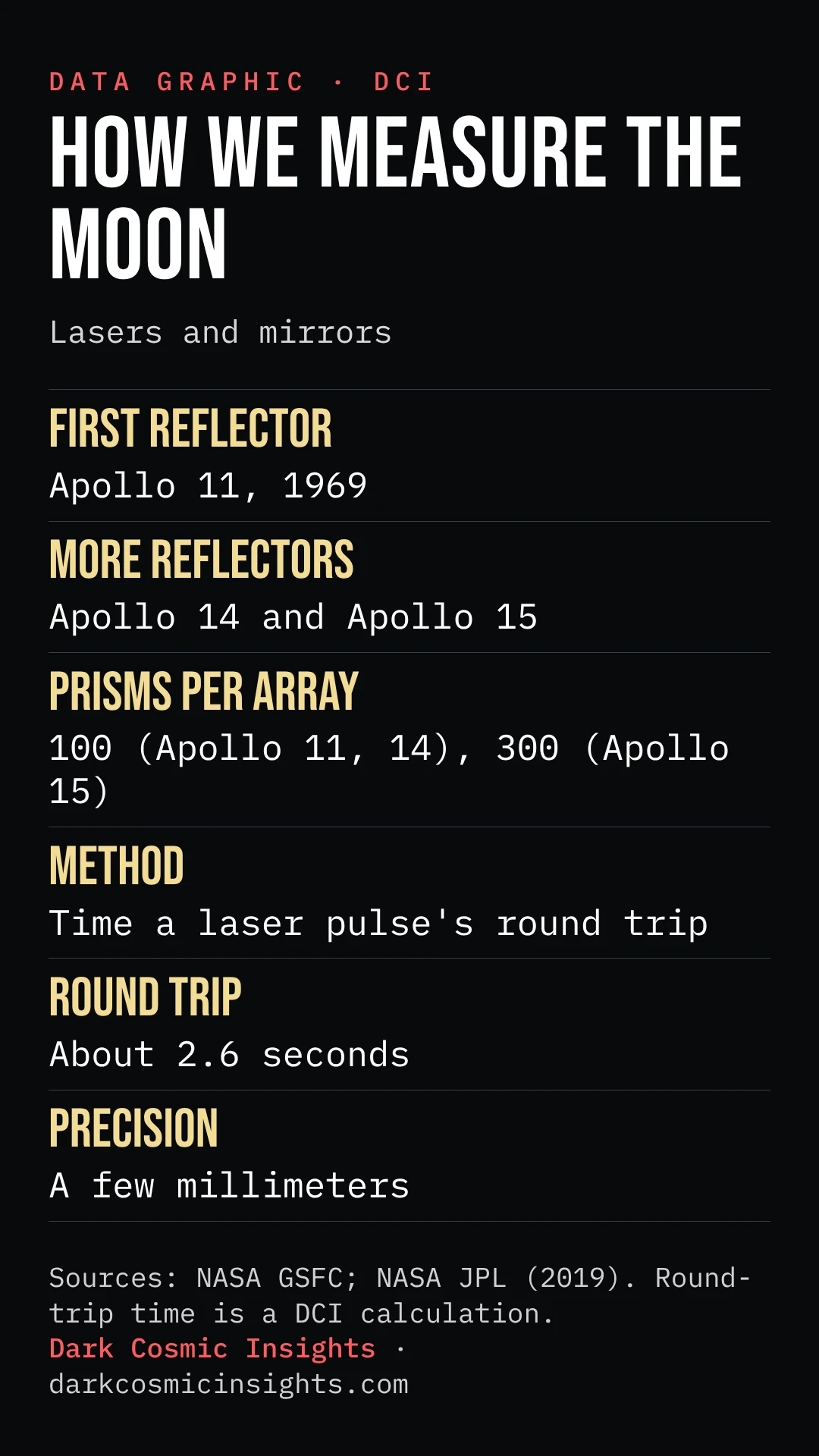
The most precise measurements come from lunar laser ranging. Apollo astronauts left special mirrors, called retroreflectors, on the lunar surface. Each one bounces light straight back toward wherever it came from. NASA says “the first laser ranging retroreflector was positioned on the Moon in 1969 by the Apollo 11 astronauts” (NASA GSFC).
Three Apollo arrays
Apollo 14 and Apollo 15 left reflectors too. NASA’s Jet Propulsion Laboratory notes that “the Apollo 11 and 14 arrays have 100 quartz glass prisms (called corner cubes) each, while the array of Apollo 15 has 300” (NASA JPL, 2019).
Timing a flash of light
Observatories on Earth fire laser pulses at the reflectors and time how long the light takes to come back. Since light travels at a known speed, about 299,792 km per second, the round-trip time gives the distance. The round trip takes about 2.6 seconds at the Moon’s average distance (DCI calculation).
Accurate to millimeters
JPL says the distance is measured “to within a fraction of an inch (a few millimeters)” (NASA JPL, 2019). It’s one of the longest-running experiments of the space age, and it’s still going.
Is the Moon Moving Away From Earth?
3.8 cm a year
Yes. Laser ranging shows the Moon is slowly spiraling outward. JPL says “the distance between the two increases by 1.5 inches (3.8 centimeters) a year” (NASA JPL, 2019). NASA’s fact sheet lists the same recession rate, 3.8 cm per year (NASA NSSDC).
Since Apollo 11
At that rate, the Moon is about 2 meters (7 feet) farther away now than when Apollo 11 left the first reflector in 1969 (DCI calculation, 57 years × 3.8 cm). Over a million years, it adds up to about 38 km (DCI calculation).
Tides are behind it
The cause is tides. The Moon’s gravity raises tidal bulges in Earth’s oceans, and Earth’s rotation drags those bulges slightly ahead of the Moon. Their pull speeds the Moon up a little, nudging it into a higher orbit. NASA notes that laser data “indicate that ocean tides on Earth have a direct influence on the Moon’s orbit” (NASA GSFC).
Earth’s day gets longer
The same tidal friction slows Earth’s spin. A study of ancient eclipse records found that Earth’s day has lengthened by about 1.8 milliseconds per century on average since 720 BC (Stephenson et al. 2016). That figure combines tides with other effects that change Earth’s rotation. We explain the Moon’s tidal grip in What Is Tidal Locking?
How Long Does Light Take to Reach the Moon?
About 1.3 seconds
Light travels about 299,792 km per second. At the Moon’s average distance, it takes about 1.28 seconds to get there (DCI calculation from NASA’s 384,400 km). At perigee, it’s about 1.21 seconds; at apogee, about 1.35 seconds (DCI calculations).
Moonlight is old sunlight
When you look at the Moon, you’re seeing sunlight that left the Sun, bounced off the lunar surface and reached your eyes. The trip from the Moon is only about a second, but the trip from the Sun to the Moon took about eight minutes. We follow that sunlight back to its source in How Hot Is the Sun?
Why mission control can talk in near real time
A delay of under three seconds for a round trip is why Apollo astronauts could hold conversations with Houston. Compare that with Mars, where messages take about 3 to 22 minutes each way, as we explain in How Far Is Mars?
How Long Does It Take to Get to the Moon?
Apollo 11: about three days
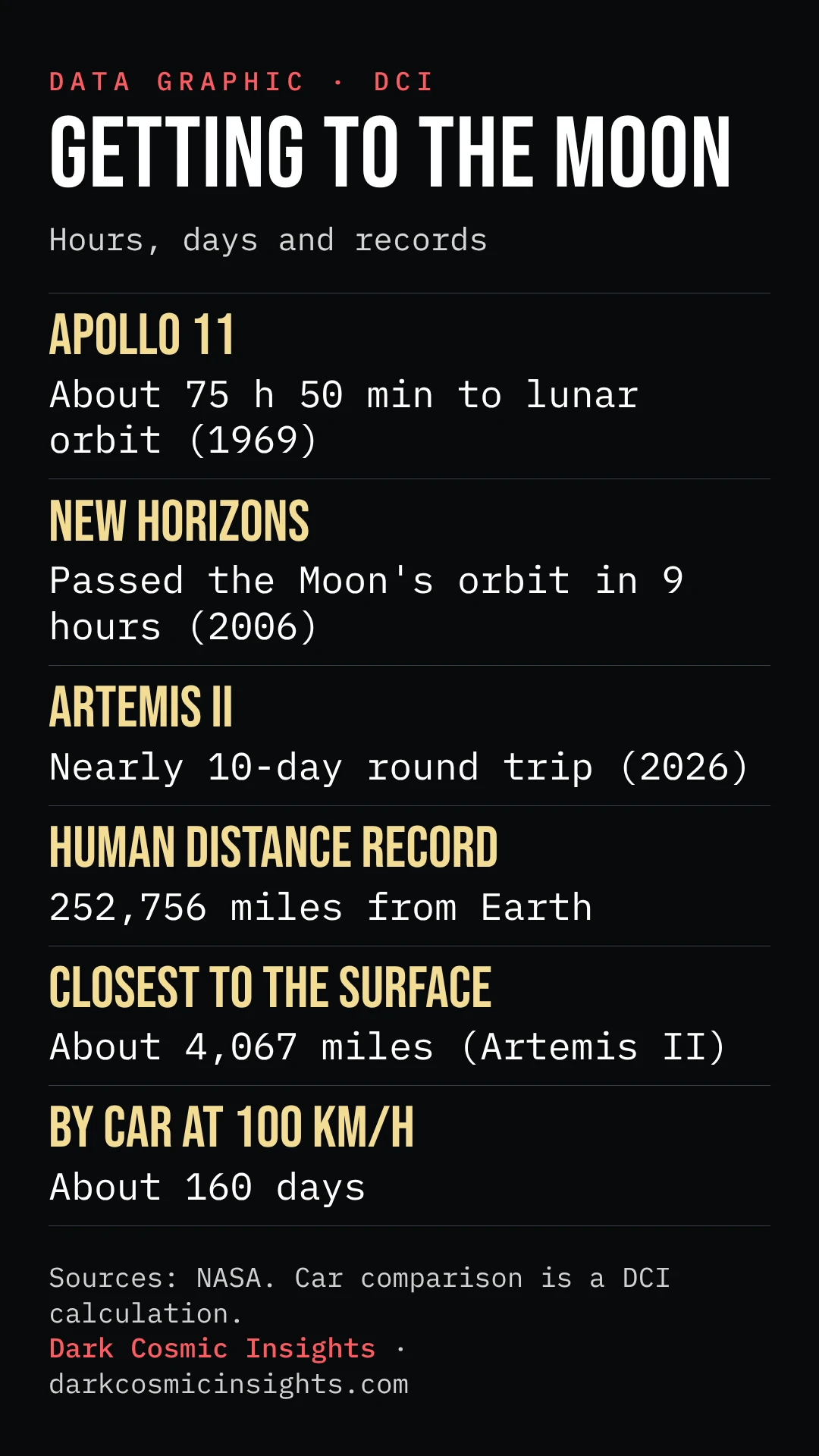
Apollo 11 launched on July 16, 1969. NASA says its first lunar orbit insertion burn came “at about 75 hours, 50 minutes into the flight,” on July 19, and the lunar module landed on July 20 (NASA). So the crew took a little over three days to reach the Moon. Travel time depends on the trajectory: Artemis II, launched April 1, 2026, made its lunar flyby on April 6, about five days after launch (DCI calculation from NASA’s dates).
New Horizons: nine hours
The fastest spacecraft to pass the Moon wasn’t going there at all. NASA’s New Horizons, launched to Pluto on January 19, 2006, “passed the Moon’s orbit in just nine hours” (NASA). It didn’t need to slow down and enter lunar orbit.
Artemis II: a 10-day round trip
The Artemis II crew, Reid Wiseman, Victor Glover, Christina Koch and Canada’s Jeremy Hansen, launched on April 1, 2026, flew around the Moon on April 6 and splashed down in the Pacific on April 10 after “a nearly 10-day journey.” They came within about 4,067 miles (6,545 km) of the lunar surface and traveled 695,081 miles in total (NASA, 2026; NASA, 2026).
Why travel times differ
Travel time depends on the trajectory, propulsion and mission goals. Apollo 11 braked into lunar orbit, while Artemis II followed a lunar flyby and return trajectory.
How Far Is That, Really?
All DCI calculations from NASA’s numbers:
- By car, at 100 km/h nonstop: about 160 days, a little over five months, to drive the Moon’s average distance.
- Walking at 5 km/h: about 8.8 years, without stopping.
- By airliner at 900 km/h: about 18 days.
- Compared with Mars: at its closest possible approach, Mars is about 142 times farther away than the Moon.
Myth vs. Fact: The Moon’s Distance
| Myth | Fact | Status |
|---|---|---|
| “The Moon is always the same distance away.” | It swings between perigee and apogee each orbit, averaging about 363,300 and 405,500 km. | Measured |
| “A supermoon is dramatically bigger.” | Up to 14% bigger and 30% brighter than the faintest full Moon, NASA says. | Measured |
| “Nobody has measured the distance precisely.” | Lasers measure it to within a few millimeters. | Measured |
| “The Moon will drift away soon.” | It moves about 3.8 cm a year, a few meters per century. | Measured |
| “Moonlight reaches us instantly.” | It takes about 1.3 seconds to cross the average distance. | Calculated |
| “Artemis II went much farther than the Moon.” | It reached 252,756 miles from Earth by swinging around the far side. | Observed |
How Can You See the Moon’s Distance Change?
Catch a supermoon
The next supermoons are on November 24, 2026 and December 24, 2026 (01:28 UTC), NASA says (NASA). In North America, the December full Moon falls on the evening of December 23 (8:28 p.m. Eastern). Watch the full Moon on those nights, then compare it with a full Moon near apogee months later.
Photograph it
The size difference is hard to notice by eye, but easy to see in photos. Use the same lens and zoom for a full Moon near perigee and another near apogee, then put the pictures side by side. The perigee Moon will look noticeably larger.
Find the Apollo sites
The Apollo landing sites are too small to see with a backyard telescope, but NASA’s Lunar Reconnaissance Orbiter has photographed them from lunar orbit, including the Apollo 15 laser reflector (NASA, PIA13037). The Moon’s surface is changing too, in its own way; see Why Is the Moon Shrinking?
The Moon’s Distance by the Numbers
| Measure | Value | Source |
|---|---|---|
| Average distance | about 384,400 km (238,855 mi) | NASA |
| Average perigee / apogee | about 363,300 / 405,500 km | NASA |
| Orbit eccentricity | 0.0549 | NASA NSSDC |
| Orbit period (sidereal / full Moon to full Moon) | 27.32 / 29.53 days | NASA NSSDC |
| Moving away | about 3.8 cm (1.5 in) a year | NASA JPL |
| Laser precision | a few millimeters | NASA JPL |
| Light travel time | about 1.3 seconds (DCI calculation) | NASA |
| Apollo 11 to lunar orbit | about 75 h 50 min | NASA |
| Artemis II farthest point | 252,756 miles from Earth | NASA |
| Next supermoons | November 24 and December 24, 2026 (UTC; December 23 in the Americas) | NASA |
Sources checked November 2026.

Moon Distance FAQ
How far is the Moon from Earth?
About 384,400 km, or 238,855 miles, on average, NASA says. Because its orbit is slightly oval, it swings each month between perigee and apogee, which average about 363,300 km and 405,500 km; the exact values change from orbit to orbit.
How long does it take to get to the Moon?
It depends on the trajectory. Apollo 11 launched on July 16, 1969, and entered lunar orbit about 75 hours and 50 minutes later, a little over three days. Artemis II launched on April 1, 2026, and made its lunar flyby on April 6, about five days later. NASA’s New Horizons, which didn’t stop at the Moon, passed its orbit in nine hours.
How long does light take to reach the Moon?
About 1.3 seconds at the Moon’s average distance. A laser pulse sent to the Moon and bounced back takes about 2.6 seconds for the round trip.
Is the Moon moving away from Earth?
Yes, by about 3.8 cm (1.5 inches) a year, measured by lasers bounced off Apollo reflectors. Earth’s ocean tides slowly push the Moon into a higher orbit.
How do scientists measure the distance to the Moon?
They fire laser pulses at retroreflectors left by Apollo 11, 14 and 15 and time how long the light takes to return. That gives the distance to within a few millimeters.
What is the closest the Moon gets to Earth?
At perigee, its closest point, the Moon averages about 363,300 km (226,000 miles) away, NASA says; individual perigees can be a little closer or farther. A full Moon near perigee is called a supermoon.
How far have humans traveled from Earth?
The record is 252,756 miles, set by the Artemis II crew on April 6, 2026, as they flew around the Moon’s far side. It beat the Apollo 13 record from 1970.
What is a supermoon?
A full Moon that happens near perigee, the Moon’s closest point to Earth. NASA says it can look up to 14 percent bigger and 30 percent brighter than the faintest full Moon of the year. The next two are on November 24, 2026, and December 24, 2026, at 01:28 UTC, which is the evening of December 23 in the Americas.
Your next step: look up on November 24, 2026. That night’s full Moon is a supermoon, near its closest point to Earth. The light reaching your eyes will have left the lunar surface just over a second earlier.

Sources and Further Reading
- NASA Science, Moon: Facts.
- NASA Space Science Data Coordinated Archive, Moon Fact Sheet; Earth Fact Sheet.
- NASA Science, What Is a Supermoon?
- NASA Goddard Space Flight Center, Measuring the Moon’s Distance.
- NASA JPL (July 2019), The Apollo Experiment That Keeps on Giving.
- Stephenson, F. R., Morrison, L. V. and Hohenkerk, C. Y. (2016), Measurement of the Earth’s rotation: 720 BC to AD 2015, Proceedings of the Royal Society A 472.
- NASA, Apollo 11 Mission Overview.
- NASA, 15 Years Ago: New Horizons Launched to Pluto and Beyond.
- NASA (April 2026), NASA’s Artemis II Crew Eclipses Record for Farthest Human Spaceflight; NASA Welcomes Record-Setting Artemis II Moonfarers Back to Earth.
- NASA images: art002e021278, S92-52043, PIA13037, AS11-40-5948, DSCOVR/EPIC Moon transit.
Explore Next
- Why we only see one side: What Is Tidal Locking?
- The Moon is changing too: Why Is the Moon Shrinking?
- The next step out: How Far Is Mars?
- Where moonlight comes from: How Hot Is the Sun?
- All eight planets side by side: Solar System Explorer
- What perigee and apogee mean: Space Glossary
- How a claim earns its label: How We Know
How This Explainer Was Checked
Every number and quote in this article was checked in November 2026 against the source linked beside it: NASA’s Moon facts and supermoon pages, NASA’s Moon and Earth fact sheets, NASA Goddard’s and NASA JPL’s lunar laser ranging explainers, Stephenson et al. (2016), NASA’s Apollo 11 overview, NASA’s New Horizons history page and NASA’s April 2026 Artemis II releases. Distances, the recession rate and laser precision are labelled Measured; the tidal explanation is labelled Modelled; mission timelines and the Artemis II record are labelled Observed. Light-travel times, Earth and Moon widths, kilometer conversions of Artemis II figures, the drift since 1969 and travel comparisons are DCI calculations. Images are labelled: real spacecraft and astronaut photos as OBSERVATION, our charts as DATA GRAPHIC. Nothing AI-generated is presented as a real image.
Final Thought: A Neighbor on a Long Leash
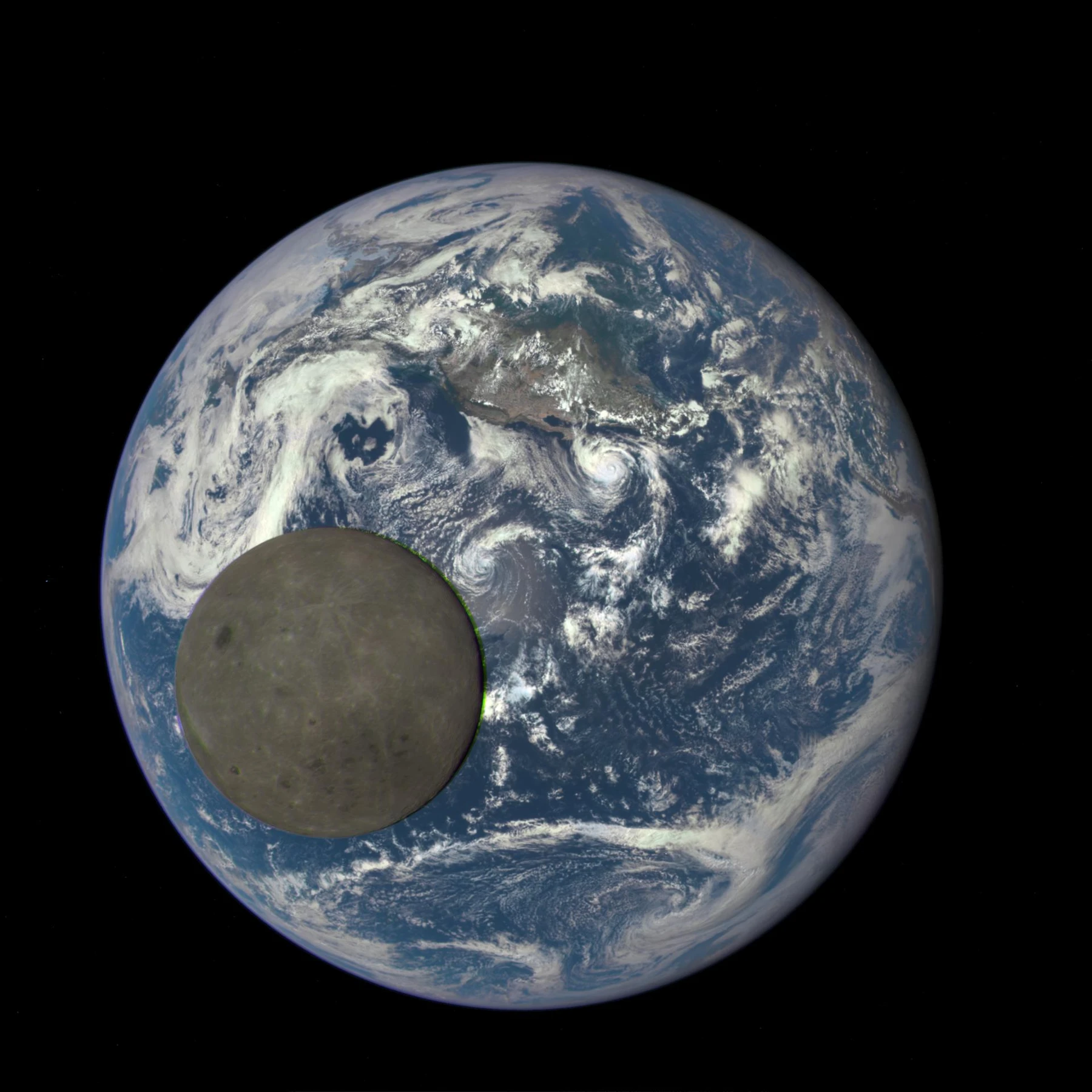
The Moon is close enough that light makes the trip in about a second, and close enough that people have walked on it and, in 2026, flown around it again. But it’s also on a slowly lengthening leash. Every year, Earth’s tides let it out by another 3.8 cm, and the mirrors Apollo astronauts left behind are still keeping score.
About the Author
Author: King | Founder of Dark Cosmic Insights