People have called Mars the red planet for thousands of years. Look up on a clear night when it’s well placed and you can see why: it glows a steady orange-red, unlike any star. NASA’s answer to why is short. “The reason Mars looks reddish is due to oxidization — or rusting — of iron in the rocks” and dust (NASA).
But “rust” isn’t one mineral, and which kind of rust colors Mars turns out to matter. In February 2025, a team of scientists suggested that the main culprit may be a water-rich iron mineral called ferrihydrite, which forms in cool water (NASA, 2025). If they’re right, Mars’s color is a clue to its watery past.
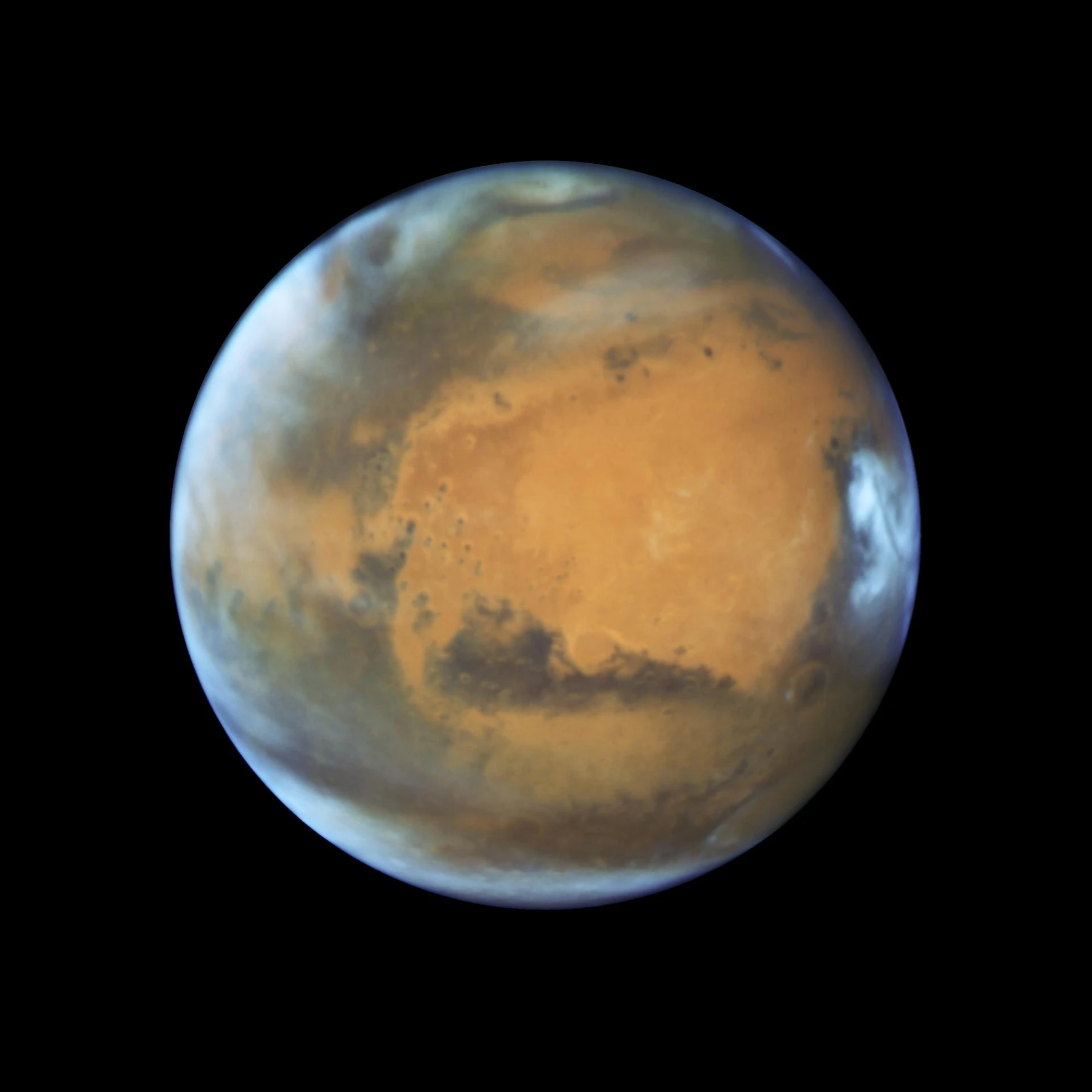
Observed, measured, modelled, open. That Mars’s surface is reddish is observed. That oxidized iron causes the color is measured from spectra taken by orbiters and rovers. Which iron mineral is the main cause is still open: ferrihydrite is a strong 2025 candidate, but it hasn’t been confirmed. What that implies about ancient water is modelled.
Quick Answer: Why Is Mars Red?
Mars is red because the iron in its rocks and dust has oxidized, or rusted, NASA says (NASA). Fine reddish dust coats much of the planet, and winds and dust storms keep spreading it around. For decades, scientists thought a dry iron oxide like hematite was the main colorant. A 2025 study in Nature Communications suggested instead that the main culprit may be ferrihydrite, a water-rich iron oxide that forms in cool water (NASA, 2025). That idea still needs to be tested on real Martian samples brought to Earth.
What this article can and cannot establish. It can show you what makes Mars look red, what orbiters and rovers have measured, and what the 2025 ferrihydrite study proposes. It cannot tell you for certain which mineral dominates Mars’s red dust, because the leading candidates haven’t been confirmed in a lab on Earth. That test depends on samples a future mission would bring back.
Table of Contents
The DCI Evidence Map: Why Mars Is Red
| Question | What we know | Status | Key source |
|---|---|---|---|
| Is Mars really red? | Yes, its surface looks orange-red | Observed | NASA, Hubble 2016 |
| What causes the color? | Oxidized, or rusted, iron in rocks and dust | Measured | NASA |
| Which iron mineral is the main cause? | Ferrihydrite is a strong 2025 candidate | Open | NASA, 2025 |
| Does that mean Mars had water? | Ferrihydrite forms in cool water, so it would point that way | Modelled | NASA, 2025 |
| Why does the red spread everywhere? | Winds and dust storms move fine dust | Observed | NASA |
| Are Martian sunsets red? | No, they look bluish | Observed | NASA, PIA19400 |
| How will we know for sure? | Test returned samples on Earth | Open | NASA, 2025 |
Status key: Observed = seen directly. Measured = a number with a stated uncertainty or a direct measurement. Modelled = inferred from measurements through a physical model, dependent on assumptions. Open = unresolved; the evidence is incomplete or points different ways. Not supported = the evidence goes against the claim, or there is none for it.
Cite this framework: “DCI Evidence Map: Why Mars Is Red,” Dark Cosmic Insights, November 2026, darkcosmicinsights.com/why-is-mars-red/.
What Makes Mars Red?
Rusted iron
Iron is common in Mars’s rocks. When iron reacts with oxygen, usually with water involved, it forms iron oxides, the same family of compounds as rust on an old car. NASA puts it simply: Mars looks reddish because of the “oxidization — or rusting — of iron in the rocks” (NASA).
Iron oxides absorb blue and green light and reflect red and orange. So a surface dusted with them looks red-orange in sunlight.
It’s mostly the dust
The red color isn’t spread evenly through all of Mars. It’s concentrated in a thin layer of fine dust that blankets much of the surface. That dust is extremely fine. In the 2025 study, the team made simulated Martian dust from particles smaller than one micrometer, a thousandth of a millimeter, to match how real Martian dust reflects light (NASA, 2025).
Wind keeps it everywhere
Dust that fine is easy to lift. NASA notes that “occasionally, winds on Mars are strong enough to create dust storms that cover much of the planet” (NASA). Over time, wind and storms have spread the red dust across the globe, so even regions made of darker rock end up with a reddish coating.

Which Kind of Rust? The 2025 Ferrihydrite Study
The old leading answer
For a long time, the most common explanation pointed to dry iron oxides, especially hematite, forming slowly over billions of years as Mars’s dry surface reacted with its thin air. NASA’s 2025 summary of the new study notes that ferrihydrite forms at lower temperatures than minerals “like hematite” that had been considered before (NASA, 2025).
The new candidate: ferrihydrite
On February 25, 2025, a team led by Adomas Valantinas, then at Brown University, published a study in Nature Communications suggesting that ferrihydrite, a water-rich iron oxide, “may be the main culprit behind Mars’ reddish dust” (NASA, 2025). Valantinas was careful to add, “We’re not the first to consider ferrihydrite as the reason for why Mars is red.” What’s new is the combination of evidence behind it.
How they tested it
The team combined three kinds of evidence (NASA, 2025):
- Orbiter data: light measurements of Mars’s surface from NASA’s Mars Reconnaissance Orbiter and ESA’s Mars Express and Trace Gas Orbiter.
- Rover data: measurements from the ground by rovers including Curiosity, Sojourner and Opportunity.
- Lab tests: they mixed ferrihydrite with ground-up basalt, Mars’s most common rock type, into ultra-fine simulated dust, then measured how it reflects light under Mars-like conditions.
Their simulated dust matched Mars’s real light signature best when ferrihydrite was the iron oxide. Valantinas said, “we believe ferrihydrite is everywhere in the dust and also probably in the rock formations, as well.”
What hasn’t been proven
The study’s language is careful: ferrihydrite “may be” the culprit. NASA notes that the team’s model of how it formed hasn’t been definitively tested. The best test would be to examine real Martian dust in labs on Earth. Perseverance is collecting samples that could eventually be returned. As co-author Jack Mustard put it, “When we get those back, we can actually check and see if this is right” (NASA, 2025). Until then, the mineral behind Mars’s color is labelled open.

What Mars’s Color Says About Water
Ferrihydrite forms in cool water
The reason the 2025 result made headlines is what ferrihydrite needs to form. NASA notes that it forms in cool water, at lower temperatures than hematite (NASA, 2025). Valantinas said forming it would need oxygen, from the air or other sources, to react with iron in water, conditions “very different” from Mars today.
A potentially habitable past
If ferrihydrite really dominates the dust, it points to a possible cool, water-rich environment when that dust formed, before Mars dried out billions of years ago. The study doesn’t say how long that water lasted. NASA Goddard’s Geronimo Villanueva, a co-author, said, “These new findings point to a potentially habitable past for Mars” (NASA, 2025). That’s a careful claim: “habitable” means conditions life could have used, not evidence that life existed. We follow all the evidence for ancient water in our guide to whether there was water on Mars.
What Color Is Mars Up Close?
In true color, orange-brown
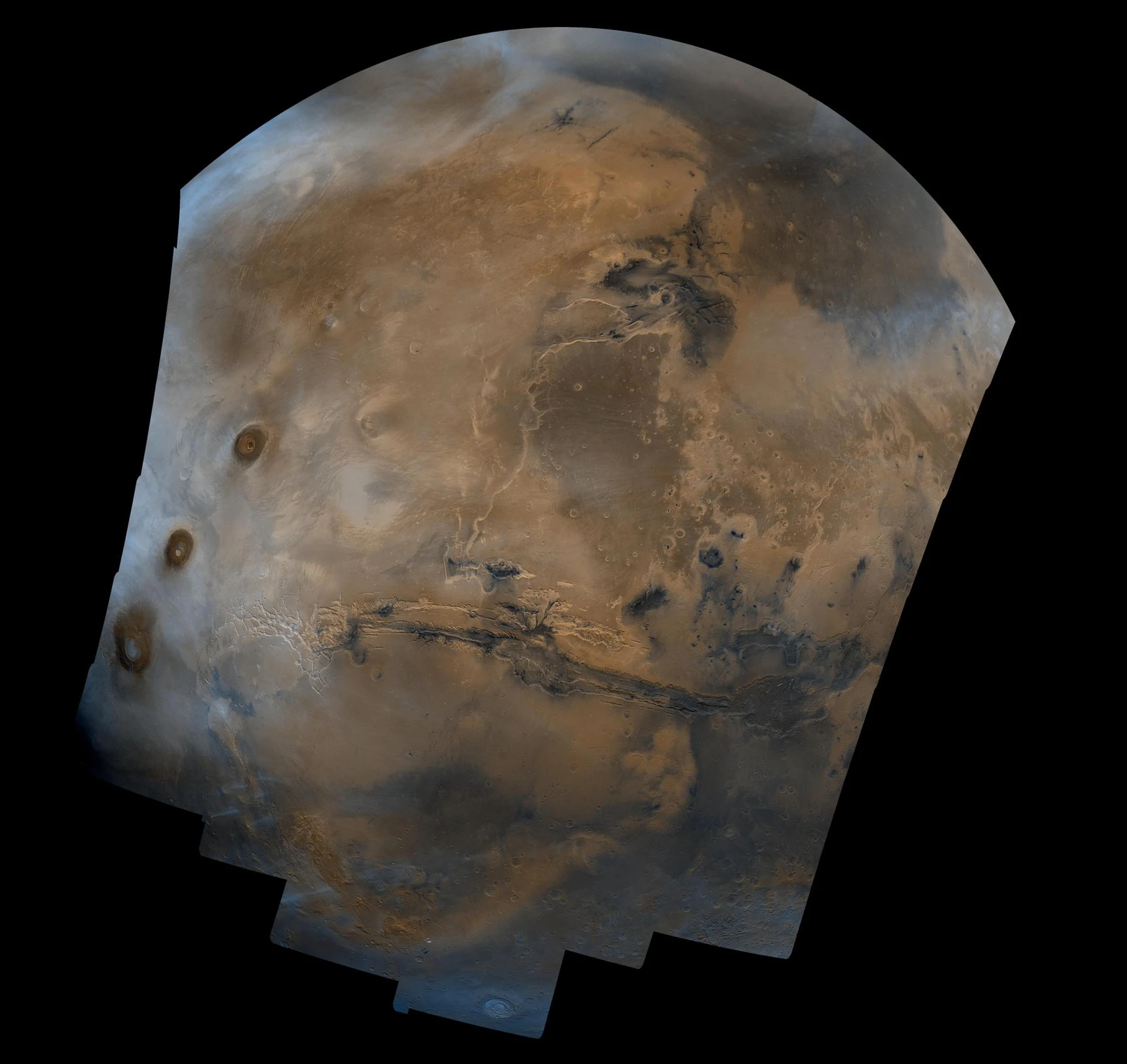
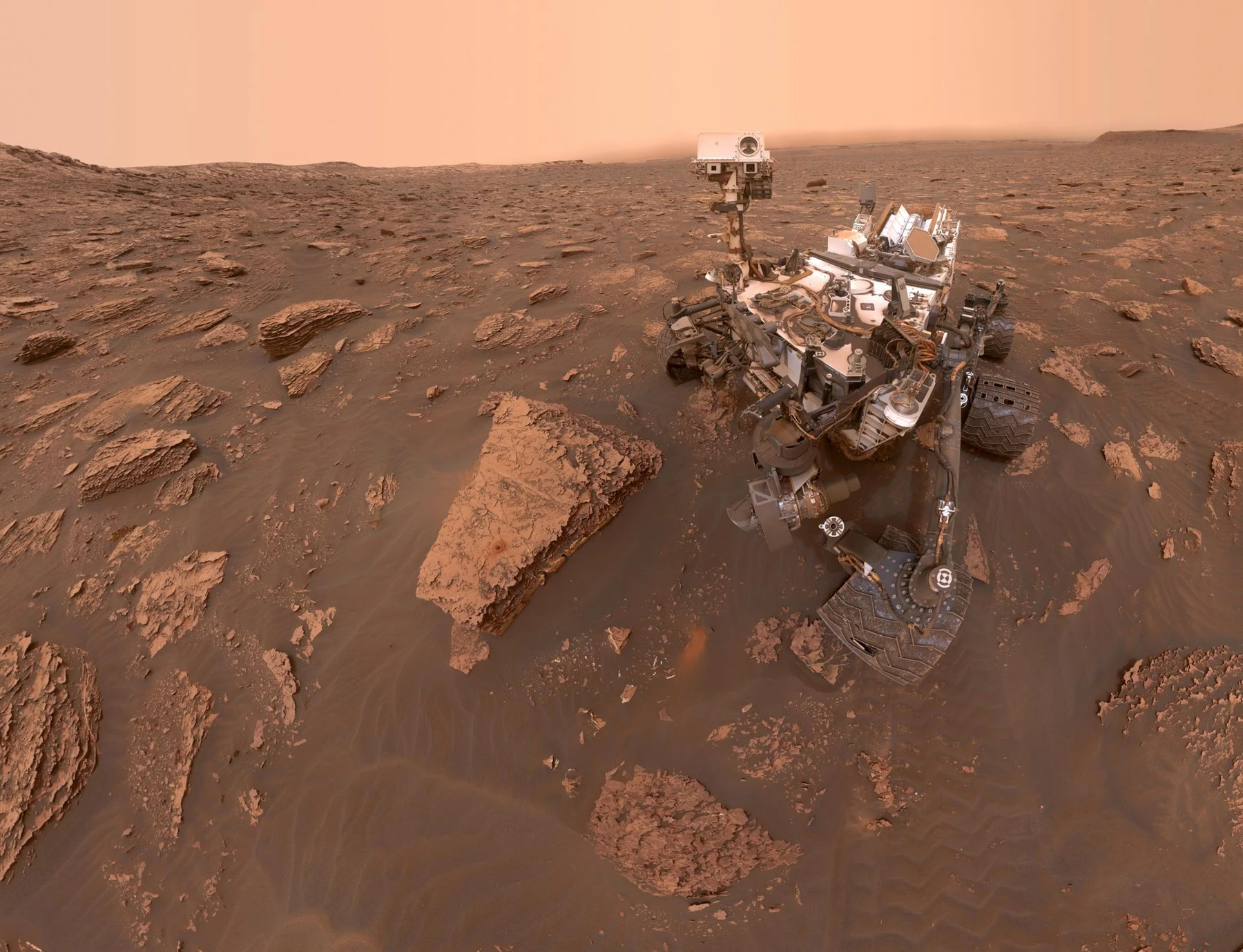
From the ground, calibrated rover images show Mars in tan and orange-brown tones more than fire-engine red. NASA often releases the same rover scene in more than one version. A calibrated “natural” color version is an estimate of how the scene would look to human eyes on Mars. A white-balanced version shows the terrain “as if illuminated under Earth-like, rather than Martian, lighting,” which helps scientists compare rocks with ones on Earth (NASA, PIA16800). Many famous Mars images, though, are processed to bring out differences between rocks. The Viking mosaic below, for example, has its color variations enhanced by about a factor of two (NASA, PIA00003). Our guide Are Space Photos Real? explains how to tell the difference.
Blue sunsets
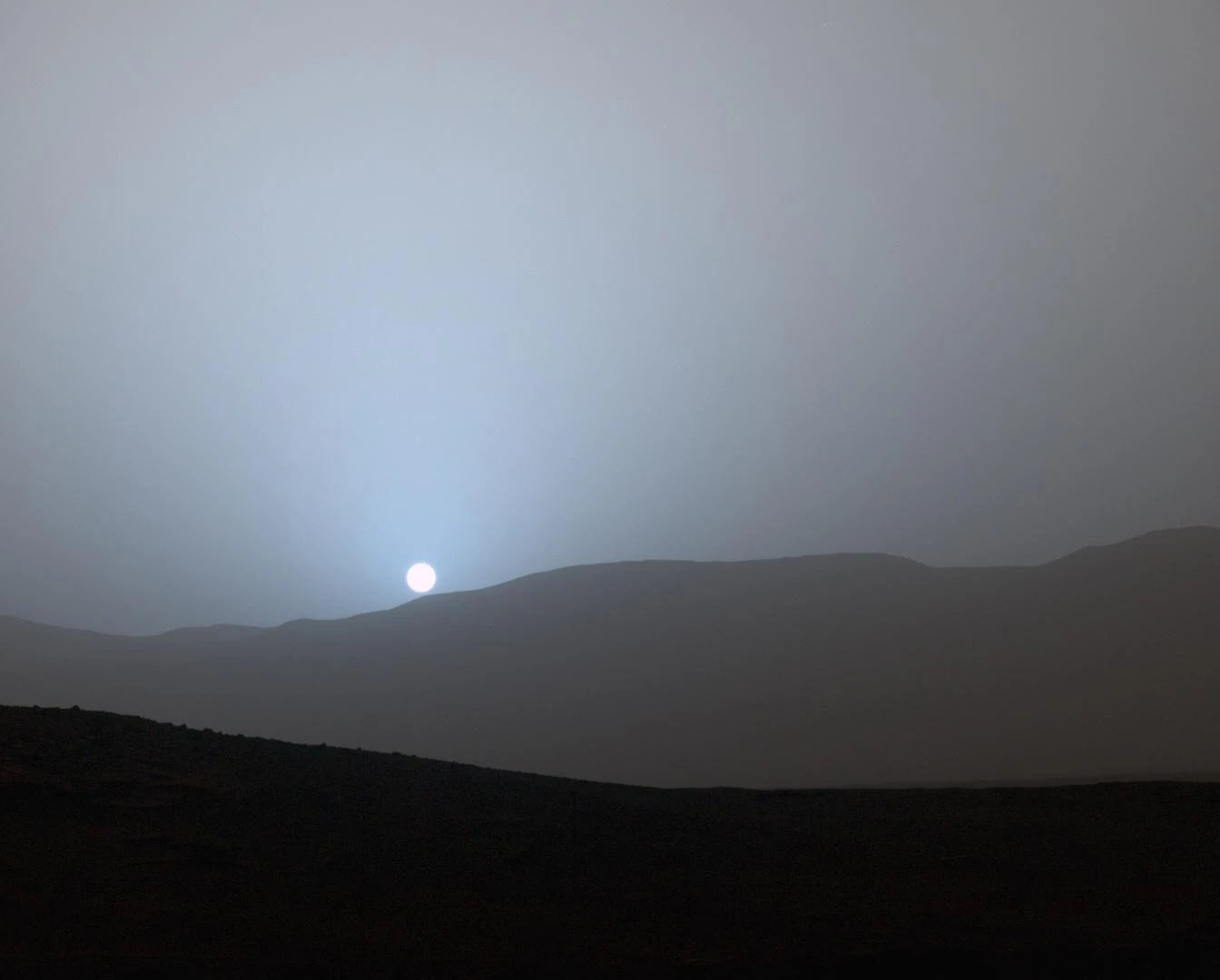
Here’s the surprise. On Mars, sunsets look blue. In 2015, Curiosity photographed its first color sunset from Gale Crater. NASA explains that dust in the Martian air “has fine particles that permit blue light to penetrate the atmosphere more efficiently than longer-wavelength colors,” so the blue stays close to the Sun’s part of the sky. The effect is strongest near sunset, when sunlight passes through the most air (NASA, PIA19400). It’s the reverse of Earth, where sunsets turn red.

Is All of Mars Red?
The poles are white
No. Mars’s polar caps are bright white, made of ice. NASA notes Mars has “seasons, polar ice caps, extinct volcanoes, canyons, and weather” (NASA). Hubble’s 2016 portrait shows frosty caps and clouds over the rust-colored ground (NASA, Hubble 2016).
Dark regions
From Earth, astronomers have long seen dark markings on Mars. One of the largest, Syrtis Major, was among the first features identified by 17th-century observers, and Christiaan Huygens used it to measure how fast Mars spins. Today it’s known to be an ancient, inactive shield volcano (NASA, Hubble 2016). Darker areas generally have less of the bright red dust covering the rock underneath.
The red is skin-deep
Because the red mostly comes from a thin coat of dust, the rock below is often darker. When rovers brush or drill into rocks, they reveal fresh surfaces that aren’t as red as the dust on top.
Myth vs. Fact: Why Mars Is Red
| Myth | Fact | Status |
|---|---|---|
| “Mars is red because it’s hot.” | Its average temperature is about −59 °C; the color comes from rusted iron. | Measured |
| “Scientists know exactly which mineral makes Mars red.” | Ferrihydrite is a strong 2025 candidate, not yet confirmed. | Open |
| “Mars is red all over.” | Its polar caps are white, and some regions are darker. | Observed |
| “Sunsets on Mars are red like Earth’s.” | They look bluish because of fine dust. | Observed |
| “Red color proves Mars had life.” | It may point to past water, which isn’t the same as life. | Modelled |
| “Every Mars photo shows its true color.” | Many are color-enhanced to bring out details. | Observed |
How Can You See Mars’s Color Yourself?
Find it in the sky
When Mars is well placed, it’s one of the brightest points in the night sky and clearly orange-red. NASA’s fact sheet lists its maximum brightness at about magnitude −2.94 (NASA NSSDC). The next opposition, when Mars is opposite the Sun and up all night, is February 19, 2027 (Royal Observatory Greenwich).
Compare it with red stars
Bright red-orange stars like Betelgeuse or Antares twinkle; Mars usually shines steadily. Putting Mars and a red star side by side is a good way to see the difference between a reflecting planet and a glowing star.
Look at rover images
NASA’s raw image sites for Curiosity and Perseverance post fresh pictures from Mars. Look for images labelled “natural color” for an estimate of what your eyes would see on Mars. Images labelled “white-balanced” show the scene as if it were lit like Earth.
Mars’s Color by the Numbers
| Measure | Value | Source |
|---|---|---|
| Cause of the color | Oxidized (rusted) iron in rocks and dust | NASA |
| 2025 leading candidate mineral | Ferrihydrite (water-rich iron oxide) | NASA, 2025 |
| Study published | February 25, 2025, Nature Communications | NASA, 2025 |
| Simulated dust particle size | under 1 micrometer | NASA, 2025 |
| Bond albedo | 0.250 (Earth: 0.294) | NASA NSSDC |
| Average temperature | about −59 °C | NASA NSSDC |
| Maximum brightness from Earth | magnitude −2.94 | NASA NSSDC |
| Next opposition | February 19, 2027 | Royal Observatory Greenwich |
Sources checked November 2026.
Why Mars Is Red FAQ
Why is Mars called the red planet?
Because it looks orange-red, both in the night sky and in photographs. The color comes from iron in its rocks and dust that has oxidized, or rusted. People have noticed and named that color for thousands of years.
Is Mars actually rusty?
In a sense, yes. Its surface dust is full of iron oxides, the same family of compounds as rust. A 2025 study suggests the main one may be ferrihydrite, a water-rich iron oxide, though that hasn’t been confirmed yet.
What is ferrihydrite?
A water-rich iron oxide mineral that forms quickly in cool water. On Earth it’s common where iron-rich water meets oxygen. Its possible presence on Mars is a clue that the planet once had cool liquid water.
What did people think made Mars red before 2025?
The most common idea was dry iron oxides such as hematite, forming slowly over billions of years on a dry surface. The 2025 study argued that a water-rich oxide fits the data better.
Is Mars red on the inside?
Not all the way through. The red color mostly comes from a thin layer of fine dust. The rock below is often darker, and rovers reveal less-red surfaces when they brush or drill into rocks.
What color is the sunset on Mars?
Bluish. Fine dust in Mars’s air lets blue light through more efficiently near the Sun, so the sky around the setting Sun glows blue, NASA explains. Curiosity photographed it in 2015.
Does Mars’s red color mean there was life?
No. It may point to cool liquid water in the past, which makes a habitable past more plausible. But water isn’t life, and no evidence of past life on Mars has been confirmed.
How will scientists confirm what makes Mars red?
By studying real Martian dust in labs on Earth. Perseverance is collecting rock and soil samples that a future mission could bring back for exactly this kind of test.
Your next step: the next time Mars is up, especially around its February 19, 2027 opposition, look at its steady orange glow and remember that you’re seeing sunlight bouncing off rusted iron dust that may have formed in ancient water.
Sources and Further Reading
- NASA Science, Mars: Facts.
- NASA (February 2025), NASA New Study on Why Mars Is Red Supports Potentially Habitable Past, on Valantinas et al., Nature Communications.
- NASA Space Science Data Coordinated Archive, Mars Fact Sheet.
- Royal Observatory Greenwich, What is a planet in opposition?
- NASA images: Hubble Mars, May 2016, PIA00003, PIA19400, PIA22486, PIA07882.
Explore Next
- Mars’s two little moons: How Many Moons Does Mars Have?
- How rovers find their way across the red dust: How Do Mars Rovers Navigate?
- How to tell true color from enhanced: Are Space Photos Real?
- Why Venus, not Mercury, is the hottest planet: What Is the Hottest Planet?
- Every planet in one place: Solar System Explorer
- How a claim earns its label: How We Know
How This Explainer Was Checked
Every number and quote in this article was checked in November 2026 against the source linked beside it: NASA’s Mars facts page, NASA’s February 2025 release on the ferrihydrite study, NASA’s Mars fact sheet, the Royal Observatory Greenwich opposition table and NASA’s image pages. That rusted iron causes Mars’s color is labelled Measured. Which iron mineral dominates is labelled Open. What ferrihydrite implies about ancient water is labelled Modelled. Where an image is color-enhanced, we say so. Images are labelled: real spacecraft and telescope images as OBSERVATION, our charts as DATA GRAPHIC. Nothing AI-generated is presented as a real image.

Final Thought: A Color With a History
For most of human history, Mars’s red was just a color, the reason it was linked with war and fire. Spacecraft showed it’s rust. Now the kind of rust is becoming a clue. If ferrihydrite really paints Mars, then every time you see that orange glow, you’re looking at the chemical memory of cool water on another world. The final check is waiting in sample tubes on Mars.
About the Author
Author: King | Founder of Dark Cosmic Insights