NASA’s Perseverance rover has now driven farther than any vehicle on another world. Almost none of that was “driven” the way you drive a car. Radio signals take minutes to cross the gap to Mars, so the rover has to steer itself. Here’s how a Mars drive actually works, from a planner’s desk in California to six wheels in Jezero Crater.
If you picture someone at NASA with a joystick, watching a live feed and steering around rocks, you’re in good company. It’s how most people imagine it. The real system is stranger and smarter. Humans decide where the rover should go and lay out a route a day at a time. The rover decides how to get there, building its own 3D map of the ground and choosing a safe path while its wheels keep turning.
This guide answers the question how do Mars rovers navigate in plain language. It covers why live driving is impossible, what the human rover planners do, how Perseverance’s self-driving software thinks, how a rover knows where it is with no GPS, the records this has unlocked, and the December 2025 test in which AI planned a route on Mars for the first time. As always at Dark Cosmic Insights, we separate what has been measured from what is still being tested, and we link every number to its source.
In this guide
- Quick Answer: How Do Mars Rovers Navigate?
- The DCI Mars Driving Evidence Map
- Why Can’t NASA Drive a Mars Rover in Real Time?
- How Does a Mars Drive Actually Work?
- Step 1: Humans Pick the Destination
- Step 2: The Rover Drives Itself Between Waypoints
- How Does a Rover Know Where It Is Without GPS?
- A Short History of Self-Driving on Mars
- The Records Self-Driving Unlocked
- New: AI That Plans the Route
- What the AI Test Did and Didn’t Show
- What Still Stops a Mars Rover?
- What Ingenuity Taught Us About Navigating Without Landmarks
- Why Self-Driving Matters Beyond Mars
- Myth vs. Fact: Mars Rover Edition
- Mars Rover Driving by the Numbers
- Frequently Asked Questions
- Sources and Further Reading
- Keep Exploring
- How This Explainer Was Checked
Quick Answer: How Do Mars Rovers Navigate?
Quick Answer: Mars rovers can’t be driven live, because radio signals take about 3 to 22 minutes to travel each way. Instead, human rover planners at NASA’s Jet Propulsion Laboratory choose a destination and send a route of waypoints, usually a day at a time. Between waypoints, the rover drives itself: Perseverance photographs the ground in stereo, builds a 3D hazard map, scores about 1,700 possible paths and picks a safe one while still moving. It tracks its own position by comparing pictures as it goes, a technique called visual odometry. More than 90% of Perseverance’s driving has been autonomous, and in December 2025 NASA tested AI-generated waypoints for the first time.
What this article can and cannot establish: We can describe how NASA’s rovers navigate, using NASA, JPL and peer-reviewed engineering sources, and report the distances and percentages those sources give. We can’t describe flight software in more detail than NASA has published, and the AI route-planning work is an early demonstration, not a routine part of operations.
The DCI Mars Driving Evidence Map
Some claims about rover driving are measured odometer facts. Others are engineering descriptions, and a few are experiments still in progress. This map sorts them.
| Question | What we know | Status | Key source |
|---|---|---|---|
| Can a rover be driven in real time from Earth? | No. One-way signal delay is about 3 to 22 minutes | Measured (physics) | NASA/JPL |
| Does Perseverance drive itself? | Mostly. About 90% of its travel had been autonomous by October 2024 | Measured | IEEE Spectrum, 2026 |
| Do humans still plan the route? | Yes. Planners pick goals and waypoints, usually no more than 100 m apart | Standard practice | NASA/JPL |
| Which rover has driven farthest off Earth? | Perseverance, 45.22 km on Oct. 11, 2026, passing Opportunity’s 45.16 km | Measured | NASA, 2026 |
| How does a rover know where it is? | By comparing images as it moves (visual odometry) plus orbital maps | Measured technique | NASA/JPL robotics |
| Has AI planned a Mars drive? | Yes, two drives in December 2025, with humans checking every command | Demonstration | NASA/JPL, 2026 |
| Does AI drive the rover live? | No. AI proposed waypoints on Earth; the rover’s own software did the driving | Clarified by NASA | NASA/JPL, 2026 |
| Will rovers soon drive kilometres a day on their own? | It’s JPL’s stated goal; not yet achieved | Aspiration | NASA/JPL, 2026 |
Cite this framework: Dark Cosmic Insights, “Mars Driving Evidence Map,” darkcosmicinsights.com, 2026.
Why Can’t NASA Drive a Mars Rover in Real Time?
Distance. Mars is, on average, about 225 million kilometres (140 million miles) from Earth (NASA/JPL). Radio signals travel at the speed of light, which is fast but not instant. Divide the distance by the speed of light and you get roughly 12.5 minutes for a one-way trip at average distance. When Earth and Mars are on the same side of the Sun, the delay drops to about 3 minutes. When they are on opposite sides, it stretches past 20.
Now imagine trying to steer with that lag. You’d see a rock in a picture that was already ten minutes old, send a command to turn, and wait another ten minutes for the turn to happen. By then the rover would have hit the rock, or rolled off a slope, long ago. And that’s before you count the hours the team needs to look at new pictures and agree on a plan.
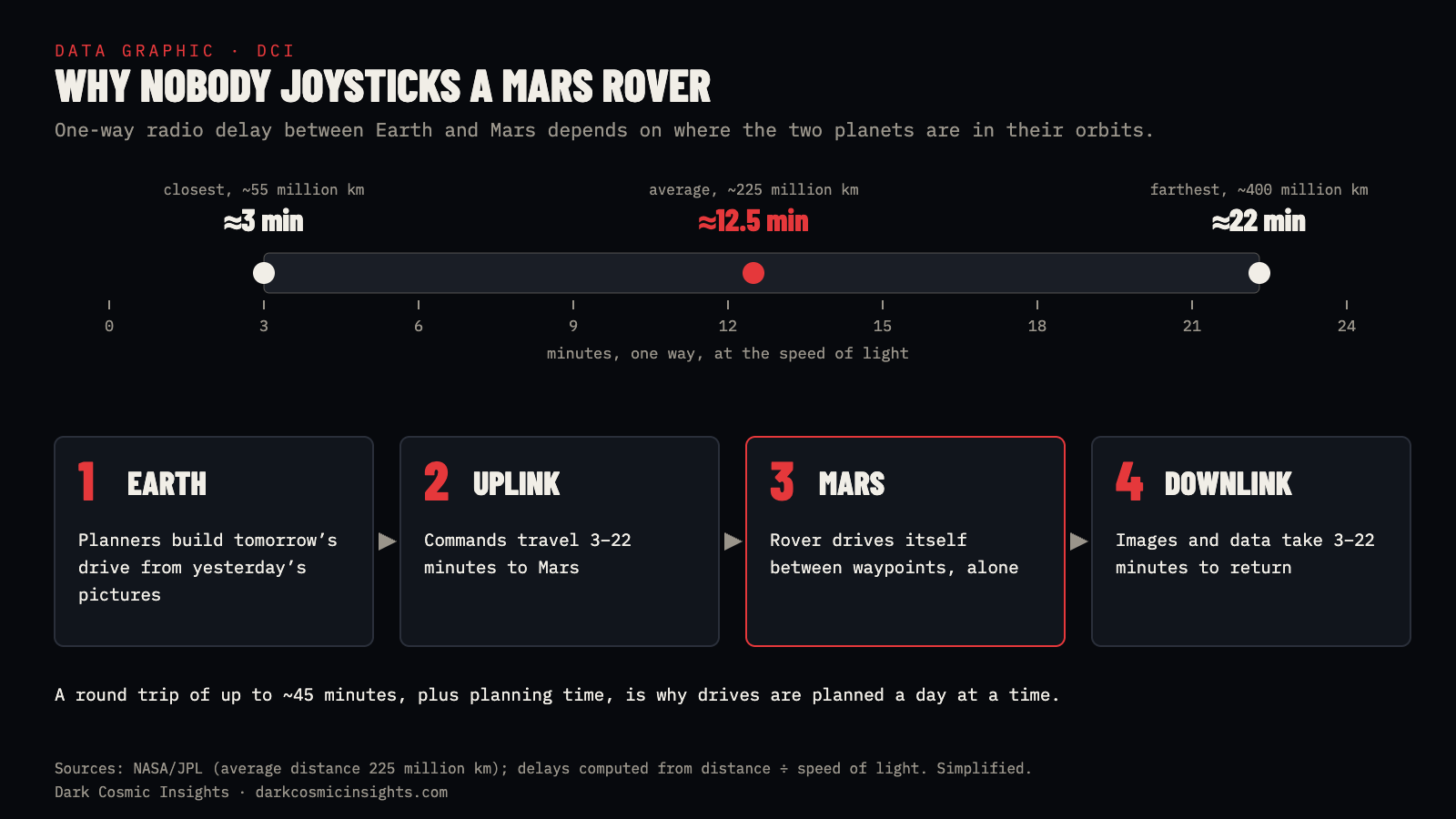
So rover teams work in a loop. Each day, the rover sends home pictures and data from the day’s drive. Planners on Earth use them to build the next set of commands, then send them up, and the rover carries them out the following Martian day (NASA/JPL). Team shifts often follow Mars time, which runs about 40 minutes longer per day than Earth time (Astronomy). A Martian day is called a sol.
How Does a Mars Drive Actually Work?
Every drive on Mars splits the work between people and software. It helps to think of three layers, each working at a different scale and speed.
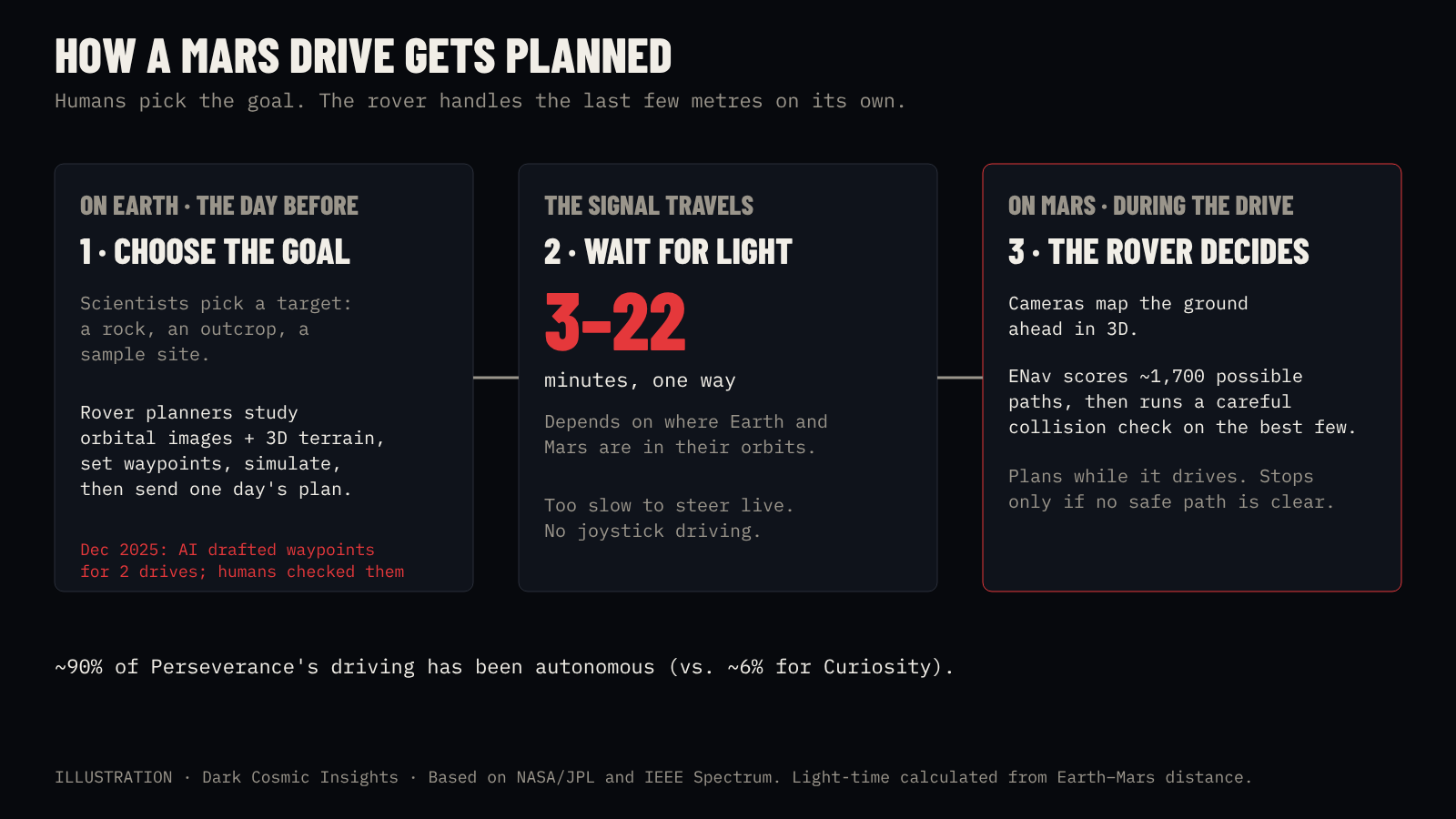
- Strategy (days to months): scientists decide which rocks, layers or landforms are worth visiting, and mission leaders set a long-term route across the landscape.
- Tactics (one sol at a time): rover planners turn the next leg into a list of commands and waypoints, check it in simulation, and send it to Mars.
- Reflexes (seconds): the rover’s own software looks at the ground in front of it, spots hazards, and chooses each next stretch of path between waypoints.
The art of rover driving is deciding how much to hand to that third layer. Give the rover too little freedom and it crawls. Give it too much on terrain it can’t read, and it could get stuck far from help. Over 30 years of Mars rovers, that balance has shifted steadily toward the rover.
Step 1: Humans Pick the Destination
Scientists decide where the rover should go next, maybe an interesting rock layer or a good spot to collect a sample. Then the rover planners, the engineers often called Mars rover drivers, take over. At least two or three work on any rover at a time: one leads by building the sequence of moves, and a second checks and advises (Astronomy).
Planners don’t work from flat photos. They use JPL software to build a 3D model of the terrain from the rover’s own navigation-camera pictures, and they often wear 3D glasses to study it (NASA). They can simulate a tricky move up to 20 times to find the best approach, and sometimes test it on a full-size model rover in JPL’s outdoor Mars yard (Astronomy). They also study high-resolution pictures taken from orbit by NASA’s Mars Reconnaissance Orbiter.
The plan they send is a list of waypoints: fixed spots where the rover receives its next set of instructions. Human planners have usually placed these no more than about 100 metres (330 feet) apart (NASA/JPL). How the rover gets from one waypoint to the next is, increasingly, up to the rover.
Step 2: The Rover Drives Itself Between Waypoints
Between waypoints, Perseverance is on its own. Its navigation cameras work in pairs, like human eyes, so its software can measure depth and build a 3D map of the ground around it. Its self-driving system, called Enhanced Autonomous Navigation (ENav), then looks at about 1,700 possible paths, typically within about 6 metres of the rover. It ranks them by travel time and roughness, and runs a detailed collision check only on the handful of best candidates (IEEE Spectrum).
That shortcut matters, because Perseverance’s main computer is roughly as powerful as a late-1990s home computer. Its radiation-hardened processor is the same type flown on Curiosity, chosen because it survives space, not because it’s fast (IEEE Spectrum). ENav saves the heavy maths for difficult ground. On easy terrain, it barely has to think.
Perseverance also carries a second computer, the Vision Compute Element. It first guided the rover’s landing in February 2021, and now spends its time processing navigation images, which frees the main computer for everything else (NASA/JPL). The result is what NASA calls “thinking while driving”: the rover plans its next move while its wheels are still turning. Curiosity, the rover before it, had to stop, take pictures, think, and only then move on (NASA).
“That made its autonomous driving an order of magnitude faster.” Masahiro Ono, NASA JPL, on Perseverance’s ENav system (IEEE Spectrum)
The gain in detail is huge. NASA notes that Sojourner, the first Mars rover in 1997, used 20 measurement points to judge the path ahead. Perseverance processes 600,000 (NASA). Its mobility team says it sped up the self-driving software four or five times compared with what came before (NASA/JPL).

How Does a Rover Know Where It Is Without GPS?
Mars has no GPS satellites. A rover can count how many times its wheels turn, but on loose sand or a steep slope, wheels slip. A rover might spin its wheels for a metre and move only a few centimetres. Trusting the wheel count would leave it badly lost.
The fix is visual odometry. As the rover drives, it takes pictures every so often and tracks how recognizable features, like pebbles and rock edges, have shifted between frames. From that shift, it works out how far it really moved (NASA/JPL). NASA’s twin Mars Exploration Rovers, Spirit and Opportunity, were the first to demonstrate the technique on another planet. It let them drive on slopes of 15 to 30 degrees, and occasionally up to 31, by correcting for slip as it happened (NASA/JPL Robotics).
Rover teams then check the rover’s position against orbital pictures, where they can match a rock the rover photographed with the same rock seen from space. Between the two, they can place the rover on a map precisely enough to plan the next day’s drive around individual boulders.
A Short History of Self-Driving on Mars
Each NASA rover has handed a little more of the driving to the machine. Sojourner, which landed with Mars Pathfinder in 1997, covered about 100 metres in its 83-sol mission (NASA). It was the size of a microwave oven and rarely strayed far from its lander.
Spirit and Opportunity landed in 2004 with a self-driving system called GESTALT, short for Grid-based Estimation of Surface Traversability Applied to Local Terrain. It used stereo cameras to judge which patches of ground were safe. About 30% of the distance driven in their first 18 months used these autonomous tools, and autonomy helped Spirit reach the Columbia Hills 50% faster. Opportunity’s best single-sol autonomous drive was 109 metres, in February 2005 (NASA/JPL Robotics). Over their whole missions, though, only about 5% of their distance was autonomous (NASA). Spirit drove 7.7 km before it stopped in 2010. Opportunity kept going until 2018 and covered 45.16 km.
Curiosity landed in Gale Crater in 2012. It is about the size of a car and still driving, with more than 38 km on its odometer (NASA). In late 2013, the team noticed dents and holes in its aluminium wheels, wear that seemed to accelerate on rougher terrain (Space.com). The original self-driving software avoided big obstacles but not the sharp rocks puncturing the wheels, so Curiosity largely couldn’t use it at first. As Mars 2020 project manager Jennifer Trosper put it, “Curiosity couldn’t AutoNav because of the wheel-wear issue” (NASA/JPL). By October 2024 only about 6.2% of Curiosity’s travel had been autonomous (IEEE Spectrum).

Perseverance, which landed in Jezero Crater in February 2021, learned from that. Its wheels are slightly larger in diameter and narrower, with 48 wavy treads instead of Curiosity’s 24 chevrons, and the rover sits higher off the ground (NASA/JPL). Paired with ENav and the Vision Compute Element, those changes turned autonomy from an occasional tool into the default way to drive.
The Records Self-Driving Unlocked
- Biggest single day: on April 3, 2023, Perseverance drove 347.69 metres in one sol, 331.74 of them autonomously. Opportunity’s best autonomous day had been 109 metres (IEEE Spectrum).
- Fast commute: while heading for Jezero’s ancient river delta, it averaged 201 metres per sol and covered about 5 km in 24 sols of driving, 95% of it autonomous (IEEE Spectrum).
- Autonomy share: more than 90% of its distance has been driven with its self-driving system (NASA).
- All-time distance: on October 11, 2026, Perseverance passed 45.22 km (28.10 miles), beating Opportunity’s off-world record of 45.16 km. Opportunity took almost 15 years. Perseverance did it in about five and a half (NASA).
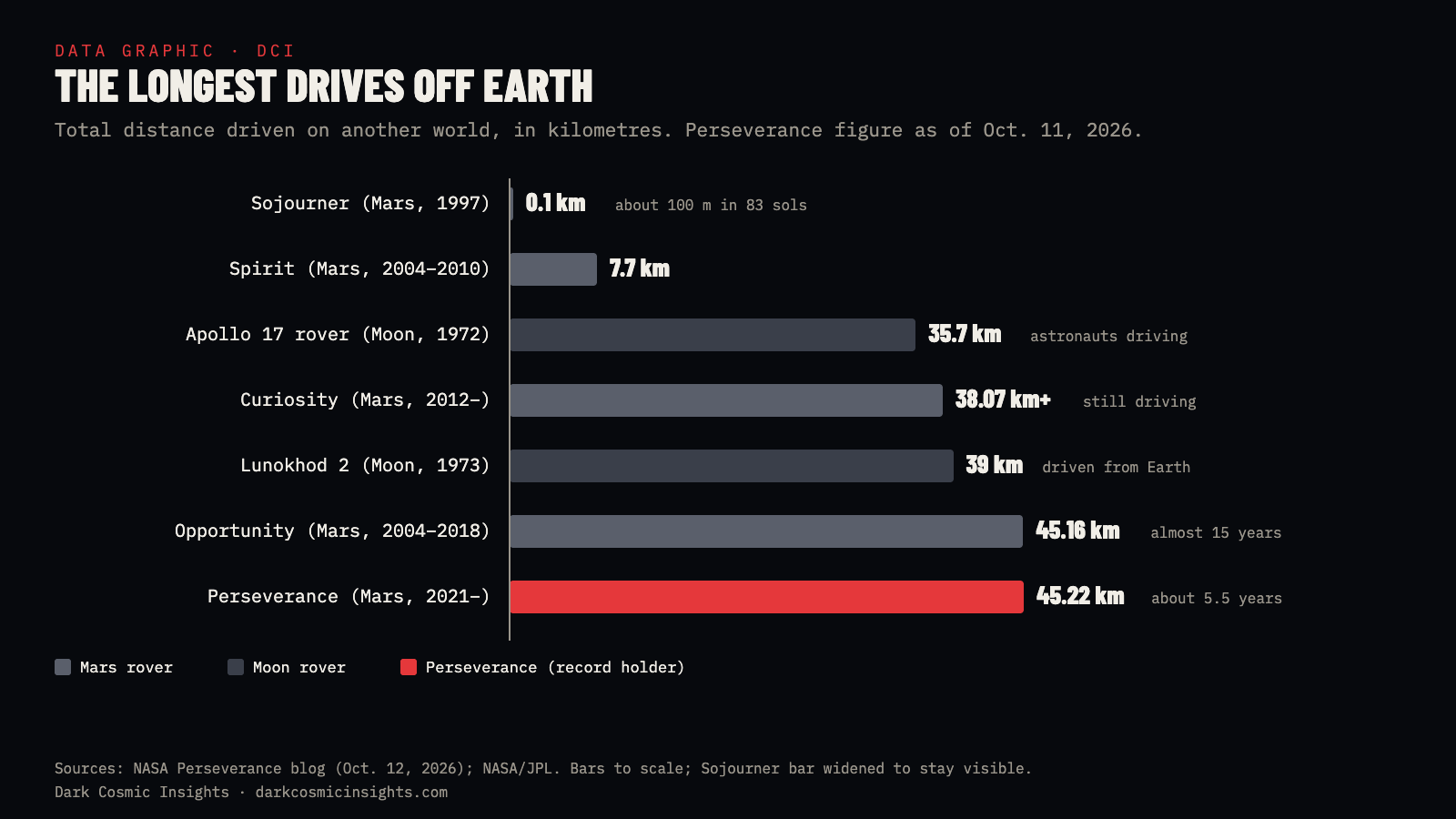
Along the way, Perseverance also passed the 35.7 km driven by the Apollo 17 astronauts on the Moon in 1972 and the 39 km driven by the Soviet Union’s Lunokhod 2 in 1973. NASA’s original plan called for no more than about 20 km (12.4 miles) of driving (NASA).
New: AI That Plans the Route
In December 2025, NASA tried something new. For two drives, on December 8 and 10 (sols 1,707 and 1,709), the waypoints weren’t drawn by human planners. They were generated by AI. JPL’s Rover Operations Center worked with the company Anthropic, using its Claude vision-language models (NASA/JPL).
The AI studied the same data human planners use: high-resolution orbital images from the HiRISE camera on the Mars Reconnaissance Orbiter, and terrain-slope data from digital elevation models. It picked out features such as bedrock, outcrops, boulder fields and sand ripples, then laid down a continuous path with waypoints. The drives covered 210 metres and 246 metres; the second took about two and a half hours along Jezero Crater’s rim (NASA/JPL).

Humans stayed in charge. Before anything went to Mars, engineers ran the commands through JPL’s “digital twin,” a virtual copy of the rover, and checked more than 500,000 telemetry variables to make sure they were compatible with the flight software (NASA/JPL). JPL roboticist Vandi Verma said the goal is a future where AI and other smart tools help rovers handle “kilometer-scale drives while minimizing operator workload.”
What the AI Test Did and Didn’t Show
Headlines about “AI driving on Mars” can mislead, so it’s worth being precise.
- It did show that an AI model could read orbital images and slope data and propose a route that engineers were willing to send to Mars.
- It did not put an AI in live control. The waypoints were planned on Earth and checked by people before uplink.
- The on-board driving was still done by Perseverance’s own ENav software, the same system that has handled most of its driving since 2021.
- Two drives are a demonstration, not a track record. NASA has not said this is now the normal way to plan drives.
The interesting part is the bottleneck it targets. Rover speed is no longer limited only by the rover. It is also limited by how much ground human planners can map and check each day. If software can draft good routes over longer distances, people can spend their time reviewing rather than drawing, and a rover could cover more ground per command cycle.
What Still Stops a Mars Rover?
Self-driving rovers are impressive, but Mars still sets the rules.
- Hard terrain: when ENav can’t quickly find a safe path, Perseverance stops to think before moving on (IEEE Spectrum).
- Night: it doesn’t drive in the dark, because it’s too cold (IEEE Spectrum).
- Glare: driving toward the Sun puts glare in the navigation cameras, which forces the team to park by mid-afternoon. Deputy robotic operations chief Mark Maimone calls it the next challenge (NASA).
- Speed: top speed is about 0.1 mph (roughly 0.16 km/h), though the rover can cover more than 300 yards (about 275 m) on a good day (NASA).
- Sharp rocks and wheel wear: Curiosity’s damaged wheels showed how one overlooked hazard can change how a whole mission drives (Space.com).
What Ingenuity Taught Us About Navigating Without Landmarks
Perseverance carried a passenger: the Ingenuity helicopter, planned for up to five test flights over 30 days. It flew 72 times over almost three years and logged more than two hours in the air (NASA). It covered about 17 km in total (NASA).
Ingenuity navigated by watching the ground with a downward-looking camera and tracking surface features, the same basic idea as a rover’s visual odometry. That worked well over flat, pebbly ground. On its 72nd flight, on January 18, 2024, it was over steep, mostly featureless sand ripples. About 20 seconds after takeoff, the navigation system couldn’t find enough features to track. The investigation concluded that the resulting errors most likely caused a hard, fast landing that broke all four rotor blades (NASA).
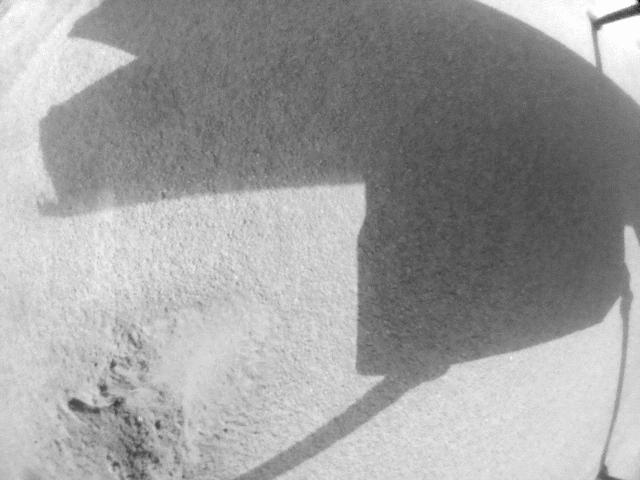
“Lack of surface texture gave the navigation system too little information to work with.” Håvard Grip, Ingenuity’s first pilot (NASA)
It’s a clean lesson for every robot that navigates by sight: a camera-based system is only as good as the texture it can see. Bland sand, glare and darkness are hazards in their own right.
Why Self-Driving Matters Beyond Mars
The farther a robot goes from Earth, the more it has to think for itself. Ingenuity’s success has the team sketching a bigger “Mars Chopper” concept, about 20 times heavier, that could carry science instruments up to about 3 km a day (NASA). On Saturn’s moon Titan, radio signals take over an hour each way, so NASA’s Dragonfly rotorcraft will have to fly with no live help at all. Read more in NASA’s Dragonfly Mission to Titan.
NASA has also linked smarter autonomy to its plans for people. Matt Wallace, who manages JPL’s Exploration Systems Office, described the AI-planned drives as part of the technology needed for a lasting human presence on the Moon and, eventually, Mars (NASA/JPL). Robots that can scout, map and haul on their own would let astronauts spend their time on the work only humans can do.
Myth vs. Fact: Mars Rover Edition
| Myth | Fact |
|---|---|
| Someone at NASA steers the rover with a joystick. | Signals take 3 to 22 minutes each way. Drives are planned in advance and the rover avoids hazards itself. |
| The rover is fully autonomous and picks its own science targets. | Humans choose the destinations and waypoints. The rover handles the path between them. |
| AI is now driving Perseverance. | AI proposed waypoints for two drives in December 2025. People checked every command, and the rover’s own software did the driving. |
| Rovers use GPS to find their way. | Mars has no GPS. Rovers use visual odometry and match their pictures to orbital maps. |
| Mars rovers are fast now. | Top speed is about 0.1 mph. A record day is still only about 350 metres. |
| The rover sees the way we do, in a single photo. | It uses paired stereo cameras to measure depth and build a 3D map, then scores hundreds of paths. |
Rover pictures raise their own questions, like why the colors sometimes look odd. For how to read them, see Are Space Photos Real?.
Mars Rover Driving by the Numbers
- 3 to 22 minutes: one-way signal delay, Earth to Mars (NASA/JPL).
- About 225 million km: average Earth–Mars distance (NASA/JPL).
- About 100 m: typical maximum spacing of human-planned waypoints (NASA/JPL).
- About 1,700: paths ENav considers, typically within about 6 m (IEEE Spectrum).
- 20 vs. 600,000: measurement points used by Sojourner and Perseverance to judge the path ahead (NASA).
- 347.69 m: Perseverance’s biggest single-sol drive, April 3, 2023 (IEEE Spectrum).
- Up to 412 m: how far Perseverance can now cover in one sol (NASA).
- 90%+ vs. about 6.2% vs. about 5%: autonomous share of driving for Perseverance, Curiosity and Spirit/Opportunity (IEEE Spectrum; NASA).
- 45.22 km: Perseverance’s odometer when it set the off-world record, Oct. 11, 2026 (NASA).
- 500,000+: telemetry variables checked before the first AI-planned drive (NASA/JPL).
- 72: flights by the Ingenuity helicopter, which was planned for five (NASA).
Frequently Asked Questions
Can NASA drive a Mars rover in real time?
No. Signals take about 3 to 22 minutes each way, so drives are planned in advance, usually a day at a time, and the rover handles obstacles itself.
Is Perseverance self-driving?
Mostly. Humans choose destinations and waypoints, but more than 90% of its distance has been driven by its own navigation software.
Did AI drive Perseverance?
AI planned the waypoints for two drives in December 2025, and engineers checked every command before sending it. The rover’s on-board software still did the moment-to-moment driving.
How fast does a Mars rover go?
Slowly. Perseverance’s top speed is about 0.1 mph. Its best day so far is about 348 metres, and NASA says it can now cover up to 412 metres in a sol.
How do rovers avoid rocks?
Stereo navigation cameras build a 3D map of the ground. Perseverance’s ENav software scores about 1,700 possible paths, then checks the best few in detail for collisions.
How does a rover know where it is on Mars?
It uses visual odometry, comparing images as it drives to measure how far it really moved, and teams match its pictures to orbital maps.
Who are the Mars rover drivers?
Engineers at NASA’s Jet Propulsion Laboratory called rover planners. They build each day’s commands in 3D software and check them in simulation.
Which rover has driven the farthest?
Perseverance. On Oct. 11, 2026, it passed 45.22 km, beating Opportunity’s 45.16 km off-world record.
Sources and Further Reading
- NASA/JPL (Jan. 30, 2026). NASA’s Perseverance Rover Completes First AI-Planned Drive on Mars.
- NASA Perseverance blog (Oct. 12, 2026). NASA’s Perseverance Sets Off-World Record for Total Distance Driven.
- IEEE Spectrum (Feb. 25, 2026). Perseverance’s autonomous driving, reporting a study in IEEE Transactions on Field Robotics (Nov. 2025).
- NASA/JPL (July 2021). NASA’s Self-Driving Perseverance Mars Rover ‘Takes the Wheel’.
- NASA Science. How Perseverance Drives on Mars.
- NASA Photojournal: PIA17751, Left-Front Wheel of Curiosity Rover; PIA26244, Ingenuity’s Navcam Reveals a Missing Rotor Blade; PIA26752, Perseverance Snaps Westernmost Selfie.
- NASA/JPL Robotics. Mars Exploration Rovers: Surface Navigation.
- NASA (Dec. 11, 2024). NASA Performs First Aircraft Accident Investigation on Another World; NASA (2024), After Three Years on Mars, NASA’s Ingenuity Helicopter Mission Ends.
- Astronomy. How Mars rover drivers navigate the Red Planet.
- Space.com (2013). Rugged Martian Terrain Chewing Up Curiosity Rover’s Wheels.
- Universe Today (2023). NASA’s Perseverance Rover is Setting Records on Mars.
Keep Exploring
For the next step in off-world autonomy, a drone that will fly itself on Saturn’s largest moon, read NASA’s Dragonfly Mission to Titan. To learn how to read rover and telescope pictures, see Are Space Photos Real?. And for how different cameras reveal different truths, try Hubble vs. Webb.
How This Explainer Was Checked
Every number in this article comes from NASA, JPL or a published engineering source, linked above, and was checked against those sources in November 2026. Distances and percentages are as of the dates given. Images labeled OBSERVATION are real rover images; DATA marks a published map or annotated image; ILLUSTRATION and DATA GRAPHIC mark original Dark Cosmic Insights diagrams. Signal delays in our diagram are calculated from published distances. Nothing here was generated by AI and presented as a real image.
About The Author
Author: King | Founder of Dark Cosmic Insights
King is the founder of Dark Cosmic Insights, a science storytelling platform exploring the strangest true stories hiding in space, science and AI. Through Dark Cosmic Insights, King digs into NASA, ESA and peer-reviewed research, separates what has been measured from what is still a mystery, and turns real discoveries into clear articles, original data graphics and Shorts that help curious people see the universe more clearly.
Follow the anomaly. Trace the source. 🔭
November 5, 2026