Saturn’s largest moon has thick orange air, rain made of methane, and seas of liquid natural gas. In late 2034, NASA plans to land a car-sized, eight-rotor drone there and fly it from place to place for more than three years. Nothing like it has ever been tried this far from Earth.
The mission is called Dragonfly, and it is being built right now at the Johns Hopkins Applied Physics Laboratory in Maryland. In 2026 alone, engineers wired up the flight vehicle, the landing area got an official name, and the team flew the whole first flight in a computer simulation, start to finish.
This guide explains the NASA Dragonfly Titan mission from the ground up: what Titan is, why flying there is easier than flying on Earth, what Dragonfly will look for, where it will land, and which big questions about Titan are still open. As always at Dark Cosmic Insights, we separate what’s been measured from what’s planned or still debated.
In this guide
- Quick Answer: What Is NASA’s Dragonfly Mission?
- The DCI Dragonfly Evidence Map
- What Is Titan?
- Why Does NASA Care So Much About Titan?
- What Did We Learn From Landing on Titan in 2005?
- Why Fly on Titan Instead of Driving?
- What Does Dragonfly Look Like?
- What Instruments Will Dragonfly Carry?
- Where Will Dragonfly Land on Titan?
- How Will Dragonfly Fly Without a Pilot?
- How Will Dragonfly Get to Titan?
- Does Titan Have an Underground Ocean?
- How Is Dragonfly Different From Ingenuity?
- Myth vs. Fact: Dragonfly Edition
- Titan and Dragonfly by the Numbers
- Frequently Asked Questions
- Sources and Further Reading
- Keep Exploring
- How This Explainer Was Checked
Quick Answer: What Is NASA’s Dragonfly Mission?
Quick Answer: Dragonfly is a NASA rotorcraft lander, about 953 kg and roughly 3.85 m across, with eight rotors in four pairs. It is scheduled to launch on a SpaceX Falcon Heavy in July 2028, arrive at Titan in late 2034, and spend about 3.3 years hopping between sites, from organic sand dunes to an ancient impact crater called Selk. It will not look for living things directly. It will study prebiotic chemistry, the chemistry that can come before life, and check how habitable Titan is. Titan is ideal for flying because its air is about four times denser than Earth’s and its gravity is about one-seventh as strong.
What this article can and cannot establish: We can report what NASA has built, tested and scheduled, and what earlier missions measured at Titan, with a source for every number. We can’t tell you what Dragonfly will find, and every date after 2026 is a plan that could still change.
The DCI Dragonfly Evidence Map
Some things about Titan and Dragonfly are measured. Others are designs on paper, and a few are open scientific arguments. This map sorts them.
| Question | What we know | Status | Key source |
|---|---|---|---|
| Does Titan have a thick atmosphere? | Yes: mostly nitrogen, surface pressure about 1.5 times Earth’s | Measured | ESA; Huygens probe, 2005 |
| Does Titan have lakes and seas? | Yes, of liquid methane and ethane, mainly near the north pole | Measured | NASA Cassini |
| Has anything landed on Titan? | Yes, ESA’s Huygens probe on January 14, 2005 | Measured | NASA/ESA |
| Is flying easier on Titan than on Earth? | Yes, because of denser air and weaker gravity | Physics + design studies | NASA; APL |
| Is Dragonfly built and tested? | Being assembled; first flight simulated in October 2026 | In progress | NASA Dragonfly blog |
| When does it launch and arrive? | Launch window July 5–25, 2028; arrival late 2034 | Planned | NASA |
| Does Titan have a global underground ocean? | Long thought likely; a 2025 study argues for slushy ice instead | Debated | Nature, 2025 |
| Is there life on Titan? | No evidence either way; Dragonfly studies chemistry, not life | Unknown | NASA fact sheet |
What Is Titan?
Titan is Saturn’s largest moon and the second-largest moon in the solar system, after Jupiter’s Ganymede. It is about 5,150 kilometres wide, a little wider than the planet Mercury (ESA). Dutch astronomer Christiaan Huygens discovered it on March 25, 1655 (NASA).
What makes Titan special is its air. It is the only moon in the solar system with a thick, planet-like atmosphere. That atmosphere is about 95% nitrogen and about 5% methane (APL), and the pressure at the surface is about 1.5 times what you feel at sea level on Earth (ESA). NASA compares it to the pressure a swimmer feels about 15 metres underwater (NASA).
It is also brutally cold, about −179 °C (NASA). At that temperature, water ice is as hard as rock and plays the role rock plays on Earth. Methane, a gas in your kitchen stove, can exist as a liquid. So Titan has a weather cycle like ours, with clouds, rain, rivers, lakes and seas, except the liquid is methane and ethane instead of water (NASA).
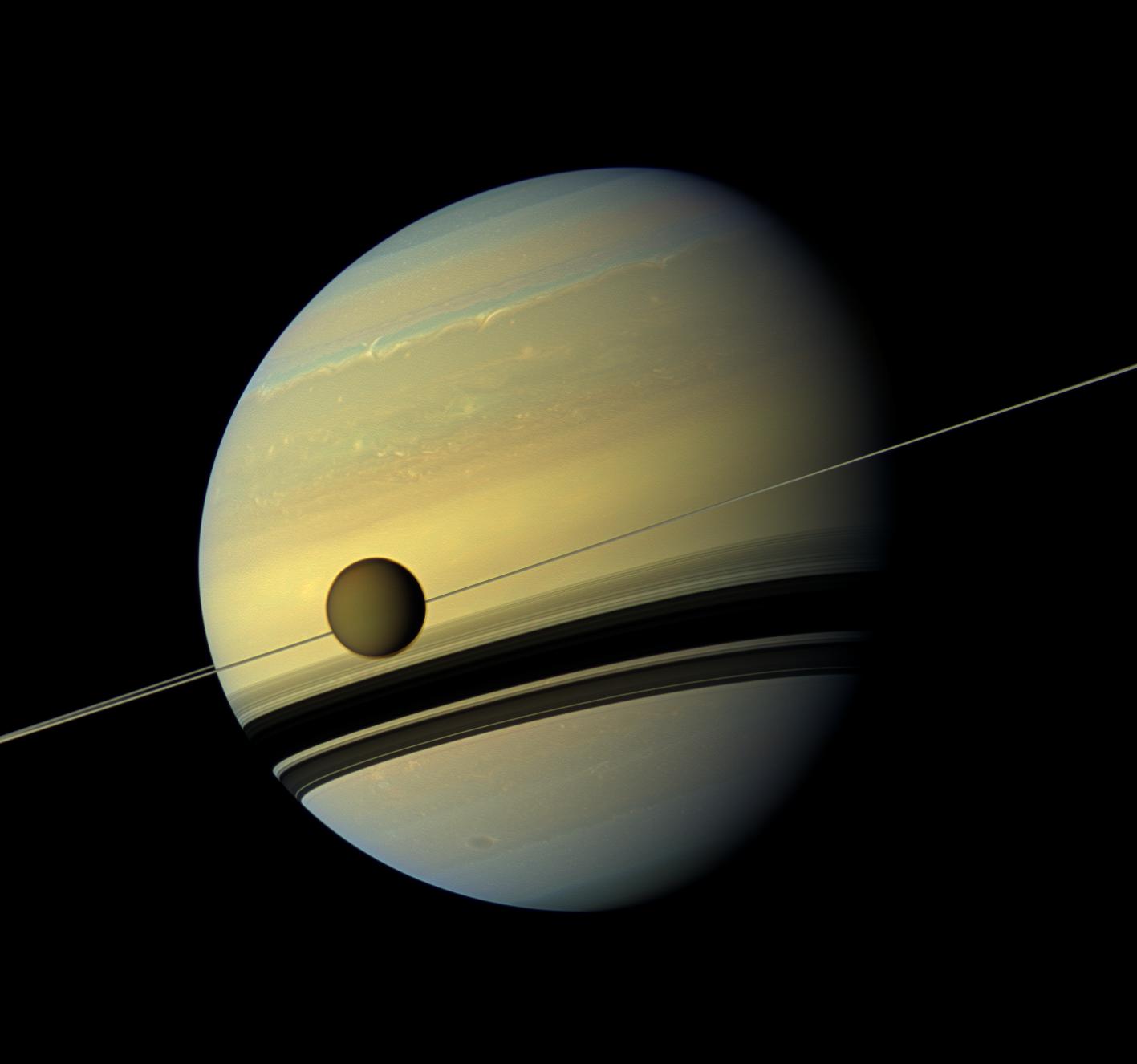
That orange haze is the reason Titan stayed mysterious for so long. Ordinary cameras can’t see through it. Cassini had to use radar and special near-infrared filters to map the surface. It’s the same reason infrared telescopes see inside dusty nebulas, as we explain in Hubble vs. Webb.
One Titan day lasts about 16 Earth days, because Titan keeps the same face toward Saturn as it orbits once every 15.95 days (ESA). The Dragonfly team calls a Titan day a Tsol (NASA).
Why Does NASA Care So Much About Titan?
Titan is a giant natural chemistry lab. Sunlight and charged particles break apart nitrogen and methane high in the atmosphere. The fragments recombine into larger carbon-rich molecules, which form the orange haze and slowly drift down to the surface. Over time, they pile up as dark organic sand and sediment (NASA fact sheet).
Carbon chemistry alone isn’t enough for the processes that lead to life on Earth. Liquid water seems to matter too. Titan’s surface is far too cold for liquid water today, but scientists think water has melted there briefly, for example when large impacts heated the icy crust. Where melted water and organic material mixed, chemical reactions similar to those on the early Earth may have run, and their products may still be preserved (NASA fact sheet).
That’s why NASA describes Dragonfly’s goal as studying prebiotic chemistry, the chemical steps that come before biology. NASA lists four aims: assess Titan’s habitability, find out how far prebiotic chemistry has progressed, identify compounds of interest for the origin of life, and search for chemical signs of water-based or hydrocarbon-based life (NASA). In NASA’s own words, it “won’t be searching for life, per se” (NASA fact sheet).
NASA also notes that Titan may offer two very different kinds of possibly habitable environment: water deep inside the moon, and hydrocarbon lakes on the surface, where any life would have to be very different from Earth’s. So far, there is no evidence of life on Titan at all (NASA).
What Did We Learn From Landing on Titan in 2005?
We’ve been to Titan’s surface once. The European Space Agency’s Huygens probe rode to Saturn attached to NASA’s Cassini spacecraft, separated, and parachuted through Titan’s atmosphere on January 14, 2005. The descent lasted 2 hours and 27 minutes, and Huygens kept working for another 72 minutes on the ground (NASA). It is still the only landing ever made in the outer solar system.

The landing photo surprised scientists. The “rocks” around Huygens turned out to be pebble-sized chunks of water ice, rounded and eroded at their bases, which suggests liquid once flowed there. The ground was darker than expected, a mix of water ice and hydrocarbon ice (NASA). In other words, Huygens landed on something like a dried riverbed.
Meanwhile, Cassini made more than 100 targeted flybys of Titan before its mission ended in 2017. It found lakes and seas of liquid methane and ethane near the poles, vast dune fields of organic sand around the equator, and river channels in between (NASA).

But Huygens had a limit: it couldn’t move. It saw one spot for 72 minutes. Titan is a whole world with dunes, craters, rivers and seas, and the most interesting chemistry may be in places far apart. Dragonfly is the answer to that problem.
Why Fly on Titan Instead of Driving?
Here’s the surprising part: Titan is one of the easiest places in the solar system to fly, and easier than Earth. Two things make it work. Titan’s atmosphere is about four times denser than Earth’s (APL), so each rotor blade has much more air to push against. And Titan’s gravity is only about one-seventh of Earth’s, so there’s less weight to hold up.
Put those together and the power needed to hover drops dramatically. Members of the Dragonfly team have estimated that flying on Titan takes roughly one-fortieth of the power the same craft would need on Earth (Smithsonian Air & Space). Treat that as a ballpark engineering estimate, not a measured number.

Driving, by contrast, is slow. Mars rovers measure their whole careers in tens of kilometres, and they need careful route planning on every drive (see How Rovers Navigate Mars Without a Driver). Dragonfly can cover tens of kilometres in under an hour of flying. NASA expects it to visit 20 to 30 different sites over its primary mission and travel about 115 km (70 miles) from its first landing spot (NASA).
It won’t fly constantly. The plan is about one flight every one or two Tsols, so roughly every 16 to 32 Earth days, with long stops in between to sample the ground, recharge, and send data home (NASA).
What Does Dragonfly Look Like?
Dragonfly is about the size of a small car. NASA’s 2026 fact sheet gives these numbers (NASA):
- Mass: about 953 kg (2,100 pounds).
- Size: about 3.85 m long, 3.85 m wide and 1.75 m tall (12.5 × 12.5 × 5.5 feet).
- Rotors: four pairs of stacked, counter-rotating (coaxial) blades, each 1.35 m (53 inches) across. That’s eight rotors in total.
- Power: a Multi-Mission Radioisotope Thermoelectric Generator (MMRTG), which turns heat from decaying plutonium into electricity, plus a 147 amp-hour battery.
- Communications: direct to Earth through NASA’s Deep Space Network, using X-band radio.

Why nuclear power? Titan is about 9.5 times farther from the Sun than Earth (ESA), and its haze blocks much of the weak sunlight that does arrive. Solar panels can’t do the job. Instead, the MMRTG trickle-charges the battery during long rest periods on the ground, and the battery supplies the big burst of power each flight needs (NASA). That battery alone weighs nearly 300 pounds (NASA).
The lander is also built like a thermos bottle. Thick foam insulation on the outside holds in heat from the nuclear power source, and warm air circulates inside to keep electronics alive at −179 °C (NASA).
In July 2026, the team installed Dragonfly’s wiring harness, its “nervous system,” on the flight fuselage. It contains an estimated 17,315 feet of wire and 374 connectors, and weighs about 100 pounds (NASA). “It’s critical hardware that exists only to serve the rest of the lander,” said Jackie Perry, the harness lead at APL.
What Instruments Will Dragonfly Carry?
Dragonfly is a flying laboratory. At each landing site it will drill into the ground, pull up samples and analyze them inside the lander. Its main science instruments are (NASA; NASA fact sheet):
- DraMS (Dragonfly Mass Spectrometer): identifies chemical compounds and can tell whether biologically relevant molecules have formed. Built by NASA Goddard and France’s space agency, CNES.
- DrACO (Drill for Acquisition of Complex Organics): drills and blows surface material into DraMS. Built by Honeybee Robotics, a Blue Origin company.
- DraGNS (Gamma-ray and Neutron Spectrometer): fires neutrons into the ground and reads the gamma rays that come back to measure which elements are present, without touching the surface (APL).
- DraGMet (Geophysics and Meteorology package): a weather station plus a seismometer to listen for “Titanquakes” and probe the deep interior (APL). Built by APL and Japan’s space agency, JAXA.
- DragonCam: a camera suite for aerial scouting and close-up views of the ground, built by Malin Space Science Systems and APL.
The combination matters. DraGNS can quickly survey what a spot is made of, helping the team decide where it’s worth spending a drill sample. DraMS then does the slow, detailed chemistry. DraGMet checks the wind and weather before each flight, just like a pilot would.
Where Will Dragonfly Land on Titan?
Dragonfly will land in Titan’s equatorial dune belt. In 2026, the International Astronomical Union approved a name for the landing region: Ahmakiq Undae, a dune field about 810 km across that borders Selk Crater (NASA).
The name comes from Maya tradition. Ahmakiq (pronounced “ah-mahk-eek”) was a spirit people appealed to for protection from crop-damaging winds; the name means “one who locks up the wind.” Titan’s dune fields are named after wind gods and goddesses, so it fits (NASA).

The real prize is Selk Crater, about 80 km wide. Scientists think the impact that made it melted Titan’s icy bedrock, possibly creating a large pool of liquid water that could have stayed liquid for hundreds to thousands of years under an insulating lid of ice, “like winter ponds on Earth” (NASA). If organic sand fell into that water, Selk could hold the products of exactly the kind of chemistry Dragonfly is designed to study.
The plan is to start on the safer dunes and interdune flats, learn how the vehicle behaves, and then work toward the crater deposits over several years.
How Will Dragonfly Fly Without a Pilot?
Titan is so far away that radio signals take more than an hour to travel each way. Nobody on Earth can steer Dragonfly in real time. It has to see the ground, pick a safe landing spot and fly itself. “Everything we do on Titan has to happen autonomously,” said Zach Putnam, Dragonfly’s mobility subsystem lead engineer at APL (NASA).
In October 2026, the team announced Dragonfly’s most complete test yet: a full simulated version of its first flight on Titan, run in real time on flight-like computers at APL (NASA). The software flew over virtual dunes, scanned for a safe site, circled back and landed.
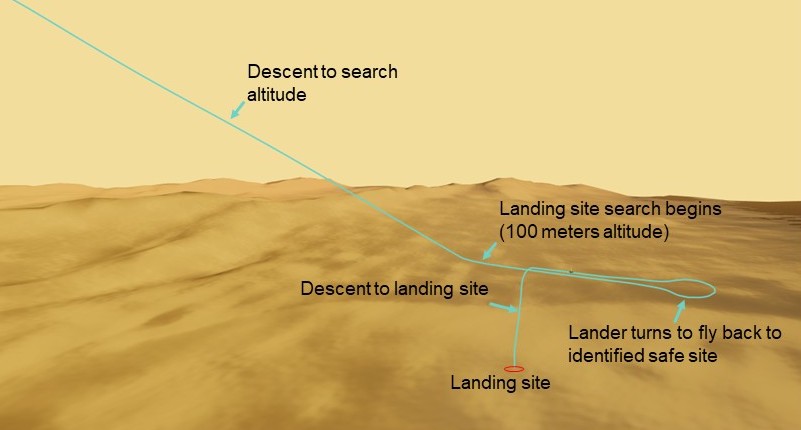
The test fed the flight software simulated data from the sensors Dragonfly will use at Titan: navigation cameras, inertial measurement units that sense motion, and a lidar that measures the height and slope of the ground. A custom emulator rendered each fake camera image in 20 to 70 milliseconds, matching the exposure times of the real cameras (NASA).
“The cool thing about first flight is that it’s our most challenging flight,” Putnam said. “It uses every piece of flight sensor hardware on the lander.” The team built up to it in steps, starting with simulations of a single rotor spinning, then a short reposition flight, then a partial scouting flight (NASA). Next, they plan to run first flight on the actual flight hardware and deliberately inject faults to check how the craft copes.
How Will Dragonfly Get to Titan?
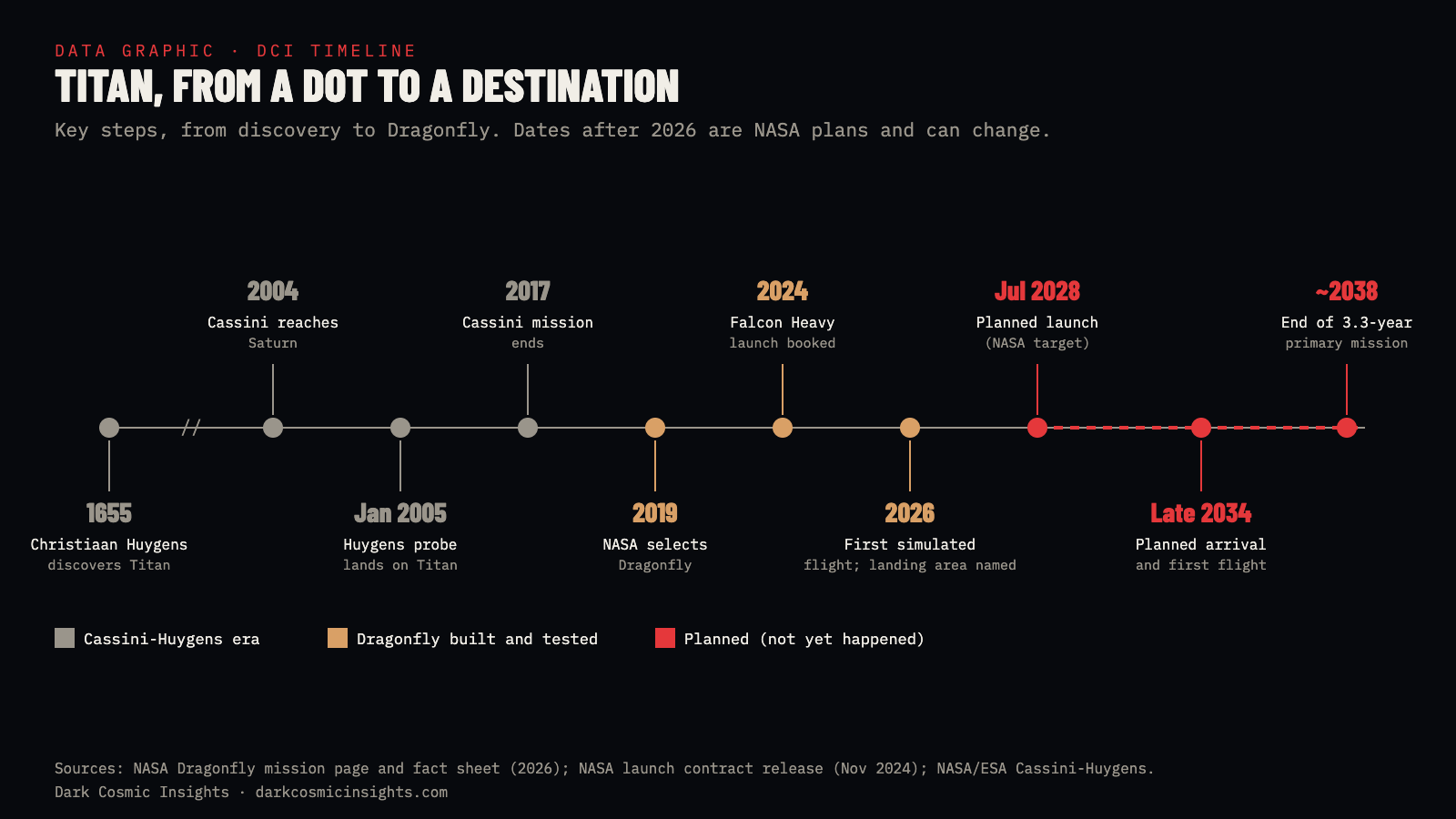
In November 2024, NASA chose SpaceX to launch Dragonfly on a Falcon Heavy rocket from Launch Complex 39A at Kennedy Space Center in Florida. The contract is worth about $256.6 million, and the launch window runs from July 5 to July 25, 2028 (NASA). The voyage to Saturn then takes about six years (NASA).
Arrival is the scariest part. Dragonfly will ride inside a capsule with a heat shield and a backshell. After entering Titan’s atmosphere and slowing under a parachute, a “pose” mechanism lowers the rotorcraft out of the backshell so it can start its rotors, release, and fly the last stretch to the ground under its own power (NASA). Lockheed Martin in Colorado, which is building the cruise stage and entry system, has been load-testing that pose mechanism and checking how the backshell might swing under its parachute.
Does Titan Have an Underground Ocean?
For years, the answer seemed to be yes. Cassini’s gravity measurements showed Titan flexing a lot under Saturn’s pull, which most scientists read as a sign of a global ocean of liquid water and ammonia under the ice (NASA). Radio signals Huygens recorded during its descent also suggested an ocean roughly 55 to 80 km down. In 2008, radar showed surface features drifting by up to 30 km, as if the icy crust were sliding over something liquid (ESA).
Then, in December 2025, a team led by Flavio Petricca at NASA’s Jet Propulsion Laboratory reanalyzed Cassini’s tracking data with improved methods and published a striking result in Nature: Titan’s interior loses far more energy to tidal friction than an ocean model allows, about 3 to 4 terawatts (Petricca et al., 2025). Their conclusion is that this “precludes” a global subsurface ocean.
Instead, they propose a thick layer of slushy, high-pressure ice near its melting point, with pockets of liquid water inside. “Our analysis shows there should be pockets of liquid water, possibly as warm as 20 degrees Celsius (68 degrees Fahrenheit),” the team says in NASA’s summary of the study (NASA). Some researchers argue the slush could even be good for life, concentrating nutrients in small pockets, a little like polar ecosystems on Earth (University of Washington).
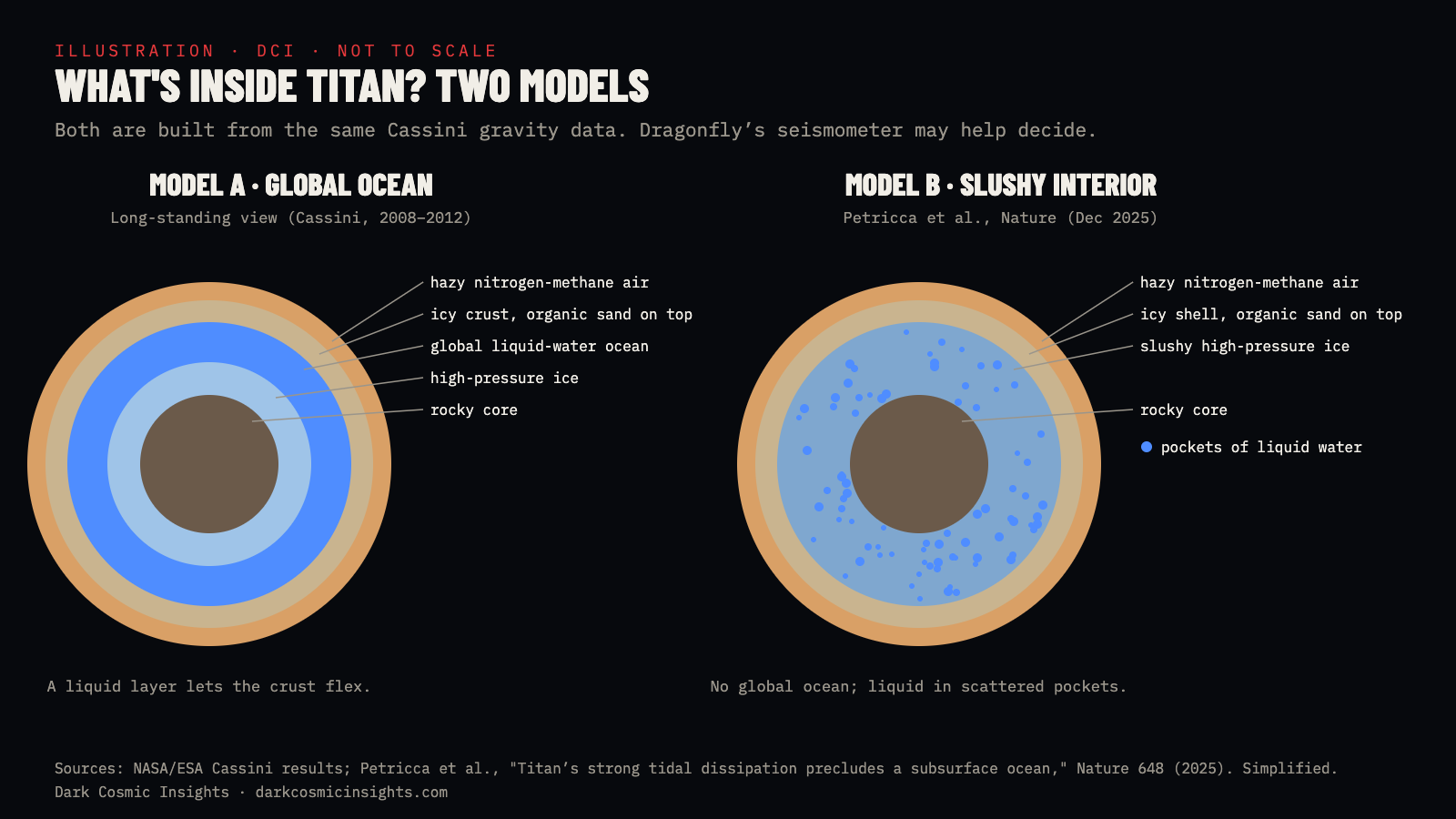
This is a live debate, not a settled fact, and that’s where Dragonfly comes in. Its DraGMet seismometer could record Titanquakes whose waves travel differently through liquid and through slush. The study’s own authors say Dragonfly “will provide a further test of whether a subsurface ocean exists” (Nature). NASA adds a caution: how much the seismometer can tell us depends on which quakes actually happen while it’s listening (NASA).
How Is Dragonfly Different From Ingenuity?
Dragonfly will not be the first aircraft on another world. That honor belongs to NASA’s Ingenuity helicopter, which made the first powered, controlled flight on Mars on April 19, 2021. Ingenuity was designed for up to five test flights in 30 days. It made 72, flying a total of about 17 km in 128.8 minutes, reaching up to 24 m altitude, before rotor damage grounded it in January 2024 (NASA; NASA).
| Ingenuity (Mars) | Dragonfly (Titan) | |
|---|---|---|
| Role | Technology demo, then scout for a rover | The whole mission: a science lab that flies |
| Mass | About 1.8 kg | About 953 kg |
| Rotors | 2 stacked, counter-rotating rotors | 8 rotors in four stacked pairs |
| Power | Solar panel + battery | Nuclear MMRTG + battery |
| Air it flies in | About 1% as dense as Earth’s | About 4 times denser than Earth’s |
| Planned lifetime | 5 flights in 30 days (made 72) | 3.3-year primary mission |
The two craft face opposite problems. Ingenuity had to spin its blades extremely fast to get lift from Mars’s thin air. Dragonfly has plenty of air, but it is roughly 500 times heavier and must survive cold, darkness and a six-year trip. What links them is autonomy: both have to fly themselves because Earth is too far away to steer them live.
Sources for the table: NASA Ingenuity Mars Helicopter page and the 2026 Dragonfly fact sheet.
Myth vs. Fact: Dragonfly Edition
| Myth | Fact |
|---|---|
| Dragonfly is a mission to find aliens. | It studies prebiotic chemistry and habitability. NASA says it won’t be searching for life, per se. |
| Dragonfly will be the first aircraft on another world. | Ingenuity flew on Mars in 2021. Dragonfly will be the first to carry a full science lab between sites. |
| Titan’s lakes are water. | They’re liquid methane and ethane. Water is frozen solid as bedrock at −179 °C. |
| Dragonfly is already flying on Titan. | Launch is planned for July 2028 and arrival for late 2034. The 2026 “first flight” was a simulation. |
| Titan definitely has a hidden ocean. | That was the leading idea for years, but a 2025 study argues for slushy ice with liquid pockets instead. |
| The pictures of Dragonfly on Titan are photos. | They’re artist’s concepts and simulations. No camera has seen Dragonfly on Titan yet. |
That last one matters for any space story. Learn to tell observations from illustrations in Are Space Photos Real?.
Titan and Dragonfly by the Numbers
- 5,150 km: Titan’s diameter, a little wider than Mercury (ESA).
- 1.5×: Titan’s surface air pressure compared with Earth’s (ESA).
- About 4×: how much denser Titan’s air is than Earth’s (APL).
- −179 °C: typical surface temperature (NASA).
- 15.95 Earth days: one Titan day, or Tsol (ESA).
- 72 minutes: how long Huygens worked on Titan’s surface in 2005 (NASA).
- 953 kg: Dragonfly’s mass; 8 rotors; 147 amp-hour battery (NASA).
- July 5–25, 2028: launch window on Falcon Heavy (NASA).
- Late 2034: planned arrival; 3.3 years: primary mission (NASA).
- 20–30 sites and about 115 km of total travel planned (NASA).
- 810 km: width of the Ahmakiq Undae landing region; 80 km: Selk Crater (NASA).
Frequently Asked Questions
When will Dragonfly launch?
NASA’s target launch window is July 5 to 25, 2028, on a SpaceX Falcon Heavy from Kennedy Space Center. Arrival at Titan is planned for late 2034.
Is Dragonfly looking for life on Titan?
Not directly. It studies prebiotic chemistry, the chemical steps that can lead toward life, and assesses how habitable Titan is. It will also look for chemical signs that could hint at water-based or hydrocarbon-based life.
Why is it easier to fly on Titan than on Earth?
Titan’s air is about four times denser than Earth’s and its gravity is about one-seventh as strong. More air to push against and less weight to lift mean far less power is needed to fly.
How big is Dragonfly?
About 3.85 m long and wide, 1.75 m tall, and about 953 kg, roughly the size of a small car. It has eight rotors in four stacked pairs.
How is Dragonfly powered?
By a nuclear MMRTG that turns heat from decaying plutonium into electricity, charging a 147 amp-hour battery. Sunlight at Titan is too weak for solar panels.
Where will Dragonfly land?
In Ahmakiq Undae, a dune field near Titan’s equator. From there it will work toward Selk Crater, where an ancient impact may have melted ice into liquid water.
Does Titan have an ocean?
Scientists long thought Titan hid a global water ocean. A 2025 reanalysis of Cassini data argues instead for slushy high-pressure ice with pockets of liquid water. Dragonfly’s seismometer may help settle it.
Has anything landed on Titan before?
Yes. ESA’s Huygens probe landed on January 14, 2005, and sent data from the surface for 72 minutes. It is still the only landing in the outer solar system.
Sources and Further Reading
- NASA, Dragonfly mission page and Dragonfly Rotorcraft and Instruments.
- NASA (2026). Dragonfly: Flights of Discovery on Titan (fact sheet, Sept. 10, 2026).
- NASA Dragonfly blog (Oct. 23, 2026). NASA’s Dragonfly Completes First Simulated Flight.
- NASA Dragonfly blog (Sept. 2, 2026). NASA’s Dragonfly Gets Wired Up While Titan Landing Area Is Named.
- NASA (Nov. 25, 2024). NASA Awards Launch Services Contract for Dragonfly Mission.
- Johns Hopkins APL, DraGMet and DraGNS instrument pages.
- NASA, Titan: Facts; Titan: An Earthlike Alien; Cassini at Titan; Huygens Probe.
- ESA, Facts about Titan; Ocean may exist beneath Titan’s crust (2008).
- NASA Photojournal: PIA07232, First Color View of Titan’s Surface; PIA22481, Titan Lakes; PIA14922, Colorful Colossuses and Changing Hues.
- Petricca, F., Vance, S.D., Parisi, M. et al. (2025). Titan’s strong tidal dissipation precludes a subsurface ocean. Nature 648, 556–561. doi:10.1038/s41586-025-09818-x. Summaries: NASA, University of Washington.
- NASA (2024). After Three Years on Mars, NASA’s Ingenuity Helicopter Mission Ends; Ingenuity 72 Pathbreaking Flights.
- Smithsonian Air & Space, Skies Over Titan.
Keep Exploring
Saturn is a weather lab too: see how its giant polar storm compares with Jupiter’s in Jupiter’s Polar Storms vs. Saturn’s Hexagon. For how robots drive themselves on another world, read How Rovers Navigate Mars Without a Driver. And to see why invisible light reveals what haze and dust hide, try Hubble vs. Webb.
How This Explainer Was Checked
Every number in this article comes from NASA, ESA, the Johns Hopkins Applied Physics Laboratory or a peer-reviewed paper, linked above, and was checked against those sources in November 2026. Dates after 2026 are NASA plans, not events. Images labeled OBSERVATION are real spacecraft images; DATA marks a published map or figure; ARTIST’S CONCEPT, ILLUSTRATION and DATA GRAPHIC mark illustrations, simulations and original Dark Cosmic Insights diagrams. Nothing here was generated by AI and presented as a real image.
About The Author
Author: King | Founder of Dark Cosmic Insights
King is the founder of Dark Cosmic Insights, a science storytelling platform exploring the strangest true stories hiding in space, science and AI. Through Dark Cosmic Insights, King digs into NASA, ESA and peer-reviewed research, separates what has been measured from what is still a mystery, and turns real discoveries into clear articles, original data graphics and Shorts that help curious people see the universe more clearly.
Follow the anomaly. Trace the source. 🔭
November 5, 2026