The nearest star beyond the Sun is more than four light-years away. Our fastest spacecraft would need thousands of years to get there, and no probe has ever reached one. Yet astronomers can tell you how far away a star is, how hot its surface is, what it’s made of, how big it is, how heavy it is and roughly how old it is.
They do all of it with one thing: light. Every star sends us a stream of photons, and hidden in that light is a surprising amount of information. The trick is knowing how to read it.
This guide walks through the full toolkit, step by step, from the geometry that gives us distance to the starquakes that reveal what’s inside. As always at Dark Cosmic Insights, we keep three things separate: what has been measured directly, what is calculated from those measurements, and what still depends on models.
In this guide
- Quick Answer: How Do Astronomers Measure Stars?
- The DCI Star Measurement Evidence Map
- Why Stars Are So Hard to Measure
- Step 1: How Do We Know How Far Away Stars Are?
- Beyond Parallax: The Cosmic Distance Ladder
- Step 2: How Bright Is a Star, Really?
- Step 3: How Do We Know What Stars Are Made Of?
- How Do We Know How Hot a Star Is?
- Step 4: How Do We Know How Big Stars Are?
- The H-R Diagram: The Map That Makes Sense of Stars
- Step 5: How Do Astronomers Measure the Mass of a Star?
- How Do We Know How Old a Star Is?
- Myth vs Fact: Are the Stars We See Already Dead?
- The Honest Limits
- Can You Measure a Star Yourself?
- What Comes Next
- Measuring Stars by the Numbers
- FAQ
- Sources and Further Reading
- Keep Exploring
Quick Answer: How Do Astronomers Measure Stars?
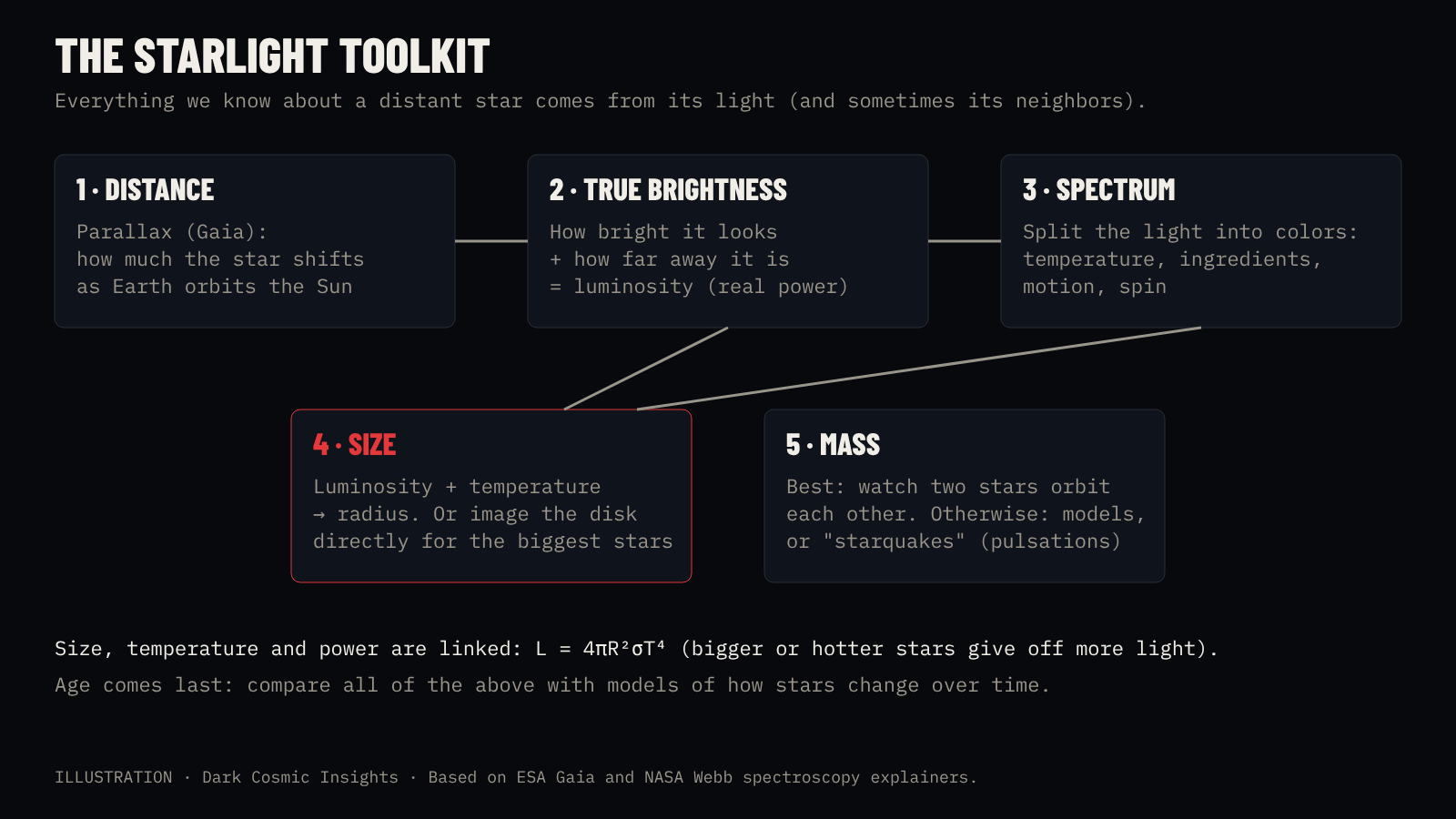
Quick Answer: Astronomers measure a nearby star’s distance with parallax, the tiny shift in its position as Earth orbits the Sun. Distance plus apparent brightness gives its true power, or luminosity. Splitting its light into a spectrum reveals its temperature, chemical makeup and motion. Luminosity and temperature together give its size. Mass is measured best when two stars orbit each other, and age is estimated by comparing all of this with models of how stars evolve.
What this article can and cannot establish: We can explain the methods astronomers use and show real measurements, with their uncertainties. We cannot give you a single “true” size or age for every star, because many values depend on models and on which layer of a star you measure. Where a number is a model estimate, we say so.
The DCI Star Measurement Evidence Map
Not every number about a star is equally solid. This map sorts the main measurements by how directly they’re obtained, from pure geometry to model-based estimates.
| Measurement | How it’s obtained | Status | Key source |
|---|---|---|---|
| Distance (nearby stars) | Parallax: geometry using Earth’s orbit | Measured | ESA Gaia |
| Distance (far away) | Standard candles calibrated by parallax | Calculated | Leavitt 1912; Riess et al. |
| Luminosity | Apparent brightness plus distance | Calculated | Inverse-square law |
| Temperature | Color and spectral lines | Measured | Spectroscopy |
| Composition | Absorption lines in the spectrum | Measured | Payne 1925 |
| Motion toward or away | Doppler shift of spectral lines | Measured | Spectroscopy |
| Size (most stars) | Luminosity plus temperature | Calculated | Stefan–Boltzmann law |
| Size (a few giants) | Imaging the disk with interferometers | Measured | Michelson & Pease 1921; ALMA |
| Mass (binary stars) | Orbits and Kepler’s laws | Measured | Binary star orbits |
| Mass and age (single stars) | Stellar models, starquakes, clusters | Modelled | Asteroseismology; cluster fitting |
Status key: Measured = obtained directly from observations; Calculated = derived from measurements using well-tested physics; Modelled = depends on computer models of stars and carries wider uncertainty.
No one has touched a star. Everything we know about them arrived as light, and the light turned out to be enough.
Why Stars Are So Hard to Measure
Seen from Earth, almost every star is a point of light. Even through the largest telescopes, most stars are far too small and far too distant to show a disk. You can’t put a ruler against one, weigh it on a scale or take its temperature with a thermometer.
The distances are the real problem. Light from Proxima Centauri, the closest star to the Sun, takes about 4.24 years to reach us. That’s roughly 40 trillion kilometres (25 trillion miles). Most of the stars you can see on a dark night are tens to hundreds of light-years away, and a few are more than a thousand.
So astronomers built a chain of methods. Each step uses what the previous step measured. Get the first step right, and the rest of the chain holds. Get it wrong, and every number after it is off. That’s why the first step, distance, gets so much attention.
Step 1: How Do We Know How Far Away Stars Are?
Hold a finger in front of your face. Close your left eye, then your right. Your finger seems to jump against the background. That jump is called parallax, and it’s the most direct way to measure the distance to a star.
Instead of two eyes a few centimetres apart, astronomers use two positions of Earth on opposite sides of its orbit, about 300 million kilometres (186 million miles) apart. They photograph a star, wait six months, and photograph it again. A nearby star appears to shift slightly against much more distant background stars. The closer the star, the bigger the shift. The annual parallax angle, p, is half the maximum angular displacement between observations six months apart; it corresponds to a baseline of one astronomical unit, the average Earth–Sun distance.

The angles are almost impossibly small
Astronomers measure these angles in arcseconds. One arcsecond is 1/3,600 of a degree, about the width of a coin seen from 4 kilometres away. Proxima Centauri has an annual parallax angle of about 0.77 arcseconds, so its maximum six-month parallax displacement is about 1.54 arcseconds. More distant stars have smaller annual parallaxes. Ohio State University’s stellar-distance explanation shows why the annual parallax is half the full angle.
This is why the first successful stellar parallax took until 1838, when the German astronomer Friedrich Bessel measured the shift of a star called 61 Cygni. His result put it about 10 light-years away. The modern value is about 11.4 light-years. For the first time, humans had a measured distance to a star, and it was staggering.
Where the parsec comes from
The geometry gives astronomers a handy unit. A star with a parallax of exactly one arcsecond would be one parsec away, short for “parallax of one arcsecond.” One parsec is about 3.26 light-years. The rule is simple: distance in parsecs equals 1 divided by the parallax in arcseconds. A star with a parallax of 0.1 arcseconds is 10 parsecs away.
Gaia: two billion stars, measured from space
Earth’s atmosphere blurs starlight, which limits how small a shift telescopes on the ground can measure. So the European Space Agency sent telescopes to space. The Hipparcos satellite (1989–1993) measured precise parallaxes for about 118,000 stars. Its successor, Gaia, launched in December 2013, went much further.
Gaia scanned the whole sky again and again for more than a decade. Its third data release, in June 2022, included positions for about 1.8 billion sources and parallaxes for about 1.5 billion of them. For bright stars, its precision reaches tens of microarcseconds. One Gaia scientist compared it to measuring the thickness of a human hair from more than 2,000 kilometres away (phys.org, 2020).

Gaia finished collecting science data in January 2025 and was switched off on March 27, 2025. Its work isn’t over. Its fourth data release, covering about five and a half years of observations, is scheduled for December 2, 2026, with a final release expected around the end of 2030 (ESA Gaia news).
Where parallax breaks down: the farther away a star is, the smaller its shift. Beyond roughly ten thousand light-years, most individual Gaia distances become too uncertain to rely on by themselves. For other galaxies, parallax is useless. That’s where the next rung of the ladder comes in.
Beyond Parallax: The Cosmic Distance Ladder
To reach farther, astronomers use standard candles: objects whose true brightness is known. If you know how bright a light bulb really is, you can tell how far away it is just by how faint it looks.
The first great standard candle was discovered by Henrietta Swan Leavitt at Harvard. In 1912 she showed that a type of pulsing star, a Cepheid variable, has a precise link between how long it takes to pulse and how bright it really is. Measure the pulse, and you know the star’s true brightness. Compare that with how bright it looks, and you get the distance.
In the 1920s, Edwin Hubble used Cepheids to show that the Andromeda “nebula” was far outside the Milky Way, a separate galaxy. For even larger distances, astronomers use exploding stars called Type Ia supernovae, which shine with a fairly standard peak brightness.
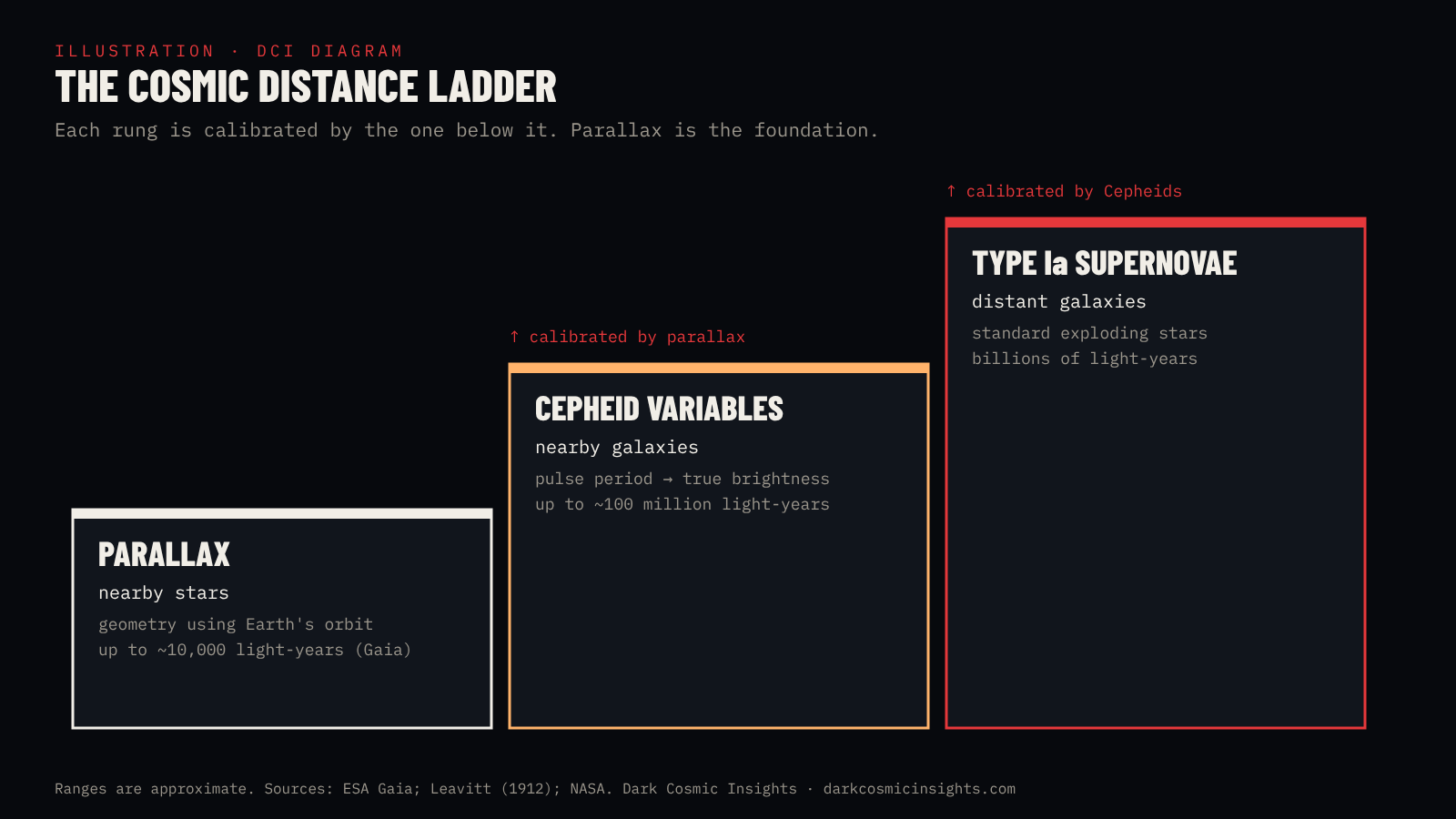
Here’s the key point: every rung is calibrated by the one below it. Cepheid brightness is pinned down using Cepheids close enough for parallax. Supernovae are calibrated using galaxies with Cepheids. That’s why Gaia’s parallaxes matter far beyond our neighborhood: they anchor distances across the universe.
Step 2: How Bright Is a Star, Really?
A star can look faint because it’s weak, or because it’s far away. Once you know the distance, you can tell the two apart.
Light spreads out as it travels, like paint spread over an ever-bigger balloon. A star twice as far away looks four times fainter. Three times as far, nine times fainter. This is the inverse-square law. Correct for it, and you get the star’s luminosity: how much energy it actually pours into space every second.
The magnitude system
Astronomers often describe brightness in magnitudes, a system that goes back to the ancient Greek astronomer Hipparchus. It runs backwards: smaller numbers mean brighter stars. A difference of 5 magnitudes is a factor of exactly 100 in brightness. Sirius, the brightest star in the night sky, has an apparent magnitude of about −1.46, while the faintest stars you can see without a telescope are around magnitude 6.
Apparent magnitude is how bright a star looks from Earth. Absolute magnitude is how bright it would look from a standard distance of 10 parsecs. Absolute magnitude lets astronomers compare stars fairly, as if they were all lined up at the same distance.
This is why distance errors matter so much. Get the distance wrong by 10%, and the luminosity is off by about 20%. The size and mass worked out from it then inherit the error.
Step 3: How Do We Know What Stars Are Made Of?
Pass starlight through a prism, or a finely ruled grating, and it spreads into a rainbow called a spectrum. Look closely and the rainbow is crossed by dark lines. In 1814 the German optician Joseph von Fraunhofer mapped hundreds of these lines in sunlight. In 1859–1860, Gustav Kirchhoff and Robert Bunsen showed that each chemical element absorbs light at its own exact colors.
Those lines work like a barcode. Hydrogen, helium, sodium, iron and calcium each leave their own pattern. Match the pattern, and you know which elements are in the star’s outer layers, without ever collecting a sample.

The discovery that stars are mostly hydrogen
In the early 1900s, astronomers assumed stars were made of roughly the same things as Earth. In 1925, a young astronomer named Cecilia Payne (later Payne-Gaposchkin) used the new physics of atoms to decode stellar spectra properly. Her doctoral thesis showed that stars are made overwhelmingly of hydrogen and helium. It was so surprising that she was urged to call her result “almost certainly not real.” She was right, and it’s now one of the foundations of astronomy.
What else the spectrum reveals
- Temperature: the pattern of lines changes with temperature, because hot and cool gases absorb differently.
- Motion toward or away from us: if a star is approaching, its lines shift slightly toward blue. If it’s receding, toward red. This Doppler shift gives the star’s speed along our line of sight.
- Spin: a fast-spinning star has broadened lines, because one side is rotating toward us while the other rotates away.
- Hidden planets: a star tugged back and forth by an orbiting planet shows a tiny, regular Doppler wobble. That’s how the first planet around a Sun-like star, 51 Pegasi b, was found in 1995.
- Magnetic fields and surface gravity: subtle splitting and widening of lines carry these clues too.
How Do We Know How Hot a Star Is?
Heat a piece of metal and it glows dull red, then orange, then yellow-white as it gets hotter. Stars follow the same physics. A star’s color tells you its surface temperature.
Cooler stars give off most of their light at redder wavelengths. Hotter stars peak in the blue. This is described by Wien’s law: the peak wavelength is inversely proportional to temperature. The Sun’s surface is about 5,772 K (about 5,500 °C), and its light peaks in the blue-green, near 500 nanometres.

O, B, A, F, G, K, M: sorting stars by temperature
At Harvard in the early 1900s, Annie Jump Cannon classified hundreds of thousands of stellar spectra by eye. Her system, still used today, sorts stars from hottest to coolest into the classes O, B, A, F, G, K and M. Generations of students have remembered it with the phrase “Oh Be A Fine Girl/Guy, Kiss Me.”
| Class | Approx. surface temperature | Color | Example |
|---|---|---|---|
| O | above 30,000 K | blue | stars in Orion’s Belt region (e.g. Alnitak) |
| B | 10,000–30,000 K | blue-white | Rigel |
| A | 7,500–10,000 K | white | Sirius A, Vega |
| F | 6,000–7,500 K | yellow-white | Procyon |
| G | 5,200–6,000 K | yellow | the Sun |
| K | 3,700–5,200 K | orange | Arcturus |
| M | below 3,700 K | red | Betelgeuse, Proxima Centauri |
Temperature ranges are approximate and vary slightly between references.
Step 4: How Do We Know How Big Stars Are?
Here’s the clever part. A star’s power, size and temperature are linked. A hotter surface gives off more light per square metre, and a bigger star has more square metres. Physicists write this as the Stefan–Boltzmann law: L = 4πR²σT⁴, where L is luminosity, R is radius and T is temperature.
If you know the luminosity (step 2) and the temperature (step 3), you can solve for the radius. No picture of the star is needed. Because temperature is raised to the fourth power, a small change in temperature makes a big difference, so a cool star must be enormous to be very bright.
Seeing a star as a disk
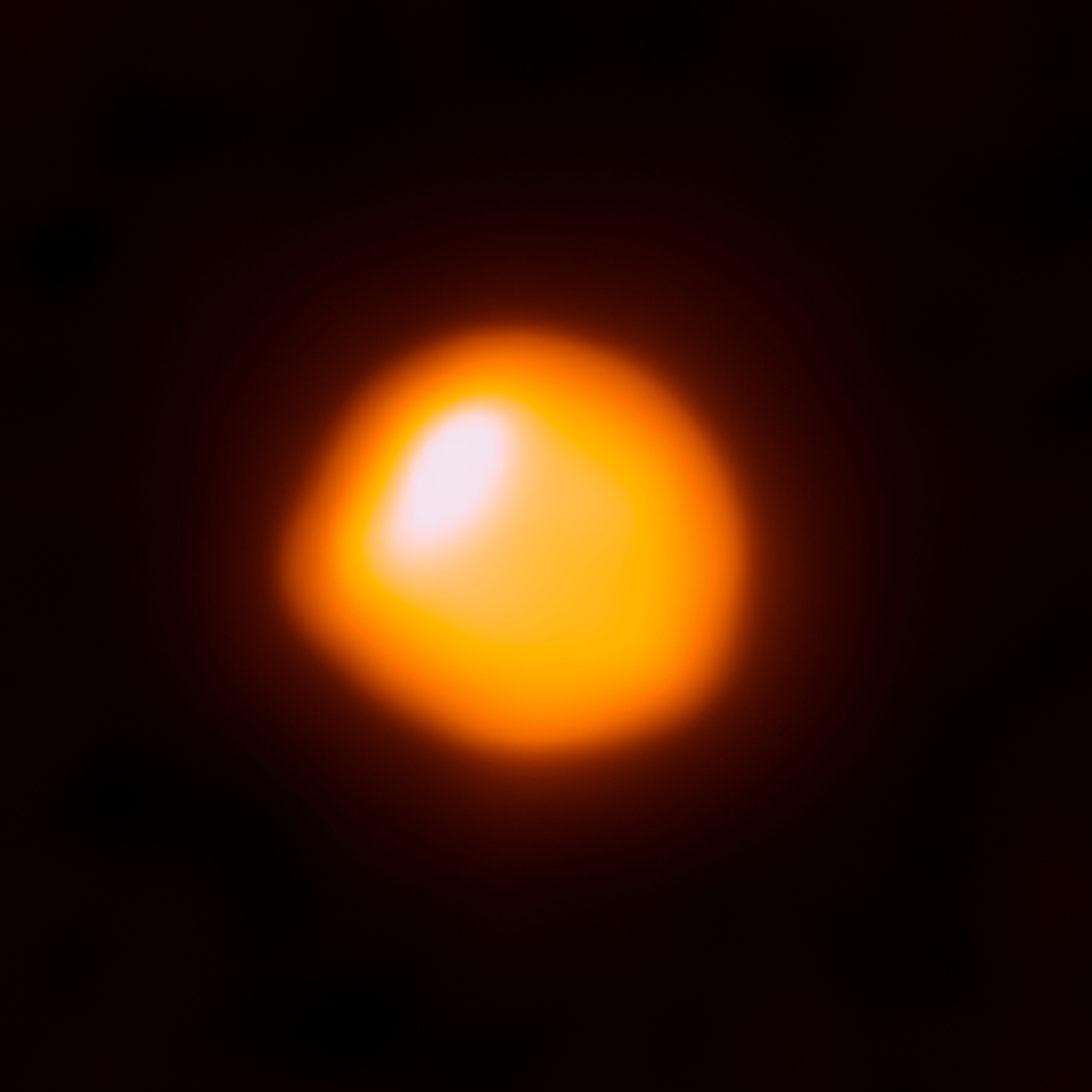
For a handful of huge, nearby stars, telescopes can actually resolve the disk. The first was Betelgeuse. In December 1920, Albert Michelson and Francis Pease linked light from two mirrors on the 100-inch Hooker telescope at Mount Wilson, a technique called interferometry, and measured the star’s angular width at about 0.047 arcseconds. Today, arrays like CHARA, also at Mount Wilson, and the radio telescope array ALMA in Chile continue the work.
Why a star’s size can have two answers
Betelgeuse also shows why “how big is a star?” can have more than one answer. In the ALMA image, which captures gas above the visible surface, Betelgeuse appears about 1,400 times wider than the Sun (ESO). A 2020 study that modelled the star’s pulsations put the radius of its visible surface at about 764 times the Sun’s (Joyce et al., ApJ 2020). Both can be right. Stars have no hard edge, and different wavelengths see different layers.
Our sister site has a full deep dive on this star: what Betelgeuse’s dimming, size and future really tell us.
The H-R Diagram: The Map That Makes Sense of Stars
Around 1911–1913, the astronomers Ejnar Hertzsprung and Henry Norris Russell independently plotted stars by temperature and luminosity. The result, now called the Hertzsprung–Russell (H-R) diagram, is one of the most important charts in science.
Stars don’t scatter randomly across it. Most fall along a diagonal band called the main sequence, where stars like the Sun spend most of their lives fusing hydrogen into helium. Red giants and supergiants sit in the upper right, cool but extremely bright because they’re huge. White dwarfs sit in the lower left, hot but faint because they’re tiny.

The diagram turns measurement into understanding. A star’s position tells you what stage of life it’s in, and that ties directly into its mass and age, the hardest numbers of all.
Step 5: How Do Astronomers Measure the Mass of a Star?
Mass is the most important number for a star. It decides how hot it burns, how long it lives and how it dies. It’s also the hardest to measure directly, because you can only weigh something by watching how its gravity moves something else.
The gold standard: binary stars
Luckily, many stars come in pairs. In a binary star, two stars orbit each other, following the same gravity rules Johannes Kepler and Isaac Newton worked out for planets. Measure the size of the orbit and how long it takes, and Kepler’s third law gives the combined mass. Measure how much each star wobbles, and you get each star’s share.
Sirius is a famous example. In 1844, Friedrich Bessel, the same astronomer who measured the first parallax, noticed that Sirius wobbled as if pulled by an unseen partner. In 1862, Alvan Graham Clark spotted the faint companion, Sirius B, a white dwarf. The pair orbit each other about every 50 years. From that orbit, Sirius A comes out at about 2 solar masses and Sirius B at about 1, packed into a body roughly the size of Earth.

When the orbit is tilted edge-on to us, the stars pass in front of each other. These eclipsing binaries are the best laboratories of all: the eclipses reveal the stars’ sizes, and the orbits reveal their masses.
Single stars: starquakes and models
For a lone star, astronomers compare its temperature, luminosity and chemistry with models of how stars of different masses should look. A powerful extra tool is asteroseismology. Stars vibrate, like bells ringing with sound waves trapped inside. Those vibrations make the star’s brightness flicker very slightly, and the pattern of “notes” depends on its internal structure, mass and age. NASA’s Kepler and TESS missions recorded these flickers for thousands of stars.
The 2020 Betelgeuse study used this kind of pulsation modelling to estimate a mass of about 16.5 to 19 times the Sun’s. It also estimated a distance of about 548 light-years, about 25% closer than some earlier estimates (Joyce et al. 2020). For Betelgeuse, parallax is unusually tricky because the star is huge and its surface restless, so the team turned the usual order around and used the star’s size to estimate its distance. Measuring stars is a web of cross-checks, not a single straight line.
In 2025, a team led by NASA’s Steve Howell used the Gemini North telescope to image a faint companion star orbiting very close to Betelgeuse, long predicted from the star’s slow brightness cycle. They named it Siwarha, “her bracelet” (NASA JPL). As its orbit is tracked, it may help pin down Betelgeuse’s mass.
How Do We Know How Old a Star Is?
Age is usually the least certain number, because no single measurement reveals it. Astronomers combine several clues:
- Star clusters: stars in a cluster formed together, so they share an age. Massive stars burn out first, so the point where stars start peeling off the main sequence, called the turnoff, works like a clock.
- Starquakes: asteroseismology reveals how much hydrogen a star’s core has used up.
- Spin: Sun-like stars slow down as they age, so their rotation speed gives a rough age. This is called gyrochronology.
- White dwarf cooling: white dwarfs cool at predictable rates, so the coolest ones in a population set a minimum age.
- The Sun: our best-dated star. Meteorites, which formed with the solar system, give an age of about 4.6 billion years.
For a lone star, an age often comes with a margin of error of a billion years or more. That’s honest science, not a failure.
Myth vs Fact: Are the Stars We See Already Dead?
It’s a popular idea: since starlight takes years to reach us, many of the stars we see might have died long ago. It sounds poetic, but it’s almost entirely wrong.
Almost every star you can see with your eyes is within a few thousand light-years, and most are much closer. Stars live for millions to billions of years. The odds that any particular naked-eye star has died in the few hundred or few thousand years its light has been travelling are tiny. Betelgeuse, at roughly 550 to 700 light-years depending on the estimate, is the famous one that will explode, but probably not for something like 100,000 years.
The kernel of truth: you are seeing every star as it was, not as it is. Light from Proxima Centauri left it about 4 years ago. Light from Betelgeuse left it during the European Middle Ages or earlier.
The Honest Limits
- Every number has an error bar. When a headline gives a star’s distance or mass, the original paper almost always gives a range.
- Dust gets in the way. Dust between us and a star dims and reddens its light, which has to be corrected for. Infrared telescopes like Webb see through much of it (see Hubble vs. Webb: why the same nebula looks so different).
- Models change. Better data has moved and resized Betelgeuse more than once. That’s science working, not failing.
- Stars change. Some pulse, flare or shed gas, so a measurement can be true for one year and different the next.
Can You Measure a Star Yourself?
You can try a surprising amount of this at home:
- Parallax with your thumb: hold your thumb at arm’s length and blink each eye. Then try it with your thumb closer. The closer object jumps more. That’s exactly the principle Gaia used.
- Star colors: on a clear winter night, compare orange Betelgeuse with blue-white Rigel in Orion. You’re seeing a temperature difference of thousands of degrees.
- A cheap spectroscope: an inexpensive diffraction grating, or even the surface of a CD, spreads light into a spectrum. Aim it at a streetlight (never the Sun) and you may see the bright lines of sodium or mercury.
- Real data: the Gaia archive is public. Free sky-map apps also use Gaia distances, so you can look up how far away the stars over your house are.
What Comes Next
- Gaia Data Release 4 (December 2, 2026): more precise distances and motions for well over a billion stars, plus new data on binary stars and exoplanets (ESA).
- Gaia’s final release (around the end of 2030): the complete ten-plus years of data.
- NASA’s Nancy Grace Roman Space Telescope: launched on August 30, 2026, on a SpaceX Falcon Heavy. Its vast sky surveys will catalogue huge numbers of stars, along with exoplanets and signs of dark energy (Spaceflight Now).
- ESA’s PLATO: planned for launch around 2027, designed to find Earth-like planets and to record starquakes that measure the ages of their host stars.
Measuring Stars by the Numbers
- Nearest star beyond the Sun: Proxima Centauri, about 4.24 light-years away
- Proxima’s parallax: about 0.77 arcseconds, the largest of any star
- First stellar parallax: 61 Cygni, by Friedrich Bessel, 1838
- One parsec: about 3.26 light-years
- Gaia DR3: about 1.8 billion sources (June 2022)
- Gaia switched off: March 27, 2025
- The Sun’s surface temperature: about 5,772 K (about 5,500 °C)
- Stars are mostly: hydrogen and helium (Cecilia Payne, 1925)
- First star measured as a disk: Betelgeuse, December 1920
- Betelgeuse’s estimated mass: about 16.5 to 19 Suns (2020 model estimate)
FAQ
How do astronomers measure stars?
Using light alone. Parallax gives the distance to nearby stars, distance plus brightness gives luminosity, the spectrum gives temperature, composition and motion, and luminosity plus temperature gives size. Mass comes best from binary star orbits, and age from comparing everything with stellar models.
How do we know how far away stars are?
For nearby stars, by parallax: measuring how much a star appears to shift as Earth moves around the Sun. ESA’s Gaia mission measured this for about 1.5 billion stars. Farther away, astronomers use standard candles such as Cepheid variables, calibrated by parallax.
How do we know what stars are made of?
From their spectra. Each element absorbs light at its own exact colors, leaving dark lines that identify it, like a barcode. In 1925 Cecilia Payne showed from these lines that stars are made mostly of hydrogen and helium.
How do we know how hot a star is?
From its color and spectral lines. Hotter stars glow bluer and cooler stars redder, following Wien’s law. The Sun’s surface is about 5,772 K. Astronomers sort stars by temperature into the classes O, B, A, F, G, K and M.
How do we know how big a star is?
Usually by calculation: a star’s luminosity and temperature together fix its radius through the Stefan–Boltzmann law. For a few large, nearby stars such as Betelgeuse, interferometers can measure the disk directly.
How do astronomers measure the mass of a star?
Most accurately with binary stars, where two stars orbit each other and Kepler’s laws give their masses. For single stars, mass is estimated by comparing the star with models, sometimes using its natural vibrations, called asteroseismology.
What is a parsec?
The distance at which a star would show a parallax of one arcsecond. It equals about 3.26 light-years. A star’s distance in parsecs is 1 divided by its parallax in arcseconds.
Can telescopes see the surface of a star?
Only for a few very large, nearby stars, such as Betelgeuse. Almost every other star appears as a point of light, so its size is calculated rather than photographed.
Sources and Further Reading
- ESA, Gaia news 2026 (DR4 date: December 2, 2026)
- Gaia Collaboration, Vallenari et al. (2023), “Gaia Data Release 3: Summary of the content and survey properties,” Astronomy & Astrophysics 674, A1, doi:10.1051/0004-6361/202243940
- phys.org (December 2020), Gaia: most accurate data ever for nearly two billion stars
- F. W. Bessel (1838), parallax of 61 Cygni, Astronomische Nachrichten 16
- H. S. Leavitt & E. C. Pickering (1912), “Periods of 25 Variable Stars in the Small Magellanic Cloud,” Harvard College Observatory Circular 173
- C. H. Payne (1925), Stellar Atmospheres, Harvard Observatory Monographs No. 1
- A. A. Michelson & F. G. Pease (1921), “Measurement of the diameter of Alpha Orionis with the interferometer,” The Astrophysical Journal 53, 249
- M. Joyce et al. (2020), “Standing on the Shoulders of Giants: New Mass and Distance Estimates for Betelgeuse,” The Astrophysical Journal 902, 63, doi:10.3847/1538-4357/abb8db
- ESO, Betelgeuse captured by ALMA (potw1726a)
- NASA JPL (July 23, 2025), NASA scientist finds predicted companion star to Betelgeuse
- NASA Webb, What Can Spectroscopy Tell Us?
- Spaceflight Now (August 2026), Roman Space Telescope, NASA’s next great observatory, launched
Keep Exploring
Learn how to tell real telescope data from artist’s impressions in Are Space Photos Real?, see why infrared changes everything in Hubble vs. Webb, or head to the planets with the strange storms at Jupiter’s and Saturn’s poles. For the full story of one star, read our sister site’s Betelgeuse deep dive.
How this explainer was checked
This Dark Cosmic Insights article was built from peer-reviewed papers, ESA and NASA mission releases, and the original historical publications. Measured, calculated and model-based values are labelled separately. Images are real telescope data unless marked as an illustration or DCI graphic.
About The Author
Author: King | Founder of Dark Cosmic Insights
King is the founder of Dark Cosmic Insights, a science storytelling platform exploring the strangest true stories hiding in space, science and AI. Through Dark Cosmic Insights, King digs into NASA, ESA and peer-reviewed research, separates what has been measured from what is still a mystery, and turns real discoveries into clear articles, original data graphics and Shorts that help curious people see the universe more clearly.
Follow the anomaly. Trace the source. 🔭
November 5, 2026